EUROPE
3114 articles
USA
0 articles
DIGITAL
7115 articles (à imprimer)
Partitions Digitales
Partitions à imprimer
7115 partitions trouvées


Brass Quartet Trombone,Trumpet,Tuba - Level 3 - Digital Download SKU: A0.1374022 By Jeff Bratz. By George Friedrich Handel, Felix Mendelssohn... Arranged by Jeff Bratz. Christmas,Holiday,Jazz,Traditional. 103 pages. HarmonyTabs Music #958595. Published by HarmonyTabs Music (A0.1374022). Dive into the festive spirit with the Second Edition of '10 Christmas Songs for Brass Quartet.' This collection presents a harmonious blend of classic and timeless holiday melodies arranged for brass quartet. Featuring beloved tunes such as 'Angels We Have Heard On High,' 'The First Noel,' and a jazzy 'Hark! The Herald Angels Sing,' this compilation invites both players and audiences to experience the joy of the season. With carefully cultivated arrangements, including an abridged 'Hallelujah Chorus,' this edition offers a delightful mix of traditional carols and celebratory songs. Whether you're performing in a brass band or simply seeking arrangements for seasonal gatherings, this collection promises to elevate your Christmas musical experience. Embrace the magic of the holidays with these beautifully crafted renditions that capture the essence of Christmas in every note! Song list: Angels We Have Heard On High, Auld Lang Syne, Away In a Manger, Deck The Halls, Go Tell It On The Mountain, God Rest Ye Merry, Gentlemen, Hallelujah Chorus (Abridged), Hark! The Herald Angels Sing, I Saw Three Ships, and The First Noel.
10 Christmas Songs for Brass Quartet: Second Edition
Quatuor de Cuivres
Jeff Bratz
$19.99 17.36 € Quatuor de Cuivres PDF SheetMusicPlus

Guitar,Piano,Vocal,Voice - Level 2 - Digital Download SKU: A0.1110724 By Various Artists, Traditional. By Various Artists, Traditional. Arranged by André Alberto Santos. Christian,Christmas,Holiday,Instructional. Score. 21 pages. Soul - Musical Creations #713025. Published by Soul - Musical Creations (A0.1110724). The Christmas Songbook is a collection of eleven pieces arranged for piano solo or piano and voice. Everyone who likes it, works at Christmas and enjoys playing the piano solo or piano and voice will love it. Download now the collection of classical pieces for string quartet in this arrangement for download. It's great for gigs, holiday celebrations, concerts, and simply jamming with friends. Contents: Angels We Have Heard On High-Piano and voice Away in a Manger—Children’s choir and piano Go Tell it on the Mountain-Children’s choir and piano Hark the Herald Angels Sing (Felix Mendelssohn)-Piano In the Bleak Midwinter (Gustav Holst)-Piano It Came Upon a Midnight Clear (R. Storrs Willis)-Intermediate piano Joy to the World (Händel)-Choir and piano O Holy Night (Adolphe Adam) Piano and voice O Holy Night (Adolphe Adam): Piano intermedium Silent Night (Franz Gruber)-Easy piano Silent Night (Franz Gruber)-Advanced piano.
The Christmas Songbook: A piano solo or piano and voice collection
Piano, Voix et Guitare
Various Artists, Traditional
$12.00 10.42 € Piano, Voix et Guitare PDF SheetMusicPlus

Baritone Saxophone,Piano - Level 1 - Digital Download SKU: A0.548713 Composed by Martin Luther. Arranged by James M. Guthrie, ASCAP. Easter,Instructional,Standards. Score and part. 4 pages. Jmsgu3 #3411737. Published by jmsgu3 (A0.548713). Out of the Depths I Cry to You by Martin Luther. The first verses feature modified counterpoint and harmony proceeding at quarter = 82. The final verse is reharmonized for maximum dramatic effect at a more contemplative tempo such as quarter = 64. Features the entire range of the instrument. Very powerful selection for Lent or Easter. Duration (3 verses) 3:05, 36 ms. Score: 3 pg. Solo part: 1 pg. The piano reads from the score. Out of the Depths Aus tiefer Not schrei ich zu dir (From deep affliction I cry out to you), is, of course, a hymn composed by Martin Luther. Moreover, Luther also wrote the lyrics, essentially a paraphrase of Psalm 130. First published in 1524, it is also one of eight songs in the original Lutheran hymnal. It appears likewise in many hymnals and in different translations. The lyrics furthermore stimulated compositions from the Renaissance to the contemporary. Consequently, composers such as Johann Sebastian Bach built an entire chorale cantata on it. Other composers similarly contributed pieces, such as Felix Mendelssohn and Max Reger. Luther Background Martin Luther, (1483 –1546) was a German professor of theology, composer, priest, and moreover, an influential character in the Protestant Reformation. Luther had a momentous impact on church and society due to his contributions to the musical arts. He wanted to disseminate the gospel among mankind and with this intention thought that the best way to do that was through music. Influence It is important to realize that other musicians, and their descendants, were encouraged by Luther’s songs and wrote their own hymns. Luther, to be sure, had a thorough musical education. For example, he knew secular and sacred songs from an early age. He, in particular, played the lute well and sang in the monastery when he was a monk. That is to say, music was an essential part of his life. He in fact first began writing songs in 1523, sometimes writing the melody as well as the lyrics. Luther was certainly able to evaluate the composers of his time. He thought especially highly of Josquin des and Ludwig Senfl. He was also acquainted, with this in mind, with other composers and their works. Legacy The Lutheran musical ethos soon covered all of Germany and later significantly fashioned Protestant musical culture. Heinrich Schütz and Johann Sebastian Bach are the most compelling evidence of this Protestant musical culture. Additionally, as a point often overlooked, the pedal organ, first refined in northern Germany, became universally prevalent. As a matter of fact, Dieterich Buxtehude established a regular evening organ concert series in Lübeck. Another key point is that this concert series, in turn, spread North German Musical ideas worldwide. Luther was especially convinced that music is a beautiful and exclusive offering of the divine.
Luther: Out of the Depths for Baritone Sax & Piano
Saxophone Baryton, Piano

$24.95 21.66 € Saxophone Baryton, Piano PDF SheetMusicPlus

Piano,Violin - Level 2 - Digital Download SKU: A0.1145323 Composed by Charles Wesley, Felix Mendelssohn. Arranged by Bernardo Pereira. Children,Christmas,Holiday,Standards,Traditional. 4 pages. Bernardo Pereira #745561. Published by Bernardo Pereira (A0.1145323). This arrangement is an easy-intermediate level score for violin with piano accompaniment of the traditional English Christmas song Hark! The Herald Angles Sing. It is a standard song for children and family play during this festive holiday. The piano plays the intro on the first four bars. The violin plays the main melody with nuances and contrasts in dynamics. The piano accompanies the melody with chords in the right-hand and arpeggios in the left-hand. The harmony is represented by chord symbols above the staff. Violin part is attached to the end of the file.
Hark! The Herald Angels Sing (violin and piano)
Violon et Piano

$2.99 2.6 € Violon et Piano PDF SheetMusicPlus

Bassoon,Instrumental Duet - Level 1 - Digital Download SKU: A0.548694 Composed by Franz Schubert. Arranged by James M. Guthrie, ASCAP. Christmas,Easter,Standards. 4 pages. Jmsgu3 #3411135. Published by jmsgu3 (A0.548694). A Bassoon Christmas/Easter classic! Duration: 4:55 Score: 3 pg. Bassoon part: 1 pg. Piano reads from the score. Schubert seems to have composed this piece as a song-setting. This is because he wanted to portray a poignant emotional event from a poem. The poem was Walter Scott's The Lady of the Lake. Consequently, this song became an integral part of Schubert's Song cycle. Therefore the cycle is called: the Lady of the Lake. In the poem, Ellen Douglas is the Lady of the Lake. The lake is probably Loch Katrine in the Scottish Highlands. First of all, Ellen goes with her father to stay in the Goblin's cave. They go because he earlier refused to join in a rebellion against King James. Roderick Dhu, the chief of the rebellious Alpine Clan, marches up the mountain with his army. But before the battle, he, first of all, hears Ellen singing. She is singing a prayer calling for help from the Virgin Mary. Schubert's piece was first performed at the castle of Countess Sophie Weissenwolff in Steyregg, Austria.  Schubert dedicated the arrangement to her, and as a result, she became famous as the lady of the lake.The incipit of Ellen's song is Ave Maria which is Latin for Hail Mary. It seems like this similarity led Schubert to adapt the melody to accommodate the Roman Catholic prayer Ave Maria. Consequently, the Latin version of Ave Maria finally became more famous than the original so that consequently many believe he wrote the Latin version first. Schubert Franz Schubert (1797–1828) was, in fact, a famous Austrian composer. Moreover, he composed during the late Classical and early Romantic periods. Schubert was comparatively prolific. He wrote more than 600 secular vocal works, seven symphonies, and, correspondingly, a massive amount of piano and chamber music. Critics agree, as a matter of fact, that his most famous works include his Piano Quintet in A major, D. 667 (also known as the Trout Quintet), the Symphony No. 8 in B minor, D. 759 (Unfinished Symphony), the last sonatas for piano (D. 958–960), and the song cycles Die schöne Müllerin (D. 795) and Winterreise (D. 911). Education Schubert was furthermore a musical child prodigy. He studied violin with his father as well as piano with his older brother. In addition, when Schubert was eleven he studied at Stadtkonvikt school, where he became familiar with the orchestral music of Haydn, Mozart, and likewise Beethoven. In due time he left school and returned home where he studied to become an educator; nevertheless, he continued studying composition with Antonio Salieri. Performance Eventually, Schubert was admitted to the Gesellschaft der Musikfreunde as a performer. This appointment straightaway established his name in Vienna as a composer and pianist. Finally, he gave his only composition recital in 1828. He died suddenly a few months later probably due to typhoid fever. Legacy Schubert’s music was by and large underappreciated while he was alive. There were all in all only a few enthusiasts in Vienna. After he died, however, interest in his work in fact increased. Felix Mendelssohn, Robert Schumann, Franz Liszt, Johannes Brahms and other famous composers in due time discovered his compositions. Nowadays, historians rank Schubert expressly among the greatest composers of the era, and his music remains in general very popular.
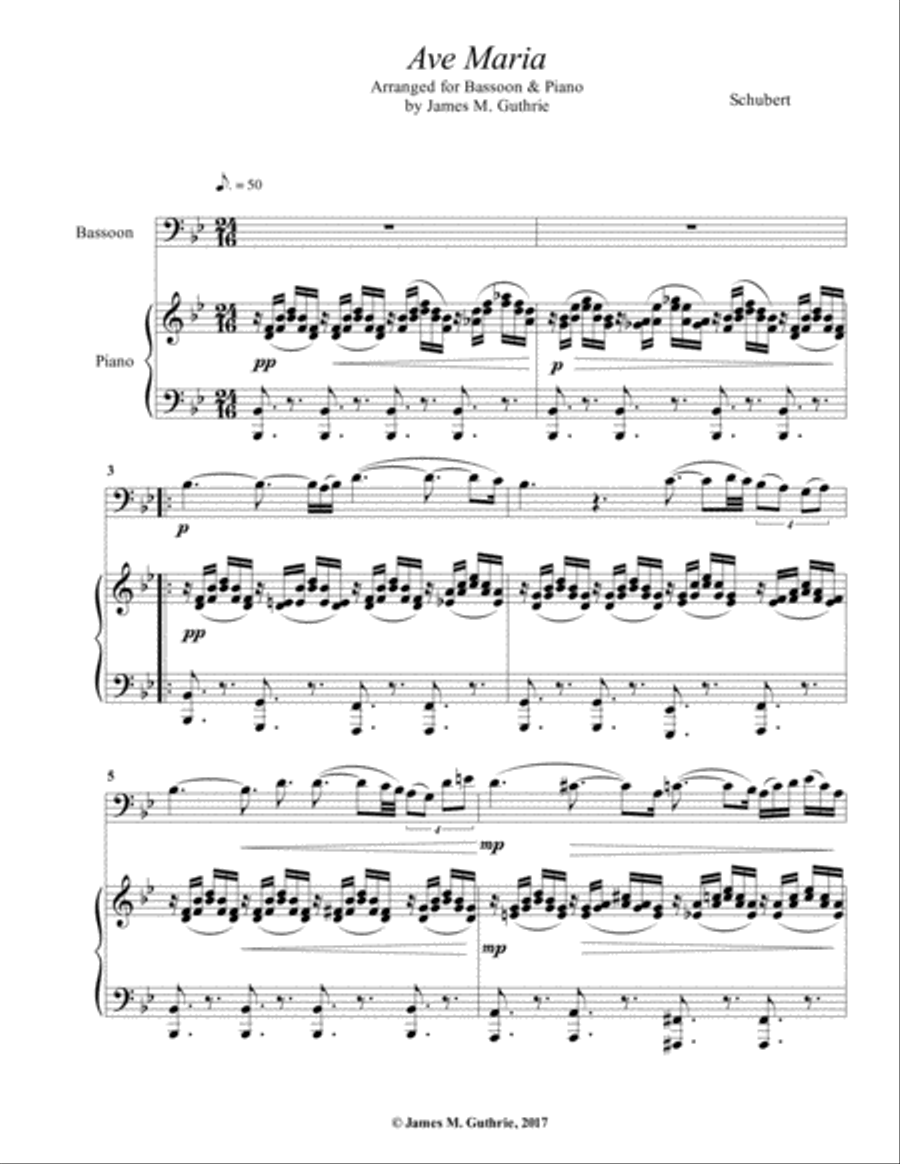
Schubert: Ave Maria for Bassoon & Piano
2 Bassons (duo)

$29.95 26.01 € 2 Bassons (duo) PDF SheetMusicPlus


Partitions Gratuites
Acheter des Partitions Musicales
Acheter des Partitions Digitales à Imprimer
Acheter des Instruments de Musique

© 2000 - 2026

Accueil - Version intégrale





