EUROPE
84 articles
USA
37 articles
DIGITAL
52 articles (ŕ imprimer)
Partitions Digitales
Partitions à imprimer
52 partitions trouvées


B-Flat Trumpet,Horn,Organ,Timpani,Trombone,Tuba - Level 3 - Digital Download SKU: A0.1272749 Composed by Felix Mendelssohn / W.H. Cummings. Arranged by Todd Marchand. Christmas,Holiday,Sacred,Traditional. 23 pages. Con Spirito Music #864944. Published by Con Spirito Music (A0.1272749). One of the “Great Four” Anglican hymns of the 19th century, Charles Wesley’s (1707-1788) “Hark! The Herald Angels Sing” first appeared in the 1739 collection, Hymns and Sacred Poems, by Wesley and his brother John (1703-1791) under the title “Hymn for Christmas-Day.”Based on a verse from the Gospel of Luke (“Glory to God in the highest, and on earth peace, good will toward men.” — 2:14), the hymn tells of an angelic host singing praises from Heaven above to Christ — the God incarnate, Savior and Redeemer of the world. George Whitefield, a fellow Anglican cleric and founder with the Wesley brothers of the evangelical movement known as Methodism, adapted the hymn and published it in his 1754 Collection of Hymns for Social Worship. Additional revisions were made by other editors, including the repetition of the opening lines, “Hark! the herald angels sing / glory to the new-born king” at the end of each stanza, as it is commonly sung today.Wesley envisioned his hymn being sung to the same tune as his “Christ the Lord is Risen Today” (published as “Hymn for Easter-Day” in Hymns and Sacred Poems). However, the tune MENDELSSOHN, an adaptation by English musician William H. Cummings (1831-1915) of music from Felix Mendelssohn’s 1840 secular cantata, Festgesang, is overwhelmingly associated with Wesley’s text today. This arrangement proceeds as follows:•  Introduction: brass, organ, timpani •  Verse 1: organ •  Verse 2: brass, timpani•  Interlude•  Verse 3: organ, brass, timpani, with alternate harmonizationIncludes full score, parts for Organ, Bb Trumpets 1-2, F Horn, Trombone, Tuba, Timpani, and reproducible bulletin insert for voices.©Copyright 2023 Todd Marchand / Con Spirito Music (ASCAP). All rights reserved. For more sacred, patriotic, folk, and holiday music for instruments and voices, visit www.conspiritomusic.com
Hark! The Herald Angels Sing — festival hymn accompaniment for organ, brass quintet, timpani

$25.00 21.27 € PDF SheetMusicPlus

Piano,Trombone - Level 1 - Digital Download SKU: A0.548699 Composed by Franz Schubert. Arranged by James M. Guthrie, ASCAP. Christmas,Easter,Standards. Score and part. 4 pages. Jmsgu3 #3411147. Published by jmsgu3 (A0.548699). A Trombone Christmas/Easter classic! Duration: 4:55 Score: 3 pg. Trombone part: 1 pg. Piano reads from the score. Schubert seems to have composed this piece as a song-setting. This is because he wanted to portray a poignant emotional event from a poem. The poem was Walter Scott's The Lady of the Lake. Consequently, this song became an integral part of Schubert's Song cycle. Therefore the cycle is called: the Lady of the Lake. In the poem, Ellen Douglas is the Lady of the Lake. The lake is probably Loch Katrine in the Scottish Highlands. First of all, Ellen goes with her father to stay in the Goblin's cave. They go because he earlier refused to join in a rebellion against King James. Roderick Dhu, the chief of the rebellious Alpine Clan, marches up the mountain with his army. But before the battle, he, first of all, hears Ellen singing. She is singing a prayer calling for help from the Virgin Mary. Schubert's piece was first performed at the castle of Countess Sophie Weissenwolff in Steyregg, Austria.  Schubert dedicated the arrangement to her, and as a result, she became famous as the lady of the lake.The incipit of Ellen's song is Ave Maria which is Latin for Hail Mary. It seems like this similarity led Schubert to adapt the melody to accommodate the Roman Catholic prayer Ave Maria. Consequently, the Latin version of Ave Maria finally became more famous than the original so that consequently many believe he wrote the Latin version first. Schubert Franz Schubert (1797–1828) was, in fact, a famous Austrian composer. Moreover, he composed during the late Classical and early Romantic periods. Schubert was comparatively prolific. He wrote more than 600 secular vocal works, seven symphonies, and, correspondingly, a massive amount of piano and chamber music. Critics agree, as a matter of fact, that his most famous works include his Piano Quintet in A major, D. 667 (also known as the Trout Quintet), the Symphony No. 8 in B minor, D. 759 (Unfinished Symphony), the last sonatas for piano (D. 958–960), and the song cycles Die schöne Müllerin (D. 795) and Winterreise (D. 911). Education Schubert was furthermore a musical child prodigy. He studied violin with his father as well as piano with his older brother. In addition, when Schubert was eleven he studied at Stadtkonvikt school, where he became familiar with the orchestral music of Haydn, Mozart, and likewise Beethoven. In due time he left school and returned home where he studied to become an educator; nevertheless, he continued studying composition with Antonio Salieri. Performance Eventually, Schubert was admitted to the Gesellschaft der Musikfreunde as a performer. This appointment straightaway established his name in Vienna as a composer and pianist. Finally, he gave his only composition recital in 1828. He died suddenly a few months later probably due to typhoid fever. Legacy Schubert’s music was by and large underappreciated while he was alive. There were all in all only a few enthusiasts in Vienna. After he died, however, interest in his work in fact increased. Felix Mendelssohn, Robert Schumann, Franz Liszt, Johannes Brahms and other famous composers in due time discovered his compositions. Nowadays, historians rank Schubert expressly among the greatest composers of the era, and his music remains in general very popular.  
Schubert: Ave Maria for Trombone & Piano
Trombone et Piano

$29.95 25.48 € Trombone et Piano PDF SheetMusicPlus

Piano,Tenor Saxophone - Level 1 - Digital Download SKU: A0.548700 Composed by Franz Schubert. Arranged by James M. Guthrie, ASCAP. Christmas,Easter,Standards. Score and part. 4 pages. Jmsgu3 #3411149. Published by jmsgu3 (A0.548700). A Tenor Sax Christmas/Easter classic! Duration: 4:55 Score: 3 pg. Alto Flute part: 1 pg. Piano reads from the score. Schubert seems to have composed this piece as a song-setting. This is because he wanted to portray a poignant emotional event from a poem. The poem was Walter Scott's The Lady of the Lake. Consequently, this song became an integral part of Schubert's Song cycle. Therefore the cycle is called: the Lady of the Lake. In the poem, Ellen Douglas is the Lady of the Lake. The lake is probably Loch Katrine in the Scottish Highlands. First of all, Ellen goes with her father to stay in the Goblin's cave. They go because he earlier refused to join in a rebellion against King James. Roderick Dhu, the chief of the rebellious Alpine Clan, marches up the mountain with his army. But before the battle, he, first of all, hears Ellen singing. She is singing a prayer calling for help from the Virgin Mary. Schubert's piece was first performed at the castle of Countess Sophie Weissenwolff in Steyregg, Austria.  Schubert dedicated the arrangement to her, and as a result, she became famous as the lady of the lake.The incipit of Ellen's song is Ave Maria which is Latin for Hail Mary. It seems like this similarity led Schubert to adapt the melody to accommodate the Roman Catholic prayer Ave Maria. Consequently, the Latin version of Ave Maria finally became more famous than the original so that consequently many believe he wrote the Latin version first. Schubert Franz Schubert (1797–1828) was, in fact, a famous Austrian composer. Moreover, he composed during the late Classical and early Romantic periods. Schubert was comparatively prolific. He wrote more than 600 secular vocal works, seven symphonies, and, correspondingly, a massive amount of piano and chamber music. Critics agree, as a matter of fact, that his most famous works include his Piano Quintet in A major, D. 667 (also known as the Trout Quintet), the Symphony No. 8 in B minor, D. 759 (Unfinished Symphony), the last sonatas for piano (D. 958–960), and the song cycles Die schöne Müllerin (D. 795) and Winterreise (D. 911). Education Schubert was furthermore a musical child prodigy. He studied violin with his father as well as piano with his older brother. In addition, when Schubert was eleven he studied at Stadtkonvikt school, where he became familiar with the orchestral music of Haydn, Mozart, and likewise Beethoven. In due time he left school and returned home where he studied to become an educator; nevertheless, he continued studying composition with Antonio Salieri. Performance Eventually, Schubert was admitted to the Gesellschaft der Musikfreunde as a performer. This appointment straightaway established his name in Vienna as a composer and pianist. Finally, he gave his only composition recital in 1828. He died suddenly a few months later probably due to typhoid fever. Legacy Schubert’s music was by and large underappreciated while he was alive. There were all in all only a few enthusiasts in Vienna. After he died, however, interest in his work in fact increased. Felix Mendelssohn, Robert Schumann, Franz Liszt, Johannes Brahms and other famous composers in due time discovered his compositions. Nowadays, historians rank Schubert expressly among the greatest composers of the era, and his music remains in general very popular.
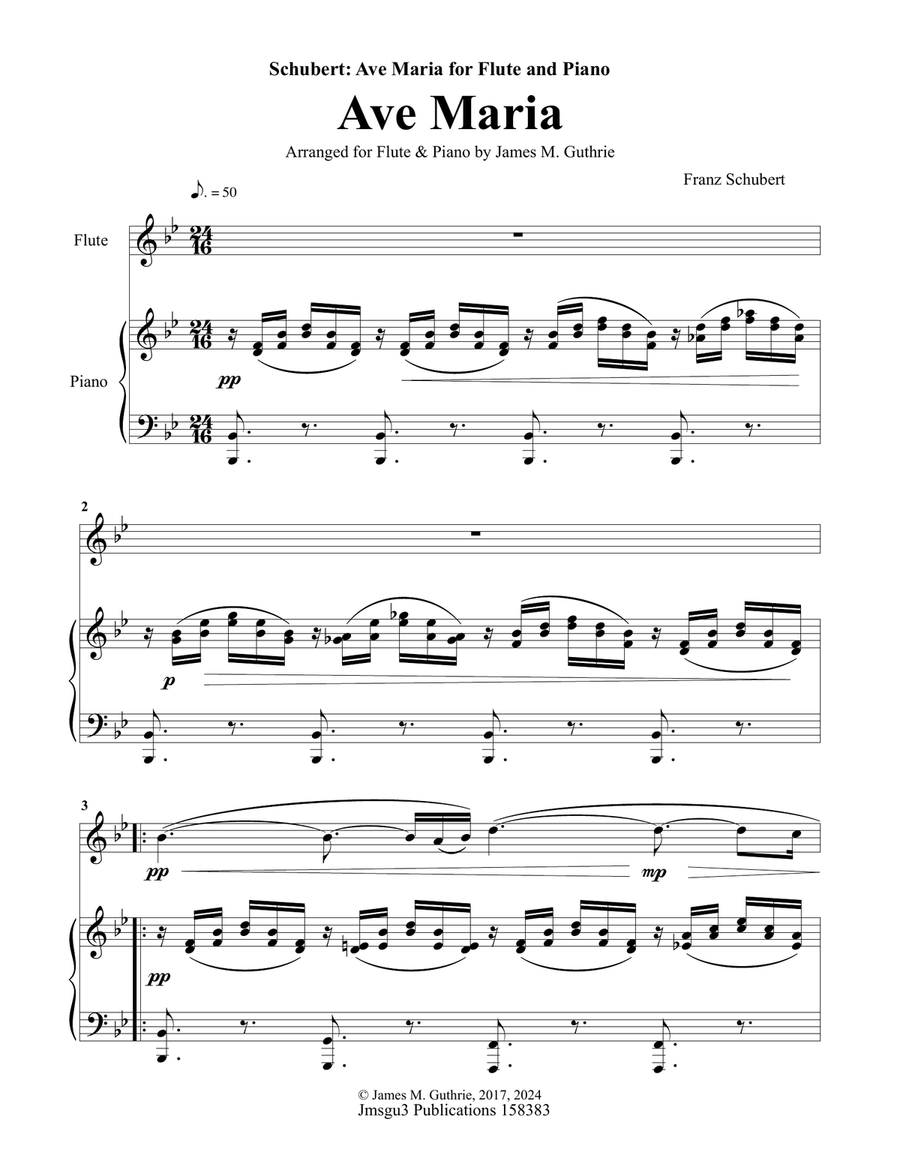
Schubert: Ave Maria for Tenor Sax & Piano
Saxophone Tenor et Piano

$29.95 25.48 € Saxophone Tenor et Piano PDF SheetMusicPlus

Flute,Piano - Level 1 - Digital Download SKU: A0.548696 Composed by Franz Schubert. Arranged by James M. Guthrie, ASCAP. Christmas,Easter,Standards. Score and part. 4 pages. Jmsgu3 #3411141. Published by jmsgu3 (A0.548696). A Flute Christmas/Easter classic! Duration: 4:55 Score: 3 pg. Flute part: 1 pg. Piano reads from the score. Schubert seems to have composed this piece as a song-setting. This is because he wanted to portray a poignant emotional event from a poem. The poem was Walter Scott's The Lady of the Lake. Consequently, this song became an integral part of Schubert's Song cycle. Therefore the cycle is called: the Lady of the Lake. In the poem, Ellen Douglas is the Lady of the Lake. The lake is probably Loch Katrine in the Scottish Highlands. First of all, Ellen goes with her father to stay in the Goblin's cave. They go because he earlier refused to join in a rebellion against King James. Roderick Dhu, the chief of the rebellious Alpine Clan, marches up the mountain with his army. But before the battle, he, first of all, hears Ellen singing. She is singing a prayer calling for help from the Virgin Mary. Schubert's piece was first performed at the castle of Countess Sophie Weissenwolff in Steyregg, Austria.  Schubert dedicated the arrangement to her, and as a result, she became famous as the lady of the lake.The incipit of Ellen's song is Ave Maria which is Latin for Hail Mary. It seems like this similarity led Schubert to adapt the melody to accommodate the Roman Catholic prayer Ave Maria. Consequently, the Latin version of Ave Maria finally became more famous than the original so that consequently many believe he wrote the Latin version first. Schubert Franz Schubert (1797–1828) was, in fact, a famous Austrian composer. Moreover, he composed during the late Classical and early Romantic periods. Schubert was comparatively prolific. He wrote more than 600 secular vocal works, seven symphonies, and, correspondingly, a massive amount of piano and chamber music. Critics agree, as a matter of fact, that his most famous works include his Piano Quintet in A major, D. 667 (also known as the Trout Quintet), the Symphony No. 8 in B minor, D. 759 (Unfinished Symphony), the last sonatas for piano (D. 958–960), and the song cycles Die schöne Müllerin (D. 795) and Winterreise (D. 911). Education Schubert was furthermore a musical child prodigy. He studied violin with his father as well as piano with his older brother. In addition, when Schubert was eleven he studied at Stadtkonvikt school, where he became familiar with the orchestral music of Haydn, Mozart, and likewise Beethoven. In due time he left school and returned home where he studied to become an educator; nevertheless, he continued studying composition with Antonio Salieri. Performance Eventually, Schubert was admitted to the Gesellschaft der Musikfreunde as a performer. This appointment straightaway established his name in Vienna as a composer and pianist. Finally, he gave his only composition recital in 1828. He died suddenly a few months later probably due to typhoid fever. Legacy Schubert’s music was by and large underappreciated while he was alive. There were all in all only a few enthusiasts in Vienna. After he died, however, interest in his work in fact increased. Felix Mendelssohn, Robert Schumann, Franz Liszt, Johannes Brahms, and other famous composers in due time discovered his compositions. Nowadays, historians rank Schubert expressly among the greatest composers of the era, and his music remains in general very popular.  
Schubert: Ave Maria for Flute & Piano
Flűte traversičre et Piano

$29.95 25.48 € Flűte traversičre et Piano PDF SheetMusicPlus

Piano,Violin - Level 1 - Digital Download SKU: A0.548703 Composed by Franz Schubert. Arranged by James M. Guthrie, ASCAP. Christmas,Easter,Standards. 4 pages. Jmsgu3 #3411155. Published by jmsgu3 (A0.548703). A Violin Christmas/Easter classic! Duration: 4:55 Score: 3 pg. Violin part: 1 pg. Piano reads from the score. Schubert seems to have composed this piece as a song-setting. This is because he wanted to portray a poignant emotional event from a poem. The poem was Walter Scott's The Lady of the Lake. Consequently, this song became an integral part of Schubert's Song cycle. Therefore the cycle is called: the Lady of the Lake. In the poem, Ellen Douglas is the Lady of the Lake. The lake is probably Loch Katrine in the Scottish Highlands. First of all, Ellen goes with her father to stay in the Goblin's cave. They go because he earlier refused to join in a rebellion against King James. Roderick Dhu, the chief of the rebellious Alpine Clan, marches up the mountain with his army. But before the battle, he, first of all, hears Ellen singing. She is singing a prayer calling for help from the Virgin Mary. Schubert's piece was first performed at the castle of Countess Sophie Weissenwolff in Steyregg, Austria.  Schubert dedicated the arrangement to her, and as a result, she became famous as the lady of the lake.The incipit of Ellen's song is Ave Maria which is Latin for Hail Mary. It seems like this similarity led Schubert to adapt the melody to accommodate the Roman Catholic prayer Ave Maria. Consequently, the Latin version of Ave Maria finally became more famous than the original so that consequently many believe he wrote the Latin version first. Schubert Franz Schubert (1797–1828) was, in fact, a famous Austrian composer. Moreover, he composed during the late Classical and early Romantic periods. Schubert was comparatively prolific. He wrote more than 600 secular vocal works, seven symphonies, and, correspondingly, a massive amount of piano and chamber music. Critics agree, as a matter of fact, that his most famous works include his Piano Quintet in A major, D. 667 (also known as the Trout Quintet), the Symphony No. 8 in B minor, D. 759 (Unfinished Symphony), the last sonatas for piano (D. 958–960), and the song cycles Die schöne Müllerin (D. 795) and Winterreise (D. 911). Education Schubert was furthermore a musical child prodigy. He studied violin with his father as well as piano with his older brother. In addition, when Schubert was eleven he studied at Stadtkonvikt school, where he became familiar with the orchestral music of Haydn, Mozart, and likewise Beethoven. In due time he left school and returned home where he studied to become an educator; nevertheless, he continued studying composition with Antonio Salieri. Performance Eventually, Schubert was admitted to the Gesellschaft der Musikfreunde as a performer. This appointment straightaway established his name in Vienna as a composer and pianist. Finally, he gave his only composition recital in 1828. He died suddenly a few months later probably due to typhoid fever. Legacy Schubert’s music was by and large underappreciated while he was alive. There were all in all only a few enthusiasts in Vienna. After he died, however, interest in his work in fact increased. Felix Mendelssohn, Robert Schumann, Franz Liszt, Johannes Brahms and other famous composers in due time discovered his compositions. Nowadays, historians rank Schubert expressly among the greatest composers of the era, and his music remains in general very popular.  

Schubert: Ave Maria for Violin & Piano
Violon et Piano

$29.95 25.48 € Violon et Piano PDF SheetMusicPlus

Baritone Saxophone,Piano - Level 1 - Digital Download SKU: A0.548692 Composed by Franz Schubert. Arranged by James M. Guthrie, ASCAP. Christmas,Easter,Standards. Score and part. 4 pages. Jmsgu3 #3411133. Published by jmsgu3 (A0.548692). A Baritone Sax Christmas/Easter classic! Duration: 4:55 Score: 3 pg. Baritone Sax part: 1 pg. Piano reads from the score. Schubert seems to have composed this piece as a song-setting. This is because he wanted to portray a poignant emotional event from a poem. The poem was Walter Scott's The Lady of the Lake. Consequently, this song became an integral part of Schubert's Song cycle. Therefore the cycle is called: the Lady of the Lake. In the poem, Ellen Douglas is the Lady of the Lake. The lake is probably Loch Katrine in the Scottish Highlands. First of all, Ellen goes with her father to stay in the Goblin's cave. They go because he earlier refused to join in a rebellion against King James. Roderick Dhu, the chief of the rebellious Alpine Clan, marches up the mountain with his army. But before the battle, he, first of all, hears Ellen singing. She is singing a prayer calling for help from the Virgin Mary. Schubert's piece was first performed at the castle of Countess Sophie Weissenwolff in Steyregg, Austria.  Schubert dedicated the arrangement to her, and as a result, she became famous as the lady of the lake.The incipit of Ellen's song is Ave Maria which is Latin for Hail Mary. It seems like this similarity led Schubert to adapt the melody to accommodate the Roman Catholic prayer Ave Maria. Consequently, the Latin version of Ave Maria finally became more famous than the original so that consequently many believe he wrote the Latin version first. Schubert Franz Schubert (1797–1828) was, in fact, a famous Austrian composer. Moreover, he composed during the late Classical and early Romantic periods. Schubert was comparatively prolific. He wrote more than 600 secular vocal works, seven symphonies, and, correspondingly, a massive amount of piano and chamber music. Critics agree, as a matter of fact, that his most famous works include his Piano Quintet in A major, D. 667 (also known as the Trout Quintet), the Symphony No. 8 in B minor, D. 759 (Unfinished Symphony), the last sonatas for piano (D. 958–960), and the song cycles Die schöne Müllerin (D. 795) and Winterreise (D. 911). Education Schubert was furthermore a musical child prodigy. He studied violin with his father as well as piano with his older brother. In addition, when Schubert was eleven he studied at Stadtkonvikt school, where he became familiar with the orchestral music of Haydn, Mozart, and likewise Beethoven. In due time he left school and returned home where he studied to become an educator; nevertheless, he continued studying composition with Antonio Salieri. Performance Eventually, Schubert was admitted to the Gesellschaft der Musikfreunde as a performer. This appointment straightaway established his name in Vienna as a composer and pianist. Finally, he gave his only composition recital in 1828. He died suddenly a few months later probably due to typhoid fever. Legacy Schubert’s music was by and large underappreciated while he was alive. There were all in all only a few enthusiasts in Vienna. After he died, however, interest in his work in fact increased. Felix Mendelssohn, Robert Schumann, Franz Liszt, Johannes Brahms and other famous composers in due time discovered his compositions. Nowadays, historians rank Schubert expressly among the greatest composers of the era, and his music remains in general very popular.

Schubert: Ave Maria for Baritone Sax & Piano
Saxophone Baryton, Piano

$29.95 25.48 € Saxophone Baryton, Piano PDF SheetMusicPlus

Bass Flute,Instrumental Solo,Piano - Level 1 - Digital Download SKU: A0.548690 Composed by Franz Schubert. Arranged by James M. Guthrie, ASCAP. Christmas,Easter,Standards. Score and individual part. 4 pages. Jmsgu3 #3411129. Published by jmsgu3 (A0.548690). A Bass Flute Christmas/Easter classic! Duration: 4:55 Score: 3 pg. Bass Flute part: 1 pg. Piano reads from the score. Schubert seems to have composed this piece as a song-setting. This is because he wanted to portray a poignant emotional event from a poem. The poem was Walter Scott's The Lady of the Lake. Consequently, this song became an integral part of Schubert's Song cycle. Therefore the cycle is called: the Lady of the Lake. In the poem, Ellen Douglas is the Lady of the Lake. The lake is probably Loch Katrine in the Scottish Highlands. First of all, Ellen goes with her father to stay in the Goblin's cave. They go because he earlier refused to join in a rebellion against King James. Roderick Dhu, the chief of the rebellious Alpine Clan, marches up the mountain with his army. But before the battle, he, first of all, hears Ellen singing. She is singing a prayer calling for help from the Virgin Mary. Schubert's piece was first performed at the castle of Countess Sophie Weissenwolff in Steyregg, Austria.  Schubert dedicated the arrangement to her, and as a result, she became famous as the lady of the lake.The incipit of Ellen's song is Ave Maria which is Latin for Hail Mary. It seems like this similarity led Schubert to adapt the melody to accommodate the Roman Catholic prayer Ave Maria. Consequently, the Latin version of Ave Maria finally became more famous than the original so that consequently many believe he wrote the Latin version first. Schubert Franz Schubert (1797–1828) was, in fact, a famous Austrian composer. Moreover, he composed during the late Classical and early Romantic periods. Schubert was comparatively prolific. He wrote more than 600 secular vocal works, seven symphonies, and, correspondingly, a massive amount of piano and chamber music. Critics agree, as a matter of fact, that his most famous works include his Piano Quintet in A major, D. 667 (also known as the Trout Quintet), the Symphony No. 8 in B minor, D. 759 (Unfinished Symphony), the last sonatas for piano (D. 958–960), and the song cycles Die schöne Müllerin (D. 795) and Winterreise (D. 911). Education Schubert was furthermore a musical child prodigy. He studied violin with his father as well as piano with his older brother. In addition, when Schubert was eleven he studied at Stadtkonvikt school, where he became familiar with the orchestral music of Haydn, Mozart, and likewise Beethoven. In due time he left school and returned home where he studied to become an educator; nevertheless, he continued studying composition with Antonio Salieri. Performance Eventually, Schubert was admitted to the Gesellschaft der Musikfreunde as a performer. This appointment straightaway established his name in Vienna as a composer and pianist. Finally, he gave his only composition recital in 1828. He died suddenly a few months later probably due to typhoid fever. Legacy Schubert’s music was by and large underappreciated while he was alive. There were all in all only a few enthusiasts in Vienna. After he died, however, interest in his work in fact increased. Felix Mendelssohn, Robert Schumann, Franz Liszt, Johannes Brahms and other famous composers in due time discovered his compositions. Nowadays, historians rank Schubert expressly among the greatest composers of the era, and his music remains in general very popular.

Schubert: Ave Maria for Bass Flute & Piano

$29.95 25.48 € PDF SheetMusicPlus

Flute,Piano - Level 1 - Digital Download SKU: A0.548688 Composed by Franz Schubert. Arranged by James M. Guthrie, ASCAP. Christmas,Easter,Standards. Score and part. 4 pages. Jmsgu3 #3411123. Published by jmsgu3 (A0.548688). An Alto Flute Christmas/Easter classic! Duration: 4:55 Score: 3 pg. Alto Flute part: 1 pg. Piano reads from the score. Schubert seems to have composed this piece as a song-setting. This is because he wanted to portray a poignant emotional event from a poem. The poem was Walter Scott's The Lady of the Lake. Consequently, this song became an integral part of Schubert's Song cycle. Therefore the cycle is called: the Lady of the Lake. In the poem, Ellen Douglas is the Lady of the Lake. The lake is probably Loch Katrine in the Scottish Highlands. First of all, Ellen goes with her father to stay in the Goblin's cave. They go because he earlier refused to join in a rebellion against King James. Roderick Dhu, the chief of the rebellious Alpine Clan, marches up the mountain with his army. But before the battle, he, first of all, hears Ellen singing. She is singing a prayer calling for help from the Virgin Mary. Schubert's piece was first performed at the castle of Countess Sophie Weissenwolff in Steyregg, Austria.  Schubert dedicated the arrangement to her, and as a result, she became famous as the lady of the lake.The incipit of Ellen's song is Ave Maria which is Latin for Hail Mary. It seems like this similarity led Schubert to adapt the melody to accommodate the Roman Catholic prayer Ave Maria. Consequently, the Latin version of Ave Maria finally became more famous than the original so that consequently many believe he wrote the Latin version first. Schubert Franz Schubert (1797–1828) was, in fact, a famous Austrian composer. Moreover, he composed during the late Classical and early Romantic periods. Schubert was comparatively prolific. He wrote more than 600 secular vocal works, seven symphonies, and, correspondingly, a massive amount of piano and chamber music. Critics agree, as a matter of fact, that his most famous works include his Piano Quintet in A major, D. 667 (also known as the Trout Quintet), the Symphony No. 8 in B minor, D. 759 (Unfinished Symphony), the last sonatas for piano (D. 958–960), and the song cycles Die schöne Müllerin (D. 795) and Winterreise (D. 911). Education Schubert was furthermore a musical child prodigy. He studied violin with his father as well as piano with his older brother. In addition, when Schubert was eleven he studied at Stadtkonvikt school, where he became familiar with the orchestral music of Haydn, Mozart, and likewise Beethoven. In due time he left school and returned home where he studied to become an educator; nevertheless, he continued studying composition with Antonio Salieri. Performance Eventually, Schubert was admitted to the Gesellschaft der Musikfreunde as a performer. This appointment straightaway established his name in Vienna as a composer and pianist. Finally, he gave his only composition recital in 1828. He died suddenly a few months later probably due to typhoid fever. Legacy Schubert’s music was by and large underappreciated while he was alive. There were all in all only a few enthusiasts in Vienna. After he died, however, interest in his work in fact increased. Felix Mendelssohn, Robert Schumann, Franz Liszt, Johannes Brahms and other famous composers in due time discovered his compositions. Nowadays, historians rank Schubert expressly among the greatest composers of the era, and his music remains in general very popular.

Schubert: Ave Maria for Alto Flute & Piano
Flűte traversičre et Piano

$29.95 25.48 € Flűte traversičre et Piano PDF SheetMusicPlus

Piano,Viola - Level 1 - Digital Download SKU: A0.548704 Composed by Franz Schubert. Arranged by James M. Guthrie, ASCAP. Christmas,Easter,Standards. Score and part. 4 pages. Jmsgu3 #3411159. Published by jmsgu3 (A0.548704). A Viola Christmas/Easter classic! Duration: 4:55 Score: 3 pg. Viola part: 1 pg. Piano reads from the score. Schubert seems to have composed this piece as a song-setting. This is because he wanted to portray a poignant emotional event from a poem. The poem was Walter Scott's The Lady of the Lake. Consequently, this song became an integral part of Schubert's Song cycle. Therefore the cycle is called: the Lady of the Lake. In the poem, Ellen Douglas is the Lady of the Lake. The lake is probably Loch Katrine in the Scottish Highlands. First of all, Ellen goes with her father to stay in the Goblin's cave. They go because he earlier refused to join in a rebellion against King James. Roderick Dhu, the chief of the rebellious Alpine Clan, marches up the mountain with his army. But before the battle, he, first of all, hears Ellen singing. She is singing a prayer calling for help from the Virgin Mary. Schubert's piece was first performed at the castle of Countess Sophie Weissenwolff in Steyregg, Austria.  Schubert dedicated the arrangement to her, and as a result, she became famous as the lady of the lake.The incipit of Ellen's song is Ave Maria which is Latin for Hail Mary. It seems like this similarity led Schubert to adapt the melody to accommodate the Roman Catholic prayer Ave Maria. Consequently, the Latin version of Ave Maria finally became more famous than the original so that consequently many believe he wrote the Latin version first. Schubert Franz Schubert (1797–1828) was, in fact, a famous Austrian composer. Moreover, he composed during the late Classical and early Romantic periods. Schubert was comparatively prolific. He wrote more than 600 secular vocal works, seven symphonies, and, correspondingly, a massive amount of piano and chamber music. Critics agree, as a matter of fact, that his most famous works include his Piano Quintet in A major, D. 667 (also known as the Trout Quintet), the Symphony No. 8 in B minor, D. 759 (Unfinished Symphony), the last sonatas for piano (D. 958–960), and the song cycles Die schöne Müllerin (D. 795) and Winterreise (D. 911). Education Schubert was furthermore a musical child prodigy. He studied violin with his father as well as piano with his older brother. In addition, when Schubert was eleven he studied at Stadtkonvikt school, where he became familiar with the orchestral music of Haydn, Mozart, and likewise Beethoven. In due time he left school and returned home where he studied to become an educator; nevertheless, he continued studying composition with Antonio Salieri. Performance Eventually, Schubert was admitted to the Gesellschaft der Musikfreunde as a performer. This appointment straightaway established his name in Vienna as a composer and pianist. Finally, he gave his only composition recital in 1828. He died suddenly a few months later probably due to typhoid fever. Legacy Schubert’s music was by and large underappreciated while he was alive. There were all in all only a few enthusiasts in Vienna. After he died, however, interest in his work in fact increased. Felix Mendelssohn, Robert Schumann, Franz Liszt, Johannes Brahms and other famous composers in due time discovered his compositions. Nowadays, historians rank Schubert expressly among the greatest composers of the era, and his music remains in general very popular.  

Schubert: Ave Maria for Viola & Piano
Alto, Piano

$29.95 25.48 € Alto, Piano PDF SheetMusicPlus

Baritone Horn TC,Euphonium,Piano - Level 1 - Digital Download SKU: A0.552828 Composed by Franz Schubert. Arranged by James M. Guthrie, ASCAP. Christmas,Easter,Standards. Score and part. 4 pages. Jmsgu3 #3411131. Published by jmsgu3 (A0.552828). A Baritone Horn Christmas/Easter classic! Duration: 4:55 Score: 3 pg. Baritone Horn part: 1 pg. Piano reads from the score. Schubert seems to have composed this piece as a song-setting. This is because he wanted to portray a poignant emotional event from a poem. The poem was Walter Scott's The Lady of the Lake. Consequently, this song became an integral part of Schubert's Song cycle. Therefore the cycle is called: the Lady of the Lake. In the poem, Ellen Douglas is the Lady of the Lake. The lake is probably Loch Katrine in the Scottish Highlands. First of all, Ellen goes with her father to stay in the Goblin's cave. They go because he earlier refused to join in a rebellion against King James. Roderick Dhu, the chief of the rebellious Alpine Clan, marches up the mountain with his army. But before the battle, he, first of all, hears Ellen singing. She is singing a prayer calling for help from the Virgin Mary. Schubert's piece was first performed at the castle of Countess Sophie Weissenwolff in Steyregg, Austria.  Schubert dedicated the arrangement to her, and as a result, she became famous as the lady of the lake.The incipit of Ellen's song is Ave Maria which is Latin for Hail Mary. It seems like this similarity led Schubert to adapt the melody to accommodate the Roman Catholic prayer Ave Maria. Consequently, the Latin version of Ave Maria finally became more famous than the original so that consequently many believe he wrote the Latin version first. Schubert Franz Schubert (1797–1828) was, in fact, a famous Austrian composer. Moreover, he composed during the late Classical and early Romantic periods. Schubert was comparatively prolific. He wrote more than 600 secular vocal works, seven symphonies, and, correspondingly, a massive amount of piano and chamber music. Critics agree, as a matter of fact, that his most famous works include his Piano Quintet in A major, D. 667 (also known as the Trout Quintet), the Symphony No. 8 in B minor, D. 759 (Unfinished Symphony), the last sonatas for piano (D. 958–960), and the song cycles Die schöne Müllerin (D. 795) and Winterreise (D. 911). Education Schubert was furthermore a musical child prodigy. He studied violin with his father as well as piano with his older brother. In addition, when Schubert was eleven he studied at Stadtkonvikt school, where he became familiar with the orchestral music of Haydn, Mozart, and likewise Beethoven. In due time he left school and returned home where he studied to become an educator; nevertheless, he continued studying composition with Antonio Salieri. Performance Eventually, Schubert was admitted to the Gesellschaft der Musikfreunde as a performer. This appointment straightaway established his name in Vienna as a composer and pianist. Finally, he gave his only composition recital in 1828. He died suddenly a few months later probably due to typhoid fever. Legacy Schubert’s music was by and large underappreciated while he was alive. There were all in all only a few enthusiasts in Vienna. After he died, however, interest in his work in fact increased. Felix Mendelssohn, Robert Schumann, Franz Liszt, Johannes Brahms and other famous composers in due time discovered his compositions. Nowadays, historians rank Schubert expressly among the greatest composers of the era, and his music remains in general very popular.

Schubert: Ave Maria for Baritone Horn & Piano

$29.95 25.48 € PDF SheetMusicPlus

Bassoon,Instrumental Duet - Level 1 - Digital Download SKU: A0.548694 Composed by Franz Schubert. Arranged by James M. Guthrie, ASCAP. Christmas,Easter,Standards. 4 pages. Jmsgu3 #3411135. Published by jmsgu3 (A0.548694). A Bassoon Christmas/Easter classic! Duration: 4:55 Score: 3 pg. Bassoon part: 1 pg. Piano reads from the score. Schubert seems to have composed this piece as a song-setting. This is because he wanted to portray a poignant emotional event from a poem. The poem was Walter Scott's The Lady of the Lake. Consequently, this song became an integral part of Schubert's Song cycle. Therefore the cycle is called: the Lady of the Lake. In the poem, Ellen Douglas is the Lady of the Lake. The lake is probably Loch Katrine in the Scottish Highlands. First of all, Ellen goes with her father to stay in the Goblin's cave. They go because he earlier refused to join in a rebellion against King James. Roderick Dhu, the chief of the rebellious Alpine Clan, marches up the mountain with his army. But before the battle, he, first of all, hears Ellen singing. She is singing a prayer calling for help from the Virgin Mary. Schubert's piece was first performed at the castle of Countess Sophie Weissenwolff in Steyregg, Austria.  Schubert dedicated the arrangement to her, and as a result, she became famous as the lady of the lake.The incipit of Ellen's song is Ave Maria which is Latin for Hail Mary. It seems like this similarity led Schubert to adapt the melody to accommodate the Roman Catholic prayer Ave Maria. Consequently, the Latin version of Ave Maria finally became more famous than the original so that consequently many believe he wrote the Latin version first. Schubert Franz Schubert (1797–1828) was, in fact, a famous Austrian composer. Moreover, he composed during the late Classical and early Romantic periods. Schubert was comparatively prolific. He wrote more than 600 secular vocal works, seven symphonies, and, correspondingly, a massive amount of piano and chamber music. Critics agree, as a matter of fact, that his most famous works include his Piano Quintet in A major, D. 667 (also known as the Trout Quintet), the Symphony No. 8 in B minor, D. 759 (Unfinished Symphony), the last sonatas for piano (D. 958–960), and the song cycles Die schöne Müllerin (D. 795) and Winterreise (D. 911). Education Schubert was furthermore a musical child prodigy. He studied violin with his father as well as piano with his older brother. In addition, when Schubert was eleven he studied at Stadtkonvikt school, where he became familiar with the orchestral music of Haydn, Mozart, and likewise Beethoven. In due time he left school and returned home where he studied to become an educator; nevertheless, he continued studying composition with Antonio Salieri. Performance Eventually, Schubert was admitted to the Gesellschaft der Musikfreunde as a performer. This appointment straightaway established his name in Vienna as a composer and pianist. Finally, he gave his only composition recital in 1828. He died suddenly a few months later probably due to typhoid fever. Legacy Schubert’s music was by and large underappreciated while he was alive. There were all in all only a few enthusiasts in Vienna. After he died, however, interest in his work in fact increased. Felix Mendelssohn, Robert Schumann, Franz Liszt, Johannes Brahms and other famous composers in due time discovered his compositions. Nowadays, historians rank Schubert expressly among the greatest composers of the era, and his music remains in general very popular.
Schubert: Ave Maria for Bassoon & Piano
2 Bassons (duo)

$29.95 25.48 € 2 Bassons (duo) PDF SheetMusicPlus

Piano,Tuba - Level 1 - Digital Download SKU: A0.548701 Composed by Franz Schubert. Arranged by James M. Guthrie, ASCAP. Christmas,Easter,Standards. Score and part. 4 pages. Jmsgu3 #3411151. Published by jmsgu3 (A0.548701). A Tuba Christmas/Easter classic! Duration: 4:55 Score: 3 pg. Tuba part: 1 pg. Piano reads from the score. Schubert seems to have composed this piece as a song-setting. This is because he wanted to portray a poignant emotional event from a poem. The poem was Walter Scott's The Lady of the Lake. Consequently, this song became an integral part of Schubert's Song cycle. Therefore the cycle is called: the Lady of the Lake. In the poem, Ellen Douglas is the Lady of the Lake. The lake is probably Loch Katrine in the Scottish Highlands. First of all, Ellen goes with her father to stay in the Goblin's cave. They go because he earlier refused to join in a rebellion against King James. Roderick Dhu, the chief of the rebellious Alpine Clan, marches up the mountain with his army. But before the battle, he, first of all, hears Ellen singing. She is singing a prayer calling for help from the Virgin Mary. Schubert's piece was first performed at the castle of Countess Sophie Weissenwolff in Steyregg, Austria.  Schubert dedicated the arrangement to her, and as a result, she became famous as the lady of the lake.The incipit of Ellen's song is Ave Maria which is Latin for Hail Mary. It seems like this similarity led Schubert to adapt the melody to accommodate the Roman Catholic prayer Ave Maria. Consequently, the Latin version of Ave Maria finally became more famous than the original so that consequently many believe he wrote the Latin version first. Schubert Franz Schubert (1797–1828) was, in fact, a famous Austrian composer. Moreover, he composed during the late Classical and early Romantic periods. Schubert was comparatively prolific. He wrote more than 600 secular vocal works, seven symphonies, and, correspondingly, a massive amount of piano and chamber music. Critics agree, as a matter of fact, that his most famous works include his Piano Quintet in A major, D. 667 (also known as the Trout Quintet), the Symphony No. 8 in B minor, D. 759 (Unfinished Symphony), the last sonatas for piano (D. 958–960), and the song cycles Die schöne Müllerin (D. 795) and Winterreise (D. 911). Education Schubert was furthermore a musical child prodigy. He studied violin with his father as well as piano with his older brother. In addition, when Schubert was eleven he studied at Stadtkonvikt school, where he became familiar with the orchestral music of Haydn, Mozart, and likewise Beethoven. In due time he left school and returned home where he studied to become an educator; nevertheless, he continued studying composition with Antonio Salieri. Performance Eventually, Schubert was admitted to the Gesellschaft der Musikfreunde as a performer. This appointment straightaway established his name in Vienna as a composer and pianist. Finally, he gave his only composition recital in 1828. He died suddenly a few months later probably due to typhoid fever. Legacy Schubert’s music was by and large underappreciated while he was alive. There were all in all only a few enthusiasts in Vienna. After he died, however, interest in his work in fact increased. Felix Mendelssohn, Robert Schumann, Franz Liszt, Johannes Brahms, and other famous composers in due time discovered his compositions. Nowadays, historians rank Schubert expressly among the greatest composers of the era, and his music remains in general very popular.  
Schubert: Ave Maria for Tuba & Piano
Tuba et Piano

$29.95 25.48 € Tuba et Piano PDF SheetMusicPlus

Bass Clarinet,Piano - Level 1 - Digital Download SKU: A0.548691 Composed by Franz Schubert. Arranged by James M. Guthrie, ASCAP. Christmas,Easter,Standards. Score and part. 4 pages. Jmsgu3 #3411127. Published by jmsgu3 (A0.548691). A Bass Clarinet Christmas/Easter classic! Duration: 4:55 Score: 3 pg. Bass Clarinet part: 1 pg. Piano reads from the score. Schubert seems to have composed this piece as a song-setting. This is because he wanted to portray a poignant emotional event from a poem. The poem was Walter Scott's The Lady of the Lake. Consequently, this song became an integral part of Schubert's Song cycle. Therefore the cycle is called: the Lady of the Lake. In the poem, Ellen Douglas is the Lady of the Lake. The lake is probably Loch Katrine in the Scottish Highlands. First of all, Ellen goes with her father to stay in the Goblin's cave. They go because he earlier refused to join in a rebellion against King James. Roderick Dhu, the chief of the rebellious Alpine Clan, marches up the mountain with his army. But before the battle, he, first of all, hears Ellen singing. She is singing a prayer calling for help from the Virgin Mary. Schubert's piece was first performed at the castle of Countess Sophie Weissenwolff in Steyregg, Austria.  Schubert dedicated the arrangement to her, and as a result, she became famous as the lady of the lake.The incipit of Ellen's song is Ave Maria which is Latin for Hail Mary. It seems like this similarity led Schubert to adapt the melody to accommodate the Roman Catholic prayer Ave Maria. Consequently, the Latin version of Ave Maria finally became more famous than the original so that consequently many believe he wrote the Latin version first. Schubert Franz Schubert (1797–1828) was, in fact, a famous Austrian composer. Moreover, he composed during the late Classical and early Romantic periods. Schubert was comparatively prolific. He wrote more than 600 secular vocal works, seven symphonies, and, correspondingly, a massive amount of piano and chamber music. Critics agree, as a matter of fact, that his most famous works include his Piano Quintet in A major, D. 667 (also known as the Trout Quintet), the Symphony No. 8 in B minor, D. 759 (Unfinished Symphony), the last sonatas for piano (D. 958–960), and the song cycles Die schöne Müllerin (D. 795) and Winterreise (D. 911). Education Schubert was furthermore a musical child prodigy. He studied violin with his father as well as piano with his older brother. In addition, when Schubert was eleven he studied at Stadtkonvikt school, where he became familiar with the orchestral music of Haydn, Mozart, and likewise Beethoven. In due time he left school and returned home where he studied to become an educator; nevertheless, he continued studying composition with Antonio Salieri. Performance Eventually, Schubert was admitted to the Gesellschaft der Musikfreunde as a performer. This appointment straightaway established his name in Vienna as a composer and pianist. Finally, he gave his only composition recital in 1828. He died suddenly a few months later probably due to typhoid fever. Legacy Schubert’s music was by and large underappreciated while he was alive. There were all in all only a few enthusiasts in Vienna. After he died, however, interest in his work in fact increased. Felix Mendelssohn, Robert Schumann, Franz Liszt, Johannes Brahms and other famous composers in due time discovered his compositions. Nowadays, historians rank Schubert expressly among the greatest composers of the era, and his music remains in general very popular.  
Schubert: Ave Maria for Bass Clarinet & Piano
Clarinette Basse, Piano

$29.95 25.48 € Clarinette Basse, Piano PDF SheetMusicPlus


Partitions Gratuites
Acheter des Partitions Musicales
Acheter des Partitions Digitales à Imprimer
Acheter des Instruments de Musique

© 2000 - 2026

Accueil - Version intégrale