EUROPE
141 articles
USA
0 articles
DIGITAL
8462 articles (à imprimer)
Partitions Digitales
Partitions à imprimer
8462 partitions trouvées

1 ....61 76 91 106 121 ....8461

Brass Ensemble Bass Trombone,Cornet,Horn - Level 3 - Digital Download SKU: A0.1227832 Composed by Giovanni Gabrieli. Arranged by James M. Guthrie, ASCAP. Chamber,Contest,Early Music,Festival,Historic,Renaissance. 72 pages. Jmsgu3 #823794. Published by jmsgu3 (A0.1227832). Minimum instrumentation: 4 Cornets in Bb, 4 Horns in F, 2 Tenor Trombones, and 2 Bass Trombones.InnovationsGabrieli preferred sacred vocal and, indeed, instrumental music. Hence, he concentrated on music that consequently took advantage of resonance and reverberation for maximum effect. Gabrieli may have invented dynamics – or was the first to indicate them, such as in his Sonata Pian' e Forte. Consequently, he was also a pioneer in spatial techniques. He, therefore, developed and used particular notation to indicate instrumentation. Gabrieli experimented with assembling massive instrumental forces into isolated groups separated by space. In this way, he consequently contributed heavily to the Baroque Concertato style.Polychoral WorksGabrieli probably used the layout of the San Marco church for his experiments. This is because he worked there as a musician and composer. Furthermore, the church had two choir lofts facing each other. He indeed used these to create striking spatial effects between instrumental forces. Indeed, many of his works are composed such that a choir or instrumental group could first be heard on one side, followed by a group response. Sometimes, there was probably a third group near the main altar.Spatial MusicAbove all, Gabrieli studied carefully detailed groups of instruments and singers. Furthermore, it seems like he created precise directions for instrumentation rather than two groups. Because they could be appropriately situated, the instruments could consequently be heard with perfect clearness at distant locations. As a result, arrangements that seem bizarre on paper can, in contrast, sound perfectly in balance.First WorksFinally, Gabrieli published his first motets and his uncle Andrea's compositions in Concerti (1587). Furthermore, these compositions indicate considerable usage of dialogue and echo effects. Consequently, here we see low and high choirs with the variance between their ranges characterized by instrumental accompaniment. Gabrieli's later motets Sacrae Symphoniae (1597) seem to move away from close antiphony. In contrast, he moves towards not simply echoing the material but developing it through sequential choral entrances. Even more, he takes this procedure to the extreme in the Motet Omnes Gentes. Unlike earlier works, here, the instruments are an essential part of the presentation—also, only parts marked Capella are supposed to be sung.HomophonyHence, after 1605, Gabrieli moves to a much more homophonic style. He writes sections purely for instruments – called Sinfonia – and smaller sections for vocal soloists, accompanied by a basso continuo. Above all, Gabrieli studied carefully detailed groups of instruments and singers. Furthermore, it seems like he created precise directions for instrumentation rather than two groups. Because they could be appropriately situated, the instruments could consequently be heard with perfect clearness at distant locations. As a result, arrangements that seem bizarre on paper can, in contrast, sound perfectly in balance.
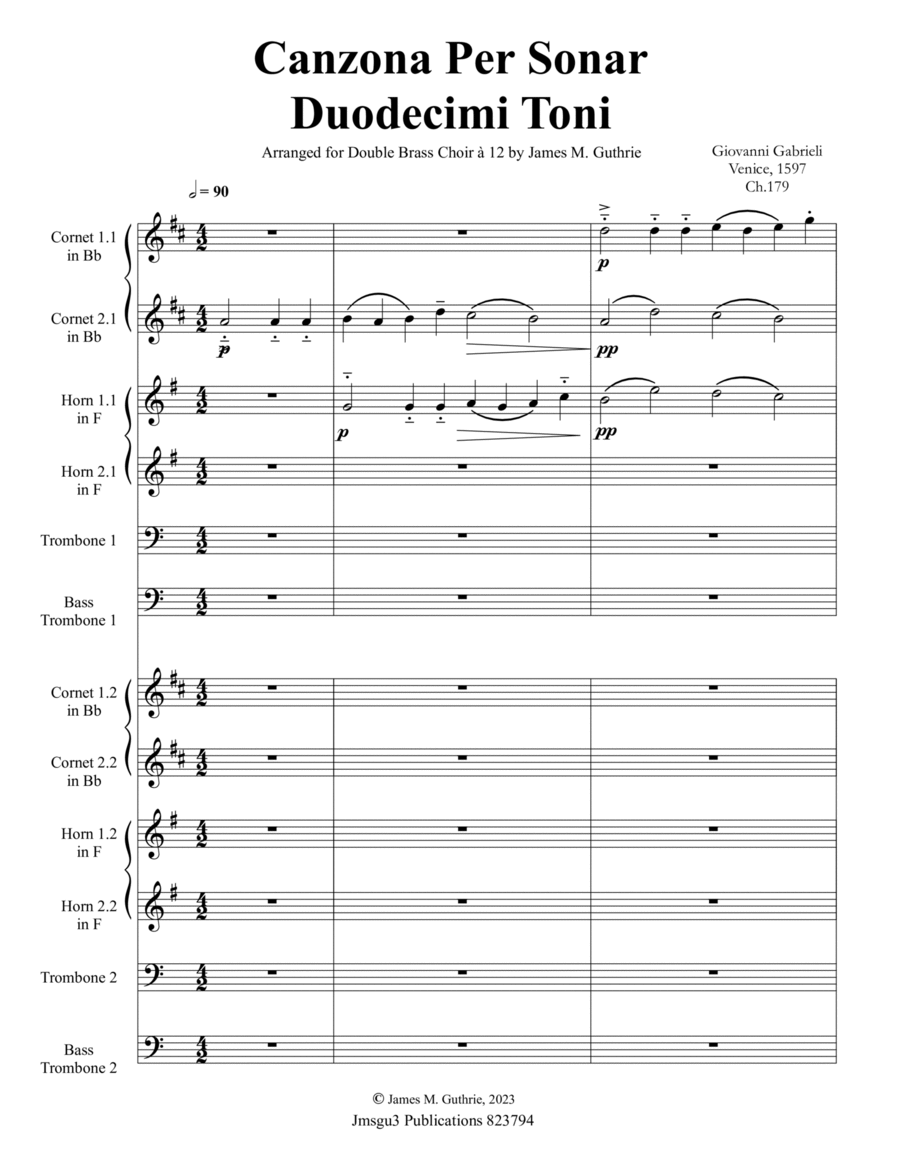
Gabrieli: Canzon per Sonar Ch. 179 for Double Brass Choir à 12

$47.95 41.35 € PDF SheetMusicPlus

Brass Ensemble Cornet,Horn,Trombone - Level 3 - Digital Download SKU: A0.1227819 Composed by Giovanni Gabrieli. Arranged by James M. Guthrie. Chamber,Contest,Early Music,Festival,Renaissance,Traditional. Score and Parts. 44 pages. Jmsgu3 #823781. Published by jmsgu3 (A0.1227819). Minimum instrumentation: 4 cornets in Bb, 4 French Horms in F, 2 Trombones. See also arrangement à 12 which includes 2 Bass Trombones.InnovationsGabrieli preferred sacred vocal and certainly instrumental music. Hence, he concentrated on music that consequently took advantage of resonance and likewise reverberation for maximum effect. Seems like Gabrieli may have invented dynamics – or was rather the first to indicate them such as in his Sonata Pian’ e Forte. Consequently, he was also a pioneer in spatial techniques. He therefore developed and used very specific notation to indicate instrumentation. Gabrieli experimented with assembling massive instrumental forces into isolated groups separated by space. In this way, he consequently contributed heavily to the Baroque Concertato style.Polychoral WorksGabrieli probably used the layout of the San Marco church for his experiments. This is because he worked there as a musician and composer. Furthermore, the church had two choir lofts facing each other. He certainly used these to create striking spatial effects between instrumental forces. Certainly, many of his works are composed such that a choir or instrumental group could first be heard on one side, then consequently followed by a response from the group on the other side. Sometimes there was probably a third group positioned near the main altar as well.Spatial MusicAbove all, Gabrieli studied carefully detailed groups of instruments and singers. Furthermore, it seems like he created precise directions for instrumentation rather than two groups. The instruments, because they could be appropriately situated, could consequently be heard with perfect clearness at distant locations. As a result, arrangements that seem bizarre on paper, can in contrast sound perfectly in balance.First WorksFinally, Gabrieli published his first motets along with his uncle Andrea's compositions in Concerti (1587). These compositions furthermore indicate considerable usage of dialogue and echo effects. Consequently, here we see low and high choirs with the variance between their ranges indicated by instrumental accompaniment. Seems like Gabrieli’s later motets Sacrae Symphoniae (1597) move away from close antiphony. In contrast, he moves towards not simply echoing the material but developing it through sequential choral entrances. Even more, he takes this procedure to the extreme in the Motet Omnes Gentes. Unlike earlier works, here the instruments are certainly an essential part of the presentation. Also, only parts marked: Capella are supposed to be sung.HomophonyHence, after 1605, Gabrieli moves to a much more homophonic style. He writes sections purely for instruments – which calls Sinfonia – and smaller sections for vocal soloists, accompanied by a basso continuo.
Gabrieli: Canzon per Sonar Ch 179 for Double Brass Choir à 10

$47.95 41.35 € PDF SheetMusicPlus

Brass Ensemble Horn,Trombone,Trumpet - Level 3 - Digital Download SKU: A0.1226488 Composed by Giovanni Gabrieli. Arranged by James M. Guthrie, ASCAP. Chamber,Contest,Early Music,Festival,Historic,Renaissance. Score and Parts. 51 pages. Jmsgu3 #822490. Published by jmsgu3 (A0.1226488). Minimum instrumentation: 4 Trumpets (or Cornets), 4 French Horns, 2 Tenor Trombones, and 2 Bass Trombones.InnovationsGabrieli preferred sacred vocal and certainly instrumental music. Hence, he concentrated on music that consequently took advantage of resonance and likewise reverberation for maximum effect. Seems like Gabrieli may have invented dynamics – or was rather the first to indicate them such as in his Sonata Pian’ e Forte. Consequently, he was also a pioneer in spatial techniques. He therefore developed and used very specific notation to indicate instrumentation. Gabrieli experimented with assembling massive instrumental forces into isolated groups separated by space. In this way, he consequently contributed heavily to the Baroque Concertato style.Polychoral WorksGabrieli probably used the layout of the San Marco church for his experiments. This is because he worked there as a musician and composer. Furthermore, the church had two choir lofts facing each other. He certainly used these to create striking spatial effects between instrumental forces. Certainly, many of his works are composed such that a choir or instrumental group could first be heard on one side, then consequently followed by a response from the group on the other side. Sometimes there was probably a third group positioned near the main altar as well.Spatial MusicAbove all, Gabrieli studied carefully detailed groups of instruments and singers. Furthermore, it seems like he created precise directions for instrumentation rather than two groups. The instruments, because they could be appropriately situated, could consequently be heard with perfect clearness at distant locations. As a result, arrangements that seem bizarre on paper, can in contrast sound perfectly in balance.First WorksFinally, Gabrieli published his first motets along with his uncle Andrea's compositions in Concerti (1587). These compositions furthermore indicate considerable usage of dialogue and echo effects. Consequently, here we see low and high choirs with the variance between their ranges indicated by instrumental accompaniment. Seems like Gabrieli’s later motets Sacrae Symphoniae (1597) move away from close antiphony. In contrast, he moves towards not simply echoing the material but developing it through sequential choral entrances. Even more, he takes this procedure to the extreme in the Motet Omnes Gentes. Unlike earlier works, here the instruments are certainly an essential part of the presentation. Also, only parts marked: Capella are supposed to be sung.HomophonyHence, after 1605, Gabrieli moves to a much more homophonic style. He writes sections purely for instruments – which calls Sinfonia – and smaller sections for vocal soloists, accompanied by a basso continuo.
Gabrieli: Canzona in Echo Ch. 180 for Double Brass Choir
Quatuor de Cuivres: 2 trompettes, Cor, trombone

$47.95 41.35 € Quatuor de Cuivres: 2 trompettes, Cor, trombone PDF SheetMusicPlus

Choral Choir (SAB) - Level 3 - Digital Download SKU: A0.725175 By Paul Barker Music. By Paul Barker. Children,Contest,Festival,Holiday,Pop,Praise & Worship. Octavo. 12 pages. Paul Barker Music #4803489. Published by Paul Barker Music (A0.725175). Celebration does exactly what it says! A feel-good concert item for any joyous occasion guaranteed to raise the roof! Easy and fun vocal lines for choirs to learn will make this is a sure hit in your concert. Also available for Combined SAB Choir, Full Orchestra, Rock Band and Piano and as an instrumental for String and Full Orchestra. Professional Accompaniment MP3 is available from this site and directly from www.paulbarkermusic.com
Celebration (SAB Choir Score)
Chorale 3 parties
Paul Barker Music
$2.25 1.94 € Chorale 3 parties PDF SheetMusicPlus

Brass Band Trombone,Trumpet,Tuba - Level 2 - Digital Download SKU: A0.1220622 Composed by Giovanni Gabrieli. Arranged by James M. Guthrie, ASCAP. Contest,Early Music,Festival,Historic,Instructional,Renaissance. Score and Parts. 45 pages. Jmsgu3 #816951. Published by jmsgu3 (A0.1220622). A musical monument: the first composition to employ dynamics Minimum Instrumentation: 4 Trumpets, 2 Alto Trombones, 3 Tenor Trombones, 1 Bass Trombone, and 1 Tuba. Suggested instrumentation: 8 trumpets, 4 Alto Trombones, 6 Tenor Trombones, 2 Bass Trombones, 4 Tubas.InnovationsFirst of all, Gabrieli preferred sacred vocal and certainly instrumental music. Hence, he concentrated on music that consequently took advantage of resonance and likewise reverberation for maximum effect. Seems like Gabrieli may have invented dynamics – or was rather the first to indicate them such as in his Sonata Pian’ e Forte. Consequently, he was also a pioneer in spatial techniques. He therefore developed and used very specific notation to indicate instrumentation. Gabrieli experimented with assembling massive instrumental forces into isolated groups separated by space. In this way, he consequently contributed heavily to the Baroque Concertato style.Polychoral WorksGabrieli probably used the layout of the San Marco church for his experiments. This is because he worked there as a musician and composer. Furthermore, the church had two choir lofts facing each other. He certainly used these to create striking spatial effects between instrumental forces. Certainly, many of his works are composed such that a choir or instrumental group could first be heard on one side, then consequently followed by a response from the group on the other side. Sometimes there was probably a third group positioned near the main altar as well.Spatial MusicAbove all, Gabrieli studied carefully detailed groups of instruments and singers. Furthermore, it seems like he created precise directions for instrumentation rather than two groups. The instruments, because they could be appropriately situated, could consequently be heard with perfect clearness at distant locations. As a result, arrangements that seem bizarre on paper, can in contrast sound perfectly in balance.First WorksFinally, Gabrieli published his first motets along with his uncle Andrea's compositions in Concerti (1587). These compositions furthermore indicate considerable usage of dialogue and echo effects. Consequently, here we see low and high choirs with the variance between their ranges indicated by instrumental accompaniment. Seems like Gabrieli’s later motets Sacrae Symphoniae (1597) move away from close antiphony. In contrast, he moves towards not simply echoing the material but developing it through sequential choral entrances. Even more, he takes this procedure to the extreme in the Motet Omnes Gentes. Unlike earlier works, here the instruments are certainly an essential part of the presentation. Also, only parts marked: Capella are supposed to be sung.HomophonyHence, after 1605, Gabrieli moves to a much more homophonic style. He writes sections purely for instruments – which he calls Sinfonia – and smaller sections for vocal soloists, accompanied by a basso continuo.
Gabrieli: Sonata Pian e Forte, Ch. 175 for Trumpet & Trombone Choir
Trompette, Trombone (duo)

$47.95 41.35 € Trompette, Trombone (duo) PDF SheetMusicPlus

Brass Ensemble Horn,Trombone,Trumpet - Level 3 - Digital Download SKU: A0.1226321 Composed by Giovanni Gabrieli. Arranged by James M. Guthrie, ASCAP. Chamber,Contest,Early Music,Festival,Historic,Renaissance. 48 pages. Jmsgu3 #822323. Published by jmsgu3 (A0.1226321). Minimum instrumentation: 3 Brass Quartets - 6 trumpets in C (or cornets) 3 French Horns in F, and 3 trombones. InnovationsGabrieli preferred sacred vocal and certainly instrumental music. Hence, he concentrated on music that consequently took advantage of resonance and likewise reverberation for maximum effect. Seems like Gabrieli may have invented dynamics – or was rather the first to indicate them such as in his Sonata Pian’ e Forte. Consequently, he was also a pioneer in spatial techniques. He therefore developed and used very specific notation to indicate instrumentation. Gabrieli experimented with assembling massive instrumental forces into isolated groups separated by space. In this way, he consequently contributed heavily to the Baroque Concertato style.Polychoral WorksGabrieli probably used the layout of the San Marco church for his experiments. This is because he worked there as a musician and composer. Furthermore, the church had two choir lofts facing each other. He certainly used these to create striking spatial effects between instrumental forces. Certainly, many of his works are composed such that a choir or instrumental group could first be heard on one side, then consequently followed by a response from the group on the other side. Sometimes there was probably a third group positioned near the main altar as well.Spatial MusicAbove all, Gabrieli studied carefully detailed groups of instruments and singers. Furthermore, it seems like he created precise directions for instrumentation rather than two groups. The instruments, because they could be appropriately situated, could consequently be heard with perfect clearness at distant locations. As a result, arrangements that seem bizarre on paper, can in contrast sound perfectly in balance.First WorksFinally, Gabrieli published his first motets along with his uncle Andrea's compositions in Concerti (1587). These compositions furthermore indicate considerable usage of dialogue and echo effects. Consequently, here we see low and high choirs with the variance between their ranges indicated by instrumental accompaniment. Seems like Gabrieli’s later motets Sacrae Symphoniae (1597) move away from close antiphony. In contrast, he moves towards not simply echoing the material but developing it through sequential choral entrances. Even more, he takes this procedure to the extreme in the Motet Omnes Gentes. Unlike earlier works, here the instruments are certainly an essential part of the presentation. Also, only parts marked: Capella are supposed to be sung.HomophonyHence, after 1605, Gabrieli moves to a much more homophonic style. He writes sections purely for instruments – which calls Sinfonia – and smaller sections for vocal soloists, accompanied by a basso continuo.
Gabrieli: Canzon in Echo a 12 Ch. 192 for Triple Brass Choir
Quatuor de Cuivres: 2 trompettes, Cor, trombone

$47.95 41.35 € Quatuor de Cuivres: 2 trompettes, Cor, trombone PDF SheetMusicPlus

Choral Choir (SAB) - Level 3 - Digital Download SKU: A0.725184 By Paul Barker Music. By Paul Barker. 20th Century,Contemporary,Contest,Easter,Festival,Sacred. Octavo. 6 pages. Paul Barker Music #4804769. Published by Paul Barker Music (A0.725184). A beautiful acoustic arrangement of Pie Jesu from the rock mass MASSive in SAB format with accompanying piano. Suitable as a lighter, more sensitive addition to your concert. Memorable vocal lines and easy to remember phrases make this work easy to learn. This uplifting and rich arrangement is suitable for a wide range of choirs and occasions. The full work MASSive and professional Accompaniment MP3 is available on this site and from www.paulbarkermusic.com ​Duration: 2:50 Level: Intermediate (UK Grade 5+ & USA 3) Occasion: General Concert - Formal/Informal - Recital Orchestration: SAB Choir & Piano/Vocal Score
Pie Jesu (SAB Choir/Piano)
Chorale 3 parties
Paul Barker Music
$2.25 1.94 € Chorale 3 parties PDF SheetMusicPlus

Choral Choir,Choral (SSAA) - Level 3 - Digital Download SKU: A0.890640 Composed by Stella ter Hart. Concert,Folk,Jewish,Standards. 8 pages. Stella ter Hart #3455425. Published by Stella ter Hart (A0.890640). Inspired by the 1,116 orphaned Polish children who, as Holocaust survivors, were brought to Canada after World War II  and became known as The Redeemed Children. These tunes, and others like them, were the only possessions they had  and their only direct connection to the past.  I received a copy of a book of tunes (unarranged) while speaking at a conference; an elderly gentlemen came up to me, pressed them into my hands and asked me to help keep them alive. The work features two tunes, both on the theme of motherhood.  The first tune describes a young mother shushing everything around her so that her little son can sleep.  The second tune rejoices when the poor are raised up and a barren woman's house is filled with the laughter of children.To honour the integrity of the tunes, this work features idiomatic writing and harmonies and captures not only the rhythm but also the intended mood and sentiment.  Brief solo opportunities feature a soprano and alto in a traditional 'cantor' style section.  Shifting from sweet and gentle to driving and energetic, this is an excellent work to build musical expression, story telling and deep empathy.Suitable for all intermediate level treble choirs for any recital, concert or festival occasion.Duration:  4:05                                                                                                                                                                         Key Structure:  Eflat major and C minor                                                                                                                             Level:  intermediate                                                                                                                                                       Language: Yiddish and Hebrew (translations and pronunciation guide provided)composer contact:  www.stellaterhart.com
Lost Lullabies - SSAA choir with piano, Holocaust children survivors
Chorale SSAA

$2.50 2.16 € Chorale SSAA PDF SheetMusicPlus

Clarinet Choir,Woodwind Ensemble Bass Clarinet,E-Flat Clarinet - Level 3 - Digital Download SKU: A0.1272643 Composed by Grant Horsley. Contest,Festival,Holiday,Jazz,Multicultural,Wedding,World. 41 pages. Grant Horsley #864869. Published by Grant Horsley (A0.1272643). Scored for Clarinet in E flat, 3 B flat Clarinets, Alto and Bass Clarinet, Weekend in Paris is a bright jazz waltz intended to convey the excitement and anticipation of a trip to Paris. The music is to bring to mind pleasure in sightseeing, wandering around cafe's, seeing children at play, people dancing and laughing and families gathering in a happy relaxed atmosphere in the glorious sunshine. The piece is in Concert D flat major establishing the bright swingy rhythm, this then flows into the second section which is more lyrical and legato. A short bridge section follows keeping the motif's heard in the first section but exploring the lower registers and remains largely legato. The first two sections are then heard again before a modulation takes place to give the piece a final lift before the end. The piece concludes quietly with a snippet of the opening motif. I have set it to intermediate level but the whole score is on the youtube link for you to assess suitability. The music would be a great addition to any repertoire as a happy piece, programmatic with a world/travelling theme in mind. Full score 16 pages-parts 4 pages. 4 mins 30 in length. Price is for the Full Score and all parts.NB Other versions of Flute choirs are also available.
"Weekend in Paris" Original Jazz Waltz for Clarinet Choir
Ensemble de Clarinettes

$14.50 12.5 € Ensemble de Clarinettes PDF SheetMusicPlus

Choral Choir,Choral (2-Part) - Level 3 - Digital Download SKU: A0.1357648 Composed by Cathy Stamegna. Arranged by Cathy Stamegna. Christian,Christmas,Contemporary,Contest,Festival,Holiday. 11 pages. Cathy Stamegna #942186. Published by Cathy Stamegna (A0.1357648). “Joy exploded here, it’s Christmas!† The lyrics capture the excitement and thrill we experience when the lights, music, and decorations usher in the Christmas season.  The lyrics transition from “decorate the halls…†to decorate your hearts…† A slower, peaceful passage follows:  “We are Christmas lights.† A return to the A section with “Joy exploded here, on Christmas!†speaks of the Christ Child who brought us joy from heaven.  Appropriate for concert, recital, or contemporary worship.  Key of F. Major, modulating to G.  Performance Time: approx. 3:00.  Both parts written in the Treble clef, yet possible for SA, middle school, or mixed choirs.
It's Christmas! (2-Part Choir)
Chorale 2 parties

$2.25 1.94 € Chorale 2 parties PDF SheetMusicPlus

Choral Choir,Choral,TTBB Chorus - Level 3 - Digital Download SKU: A0.1411511 By Michael A. Schmid. By Kenneth Martin. Arranged by Kenneth Martin. 21st Century,Christian,Contemporary,Contest,Festival,Praise & Worship. 27 pages. Martin Music Editions #993780. Published by Martin Music Editions (A0.1411511). Experience the profound gratitude expressed in 'We Thank You, Lord', a stirring choral work with text by Michael A. Schmid, now tailored for Men's Chorus, TTBB. This piece offers a unique opportunity for Tenor 1, Tenor 2, Baritone, and Bass voices to blend in harmony, creating a powerful musical expression.In 'We Thank You, Lord', the melody gracefully transitions between the Tenor and Baritone/Bass voices, with each section having its moment to shine. This distinctive arrangement ensures a balanced showcase for both the upper and lower registers, resulting in a resonant and unified sound.The accompaniment, skillfully woven into the piano part, provides a solid foundation for the voices, with intricate melodies and harmonies adding depth and emotion. This thoughtful arrangement supports singers in delivering a heartfelt performance that truly connects with listeners.For added versatility and beauty, 'We Thank You, Lord' offers the option to include a C instrument such as violin, flute, or oboe, enhancing the overall texture and adding richness to the musical tapestry. Moreover, parts for brass quintet are included, further expanding the ensemble possibilities.This anthem is very accessible for intermediate level men's choirs, making it perfect for Sunday worship or any other performance occasion. With its striking harmony, lyric melody and compelling message of gratitude, 'We Thank You, Lord' is ready to uplift and inspire all who experience it!Don't miss the opportunity to share the message of thankfulness and appreciation with 'We Thank You, Lord' – a heartfelt choral piece that will touch the hearts of all who hear it!
Sacred Music for Men's Choir - We Thank You, Lord
Chorale TTBB
Michael A Schmid
$2.10 1.81 € Chorale TTBB PDF SheetMusicPlus

Clarinet Choir,Woodwind Ensemble Bass Clarinet,E-Flat Clarinet - Level 3 - Digital Download SKU: A0.785831 Composed by Grant Horsley. Classical,Folk,Multicultural,Wedding,World. 23 pages. Grant Horsley #6596469. Published by Grant Horsley (A0.785831). The Maypole Green is a short concert piece of around 2 mins 50. Arranged for 1 E flat Clarinet, 3 B flat Clarinets, Alto and Bass.It is in ternary form in concert C major with the middle section in FThe maypole by tradition is a tall wooden pole erected as a part of various European folk festivals, around which a maypole dance often takes place, generally early May but can be midsummer- it is a very merry dance!The youtube link has the full score for you to assess, I have placed it at Intermediate level.Great for concerts, festivals, events, weddings etc.Price is for the full score and parts.
"The Maypole Green" For Clarinet Choir-Intermediate
Ensemble de Clarinettes

$11.99 10.34 € Ensemble de Clarinettes PDF SheetMusicPlus

Piano,Vocal,Voice - Level 1 - Digital Download SKU: A0.1084631 Composed by Alan Bullard. Children,Christmas,Holiday. Score. 5 pages. Colne Edition / BullardMusic #688816. Published by Colne Edition / BullardMusic (A0.1084631). This is a SINGLE COPY download suitable for solo/duo performance or for when the song is taught by rote. It is also available for choirs at a cheaper unit price, but with a minimum order of ten, from this site. A movement from Bullard's A Feast for Christmas , where it is entitled Christmas Grace, this grace may be sung by upper voices (or any equal voices) in two parts or in unison. The complete A Feast for Christmas is also available on this site. Alan Bullard’s choral works are performed worldwide, and many have been recorded and broadcast. He has a growing reputation for music that choirs enjoy performing, and which speaks directly to audiences. The Colne Choral Series contains a range of Bullard’s pieces for adult and youth choirs of all types, including cantatas and choral suites as well as individual movements. For full details please visit www.colneedition.co.uk or www.alanbullard.co.uk.
Festival Grace (solo or duo)
Piano Facile

$4.99 4.3 € Piano Facile PDF SheetMusicPlus


1 ....61 76 91 106 121 ....8461


Partitions Gratuites
Acheter des Partitions Musicales
Acheter des Partitions Digitales à Imprimer
Acheter des Instruments de Musique

© 2000 - 2026

Accueil - Version intégrale





