EUROPE
2517 articles
USA
0 articles
DIGITAL
5075 articles (à imprimer)
Partitions Digitales
Partitions à imprimer
5075 partitions trouvées


SATB choir - Intermediate - Digital Download SKU: LX.65-1887S An Advent Celebration for Choir,Cong,Narrator,Org. Composed by Gilbert M. Martin. Choral Cantatas. Advent. Cant. 40 pages. Sacred Music Press #e65/1887S. Published by Sacred Music Press (LX.65-1887S). UPC: 000308044850. Text: K Thomas Greene.The Sacred Music Press proudly offers this distinguished cantata for the contemplative days before Christmas. Old testament prophecies are found in familiar congregational carols, including Come, Thou Long-Expected Jesus Hark, The Glad Sound; Hail to the Lord's Anointed; and Lift Up Your Heads. Unique and inventive choral anthems include the contemplative Once He Came In Blessing, the majestic There's A Voice In The Wilderness Crying, an engaging setting of O Come O Come Emmanuel, and the uplifting finale, The King Shall Come. The discerning and insightful narration by the Reverend K. Thomas Greene highlights the events leading up to that first Christmas in Bethlehem. The individual anthems may be performed separately on the Sundays in Advent and later combined for a full presentation.
The King Shall Come
Chorale SATB

$8.95 7.78 € Chorale SATB PDF SheetMusicPlus

Viola and piano - easy to intermediate - Digital Download SKU: S9.Q12424 Military March No. 1. Composed by Edward Elgar. Arranged by Wolfgang Birtel. This edition: Sheet music. Edition Schott - Single Edition. Downloadable. Op. 39/1. Schott Music - Digital #Q12424. Published by Schott Music - Digital (S9.Q12424). A 'Last Night of the Proms' without this march – unthinkable! 'Pomp and Circumstance Military March No. 1' with its middle section, the hymn-like 'Land of Hope and Glory' by Edward Elgar (1857–1934), belongs to the finale of the London music event like the Radetzky March usually played as last piece to the New Year's Concert of the Vienna Philharmonic Orchestra. The fame and popularity of the other four military marches composed by Elgar between 1901 and 1907 fade in comparison to this secret national anthem of Great Britain (although strongly rivalled by 'Rule, Britannia!'). It is, indeed, an equally rousing and catchy piece of music, and the catchy tune in the middle has just become a classical 'hit'. Thanks to the present edition, all those who do not have a large symphony orchestra at home can now play this rousing march by themselves.
Pomp and Circumstance
Alto, Piano

$5.99 5.21 € Alto, Piano PDF SheetMusicPlus

Piano,Viola - Level 2 - Digital Download SKU: A0.939404 Composed by Robert Debbaut. 20th Century,Classical,Contemporary. Score and part. 26 pages. ROBERT DEBBAUT #6342197. Published by ROBERT DEBBAUT (A0.939404). Mozart set Christian Adolph Overbeck’s text to Komm, lieber Mai in January 1791 shortly before what would be his last birthday. Overbeck, a poet and lawyer and later Mayor of Lübeck, wrote a set of poems in 1776 under the title Fritzchen an den Mai (Fritz on the May). This song is highly regarded among the German art songs of the era. Mozart coupled it with two other songs under the title Sehnsucht nach dem Fruhlinge (Longing for Spring). Seemingly taken by his theme, Mozart uses it again in the finale of his last piano concerto, Piano Concerto No. 27 in B-flat Major, K. 595. Mozart’s three songs were published in a collection of children’s song by Ignaz Alberti. While the voice is supposed to be that of a child, it is really an adult’s longing for the flowering of Spring and the promise of new birth and, perhaps, new love.This set of variations were written as a recital work with a young violist (playable in first position) in mind.  They are abouyt five minutes in length.
Variations on a Theme of Mozart for Young Violist and Piano
Alto, Piano

$9.95 8.65 € Alto, Piano PDF SheetMusicPlus

Piano,Trombone - Level 3 - Digital Download SKU: A0.549831 Composed by Peter Ilyich Tchaikovsky. Arranged by James M. Guthrie, ASCAP. Children,Christmas,Romantic Period,Standards. Score and part. 48 pages. Jmsgu3 #3550639. Published by jmsgu3 (A0.549831). Duration: 6:12, Score: 29 pages, Solo part: 6 pages, Piano part: 12 pages. This is the grand finale of the Nutcracker Suite. Pyotr Ilyich Tchaikovsky Tchaikovsky is probably the most popular of the great composers in America. His music certainly appeals to musicians. Likewise, it appeals even to folks who don’t normally listen to serious music. This is probably because of his most noteworthy melodies. Above all, he writes with great emotion. This certainly makes a most noteworthy if not an unforgettable impact. Education First of all, He attended classes at the Russian Musical Society. Even more, He also attended the St. Petersburg Conservatory. There he studied music theory with Nikolai Zaremba. He also consequently studied composition with Anton Rubenstein. It seems like Rubenstein came under criticism from a group of Russian composers known as the Five. The Five The Five certainly rejected Western musical influences. They rather sought to use elements from Russian music. They furthermore wanted to use more exotic musical materials. Western Techniques More than other Russian composers, Tchaikovsky studied modern Western music. He certainly develops his music like the European masters. So, rather than repeating a motive, he moves to a new key. He then introduces a different theme in the new key. Hence, he maintained his independence from the Five. Even more, he became the first Russian composer of international stature. Influences Tchaikovsky was probably influenced in his ballet scoring by Léo Delibes. Richard Wagner influenced his symphonic writing. Tchaikovsky’s most famous works include the 1812 Overture, The Nutcracker Suite, and Swan Lake. Also famous are the Violin Concerto in D and the six symphonies. The greatest of the six symphonies may be No. 6, the Pathétique. Nutcracker Suite, Op. 71a The Nutcracker Suite is a ballet that was performed for the first time in December 1892 in St. Petersburg. To begin with, the original ballet failed to attract a positive reception. However, the ballet suite became probably one of the most popular of all of Tchaikovsky’s works. The ballet suite became even more famous in the 1960s. It is now performed all over the world, particularly during the Christmas season.  
Tchaikovsky: Waltz of the Flowers from Nutcracker Suite for Trombone & Piano
Trombone et Piano

$32.95 28.65 € Trombone et Piano PDF SheetMusicPlus

Piano,Trombone - Level 5 - Digital Download SKU: A0.810983 Composed by Cherry Classics Music. Arranged by John, W., and Ware. 20th Century,Contemporary. Score and part. 63 pages. Gordon Cherry #4601711. Published by Gordon Cherry (A0.810983). This fine work has sat dormant for many years and has now come to light thanks to the efforts of Charlie Vernon, Bass Trombonist of the Chicago Symphony, who performed this virtuoso work as a young performer. The concerto is in the standard three movement form: Fast, slow, fast. This publication is a reduction from the original orchestral version (to be released at some point in the future). Here is a description of the Concerto by the composer, John W. Ware. I started on the trombone concerto in my junior year studying composition at Indiana University.  While working on it, I learned of an opportunity to make it sort of a thesis piece (though students didn't write a thesis in composition while an undergrad).  The original version was for trombone with string orchestra, and it was performed by the IU String Orchestra, conducted by Dr. Arthur Corra, with Robert Priez, trombone, as part of my senior composition recital.  I thought the performance was quite good (Priez played extraordinarily well), and the piece received a newspaper review in the Indiana Daily Student, in which the reviewer wrote that the work was almost too exciting.  I thought at the time that he had given me and my music a fine compliment.  I made a piano version of the accompaniment, shortening and tightening the first movement, for performances in 1966; I made a second revision in 1967 for a performance by E. J. Eaton, trombonist at the University of Tennessee at Martin, arriving at the form in which the work exists now. The first movement is in fairly normal sonata-allegro form, in the key of A minor.  It alternates between assertive and more thoughtful moods.   There is no introduction; the soloist enters immediately and dominates much of the movement. The main theme is--by some manipulation--a source for most of the other themes, and all of the themes are used in close proximity to each other, including contrapuntal combinations, especially near the end.  Originally the movement included a lengthy fugato, now much shortened and including a stretto that builds and subsides before a cadenza leading to a coda based on both the principal and secondary themes.  Key relations in this movement, as in the other two, are quite free and often chromatic, with frequent third-relations; but returns to the tonic at the end are emphatic.  The writing is challenging for both soloist and accompanist; the piece is substantial, requiring technique and stamina. The second movement is in F minor and is also built on both contrast and close relationships between the main and secondary themes.  The main theme is heard in the piano part before the soloist enters.  The mood is more lyric than in the first movement, but with dramatic episodes also.  In this movement are some definite derivations from themes in the first movement.  The ending is a sort of lengthened shadow of the opening. The finale returns to A minor, with themes slightly related to polonaise rhythms, but with strong echoes of first-movement themes.  Here, too, dramatic and lyric episodes alternate, with dotted rhythms frequently propelling the music forward.  The introduction is a brief and simple preparation for the solo entry.  Later in the movement, a very brief, slightly slower section is soon overtaken by the original tempo.  Toward the end, there is a second cadenza, again leading to a swift and energetic coda. The work is about 20 minutes in length and is appropriate for advanced performers.
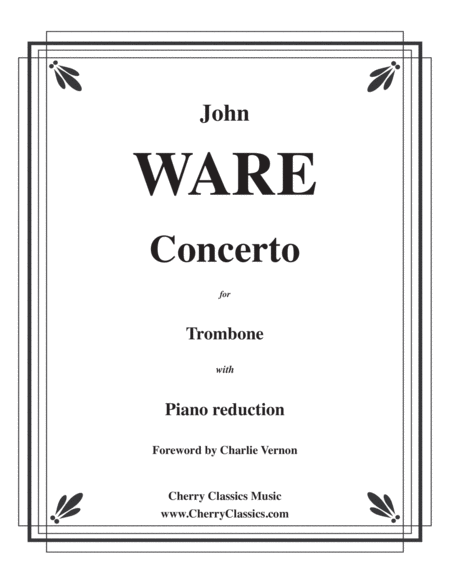
Concerto for Trombone and Piano accompaniment (piano reduction)
Trombone et Piano

$35.00 30.43 € Trombone et Piano PDF SheetMusicPlus

Beethoven : Symphonie n° 9, Opus 125 - IV. Final : Ode à la joie (niveau intermédiaire/difficile, sax alto)
Saxophone
Téléchargez la partition Saxophone Symphonie n° 9, Opus 125 - IV. Final : Ode à la joie (n…
5.99 € Saxophone PDF Tomplay

Instrumental Duet Cello,Instrumental Duet,Violin - Level 4 - Digital Download SKU: A0.589779 Composed by Desmond Cox, Elton Box, Paddy Roberts, and Ralph Butler. Arranged by David McKeown. Contemporary. Score and parts. 7 pages. David McKeown #6094369. Published by David McKeown (A0.589779). Horsey Horsey is a comedy song arranged by David McKeown as a duet for one Violin and one Cello. Horsey Horsey was written in 1937 by Paddy Roberts and Ralph Butler. Paddy Roberts was a South African musician who flew in the RAF during the Second World War, then later as a commercial airline pilot. His music career finally got off the ground in the mid ‘50s. Ralph Butler was a well-known comedy lyricist of the time, responsible also for The Sun Has Got His Hat On, Nellie The Elephant and Run Rabbit, Run among others. Nowadays Horsey Horsey is best known as a nursery rhyme.This duet version of Horsey Horsey is a fun Theme and Variations, with the melody presented in swing style, in a slow minor key version, in 6/8 and in a nineteenth century style grand finale. The arrangement moves through several different keys, exploring a wide range of the instruments, and is therefore suitable for players at an Advanced Intermediate level. Click the link above to listen to a full Youtube performance of the Clarinet version of this duet. There are many more top quality arrangements and compositions by David McKeown for you to browse at https://www.sheetmusicplus.com/publishers/david-mckeown/6203
Horsey Horsey
Violon, Violoncelle (duo)

$5.99 5.21 € Violon, Violoncelle (duo) PDF SheetMusicPlus

Piano - Digital Download SKU: LV.14044 Composed by M. P. King. Waterfronts, Ships, Smoke, Shorelines, Crowds, Celebrations, Couples, Warfare. Lester S. Levy Collection. 13 pages. Published by Johns Hopkins University Sheridan Libraries (LV.14044). The Royal Nalmachia, Fair & Fire-Works, A Grand DRamatic Divertissement for the Piano forte. Composed by M.P. King. Published [n.d.] by Goulding, D'Almaine, Potter & Co., Music & Musical Instrument Sellers, 20 Soho Square in London. Composition of multimovement work; includes Overture, The Fair, The Naumachial, The Fire Works, and Finale with piano instrumentation. Subject headings for this piece include Waterfronts, Ships, Smoke, Shorelines, Crowds, Celebrations, Couples, Warfare. About The Lester S. Levy CollectionThe Lester S. Levy Collection of Sheet Music consists of over 29,000 pieces of American popular music. Donated to Johns Hopkins University Sheridan Libraries, the collection's strength is its thorough documentation of nineteenth-century American through popular music. This sheet music has been provided by Project Gado, a San Francisco Bay Area startup whose mission is to digitize and share the world's visual history.WARNING: These titles are provided as historical documents. Language and concepts within reflect the opinions and values of the time and may be offensive to some.
The Royal Nalmachia, Fair & Fire-Works, A Grand Dramatic Divertissement
Piano seul

$5.99 5.21 € Piano seul PDF SheetMusicPlus

Full Orchestra - Digital Download SKU: A0.819695 Composed by Franz Joseph Haydn. Arranged by J.G. Cucó Barber. Classical. Score and parts. 266 pages. J.G. Cuco Barber #5989235. Published by J.G. Cuco Barber (A0.819695). Composer Haydn, JosephOpus/Catalogue Number Hob.I:101Key D majorMovements/Sections 4 movements:Adagio - Presto (D major, 351 bars)Andante (G major, 150 bars)Minuet - Trio. Allegretto (D major, 160 bars)Finale. Vivace (D major, 280 bars)Year/Date of Composition 1794First Publication 1799? – Offenbach: Johann André (parts)Average Duration 30 minutesComposer Time Period ClassicalPiece Style ClassicalInstrumentation: Orchestra:Flute 1Flute 2Oboe 1Oboe 2Clarinet in A 1 original & Bb transposedClarinet in A 2 original & Bb transposedBassoon 1Bassoon 2Horn in D/G 1 original & F transposedHorn in D/G 2 original & F transposedTrumpet in D/C 1 original & Bb transposedTrumpet in D/C 2 original & Bb transposedTimpaniViolin IViolin IIViolaVioloncelloContrabass
Haydn - Symphony No.101 in D major, Hob.I:101 "The Clock"
Orchestre

$28.00 24.35 € Orchestre PDF SheetMusicPlus


Partitions Gratuites
Acheter des Partitions Musicales
Acheter des Partitions Digitales à Imprimer
Acheter des Instruments de Musique

© 2000 - 2026

Accueil - Version intégrale





