EUROPE
1662 articles
USA
0 articles
DIGITAL
6232 articles (à imprimer)
Partitions Digitales
Partitions à imprimer
6232 partitions trouvées


Volume 2 French Horn - Advanced SKU: HL.4471010 Volume 2 - Advanced. Edited by H. Voxman. Concert Band Method. Ensemble Collection. Classical, Duet. 72 pages. Published by Rubank Publications (HL.4471010). ISBN 9781423445388. UPC: 073999499902. 9.0x12.0x0.179 inches.This classic series of duets for like instruments is recognizable to nearly everyone who has ever studied an instrument. The wealth of material supplements musical development and provides a rich experience for growing musicians. Duet playing is often a student's first form of ensemble experience - technique, tone quality, intonation and balance are introduced as students do one of the things they enjoy most - making music with a friend. And duet playing leads easily and naturally to competent performance in larger ensembles. (Vol. I – Easy to Medium, Vol. 2 – Medium to Advanced).
Selected Duets - French Horn (Volume 2)

$11.99 10.43 € PDF SheetMusicPlus

Alto Saxophone Solo - Level 1 - Digital Download SKU: A0.587799 Composed by Various. Arranged by David McKeown. Christmas,Instructional,Praise & Worship,Sacred. Individual part. 8 pages. David McKeown #4978267. Published by David McKeown (A0.587799). 20 Really Easy Christmas Carols for Alto Saxophone is a collection of your favourite carols arranged simply in the easiest keys and range for early stage players.We all know that tricky period when beginner saxophonists have mastered basic technique and can play a range of around an octave and a half. At this point, I find lots of simple material is ideal to consolidate early successes. Playing simple Christmas carols is usually a big motivation to students. Now, with this collection of carols, students can join in with Christmas music-making and develop those reading skills at the same time.These 20 carols are arranged in easy keys, going no lower than DThe carols are in alphabetical order and are as follows;·     Away in a Manger·     Deck the Halls·     Ding Dong Merrily on High·     The First Nowell·     God Rest ye Merry Gentleman·     Good Christian Men Rejoice·     Good King Wenceslas·     Hark, the Herald Angels Sing·     The Holly and the Ivy·     I Saw Three Ships·     In the Bleak Midwinter·     It Came upon a Midnight Clear·     O Cone All Ye Faithful·     O Come, O Come Emmanuel·     O Little Town of Bethlehem·     Once in Royal David’s City·     Silent Night·     We Three Kings·     While Shepherds Watched·     We Wish you a Merry Christmas There are many more top quality arrangements and compositions by David McKeown for you to browse at http://www.sheetmusicplus.com/publishers/david-mckeown/6203  <!-- /* Style Definitions */ p.MsoNormal, li.MsoNormal, div.MsoNormal {mso-style-unhide:no; mso-style-qformat:yes; mso-style-parent:; margin:0in; margin-bottom:.0001pt; mso-pagination:widow-orphan; font-size:12.0pt; font-family:Calibri; mso-ascii-font-family:Calibri; mso-ascii-theme-font:minor-latin; mso-fareast-font-family:Calibri; mso-fareast-theme-font:minor-latin; mso-hansi-font-family:Calibri; mso-hansi-theme-font:minor-latin; mso-bidi-font-family:Times New Roman; mso-bidi-theme-font:minor-bidi; mso-fareast-language:EN-US;} a:link, span.MsoHyperlink {mso-style-noshow:yes; mso-style-priority:99; color:blue; text-decoration:underline; text-underline:single;} a:visited, span.MsoHyperlinkFollowed {mso-style-noshow:yes; mso-style-priority:99; color:#954F72; mso-themecolor:followedhyperlink; text-decoration:underline; text-underline:single;} p.MsoListParagraph, li.MsoListParagraph, div.MsoListParagraph {mso-style-priority:34; mso-style-unhide:no; mso-style-qformat:yes; margin-top:0in; margin-right:0in; margin-bottom:0in; margin-left:.5in; margin-bottom:.0001pt; mso-add-space:auto; mso-pagination:widow-orphan; font-size:12.0pt; font-family:Calibri; mso-ascii-font-family:Calibri; mso-ascii-theme-font:minor-latin; mso-fareast-font-family:Calibri; mso-fareast-theme-font:minor-latin; mso-hansi-font-family:Calibri; mso-hansi-theme-font:minor-latin; mso-bidi-font-family:Times New Roman; mso-bidi-theme-font:minor-bidi; mso-fareast-language:EN-US;} p.MsoListParagraphCxSpFirst, li.MsoListParagraphCxSpFirst, div.MsoListParagraphCxSpFirst {mso-style-priority:34; mso-style-unhide:no; mso-style-qformat:yes; mso-style-type:export-only; margin-top:0in; margin-right:0in; margin-bottom:0in; margin-left:.5in; margin-bottom:.0001pt; mso-add-space:auto; mso-pagination.
20 Really Easy Christmas Carols for Alto Saxophone
Saxophone Alto

$7.99 6.95 € Saxophone Alto PDF SheetMusicPlus

Percussion Ensemble - Level 5 - Digital Download SKU: A0.962405 Composed by Salvador Rojo Gamón. Concert,Contemporary,Instructional,Standards. Score and parts. 255 pages. Salvador Rojo-Gamon #5801921. Published by Salvador Rojo-Gamon (A0.962405). Four ForcesReviewsScherzohttps://scherzo.es/badajoz-vanguardias-lugarenas/Periodico Extremadurahttps://www.elperiodicoextremadura.com/noticias/badajoz/fuerzas_1214372.html NotesThis work was commissioned by Extremadura Orchestra for Percussion and Chamber orchestra.It has two movements. The first one has been done for mallets and the second one was built on a base of a drums work (GEA).The duration of those movements is 26 minutes, being around 11 minutes the first and 15 minutes the second one.The chamber music is formed by:Woodwind quintet (Flute, Oboe, Clarinet, Horn & Bassoon)Brasswind quintet (Trumpet 1, Trumpet 2, Horn, Trombone & Tuba)Strings orchestraThree firsts violinsThree seconds violinsThree violasTwo cellosFor the second movement is high recommendable to enlarge the strings, a good number of musician could be doubling.I. Strong ForcesThe work is inspired by the four fundamental forces of nature. These forces explain any phenomena which can be produced in the universe.Throughout all composition, it is latent the mathematic construction based in the series Fibonacci. In the first of the movements, Fibonacci's series is present in the notes' sequence that forms the series of 16 sounds and it is going to be present throughout the whole work. This series is taking form along the movement and it is getting melody and harmony.Although it is far away from the sonata form, as we know it in its period of highest glory, it takes elements of it and updates to our days. In this movement, we can find sonata form elements as the exposition, development, transitions or coda.The central part of the first movement becomes in the slow movement, being more intimate and lyrical, free of the serials ties although it uses resources before cited -now called common practice-.The movement finish with a short re-exposition that concludes with the virtuosic of the soloist doubling the series and adding more tension until conforming the series in its full whole.II. Weak ForcesIt is the most tribal of both movements. Its structure is more complex and in it, we also can find clear reminiscences to the sonata form.We can divide the movement into two big blocks. The first one is formed for the introduction and sections one and two.IntroducciónIt is based in one ostinato of three notes where the accent is changing provoking unsymmetric, this ostinato represents the nucleus of our existence. The piccolo and the trombone introduce us to the human element representing the two elements that form the development of the whole movement.The two elements of thematics are taken from the series, the first one is easily recognizable because it appears in his primary form.First section & cadenzaIn this movement, the rhythm, the melody, and the harmony are based on the sequence of Fibonacci. As the theme ostinato of the soloist as the melody is formed under the rhythm of 1, 2, 3 and 5. This section leads us to the second section with a clear mode of cadence. In the cadenza, the elements of the rhythm are varied freely with an accompaniment of the Spring Drum.DevelopmentIt is formed by two Rondo sub-sections in which the solo part has been created through the mirror technique.Both sections have the next form:Intro-A-B-A-B-(B(minor)+A)Intro-A-B-A-B-(B(major)+A)First section & CodaThe movement ends with the repetition of the first section and the final code. 
Four Forces (Second movement) II. Weak Forces
Ensemble de Percussions

$150.00 130.43 € Ensemble de Percussions PDF SheetMusicPlus

Piano,Vocal,Voice - Level 4 - Digital Download SKU: A0.1353635 Composed by Philip Seward. 21st Century,Broadway,Chamber,Contemporary,Musical/Show,Opera. Score. 79 pages. Music Anon #938378. Published by Music Anon (A0.1353635). Music by Philip Seward • Libretti by Joan Mazzonelli & Philip SewardThis volume offers four scenes for women singers for use in opera scene study and performance. There are a wide range of characters represented and various musical styles. The first is from High Fidelity which has been adapted from Anton Chekhov’s The Bear and George Bernard Shaw’s How He Lied to Her Husband. There are also references to Wolfgang Amadeus Mozart’s Cosí fan tutte later in the score. In this opening scene, Aurora Wentworth is practicing the mourning she believes society expects of her while her cousin, Georgina, from Milwaukee arrives to spice up the summer morning.The second scene from Dorabella’s Daughters finds Anabella trapped in a woodsman’s cottage the day after her wedding. The opera opens at the wedding reception for her stepsister Cinderella where Annabella is particularly spiteful. In a fury, she marries the next man who walks in the room — as it happens,  a woodsman — or so she thinks. In this scene she is mourning her fate. Her younger sister, Brendella comes to visit and the two are joined later by their very happy stepsister, Cinderella.The third scene from The Passion of John presents three women with their own perspectives on Jesus in this stylized presentation of the Gospel of John. The first singer offers the perspective of the gospel, the second presents a firsthand narrative of the Samaritan woman and the third is the woman who was accused of adultery. All three are accompanied by a women’s choral ensemble, flute, classical guitar and cello.The final scene in this collection comes from The Proposal. The opera is composed as two loosely joined acts where the first is sung by four women and the second by three men. The action concerns the aftermath of a proposal of marriage where the woman, Eve, asks for time to consider. The unexpected response sends Sam into a bit of a tailspin. In this scene, from the end of the first act Eve is arguing with three versions of herself in the middle of the night: the romantic, the maternal and the one focused on career. The scene opens right after Eve-Romantic has just waxed poetic about the perfect fairytale romance.
Opera Scenes for Women
Piano, Voix

$45.00 39.13 € Piano, Voix PDF SheetMusicPlus

Instrumental Duet Alto Recorder,Instrumental Duet - Level 2 - Digital Download SKU: A0.966354 Composed by Greg Shapley. 20th Century,Contemporary,Standards. Score and parts. 4 pages. Greg Shapley #1984573. Published by Greg Shapley (A0.966354). Phrygian Swell is an easy to play round for recorders in three parts (it may also be played by many other instruments). It is written for near-beginners, but its designed so that the sum is greater that its parts. Included in this score are two versions. The original changes time signature every bar (eventually getting up to 23/4). It plays with a number of concepts, all designed as educational tools. Firstly, it is written entirely in the mode known as Phrygian. This mode has a distinctive mystical sound primarily due to its first interval – which is a minor second. Secondly, it has been written to get players thinking about time without being too challenging (so despite the change of time signatures, most notes are just crotchets). Another educational facet of these changing time signatures is that they ascend by primary numbers. Thirdly, being a round it gets young players used to playing different parts with other players, while initially being able to rehearse altogether. Fourthly, this piece is comprised entirely of scales, but it doesn't just sound like an exercise (I hope). The second version, barred in 4/4 is exactly the same as the first, except for the rebarring. This is done in case following the continually changing time signatures is too difficult (although it does defeat the purpose of the piece to a certain extent). This version of this piece was written for three alto/treble (transposed from the original for descant/soprano or tenor), but due to its simplicity and range, could be played by many other instruments.
Phrygian Swell (for alto/treble recorders)

$1.99 1.73 € PDF SheetMusicPlus

Small Ensemble Hand Percussion,Voice - Level 3 - Digital Download SKU: A0.835774 Composed by Paul Burnell. Contemporary. Score and parts. 3 pages. Paul Burnell #3214065. Published by Paul Burnell (A0.835774). For voice and hands (optional percussion/instruments) The performer speaks rhythmically and at the same time rubs together the palms of their hands, or sandpaper blocks, with the same spoken rhythm and also where marked in the text with dashes (- - - - -). The bracketed direction (open hands) is not spoken, but is an indication to the performer to open their hands wide as a dramatic gesture. Examples of optional instruments - all playing a very quiet tremolo: Three players on low drums with soft sticksAny three low notes on marimba or vibraphoneThree groups of strings quite drumming fingers on the instrument bodies. The three players/groups enter as indicated in relation to the text - [1], [2], [3] - and stop, fade, crescendo where indicated. Programme note: ‘And She Flew’ was composed by Paul Burnell in 2006 and was first performed by percussionist Chris Brannick. The piece can be performed as a solo or together with accompanying instruments playing a quiet tremolo. 
And She Flew

$1.99 1.73 € PDF SheetMusicPlus

Choral Choir (SATB) - Level 2 - Digital Download SKU: A0.927475 Composed by Annie Routley. Christian,Praise & Worship,Sacred,Spiritual. Octavo. 7 pages. Christian Music Ministries #6306121. Published by Christian Music Ministries (A0.927475). Words and music by Annie RoutleyA setting of words from Hebrews 12:2 (chorus) with verses encouraging faith and hope in the midst of a painful situation.Sources of inspiration for this song were threefold: firstly the Scripture from Hebrews 12 was my baptism verse, on Easter Sunday 1979; secondly, from Corrie ten Boom´s ´The Hiding Place´, where her sister Betsy tells Corrie not to look at the wounds she´d received from the concentration camp guards, but to look instead at Jesus and fix her eyes on him; and thirdly, from C S Lewis´ ´The Magician´s Nephew´, where Digory wants so desperately for Aslan to cure his mother who is terminally ill, but the great Lion sets him a task instead which will protect all of Narnia for years to come; Digory is looking down at Aslan´s paws, his heart heavy, but as he looks up into the Lion´s face, what he sees there surprises him very deeply – for Aslan´s eyes are filled with tears. He realizes that Aslan cares even more deeply about Digory´s mother than he himself.For soloist, 4–part choir and piano accompaniment. Guitar chords also included.From the Roger Jones Song Collection (2010); originally from the collection ´Precious and honoured´ (1995). A backing track and/or instrumental parts are available on request from events@cmm.org.uk
Let us fix our eyes upon Jesus
Chorale SATB

$1.99 1.73 € Chorale SATB PDF SheetMusicPlus

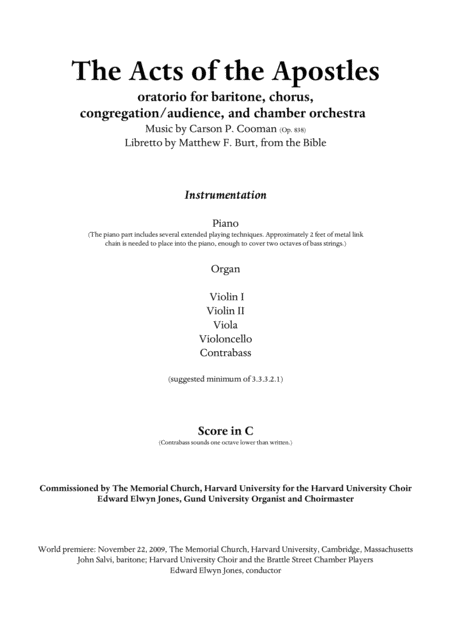
Chamber Orchestra - Level 5 - Digital Download SKU: A0.533578 Composed by Carson Cooman. Christian,Contemporary,Spiritual. Score and parts. 189 pages. Musik Fabrik Music Publishing #3025409. Published by Musik Fabrik Music Publishing (A0.533578). The Acts of the Apostles (2009), an oratorio for baritone, chorus, congregation/audience, and chamber orchestra (piano, organ, strings-suggested minimum of 3.3.3.2.1),was commissioned by The Memorial Church at Harvard University. It is dedicated to Edward Elwyn Jones and theHarvard University Choir.The biblical books of Luke and Acts form a pair of documents from a single author and with a single audience (thelikely-metaphorical “Theophilusâ€), yet they are unusual for being composed in such contrasting genres. Luke’sgospel, using Mark as a primary source throughout, features a comparable literary style to that of the otherevangelists. Acts, by contrast, is a historical monograph that charts the birth of the Church with dramatic storiesabout—and speeches from—the apostles, painting a vivid, if not necessarily chronological, picture of their victoriesand struggles. As such, it is a book that provides excellent source material for a dramatic choral libretto of this scale.Although much of Acts is focused on the ministry of Saul/Paul, this oratorio draws most of its material from thefirst third of the book, prior to and including the conversion of Saul. In the Prologue, Christ’s ascension is narratedand—following an orchestral Sinfonia—the chorus sings words of Jesus from the Sermon on the Plain in Luke’sgospel that foreshadow many of the trials the apostles go on to face. The astounding account of Pentecost follows:here, words from the book of Ruth, customarily read on the feast of Shavuot (Pentecost), are included, telling thestory of a Moabite woman who converted to the Israelite faith—a parallel to the expansion of the Christian messageto all nations by the gift of the Holy Spirit. The Prayer for Boldness, quoting Psalm 2, asks God for protection fromthe threats of persecution that the apostles will now face.Stephen, regarded as the proto-martyr of the Christian Church, offers one of the most developed speeches in Acts,only a small portion of which is presented here. Full of scriptural references, including the quotation from Isaiah“Heaven is my throne…â€, the end of the narrative is remarkable for two reasons: firstly, Stephen’s final wordsmirror those of Christ on the cross in Luke’s gospel—where Jesus forgives his executioners and prays “Father, intoyour hands I commend my spirit†(Luke 23:46); secondly, Saul is specifically mentioned as one who approved ofStephen’s stoning, indicative of the redemptive possibilities of the Christian message.The account of the baptism of the Ethiopian eunuch here in the oratorio ends with the First Song of Isaiah—whilenot quoted in Acts, it seems a fitting conclusion to the scene as Philip and the eunuch were reading Isaiah together,and the canticle has often been associated by Christians with the rite of baptism. Similarly, the story of Saul’sConversion is followed here by a Christological poem found in Paul’s letter to the Philippians, though it is likely aquotation from an earlier source. It is often regarded as the earliest extant Christian hymn.The Acts of the Apostles concludes with Luke’s realistic assessment that in spite of Paul’s energetic evangelism manyremained unconvinced by the Christian message. At the heart of both Luke’s gospel and Acts is the tension betweenthe uniquely important role of the Jewish traditions that Jesus himself practiced and the expansion of the gospel togentiles, of whom Luke himself is one. It is appropriate, therefore, to follow Paul’s message of salvation to thegentiles with the Magnificat: a canticle that emphasizes the promises of God to the people of Israel throughouthistory.Three traditional hymn texts are found in the oratorio, each set congregationally to a pre-existing tune. The first,“Spirit of mercy, truth, and love†is an eighteenth century poem that e.

Carson Cooman: The Acts of the Apostles (2009), an oratorio for baritone, chorus, congregation/audie
Orchestre de chambre

$25.95 22.57 € Orchestre de chambre PDF SheetMusicPlus


Partitions Gratuites
Acheter des Partitions Musicales
Acheter des Partitions Digitales à Imprimer
Acheter des Instruments de Musique

© 2000 - 2026

Accueil - Version intégrale