EUROPE
9603 articles
USA
0 articles
DIGITAL
228477 articles (à imprimer)
Partitions Digitales
Partitions à imprimer
228477 partitions trouvées


Choral Choir (SATB) - Level 4 - Digital Download SKU: A0.828704 Composed by Giovanni Bononcini, Giovanni Battista Bononcini. Arranged by Guido Menestrina. Baroque,Contemporary,Sacred. Octavo. 44 pages. Guido Menestrina #368381. Published by Guido Menestrina (A0.828704). Anthem which was performed in King Henry the Seventh's Chappel at the Funeral of the most Noble & Victorious Prince John Duke of Marlborough By Giovanni Bononcini (1670-1747) transcribed by Guido Menestrina Il padre, Giovanni Maria Bononcini (Buononcini) (1642-1678), era stato violinista e compositore: attivo alla corte di Modena, aveva scritto un trattato, Musico prattico, pubblicato nel 1673. Il fratello minore di Giovanni, Antonio Maria, fu anch'egli musicista. Proprio dal padre Giovanni ricevette la prima educazione musicale; quando questi morì, nel 1678, divenne studente di Giovanni Paolo Colonna a Bologna, dove vennero eseguiti i suoi primi lavori. Proprio grazie al Colonna entrò a far parte dell'Accademia dei Filarmonici in veste di compositore. Nel 1685 aveva già preparato e pubblicato le sue prime opere. Ottenne nel 1688 il posto di musicista presso la basilica di San Petronio, e più tardi divenne maestro di cappella nella chiesa di San Giovanni in Monte. Sempre a Bologna fece la conoscenza del librettista Silvio Stampiglia, assieme al quale, tra il 1692 e il 1696, produrrà cinque opere. A partire dal 1692 si recò a Milano, Roma (dove fu apprezzato e sostenuto da Filippo II Colonna e dalla sua consorte Olimpia Pamphilj) e Venezia; infine, dal 1698 al 1711 si stabilì a Vienna, dove godette i favori degli imperatori Leopoldo I e Giuseppe I. Di passaggio a Berlino nel 1702, incontrò Georg Friedrich Händel, di quindici anni più giovane di lui, di cui riconobbe il talento precoce: lo avrebbe rincontrato alcuni anni più tardi. Dal 1714 al 1719 fu di nuovo a Roma, al servizio di Johann Wenzel, Conte di Gallas, Ambasciatore dell'Imperatore d'Austria a Roma, molto noto per il suo amore per la musica. Al Conte di Gallas, Bononcini dedicò la Favola Pastorale Erminia, rappresentata al Teatro della Pace nella Stagione del Carnevale del 1719. Il dramma musicale ebbe grandissimo successo sia per la musica, sia per gli interpreti, fra cui si segnalarono Domenico Gizzi (1687-1758), Musico Soprano della Real Cappella di Napoli ed il celebre contralto napoletano Francesco Vitale. Sempre nella Stagione del Carnevale 1719 al Teatro della Pace, Bononcini rappresentò il dramma per musica L'Etearco, dal librettista Silvio Stampiglia dedicato alla Contessa Ernestina di Gallas, moglie dell'Ambasciatore austriaco. Anche in questo dramma per musica Domenico Gizzi e Francesco Vitale fecero apprezzare tutte le spezie più ricercate del virtuosismo canoro. Poi, dal 1720 si stabilì a Londra, sotto la protezione del John Churchill, I duca di Marlborough. Qui si esibì anche al violoncello in numerosi concerti, molto apprezzati dall'aristocrazia inglese. Divenne membro della prestigiosa Royal Academy of Music.[senza fonte] Il pubblico londinese era, all'epoca, totalmente ignorante dell'opera italiana, e Händel stava muovendo i primi passi della sua prestigiosa carriera. Fra i due compositori si accese un forte spirito di competizione, sia che collaborassero alla realizzazione della medesima impresa (i tre atti dell'opera Muzio Scevola furono composti il primo da Filippo Amadi, il secondo da Bononcini, il terzo da Händel, al fine di soddisfare tutti e tre gli artisti), sia che, più spesso, si impegnassero in produzioni rivali. Le opere di maggior successo di Bononcini in quegli anni furono Astarto (1720), Crispo (1722), Griselda (1722), che si rivelò un vero e proprio trionfo, Erminia (1723), Calfurnia (1724). A favore dell'italiano era anche una certa ostilità verso Händel dovuta alle sue origini tedesche e alla contemporanea presenza sul trono inglese della poco amata dinastia di Hannover. Ma nel 1727-1728 scoppiò uno scandalo che compromise il successo di Bononcini e lo costrinse a lasciare Londra: il compositore Antonio Lotti accusò il madrigale di Bononcini In una siepe ombrosa di essere un plagio di un brano dei suoi Duetti, terzetti e madrigali. Fuggito a Parigi nel 1733, a causa di speculazion.
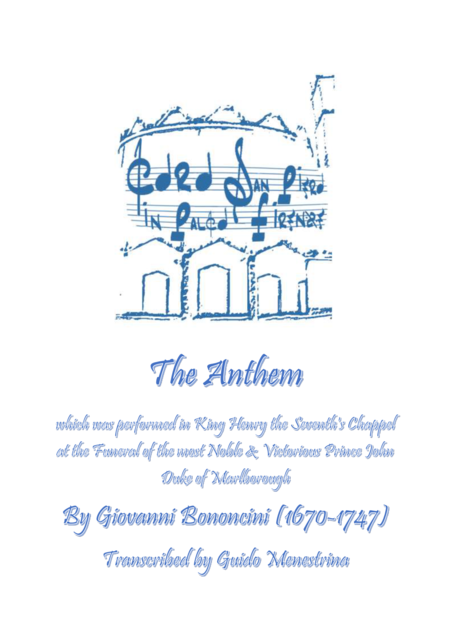
Giovanni Bononcini - Anthem (for the Funeral of John Duke of Marlborough)
Chorale SATB
Giovanni Bononcini (1670-1747) transcribed by Guido Menestrina Il padre, Giovanni Maria Bononcini (Buononcini) (1642-1678), era stato violinista e compositore: attivo alla corte di Modena, aveva scritto un trattato, Musico prattico, pubblicato nel 1673 Il fratello minore di Giovanni, Antonio Maria, fu anch'egli musicista
$9.99 8.67 € Chorale SATB PDF SheetMusicPlus

Instrumental Duet Harp,Instrumental Duet,Violin - Level 5 - Digital Download SKU: A0.875784 Composed by P. I. Tchaikovsky. Arranged by N. Szederkenyi. Romantic Period. Score and parts. 12 pages. IStrings #3866767. Published by iStrings (A0.875784). This beautiful piece by Tchaikovsky is one of a set of three for violin and piano. It is the original violin part edited with fingerings / bowings with the piano part transcribed to a lovely harp accompaniment. Very much like his ballet music, played some times even as an extra part for the ballet Swan Lake. Written by Hungarian violin virtuoso Nandor Szederkenyi, former concertmaster in several major orchestras from Japan to Austria, who also had a long career as soloist. Published using the leading notation software Finale, he includes bowings and fingerings, in collaboration with his duo partner/daughter who took care of the pedal markings of the harp part.
Meditation Op. 42 No. 1 - transcription for violin & harp
Harpe, Violon (duo)

$15.00 13.02 € Harpe, Violon (duo) PDF SheetMusicPlus

Small Ensemble Bassoon,Clarinet,Flute,Horn,Oboe - Digital Download SKU: A0.839017 Composed by Christoph Willibald Von Gluck. Arranged by Kenneth Martin. Classical,Concert. Score and parts. 15 pages. Martin Music Editions #5214107. Published by Martin Music Editions (A0.839017). Orfeo ed Euridice (French: Orphée et Eurydice; English: Orpheus and Eurydice) is an opera composed by Christoph Willibald Gluck, based on the myth of Orpheus and set to a libretto by Ranieri de' Calzabigi. It belongs to the genre of the azione teatrale, meaning an opera on a mythological subject with choruses and dancing. The piece was first performed at the Burgtheater in Vienna on 5 October 1762, in the presence of Empress Maria Theresa. Orfeo ed Euridice is the first of Gluck's reform operas, in which he attempted to replace the abstruse plots and overly complex music of opera seria with a noble simplicity in both the music and the drama. The opera is the most popular of Gluck's works, and was one of the most influential on subsequent German operas. Variations on its plot-the underground rescue-mission in which the hero must control, or conceal, his emotions-can be found in Mozart's The Magic Flute, Beethoven's Fidelio, and Wagner's Das Rheingold. Though originally set to an Italian libretto, Orfeo ed Euridice owes much to the genre of French opera, particularly in its use of accompanied recitative and a general absence of vocal virtuosity. Indeed, twelve years after the 1762 premiere, Gluck re-adapted the opera to suit the tastes of a Parisian audience at the Académie Royale de Musique with a libretto by Pierre-Louis Moline. This reworking was given the title Orphée et Eurydice, and several alterations were made in vocal casting and orchestration to suit French tastes.
ARIA from L'Orfeo ed Euridice (Gluck) for Wind Quintet (Horn in F solo)
Quintette à Vent: flûte, Hautbois, basson, clarinette, Cor

$5.99 5.2 € Quintette à Vent: flûte, Hautbois, basson, clarinette, Cor PDF SheetMusicPlus

Brass Ensemble Horn,Trombone,Trumpet,Tuba - Level 3 - Digital Download SKU: A0.839015 Composed by Christoph Willibald Von Gluck. Arranged by Kenneth Martin. Classical,Concert. Score and parts. 11 pages. Martin Music Editions #5214105. Published by Martin Music Editions (A0.839015). Orfeo ed Euridice (French: Orphée et Eurydice; English: Orpheus and Eurydice) is an opera composed by Christoph Willibald Gluck, based on the myth of Orpheus and set to a libretto by Ranieri de' Calzabigi. It belongs to the genre of the azione teatrale, meaning an opera on a mythological subject with choruses and dancing. The piece was first performed at the Burgtheater in Vienna on 5 October 1762, in the presence of Empress Maria Theresa. Orfeo ed Euridice is the first of Gluck's reform operas, in which he attempted to replace the abstruse plots and overly complex music of opera seria with a noble simplicity in both the music and the drama. The opera is the most popular of Gluck's works, and was one of the most influential on subsequent German operas. Variations on its plot-the underground rescue-mission in which the hero must control, or conceal, his emotions-can be found in Mozart's The Magic Flute, Beethoven's Fidelio, and Wagner's Das Rheingold. Though originally set to an Italian libretto, Orfeo ed Euridice owes much to the genre of French opera, particularly in its use of accompanied recitative and a general absence of vocal virtuosity. Indeed, twelve years after the 1762 premiere, Gluck re-adapted the opera to suit the tastes of a Parisian audience at the Académie Royale de Musique with a libretto by Pierre-Louis Moline. This reworking was given the title Orphée et Eurydice, and several alterations were made in vocal casting and orchestration to suit French tastes.
ARIA from L'Orfeo ed Euridice (Gluck) for Brass Quintet (Horn in F solo)
Quatuor de Cuivres : 2 trompettes, trombone, tuba

$5.99 5.2 € Quatuor de Cuivres : 2 trompettes, trombone, tuba PDF SheetMusicPlus

Instrumental Duet Horn,Instrumental Duet - Level 1 - Digital Download SKU: A0.768540 Composed by Jim Evans. Concert,Contemporary,Standards. Score and parts. 8 pages. Beginning.band #3049853. Published by beginning.band (A0.768540). A collection of four duets written with the youngest players in mind!Ranges limited so that students can focus on rhythmic accuracy, tone quality, dynamics, and expression.Rhythms are limited to whole, dotted half, half, quarter, and paired eighth notes. Rhythms that even the youngest musicians can count! No syncopation!No pick-ups! Each piece starts on a downbeat so the kids can come in with confidence!Each piece is about one minute in length to accommodate the limited stamina of younger players.A variety of styles and moods to motivate studentsEvery measure of each part and score is numbered! You're welcome! ;)Duets may be performed by any two instruments, with like or mixed instrumentation, but if you use mixed instrumentaion you may have better results if upper instruments play the top line and lower instruments play the bottom line. Also, it may be preferable to avoid having two tubas, as the results may be less desirable.Books for Flute/Oboe, Bb treble, Eb treble, Tenor Saxophone, Horn, Bass Clef, Tuba, Bells/XylophoneNotesSneaking AroundMeter: 4/4Key: BbRange: Low A - GFocus: Staccato, Slur, Phrasing, Dynamic ContrastCountry DanceMeter: 3/4Key: BbRange: Low A  GFocus: Staccato, Triple Meter, PhrasingAll Aboard!Meter: 4/4Key: C minorRange: Bb - AbFocus: Staccato, Slur, Phrasing, Dynamic Contrast,Note: The second part on this piece may be expecially challenging for young flute, oboe, and trombone players.Give and TakeMeter: 3/2Key: BbRange: Bb - FFocus: Interplay between voices, especially contrasting staccato and legato, Triple MeterNote: The meter signature of 3/2 allows for livelier rhythmic content without presenting sixteenth notes. Students should be able to read it in 6/4, then perform it in three when they get a feel for it.
Elementary Duets, Volume 1, for Horn in F
2 Cors (duo)

$4.00 3.47 € 2 Cors (duo) PDF SheetMusicPlus

Tuba Solo - Level 3 - Digital Download SKU: A0.991803 Composed by Jason Allie. Baroque,Classical,Contemporary,World. Individual part. 9 pages. Joaba LLC #3109629. Published by Joaba LLC (A0.991803). DescriptionA delightful, intermediate level work suitable for encouraging students, hobbyists and professionals to improve or show off their performance skills. This lively work engages the audience with a breadth of moods from enlightening to reflective to celebratory. A great recital piece or encore piece to show off the melodiousness, harmoniousness and vibrancy of the tuba. Please send feedback, praises and more to contact@joaba.com.Total Duration: ~8 minutesPerformance Notes Prelude The real art of performing this piece is to master its dynamics. With the long pianissimo to forte crescendo at the introduction, the contrasting forte/mezzo piano sections and brisk, shorter crescendos for the cadences, the tubist must be aware of dynamics at all time and use them wisely.The second aspect to performing this piece is to contrast the 2 eighth note plus quarter note slurs motif against the arpeggiations.  The introduction starts with the slurs and evolves into the arpeggiations by the first forte and the remaining piece explores the contrast between the two.  Performers should feel free to try different dynamics, try different tempos (like zipping through the arpeggiations and slowing for the motif), etc.   The goal is to bring the listener through the pleasantries of introductions to feel fresh and eager for further discourse ahead. March The rewarding challenge in this piece is to bring out the difference between cheery and con brio.  The former being achieved by emphasizing the swaggering, strutting feel of the one-measure-per-beat feel and the latter by emphasizing the intervallic bounciness with the one-two march feel.Note that the motif (with the quarter note morphing into an eighth note) along with simpler arpeggiations are brought to play in a new manner reinforcing the positive mood from the prelude.The goal is to befriend the listener with an engaging, buoyant time. Air The tubist will exercise great breath control and phrasing to achieve a sublime solemnness counterbalancing the prior two movements.The motif now takes center stage headlining the main melodic phrases; however, here it is disjointed and conveys the sighing for the solemnness.After the pleasantness of the march, affableness having garnered friendship, we now open ourselves to share some somber matters and offer consolation.  The intended goal here is to add depth to the relationship by addressing darker aspects in the discourse. Slip-jig Rondo Harking back to the compound meter of the prelude, this dance adventurously wakens the listener from the solemnness of the air asserting a new grandness and gladness.  This is a slip-jig put into the rondo form so celebrate the main dance theme when it comes around and put fire and character into the transitions to make it worthwhile.The motif now jumps into the compound meter’s beat and morphs into three slurred, conjoint eighth notes.  Now this motif enables several affects: exciting dance steps, transitions/modulations and concluding the phrases and the piece itself.The performer should aim to lead and amaze the listener with the waltz-like slip-jig rhythm and astound with the virtuosic transitions as a final send-off.
Unaccompanied Tuba Suite #1 in B-flat Major
Tuba

$9.99 8.67 € Tuba PDF SheetMusicPlus

String Ensemble - Level 3 - Digital Download SKU: A0.826635 Composed by Traditional. Arranged by Bud Caputo. Jazz,Traditional. Score and parts. 37 pages. Bud Caputo #3104591. Published by Bud Caputo (A0.826635). When The Saints Go Marchin' In- this ever popular jazz/folk song, begins with a traditional New Orleans funeral chorale and transforms into a true Dixieland style street parade complete with three part hetero-phony in the final chorus.  A Violin 3 part is added to support the Violas and the Banjo Guitar part is optional. Improvisation, take-home practice sheets, are included for all strings.  At the improvisation section, one string bass is preferred who may play the walking line or create a line based upon the provided chord changes.
When The Saints Go Marchin' In, For Jazz String Ensemble

$24.00 20.82 € PDF SheetMusicPlus

Full Orchestra - Level 3 - Digital Download SKU: A0.1317771 Composed by Various. Arranged by Trevor Davies. Advent,Christmas,Praise & Worship. 176 pages. Musicworks.co.uk #906454. Published by Musicworks.co.uk (A0.1317771). Once in Royal David's City; Rocking Carol (Czech); See Amid the Winter's Snow; Silent Night; The First Noel. This set of arrangements is ideal for the ever popular “Audience Participation†type of Carol Concert as well as traditional carol services. Set at an intermediate standard, the arrangements are accessible to a broad ability range and are mostly based on the standard choral arrangements. The orchestration is standard with a range of optional cover parts, eg clarinet/oboe etc.Presented as clearly indexed pdf for ease of access to individual parts. Originally produced in 1997 for an Oxford Middle School, this resource has found its way to schools as far afield as Portugal and New Zealand as well as many establishments in the UK.
20 Carols for Orchestra Volume 4
Orchestre

$14.95 12.97 € Orchestre PDF SheetMusicPlus

String Trio Cello,Viola,Violin - Level 2 - Digital Download SKU: A0.565745 By Sharon Wilson. By Traditional. Arranged by Sharon Wilson. Christmas,Easter,Folk,Praise & Worship,Sacred. 6 pages. Sharon Wilson #6072031. Published by Sharon Wilson (A0.565745). This delightful instrumental trio arrangement (for VIOLIN, VIOLA, and CELLO) features the tradition tune KINGSFOLD. During the Christmas season, this tune is frequently associated with lyrics by Louis FitzGerald Benson and titled O Sing a Song of Bethlehem. This hymn is also known as I Heard the Voice of Jesus Say. Bright and energetic, this string trio arrangement is an excellent selection for Christmas concerts and recitals during the holiday season as well as worship services any time of year.All three parts lead with melody at times, beginning with the VIOLA. An optional repeat is provided in case a longer musical selection is needed. All notes for each instrument (VIOLIN, VIOLA, and CELLO) are playable in the first position making this arrangement an excellent choice for early-intermediate string players.  The purchase price includes a 2-page combined score with all three parts on each page plus separate 1-staff scores for the VIOLIN, VIOLA, and CELLO (1 page each).This arrangement is one of the 10 songs in the collection Easy String Trios: Christmas Carols (A Collection of 10 Easy Trios for Violin, Viola, and Cello). Visit Sharon Wilson's website: https://www.sharonwilsonmusic.com/Subscribe to her YouTube Channel: https://youtube.com/@SharonWilsonMusic
O Sing a Song of Bethlehem (for String Trio – Violin, Viola, and Cello)
Trio à Cordes: violon, alto, violoncelle
Sharon Wilson
$5.99 5.2 € Trio à Cordes: violon, alto, violoncelle PDF SheetMusicPlus

String Trio Cello,Violin - Level 2 - Digital Download SKU: A0.565734 By Sharon Wilson. By Traditional. Arranged by Sharon Wilson. Christmas,Easter,Praise & Worship,Sacred,Traditional. 6 pages. Sharon Wilson #6062395. Published by Sharon Wilson (A0.565734). This delightful instrumental trio arrangement (for 2 VIOLINS and 1 CELLO) features the tradition tune KINGSFOLD. During the Christmas season, this tune is frequently associated with lyrics by Louis FitzGerald Benson and titled O Sing a Song of Bethlehem. This hymn is also known as I Heard the Voice of Jesus Say. Bright and energetic, this string trio arrangement is an excellent selection for Christmas concerts and recitals during the holiday season as well as worship services any time of year.All three parts lead with melody at times, beginning with the VIOLIN 2. An optional repeat is provided in case a longer musical selection is needed. All notes for both VIOLIN parts and the CELLO are playable in the first position making this arrangement an excellent choice for early-intermediate string players.The purchase price includes a 2-page combined score with all three parts on each page plus separate 1-staff scores for the VIOLIN 1, VIOLIN 2, and CELLO (1 page each).This arrangement is one of the 10 songs in the collection Easy String Trios: Christmas Carols (A Collection of 10 Easy Trios for 2 Violins and 1 Cello).  Visit Sharon Wilson's website: https://www.sharonwilsonmusic.com/Subscribe to her YouTube Channel: https://youtube.com/@SharonWilsonMusic
O Sing a Song of Bethlehem (for String Trio – 2 Violins and 1 Cello)
Trio à Cordes: 2 violons, violoncelle
Sharon Wilson
$5.99 5.2 € Trio à Cordes: 2 violons, violoncelle PDF SheetMusicPlus

String Quartet String Quartet - Level 3 - Digital Download SKU: A0.955012 Composed by Jim Bosse. Concert,Contemporary. Score and parts. 36 pages. Jim Bosse #4594705. Published by Jim Bosse (A0.955012). This is the final movement of Temple Canyon Suite, a set of five pieces originally scored for classical guitar. The composer arranged this version for string quartet. The pieces were inspired by beautiful locations in the mountains of Colorado. Performance time for this piece is 5 minutes. Performance demand is in the intermediate level. All five pieces, performed on guitar by Jim, may be viewed by logging on to YouTube and searching jimbosseguitar. Jim's website is www.facebook.com/jimbosseguitar .
Mining Camp at Badger Creeking
Quatuor à cordes: 2 violons, alto, violoncelle

$2.99 2.59 € Quatuor à cordes: 2 violons, alto, violoncelle PDF SheetMusicPlus

Bass Trombone,Instrumental Solo,Piano - Level 5 - Digital Download SKU: A0.811032 Composed by Wolking, Henry. 20th Century,Contemporary,Romantic Period. Score and individual part. 25 pages. Gordon Cherry #4728693. Published by Gordon Cherry (A0.811032). Bass Trombone Music by Henry Wolking is a four-movement Sonata for Bass Trombone & Piano written in 2007 for Professor Donn Schaefer of the University of Utah. The work was premiered at the 2008 Eastern Trombone Workshop by Professor Schaefer.The 1st movement entitled Roger is about Roger Miller the country singer.Movement II is after Lou Harrison a mystic classical composer. Mr. Wolking's English Setter Simon is the star of movement III and Thelonius Monk's Blue Monk legendary jazz composition is the inspiration for movement IV.This work is written for virtuoso performers and can be a main work on a recital or concert.  Professor Wolking's Sonata is a brilliant piece of music and should become a standard of the repertoire over the course of time.
Music for Bass Trombone and Piano
Trombone basse et Piano

$22.50 19.52 € Trombone basse et Piano PDF SheetMusicPlus


Partitions Gratuites
Acheter des Partitions Musicales
Acheter des Partitions Digitales à Imprimer
Acheter des Instruments de Musique

© 2000 - 2026

Accueil - Version intégrale





