EUROPE
1099 articles
USA
0 articles
DIGITAL
3582 articles (à imprimer)
Partitions Digitales
Partitions à imprimer
3582 partitions trouvées


String Orchestra - Digital Download SKU: A0.532834 Composed by Therese Brenet. 20th Century,Contemporary. Score and parts. 39 pages. Musik Fabrik Music Publishing #45419. Published by Musik Fabrik Music Publishing (A0.532834). Thérèse Brenet was attracted to the Chinese poems in La Flûte de Jade by Franz Toussaint. She chose seven of these poems in a contrasting style and assembled them into a single work, striving to create an unusual orchestration which reflects this delicate, fantastic and sensual qualities of these poems. Her orchestration uses a small group of strings which are re-enforced by a harpsichord, a vibraphone, a harp and percussion, often superimposed, which serve to underline the delicate character of the poems. IN addition, she uses all styles of vocal production, from whispered passages to spoken words or screams, and from singing normally to sprechgesang. The work finishes serenely with a long melody in flute upon which the baritone repeats the last phrases of the poem in a long perdendosi. The voice and the flute slowly die away without there being a definite ending to the work, which allow the listener to imagine that the work continues, as in a waking dream. One could imagine hearing the echo of the words whispered by the baritone and the arien and luminous sounds of the flute which has lulled us as a soloist throughout the seven poems of the cycle. The orchestration is for 4 percussion, harp, harpsichord, piano and strings (44221). The piece generally lasts approximately fourteen minutes. The composer has intentionally broken with tradition by using instrumental notation for the vovcal part. This notations gives, in her view, a greater ease of reading when the voice exchanges with the flute. This version for flute, voice and piano is identical, as much as is possible, with the orchestral version, excpet for short segments in the 5th and 7th poems. These differences only affect the flute and piano parts and do not affect the vocal part. The Baritone may therefore use this score for performances with orchestra. The Flutist should use the part included in the orchestral parts for performances with orchestra. This work was first performed at the Villa Medicis during Thérèse Brenet time spend there during her Prix de Rome voyage. It was recorded in 2014 with Kurt Ollmann Baritone, Christel Rayneau, flute and the National Polish Radio Orchestra under the direction of Paul Wehage. The orchestral materials are on rental from the publisher.
Thérèse Brenet: Poème de Jade, seven mélodies on Chinese Poems for baritone, flute solo and orchestr
Orchestre à Cordes

$25.95 22.57 € Orchestre à Cordes PDF SheetMusicPlus

Oboe,Piano - Level 5 - Digital Download SKU: A0.1276462 Composed by Robert Schumann. Arranged by Zellev. 19th Century,Christmas,Classical,Romantic Period,Wedding. Score and part. 22 pages. Zellev Music #868187. Published by Zellev Music (A0.1276462). The Three Romances for Oboe and Piano, Op. 94 (German: Drei Romanzen) is a composition by Robert Schumann, his only composition for oboe. It was composed in December 1849. The work consists of three short pieces in A-B-A form, and it was written during what was speculated to be one of Schumann's manic episodes.An average full performance lasts roughly 12 minutes.The Romances were written in December 1849, one of the most productive years of Schumann's entire career. Previously that year, Schumann had written two other works for wind instruments and piano: the Adagio and Allegro, op. 70, for French Horn and piano, and the Fantasy Pieces for Clarinet and Piano, op. 73. According to Schumann himself, the pieces were written on December 7, 11, and 12th in Dresden., Unlike many other oboes, works at the time, the pieces were not the result of a commission by a prominent soloist of the day. Schumann gave the pieces to his wife Clara Schumann, whom he once described as his own right hand, as a Christmas present, calling them his hundredth opusculum. Schumann's mental health was quickly deteriorating during the time of the pieces' writing; shortly afterward, he moved from Dresden to Düsseldorf, where he was admitted to and eventually died in an asylum.On November 2, 1850, the pieces were first performed privately as a piano and violin piece with Clara Schumann on piano and François Schubert on violin. The works were first performed several years after Schumann's death, in 1863; the performances took place on January 24 and February 14 in the Gewandhaus, featuring Emilius Lund on oboe and Carl Reinecke on piano.The piece was dedicated to Wilhelm Joseph von Wasielewski. The original edition was published by N. Simrock. The publication date is unknown, but it is estimated to have been anywhere from December 1850 to February 1851. Nikolaus Simrock wrote a letter to Schumann on November 19, 1850, asking whether or not Schumann would agree if we were to print on the title page: 'for oboe and pianoforte' and on this with a violin 'for violin and pianoforte' and on the third 'for clarinet and pianoforte,' since it is not looked upon with favor when several instruments appear on the title page. However, Schumann denied the request, replying, If I had originally written the work for violin or clarinet, it would have become a completely different piece. I regret not being able to comply with your wishes, but I can do no other. Two copies of the original printing exist Schumann's copy and Wasielewski's dedication copy (both either in museums or private collections).Disobeying Schumann's wishes, Simrock published alternate violin and oboe parts in the first edition. In her compilation of Robert's works post-mortem, Clara only included the violin transcription, possibly due to her only playing the piece with violinists. There have been several recordings of the music, including a recent one along with other Schumann oboe works by Oboe Classics. The romances are now a standard part of the oboe repertoire and often considered the best piece of romantic repertoire for the oboe.
3 Romances, Op. 94 for Oboe and Piano - Robert Schumann
Hautbois, Piano (duo)

$20.00 17.39 € Hautbois, Piano (duo) PDF SheetMusicPlus

Tuba Solo - Digital Download SKU: A0.865253 Arranged by Chris Cooke. Christian,Gospel,Praise & Worship,Sacred. Individual part. 65 pages. Chris Cooke #3603527. Published by Chris Cooke (A0.865253). 50 Favorite Hymns for Solo and Duet Instruments is a sequel to the first book, Hymns for Solo and Duet Instruments.  This second collection contains my all-time favorites and is written for early-mid-intermediate players.  The hymns are written so that instruments can be mixed and matched for duet or ensemble purposes.  Suitable for worship services, they can be played as offertories or special music selections, or as accompaniment to congregational singing.  Many of the hymns are in the traditional hymnal keys, however, there are some that may be slightly lower to accommodate instrumental ranges.  This tuba book contains only the melody of these hymns. One verse and chorus is written for each and can be repeated as needed.  Hymns with a particular theme or key can be combined for a medley, e.g. I Love to Tell the Story, Oh How I Love Jesus, and He Keeps Me Singing-all are in A-flat.  Melody and duet parts are available for flute/oboe, clarinet/trumpet, alto sax, French horn, and trombone/baritone/bassoon.  When necessary, parts occasionally cross for ease of playing for the bass instruments.  A piano accompaniment book is also available.  These accompaniments are eclectic in style and span the gamut from classical to gospel.  The hymns with their concert keys are:   All Things Bright and Beautiful, alternate tune, C And Can It Be, F Are You Washed in the Blood, G At Calvary, C Be Thou My Vision, E-flat Blessed Be the Name, A-flat Breathe on Me, Breath of God, F Come Christians, Join to Sing, E-flat Faith is the Victory, E-flat Glory to His Name, G Heavenly Sunlight, F He Keeps Me Singing, A-flat I Love to Tell the Story, A-flat Immortal, Invisible, God Only Wise, A-flat It Is Mine, B-flat Jesus Saves, F Joy Unspeakable and Full of Glory, A-flat Just As I Am, E-flat Leaning on the Everlasting Arms, A-flat Like a River Glorious, F Love Lifted Me, B-flat My Faith Looks Up to Thee, D Nothing But The Blood, A-flat Oh How I Love Jesus, A-flat On Jordan’s Stormy Banks, E-flat Praise Him!  Praise Him!  F Redeemed, How I Love to Proclaim It!  A-flat Rejoice, The Lord Is King!  C Revive Us Again, F Rock of Ages, B-flat Send the Light, F Since I Have Been Redeemed, F Since Jesus Came into My Heart, F Softly and Tenderly, F Stand Up, Stand Up for Jesus, G Standing on the Promises, B-flat Sunshine in my Soul, F The Old Rugged Cross, B-flat There is Power in the Blood, B-flat There Shall Be Showers of Blessing, B-flat The Solid Rock, F This is My Father’s World, E-flat To God Be the Glory, G Trust and Obey, F We Gather Together, B-flat When the Roll is Called Up Yonder, G When We All Get to Heaven, C Wonderful Grace of Jesus, B-flat Wonderful Words of Life, F
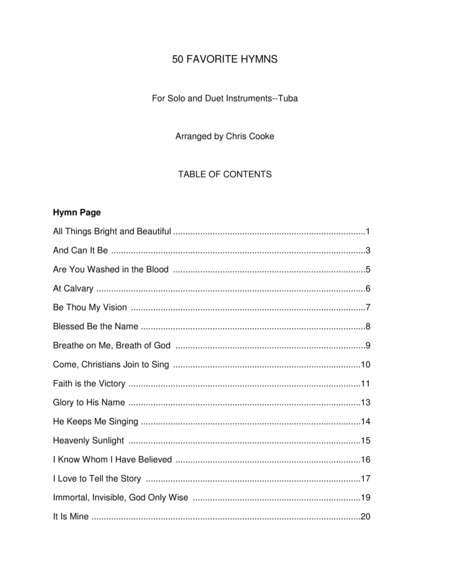
50 Favorite Hymns for Solo and Duet Instruments--Tuba
Tuba

$7.97 6.93 € Tuba PDF SheetMusicPlus

Piano Solo - Level 2 - Digital Download SKU: A0.1345127 Composed by Harry Warren and Johnny Mercer. Arranged by Phyllis Love. Film/TV,Jazz,Standards. Score. 3 pages. Phyllis Love #930061. Published by Phyllis Love (A0.1345127). On the Atchison, Topeka and the Santa Fe from The Harvey GirlsThis delightful arrangement starts off with a rhythm that evokes a train. It's harmonically interesting, with an introduction that sets in motion an exciting beat and sets up the melody nicely.Accessible enough for any intermediate performer, yet incredibly rewarding for even the most accomplished pianist. Phyllis Love's instrumental arrangements for jazz piano remain true to the original melodies, with inventive harmonies and dynamic rhythmic patterns perfect for solo players! Each is a tasty addition to your show set, whether it's a classic show tune or a Standard from the Great American Songbook.Check out these other Phyllis Love arrangements for students of jazz piano:The Breeze and IThe Last Time I Saw ParisYesterdaysYou and the Night and the MusicWe'll Be Together AgainA Nightingale Sang In Berkeley SquareFalling In Love With LoveFor All We KnowI Thought About YouI'll Remember AprilI'm Old FashionedIt Might As Well Be SpringIt's Only A Paper MoonLove Walked InMona LisaOnce In A WhileSummertimeSurrey With The Fringe On TopTenderlyThat Old Black MagicPhyllis Love is a professional jazz pianist in the New York City area who's appeared at storied venues including Windows on the World, Gramercy Park Hotel, and Mama Leone's. She's performed with the Bill Lombardo Orchestra, scored music for film (Brighty of the Grand Canyon co-composer), and written jingles for Harvey’s Bristol Crème, Estee Lauder, Seiko watches and many others.
On The Atchison, Topeka And The Santa Fe
Piano seul

$5.99 5.21 € Piano seul PDF SheetMusicPlus

Piano Solo - Level 3 - Digital Download SKU: A0.1345121 Composed by Arthur Schwartz and Howard Dietz. Arranged by Phyllis Love. Broadway,Jazz,Musical/Show,Standards. Score. 3 pages. Phyllis Love #930056. Published by Phyllis Love (A0.1345121). You and the Night and the Music from Revenge With MusicA 1934 romantic Broadway show tune that became a standard in the American Songbook. It's played here with a contrapuntal treatment and Latin flavor, while the bridge has a completely different feel with arpeggiated chords.Accessible enough for any intermediate performer, yet incredibly rewarding for even the most accomplished pianist. Phyllis Love's instrumental arrangements for jazz piano remain true to the original melodies, with inventive harmonies and dynamic rhythmic patterns perfect for solo players! Each is a tasty addition to your show set, whether it's a classic show tune or a Standard from the Great American Songbook.Check out these other Phyllis Love arrangements for students of jazz piano:The Breeze and IThe Last Time I Saw ParisYesterdaysWe'll Be Together AgainA Nightingale Sang In Berkeley SquareFalling In Love With LoveFor All We KnowI Thought About YouI'll Remember AprilI'm Old FashionedIt Might As Well Be SpringIt's Only A Paper MoonLove Walked InMona LisaOn the Atchison, Topeka and the Santa FeOnce In A WhileSummertimeSurrey With The Fringe On TopTenderlyThat Old Black MagicPhyllis Love is a professional jazz pianist in the New York City area who's appeared at storied venues including Windows on the World, Gramercy Park Hotel, and Mama Leone's. She's performed with the Bill Lombardo Orchestra, scored music for film (Brighty of the Grand Canyon co-composer), and written jingles for Harvey’s Bristol Crème, Estee Lauder, Seiko watches and many others.
You And The Night And The Music
Piano seul

$4.99 4.34 € Piano seul PDF SheetMusicPlus

Piano,Soprano Saxophone - Level 4 - Digital Download SKU: A0.533501 Composed by Ali Ben Sou Alle. Concert,Romantic Period,Standards. Score and part. 30 pages. Musik Fabrik Music Publishing #3001077. Published by Musik Fabrik Music Publishing (A0.533501). The work is divided into three large sections. An initial introduction and aria leads an Irish ballade The Last Rose of Summer which is then varied. The Valse Brillante which follows is interrupted by a reprise of the ballade before finishing with a brillant coda.One of the most enigmatic figures in the history of Wind Music, Ali Ben Sou Alle (Charles-Valentin Soualle) was born in 1820 in Arras, France. After receiving his first prize in Clarinet at the Paris Conservatory in 1844. he served as the director of music of The French Marine Band in Senegal, and then was named first clarinet solo at the Opéra-Comique in Paris. However, after the Revolution of 1848, Soualle was forced to flee France to England where he settled in London, playing in the Orchestra of the Queen's Theatre. His songs and piano pieces were published in London.While in London, Soualle met another exiled French musician, Louis Antoine Jullien, who conducted a light music series in London. Jullien encouraged Soualle to take up the saxophone, and after modifying the instrument by adding a single octave mechanism (the modern system used today) and keys for the lower register, Soualle became known as a virtuoso and began touring performing solo recitals (or mono-concerts, as they were called at the time) calling his modified saxophone the «turcophone ». He performed in all the European capitals and then traveled to Australia, New Zealand, Manilla, Java, through China and then to India where he finally settled in Mysore, becoming the director of the Royal Music for the Maharadjah. It was during this period that he converted to Islam and changed his nmae to Ali ben Sou Alle (or Ali, son of Soualle). He subsequently travaled to Ile Maurice, to French Polynesia, the Cap of Natal and the Cap of Good Hope. All of these voyages were subjects of musical works which Soualle entitled Souvenirs de... and may perhaps have been part of a collectionknown as The Royal Album which was presented to the Prince of Wales after a royal concert. Soualle returned to Mysore in 1858 and was almost killed in the Indian Revolution.Around 1860, Soualle returned to France for health reasons and began publishing his own music. On March 27 1865, he performed a command performance for the Emperor Napoleon III at the Tuileries Palace in the presence of the entire Imperial Family. After 1865, nothing more is known about him.
Ali Ben Sou Alle: Souvenirs d'Irelande for soprano saxophone and piano
Saxophone Soprano et Piano

$19.95 17.35 € Saxophone Soprano et Piano PDF SheetMusicPlus

Alto Saxophone,Piano - Level 4 - Digital Download SKU: A0.533508 Composed by Ali Ben Sou Alle. Concert,Romantic Period,Standards. Score and part. 35 pages. Musik Fabrik Music Publishing #3002551. Published by Musik Fabrik Music Publishing (A0.533508). This fantasy uses motifs from Donizetti's opera. After the opening which uses motives from the Overture, the main melody of the famous Sextet is presented. The tenor aria from the last act is presented with several vrariations. Finally, motifs form the fmaous mad scene end the work in a brilliant valse.One of the most enigmatic figures in the history of the Saxophone, Ali Ben Sou Alle (Charles-Valentin Soualle) was born in 1820 in Arras, France. After receiving his first prize in Clarinet at the Paris Conservatory in 1844. he served as the director of music of The French Marine Band in Senegal, and then was named first clarinet solo at the Opéra-Comique in Paris. However, after the Revolution of 1848, Soualle was forced to flee France to England where he settled in London, playing in the Orchestra of the Queen's Theatre. His songs and piano pieces were published in London.  While in London, Soualle met another exiled French musician, Louis Antoine Jullien, who conducted a light music series in London. Jullien encouraged Soualle to take up the saxophone, and after modifying the instrument by adding a single octave mechanism (the modern system used today) and keys for the lower register, Soualle became known as a virtuoso and began touring performing solo recitals (or mono-concerts, as they were called at the time) calling his modified saxophone the «turcophone ». He performed in all the European capitals and then traveled to Australia, New Zealand, Manilla, Java, through China and then to India where he finally settled in Mysore, becoming the director of the Royal Music for the Maharadjah. It was during this period that heconverted to Islam and changed his nmae to Ali ben Sou Alle (or Ali, son of Soualle).   He subsequently travaled to Ile Maurice, to French Polynesia, the Cap of Natal and the Cap of Good Hope. All of these voyages were subjects of musical works which Soualle entitled Souvenirs de... and may perhaps have been part of a collection known as The Royal Album which was presented to the Prince of Wales after a royal concert.  Soualle returned to Mysore in 1858 and was almost killed in the Indian Revolution.  Around 1860, Soualle returned to France for health reasons and began publishing his own music. OnMarch 27 1865, he performed a command performance for the Emperor Napoleon III at the Tuileries Palace in the presence of the entire Imperial Family. After 1865, nothing more is known about him.
Ali Ben Sou Alle: Grande Fantaisie Variée sur "Lucia di Lammermoor" for alto saxophone and piano
Saxophone Alto et Piano

$19.95 17.35 € Saxophone Alto et Piano PDF SheetMusicPlus

Mixed Percussion Bells,Boomwhackers,Handbell,Handchime,Orff Instrument,Xylophone - Level 1 - Digital Download SKU: A0.569889 By Sharon Wilson. By Arthur de Lulli. Arranged by Sharon Wilson Music. 20th Century,Children,Folk,Instructional,March. 46 pages. Sharon Wilson #6616395. Published by Sharon Wilson (A0.569889). This sheet music is notated for 8-note, C major diatonic scale (one octave) instruments with Handbells on one staff and Boomwhackers® on a second staff creating a 2-part instrumental ensemble (requires one set of each instrument). For most of the song, the Handbells play the melody while the Boomwhackers® keep a steady beat with three-note chords.The first 31 measures progress through the melody one time and can be used as a stand-alone performance. This first part of the arrangement is perfect for introducing new players to Bells and Boomwhackers®. Beginning in measure 32, the arrangement becomes more challenging by embellishing the melody, adding eighth notes, and alternating the chopstick theme between the parts. This second section utilizes more advanced note-reading and rhythmic skills and helps develop the ringing and whacking techniques needed for more advanced songs. Included in this set of scores is a combined score with both instrument parts on a grand staff plus a separate score for each instrument. A note and chord reference chart is also provided. To aid in the learning and teaching of this song or for use with other instruments (such as a Ukulele), chord names are included on the Boomwhackers® staff and score. In addition, a complete set of scores for 4 ringers and 3 whackers is provided. Though there are multiple combinations for the number of ringers and whackers needed for any given performance, this extra set of scores is specifically designed for 7 performers with 2 notes assigned to each player. For each ringer and whacker, the 1-staff score shows only the notes they are assigned. This alternate score format may be easier to sight-read since the only notes on the staff are the assigned notes allowing the player to focus on rhythm. This set of scores uses colored noteheads corresponding to the Boomwhackers® color scheme. Only filled noteheads (quarter and eighth notes) are used so the notes are full color and easier to distinguish (this does not indicate the bells need to be silenced immediately before the next beat). Also, only quarter and eighth rests are used to help visualize the number of beats per measure. Notes used for each instrument are as follows: Bells ~ C D E F G A B C* where C* is high C, one octave above middle C Boomwhackers® ~ C D E F G B Note assignment suggestions are provided. Other suggestions and uses:* have both parts played by bells or both parts played using only Boomwhackers®* form a choir using multiple sets of bells and/or Boomwhackers® * use as part of the music education for children at school, home, or church* these colorful, inexpensive instruments can be enjoyed by all ages and add a fun, unique element to activities and programs: senior centers, family reunions, church retreats, home school groupsPermission is granted to make as many copies as needed for one family, church, school, or other performing group. Please purchase additional copies for multiple groups or organizations. Boomwhackers® is a registered trademark of Rhythm Band Instruments LLC. Used by permissionVisit Sharon Wilson's website: https://www.sharonwilsonmusic.com/Subscribe to her YouTube Channel: https://youtube.com/@SharonWilsonMusicKeywords: boomwhacker, boomwacker, boomwackers, pitched percussion, tuned percussion tubes, plastic tubes, elementary classroom music
CHOPSTICKS: The Celebrated Chop Stick Waltz for 13-note Bells and Boomwhackers (Color Coded Notes)
Sharon Wilson
$10.00 8.7 € PDF SheetMusicPlus

Woodwind Ensemble,Woodwind Quartet Bassoon,Clarinet,Flute,Oboe - Level 5 - Digital Download SKU: A0.755218 Composed by Sy Brandon. 20th Century,Contemporary. 93 pages. Sy Brandon #3418979. Published by Sy Brandon (A0.755218). Divertimento is in three movements. The first movement Frolic has three main thematic ideas. The first contains dotted rhythms, staccato articulation, and meter change. The second thematic idea is related to the first in that it also uses dotted rhythms and meter change, but is more legato and begins with more sustained notes. The third thematic section is thinner in texture, more playful, and has a legato theme over a staccato background. The motivic material in each of these sections has similarities. Contrast is primarily obtained through change of style and mood. These thematic ideas develop throughout the movement by varying key, instrumentation, and melodic material. There are several sections of imitation that are very energetic. The second movement Ballad is lyrical at an Andante tempo. The form of the movement is through-composed as the motives develop into new variations instead of having clearly distinguished themes. There is however a recapitulation that brings the listen back to the opening material. The main motives that develop are a sixteenth note pattern that is arpeggiated and also stepwise, a dotted quarter and eighth note idea that is often on weak beats as well as appearing on strong beats, and scalewise eighth note lines. All of these interweave among the parts with frequent counterpoint and some imitation. The harmony is lush with seventh chords used frequently. The last movement Tarantella is in a lively tempo. The form of this movement is a large ABA(Scherzo, Trio, Scherzo). The A sections are in triple meter while the B section is in duple. The A section is in three parts, forming an ABA within the large A. The material for the first part is motivically derived. The first motive is a dotted eighth, sixteenth, eighth note followed by even eighth notes. The second motive is four chromatic sixteenth notes followed by an eighth note. This motive appears both ascending and descending. The B section within this large A consists of a slurred melodic line that has both stepwise motion and leaps. It is accompanied by staccato chromatic eighth notes. The large B section is folksong-like and is in a recognizable binary form that repeats in a new key. The large A serves as a recapitulation of the opening section and it ends lightly and playfully in keeping with the Divertimento title that means to divert or amuse.
Divertimento for Woodwind Quartet
Flûte, Hautbois, Clarinette, Basson

$14.99 13.03 € Flûte, Hautbois, Clarinette, Basson PDF SheetMusicPlus

Saxophone Quartet,Woodwind Ensemble - Level 5 - Digital Download SKU: A0.755222 Composed by Sy Brandon. 20th Century,Contemporary. 95 pages. Sy Brandon #3418983. Published by Sy Brandon (A0.755222). Divertimento is in three movements. The first movement Frolic has three main thematic ideas. The first contains dotted rhythms, staccato articulation, and meter change. The second thematic idea is related to the first in that it also uses dotted rhythms and meter change, but is more legato and begins with more sustained notes. The third thematic section is thinner in texture, more playful, and has a legato theme over a staccato background. The motivic material in each of these sections has similarities. Contrast is primarily obtained through change of style and mood. These thematic ideas develop throughout the movement by varying key, instrumentation, and melodic material. There are several sections of imitation that are very energetic. The second movement Ballad is lyrical at an Andante tempo. The form of the movement is through-composed as the motives develop into new variations instead of having clearly distinguished themes. There is however a recapitulation that brings the listen back to the opening material. The main motives that develop are a sixteenth note pattern that is arpeggiated and also stepwise, a dotted quarter and eighth note idea that is often on weak beats as well as appearing on strong beats, and scalewise eighth note lines. All of these interweave among the parts with frequent counterpoint and some imitation. The harmony is lush with seventh chords used frequently. The last movement Tarantella is in a lively tempo. The form of this movement is a large ABA(Scherzo, Trio, Scherzo). The A sections are in triple meter while the B section is in duple. The A section is in three parts, forming an ABA within the large A. The material for the first part is motivically derived. The first motive is a dotted eighth, sixteenth, eighth note followed by even eighth notes. The second motive is four chromatic sixteenth notes followed by an eighth note. This motive appears both ascending and descending. The B section within this large A consists of a slurred melodic line that has both stepwise motion and leaps. It is accompanied by staccato chromatic eighth notes. The large B section is folksong-like and is in a recognizable binary form that repeats in a new key. The large A serves as a recapitulation of the opening section and it ends lightly and playfully in keeping with the Divertimento title that means to divert or amuse.
Divertimento for Saxophone Quartet
Quatuor de Saxophones: 4 saxophones

$14.99 13.03 € Quatuor de Saxophones: 4 saxophones PDF SheetMusicPlus

Clarinet Choir,Woodwind Ensemble Bass Clarinet,Contra Alto Clarinet,E-Flat Clarinet - Level 4 - Digital Download SKU: A0.764956 Composed by Lori Archer Sutherland. Contemporary,Folk,Standards. 50 pages. Lori Archer Sutherland #4597193. Published by Lori Archer Sutherland (A0.764956). For clarinet choir (Eb, 4 Bb, Alto, Bass, Eb Contra, Bb Contra. Alternate Bb parts included for Eb and Alto. Basset horn part included (doubles Alto)).You may print multiple parts as needed for your ensemble.The Monk’s Turned Topsy-Turvy is an original fantasy for clarinet choir, based on the old French-Canadian children’s song, Ah! Si mon moine voulait danser! (Danse, mon moine, danse). The title is a play on words: moine means both monk and spinning top in French. The lyrics speak of persuading mon moine to dance by offering various articles of clothing, such as a hood or cap.After a brief, yet bold, introduction, the piece jumps into a straightforward rendition of the tune. From there, the melody is repeated, bringing in other voices and added flourishes. While the tune starts to repeat a third time, it doesn’t get to finish its full statement. It’s interrupted by a run up through the ensemble into a rollicking 7/8 section.With a rhythmic accompaniment underneath, the jaunty melody begins in the third clarinets. The upper instruments take over briefly in 6/8, then the tune returns to 7/8. After a quick breather, the accompaniment introduces an upward sweep motif. This alternates with the accompaniment pattern heard at the beginning of the 7/8 section.The lower voices then take control, driving downward into a different tonality and mood. An undulating accompaniment sets a dreamlike feel, with different voices quoting fragments of the theme. The accompaniment transfers between voices throughout the section, eventually changing back into a 3/4, then a 2/4 feel, resulting in a transition back to the original feel of the piece.The low voices get the melody, with rhythmic accompaniment and racing runs throughout the other sections. The melody goes a bit topsy-turvy before the group comes together in the descending quarter note motif from the beginning of the piece, bringing us to the coda. There’s one final quote of the opening of the main theme from the low voices, leading to a whirlwind in the first and Eb with accented notes and suspensions underneath. The Eb pipes up with one last comment and the group closes out the piece.Also available for concert band (S0.708971)
The Monk's Turned Topsy-Turvy
Ensemble de Clarinettes

$25.00 21.74 € Ensemble de Clarinettes PDF SheetMusicPlus

Piano Solo - Level 5 - Digital Download SKU: A0.1227903 By 101 String Orchestra. By Jerome Kern and Oscar Hammerstein. Arranged by Timothy Stapay. Broadway,Film/TV,Jazz,Musical/Show,Singer/Songwriter,Standards. Score. 10 pages. Timothy Stapay #823903. Published by Timothy Stapay (A0.1227903). This arrangement of The Last Time I Saw Paris is written as played by piano artist, Liberace.  It contains an introduction, by Liberace, using parts of the French song, Clair De Lune by Claude Debussy.The Last Time I Saw Paris is a song composed by Jerome Kern, with lyrics by Oscar Hammerstein II, published in 1940.  It was sung in the 1941 film Lady Be Good by Ann Sothern.By December 1940, six versions of the song were on the charts, with Kate Smith having exclusive radio rights for the song for six weeks. The song catered to a wartime nostalgia for songs about European cities following the Second World War Battle of France (which brought Paris under Nazi control), with A Nightingale Sang in Berkeley Square also proving popular.The song won the Academy Award for Best Original Song in 1941. This was Kern's second Academy Award for Best Original Song (following his success with The Way You Look Tonight in 1936), and Hammerstein's first. Władziu Valentino Liberace(May 16, 1919 – February 4, 1987) was an American pianist, singer, and actor.  A child prodigy born in Wisconsin to parents of Italian and Polish origin, he enjoyed a career spanning four decades of concerts, recordings, television, motion pictures, and endorsements. At the height of his fame from the 1950s to 1970s, he was the highest-paid entertainer in the world!Lyrics:(Verse)A lady known as ParisRomantic and charmingHas left her old companionsAnd faded from viewLonely men with lonely eyes are seeking her in vainThe streets are where they wereBut there's no sign of herShe has left the Seine(Chorus)The last time I saw ParisHer heart was warm and gayI heard the laughter of her heartIn every street cafeThe last time I saw ParisHеr trees were dressеd for springAnd lovers walked beneath those treesAnd birds had songs to singI dodged the same old taxicabsThat I had dodged for yearsThe chorus of their squeaking hornsWas music to my ears The last time I saw ParisHer heart was warm and gayNo matter how they change herI'll remember her that wayI'll think of happy hoursAnd people who shared themOld women selling flowersIn markets at dawn(Bridge)Children who applauded Punch and Judy in the parkAnd those who danced at night and kept our Paris brightTill the town went dark(Chorus)The last time I saw ParisHer heart was warm and gayI heard the laughter of her heartIn every street cafeThe last time I saw ParisHer trees were dressed for springAnd lovers walked beneath those treesAnd birds had songs to sing I dodged the same old taxicabsThat I had dodged for yearsThe chorus of their squeaking hornsWas music to my earsThe last time I saw ParisHer heart was warm and gayNo matter how they change herI'll remember her that wayI'll think of happy hoursAnd people who shared themOld women selling flowersIn markets at dawn
The Last Time I Saw Paris
Piano seul
101 String Orchestra
$8.99 7.82 € Piano seul PDF SheetMusicPlus

Oboe, clarinet, bassoon - Digital Download SKU: IZ.BCMS171 Composed by Sy Brandon. BCMCC (Bassoon Chamber Music Composition Competition). Score and Parts. 69 pages. Imagine Music - Digital #BCMS171. Published by Imagine Music - Digital (IZ.BCMS171). 9 x 12 in inches.Divertimento is in three movements. The first movement, Frolic, has three main thematic ideas. The first contains dotted rhythms, staccato articulation, and meter change. The second thematic idea is related to the first in that it also uses dotted rhythms and meter change, but is more legato and begins with more sustained notes. The third thematic section is thinner in texture, more playful, and has a legato theme over a staccato background. The motivic material in each of these sections has similarities. Contrast is primarily obtained through change of style and mood. These thematic ideas develop throughout the movement by varying key, instrumentation, and melodic material. There are several sections of imitation that are very energetic.The second movement, Ballad, is lyrical at an Andante tempo. The form of the movement is through-composed as the motives develop into new variations instead of having clearly distinguished themes. There is however a recapitulation that brings the listen back to the opening material. The main motives that develop are a sixteenth note pattern that is arpeggiated and also stepwise, a dotted quarter and eighth note idea that is often on weak beats as well as appearing on strong beats, and scalewise eighth note lines.All of these interweave among the parts with frequent counterpoint and some imitation. The harmony is lush with seventh chords used frequently.The last movement, Tarantella, is in a lively tempo. The form of this movement is a large ABA(Scherzo, Trio, Scherzo). The A sections are in triple meter while the B section is in duple. The A section is in three parts, forming an ABA within the large A. The material for the first part is motivically derived. The first motive is a dotted eighth, sixteenth, eighth note followed by even eighth notes. The second motive is four chromatic sixteenth notes followed by an eighth note. This motive appears both ascending and descending. The B section within this large A consists of a slurred melodic line that has both stepwise motion and leaps. It is accompanied by staccato chromatic eighth notes. The large B section is folksong-like and is in a recognizable binary form that repeats in a new key. The large A serves as a recapitulation of the opening section and it ends lightly and playfully in keeping with the Divertimento title that means to divert or amuse.
Divertimento

$32.00 27.83 € PDF SheetMusicPlus

Brass Ensemble - Level 5 - Digital Download SKU: A0.767421 Composed by Mike Lyons. Concert,Contemporary,Standards. Score and parts. 73 pages. Lyons Music Services #3860115. Published by Lyons Music Services (A0.767421). Titans:  This is a piece inspired by the mythological Titans, who were deposed by the Greek God Zeus, who exiled them and founded the Olympian tradition. The titans were created by the mating of Uranus (Heaven) and Gaea (the Earth). Gaea and Uranus were themselves created from Chaos (the Void). There were many Titans. Cronus, often mistaken for the god of time, was their leader, their brother and the father of their children. Cronus mated with his sister Rhea to produce the gods Zeus, Hades and Poseidon.  Cronus was given a prophecy that he would be deposed by his children, so he forced Rhea to give her children to him when they were born whereupon he ate them. She managed to deceive him and hid Zeus, the youngest male child, away. Zeus eventually freed his siblings, by making Cronus vomit to bring them back to the world and thus he became the oldest. The other gods were persuaded to make Zeus their leader and together they deposed Cronus and defeated the Titans in a war (the Titanomachy) that lasted for many years. Zeus and the other gods were not able to kill Cronus, so he exiled him and all of the other Titans in a place called Tartarus, which was part of the underworld, where Cronus would have no access to power of any kind. The music is based mostly on the opening chords, which recur again and again, representing Tartarus and also Cronus and all of his children in one form or another. Melodic material throughout is shaped by the chords and their progressions and I have applied simple transformations – for example, in the last section I have shaped the motifs by applying a snippet of a Fibonacci sequence and overlaying the result in different parts like a canon. I decided to use this because the Fibonacci sequence is representative of nature and the growth of life so it links to Gaea, who represents the creative force. Obviously, Cronus, Gaea, Chaos, Zeus, Hades, Poseidon and Tartarus are all represented here, but so too are Oceanus, Phoebe, Mnemosyne and The Titanomachy (The war of the Olympians against the Titans). The piece finishes with a reprise of the opening chords, which have transformed into a less bleak soundscape, with Cronus and the other Titans safely locked away in Tartarus.This is a difficult and challenging piece demanding a high level of skill from all players. it uses a number of dramatic effects and will stretch any ensemble.I am looking into making a version of this piece for Brass Quintet.Watch te score playing here https://www.youtube.com/watch?v=2w7dUmJh5k4
Brass Quartet - Titans
Ensemble de cuivres

$20.00 17.39 € Ensemble de cuivres PDF SheetMusicPlus


Partitions Gratuites
Acheter des Partitions Musicales
Acheter des Partitions Digitales à Imprimer
Acheter des Instruments de Musique

© 2000 - 2026

Accueil - Version intégrale





