EUROPE
1099 articles
USA
0 articles
DIGITAL
3582 articles (à imprimer)
Partitions Digitales
Partitions à imprimer
3582 partitions trouvées

1 ....61 76 91 106 121 ....3571

Bass Flute,Instrumental Solo,Piano - Level 1 - Digital Download SKU: A0.548690 Composed by Franz Schubert. Arranged by James M. Guthrie, ASCAP. Christmas,Easter,Standards. Score and individual part. 4 pages. Jmsgu3 #3411129. Published by jmsgu3 (A0.548690). A Bass Flute Christmas/Easter classic! Duration: 4:55 Score: 3 pg. Bass Flute part: 1 pg. Piano reads from the score. Schubert seems to have composed this piece as a song-setting. This is because he wanted to portray a poignant emotional event from a poem. The poem was Walter Scott's The Lady of the Lake. Consequently, this song became an integral part of Schubert's Song cycle. Therefore the cycle is called: the Lady of the Lake. In the poem, Ellen Douglas is the Lady of the Lake. The lake is probably Loch Katrine in the Scottish Highlands. First of all, Ellen goes with her father to stay in the Goblin's cave. They go because he earlier refused to join in a rebellion against King James. Roderick Dhu, the chief of the rebellious Alpine Clan, marches up the mountain with his army. But before the battle, he, first of all, hears Ellen singing. She is singing a prayer calling for help from the Virgin Mary. Schubert's piece was first performed at the castle of Countess Sophie Weissenwolff in Steyregg, Austria.  Schubert dedicated the arrangement to her, and as a result, she became famous as the lady of the lake.The incipit of Ellen's song is Ave Maria which is Latin for Hail Mary. It seems like this similarity led Schubert to adapt the melody to accommodate the Roman Catholic prayer Ave Maria. Consequently, the Latin version of Ave Maria finally became more famous than the original so that consequently many believe he wrote the Latin version first. Schubert Franz Schubert (1797–1828) was, in fact, a famous Austrian composer. Moreover, he composed during the late Classical and early Romantic periods. Schubert was comparatively prolific. He wrote more than 600 secular vocal works, seven symphonies, and, correspondingly, a massive amount of piano and chamber music. Critics agree, as a matter of fact, that his most famous works include his Piano Quintet in A major, D. 667 (also known as the Trout Quintet), the Symphony No. 8 in B minor, D. 759 (Unfinished Symphony), the last sonatas for piano (D. 958–960), and the song cycles Die schöne Müllerin (D. 795) and Winterreise (D. 911). Education Schubert was furthermore a musical child prodigy. He studied violin with his father as well as piano with his older brother. In addition, when Schubert was eleven he studied at Stadtkonvikt school, where he became familiar with the orchestral music of Haydn, Mozart, and likewise Beethoven. In due time he left school and returned home where he studied to become an educator; nevertheless, he continued studying composition with Antonio Salieri. Performance Eventually, Schubert was admitted to the Gesellschaft der Musikfreunde as a performer. This appointment straightaway established his name in Vienna as a composer and pianist. Finally, he gave his only composition recital in 1828. He died suddenly a few months later probably due to typhoid fever. Legacy Schubert’s music was by and large underappreciated while he was alive. There were all in all only a few enthusiasts in Vienna. After he died, however, interest in his work in fact increased. Felix Mendelssohn, Robert Schumann, Franz Liszt, Johannes Brahms and other famous composers in due time discovered his compositions. Nowadays, historians rank Schubert expressly among the greatest composers of the era, and his music remains in general very popular.
Schubert: Ave Maria for Bass Flute & Piano

$29.95 26.04 € PDF SheetMusicPlus

Baritone Saxophone,Piano - Level 1 - Digital Download SKU: A0.548692 Composed by Franz Schubert. Arranged by James M. Guthrie, ASCAP. Christmas,Easter,Standards. Score and part. 4 pages. Jmsgu3 #3411133. Published by jmsgu3 (A0.548692). A Baritone Sax Christmas/Easter classic! Duration: 4:55 Score: 3 pg. Baritone Sax part: 1 pg. Piano reads from the score. Schubert seems to have composed this piece as a song-setting. This is because he wanted to portray a poignant emotional event from a poem. The poem was Walter Scott's The Lady of the Lake. Consequently, this song became an integral part of Schubert's Song cycle. Therefore the cycle is called: the Lady of the Lake. In the poem, Ellen Douglas is the Lady of the Lake. The lake is probably Loch Katrine in the Scottish Highlands. First of all, Ellen goes with her father to stay in the Goblin's cave. They go because he earlier refused to join in a rebellion against King James. Roderick Dhu, the chief of the rebellious Alpine Clan, marches up the mountain with his army. But before the battle, he, first of all, hears Ellen singing. She is singing a prayer calling for help from the Virgin Mary. Schubert's piece was first performed at the castle of Countess Sophie Weissenwolff in Steyregg, Austria.  Schubert dedicated the arrangement to her, and as a result, she became famous as the lady of the lake.The incipit of Ellen's song is Ave Maria which is Latin for Hail Mary. It seems like this similarity led Schubert to adapt the melody to accommodate the Roman Catholic prayer Ave Maria. Consequently, the Latin version of Ave Maria finally became more famous than the original so that consequently many believe he wrote the Latin version first. Schubert Franz Schubert (1797–1828) was, in fact, a famous Austrian composer. Moreover, he composed during the late Classical and early Romantic periods. Schubert was comparatively prolific. He wrote more than 600 secular vocal works, seven symphonies, and, correspondingly, a massive amount of piano and chamber music. Critics agree, as a matter of fact, that his most famous works include his Piano Quintet in A major, D. 667 (also known as the Trout Quintet), the Symphony No. 8 in B minor, D. 759 (Unfinished Symphony), the last sonatas for piano (D. 958–960), and the song cycles Die schöne Müllerin (D. 795) and Winterreise (D. 911). Education Schubert was furthermore a musical child prodigy. He studied violin with his father as well as piano with his older brother. In addition, when Schubert was eleven he studied at Stadtkonvikt school, where he became familiar with the orchestral music of Haydn, Mozart, and likewise Beethoven. In due time he left school and returned home where he studied to become an educator; nevertheless, he continued studying composition with Antonio Salieri. Performance Eventually, Schubert was admitted to the Gesellschaft der Musikfreunde as a performer. This appointment straightaway established his name in Vienna as a composer and pianist. Finally, he gave his only composition recital in 1828. He died suddenly a few months later probably due to typhoid fever. Legacy Schubert’s music was by and large underappreciated while he was alive. There were all in all only a few enthusiasts in Vienna. After he died, however, interest in his work in fact increased. Felix Mendelssohn, Robert Schumann, Franz Liszt, Johannes Brahms and other famous composers in due time discovered his compositions. Nowadays, historians rank Schubert expressly among the greatest composers of the era, and his music remains in general very popular.
Schubert: Ave Maria for Baritone Sax & Piano
Saxophone Baryton, Piano

$29.95 26.04 € Saxophone Baryton, Piano PDF SheetMusicPlus

Baritone Horn TC,Euphonium,Piano - Level 1 - Digital Download SKU: A0.552828 Composed by Franz Schubert. Arranged by James M. Guthrie, ASCAP. Christmas,Easter,Standards. Score and part. 4 pages. Jmsgu3 #3411131. Published by jmsgu3 (A0.552828). A Baritone Horn Christmas/Easter classic! Duration: 4:55 Score: 3 pg. Baritone Horn part: 1 pg. Piano reads from the score. Schubert seems to have composed this piece as a song-setting. This is because he wanted to portray a poignant emotional event from a poem. The poem was Walter Scott's The Lady of the Lake. Consequently, this song became an integral part of Schubert's Song cycle. Therefore the cycle is called: the Lady of the Lake. In the poem, Ellen Douglas is the Lady of the Lake. The lake is probably Loch Katrine in the Scottish Highlands. First of all, Ellen goes with her father to stay in the Goblin's cave. They go because he earlier refused to join in a rebellion against King James. Roderick Dhu, the chief of the rebellious Alpine Clan, marches up the mountain with his army. But before the battle, he, first of all, hears Ellen singing. She is singing a prayer calling for help from the Virgin Mary. Schubert's piece was first performed at the castle of Countess Sophie Weissenwolff in Steyregg, Austria.  Schubert dedicated the arrangement to her, and as a result, she became famous as the lady of the lake.The incipit of Ellen's song is Ave Maria which is Latin for Hail Mary. It seems like this similarity led Schubert to adapt the melody to accommodate the Roman Catholic prayer Ave Maria. Consequently, the Latin version of Ave Maria finally became more famous than the original so that consequently many believe he wrote the Latin version first. Schubert Franz Schubert (1797–1828) was, in fact, a famous Austrian composer. Moreover, he composed during the late Classical and early Romantic periods. Schubert was comparatively prolific. He wrote more than 600 secular vocal works, seven symphonies, and, correspondingly, a massive amount of piano and chamber music. Critics agree, as a matter of fact, that his most famous works include his Piano Quintet in A major, D. 667 (also known as the Trout Quintet), the Symphony No. 8 in B minor, D. 759 (Unfinished Symphony), the last sonatas for piano (D. 958–960), and the song cycles Die schöne Müllerin (D. 795) and Winterreise (D. 911). Education Schubert was furthermore a musical child prodigy. He studied violin with his father as well as piano with his older brother. In addition, when Schubert was eleven he studied at Stadtkonvikt school, where he became familiar with the orchestral music of Haydn, Mozart, and likewise Beethoven. In due time he left school and returned home where he studied to become an educator; nevertheless, he continued studying composition with Antonio Salieri. Performance Eventually, Schubert was admitted to the Gesellschaft der Musikfreunde as a performer. This appointment straightaway established his name in Vienna as a composer and pianist. Finally, he gave his only composition recital in 1828. He died suddenly a few months later probably due to typhoid fever. Legacy Schubert’s music was by and large underappreciated while he was alive. There were all in all only a few enthusiasts in Vienna. After he died, however, interest in his work in fact increased. Felix Mendelssohn, Robert Schumann, Franz Liszt, Johannes Brahms and other famous composers in due time discovered his compositions. Nowadays, historians rank Schubert expressly among the greatest composers of the era, and his music remains in general very popular.
Schubert: Ave Maria for Baritone Horn & Piano

$29.95 26.04 € PDF SheetMusicPlus

Piano,Viola - Level 1 - Digital Download SKU: A0.548704 Composed by Franz Schubert. Arranged by James M. Guthrie, ASCAP. Christmas,Easter,Standards. Score and part. 4 pages. Jmsgu3 #3411159. Published by jmsgu3 (A0.548704). A Viola Christmas/Easter classic! Duration: 4:55 Score: 3 pg. Viola part: 1 pg. Piano reads from the score. Schubert seems to have composed this piece as a song-setting. This is because he wanted to portray a poignant emotional event from a poem. The poem was Walter Scott's The Lady of the Lake. Consequently, this song became an integral part of Schubert's Song cycle. Therefore the cycle is called: the Lady of the Lake. In the poem, Ellen Douglas is the Lady of the Lake. The lake is probably Loch Katrine in the Scottish Highlands. First of all, Ellen goes with her father to stay in the Goblin's cave. They go because he earlier refused to join in a rebellion against King James. Roderick Dhu, the chief of the rebellious Alpine Clan, marches up the mountain with his army. But before the battle, he, first of all, hears Ellen singing. She is singing a prayer calling for help from the Virgin Mary. Schubert's piece was first performed at the castle of Countess Sophie Weissenwolff in Steyregg, Austria.  Schubert dedicated the arrangement to her, and as a result, she became famous as the lady of the lake.The incipit of Ellen's song is Ave Maria which is Latin for Hail Mary. It seems like this similarity led Schubert to adapt the melody to accommodate the Roman Catholic prayer Ave Maria. Consequently, the Latin version of Ave Maria finally became more famous than the original so that consequently many believe he wrote the Latin version first. Schubert Franz Schubert (1797–1828) was, in fact, a famous Austrian composer. Moreover, he composed during the late Classical and early Romantic periods. Schubert was comparatively prolific. He wrote more than 600 secular vocal works, seven symphonies, and, correspondingly, a massive amount of piano and chamber music. Critics agree, as a matter of fact, that his most famous works include his Piano Quintet in A major, D. 667 (also known as the Trout Quintet), the Symphony No. 8 in B minor, D. 759 (Unfinished Symphony), the last sonatas for piano (D. 958–960), and the song cycles Die schöne Müllerin (D. 795) and Winterreise (D. 911). Education Schubert was furthermore a musical child prodigy. He studied violin with his father as well as piano with his older brother. In addition, when Schubert was eleven he studied at Stadtkonvikt school, where he became familiar with the orchestral music of Haydn, Mozart, and likewise Beethoven. In due time he left school and returned home where he studied to become an educator; nevertheless, he continued studying composition with Antonio Salieri. Performance Eventually, Schubert was admitted to the Gesellschaft der Musikfreunde as a performer. This appointment straightaway established his name in Vienna as a composer and pianist. Finally, he gave his only composition recital in 1828. He died suddenly a few months later probably due to typhoid fever. Legacy Schubert’s music was by and large underappreciated while he was alive. There were all in all only a few enthusiasts in Vienna. After he died, however, interest in his work in fact increased. Felix Mendelssohn, Robert Schumann, Franz Liszt, Johannes Brahms and other famous composers in due time discovered his compositions. Nowadays, historians rank Schubert expressly among the greatest composers of the era, and his music remains in general very popular.  
Schubert: Ave Maria for Viola & Piano
Alto, Piano

$29.95 26.04 € Alto, Piano PDF SheetMusicPlus

Piano,Violin - Level 1 - Digital Download SKU: A0.548703 Composed by Franz Schubert. Arranged by James M. Guthrie, ASCAP. Christmas,Easter,Standards. 4 pages. Jmsgu3 #3411155. Published by jmsgu3 (A0.548703). A Violin Christmas/Easter classic! Duration: 4:55 Score: 3 pg. Violin part: 1 pg. Piano reads from the score. Schubert seems to have composed this piece as a song-setting. This is because he wanted to portray a poignant emotional event from a poem. The poem was Walter Scott's The Lady of the Lake. Consequently, this song became an integral part of Schubert's Song cycle. Therefore the cycle is called: the Lady of the Lake. In the poem, Ellen Douglas is the Lady of the Lake. The lake is probably Loch Katrine in the Scottish Highlands. First of all, Ellen goes with her father to stay in the Goblin's cave. They go because he earlier refused to join in a rebellion against King James. Roderick Dhu, the chief of the rebellious Alpine Clan, marches up the mountain with his army. But before the battle, he, first of all, hears Ellen singing. She is singing a prayer calling for help from the Virgin Mary. Schubert's piece was first performed at the castle of Countess Sophie Weissenwolff in Steyregg, Austria.  Schubert dedicated the arrangement to her, and as a result, she became famous as the lady of the lake.The incipit of Ellen's song is Ave Maria which is Latin for Hail Mary. It seems like this similarity led Schubert to adapt the melody to accommodate the Roman Catholic prayer Ave Maria. Consequently, the Latin version of Ave Maria finally became more famous than the original so that consequently many believe he wrote the Latin version first. Schubert Franz Schubert (1797–1828) was, in fact, a famous Austrian composer. Moreover, he composed during the late Classical and early Romantic periods. Schubert was comparatively prolific. He wrote more than 600 secular vocal works, seven symphonies, and, correspondingly, a massive amount of piano and chamber music. Critics agree, as a matter of fact, that his most famous works include his Piano Quintet in A major, D. 667 (also known as the Trout Quintet), the Symphony No. 8 in B minor, D. 759 (Unfinished Symphony), the last sonatas for piano (D. 958–960), and the song cycles Die schöne Müllerin (D. 795) and Winterreise (D. 911). Education Schubert was furthermore a musical child prodigy. He studied violin with his father as well as piano with his older brother. In addition, when Schubert was eleven he studied at Stadtkonvikt school, where he became familiar with the orchestral music of Haydn, Mozart, and likewise Beethoven. In due time he left school and returned home where he studied to become an educator; nevertheless, he continued studying composition with Antonio Salieri. Performance Eventually, Schubert was admitted to the Gesellschaft der Musikfreunde as a performer. This appointment straightaway established his name in Vienna as a composer and pianist. Finally, he gave his only composition recital in 1828. He died suddenly a few months later probably due to typhoid fever. Legacy Schubert’s music was by and large underappreciated while he was alive. There were all in all only a few enthusiasts in Vienna. After he died, however, interest in his work in fact increased. Felix Mendelssohn, Robert Schumann, Franz Liszt, Johannes Brahms and other famous composers in due time discovered his compositions. Nowadays, historians rank Schubert expressly among the greatest composers of the era, and his music remains in general very popular.  
Schubert: Ave Maria for Violin & Piano
Violon et Piano

$29.95 26.04 € Violon et Piano PDF SheetMusicPlus

Flute,Piano - Level 1 - Digital Download SKU: A0.548688 Composed by Franz Schubert. Arranged by James M. Guthrie, ASCAP. Christmas,Easter,Standards. Score and part. 4 pages. Jmsgu3 #3411123. Published by jmsgu3 (A0.548688). An Alto Flute Christmas/Easter classic! Duration: 4:55 Score: 3 pg. Alto Flute part: 1 pg. Piano reads from the score. Schubert seems to have composed this piece as a song-setting. This is because he wanted to portray a poignant emotional event from a poem. The poem was Walter Scott's The Lady of the Lake. Consequently, this song became an integral part of Schubert's Song cycle. Therefore the cycle is called: the Lady of the Lake. In the poem, Ellen Douglas is the Lady of the Lake. The lake is probably Loch Katrine in the Scottish Highlands. First of all, Ellen goes with her father to stay in the Goblin's cave. They go because he earlier refused to join in a rebellion against King James. Roderick Dhu, the chief of the rebellious Alpine Clan, marches up the mountain with his army. But before the battle, he, first of all, hears Ellen singing. She is singing a prayer calling for help from the Virgin Mary. Schubert's piece was first performed at the castle of Countess Sophie Weissenwolff in Steyregg, Austria.  Schubert dedicated the arrangement to her, and as a result, she became famous as the lady of the lake.The incipit of Ellen's song is Ave Maria which is Latin for Hail Mary. It seems like this similarity led Schubert to adapt the melody to accommodate the Roman Catholic prayer Ave Maria. Consequently, the Latin version of Ave Maria finally became more famous than the original so that consequently many believe he wrote the Latin version first. Schubert Franz Schubert (1797–1828) was, in fact, a famous Austrian composer. Moreover, he composed during the late Classical and early Romantic periods. Schubert was comparatively prolific. He wrote more than 600 secular vocal works, seven symphonies, and, correspondingly, a massive amount of piano and chamber music. Critics agree, as a matter of fact, that his most famous works include his Piano Quintet in A major, D. 667 (also known as the Trout Quintet), the Symphony No. 8 in B minor, D. 759 (Unfinished Symphony), the last sonatas for piano (D. 958–960), and the song cycles Die schöne Müllerin (D. 795) and Winterreise (D. 911). Education Schubert was furthermore a musical child prodigy. He studied violin with his father as well as piano with his older brother. In addition, when Schubert was eleven he studied at Stadtkonvikt school, where he became familiar with the orchestral music of Haydn, Mozart, and likewise Beethoven. In due time he left school and returned home where he studied to become an educator; nevertheless, he continued studying composition with Antonio Salieri. Performance Eventually, Schubert was admitted to the Gesellschaft der Musikfreunde as a performer. This appointment straightaway established his name in Vienna as a composer and pianist. Finally, he gave his only composition recital in 1828. He died suddenly a few months later probably due to typhoid fever. Legacy Schubert’s music was by and large underappreciated while he was alive. There were all in all only a few enthusiasts in Vienna. After he died, however, interest in his work in fact increased. Felix Mendelssohn, Robert Schumann, Franz Liszt, Johannes Brahms and other famous composers in due time discovered his compositions. Nowadays, historians rank Schubert expressly among the greatest composers of the era, and his music remains in general very popular.
Schubert: Ave Maria for Alto Flute & Piano
Flûte traversière et Piano

$29.95 26.04 € Flûte traversière et Piano PDF SheetMusicPlus

Bass Clarinet,Piano - Level 1 - Digital Download SKU: A0.548691 Composed by Franz Schubert. Arranged by James M. Guthrie, ASCAP. Christmas,Easter,Standards. Score and part. 4 pages. Jmsgu3 #3411127. Published by jmsgu3 (A0.548691). A Bass Clarinet Christmas/Easter classic! Duration: 4:55 Score: 3 pg. Bass Clarinet part: 1 pg. Piano reads from the score. Schubert seems to have composed this piece as a song-setting. This is because he wanted to portray a poignant emotional event from a poem. The poem was Walter Scott's The Lady of the Lake. Consequently, this song became an integral part of Schubert's Song cycle. Therefore the cycle is called: the Lady of the Lake. In the poem, Ellen Douglas is the Lady of the Lake. The lake is probably Loch Katrine in the Scottish Highlands. First of all, Ellen goes with her father to stay in the Goblin's cave. They go because he earlier refused to join in a rebellion against King James. Roderick Dhu, the chief of the rebellious Alpine Clan, marches up the mountain with his army. But before the battle, he, first of all, hears Ellen singing. She is singing a prayer calling for help from the Virgin Mary. Schubert's piece was first performed at the castle of Countess Sophie Weissenwolff in Steyregg, Austria.  Schubert dedicated the arrangement to her, and as a result, she became famous as the lady of the lake.The incipit of Ellen's song is Ave Maria which is Latin for Hail Mary. It seems like this similarity led Schubert to adapt the melody to accommodate the Roman Catholic prayer Ave Maria. Consequently, the Latin version of Ave Maria finally became more famous than the original so that consequently many believe he wrote the Latin version first. Schubert Franz Schubert (1797–1828) was, in fact, a famous Austrian composer. Moreover, he composed during the late Classical and early Romantic periods. Schubert was comparatively prolific. He wrote more than 600 secular vocal works, seven symphonies, and, correspondingly, a massive amount of piano and chamber music. Critics agree, as a matter of fact, that his most famous works include his Piano Quintet in A major, D. 667 (also known as the Trout Quintet), the Symphony No. 8 in B minor, D. 759 (Unfinished Symphony), the last sonatas for piano (D. 958–960), and the song cycles Die schöne Müllerin (D. 795) and Winterreise (D. 911). Education Schubert was furthermore a musical child prodigy. He studied violin with his father as well as piano with his older brother. In addition, when Schubert was eleven he studied at Stadtkonvikt school, where he became familiar with the orchestral music of Haydn, Mozart, and likewise Beethoven. In due time he left school and returned home where he studied to become an educator; nevertheless, he continued studying composition with Antonio Salieri. Performance Eventually, Schubert was admitted to the Gesellschaft der Musikfreunde as a performer. This appointment straightaway established his name in Vienna as a composer and pianist. Finally, he gave his only composition recital in 1828. He died suddenly a few months later probably due to typhoid fever. Legacy Schubert’s music was by and large underappreciated while he was alive. There were all in all only a few enthusiasts in Vienna. After he died, however, interest in his work in fact increased. Felix Mendelssohn, Robert Schumann, Franz Liszt, Johannes Brahms and other famous composers in due time discovered his compositions. Nowadays, historians rank Schubert expressly among the greatest composers of the era, and his music remains in general very popular.  
Schubert: Ave Maria for Bass Clarinet & Piano
Clarinette Basse, Piano

$29.95 26.04 € Clarinette Basse, Piano PDF SheetMusicPlus

Piano,Tenor Saxophone - Level 1 - Digital Download SKU: A0.548700 Composed by Franz Schubert. Arranged by James M. Guthrie, ASCAP. Christmas,Easter,Standards. Score and part. 4 pages. Jmsgu3 #3411149. Published by jmsgu3 (A0.548700). A Tenor Sax Christmas/Easter classic! Duration: 4:55 Score: 3 pg. Alto Flute part: 1 pg. Piano reads from the score. Schubert seems to have composed this piece as a song-setting. This is because he wanted to portray a poignant emotional event from a poem. The poem was Walter Scott's The Lady of the Lake. Consequently, this song became an integral part of Schubert's Song cycle. Therefore the cycle is called: the Lady of the Lake. In the poem, Ellen Douglas is the Lady of the Lake. The lake is probably Loch Katrine in the Scottish Highlands. First of all, Ellen goes with her father to stay in the Goblin's cave. They go because he earlier refused to join in a rebellion against King James. Roderick Dhu, the chief of the rebellious Alpine Clan, marches up the mountain with his army. But before the battle, he, first of all, hears Ellen singing. She is singing a prayer calling for help from the Virgin Mary. Schubert's piece was first performed at the castle of Countess Sophie Weissenwolff in Steyregg, Austria.  Schubert dedicated the arrangement to her, and as a result, she became famous as the lady of the lake.The incipit of Ellen's song is Ave Maria which is Latin for Hail Mary. It seems like this similarity led Schubert to adapt the melody to accommodate the Roman Catholic prayer Ave Maria. Consequently, the Latin version of Ave Maria finally became more famous than the original so that consequently many believe he wrote the Latin version first. Schubert Franz Schubert (1797–1828) was, in fact, a famous Austrian composer. Moreover, he composed during the late Classical and early Romantic periods. Schubert was comparatively prolific. He wrote more than 600 secular vocal works, seven symphonies, and, correspondingly, a massive amount of piano and chamber music. Critics agree, as a matter of fact, that his most famous works include his Piano Quintet in A major, D. 667 (also known as the Trout Quintet), the Symphony No. 8 in B minor, D. 759 (Unfinished Symphony), the last sonatas for piano (D. 958–960), and the song cycles Die schöne Müllerin (D. 795) and Winterreise (D. 911). Education Schubert was furthermore a musical child prodigy. He studied violin with his father as well as piano with his older brother. In addition, when Schubert was eleven he studied at Stadtkonvikt school, where he became familiar with the orchestral music of Haydn, Mozart, and likewise Beethoven. In due time he left school and returned home where he studied to become an educator; nevertheless, he continued studying composition with Antonio Salieri. Performance Eventually, Schubert was admitted to the Gesellschaft der Musikfreunde as a performer. This appointment straightaway established his name in Vienna as a composer and pianist. Finally, he gave his only composition recital in 1828. He died suddenly a few months later probably due to typhoid fever. Legacy Schubert’s music was by and large underappreciated while he was alive. There were all in all only a few enthusiasts in Vienna. After he died, however, interest in his work in fact increased. Felix Mendelssohn, Robert Schumann, Franz Liszt, Johannes Brahms and other famous composers in due time discovered his compositions. Nowadays, historians rank Schubert expressly among the greatest composers of the era, and his music remains in general very popular.
Schubert: Ave Maria for Tenor Sax & Piano
Saxophone Tenor et Piano

$29.95 26.04 € Saxophone Tenor et Piano PDF SheetMusicPlus

Piano,Trombone - Level 1 - Digital Download SKU: A0.548699 Composed by Franz Schubert. Arranged by James M. Guthrie, ASCAP. Christmas,Easter,Standards. Score and part. 4 pages. Jmsgu3 #3411147. Published by jmsgu3 (A0.548699). A Trombone Christmas/Easter classic! Duration: 4:55 Score: 3 pg. Trombone part: 1 pg. Piano reads from the score. Schubert seems to have composed this piece as a song-setting. This is because he wanted to portray a poignant emotional event from a poem. The poem was Walter Scott's The Lady of the Lake. Consequently, this song became an integral part of Schubert's Song cycle. Therefore the cycle is called: the Lady of the Lake. In the poem, Ellen Douglas is the Lady of the Lake. The lake is probably Loch Katrine in the Scottish Highlands. First of all, Ellen goes with her father to stay in the Goblin's cave. They go because he earlier refused to join in a rebellion against King James. Roderick Dhu, the chief of the rebellious Alpine Clan, marches up the mountain with his army. But before the battle, he, first of all, hears Ellen singing. She is singing a prayer calling for help from the Virgin Mary. Schubert's piece was first performed at the castle of Countess Sophie Weissenwolff in Steyregg, Austria.  Schubert dedicated the arrangement to her, and as a result, she became famous as the lady of the lake.The incipit of Ellen's song is Ave Maria which is Latin for Hail Mary. It seems like this similarity led Schubert to adapt the melody to accommodate the Roman Catholic prayer Ave Maria. Consequently, the Latin version of Ave Maria finally became more famous than the original so that consequently many believe he wrote the Latin version first. Schubert Franz Schubert (1797–1828) was, in fact, a famous Austrian composer. Moreover, he composed during the late Classical and early Romantic periods. Schubert was comparatively prolific. He wrote more than 600 secular vocal works, seven symphonies, and, correspondingly, a massive amount of piano and chamber music. Critics agree, as a matter of fact, that his most famous works include his Piano Quintet in A major, D. 667 (also known as the Trout Quintet), the Symphony No. 8 in B minor, D. 759 (Unfinished Symphony), the last sonatas for piano (D. 958–960), and the song cycles Die schöne Müllerin (D. 795) and Winterreise (D. 911). Education Schubert was furthermore a musical child prodigy. He studied violin with his father as well as piano with his older brother. In addition, when Schubert was eleven he studied at Stadtkonvikt school, where he became familiar with the orchestral music of Haydn, Mozart, and likewise Beethoven. In due time he left school and returned home where he studied to become an educator; nevertheless, he continued studying composition with Antonio Salieri. Performance Eventually, Schubert was admitted to the Gesellschaft der Musikfreunde as a performer. This appointment straightaway established his name in Vienna as a composer and pianist. Finally, he gave his only composition recital in 1828. He died suddenly a few months later probably due to typhoid fever. Legacy Schubert’s music was by and large underappreciated while he was alive. There were all in all only a few enthusiasts in Vienna. After he died, however, interest in his work in fact increased. Felix Mendelssohn, Robert Schumann, Franz Liszt, Johannes Brahms and other famous composers in due time discovered his compositions. Nowadays, historians rank Schubert expressly among the greatest composers of the era, and his music remains in general very popular.  
Schubert: Ave Maria for Trombone & Piano
Trombone et Piano

$29.95 26.04 € Trombone et Piano PDF SheetMusicPlus

Woodwind Ensemble,Woodwind Quintet Bassoon - Level 1 - Digital Download SKU: A0.957292 Composed by Bach, Martin Luther. Arranged by Ander. Baroque,Easter,Renaissance,Sacred,Wedding. 51 pages. Woods Only, Arrangements #6748239. Published by Woods Only, Arrangements (A0.957292). This album contains 5 of Johann Sebastian Bach's most famous and versatile pieces for bassoon quintet, all very well suited for the beginners who want to get to know the baroque repertoire. They are also suitable for performances at events such as: weddings, Christian and church ceremonies, Easter, and academic recitals or concerts. They can be used in music institutions and by teachers as repertoire material and study methods, either for performance or instrumental technique. This collection includes a totally free bonus for you to enjoy: Martin Luther's A Mighty Fortress is Our God, a Renaissance sacred song for choir, which has been adapted for this set. You can also buy each one individually by checking right at the end of each description of each work.1: Air on the G String - The original piece is part of Johann Sebastian Bach's Suite No. 3 for orchestra, in D Major, BWV 1068, written for Prince Leopold of Anhalt. The so-called Air on the G String dates from one of these latter employments. In the service of the Prince of Cöthen, Bach composed not only the famous Brandenburg Concertos, but also several orchestral suites, from the third of which comes the Air on the G String. This curious title derives from a later arrangement of this piece for violin solo, in which the melody is played entirely on the lower, higher string of the instrument. ID: S0.11897552: Arioso - The Cantata 156 (BWV 156) was written for the third Sunday after Epiphany in 1729, and was first performed on January 23 of that year. The text is by Picander, one of Bach's favorite librettists. Of the four cantatas written by Bach for the feast, it was the last and only one scored for solo voice. This is a choral cantata, employing a choral melody in several movements. Cantata 156, in fact, employs two different choral melodies and texts in the second and sixth movements. A cantata is a sung symphony consisting of several parts, one of which is the Arioso, which is the initial instrumental part. ID: S0.11899753: Jesu, joy of man's desiring - This is one of Bach's most beautiful cantatas, made famous by the Jesus the Joy of Men chorus. It was originally composed for Advent 1716 in Weimar. Years later, already in Leipzig, Advent was tempus clausum, there was no music in the churches. Bach then reworked it for the Feast of Mary's Visitation. It is the final chorale of the cantata Herz und Mund und Tat und Leben. Although it is the 32nd cantata composed by Bach, of those that have survived, it was given BWV 147 in the complete catalog of his works. ID: S0.11900254: O Jesulein süss, o Jesulein mild - The Jesulein süß, the Jesulein mild is an original traditional German choral melody for voice and continuous bass arranged by Johann Sebastian Bach around 1735. With lyrics by Valentin Thilo, O Jesulein süss is a sacred melody adapted and catalogued as BWV 493. The first translation is by Dirk van Hogendorp, who made it more of a song for the time of suffering. ID: S0.11901515: Minuet in G major - This famous piece has traditionally been attributed to Johann Sebastian Bach, as it appears in the Notebook for Anna Magdalena , a notebook that Bach gave to his wife Anna Magdalena in 1725 and which was to be filled with the favorite selections of Bach family members. However, recent research has concluded that this minuet, sometimes referred to as BWV Anhang 114. was probably composed by Christian Petzold, a German composer and organist contemporary with Bach. ID: S0.1190367Bonuses: A Mighty Fortress is Our God, by Martin Luther - Ein feste Burg ist unser Gott is a hymn written by Martin Luther probably before 1529. The melody was also considered his work for a long time, but it was created at least with the collaboration of Johann Walter. The song is of great symbolic power for Protesta.
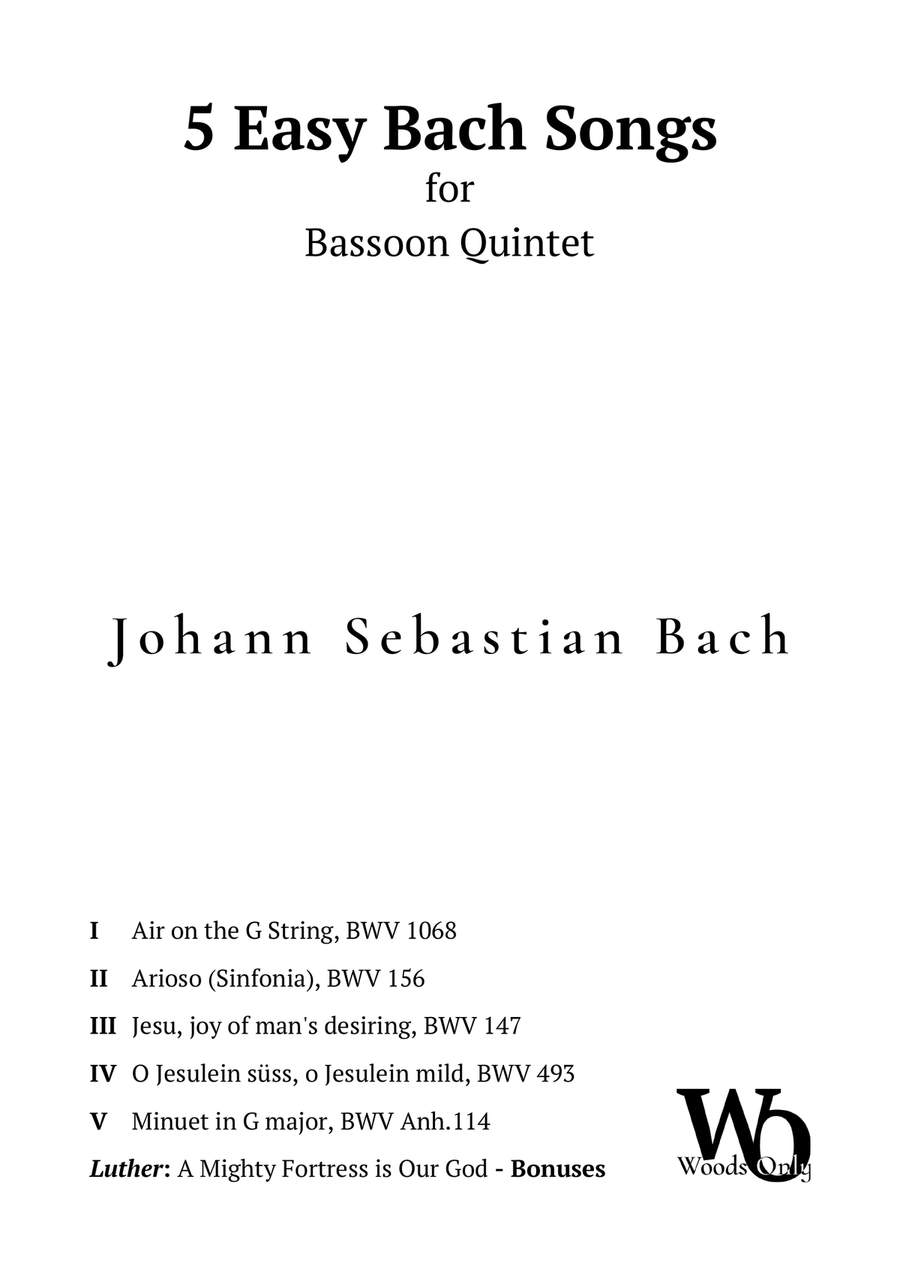
5 Famous Songs by Bach for Bassoon Quintet
5 Bassons

$39.99 34.77 € 5 Bassons PDF SheetMusicPlus

Woodwind Ensemble,Woodwind Quintet Flute - Level 1 - Digital Download SKU: A0.957285 Composed by Bach, Martin Luther. Arranged by Ander. Baroque,Easter,Renaissance,Sacred,Wedding. 51 pages. Woods Only, Arrangements #6748221. Published by Woods Only, Arrangements (A0.957285). This album contains 5 of Johann Sebastian Bach's most famous and versatile pieces for flute quintet, all very well suited for the beginners who want to get to know the baroque repertoire. They are also suitable for performances at events such as: weddings, Christian and church ceremonies, Easter, and academic recitals or concerts. They can be used in music institutions and by teachers as repertoire material and study methods, either for performance or instrumental technique. This collection includes a totally free bonus for you to enjoy: Martin Luther's A Mighty Fortress is Our God, a Renaissance sacred song for choir, which has been adapted for this set. You can also buy each one individually by checking right at the end of each description of each work.1: Air on the G String - The original piece is part of Johann Sebastian Bach's Suite No. 3 for orchestra, in D Major, BWV 1068, written for Prince Leopold of Anhalt. The so-called Air on the G String dates from one of these latter employments. In the service of the Prince of Cöthen, Bach composed not only the famous Brandenburg Concertos, but also several orchestral suites, from the third of which comes the Air on the G String. This curious title derives from a later arrangement of this piece for violin solo, in which the melody is played entirely on the lower, higher string of the instrument. ID: S0.11897152: Arioso - The Cantata 156 (BWV 156) was written for the third Sunday after Epiphany in 1729, and was first performed on January 23 of that year. The text is by Picander, one of Bach's favorite librettists. Of the four cantatas written by Bach for the feast, it was the last and only one scored for solo voice. This is a choral cantata, employing a choral melody in several movements. Cantata 156, in fact, employs two different choral melodies and texts in the second and sixth movements. A cantata is a sung symphony consisting of several parts, one of which is the Arioso, which is the initial instrumental part. ID: S0.11899053: Jesu, joy of man's desiring - This is one of Bach's most beautiful cantatas, made famous by the Jesus the Joy of Men chorus. It was originally composed for Advent 1716 in Weimar. Years later, already in Leipzig, Advent was tempus clausum, there was no music in the churches. Bach then reworked it for the Feast of Mary's Visitation. It is the final chorale of the cantata Herz und Mund und Tat und Leben. Although it is the 32nd cantata composed by Bach, of those that have survived, it was given BWV 147 in the complete catalog of his works. ID: S0.11900094: O Jesulein süss, o Jesulein mild - The Jesulein süß, the Jesulein mild is an original traditional German choral melody for voice and continuous bass arranged by Johann Sebastian Bach around 1735. With lyrics by Valentin Thilo, O Jesulein süss is a sacred melody adapted and catalogued as BWV 493. The first translation is by Dirk van Hogendorp, who made it more of a song for the time of suffering. ID: S0.11901155: Minuet in G major - This famous piece has traditionally been attributed to Johann Sebastian Bach, as it appears in the Notebook for Anna Magdalena , a notebook that Bach gave to his wife Anna Magdalena in 1725 and which was to be filled with the favorite selections of Bach family members. However, recent research has concluded that this minuet, sometimes referred to as BWV Anhang 114. was probably composed by Christian Petzold, a German composer and organist contemporary with Bach. ID: S0.1190345Bonuses: A Mighty Fortress is Our God, by Martin Luther - Ein feste Burg ist unser Gott is a hymn written by Martin Luther probably before 1529. The melody was also considered his work for a long time, but it was created at least with the collaboration of Johann Walter. The song is of great symbolic power for Protestantism; wh.
5 Famous Songs by Bach for Flute Quintet
Quintette de Flûte : 5 flûtes

$39.99 34.77 € Quintette de Flûte : 5 flûtes PDF SheetMusicPlus

Woodwind Ensemble,Woodwind Quintet Baritone Saxophone - Level 1 - Digital Download SKU: A0.957296 Composed by Bach, Martin Luther. Arranged by Ander. Baroque,Easter,Renaissance,Sacred,Wedding. 51 pages. Woods Only, Arrangements #6748249. Published by Woods Only, Arrangements (A0.957296). This album contains 5 of Johann Sebastian Bach's most famous and versatile pieces for baritone sax quintet, all very well suited for the beginners who want to get to know the baroque repertoire. They are also suitable for performances at events such as: weddings, Christian and church ceremonies, Easter, and academic recitals or concerts. They can be used in music institutions and by teachers as repertoire material and study methods, either for performance or instrumental technique. This collection includes a totally free bonus for you to enjoy: Martin Luther's A Mighty Fortress is Our God, a Renaissance sacred song for choir, which has been adapted for this set. You can also buy each one individually by checking right at the end of each description of each work.1: Air on the G String - The original piece is part of Johann Sebastian Bach's Suite No. 3 for orchestra, in D Major, BWV 1068, written for Prince Leopold of Anhalt. The so-called Air on the G String dates from one of these latter employments. In the service of the Prince of Cöthen, Bach composed not only the famous Brandenburg Concertos, but also several orchestral suites, from the third of which comes the Air on the G String. This curious title derives from a later arrangement of this piece for violin solo, in which the melody is played entirely on the lower, higher string of the instrument. ID: S0.11897772: Arioso - The Cantata 156 (BWV 156) was written for the third Sunday after Epiphany in 1729, and was first performed on January 23 of that year. The text is by Picander, one of Bach's favorite librettists. Of the four cantatas written by Bach for the feast, it was the last and only one scored for solo voice. This is a choral cantata, employing a choral melody in several movements. Cantata 156, in fact, employs two different choral melodies and texts in the second and sixth movements. A cantata is a sung symphony consisting of several parts, one of which is the Arioso, which is the initial instrumental part. ID: S0.11899833: Jesu, joy of man's desiring - This is one of Bach's most beautiful cantatas, made famous by the Jesus the Joy of Men chorus. It was originally composed for Advent 1716 in Weimar. Years later, already in Leipzig, Advent was tempus clausum, there was no music in the churches. Bach then reworked it for the Feast of Mary's Visitation. It is the final chorale of the cantata Herz und Mund und Tat und Leben. Although it is the 32nd cantata composed by Bach, of those that have survived, it was given BWV 147 in the complete catalog of his works. ID: S0.11900374: O Jesulein süss, o Jesulein mild - The Jesulein süß, the Jesulein mild is an original traditional German choral melody for voice and continuous bass arranged by Johann Sebastian Bach around 1735. With lyrics by Valentin Thilo, O Jesulein süss is a sacred melody adapted and catalogued as BWV 493. The first translation is by Dirk van Hogendorp, who made it more of a song for the time of suffering. ID: S0.11901695: Minuet in G major - This famous piece has traditionally been attributed to Johann Sebastian Bach, as it appears in the Notebook for Anna Magdalena , a notebook that Bach gave to his wife Anna Magdalena in 1725 and which was to be filled with the favorite selections of Bach family members. However, recent research has concluded that this minuet, sometimes referred to as BWV Anhang 114. was probably composed by Christian Petzold, a German composer and organist contemporary with Bach. ID: S0.1190375Bonuses: A Mighty Fortress is Our God, by Martin Luther - Ein feste Burg ist unser Gott is a hymn written by Martin Luther probably before 1529. The melody was also considered his work for a long time, but it was created at least with the collaboration of Johann Walter. The song is of great symbolic power for Protestant.
5 Famous Songs by Bach for Baritone Sax Quintet
Quintette de Saxophone: 5 saxophones

$39.99 34.77 € Quintette de Saxophone: 5 saxophones PDF SheetMusicPlus

Woodwind Ensemble,Woodwind Quintet - Level 1 - Digital Download SKU: A0.957290 Composed by Bach, Martin Luther. Arranged by Ander. Baroque,Easter,Renaissance,Sacred,Wedding. 51 pages. Woods Only, Arrangements #6748233. Published by Woods Only, Arrangements (A0.957290). This album contains 5 of Johann Sebastian Bach's most famous and versatile pieces for english horn quintet, all very well suited for the beginners who want to get to know the baroque repertoire. They are also suitable for performances at events such as: weddings, Christian and church ceremonies, Easter, and academic recitals or concerts. They can be used in music institutions and by teachers as repertoire material and study methods, either for performance or instrumental technique. This collection includes a totally free bonus for you to enjoy: Martin Luther's A Mighty Fortress is Our God, a Renaissance sacred song for choir, which has been adapted for this set. You can also buy each one individually by checking right at the end of each description of each work.1: Air on the G String - The original piece is part of Johann Sebastian Bach's Suite No. 3 for orchestra, in D Major, BWV 1068, written for Prince Leopold of Anhalt. The so-called Air on the G String dates from one of these latter employments. In the service of the Prince of Cöthen, Bach composed not only the famous Brandenburg Concertos, but also several orchestral suites, from the third of which comes the Air on the G String. This curious title derives from a later arrangement of this piece for violin solo, in which the melody is played entirely on the lower, higher string of the instrument. ID: S0.11897512: Arioso - The Cantata 156 (BWV 156) was written for the third Sunday after Epiphany in 1729, and was first performed on January 23 of that year. The text is by Picander, one of Bach's favorite librettists. Of the four cantatas written by Bach for the feast, it was the last and only one scored for solo voice. This is a choral cantata, employing a choral melody in several movements. Cantata 156, in fact, employs two different choral melodies and texts in the second and sixth movements. A cantata is a sung symphony consisting of several parts, one of which is the Arioso, which is the initial instrumental part. ID: S0.11899713: Jesu, joy of man's desiring - This is one of Bach's most beautiful cantatas, made famous by the Jesus the Joy of Men chorus. It was originally composed for Advent 1716 in Weimar. Years later, already in Leipzig, Advent was tempus clausum, there was no music in the churches. Bach then reworked it for the Feast of Mary's Visitation. It is the final chorale of the cantata Herz und Mund und Tat und Leben. Although it is the 32nd cantata composed by Bach, of those that have survived, it was given BWV 147 in the complete catalog of his works. ID: S0.11900214: O Jesulein süss, o Jesulein mild - The Jesulein süß, the Jesulein mild is an original traditional German choral melody for voice and continuous bass arranged by Johann Sebastian Bach around 1735. With lyrics by Valentin Thilo, O Jesulein süss is a sacred melody adapted and catalogued as BWV 493. The first translation is by Dirk van Hogendorp, who made it more of a song for the time of suffering. ID: S0.11901435: Minuet in G major - This famous piece has traditionally been attributed to Johann Sebastian Bach, as it appears in the Notebook for Anna Magdalena , a notebook that Bach gave to his wife Anna Magdalena in 1725 and which was to be filled with the favorite selections of Bach family members. However, recent research has concluded that this minuet, sometimes referred to as BWV Anhang 114. was probably composed by Christian Petzold, a German composer and organist contemporary with Bach. ID: S0.1190361Bonuses: A Mighty Fortress is Our God, by Martin Luther - Ein feste Burg ist unser Gott is a hymn written by Martin Luther probably before 1529. The melody was also considered his work for a long time, but it was created at least with the collaboration of Johann Walter. The song is of great symbolic power for Protestant.
5 Famous Songs by Bach for English Horn Quintet
Quintette à Vent: flûte, Hautbois, basson, clarinette, Cor

$39.99 34.77 € Quintette à Vent: flûte, Hautbois, basson, clarinette, Cor PDF SheetMusicPlus

Woodwind Ensemble,Woodwind Quintet Clarinet - Level 1 - Digital Download SKU: A0.957291 Composed by Bach, Martin Luther. Arranged by Ander. Baroque,Easter,Renaissance,Sacred,Wedding. 51 pages. Woods Only, Arrangements #6748235. Published by Woods Only, Arrangements (A0.957291). This album contains 5 of Johann Sebastian Bach's most famous and versatile pieces for clarinet quintet, all very well suited for the beginners who want to get to know the baroque repertoire. They are also suitable for performances at events such as: weddings, Christian and church ceremonies, Easter, and academic recitals or concerts. They can be used in music institutions and by teachers as repertoire material and study methods, either for performance or instrumental technique. This collection includes a totally free bonus for you to enjoy: Martin Luther's A Mighty Fortress is Our God, a Renaissance sacred song for choir, which has been adapted for this set. You can also buy each one individually by checking right at the end of each description of each work.1: Air on the G String - The original piece is part of Johann Sebastian Bach's Suite No. 3 for orchestra, in D Major, BWV 1068, written for Prince Leopold of Anhalt. The so-called Air on the G String dates from one of these latter employments. In the service of the Prince of Cöthen, Bach composed not only the famous Brandenburg Concertos, but also several orchestral suites, from the third of which comes the Air on the G String. This curious title derives from a later arrangement of this piece for violin solo, in which the melody is played entirely on the lower, higher string of the instrument. ID: S0.11897532: Arioso - The Cantata 156 (BWV 156) was written for the third Sunday after Epiphany in 1729, and was first performed on January 23 of that year. The text is by Picander, one of Bach's favorite librettists. Of the four cantatas written by Bach for the feast, it was the last and only one scored for solo voice. This is a choral cantata, employing a choral melody in several movements. Cantata 156, in fact, employs two different choral melodies and texts in the second and sixth movements. A cantata is a sung symphony consisting of several parts, one of which is the Arioso, which is the initial instrumental part. ID: S0.11899733: Jesu, joy of man's desiring - This is one of Bach's most beautiful cantatas, made famous by the Jesus the Joy of Men chorus. It was originally composed for Advent 1716 in Weimar. Years later, already in Leipzig, Advent was tempus clausum, there was no music in the churches. Bach then reworked it for the Feast of Mary's Visitation. It is the final chorale of the cantata Herz und Mund und Tat und Leben. Although it is the 32nd cantata composed by Bach, of those that have survived, it was given BWV 147 in the complete catalog of his works. ID: S0.11900234: O Jesulein süss, o Jesulein mild - The Jesulein süß, the Jesulein mild is an original traditional German choral melody for voice and continuous bass arranged by Johann Sebastian Bach around 1735. With lyrics by Valentin Thilo, O Jesulein süss is a sacred melody adapted and catalogued as BWV 493. The first translation is by Dirk van Hogendorp, who made it more of a song for the time of suffering. ID: S0.11901475: Minuet in G major - This famous piece has traditionally been attributed to Johann Sebastian Bach, as it appears in the Notebook for Anna Magdalena , a notebook that Bach gave to his wife Anna Magdalena in 1725 and which was to be filled with the favorite selections of Bach family members. However, recent research has concluded that this minuet, sometimes referred to as BWV Anhang 114. was probably composed by Christian Petzold, a German composer and organist contemporary with Bach. ID: S0.1190363Bonuses: A Mighty Fortress is Our God, by Martin Luther - Ein feste Burg ist unser Gott is a hymn written by Martin Luther probably before 1529. The melody was also considered his work for a long time, but it was created at least with the collaboration of Johann Walter. The song is of great symbolic power for Protestantism;.
5 Famous Songs by Bach for Clarinet Quintet
Quintette de Clarinettes: 5 clarinettes

$39.99 34.77 € Quintette de Clarinettes: 5 clarinettes PDF SheetMusicPlus

Woodwind Ensemble,Woodwind Quintet Soprano Saxophone - Level 1 - Digital Download SKU: A0.957293 Composed by Bach, Martin Luther. Arranged by Ander. Baroque,Easter,Renaissance,Sacred,Wedding. 51 pages. Woods Only, Arrangements #6748243. Published by Woods Only, Arrangements (A0.957293). This album contains 5 of Johann Sebastian Bach's most famous and versatile pieces for soprano sax quintet, all very well suited for the beginners who want to get to know the baroque repertoire. They are also suitable for performances at events such as: weddings, Christian and church ceremonies, Easter, and academic recitals or concerts. They can be used in music institutions and by teachers as repertoire material and study methods, either for performance or instrumental technique. This collection includes a totally free bonus for you to enjoy: Martin Luther's A Mighty Fortress is Our God, a Renaissance sacred song for choir, which has been adapted for this set. You can also buy each one individually by checking right at the end of each description of each work.1: Air on the G String - The original piece is part of Johann Sebastian Bach's Suite No. 3 for orchestra, in D Major, BWV 1068, written for Prince Leopold of Anhalt. The so-called Air on the G String dates from one of these latter employments. In the service of the Prince of Cöthen, Bach composed not only the famous Brandenburg Concertos, but also several orchestral suites, from the third of which comes the Air on the G String. This curious title derives from a later arrangement of this piece for violin solo, in which the melody is played entirely on the lower, higher string of the instrument. ID: S0.11897592: Arioso - The Cantata 156 (BWV 156) was written for the third Sunday after Epiphany in 1729, and was first performed on January 23 of that year. The text is by Picander, one of Bach's favorite librettists. Of the four cantatas written by Bach for the feast, it was the last and only one scored for solo voice. This is a choral cantata, employing a choral melody in several movements. Cantata 156, in fact, employs two different choral melodies and texts in the second and sixth movements. A cantata is a sung symphony consisting of several parts, one of which is the Arioso, which is the initial instrumental part. ID: S0.11899773: Jesu, joy of man's desiring - This is one of Bach's most beautiful cantatas, made famous by the Jesus the Joy of Men chorus. It was originally composed for Advent 1716 in Weimar. Years later, already in Leipzig, Advent was tempus clausum, there was no music in the churches. Bach then reworked it for the Feast of Mary's Visitation. It is the final chorale of the cantata Herz und Mund und Tat und Leben. Although it is the 32nd cantata composed by Bach, of those that have survived, it was given BWV 147 in the complete catalog of his works. ID: S0.11900274: O Jesulein süss, o Jesulein mild - The Jesulein süß, the Jesulein mild is an original traditional German choral melody for voice and continuous bass arranged by Johann Sebastian Bach around 1735. With lyrics by Valentin Thilo, O Jesulein süss is a sacred melody adapted and catalogued as BWV 493. The first translation is by Dirk van Hogendorp, who made it more of a song for the time of suffering. ID: S0.11901555: Minuet in G major - This famous piece has traditionally been attributed to Johann Sebastian Bach, as it appears in the Notebook for Anna Magdalena , a notebook that Bach gave to his wife Anna Magdalena in 1725 and which was to be filled with the favorite selections of Bach family members. However, recent research has concluded that this minuet, sometimes referred to as BWV Anhang 114. was probably composed by Christian Petzold, a German composer and organist contemporary with Bach. ID: S0.1190369Bonuses: A Mighty Fortress is Our God, by Martin Luther - Ein feste Burg ist unser Gott is a hymn written by Martin Luther probably before 1529. The melody was also considered his work for a long time, but it was created at least with the collaboration of Johann Walter. The song is of great symbolic power for Protestanti.
5 Famous Songs by Bach for Soprano Sax Quintet
Quintette de Saxophone: 5 saxophones

$39.99 34.77 € Quintette de Saxophone: 5 saxophones PDF SheetMusicPlus


1 ....61 76 91 106 121 ....3571


Partitions Gratuites
Acheter des Partitions Musicales
Acheter des Partitions Digitales à Imprimer
Acheter des Instruments de Musique

© 2000 - 2026

Accueil - Version intégrale





