EUROPE
7373 articles
USA
0 articles
DIGITAL
333 articles (à imprimer)
Partitions Digitales
Partitions à imprimer
333 partitions trouvées


Oboe Solo - Level 1 - Digital Download SKU: A0.1183101 By Dirk Quinn Band. By Charles Borrelli and Roger Courtland. Arranged by Marcony Carvalho. 20th Century,March,Traditional. Individual part. 1 pages. Zedas Couve #782821. Published by Zedas Couve (A0.1183101). The Eagles' Victory Song was the creation of Charles Borrelli and Richard Courtland Harrison, a Washington, D.C. music teacher and arranger for jazz guitarist Charlie Byrd. The song was mistakenly credited to R. Courtland by the Copyright office and in various editions of Eagles programs from the late 1950s through the 1960s.In 1963, Jerry Wolman purchased the Philadelphia Eagles. Wolman was a sports fan growing up and loved hearing the Washington Redskins' fight song Hail to the Redskins at games. Spawning from his admiration for the Redskins' song, Wolman searched for musicians to implement a team song for the Eagles, and founded The Philadelphia Eagles' Sound of Brass band in 1964. The group included 200 musicians and dancers, and was led by Arlen Saylor, who was appointed as the Eagles' entertainment director in 1966 and is credited with penning an arrangement of the fight song that the band played at home games during halftime in the 1960s. Wolman's push to popularize the fight song flew under the radar, however, and in 1969 the Sound of Brass band was discontinued.The song came back into light in 1997, when Bobby Mansure, founder of an unofficial Eagles pep band, asked team management to allow the band to play in the parking lot during home games. Management gave Mansure's pep band an audition, allowing them to play at two preseason games to gauge fan reaction. The song went over so well that Mansure and the band retained a permanent position as the official Philadelphia Eagles Pep Band.In 1998, following Mansure's reintroduction of the song, Eagles management attempted to rebuild its popularity among fans by changing some aspects of the song: they modified the key, changed the opening lyric from Fight, Eagles Fight to Fly, Eagles Fly, and re-marketed the song with that as the title. In addition, they appended the popular E-A-G-L-E-S chant—which had emerged in the 1980s—to the end of the song. While management planned to play the song throughout the 1998 season, the Eagles' poor performance that year caused them to hold off reintroducing the song until the following year. The Eagles fared better during their 1999 season, and subsequently, the fight song was played after every score.
Eagles' Victory Song
Hautbois (partie séparée)
Dirk Quinn Band
$4.99 4.35 € Hautbois (partie séparée) PDF SheetMusicPlus

Piano,Trombone - Level 1 - Digital Download SKU: A0.1182600 By Dirk Quinn Band. By Charles Borrelli and Roger Courtland. Arranged by Marcony Carvalho. 20th Century,March,Patriotic,Traditional. Score and part. 2 pages. Zedas Couve #782346. Published by Zedas Couve (A0.1182600). The Eagles' Victory Song was the creation of Charles Borrelli and Richard Courtland Harrison, a Washington, D.C. music teacher and arranger for jazz guitarist Charlie Byrd. The song was mistakenly credited to R. Courtland by the Copyright office and in various editions of Eagles programs from the late 1950s through the 1960s.In 1963, Jerry Wolman purchased the Philadelphia Eagles. Wolman was a sports fan growing up and loved hearing the Washington Redskins' fight song Hail to the Redskins at games. Spawning from his admiration for the Redskins' song, Wolman searched for musicians to implement a team song for the Eagles, and founded The Philadelphia Eagles' Sound of Brass band in 1964. The group included 200 musicians and dancers, and was led by Arlen Saylor, who was appointed as the Eagles' entertainment director in 1966 and is credited with penning an arrangement of the fight song that the band played at home games during halftime in the 1960s. Wolman's push to popularize the fight song flew under the radar, however, and in 1969 the Sound of Brass band was discontinued.The song came back into light in 1997, when Bobby Mansure, founder of an unofficial Eagles pep band, asked team management to allow the band to play in the parking lot during home games. Management gave Mansure's pep band an audition, allowing them to play at two preseason games to gauge fan reaction. The song went over so well that Mansure and the band retained a permanent position as the official Philadelphia Eagles Pep Band.In 1998, following Mansure's reintroduction of the song, Eagles management attempted to rebuild its popularity among fans by changing some aspects of the song: they modified the key, changed the opening lyric from Fight, Eagles Fight to Fly, Eagles Fly, and re-marketed the song with that as the title. In addition, they appended the popular E-A-G-L-E-S chant—which had emerged in the 1980s—to the end of the song. While management planned to play the song throughout the 1998 season, the Eagles' poor performance that year caused them to hold off reintroducing the song until the following year. The Eagles fared better during their 1999 season, and subsequently, the fight song was played after every score.
Eagles' Victory Song
Trombone et Piano
Dirk Quinn Band
$4.99 4.35 € Trombone et Piano PDF SheetMusicPlus

Cello,Piano - Level 4 - Digital Download SKU: A0.1199020 By John Legend. By John Stephens, Lauren Frawley, Melanie Fontana, Michael Lindgren Schulze, Michel Lindgren Shulz, Michel Schulz, Mick Schultz, Stephen Franks, Stephen Mcgregor, and Steven Franks. Arranged by George B Chave. Chamber,Contemporary,Multicultural,Pop,Rock,World. Score and part. 7 pages. BrassMagicMusic.com #798091. Published by BrassMagicMusic.com (A0.1199020). This catchy Reggae-style piece, originally made famous by John Legend, features solo Violoncello with Piano Accompaniment geared toward the High School or advanced Middle School performer.  It is in concert G-major.  The cello range in this arrangement spans from written D3 to D4 [one ledger line above the staff]. The diatonic nature of this arrangement (only 2 measures contain an accidental) and the range make this easily accessible to younger performers. There is, however, some syncopation in keeping with the original melody, but nothing out-of-reach for a competent performer.  The piano accompaniment is reasonably simple: a somewhat active L.H. part with chord comping in the R.H.
I Want You To Know
Violoncelle, Piano
John Legend
$5.00 4.36 € Violoncelle, Piano PDF SheetMusicPlus

Easy Piano - Level 3 - Digital Download SKU: A0.902317 Composed by W. G. Cooper. Arranged by Rumi Oh. Christian,Gospel,Praise & Worship,Spiritual. Score. 3 pages. Rumi Oh Worship Music #6136877. Published by Rumi Oh Worship Music (A0.902317). Your favorite hymns arranged in 3 levels of difficulties as a self-study guide for beginner and intermediate players to challenge basic chords skills and improve accompaniment technics to play more beautifully. Level 1 contains R.H. melody with easy L.H. accompaniment. Level 2 adds more chords making a richer harmony. Level 3 includes complexity in rhythms, chords, tension notes and fills. It also introduces a way to repeat the song after ending.
[Wonderful Peace] Favorite hymns arrangements with 3 levels of difficulties for beginner and interme
Piano Facile

$3.49 3.04 € Piano Facile PDF SheetMusicPlus

Bassoon - Level 1 - Digital Download SKU: A0.1474103 Composed by James Smith. Classical,Contest,Festival,Instructional,Multicultural,Traditional,World. Educational Method. 44 pages. Ensemble Llama Music #1051737. Published by Ensemble Llama Music (A0.1474103). I’m a bassoonist, and I don’t like the teaching materials for bassoon that are out there. There’s not enough depth and engagement in them, and nothing that supports the everyday music teacher. So I set out to create something that I would feel comfortable giving to my private students to help them grow as musicians. There are many types of music in the book: etudes, exercises, warm-ups, backwards and upside down duets (one person plays normally, the other person reads the music in an unusual way), improvised music, and composition. Musical styles range across a variety of cultures and genres such as classical, blues, fiddle tunes, marches, contemporary, musicals, and more.  Using carefully crafted etudes, exercises, and songs in a variety of styles, your bassoon students are going to to find immediate success. The bite-sized examples encourage students to focus on tone, as they extend their technique and range on this wonderful instrument. Examples from the book:1.1 - Memories1.2 - Can-Can1.3 - Baby-Back Blues1.4 - Somewhere Nice1.5 - Go Down, Moses1.6 - Magenta Sky (A Backwards Duet)1.7 - Cakewalk1.8 - Red River Valley1.9 - Symphony No. 6, Mvt. 2 (Tchaikovsky)1.10 - Arkansas Traveler1.11 - Give My Regards to Broadway (key of B Flat Major)1.12 - In The Hall of the Mountain King1.13 - Landlord Fill The Flowing Bowl1.14 - It Ain't Gonna Rain No Mo'1.15 - Shalom Chaverim1.16 - Londonderry Air1.17 - Theme & Variations, Für Elise1.18 - Ominous (A Backwards Duet)Create & Improvise: St. Louis Blues (W.C. Handy)1.19 - Interlude1.20 - L'Adieu Des Bergers1.21 - Washington Post March1.22 - The Sea Monster - A Short Improvised Piece1.23 - Give My Regards to Broadway (key of G Major)1.24 - Anna Lisle (The Alma Mater Song)Critical Hit - Bassoon Concert Piece2.1 - More Memories2.2 & 2.3 - Ten Little Indians2.4 - Parliament (An Upside-Down Duet)2.5 - Bassoon Warm-Up2.6 - F Major Studies2.7 - Airang2.8 - Arpeggio In Blue2.9 - C Major Studies2.10 - Mazurka in A-flat Major2.11 - Etudes With Flats2.12 - Take Me Out To The Ball Game2.13 - Arpeggios (Part 1)2.14 - Etudes With Arpeggios2.15 - The Sar Spangled Banner2.16 - Arpeggios (Part 2)2.17 - More Arpeggio Studies2.18 - Battle Hymn of the Republic2.19 - Arpeggios (Part 3)2.20 - Kolme Varista2.21 - Swallowtail Jig2.22 - Jesu, Joy of Man's Desiring2.23 - St. Anne's Reel2.24 - Dear Old Stockholm2.25 - Esprit De CorpsSketch On a Theme From The Sorceror's Apprentice - Bassoon Concert Piece.
Next Level Bassoon: Etudes, Exercises & Engaging Songs For The Emerging Bassoonist

$29.99 26.13 € PDF SheetMusicPlus

B-Flat Trumpet,Piano - Level 1 - Digital Download SKU: A0.1182594 By Dirk Quinn Band. By Charles Borrelli and Roger Courtland. Arranged by Marcony Carvalho. 20th Century,Classical,March. Score and part. 2 pages. Zedas Couve #782339. Published by Zedas Couve (A0.1182594). The Eagles' Victory Song was the creation of Charles Borrelli and Richard Courtland Harrison, a Washington, D.C. music teacher and arranger for jazz guitarist Charlie Byrd. The song was mistakenly credited to R. Courtland by the Copyright office and in various editions of Eagles programs from the late 1950s through the 1960s.In 1963, Jerry Wolman purchased the Philadelphia Eagles. Wolman was a sports fan growing up and loved hearing the Washington Redskins' fight song Hail to the Redskins at games. Spawning from his admiration for the Redskins' song, Wolman searched for musicians to implement a team song for the Eagles, and founded The Philadelphia Eagles' Sound of Brass band in 1964. The group included 200 musicians and dancers, and was led by Arlen Saylor, who was appointed as the Eagles' entertainment director in 1966 and is credited with penning an arrangement of the fight song that the band played at home games during halftime in the 1960s. Wolman's push to popularize the fight song flew under the radar, however, and in 1969 the Sound of Brass band was discontinued.The song came back into light in 1997, when Bobby Mansure, founder of an unofficial Eagles pep band, asked team management to allow the band to play in the parking lot during home games. Management gave Mansure's pep band an audition, allowing them to play at two preseason games to gauge fan reaction. The song went over so well that Mansure and the band retained a permanent position as the official Philadelphia Eagles Pep Band.In 1998, following Mansure's reintroduction of the song, Eagles management attempted to rebuild its popularity among fans by changing some aspects of the song: they modified the key, changed the opening lyric from Fight, Eagles Fight to Fly, Eagles Fly, and re-marketed the song with that as the title. In addition, they appended the popular E-A-G-L-E-S chant—which had emerged in the 1980s—to the end of the song. While management planned to play the song throughout the 1998 season, the Eagles' poor performance that year caused them to hold off reintroducing the song until the following year. The Eagles fared better during their 1999 season, and subsequently, the fight song was played after every score.
Eagles' Victory Song
Trompette, Piano
Dirk Quinn Band
$4.99 4.35 € Trompette, Piano PDF SheetMusicPlus

Soprano Saxophone Solo - Level 1 - Digital Download SKU: A0.1183091 By Dirk Quinn Band. By Charles Borrelli and Roger Courtland. Arranged by Marcony Carvalho. 20th Century,March,Traditional. Individual part. 1 pages. Zedas Couve #782816. Published by Zedas Couve (A0.1183091). The Eagles' Victory Song was the creation of Charles Borrelli and Richard Courtland Harrison, a Washington, D.C. music teacher and arranger for jazz guitarist Charlie Byrd. The song was mistakenly credited to R. Courtland by the Copyright office and in various editions of Eagles programs from the late 1950s through the 1960s.In 1963, Jerry Wolman purchased the Philadelphia Eagles. Wolman was a sports fan growing up and loved hearing the Washington Redskins' fight song Hail to the Redskins at games. Spawning from his admiration for the Redskins' song, Wolman searched for musicians to implement a team song for the Eagles, and founded The Philadelphia Eagles' Sound of Brass band in 1964. The group included 200 musicians and dancers, and was led by Arlen Saylor, who was appointed as the Eagles' entertainment director in 1966 and is credited with penning an arrangement of the fight song that the band played at home games during halftime in the 1960s. Wolman's push to popularize the fight song flew under the radar, however, and in 1969 the Sound of Brass band was discontinued.The song came back into light in 1997, when Bobby Mansure, founder of an unofficial Eagles pep band, asked team management to allow the band to play in the parking lot during home games. Management gave Mansure's pep band an audition, allowing them to play at two preseason games to gauge fan reaction. The song went over so well that Mansure and the band retained a permanent position as the official Philadelphia Eagles Pep Band.In 1998, following Mansure's reintroduction of the song, Eagles management attempted to rebuild its popularity among fans by changing some aspects of the song: they modified the key, changed the opening lyric from Fight, Eagles Fight to Fly, Eagles Fly, and re-marketed the song with that as the title. In addition, they appended the popular E-A-G-L-E-S chant—which had emerged in the 1980s—to the end of the song. While management planned to play the song throughout the 1998 season, the Eagles' poor performance that year caused them to hold off reintroducing the song until the following year. The Eagles fared better during their 1999 season, and subsequently, the fight song was played after every score.
Eagles' Victory Song
Saxophone (partie séparée)
Dirk Quinn Band
$4.99 4.35 € Saxophone (partie séparée) PDF SheetMusicPlus

Piano - Digital Download SKU: LV.9981 Composed by A. Sullivan. Arranged by Cramer. Ethnic stereotypes--Japan, Tree limbs, Couples, Native dress. Lester S. Levy Collection. 14 pages. Published by Johns Hopkins University Sheridan Libraries (LV.9981). The Mikado. Potpourri. X.L.C.R. Edition. A. Sullivan. Arr. by Cramer. Published 1885 by in n.p. Composition of sectional [quotes tunes from Operetta, e.g., He's going to marry Yum-Yum, and Our great Mikado.] with piano instrumentation. Subject headings for this piece include Ethnic stereotypes--Japan, Tree limbs, Couples, Native dress. About The Lester S. Levy CollectionThe Lester S. Levy Collection of Sheet Music consists of over 29,000 pieces of American popular music. Donated to Johns Hopkins University Sheridan Libraries, the collection's strength is its thorough documentation of nineteenth-century American through popular music. This sheet music has been provided by Project Gado, a San Francisco Bay Area startup whose mission is to digitize and share the world's visual history.WARNING: These titles are provided as historical documents. Language and concepts within reflect the opinions and values of the time and may be offensive to some.
The Mikado. Potpourri
Piano seul

$5.99 5.22 € Piano seul PDF SheetMusicPlus

Bass Guitar - Level 3 - Digital Download SKU: A0.1113598 By Coolio Featuring L.V. By Artis Ivey, Doug Rasheed, Larry Sanders, and Stevie Wonder. Arranged by Daniel Roberts. 20th Century,Film/TV,Hip-Hop,Instructional,R & B. Score. 2 pages. Daniel P Roberts #715501. Published by Daniel P Roberts (A0.1113598). Bass line of Synth Bass arranged for 5-string Bass with TAB. Use octave pedal. As I walk through the valley of the shadow of death I take a look at my life and realize there's not much left 'Cause I've been blastin' and laughin' so long, that Even my mama thinks that my mind is gone But I ain't never crossed a man that didn't deserve it Me be treated like a punk, you know that's unheard of You better watch how you're talkin', and where you're walkin' Or you and your homies might be lined in chalk I really hate to trip but I gotta loc As they croak, I see myself in the pistol smoke, fool I'm the kinda G the little homies wanna be like On my knees in the night, sayin' prayers in the streetlight Been spendin' most their lives, livin' in the gangsta's paradise Been spendin' most their lives, livin' in the gangsta's paradise Keep spendin' most our lives, livin' in the gangsta's paradise Keep spendin' most our lives, livin' in the gangsta's paradise Look at the situation they got me facin' I can't live a normal life, I was raised by the street So I gotta be down with the hood team Too much television watchin' got me chasin' dreams I'm an educated fool with money on my mind Got my ten in my hand and a gleam in my eye I'm a loc'd out gangsta set trippin' banger And my homies is down so don't arouse my anger, fool Death ain't nothin' but a heartbeat away I'm livin' life, do or die, what can I say I'm 23 now, but will I live to see 24? The way things is going, I don't know Tell me why are we, so blind to see That the ones we hurt, are you and me? Been spendin' most their lives, livin' in the gangsta's paradise Been spendin' most their lives, livin' in the gangsta's paradise Keep spendin' most our lives, livin' in the gangsta's paradise Keep spendin' most our lives, livin' in the gangsta's paradise Power and the money, money and the power Minute after minute, hour after hour Everybody's runnin', but half of them ain't lookin' It's goin' on in the kitchen, but I don't know what's cookin' They say I gotta learn, but nobody's here to teach me If they can't understand it, how can they reach me I guess they can't, I guess they won't I guess they front, that's why I know my life is out of luck, fool Been spendin' most their lives, livin' in the gangsta's paradise Been spendin' most their lives, livin' in the gangsta's paradise Keep spendin' most our lives, livin' in the gangsta's paradise Keep spendin' most our lives, livin' in the gangsta's paradise Tell me why are we, so blind to see That the ones we hurt, are you and me? Tell me why are we, so blind to see That the ones we hurt, are you and me?
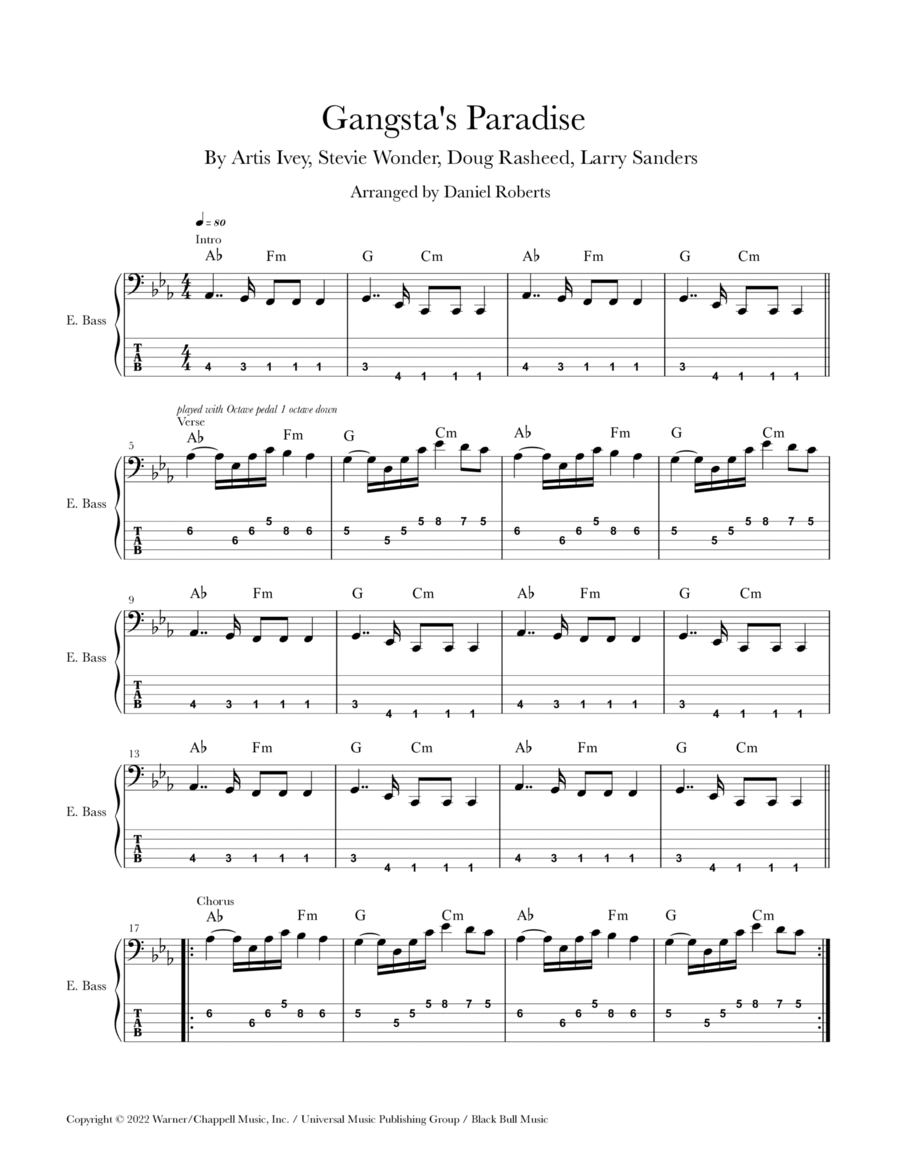
Gangsta's Paradise
Basse electrique
Coolio Featuring L V
$4.99 4.35 € Basse electrique PDF SheetMusicPlus

Choir - Level 4 - Digital Download SKU: A0.1116611 By R.Liberti - Sopran N.Caronti - Alto G.Marsetti - Tenor L.Villa - Bass. By Antonello Rizzella. A Cappella,Christian,Contemporary,Sacred. Full Performance. Duration 212. Antonello Rizzella #718266. Published by Antonello Rizzella (A0.1116611). Composing this work I considered a priority the expressiveness and emphasis that the choir's voices can give the text of the Nunc dimittis: the sigh of an old man who after so much waiting sees his Lord! The prophecy that becomes reality! A lot of patience spent for the long wait that then becomes breath acce- lerated with emotion and then Light. The splendor of the child, of the King of Israel but also the Light that a by now old Simeone begins to yearn to see at the end of his long life. The language deliberately alternates different stylistic features with one true goal: to exalt the Word, make it vibrate with expressiveness.
Nunc Dimittis
R Liberti - Sopran N
$2.00 1.74 € PDF SheetMusicPlus

Alto Saxophone,Piano - Level 4 - Digital Download SKU: A0.1199007 By John Legend. By John Stephens, Lauren Frawley, Melanie Fontana, Michael Lindgren Schulze, Michel Lindgren Shulz, Michel Schulz, Mick Schultz, Stephen Franks, Stephen Mcgregor, and Steven Franks. Arranged by George B Chave. Chamber,Contemporary,Multicultural,Pop,Rock,World. Score and part. 7 pages. BrassMagicMusic.com #798078. Published by BrassMagicMusic.com (A0.1199007). This catchy Reggae-style piece, originally made famous by John Legend, features solo Alto Saxophone with Piano Accompaniment geared toward the High School or advanced Middle School performer.  It is in concert Bb-major (written G-major).  The alto sax range in this arrangement spans from written D4 to D5 [on the staff]. The diatonic nature of this arrangement (only 2 measures contain an accidental) and the range make this easily accessible to younger performers. There is, however, some syncopation in keeping with the original melody, but nothing out-of-reach for a competent performer.  The piano accompaniment is reasonably simple: a somewhat active L.H. part with chord comping in the R.H.
I Want You To Know
Saxophone Alto et Piano
John Legend
$5.00 4.36 € Saxophone Alto et Piano PDF SheetMusicPlus


Partitions Gratuites
Acheter des Partitions Musicales
Acheter des Partitions Digitales à Imprimer
Acheter des Instruments de Musique

© 2000 - 2026

Accueil - Version intégrale





