EUROPE
1642 articles
USA
3330 articles
DIGITAL
6874 articles (à imprimer)
Partitions Digitales
Partitions à imprimer
6874 partitions trouvées


Piano,Trombone - Level 1 - Digital Download SKU: A0.548492 Composed by Gruber. Arranged by James M. Guthrie, ASCAP. Christmas. Score and part. 3 pages. Jmsgu3 #3387069. Published by jmsgu3 (A0.548492). Silent Night with new harmony for the final verse! Score: 2 pg. Part: 1 pg. Silent Night Origins Father Joseph Mohr wrote the lyrics for a new Christmas Carol. He wanted the new carol for his Christmas Eve Mass. With only a couple of hours until the service, He asked organist and schoolteacher Franz Gruber to write a melody and simple accompaniment to go with the lyrics. The result is probably the most famous of all Christmas carols – Silent Night. First Performance Perhaps because the organ was undergoing repairs, or to make sure the accompaniment was easy enough, Mohr asked Gruber to write it for the guitar. Mohr played the guitar, and both Mohr and Gruber gave the world premiere performance at the Christmas Eve Mass in 1818 at St. Nicholas Church in Oberndorf in Salzburg. Original Score Eventually, the original score became lost, and consequently, Mohr's name was largely forgotten.  Though the public originally recognized Gruber as the composer, many people over time began rumors that a more famous composer was responsible. Thus, they floated the names of Haydn, Mozart, and even Beethoven. Authorities eventually settled the matter when a manuscript in Mohr’s handwriting turned up in 1820. Consequently, we learn that Mohr wrote the lyrics in 1816, and Gruber composed the melody in 1818. Popularity Nonetheless, Silent Night is still very popular. Singers have performed this song in nearly every genre and in multiple languages. Perhaps the most famous version is the one Bing Crosby crafted. This version is the third best-selling physical single recording in the history of recorded music. This particular recording was released in 1935 and sold at least 30 million copies. Only two songs have ever sold more. Elton John released Candle in the Wind in 1997 and sold 33 million copies. The record for most copies ever sold goes to Bing Crosby. He released White Christmas in 1942 and sold 50 million physical copies.  Register for free lifetime updates and revisions at www.jamesguthrie.com    
Silent Night for Trombone & Piano
Trombone et Piano

$28.95 24.49 € Trombone et Piano PDF SheetMusicPlus

String Trio Cello,Viola,Violin - Level 4 - Digital Download SKU: A0.1215881 Composed by Ludwig van Beethoven (1770 – 1827). Arranged by James M. Guthrie, ASCAP. 19th Century,Chamber,Classical,Contest,Festival,Wedding. 81 pages. Jmsgu3 #812575. Published by jmsgu3 (A0.1215881). Beethoven’s Eleven Bagatelles Op. 119 are known for their expressive melodies and harmonies, and their innovative approach to form and tonality. The bagatelles were written during a period of time when Beethoven was undergoing a difficult phase in his life; he was struggling with hearing loss, family problems, and depression. Despite these challenges, he managed to produce a set of musical gems that are deeply moving and uplifting. The bagatelles show a remarkable range and depth of emotion, from playful and humorous to introspective and melancholic. These pieces serve as a testament to his resilience and creative genius in the face of personal adversity. More than two centuries after their composition, the bagatelles continue to inspire music enthusiasts around the world. The Bagatelles Op. 119 is a combination of old and new pieces that were not originally planned as a cycle.CONTENTS:No. 1. Allegretto.No. 2. Andante con moto.No. 3. à l’ Allemande.No. 4. Andante cantabile.No. 5. Risoluto.No. 6. Andante – Allegretto.No. 7. Tranquillo.No. 8. Moderato cantabile.No. 9. Vivace moderato.No. 10. Allegramente.No. 11. Andante ma non troppo.
Beethoven: Eleven Bagatelles Op. 119 Complete for String Trio
Trio à Cordes: violon, alto, violoncelle

$99.95 84.56 € Trio à Cordes: violon, alto, violoncelle PDF SheetMusicPlus

Concert Band - Digital Download SKU: AX.00-PC-0000833_WPTBBBC (wp) B-flat Tuba B.C.. Composed by Craig Andrew Fitzpatrick. Instructional. World Part. 1 pages. Alfred Music - Digital Sheet Music #00-PC-0000833_wpTBBBC. Published by Alfred Music - Digital Sheet Music (AX.00-PC-0000833_WPTBBBC). UPC: 038081274300.All things . . . for concert band, is a setting of the traditional tune All Things Bright and Beautiful. The melody, while undergoing quite a few variations and transformations, still remains true to the original lyric quality hymn tune. Initially, the hymn is fragmented and slowly is presented in larger pieces as the work progresses. At the climax of the piece a clear and exuberant presentation of the original tune can be heard. The piece then concludes by returning to where it began by fragmenting the melody again and fading into the distance.Concert/Contest.
All Things: (wp) B-flat Tuba B.C.
Orchestre d'harmonie

$3.00 2.54 € Orchestre d'harmonie PDF SheetMusicPlus

Concert Band - Level 4 - Digital Download SKU: A0.1008264 Composed by William Brenner. Contemporary. Score and parts. 80 pages. William Brenner #5370501. Published by William Brenner (A0.1008264). Halifax was devastated on 6 December 1917 when two ships collided in the city's harbour, one of them a munitions ship loaded with explosives bound for the battlefields of the First World War. What followed was one of the largest human-made explosions prior to the detonation of the first atomic bombs in 1945.(...)In early December, one of the merchant ships in port was the large, Norwegian vessel Imo, en route from Halifax to New York to pick up relief supplies (...) Another was the French munitions ship Mont-Blanc - filled with tons of benzol, the high explosive picric acid, TNT and gun cotton - arriving in Halifax to join a convoy across the ocean.(...)The Imo was departing the harbour on the morning of 6 December 1917 (...) Imo had an experienced, local harbour pilot on board, William Hayes, who knew the navigation rules of the harbour. However, earlier encounters that morning with two inbound vessels moving towards Bedford Basin - both of which Imo had passed starboard-to-starboard - resulted in the unusual position that Imo now occupied, too far to the east (...) The Mont-Blanc had arrived outside Halifax the previous day and anchored overnight at the mouth of the harbour. On the morning of 6 December, the ship was cleared by harbour authorities to proceed toward Bedford Basin. Despite the Mont-Blanc's dangerous cargo, there was no special protocol for the passage of munitions ships in the harbour. Other ships such as the Imo were not ordered to hold their positions that morning until the Mont-Blanc had made safe passage through the port. Francis Mackey, Mont-Blanc's pilot, was guiding the ship inbound on the Dartmouth-side of the Narrows, when he encountered the Imo heading straight towards him in what he believed was Mont-Blanc's lane. Mackey would later maintain that the Imo was moving at an unsafe speed for such a large, unwieldly ship in the harbour, and also that incoming ships (in this case Mont-Blanc) had the right-of-way over outgoing vessels. Regardless of the accuracy of those claims, what is certain is that the Imo was sailing too far to the east, in what should have been Mont-Blanc's path.After a series of whistles and miscommunications between the officers and pilots on the two ships, and failed manoeuvres to avoid a collision, the Imo struck the starboard bow of the Mont-Blanc. After a few moments the two ships parted, leaving a gash in Mont-Blanc's hull and generating sparks that ignited volatile grains of dry picric acid, stored below its decks. (...) The Mont-Blanc exploded at 9:04:35 a.m., sending out a shock wave in all directions, followed by a tsunami that washed violently over the Halifax and Dartmouth shores. More than 2.5 square km of Richmond were totally levelled, either by the blast, the tsunami, or the structure fires caused when buildings collapsed inward on lanterns, stoves and furnaces.Homes, offices, churches, factories, vessels (including the Mont-Blanc), the railway station and freight yards - and hundreds of people in the immediate area - were obliterated. (...) Across Halifax, there were miraculous stories of survival. And equally, stories of tragedy. Many children were killed on their walk to school that morning, or blinded by flying glass. Those that survived the blast stumbled home, only to find their houses shattered, or their parents dead or wounded, among the wreckage. (...) Every year on 6 December, people gather above the Narrows to hear the ringing of the memorial's carillon bells, and to remember the victims of the disaster. www.thecanadianencyclopedia.ca/en/article/halifax-explosion
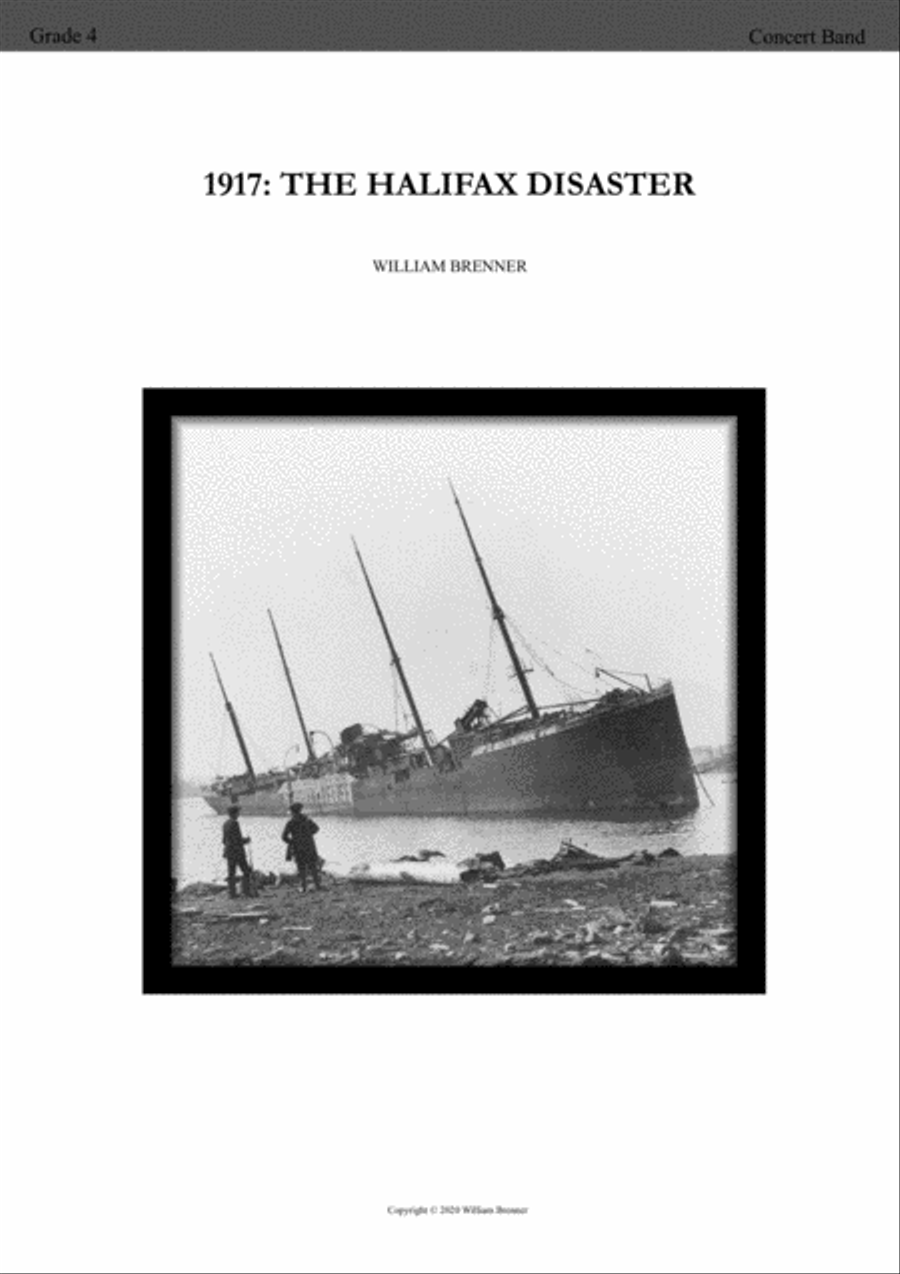
1917: The Halifax Disaster
Orchestre d'harmonie

$22.99 19.45 € Orchestre d'harmonie PDF SheetMusicPlus

Concert Band - Level 4 - Digital Download SKU: A0.942434 Arranged by Brock Lupton. Romantic Period. Score and parts. 84 pages. Brock Lupton #6879051. Published by Brock Lupton (A0.942434). Brahms composed the Alto Rhapsody, properly known as Rhapsody for Alto, Male Chorus, and Orchestra, opus 53 in 1869. It was first performed in Jena on March 3, 1870. The text is based on Harzreise im Winter (Winter Journey in the Harz Mountains), a poem by well-known German poet Johann Wolfgang von Goethe (1749-1832). The Alto Rhapsody, like many of Brahms’ works, has loneliness and alienation as its central themes. Brahms’ devotion to Clara Schumann, Robert Schumann’s widow, is well-known (the letters between her and Brahms fill two volumes). What is less well-known is that he was undoubtedly very fond of Julie Schumann, Clara’s daughter.In 1869, Brahms spent the summer near the Schumann’s residence and was in daily contact with Julie and Clara completing, among other works, the Liebeslieder (Love Song) Waltzes. In early July, Julie announced her engagement. Of course, I told Johannes first of all, Clara noted in her diary on the 11th. Soon after, the conductor Hermann Levi told her that Brahms had been devotedly attached to her daughter. By July 16th, Clara noted in her diary that Brahms speaks only in monosyllables . . . [and] treats Julie in the same manner, although he used to be so especially nice to her. Did he love her? Julie was married on September 22. Later on that very wedding day, Brahms called on Clara, who wrote in her diary, Johannes brought me a very wonderful piece . . . the words from Goethe’s Harzreise. . . He called it his bridal song. This piece seems to me neither more nor less than the expression of his own heart’s anguish. If only he would for once speak so tenderly! This piece is of course the dark and emotional Alto Rhapsody. Goethe’s poem Harzreise im Winter poetically describes the kind of life God intends for different temperaments. The three stanzas set by Brahms concern the fate of a man in fruitless struggle against the bonds of misery. A young man, turned misanthropic by sorrow, seeks solitude in the wilderness. The piece is in the baroque cantata style, with an opening recitative, and aria, and a concluding chorale. The alto describes the desolate winter landscape and in the final chorale joins the male chorus in a prayer for a melody that can bring comfort to the thirsting soul (indeed the plea restore his heart is repeated three times at the end, as a kind of Amen). In the Alto Rhapsody it is not hard to find evidence for Brahms’ statement that I speak through my music. The foregoing is from a program note written for a 1997 New York Choral Society performance of the Alto Rhapsody in observance of the centenary of the death of Johannes Brahms. It has been taken from the society web page http://www.nychoral.org/brahms/brahms3.htmlAn English translation of the German text used by Brahms SOLOBut down there, who is it?His path loses itself in the bush. Behind him the branches close. The grass stands up again. Desolation surrounds him. O, who heals the wounds of the one to whom balm has become poison, who drank hatred of people from the fullness of love? Once despised, now a despiser. Secretly he destroys himself in unsatisfying self-seeking. CHORUS If there is in your psaltery, Father of Love, a tone his ear can hear, let it enliven his heart.  .
Rhapsody for Concert Band
Orchestre d'harmonie
July 16th, Clara noted in her diary that Brahms speaks only in monosyllables
$20.00 16.92 € Orchestre d'harmonie PDF SheetMusicPlus

String Trio Cello,Viola,Violin - Level 3 - Digital Download SKU: A0.1214835 Composed by Ludwig van Beethoven (1770 – 1827). Arranged by James M. Guthrie, ASCAP. 19th Century,Chamber,Classical,Contest,Festival,Wedding. 5 pages. Jmsgu3 #811767. Published by jmsgu3 (A0.1214835). Beethoven’s Eleven Bagatelles Op. 119 are known for their expressive melodies and harmonies, and their innovative approach to form and tonality. The bagatelles were written during a period of time when Beethoven was undergoing a difficult phase in his life; he was struggling with hearing loss, family problems, and depression. Despite these challenges, he managed to produce a set of musical gems that are deeply moving and uplifting. The bagatelles show a remarkable range and depth of emotion, from playful and humorous to introspective and melancholic. These pieces serve as a testament to his resilience and creative genius in the face of personal adversity. More than two centuries after their composition, the bagatelles continue to inspire music enthusiasts around the world. The Bagatelles Op. 119 is a combination of old and new pieces that were not originally planned as a cycle.
Beethoven: Bagatelle Op. 119 No. 8 for String Trio
Trio à Cordes: violon, alto, violoncelle

$24.95 21.11 € Trio à Cordes: violon, alto, violoncelle PDF SheetMusicPlus

Horn,Trombone,Trumpet,Tuba - Level 4 - Digital Download SKU: A0.1158199 Composed by Dr. Daniel N. Thrower. 20th Century,Chamber,Classical,March,Patriotic. 32 pages. Https://gildedmusicpress.com/ #758476. Published by https://gildedmusicpress.com/ (A0.1158199). There is nothing more quintessentially military than the grand sound of marches at special military events. Hundreds of marches have served their purposes through the many decades of military tradition in the United States of America. This 3.5-minute march was composed for the occasion of the change of command of the 55th Wing—“The Fightin’ 55thâ€â€”under Air Combat Command, located at Offutt Air Force Base in Nebraska. The ceremony took place on June 14, 2019, which was also Flag Day. The new march served as a grateful tribute to the outgoing Commander, Colonel Michael H. Manion, and a welcoming gesture to the new Commander, Colonel Gavin P. Marks. Printed copies of the score were presented to the Commanders before the ceremony, and the march was premiered as the final pre-ceremony musical selection. The opening motifs are strongly reminiscent of the introductory measures of the “Air Force Song†most commonly played by Air Force brass quintets. Keeping in tradition with the form of most marches, the “Trio†section presents new material in a new key (down a fifth), with a contrastingly quiet dynamic. The opening motif of the Trio strain is a mutation, or a paraphrase, of “Anchors Aweighâ€, emphasizing the joint-force nature of the 55th Wing. The melody is repeated with a louder dynamic and a countermelody in the horn, and then is repeated once more with increased excitement in the accompaniment, variety of dynamics, and even a temporary key shift. Straying from the form most used by the “March Kingâ€, John Philip Sousa, Dr. Thrower omitted a fourth or final strain, and instead he modulated the key back to the original B-flat major and brought back the melodic content from the first strain. This form predates Sousa, and was more commonly used in Europe and early America. It smacks of “sonata formâ€, and even the modern formal designation of “recapitulating march†alludes to sonata form. The final recapitulating strain repeats with an obbligato soaring above it in the first trumpet part, now on piccolo trumpet. The march ends with a short coda that brings back the opening motivic allusion to the Air Force Song. Due to the selected formal structure, this march, “The Fightin’ 55thâ€, is much more unified than most typical marches. The very nature of military marches (including America’s beloved “Stars and Stripes Foreverâ€) displays four or even five completely unrelated melodies, or strains, throughout. The incorporation of thematic structure similar to that found in sonata form indeed makes “The Fightin’ 55th†an appropriate and even artistic concert march.
The Fightin' 55th (for Brass Quintet & Percussion)
Quintette de Cuivres: 2 trompettes, Cor, trombone, tuba

$24.95 21.11 € Quintette de Cuivres: 2 trompettes, Cor, trombone, tuba PDF SheetMusicPlus

Choral Choir,Choral (SATB) - Level 2 - Digital Download SKU: A0.1316374 By Liam Payne. By James Newman, Phil Cook, Philip Cook, and Samuel Preston. Arranged by Christopher Alexander. Christmas,Pop. 16 pages. Christopher Alexander #905118. Published by Christopher Alexander (A0.1316374). Though sharing its title with another well-known popular Christmas song, this song is very much different.  Liam Payne’s holiday pop ballad begins with a lyrical piano motif typical of most contemporary tunes on the radio.  The song retains its easygoing feeling through the verses and chorus even as the vocal texture expands to common triad structures.  This 2023 hit will be a great addition to the pop music in your Christmas concerts.Available in SATB, SSA, and TB.
All I Want (for Christmas)
Chorale SATB
Liam Payne
$2.25 1.9 € Chorale SATB PDF SheetMusicPlus

Concert Band - Level 3 - Digital Download SKU: A0.983162 Composed by Craig Wadley. Concert,Contemporary,Standards. Score and parts. 102 pages. Wadley Publications #3043809. Published by Wadley Publications (A0.983162). The Privateers is a swashbuckling depiction of an oceangoing pirate adventure, presented in the form of a march.  The piece starts with a brief fanfare, followed immediately by a rousing melody in the style of an old sea-shanty.  Images of sailing upon an endless sea of stars come to mind as a tranquil nocturne is presented, but the peace is shattered as cutlasses and sabers clash in a dogfight sure to end in Davy Jones’ locker!  The music swells to a dramatic conclusion as our mighty galleon surges across a stormy sea.   Instrumentation   The Privateers comes with full sets of both concert/stage and marching/field parts, allowing for great flexibility in your performance venues. Contemporary marching bands and drum & bugle corps utilize specialized field percussion which is typically not used in a concert setting.  With this piece, the use of outdoor percussion (quad toms and a tonal bass drum line) onstage is encouraged, although not required.  A single bass drum line is included which may be used instead of (or in addition to) the tonal bass drum line, and the Quad Toms part may be omitted.    A piano part is included, primarily for optional use indoors as a color instrument for the ensemble.  However, smaller bands in particular may find it useful for filling out the accompaniment line if instrumentation is limited.  Optionally, a very small ensemble of melodic instruments could be used, with the piano acting as a full-fledged accompaniment.   Several optional parts are included, such as Eb and Bb Horn, for ensembles with limited instrumentation.  Also, the two Low Winds parts should be distributed equally across trombone, baritone/euphonium, and tenor sax players.   Double reed parts are not included.  Double these instruments on appropriate parts to suit the needs of your ensemble.   Teaching Points   Meter – The alternation of 6/8 and 4/4 with a constant pulse (rather than a constant 8th note) provides an excellent opportunity to teach your students to shift the subdivision of the beat from triple to duple and back again.   Chromaticism & Accidentals – There is a recurring passage which features the prominent use of secondary dominants, or circle of fifths chord motion.  Students can learn a few less-than-common accidentals and enharmonics, while also getting a larger lesson in music theory.
The Privateers
Orchestre d'harmonie

$24.99 21.14 € Orchestre d'harmonie PDF SheetMusicPlus

String Quartet Cello,String Quartet,Viola,Violin - Level 2 - Digital Download SKU: A0.1230870 Composed by Ludwig van Beethoven. Arranged by James M. Guthrie, ASCAP. 19th Century,Chamber,Classical,Contest,Festival,Romantic Period. 9 pages. Jmsgu3 #826552. Published by jmsgu3 (A0.1230870). Beethoven’s Eleven Bagatelles Op. 119 are known for their expressive melodies and harmonies, and their innovative approach to form and tonality. The bagatelles were written during a period of time when Beethoven was undergoing a difficult phase in his life; he was struggling with hearing loss, family problems, and depression. Despite these challenges, he managed to produce a set of musical gems that are deeply moving and uplifting. The bagatelles show a remarkable range and depth of emotion, from playful and humorous to introspective and melancholic. These pieces serve as a testament to his resilience and creative genius in the face of personal adversity. More than two centuries after their composition, the bagatelles continue to inspire music enthusiasts around the world. The Bagatelles Op. 119 is a combination of old and new pieces that were not originally planned as a cycle. No. 1. Allegretto.No. 2. Andante con moto.No. 3. à l’ Allemande.No. 4. Andante cantabile.No. 5. Risoluto.No. 6. Andante – Allegretto.No. 7. Tranquillo.No. 8. Moderato cantabile.No. 9. Vivace moderato.No. 10. Allegramente.No. 11. Andante ma non troppo.
Beethoven: Bagatelle Op. 119 No. 2 for String Quartet
Quatuor à cordes: 2 violons, alto, violoncelle

$24.95 21.11 € Quatuor à cordes: 2 violons, alto, violoncelle PDF SheetMusicPlus

Choral Choir,Choral (TB) - Level 2 - Digital Download SKU: A0.1316376 By Liam Payne. By James Newman, Phil Cook, Philip Cook, and Samuel Preston. Arranged by Christopher Alexander. Christmas,Pop. 16 pages. Christopher Alexander #905120. Published by Christopher Alexander (A0.1316376). Though sharing its title with another well-known popular Christmas song, this song is very much different.  Liam Payne’s holiday pop ballad begins with a lyrical piano motif typical of most contemporary tunes on the radio.  The song retains its easygoing feeling through the verses and chorus even as the vocal texture expands to common triad structures.  This 2023 hit will be a great addition to the pop music in your Christmas concerts.Available in SATB, SSA, and TB.
All I Want (for Christmas)
Chorale 2 parties
Liam Payne
$2.25 1.9 € Chorale 2 parties PDF SheetMusicPlus


Partitions Gratuites
Acheter des Partitions Musicales
Acheter des Partitions Digitales à Imprimer
Acheter des Instruments de Musique

© 2000 - 2026

Accueil - Version intégrale





