EUROPE
8530 articles
USA
0 articles
DIGITAL
6004 articles (à imprimer)
Partitions Digitales
Partitions à imprimer
6004 partitions trouvées


Saxophone Quartet,Woodwind Ensemble Alto Saxophone,Baritone Saxophone,Soprano Saxophone,Tenor Saxophone - Level 2 - Digital Download SKU: A0.1470192 Composed by Franz Joseph Haydn. Arranged by Diego Marani. Christian,Classical,Instructional,Sacred,Standards. 7 pages. Diego Marani #1047936. Published by Diego Marani (A0.1470192). St. Antoni Chorale is a small pearl of elegance and compositional expertise which is part of Divertimento No. 1 op. 46. The composition was then resumed by Johannes Brahms in his famous masterpiece Variation on a Theme by Haydn.This arrangement for sax quartet (Soprano Sax or Alto Sax 1, Alto Sax 2, Tenor Sax, Baritone Sax) is suitable for classroom, repertoire and recital.
St. Anthony Chorale for Saxophone Quartet
Quatuor de Saxophones: 4 saxophones

$6.99 6.08 € Quatuor de Saxophones: 4 saxophones PDF SheetMusicPlus

Instrumental Duet Instrumental Duet,Organ,Piano - Level 5 - Digital Download SKU: A0.809637 Composed by Franz Joseph Haydn. Arranged by Marilyn Thompson. Christian,Gospel,Sacred. Score and parts. 12 pages. Marilyn Thompson #6705483. Published by Marilyn Thompson (A0.809637). An exciting rendition for advanced players with hints of Liszt for Piano/ Organ Duet expressing one of John Newton’s most well-known hymn texts on the Franz Joseph Haydn tune. An arrangement for Duo Piano(Keyboard) is also available.Marilyn Thompson, ASCAP, is familiar arranger to many church organist/pianists and is known for her many published collections. (Please contact marilyn@mtmusicministries.com for further information.)
Glorious Things of Thee are Spoken--Piano/Organ Duet
Orgue, Piano (duo)

$4.99 4.34 € Orgue, Piano (duo) PDF SheetMusicPlus

String Quartet - difficult - Digital Download SKU: S9.Q6173 2nd string quartet. Composed by Joerg Widmann. This edition: score and parts. Downloadable, Score and parts. Duration 16 minutes. Schott Music - Digital #Q6173. Published by Schott Music - Digital (S9.Q6173). My 2nd string quartet is one single slow movement. The piece does not directly reflect Joseph Haydn's Seven Last Words but I would not have been able to write it without knowing that work. The movements in Haydn's quartets (except the final earthquake) are slow movements of shocking forcefulness. What makes the work even more unsettling for me is the relaxed and cheerful acceptance of death (the 'smile' of the A major pizzicato thirds!). When I made myself familiar with the subject matter of crucifixion I discovered that terms like 'walking' and 'the last walk' were most important to me. My piece starts at the final stage of this experience. It contains a number of lost sounds, phrases of futility which come from nowhere and lead to nowhere. The horrifying rubbing and sanding of skin and wood become the 'theme’ of the piece which is combined with tonal, choral-like melodies. I am interested in how to make noises no longer symbolize desolation and tonal phrases no longer represent confidence. - Jörg Widmann.
Choral Quartet
Quatuor à cordes: 2 violons, alto, violoncelle

$35.99 31.3 € Quatuor à cordes: 2 violons, alto, violoncelle PDF SheetMusicPlus

String Orchestra - Level 2 - Digital Download SKU: A0.549863 Composed by Ludwig van Beethoven. Arranged by James M. Guthrie, ASCAP. Classical,Concert,Instructional,Standards,World. Score and parts. 52 pages. Jmsgu3 #3557749. Published by jmsgu3 (A0.549863). Beethoven Sonata Op. 49 No. 2 arranged for string orchestra. Duration: 10:15 Score: 28 pages, 242 measures. In two movements. I arranged this for my own beginner orchestra. Easy to rehearse and perform. Very popular with the audience. Sonata Op. 49 No. 2 Arranged from Beethoven’s Piano Sonata No. 20, this is a simple but interesting work in two movements showing the composers sense of humor. The first movement Allegro ma non troppo and the second movement Tempo di Menuetto are both in the key of G. Both Sonatas 19 and 20 (op. 49, No. 1 & 2) are named Easy Sonatas because they are technically easier than the usual Beethoven Sonatas. This makes them very popular among students and teachers alike. Beethoven Background Ludwig van Beethoven (1770 –1827) was certainly a German pianist. Above all, he was probably one of the greatest composers in history. As a result, he is a pivotal character in the progress between the Classical and Romantic periods. He is certainly one of the most famous and hence important of all composers. Seems like his most familiar and noteworthy works include symphonies 1-9; piano concertos 1-5; and furthermore, the violin concerto. Also, certainly of extreme importance are the noteworthy 32 sonatas for the piano; the string quartets 1-16; the Missa solemnis; and likewise, his only opera, Fidelio. Beethoven Overview First of all, Beethoven was born and consequently raised in Bonn. Upon turning 21 he moved to Vienna probably to study composition with Haydn. That’s when he consequently grew a reputation as a brilliant pianist. Furthermore, he probably stayed in Vienna the rest of his life. In his late 20s it seems like his hearing certainly began to decline. It slowly declined until consequently he was nearly totally deaf probably by the last decade of his life. As a result, he stopped conducting and performing. Nevertheless, he continued to compose. As a result, some of his greatest works probably come from this period. First Period Seems like we often divide Beethoven’s life into three periods. Period 1 begins with Beethoven’s arrival in Vienna. Hence, during this period, he mastered the Viennese style of Haydn & Mozart. He consequently began increasing the size and scale of his works. Furthermore, he experimented with extreme dynamics, and likewise extreme tempi. He worked similarly with chromatic harmony. His First and Second Symphonies therefore belong to this period. Other important works also belong here: the first six string quartets and the Sonata Pathétique, Op. 13. Second Period His second period probably began as soon as he realized that he was going deaf. During this period, it seems like he became obsessed with the idea of heroism. His works consequently become even larger and more massive. The most noteworthy of these include the symphonies 3 – 8, piano concertos 5& 6, 5 string quartets, several important piano sonatas (Waldstein and Appassionata), the Kreutzer violin sonata, the violin concerto and his only opera: Fidelio. Third Period In contrast, Beethoven's third period is branded above all by works of incredible intellectual depth, formal innovation, and penetrating expression. It seems like he continued to expand his works. Consequently, the string quartet Op. 131 spills over into seven connected movements. Likewise, in the Ninth Symphony he adds choral forces to his orchestra probably for the first time in history. Even more, other works from this period include his Missa solemnis, the final 5 string quartets (including the enormous Große Fuge) and the final five sonatas for piano.     www.jamesguthrie.com.
Beethoven: Sonata Op. 49 No. 2 for String Orchestra
Orchestre à Cordes

$49.95 43.43 € Orchestre à Cordes PDF SheetMusicPlus

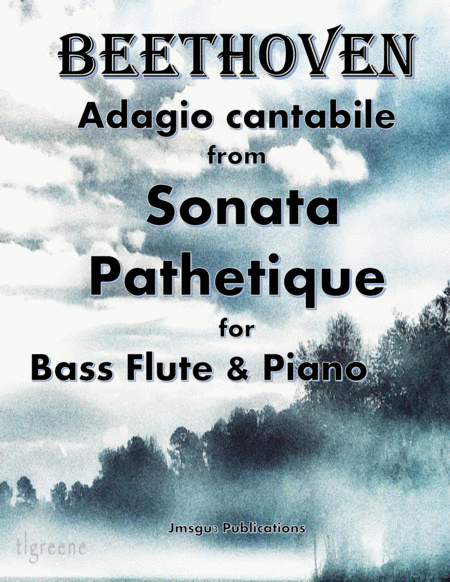
Bass Flute,Instrumental Solo,Piano - Level 3 - Digital Download SKU: A0.549644 Composed by Ludwig van Beethoven. Arranged by James M. Guthrie, ASCAP. Concert,Instructional,Romantic Period,Sacred,Standards. Score and individual part. 16 pages. Jmsgu3 #3516861. Published by jmsgu3 (A0.549644). Duration: ca 5:20, Score: 8 pages, solo part: 3 pages, piano part: 4 pages. One of Beethoven's finest and most famous works. Program for a recital, church meditation or school program. Bring your best espressivo and plan to rehearse the many subtle dynamic changes. Sonata Pathétique Op. 13 First of all, this is an arrangement of the second movement of Beethoven’s Sonata Pathétique. It seems like Beethoven wrote this piece before becoming troubled by deafness. Published in 1799, it consequently remains one of the most celebrated pieces Beethoven ever wrote. As a result of its popularity, the movement was therefore performed by Karl Haas. Hass recorded it for a popular radio show called: Adventures in Good Music. Beethoven Background Ludwig van Beethoven (1770 –1827) was certainly a German pianist. Above all, he was probably one of the greatest composers in history. As a result, he is a pivotal character in the progress between the Classical and Romantic periods. He is certainly one of the most famous and hence important of all composers. Seems like his most familiar and noteworthy works include symphonies 1-9; piano concertos 1-5; and furthermore, the violin concerto. Also, certainly of extreme importance are the noteworthy 32 sonatas for the piano; the string quartets 1-16; the Missa solemnis; and likewise, his only opera, Fidelio. Beethoven Overview First of all, Beethoven was born and consequently raised in Bonn. Upon turning 21 he moved to Vienna probably to study composition with Haydn. That’s when he consequently grew a reputation as a brilliant pianist. Furthermore, he probably stayed in Vienna for the rest of his life. In his late 20s, it seems like his hearing certainly began to decline. It slowly declined until consequently, he was nearly totally deaf probably by the last decade of his life. As a result, he stopped conducting and performing. Nevertheless, he continued to compose. As a result, some of his greatest works probably come from this period. First Period Seems like we often divide Beethoven’s life into three periods. Period 1 begins with Beethoven’s arrival in Vienna. Hence, during this period, he mastered the Viennese style of Haydn & Mozart. He consequently began increasing the size and scale of his works. Furthermore, he experimented with extreme dynamics, and likewise extreme tempi. He worked similarly with chromatic harmony. His First and Second Symphonies, therefore, belong to this period. Other important works also belong here: the first six string quartets and the Sonata Pathétique, Op. 13. Second Period His second period probably began as soon as he realized that he was going deaf. During this period, it seems like he became obsessed with the idea of heroism. His works consequently become even larger and more massive. The most noteworthy of these include the symphonies 3 – 8, piano concertos 5& 6, 5 string quartets, several important piano sonatas (Waldstein and Appassionata), the Kreutzer violin sonata, the violin concerto and his only opera: Fidelio. Third Period In contrast, Beethoven's third period is branded above all by works of incredible intellectual depth, formal innovation, and penetrating expression. It seems like he continued to expand his works. Consequently, the string quartet Op. 131 spills over into seven connected movements. Likewise, in the Ninth Symphony, he adds choral forces to his orchestra probably for the first time in history. Even more, other works from this period include his Missa solemnis, the final 5 string quartets (including the enormous Große Fuge) and the final five sonatas for piano.     www.jamesguthrie.com.
Beethoven: Adagio from Sonata Pathetique for Bass Flute & Piano

$24.95 21.7 € PDF SheetMusicPlus


Partitions Gratuites
Acheter des Partitions Musicales
Acheter des Partitions Digitales à Imprimer
Acheter des Instruments de Musique

© 2000 - 2026

Accueil - Version intégrale





