EUROPE
42419 articles
USA
0 articles
DIGITAL
10311 articles (à imprimer)
Partitions Digitales
Partitions à imprimer
10311 partitions trouvées


E-Flat Clarinet,Piano - Level 4 - Digital Download SKU: A0.549450 Composed by Sir Arthur Seymour Sullivan. Arranged by James M. Guthrie, ASCAP. Instructional,Romantic Period,Sacred,Standards. Score and part. 15 pages. Jmsgu3 #3497161. Published by jmsgu3 (A0.549450). Score: 10 pages, solo part: 2 pages, piano part: 3 pages. Duration: 4:25. Not difficult, but requires sensitivity & dynamic control. Suitable for recitals, church meditations, or school programs.  School Years First of all, Sullivan attended music school at the Royal Academy of Music. Because Sullivan was so talented, the Academy awarded him the Mendelssohn Scholarship for two years in a row. He, therefore, studied with John Goss, who studied with Thomas Atwood, who in turn studied with Mozart. Sullivan similarly studied the piano at the Academy with Arthur O’Leary. Study Abroad During his first year, he also earned money by singing solos in the Chapel Royal. At the end of his second year, the Academy consequently continued his scholarship and sent him to study at the Leipzig Conservatoire. He certainly studied composition, and likewise counterpoint and piano. Hence, during his final year in Leipzig, Sullivan finally completed his graduation composition project: Incidental Music for Shakespeare’s The Tempest. Association with Gilbert It seems like Sullivan built the bulk of his composing career largely in the 1860s. As a result, he became famous for his incidental music for the Tempest and his Irish Symphony. He, therefore, began collaborating with the poet W. S. Gilbert in the 1870s. Rather than focus on serious opera, Gilbert and Sullivan, in contrast, concentrated on comic opera such as H. M. S. Pinafore, the Pirates of Penzance, and the Mikado. Therefore, certainly as a result of his education and experience, Sullivan composed a total of 24 operas, 11 symphonic works, 10 choral pieces. Even more, he wrote a large number of noteworthy hymns such as Onward Christian Soldiers. The general style of his music is maybe similar to Mendelssohn, Schumann, and perhaps Liszt. It seems like Sullivan was fond of writing distinct melodies for each character in his operettas. His melodies combine together as the characters did. Furthermore, he was a master orchestrator, and therefore played the flute, clarinet, trumpet, and trombone fluently. The Lost Chord Sullivan wrote his most noteworthy song the Lost Chord in 1877. As a result, it was a great success and was certainly performed all over the world by a variety of singers such as Enrico Caruso. Because Sullivan was the most famous composer in England, the Lost Chord became the most famous of all British or American songs of the 1870s and 1890s. Consequently, in 1888 Thomas Edison recorded The Lost Chord for the phonograph. It was one of the first songs ever recorded. Furthermore, Queen Victoria knighted Sullivan in 1883.  
Sullivan: The Lost Chord for Alto Clarinet & Piano
Clarinette

$26.95 23.32 € Clarinette PDF SheetMusicPlus

B-Flat Clarinet,Piano - Level 4 - Digital Download SKU: A0.549444 Composed by Sir Arthur Seymour Sullivan. Arranged by James M. Guthrie, ASCAP. Instructional,Romantic Period,Sacred,Standards. Score and part. 15 pages. Jmsgu3 #3494745. Published by jmsgu3 (A0.549444). Score: 10 pages, solo part: 2 pages, piano part: 3 pages. Duration: 4:25. Not difficult, but requires sensitivity & dynamic control. Suitable for recitals, church meditations, or school programs. School Years First of all, Sullivan attended music school at the Royal Academy of Music. Because Sullivan was so talented, the Academy awarded him the Mendelssohn Scholarship for two years in a row. He, therefore, studied with John Goss, who studied with Thomas Atwood, who in turn studied with Mozart. Sullivan similarly studied the piano at the Academy with Arthur O’Leary. Study Abroad During his first year, he also earned money by singing solos in the Chapel Royal. At the end of his second year, the Academy consequently continued his scholarship and sent him to study at the Leipzig Conservatoire. He certainly studied composition, and likewise counterpoint and piano. Hence, during his final year in Leipzig, Sullivan finally completed his graduation composition project: Incidental Music for Shakespeare’s The Tempest. Association with Gilbert It seems like Sullivan built the bulk of his composing career largely in the 1860s. As a result, he became famous for his incidental music for the Tempest and his Irish Symphony. He, therefore, began collaborating with the poet W. S. Gilbert in the 1870s. Rather than focus on serious opera, Gilbert and Sullivan, in contrast, concentrated on comic operas such as H. M. S. Pinafore, the Pirates of Penzance, and the Mikado. Therefore, certainly as a result of his education and experience, Sullivan composed a total of 24 operas, 11 symphonic works, and 10 choral pieces. Even more, he wrote a large number of noteworthy hymns such as Onward Christian Soldiers. Lost Chord The general style of his music is maybe similar to Mendelssohn, Schumann, and perhaps Liszt. It seems like Sullivan was fond of writing distinct melodies for each character in his operettas. His melodies combine together as the characters did. Furthermore, he was a master orchestrator, and therefore played the flute, clarinet, trumpet, and trombone fluently. The Lost Chord Sullivan wrote his most noteworthy song the Lost Chord in 1877. As a result, it was a great success and was certainly performed all over the world by a variety of singers such as Enrico Caruso. Because Sullivan was the most famous composer in England, the Lost Chord became the most famous of all British or American songs of the 1870s and 1890s. Consequently, in 1888 Thomas Edison recorded The Lost Chord for the phonograph. It was one of the first songs ever recorded. Furthermore, Queen Victoria knighted Sullivan in 1883.  
Sullivan: The Lost Chord for Clarinet & Piano
Clarinette et Piano

$26.95 23.32 € Clarinette et Piano PDF SheetMusicPlus

Alto Saxophone,Piano - Level 4 - Digital Download SKU: A0.549443 Composed by Sir Arthur Seymour Sullivan. Arranged by James M. Guthrie, ASCAP. Instructional,Romantic Period,Sacred,Standards. Score and part. 15 pages. Jmsgu3 #3494751. Published by jmsgu3 (A0.549443). Score: 10 pages, solo part: 2 pages, piano part: 3 pages. Duration: 4:25. Not difficult, but requires sensitivity & dynamic control. Suitable for recitals, church meditations, or school programs. School Years First of all, Sullivan attended music school at the Royal Academy of Music. Because Sullivan was so talented, the Academy awarded him the Mendelssohn Scholarship for two years in a row. He, therefore, studied with John Goss, who studied with Thomas Atwood, who in turn studied with Mozart. Sullivan similarly studied the piano at the Academy with Arthur O’Leary. Study Abroad During his first year, he also earned money by singing solos in the Chapel Royal. At the end of his second year, the Academy consequently continued his scholarship and sent him to study at the Leipzig Conservatoire. He certainly studied composition, and likewise counterpoint and piano. Hence, during his final year in Leipzig, Sullivan finally completed his graduation composition project: Incidental Music for Shakespeare’s The Tempest. Association with Gilbert It seems like Sullivan built the bulk of his composing career largely in the 1860s. As a result, he became famous for his incidental music for the Tempest and his Irish Symphony. He, therefore, began collaborating with the poet W. S. Gilbert in the 1870s. Rather than focus on serious opera, Gilbert and Sullivan, in contrast, concentrated on comic operas such as H. M. S. Pinafore, the Pirates of Penzance, and the Mikado. Therefore, certainly as a result of his education and experience, Sullivan composed a total of 24 operas, 11 symphonic works, and 10 choral pieces. Even more, he wrote a large number of noteworthy hymns such as Onward Christian Soldiers. Lost Chord Winds The general style of his music is maybe similar to Mendelssohn, Schumann, and perhaps Liszt. It seems like Sullivan was fond of writing distinct melodies for each character in his operettas. His melodies combine together as the characters did. Furthermore, he was a master orchestrator, and therefore played the flute, clarinet, trumpet, and trombone fluently. The Lost Chord Sullivan wrote his most noteworthy song the Lost Chord in 1877. As a result, it was a great success and was certainly performed all over the world by a variety of singers such as Enrico Caruso. Because Sullivan was the most famous composer in England, the Lost Chord became the most famous of all British or American songs of the 1870s and 1890s. Consequently, in 1888 Thomas Edison recorded The Lost Chord for the phonograph. It was one of the first songs ever recorded. Furthermore, Queen Victoria knighted Sullivan in 1883.  
Sullivan: The Lost Chord for Alto Sax & Piano
Saxophone Alto et Piano

$26.95 23.32 € Saxophone Alto et Piano PDF SheetMusicPlus

Baritone Horn TC,Euphonium,Piano - Level 4 - Digital Download SKU: A0.552854 Composed by Sir Arthur Seymour Sullivan. Arranged by James M. Guthrie, ASCAP. Instructional,Romantic Period,Sacred,Standards. Score and part. 15 pages. Jmsgu3 #3497277. Published by jmsgu3 (A0.552854). Score: 10 pages, solo part: 2 pages, piano part: 3 pages. Duration: 4:25. Not difficult, but requires sensitivity & dynamic control. Suitable for recitals, church meditations, or school programs. School Years First of all, Sullivan attended music school at the Royal Academy of Music. Because Sullivan was so talented, the Academy awarded him the Mendelssohn Scholarship for two years in a row. He, therefore, studied with John Goss, who studied with Thomas Atwood, who in turn studied with Mozart. Sullivan similarly studied the piano at the Academy with Arthur O’Leary. Study Abroad During his first year, he also earned money by singing solos in the Chapel Royal. At the end of his second year, the Academy consequently continued his scholarship and sent him to study at the Leipzig Conservatoire. He certainly studied composition, and likewise counterpoint and piano. Hence, during his final year in Leipzig, Sullivan finally completed his graduation composition project: Incidental Music for Shakespeare’s The Tempest. Association with Gilbert It seems like Sullivan built the bulk of his composing career largely in the 1860s. As a result, he became famous for his incidental music for the Tempest and his Irish Symphony. He, therefore, began collaborating with the poet W. S. Gilbert in the 1870s. Rather than focus on serious opera, Gilbert and Sullivan, in contrast, concentrated on comic opera such as H. M. S. Pinafore, the Pirates of Penzance, and the Mikado. Therefore, certainly as a result of his education and experience, Sullivan composed a total of 24 operas, 11 symphonic works, 10 choral pieces. Even more, he wrote a large number of noteworthy hymns such as Onward Christian Soldiers. Lost Chord The general style of his music is maybe similar to Mendelssohn, Schumann, and perhaps Liszt. It seems like Sullivan was fond of writing distinct melodies for each character in his operettas. His melodies combine together as the characters did. Furthermore, he was a master orchestrator, and therefore played the flute, clarinet, trumpet, and trombone fluently. The Lost Chord Sullivan wrote his most noteworthy song the Lost Chord in 1877. As a result, it was a great success and was certainly performed all over the world by a variety of singers such as Enrico Caruso. Because Sullivan was the most famous composer in England, the Lost Chord became the most famous of all British or American songs of the 1870s and 1890s. Consequently, in 1888 Thomas Edison recorded The Lost Chord for the phonograph. It was one of the first songs ever recorded. Furthermore, Queen Victoria knighted Sullivan in 1883.    
Sullivan: The Lost Chord for Baritone Horn & Piano

$26.95 23.32 € PDF SheetMusicPlus

Euphonium,Piano - Level 4 - Digital Download SKU: A0.549459 Composed by Sir Arthur Seymour Sullivan. Arranged by James M. Guthrie, ASCAP. Instructional,Romantic Period,Sacred,Standards. Score and part. 15 pages. Jmsgu3 #3497273. Published by jmsgu3 (A0.549459). Score: 10 pages, solo part: 2 pages, piano part: 3 pages. Duration: 4:25. Not difficult, but requires sensitivity & dynamic control. Suitable for recitals, church meditations, or school programs. School Years First of all, Sullivan attended music school at the Royal Academy of Music. Because Sullivan was so talented, the Academy awarded him the Mendelssohn Scholarship for two years in a row. He, therefore, studied with John Goss, who studied with Thomas Atwood, who in turn studied with Mozart. Sullivan similarly studied the piano at the Academy with Arthur O’Leary. Study Abroad During his first year, he also earned money by singing solos in the Chapel Royal. At the end of his second year, the Academy consequently continued his scholarship and sent him to study at the Leipzig Conservatoire. He certainly studied composition, and likewise counterpoint and piano. Hence, during his final year in Leipzig, Sullivan finally completed his graduation composition project: Incidental Music for Shakespeare’s The Tempest. Association with Gilbert It seems like Sullivan built the bulk of his composing career largely in the 1860s. As a result, he became famous for his incidental music for the Tempest and his Irish Symphony. He, therefore, began collaborating with the poet W. S. Gilbert in the 1870s. Rather than focus on serious opera, Gilbert and Sullivan, in contrast, concentrated on comic opera such as H. M. S. Pinafore, the Pirates of Penzance, and the Mikado. Therefore, certainly as a result of his education and experience, Sullivan composed a total of 24 operas, 11 symphonic works, 10 choral pieces. Even more, he wrote a large number of noteworthy hymns such as Onward Christian Soldiers. Lost Chord The general style of his music is maybe similar to Mendelssohn, Schumann, and perhaps Liszt. It seems like Sullivan was fond of writing distinct melodies for each character in his operettas. His melodies combine together as the characters did. Furthermore, he was a master orchestrator, and therefore played the flute, clarinet, trumpet, and trombone fluently. The Lost Chord Sullivan wrote his most noteworthy song the Lost Chord in 1877. As a result, it was a great success and was certainly performed all over the world by a variety of singers such as Enrico Caruso. Because Sullivan was the most famous composer in England, the Lost Chord became the most famous of all British or American songs of the 1870s and 1890s. Consequently, in 1888 Thomas Edison recorded The Lost Chord for the phonograph. It was one of the first songs ever recorded. Furthermore, Queen Victoria knighted Sullivan in 1883.    
Sullivan: The Lost Chord for Euphonium & Piano
Euphonium, Piano (duo)

$26.95 23.32 € Euphonium, Piano (duo) PDF SheetMusicPlus

Bass Clarinet,Piano - Level 4 - Digital Download SKU: A0.549451 Composed by Sir Arthur Seymour Sullivan. Arranged by James M. Guthrie, ASCAP. Instructional,Romantic Period,Sacred,Standards. Score and part. 15 pages. Jmsgu3 #3497171. Published by jmsgu3 (A0.549451). Score: 10 pages, solo part: 2 pages, piano part: 3 pages. Duration: 4:25. Not difficult, but requires sensitivity & dynamic control. Suitable for recitals, church meditations, or school programs. School Years First of all, Sullivan attended music school at the Royal Academy of Music. Because Sullivan was so talented, the Academy awarded him the Mendelssohn Scholarship for two years in a row. He, therefore, studied with John Goss, who studied with Thomas Atwood, who in turn studied with Mozart. Sullivan similarly studied the piano at the Academy with Arthur O’Leary. Study Abroad During his first year, he also earned money by singing solos in the Chapel Royal. At the end of his second year, the Academy consequently continued his scholarship and sent him to study at the Leipzig Conservatoire. He certainly studied composition, and likewise counterpoint and piano. Hence, during his final year in Leipzig, Sullivan finally completed his graduation composition project: Incidental Music for Shakespeare’s The Tempest. Association with Gilbert It seems like Sullivan built the bulk of his composing career largely in the 1860s. As a result, he became famous for his incidental music for the Tempest and his Irish Symphony. He, therefore, began collaborating with the poet W. S. Gilbert in the 1870s. Rather than focus on serious opera, Gilbert and Sullivan, in contrast, concentrated on comic opera such as H. M. S. Pinafore, the Pirates of Penzance, and the Mikado. Therefore, certainly as a result of his education and experience, Sullivan composed a total of 24 operas, 11 symphonic works, 10 choral pieces. Even more, he wrote a large number of noteworthy hymns such as Onward Christian Soldiers. Lost Chord The general style of his music is maybe similar to Mendelssohn, Schumann, and perhaps Liszt. It seems like Sullivan was fond of writing distinct melodies for each character in his operettas. His melodies combine together as the characters did. Furthermore, he was a master orchestrator, and therefore played the flute, clarinet, trumpet, and trombone fluently. The Lost Chord Sullivan wrote his most noteworthy song the Lost Chord in 1877. As a result, it was a great success and was certainly performed all over the world by a variety of singers such as Enrico Caruso. Because Sullivan was the most famous composer in England, the Lost Chord became the most famous of all British or American songs of the 1870s and 1890s. Consequently, in 1888 Thomas Edison recorded The Lost Chord for the phonograph. It was one of the first songs ever recorded. Furthermore, Queen Victoria knighted Sullivan in 1883.  
Sullivan: The Lost Chord for Bass Clarinet & Piano
Clarinette Basse, Piano

$26.95 23.32 € Clarinette Basse, Piano PDF SheetMusicPlus

Instrumental Solo,Piano,Piccolo - Level 4 - Digital Download SKU: A0.549453 Composed by Sir Arthur Seymour Sullivan. Arranged by James M. Guthrie, ASCAP. Instructional,Romantic Period,Sacred,Standards. Score and individual part. 15 pages. Jmsgu3 #3497211. Published by jmsgu3 (A0.549453). Score: 10 pages, solo part: 2 pages, piano part: 3 pages. Duration: 4:25.Not difficult, but requires sensitivity & dynamic control. Suitable for recitals, church meditations, or school programs. School Years First of all, Sullivan attended music school at the Royal Academy of Music. Because Sullivan was so talented, the Academy awarded him the Mendelssohn Scholarship for two years in a row. He, therefore, studied with John Goss, who studied with Thomas Atwood, who in turn studied with Mozart. Sullivan similarly studied the piano at the Academy with Arthur O’Leary. Study Abroad During his first year, he also earned money by singing solos in the Chapel Royal. At the end of his second year, the Academy consequently continued his scholarship and sent him to study at the Leipzig Conservatoire. He certainly studied composition, and likewise counterpoint and piano. Hence, during his final year in Leipzig, Sullivan finally completed his graduation composition project: Incidental Music for Shakespeare’s The Tempest. Association with Gilbert It seems like Sullivan built the bulk of his composing career largely in the 1860s. As a result, he became famous for his incidental music for the Tempest and his Irish Symphony. He, therefore, began collaborating with the poet W. S. Gilbert in the 1870s. Rather than focus on serious opera, Gilbert and Sullivan, in contrast, concentrated on comic opera such as H. M. S. Pinafore, the Pirates of Penzance, and the Mikado. Therefore, certainly as a result of his education and experience, Sullivan composed a total of 24 operas, 11 symphonic works, 10 choral pieces. Even more, he wrote a large number of noteworthy hymns such as Onward Christian Soldiers. Lost Chord The general style of his music is maybe similar to Mendelssohn, Schumann, and perhaps Liszt. It seems like Sullivan was fond of writing distinct melodies for each character in his operettas. His melodies combine together as the characters did. Furthermore, he was a master orchestrator, and therefore played the flute, clarinet, trumpet, and trombone fluently. The Lost Chord Sullivan wrote his most noteworthy song the Lost Chord in 1877. As a result, it was a great success and was certainly performed all over the world by a variety of singers such as Enrico Caruso. Because Sullivan was the most famous composer in England, the Lost Chord became the most famous of all British or American songs of the 1870s and 1890s. Consequently, in 1888 Thomas Edison recorded The Lost Chord for the phonograph. It was one of the first songs ever recorded. Furthermore, Queen Victoria knighted Sullivan in 1883.  
Sullivan: The Lost Chord for Piccolo & Piano
Piccolo, Piano

$26.95 23.32 € Piccolo, Piano PDF SheetMusicPlus

Cello,Piano - Level 3 - Digital Download SKU: A0.549440 Composed by Sir Arthur Seymour Sullivan. Arranged by James M. Guthrie, ASCAP. Instructional,Romantic Period,Sacred,Standards. Score and part. 14 pages. Jmsgu3 #3494673. Published by jmsgu3 (A0.549440). Score: 7 pages, solo part: 2 pages, piano part: 3 pages. Duration: 4:25. Not difficult, but requires sensitivity & dynamic control. Suitable for recitals, church meditations, or school programs. School Years First of all, Sullivan attended music school at the Royal Academy of Music. Because Sullivan was so talented, the Academy awarded him the Mendelssohn Scholarship for two years in a row. He, therefore, studied with John Goss, who studied with Thomas Atwood, who in turn studied with Mozart. Sullivan similarly studied the piano at the Academy with Arthur O’Leary. Study Abroad During his first year, he also earned money by singing solos in the Chapel Royal. At the end of his second year, the Academy consequently continued his scholarship and sent him to study at the Leipzig Conservatoire. He certainly studied composition, and likewise counterpoint and piano. Hence, during his final year in Leipzig, Sullivan finally completed his graduation composition project: Incidental Music for Shakespeare’s The Tempest. Association with Gilbert It seems like Sullivan built the bulk of his composing career largely in the 1860s. As a result, he became famous for his incidental music for the Tempest and his Irish Symphony. He, therefore, began collaborating with the poet W. S. Gilbert in the 1870s. Rather than focus on serious opera, Gilbert and Sullivan, in contrast, concentrated on comic operas such as H. M. S. Pinafore, the Pirates of Penzance, and the Mikado. Therefore, certainly as a result of his education and experience, Sullivan composed a total of 24 operas, 11 symphonic works, and 10 choral pieces. Even more, he wrote a large number of noteworthy hymns such as Onward Christian Soldiers. Lost Chord The general style of his music is maybe similar to Mendelssohn, Schumann, and perhaps Liszt. It seems like Sullivan was fond of writing distinct melodies for each character in his operettas. His melodies combine together as the characters did. Furthermore, he was a master orchestrator, and therefore played the flute, clarinet, trumpet, and trombone fluently. The Lost Chord Sullivan wrote his most noteworthy song the Lost Chord in 1877. As a result, it was a great success and was certainly performed all over the world by a variety of singers such as Enrico Caruso. Because Sullivan was the most famous composer in England, the Lost Chord became the most famous of all British or American songs of the 1870s and 1890s. Consequently, in 1888 Thomas Edison recorded The Lost Chord for the phonograph. It was one of the first songs ever recorded. Furthermore, Queen Victoria knighted Sullivan in 1883.    
Sullivan: The Lost Chord for Cello & Piano
Violoncelle, Piano

$26.95 23.32 € Violoncelle, Piano PDF SheetMusicPlus

Instrumental Duet Bassoon,Instrumental Duet - Level 4 - Digital Download SKU: A0.549452 Composed by Sir Arthur Seymour Sullivan. Arranged by James M. Guthrie, ASCAP. Instructional,Romantic Period,Sacred,Standards. Score and parts. 15 pages. Jmsgu3 #3497185. Published by jmsgu3 (A0.549452). Score: 10 pages, solo part: 2 pages, piano part: 3 pages. Duration: 4:25. Not difficult, but requires sensitivity & dynamic control. Suitable for recitals, church meditations, or school programs. School Years First of all, Sullivan attended music school at the Royal Academy of Music. Because Sullivan was so talented, the Academy awarded him the Mendelssohn Scholarship for two years in a row. He, therefore, studied with John Goss, who studied with Thomas Atwood, who in turn studied with Mozart. Sullivan similarly studied the piano at the Academy with Arthur O’Leary. Study Abroad During his first year, he also earned money by singing solos in the Chapel Royal. At the end of his second year, the Academy consequently continued his scholarship and sent him to study at the Leipzig Conservatoire. He certainly studied composition, and likewise counterpoint and piano. Hence, during his final year in Leipzig, Sullivan finally completed his graduation composition project: Incidental Music for Shakespeare’s The Tempest. Association with Gilbert It seems like Sullivan built the bulk of his composing career largely in the 1860s. As a result, he became famous for his incidental music for the Tempest and his Irish Symphony. He, therefore, began collaborating with the poet W. S. Gilbert in the 1870s. Rather than focus on serious opera, Gilbert and Sullivan, in contrast, concentrated on comic opera such as H. M. S. Pinafore, the Pirates of Penzance, and the Mikado. Therefore, certainly as a result of his education and experience, Sullivan composed a total of 24 operas, 11 symphonic works, 10 choral pieces. Even more, he wrote a large number of noteworthy hymns such as Onward Christian Soldiers. Lost Chord The general style of his music is maybe similar to Mendelssohn, Schumann, and perhaps Liszt. It seems like Sullivan was fond of writing distinct melodies for each character in his operettas. His melodies combine together as the characters did. Furthermore, he was a master orchestrator, and therefore played the flute, clarinet, trumpet, and trombone fluently. The Lost Chord Sullivan wrote his most noteworthy song the Lost Chord in 1877. As a result, it was a great success and was certainly performed all over the world by a variety of singers such as Enrico Caruso. Because Sullivan was the most famous composer in England, the Lost Chord became the most famous of all British or American songs of the 1870s and 1890s. Consequently, in 1888 Thomas Edison recorded The Lost Chord for the phonograph. It was one of the first songs ever recorded. Furthermore, Queen Victoria knighted Sullivan in 1883.    
Sullivan: The Lost Chord for Bassoon & Piano
2 Bassons (duo)

$26.95 23.32 € 2 Bassons (duo) PDF SheetMusicPlus

B-Flat Trumpet,Piano - Level 4 - Digital Download SKU: A0.549457 Composed by Sir Arthur Seymour Sullivan. Arranged by James M. Guthrie, ASCAP. Instructional,Romantic Period,Sacred,Standards. Score and part. 15 pages. Jmsgu3 #3497259. Published by jmsgu3 (A0.549457). Score: 10 pages, solo part: 2 pages, piano part: 3 pages. Duration: 4:25. Not difficult, but requires sensitivity & dynamic control. Suitable for recitals, church meditations, or school programs. School Years First of all, Sullivan attended music school at the Royal Academy of Music. Because Sullivan was so talented, the Academy awarded him the Mendelssohn Scholarship for two years in a row. He, therefore, studied with John Goss, who studied with Thomas Atwood, who in turn studied with Mozart. Sullivan similarly studied the piano at the Academy with Arthur O’Leary. Study Abroad During his first year, he also earned money by singing solos in the Chapel Royal. At the end of his second year, the Academy consequently continued his scholarship and sent him to study at the Leipzig Conservatoire. He certainly studied composition, and likewise counterpoint and piano. Hence, during his final year in Leipzig, Sullivan finally completed his graduation composition project: Incidental Music for Shakespeare’s The Tempest. Association with Gilbert It seems like Sullivan built the bulk of his composing career largely in the 1860s. As a result, he became famous for his incidental music for the Tempest and his Irish Symphony. He, therefore, began collaborating with the poet W. S. Gilbert in the 1870s. Rather than focus on serious opera, Gilbert and Sullivan, in contrast, concentrated on comic opera such as H. M. S. Pinafore, the Pirates of Penzance, and the Mikado. Therefore, certainly as a result of his education and experience, Sullivan composed a total of 24 operas, 11 symphonic works, 10 choral pieces. Even more, he wrote a large number of noteworthy hymns such as Onward Christian Soldiers. Lost Chord The general style of his music is maybe similar to Mendelssohn, Schumann, and perhaps Liszt. It seems like Sullivan was fond of writing distinct melodies for each character in his operettas. His melodies combine together as the characters did. Furthermore, he was a master orchestrator, and therefore played the flute, clarinet, trumpet, and trombone fluently. The Lost Chord Sullivan wrote his most noteworthy song the Lost Chord in 1877. As a result, it was a great success and was certainly performed all over the world by a variety of singers such as Enrico Caruso. Because Sullivan was the most famous composer in England, the Lost Chord became the most famous of all British or American songs of the 1870s and 1890s. Consequently, in 1888 Thomas Edison recorded The Lost Chord for the phonograph. It was one of the first songs ever recorded. Furthermore, Queen Victoria knighted Sullivan in 1883.  
Sullivan: The Lost Chord for Trumpet & Piano
Trompette

$26.95 23.32 € Trompette PDF SheetMusicPlus

Vocal, Solo Solo Voice - Digital Download SKU: H1.804DP Arranged by Don Doig, Jack Schrader, and John F. Wilson. General Worship. Collection. 392 pages. Hope Publishing - Digital #804DP. Published by Hope Publishing - Digital (H1.804DP). By Various Writers.140 Christian songs by Various Writers Contains over 140 songs including: Because He Lives, Communion Song, Great Is Thy Faithfulness, the Holy City, I Wonder as I Wander, Learning to Lean, Malotte's Lord's Prayer, Wedding Song, and The Palms. Contains over 140 songs including: Because He Lives, Communion Song, Great Is Thy Faithfulness, the Holy City, I Wonder as I Wander, Learning to Lean, Malotte's Lord's Prayer, Wedding Song, and The Palms.
Everything for the Church Soloist-Digital Download
Various Writers

140 Christian songs by Various Writers Contains over 140 songs including: Because He Lives, Communion Song, Great Is Thy Faithfulness, the Holy City, I Wonder as I Wander, Learning to Lean, Malotte's Lord's Prayer, Wedding Song, and The Palms
$79.95 69.18 € PDF SheetMusicPlus

Full Orchestra - Level 3 - Digital Download SKU: A0.976734 Composed by Robert Myers. 20th Century,Christmas,Contemporary. Score and parts. 99 pages. WheatMyer Music #6496769. Published by WheatMyer Music (A0.976734). CONJUNCTION interprets the convergence of Jupiter and Saturn near the end of the year 2020 as a celestial metaphor for the good news of Christ's birth in a replay of the Star of Bethlehem. Hence, its subtitle of The Christmas Star of 2020. The music, along with narration from selected Old and New Testament scriptures, delivers a message of hope amid the turmoil and chaos of current times.It's written for smaller concert bands hungry for challenging music. Ample cues and doubling allow for flexible instrumentation while mixed meters, varying tempos and textures, and interesting solo lines provide opportunities for strong players to shine. CONJUNCTION is also available with strings for orchestra.PROGRAM NOTES:2020 is widely characterized for its maladies: murders, burning cities, riots, a pandemic, economic shocks, and political turmoil. For some of us, it also held personal tragedy such as my brother’s passing from COVID. But, 2020 also brought a sign of hope, namely the celestial phenomenon known as the Great Conjunction of 2020. For earth-bound observers, this was the closest approach of Jupiter and Saturn in almost 400 years as they appeared to almost touch in the early evening sky to produce the most brilliant evening star of our lifetimes. The occurrence of the event in November-December neatly coincided with the Advent season, peaking just before Christmas Day. One could hardly fail to note the parallels with the Christmas star of Matthew’s gospel which gave the conjunction its alternate name, the Christmas Star of 2020. Thus, this star spoke, to those with ears to hear, the same message the prophet Isaiah wrote about the coming Messiah, The people that walked in darkness have seen a great light. This star thus served to remind us that the LORD has not rejected us; He will show His favor again; His love has not vanished; His promises have not failed; He has not forgotten to be merciful or compassionate; and we are called to remember His mighty deeds (Psalm 77). CONJUNCTION: The Christmas Star of 2020 is inspired by these particulars.For the music, I looked to Gustav Holst’s The Planets for themes that would portray Jupiter and Saturn’s pas de deux. I selected several motives from the corresponding movements mixed and matched in sometimes easily recognized quotations and other times in heavily camouflaged derivations. An exuberant polyphonic passage recaps themes from both Jupiter and Saturn when the music resolves from uncertainty into hopefulness. While Holst’s motives provide CONJUNCTION’s foundation I also used Handel’s Messiah for transitory and climactic material. You will hear his The people who walked in darkness have seen a great light in transitions and a short trombone solo. And a re-harmonization of the opening line from For unto us a child is born brings the music to a joyous climax.Although the music stands firmly on its own, I elected to incorporate some narrative to make the musical sentiment explicit. In a commentary on 2020’s grim events, I took adaptations of Habakkuk 1:2-4 and 2 Tim 3:1-4 and set them over Saturn’s plodding and ominous harmonies. Contrasting replies shimmer with hope as the narration melds Isaiah 9:2 and Luke 1:78-79 over another Saturn motive set against pitch sets from Jupiter’s main hymn theme. Still, it’s the music that tells the story of the Christmas Star of 2020.Please visit my website for a complete score preview: https://wheatmyermusic.com/conjunction-the-christmas-star-of-2020I feel somewhat guilty making claim to this music as almost all the building blocks are taken from other composers. But the end result is neither a medley, nor an arrangement, rather it is something clearly new, so I call it my own with deep respect to those giants on whose shoulders I stand.Robert MyersS.D.G.
CONJUNCTION: The Christmas Star of 2020
Orchestre

$95.00 82.2 € Orchestre PDF SheetMusicPlus

Alto Voice,Sampler - Level 4 - Digital Download SKU: A0.1350393 By David Warin Solomons. By David Warin Solomons. Contemporary,Multicultural,Singer/Songwriter,World. Full Performance. Duration 249. David Warin Solomons #935190. Published by David Warin Solomons (A0.1350393). Déjeuner du matin - poem by Jacques PrévertEnglish translation by Lawrence FerlinghettiMusical improvisation on 8-track Fostex with Archimedes sequencer sung by David W Solomons with various samples (1989)using my Isaiah sequence (circular A minor arpeggio feature with bass note going down by semitones returning via a dominant 7th chord)This is best heard on headphones to get the English and French versions separately.Recently described by Howie Richey as follows:sounds like Stairway to Heaven sung by Sgt. Pepper!Yup I can see that LOLFrench and English versions:Déjeuner Du MatinIl a mis le caféDans la tasseIl a mis le laitDans la tasse de caféIl a mis le sucreDans le café au laitAvec la petite cuillèreIl a tournéIl a bu le café au laitEt il a reposé la tasseSans me parlerIl a alluméUne cigaretteIl a fait des rondsAvec la fuméeIl a mis les cendresDans le cendrierSans me parlerSans me regarderIl s'est levéIl a misSon chapeau sur la têteIl a misSon manteau de pluieParce qu'il pleuvaitEt il est partiSous la pluieSans une paroleSans me regarderEt moi, j'ai prisMa tête dans ma mainEt j'ai pleuréBreakfastHe put the coffee in the cupHe put the milk inthe cup of coffeeHe put the sugarin the café au laitWith a coffee spoon he stirred he drank the café au lait and set down the cupwithout a word to mewithout a word to mehe lit a cigarettehe made smoke ringswith the smokehe put the ashesin the ash traywithout a word to mewithout a look at mehe got uphe put his hat upon his headhe put his raincoat on because it was rainingand he left in the rainwith out a wordwithout a look at meand I ....I took my head in my hand and I cried.
Déjeuner du matin sung in French and English with various samples (mp3)
David Warin Solomons
$5.50 4.76 € PDF SheetMusicPlus

Acoustic Guitar,Instrumental Solo - Level 3 - Digital Download SKU: A0.1156205 Composed by Traditional/Anonymous. Arranged by Socrates Arvanitakis. Classical,Early Music,Folk,Traditional. Individual part. 43 pages. Socrates Arvanitakis #756519. Published by Socrates Arvanitakis (A0.1156205). This is the seventeenth volume of an extensive collection of folk songs arranged for the classical guitar mostly in two-part counterpoint. The arrangements are of moderate difficulty and the aims of this publication are to familiarise, entertain and educate guitarists (and other musicians) with a melodic repertoire of lasting aesthetic value, under the light of contrapuntal treatment. The thirty five volumes of this collection can certainly be printed on paper if so desired and there are a few pages in each volume, either blank or with photographs of various musicians, which can be inserted at will in any place for the correct ordering of left and right hand pages so that page turns can be avoided. The principle of avoiding page turns has been maintained in all volumes, but this edition is also designed with mobile electronic devices in mind such as tablets etc, using the environment and facilities of a score reading application, towards a paperless world, at least in music. Therefore the size of the staves is bigger than usual for ease of reading on a small screen but not big enough to exceed the limit of a two-page view. Active internal links for navigating from thematic indexes to particular songs and back to indexes have been added, and also external internet links to sites that give further information for the 945 songs of this first collection for classical guitar.Folk Songs For Classical Guitar - Volume 17 (Songs 433-459)I Love My LoveI must live all aloneI saw a maidenI will Give my Love an AppleI will give you the keys of Heaven (Cheshire)I wish I was Single AgainI wish I wish 1 (My True Love Once He courted Me 1)I wish I wish 2 (My True Love Once He courted Me 2)I wish I wish 3 (My True Love Once He courted Me 3)I wish I wish 4 (My True Love Once He courted Me 4)I Wonder as I WanderI’ll Build Myself A Gallant ShipI’ll Mount the Air on Swallow’s Wings [The Loyal Lover]I’ll Tell You of a FellowI’m a Man that’s done wrong to my ParentsI’m A’ Doon For Lack of JohnnieI’se the B’y That Builds the BoatI’ve Set My Face For Zion’s KingdomIn a British Man O’ WarIn Bethlehem CityIn Good King Arthur’s Time (King Arthur’s Servants)In My Father’s GardenIn Nightly StillnessIron Horse (THE)Isle of DreamsIt’s of a farmer all in the town.
Folk Songs For Classical Guitar - Volume 17 (Songs 433-459)

$25.00 21.63 € PDF SheetMusicPlus

Piano Solo - Level 3 - Digital Download SKU: A0.533330 Composed by Marie-Agnès Nataf. Concert,Contemporary. Score. 7 pages. Musik Fabrik Music Publishing #2344341. Published by Musik Fabrik Music Publishing (A0.533330). Il fuoco rubato is one of the 3 pieces for piano solo Anamorphoses whose titles areBartoquade I, Bartoquade II b and Il fuoco rubato. These pieces can be linked together as awhole, in that order. The duration is of 5 minutes. They can also be played separately, orgrouped by two (Bartoquades I et II b, duration 3’). The same approach governs the writing ofthese compositions : taking model on works of the repertoire and transforming them as muchas possible while keeping a lot of important parameters.There are many cautionary accidentals. They are not enclosed in brackets to avoidoverloading writing. They are not systematically mentionned. In case of doubt, one willconsider the logic of the composition. When useful, one can distribute differently notesbetween the 2 hands on the condition of respecting the balance between voices. The sign *[on measure 80 means chromatic cluster (F-F#-G).  Marie-Agnès NATAF was born on March 2, 1952 at Issy-les-Moulineaux, in the suburbs of Paris, Before deciding to devote herself completely to music, she began by studying both mathematics and musics at the same time. She had a varied base in her musical training, which allowed her to understand the teaching of her main teacher Narcis BONET. She studied the piano, chamber music, musical analysis, harmony and also to a lesser degree the flute, counterpoint and conducting. As a pianist, she received a First Prize in Piano and in Chamber Music at the Orsay Conservatory, the Gold Medla at the National Music School of Cahcan and the Artist Diploma at the Ecole Normale de Musique de Paris – in the class of Germaine MOUNIER. For composition, she studied with Narcis BONET (who later invited her to the Conservatoire Américain of Fontainebleau as accompanist and teacher of French Diction), Yoshihisa TAÃRA, and Edith CANAT de CHIZY. Having taught for a time at the Ecole Normale de Musique de Paris, she is currently professor of piano at the Conservatoire Erik Satie of Villebon-sur-Yvette, Marie-Agnès Nataf has a double career of performer and composer. In both areas, she is especially attracted to chamber music, for the rich musical and human exchanges that this type of music permits. She has written her works Trois mélodies sur des poèmes de Marie-Isabelle SOLANO, Révolte sans paroles and Elan brisé for her colleagues the mezzo-soprano Nicole PARAMYTHIOTTI and the flutiste Isabelle MARCHAL with whom he has given concerts for many years. As a performer, she has premiered works by composers such as Gian-Paolo CHITI, Gloria COATES, Jean-Marie MACHADO, Yoshifumi UMEZAWA, Miao Wen WANG, without speaking of her own compositions. She also tries to discover high quality works of music which are rarely performed, especially works by women composers such as Thérèse BRENET, Dianne GOOLKASIAN-RAHBEE, Ruth LOMON. Her principal works are Trois mélodies sur des poèmes de Marie-Isabelle SOLANO, for mezzo-soprano and piano, 8'30, 1981-83-86. Bartoquade I - Anamorphoses I, 1', et Bartoquade II b - Anamorphoses II, 2', for piano, 1990 revised in 2012. Il fuoco rubato - Anamorphoses III for piano, 2', 1991 revised in 2012. Révolte sans paroles for mezzo-soprano, flute and piano, 16'30, 2000. and Elan brisé and flute and piano, 6'30, 2005. In 2001, on the ocassion of the premier of Révolte sans paroles at the Centre Culturel Jacques Brel of of Villebon-sur-Yvette, she was invited to give a conference on her works at the Conservatoire Erik Satie. In April 2002, her songs were selected by the ensemble North /South Consonance directed by Max LIFCHITZ in a competition. In 2012, the Bartoquades were chosen to be on the list of works proposed by the FFEM for their examination list for intermediate pianists. On the su.
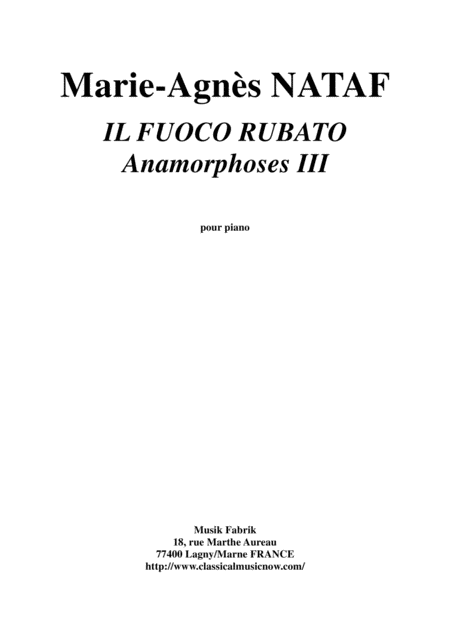
Marie-Agnès Nataf: IL FUOCO RUBATO Anamorphoses III for piano
Piano seul

$7.95 6.88 € Piano seul PDF SheetMusicPlus


Partitions Gratuites
Acheter des Partitions Musicales
Acheter des Partitions Digitales à Imprimer
Acheter des Instruments de Musique

© 2000 - 2026

Accueil - Version intégrale





