EUROPE
9401 articles
USA
0 articles
DIGITAL
32519 articles (à imprimer)
Partitions Digitales
Partitions à imprimer
32519 partitions trouvées


String Orchestra - Level 4 - Digital Download SKU: A0.922639 Composed by Johann Strauss Jr. Arranged by Aaron Meier. Romantic Period,World. Score and parts. 1 pages. Aaron Meier #5792379. Published by Aaron Meier (A0.922639). Original by Johann Strauss II Reduction to String Orchestra by Aaron Meier Part: Double Bass True to the original work by Strauss, this reduction for string orchestra features the ornaments and mystical writing that defines Strauss' polkas. There are optional percussion parts to be added at the discretion of the ensemble, however even without percussion the ensemble will sound full (the percussion acts as an ornament). Difficulty: Intermediate-advanced - advanced (best-suited for advanced student ensembles) --- Performance Notes: • Approximate length: 3:30 minutes • 1st Violins: In m. 1, trill a half step from a Dâ™­ to a Dâ™®  • 2nd Violins:  - At m. 42, divide players by 3, with 2 players playing line A and the remaining player playing line B  - At m. 72-75, emphasize the Eâ™­ in the div. • Snare Drum: The buzz roll needs to be quieter than how it is played in the midi recording (*see YouTube link ↓) History: The Olga-Polka itself owed its creation to a Russian royal wedding which took place in St. Petersburg on 28 August 1857. On that day, amid accompanying splendour, the music-loving Grand Duke Michail Nikolaievich (1832-1909), youngest brother of Tsar Alexander II, married Princess Caecilie of Baden (1839-91), daughter of Archduke Leopold of Baden. Johann Strauss, who at that time was giving a summer season of concerts in nearby Pavlovsk, used the opportunity occasioned by the event to enhance his already enviable popularity with the Russian royal family and composed the Caecilien-Polka in honour of the lovely young bride. Indeed, it is clear from a letter which Johann wrote in late July 1857 to Carl Haslinger, his publisher in Vienna, that the new polka had been prepared well in advance of the wedding (the fair copy of the full orchestral score made for the publisher's engraver is dated 9 August) and was enjoying success even before the royal couple's official engagement on 16August 1857. Sometime after performing the Caecilien-Polka in Pavlovsk, Johann despatched the work to the Austrian capital where his brother Josef conducted its Viennese première, together with that of Johann's waltz Telegraphische Depeschen (op. 195, Volume 28), at his own benefit concert in the Volksgartenon Sunday 18 October 1857. The Wiener Allgemeine Theaterzeitung (16.10.1857) remarked that both works have caused a sensation in St. Petersburg and are truly genial Viennese sounds full of verve and melody. Since tradition demanded that the German Princess Caecilie adopt a Russian name - Olga Feodorovna - before her marriage, so Johann's Caecilien-Polka also underwent a change of identity. On 8 December 1857 Carl Haslinger announced the publication of Strauss's Olga-Polka, on the title page of which is the inscription: Dedicated to her Imperial Highness Grand Duchess Olga, née Princess of Baden. It was under this title, too, that Johann himself first conducted the work in Vienna at a concert in the Volksgarten on 1 November 1857, shortly after his return from Russia. Reporting on this event, the Wiener Allgemeine Theaterzeitung (3.11.1857) observed: The 'Olga-Polka' is a most delightful, fragrant musical bouquet, full of fine, gracious rhythms. [excerpted from NAXOS Records] Kemp, Peter. Program Notes - About this Recording. NAXOS, 1993, www.naxos.com/mainsite/blurbs_reviews.asp?item_code=8.223232&catNum=223232&filetype=About%20.......... Accessed 5 June 2020. Resources: • Visit.
Olga-Polka, Op. 196 (arr. for string orchestra): Double Bass
Orchestre à Cordes

$3.99 3.46 € Orchestre à Cordes PDF SheetMusicPlus

Chamber Orchestra - Level 4 - Digital Download SKU: A0.922640 Composed by Johann Strauss Jr. Arranged by Aaron Meier. Romantic Period,World. Score and parts. 1 pages. Aaron Meier #5792381. Published by Aaron Meier (A0.922640). Original by Johann Strauss II Reduction to String Orchestra by Aaron Meier Part: *Optional Percussion (snare drum, triangle, cymbals) True to the original work by Strauss, this reduction for string orchestra features the ornaments and mystical writing that defines Strauss' polkas. There are optional percussion parts to be added at the discretion of the ensemble, however even without percussion the ensemble will sound full (the percussion acts as an ornament). Difficulty: Intermediate-advanced - advanced (best-suited for advanced student ensembles) --- Performance Notes: • Approximate length: 3:30 minutes • 1st Violins: In m. 1, trill a half step from a Dâ™­ to a Dâ™®  • 2nd Violins:  - At m. 42, divide players by 3, with 2 players playing line A and the remaining player playing line B  - At m. 72-75, emphasize the Eâ™­ in the div. • Snare Drum: The buzz roll needs to be quieter than how it is played in the midi recording (*see YouTube link ↓) History: The Olga-Polka itself owed its creation to a Russian royal wedding which took place in St. Petersburg on 28 August 1857. On that day, amid accompanying splendour, the music-loving Grand Duke Michail Nikolaievich (1832-1909), youngest brother of Tsar Alexander II, married Princess Caecilie of Baden (1839-91), daughter of Archduke Leopold of Baden. Johann Strauss, who at that time was giving a summer season of concerts in nearby Pavlovsk, used the opportunity occasioned by the event to enhance his already enviable popularity with the Russian royal family and composed the Caecilien-Polka in honour of the lovely young bride. Indeed, it is clear from a letter which Johann wrote in late July 1857 to Carl Haslinger, his publisher in Vienna, that the new polka had been prepared well in advance of the wedding (the fair copy of the full orchestral score made for the publisher's engraver is dated 9 August) and was enjoying success even before the royal couple's official engagement on 16August 1857. Sometime after performing the Caecilien-Polka in Pavlovsk, Johann despatched the work to the Austrian capital where his brother Josef conducted its Viennese première, together with that of Johann's waltz Telegraphische Depeschen (op. 195, Volume 28), at his own benefit concert in the Volksgartenon Sunday 18 October 1857. The Wiener Allgemeine Theaterzeitung (16.10.1857) remarked that both works have caused a sensation in St. Petersburg and are truly genial Viennese sounds full of verve and melody. Since tradition demanded that the German Princess Caecilie adopt a Russian name - Olga Feodorovna - before her marriage, so Johann's Caecilien-Polka also underwent a change of identity. On 8 December 1857 Carl Haslinger announced the publication of Strauss's Olga-Polka, on the title page of which is the inscription: Dedicated to her Imperial Highness Grand Duchess Olga, née Princess of Baden. It was under this title, too, that Johann himself first conducted the work in Vienna at a concert in the Volksgarten on 1 November 1857, shortly after his return from Russia. Reporting on this event, the Wiener Allgemeine Theaterzeitung (3.11.1857) observed: The 'Olga-Polka' is a most delightful, fragrant musical bouquet, full of fine, gracious rhythms. [excerpted from NAXOS Records] Kemp, Peter. Program Notes - About this Recording. NAXOS, 1993, www.naxos.com/mainsite/blurbs_reviews.asp?item_code=8.223232&catNum=223232&filetype=About%20.......... Accessed 5 June 2020.
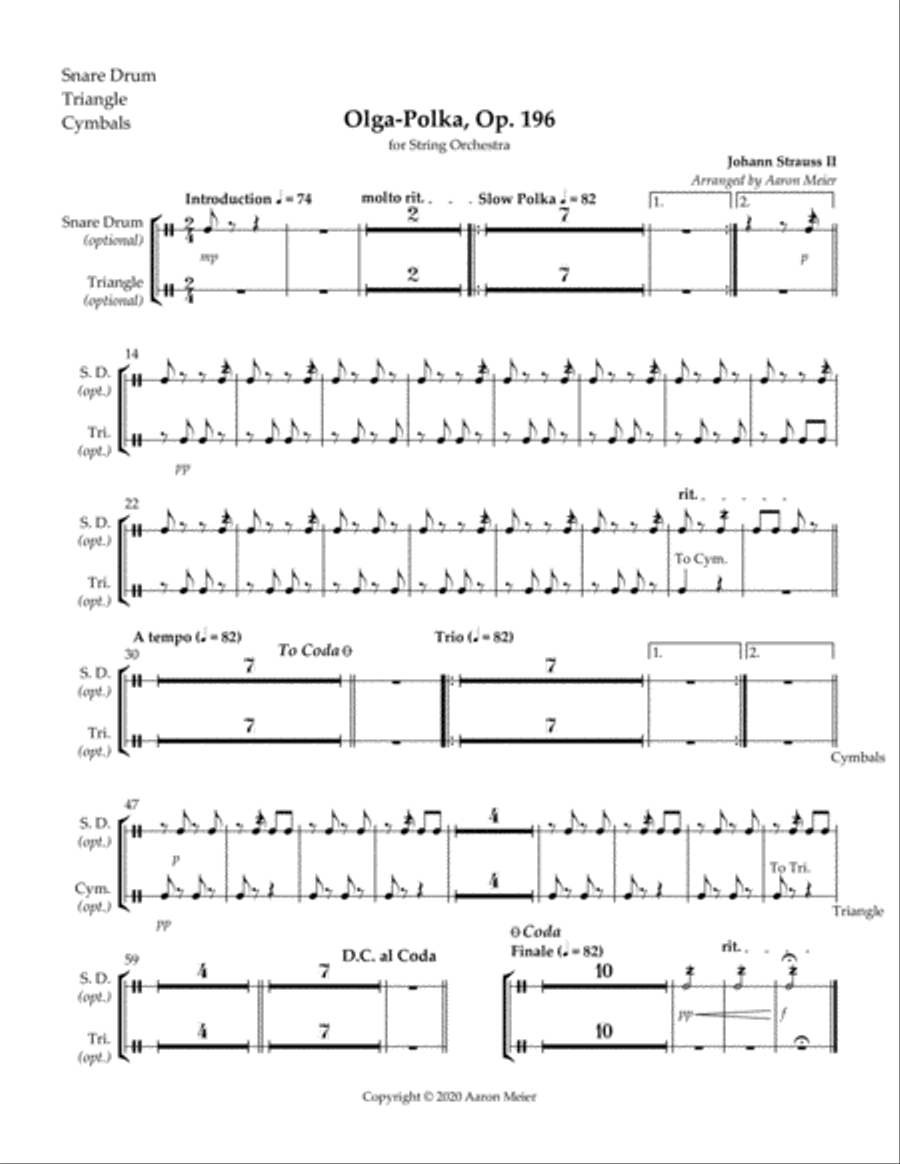
Olga-Polka, Op. 196 (arr. for string orchestra): Optional Percussion
Orchestre de chambre

$3.99 3.46 € Orchestre de chambre PDF SheetMusicPlus

Choral Choir (SAB) - Level 3 - Digital Download SKU: A0.1184357 Composed by Susan J. Galentine. Classical,Easter,Religious,Sacred,Traditional. Octavo. 18 pages. Susan Galentine #784082. Published by Susan Galentine (A0.1184357). Watchmen Tell is an uplifting SAB choral piece with piano accompaniment. This would be a wonderful Spring or Easter piece in a secular or religious setting. The composer wrote it for her mothers funeral, wanting to end the service in a positive Celebration of Life sort of way. It was performed by the First Presbyterian Choir on February 9, 2022, however many changes have been made to the piece since. The MP3 is computer generated and is only to give conductors an idea of how it might sound. Human voices of course will add richness, artistry, and expression to the music.
Watchmen Tell
Chorale 3 parties

$2.50 2.17 € Chorale 3 parties PDF SheetMusicPlus

String Orchestra - Level 4 - Digital Download SKU: A0.922637 Composed by Johann Strauss Jr. Arranged by Aaron Meier. Romantic Period,World. Score and parts. 1 pages. Aaron Meier #5792373. Published by Aaron Meier (A0.922637). Original by Johann Strauss II Reduction to String Orchestra by Aaron Meier Part: Cello True to the original work by Strauss, this reduction for string orchestra features the ornaments and mystical writing that defines Strauss' polkas. There are optional percussion parts to be added at the discretion of the ensemble, however even without percussion the ensemble will sound full (the percussion acts as an ornament). Difficulty: Intermediate-advanced - advanced (best-suited for advanced student ensembles) --- Performance Notes: • Approximate length: 3:30 minutes • 1st Violins: In m. 1, trill a half step from a Dâ™­ to a Dâ™®  • 2nd Violins:  - At m. 42, divide players by 3, with 2 players playing line A and the remaining player playing line B  - At m. 72-75, emphasize the Eâ™­ in the div. • Snare Drum: The buzz roll needs to be quieter than how it is played in the midi recording (*see YouTube link ↓) History: The Olga-Polka itself owed its creation to a Russian royal wedding which took place in St. Petersburg on 28 August 1857. On that day, amid accompanying splendour, the music-loving Grand Duke Michail Nikolaievich (1832-1909), youngest brother of Tsar Alexander II, married Princess Caecilie of Baden (1839-91), daughter of Archduke Leopold of Baden. Johann Strauss, who at that time was giving a summer season of concerts in nearby Pavlovsk, used the opportunity occasioned by the event to enhance his already enviable popularity with the Russian royal family and composed the Caecilien-Polka in honour of the lovely young bride. Indeed, it is clear from a letter which Johann wrote in late July 1857 to Carl Haslinger, his publisher in Vienna, that the new polka had been prepared well in advance of the wedding (the fair copy of the full orchestral score made for the publisher's engraver is dated 9 August) and was enjoying success even before the royal couple's official engagement on 16August 1857. Sometime after performing the Caecilien-Polka in Pavlovsk, Johann despatched the work to the Austrian capital where his brother Josef conducted its Viennese première, together with that of Johann's waltz Telegraphische Depeschen (op. 195, Volume 28), at his own benefit concert in the Volksgartenon Sunday 18 October 1857. The Wiener Allgemeine Theaterzeitung (16.10.1857) remarked that both works have caused a sensation in St. Petersburg and are truly genial Viennese sounds full of verve and melody. Since tradition demanded that the German Princess Caecilie adopt a Russian name - Olga Feodorovna - before her marriage, so Johann's Caecilien-Polka also underwent a change of identity. On 8 December 1857 Carl Haslinger announced the publication of Strauss's Olga-Polka, on the title page of which is the inscription: Dedicated to her Imperial Highness Grand Duchess Olga, née Princess of Baden. It was under this title, too, that Johann himself first conducted the work in Vienna at a concert in the Volksgarten on 1 November 1857, shortly after his return from Russia. Reporting on this event, the Wiener Allgemeine Theaterzeitung (3.11.1857) observed: The 'Olga-Polka' is a most delightful, fragrant musical bouquet, full of fine, gracious rhythms. [excerpted from NAXOS Records] Kemp, Peter. Program Notes - About this Recording. NAXOS, 1993, www.naxos.com/mainsite/blurbs_reviews.asp?item_code=8.223232&catNum=223232&filetype=About%20.......... Accessed 5 June 2020. Resources: • Visit
Olga-Polka, Op. 196 (arr. for string orchestra): Cello
Orchestre à Cordes

$3.99 3.46 € Orchestre à Cordes PDF SheetMusicPlus

String Orchestra - Level 4 - Digital Download SKU: A0.922634 Composed by Johann Strauss Jr. Arranged by Aaron Meier. Romantic Period,World. Score and parts. 1 pages. Aaron Meier #5792359. Published by Aaron Meier (A0.922634). Original by Johann Strauss II Reduction to String Orchestra by Aaron Meier Part: Violin I True to the original work by Strauss, this reduction for string orchestra features the ornaments and mystical writing that defines Strauss' polkas. There are optional percussion parts to be added at the discretion of the ensemble, however even without percussion the ensemble will sound full (the percussion acts as an ornament). Difficulty: Intermediate-advanced - advanced (best-suited for advanced student ensembles) --- Performance Notes: • Approximate length: 3:30 minutes • 1st Violins: In m. 1, trill a half step from a Dâ™­ to a Dâ™®  • 2nd Violins:  - At m. 42, divide players by 3, with 2 players playing line A and the remaining player playing line B  - At m. 72-75, emphasize the Eâ™­ in the div. • Snare Drum: The buzz roll needs to be quieter than how it is played in the midi recording (*see YouTube link ↓) History: The Olga-Polka itself owed its creation to a Russian royal wedding which took place in St. Petersburg on 28 August 1857. On that day, amid accompanying splendour, the music-loving Grand Duke Michail Nikolaievich (1832-1909), youngest brother of Tsar Alexander II, married Princess Caecilie of Baden (1839-91), daughter of Archduke Leopold of Baden. Johann Strauss, who at that time was giving a summer season of concerts in nearby Pavlovsk, used the opportunity occasioned by the event to enhance his already enviable popularity with the Russian royal family and composed the Caecilien-Polka in honour of the lovely young bride. Indeed, it is clear from a letter which Johann wrote in late July 1857 to Carl Haslinger, his publisher in Vienna, that the new polka had been prepared well in advance of the wedding (the fair copy of the full orchestral score made for the publisher's engraver is dated 9 August) and was enjoying success even before the royal couple's official engagement on 16August 1857. Sometime after performing the Caecilien-Polka in Pavlovsk, Johann despatched the work to the Austrian capital where his brother Josef conducted its Viennese première, together with that of Johann's waltz Telegraphische Depeschen (op. 195, Volume 28), at his own benefit concert in the Volksgartenon Sunday 18 October 1857. The Wiener Allgemeine Theaterzeitung (16.10.1857) remarked that both works have caused a sensation in St. Petersburg and are truly genial Viennese sounds full of verve and melody. Since tradition demanded that the German Princess Caecilie adopt a Russian name - Olga Feodorovna - before her marriage, so Johann's Caecilien-Polka also underwent a change of identity. On 8 December 1857 Carl Haslinger announced the publication of Strauss's Olga-Polka, on the title page of which is the inscription: Dedicated to her Imperial Highness Grand Duchess Olga, née Princess of Baden. It was under this title, too, that Johann himself first conducted the work in Vienna at a concert in the Volksgarten on 1 November 1857, shortly after his return from Russia. Reporting on this event, the Wiener Allgemeine Theaterzeitung (3.11.1857) observed: The 'Olga-Polka' is a most delightful, fragrant musical bouquet, full of fine, gracious rhythms. [excerpted from NAXOS Records] Kemp, Peter. Program Notes - About this Recording. NAXOS, 1993, www.naxos.com/mainsite/blurbs_reviews.asp?item_code=8.223232&catNum=223232&filetype=About%20.......... Accessed 5 June 2020. Resources: • Visit

Olga-Polka, Op. 196 (arr. for string orchestra): Violin I
Orchestre à Cordes

$3.99 3.46 € Orchestre à Cordes PDF SheetMusicPlus

Chamber Orchestra - Level 4 - Digital Download SKU: A0.922635 Composed by Johann Strauss Jr. Arranged by Aaron Meier. Romantic Period,World. Score and parts. 7 pages. Aaron Meier #5792353. Published by Aaron Meier (A0.922635). Original by Johann Strauss II Reduction to String Orchestra by Aaron Meier Part: Full Score ONLY True to the original work by Strauss, this reduction for string orchestra features the ornaments and mystical writing that defines Strauss' polkas. There are optional percussion parts to be added at the discretion of the ensemble, however even without percussion the ensemble will sound full (the percussion acts as an ornament). Difficulty: Intermediate-advanced - advanced (best-suited for advanced student ensembles) ---Performance Notes: • Approximate length: 3:30 minutes • 1st Violins: In m. 1, trill a half step from a Dâ™­ to a Dâ™®  • 2nd Violins:  - At m. 42, divide players by 3, with 2 players playing line A and the remaining player playing line B  - At m. 72-75, emphasize the Eâ™­ in the div. • Snare Drum: The buzz roll needs to be quieter than how it is played in the midi recording (*see YouTube link ↓) History: The Olga-Polka itself owed its creation to a Russian royal wedding which took place in St. Petersburg on 28 August 1857. On that day, amid accompanying splendour, the music-loving Grand Duke Michail Nikolaievich (1832-1909), youngest brother of Tsar Alexander II, married Princess Caecilie of Baden (1839-91), daughter of Archduke Leopold of Baden. Johann Strauss, who at that time was giving a summer season of concerts in nearby Pavlovsk, used the opportunity occasioned by the event to enhance his already enviable popularity with the Russian royal family and composed the Caecilien-Polka in honour of the lovely young bride. Indeed, it is clear from a letter which Johann wrote in late July 1857 to Carl Haslinger, his publisher in Vienna, that the new polka had been prepared well in advance of the wedding (the fair copy of the full orchestral score made for the publisher's engraver is dated 9 August) and was enjoying success even before the royal couple's official engagement on 16August 1857. Sometime after performing the Caecilien-Polka in Pavlovsk, Johann despatched the work to the Austrian capital where his brother Josef conducted its Viennese première, together with that of Johann's waltz Telegraphische Depeschen (op. 195, Volume 28), at his own benefit concert in the Volksgartenon Sunday 18 October 1857. The Wiener Allgemeine Theaterzeitung (16.10.1857) remarked that both works have caused a sensation in St. Petersburg and are truly genial Viennese sounds full of verve and melody. Since tradition demanded that the German Princess Caecilie adopt a Russian name - Olga Feodorovna - before her marriage, so Johann's Caecilien-Polka also underwent a change of identity. On 8 December 1857 Carl Haslinger announced the publication of Strauss's Olga-Polka, on the title page of which is the inscription: Dedicated to her Imperial Highness Grand Duchess Olga, née Princess of Baden. It was under this title, too, that Johann himself first conducted the work in Vienna at a concert in the Volksgarten on 1 November 1857, shortly after his return from Russia. Reporting on this event, the Wiener Allgemeine Theaterzeitung (3.11.1857) observed: The 'Olga-Polka' is a most delightful, fragrant musical bouquet, full of fine, gracious rhythms. [excerpted from NAXOS Records] Kemp, Peter. Program Notes - About this Recording. NAXOS, 1993, www.naxos.com/mainsite/blurbs_reviews.asp?item_code=8.223232&catNum=223232&filetype=About%20.......... Accessed 5 June 2020. Resources: • Visit sites.google.com/view/aaronmeier for more information regarding this arrangement and other works. • Find a full midi recording of this arrangement on YouTub.

Olga-Polka, Op. 196 (arr. for string orchestra): Full Score
Orchestre

$10.99 9.52 € Orchestre PDF SheetMusicPlus

Brass Quintet - Level 2 - Digital Download SKU: A0.775294 Composed by George Gershwin, Arthur Francis. Arranged by Bill Wilson. Broadway,Musical/Show. 10 pages. Alexander Wilson #4796741. Published by Alexander Wilson (A0.775294). Tra-La-La, by master composer George Gershwin and lyricist Arthur Francis, is a cute little tune with occasional surprises. Tra-La-La was written for the 1922 Broadway show For Goodness Sake. However, it was never performed in that show. Almost 30 years later it was included in the movie An American in Paris.   Our arrangement shares lead responsibilities between first trumpet, French horn, and trombone. Performance time is approximately 1:39. Visit our website, www.tootsuitebrasspublishing.com, for a catalog of our arrangements available through sheetmusicplus.com.
Tra-La-La
Quintette de Cuivres: 2 trompettes, Cor, trombone, tuba

$4.00 3.47 € Quintette de Cuivres: 2 trompettes, Cor, trombone, tuba PDF SheetMusicPlus

String Quartet Cello,String Quartet,Viola,Violin - Level 3 - Digital Download SKU: A0.1162880 By Journey. By Jonathan Cain. Arranged by Charles Gunsaullus. Pop,Rock,Wedding. Score and parts. 13 pages. Charles Gunsaullus #763237. Published by Charles Gunsaullus (A0.1162880). A great love song from Journey, Faithfully is full of both great lyrics and great music.  Perfect for weddings, this song could be used for anything from background music to the bride's entrance.  This arrangement is quite simple, but some of the rhythms are a little tricky.  Once you know how it goes, however, this arrangement is a breeze to play, especially since it is transposed down a half-step from the original (B major to Bb major).
Faithfully
Quatuor à cordes: 2 violons, alto, violoncelle
Journey
$12.99 11.26 € Quatuor à cordes: 2 violons, alto, violoncelle PDF SheetMusicPlus

Carillon,Instrumental Solo - Level 3 - Digital Download SKU: A0.1302179 Composed by Béla Bartók (1881–1945). Arranged by Richard Giszczak. Children,Classical,Folk,Multicultural,World. Individual part. 5 pages. Singing Winds Music Company #891782. Published by Singing Winds Music Company (A0.1302179). This arrangement is set for Carillon, however it may also be played on piano, organ, or electronic keyboard or adapted to other instruments. It is a transcription of piano music by Béla Bartók adapted to the range and tonalities of a carillon. The pieces in Volume 1 are based on Hungarian Folk Songs.  This piece is scored for one carillon with two performers.I use the following story to explain how this piece is written:Imagine yourself traveling through the Hungarian countryside about 100 years ago.  You are in an open carriage or on horseback.  As you travel, you begin to hear broken strains of music from somewhere up ahead.  As you get closer, more of the melody is heard.  You reach the location of the music performance and pause to watch and listen to The Swineherd's Dance.  After a few minutes you realize you must be on your way.  As you continue your travels, the music fades out in the distance behind you..
For Children, Volume 1: 42. The Swineherd's Dance (duet)

$2.00 1.73 € PDF SheetMusicPlus

Jazz Combo - Digital Download SKU: A0.979629 Composed by Roger Aldridge. 20th Century,Blues,Jazz. Score and parts. 1 pages. Roger Aldridge #427659. Published by Roger Aldridge (A0.979629). Pi, Why? is an unconventional blues that uses Pi (3.1415926....) as a sequence of melodic intervals. Do not let that scare you away -- the music swings. The structure of this 18-bar tune is based on 3-bar phrases and there is shifting time in places. The first 32 digits of Pi are used in this tune: 3.1415926535897932384626433832795. Here is how I converted the Pi numbers to melodic intervals: Simply, each number becomes an interval in relation to the root of the chord being used at the time. That is, the relationships change when the chords change. The intervals are natural or altered (b9, #9, #11, etc.) chord tones or higher tensions. For 3 on V7 chords, I use either natural 3 or minor 3 (enharmonically #9). The tune starts with the sequence of 3 (#9), 1, 4 (#11), 1, 5, 9 (b9) played twice with C7 (#9) and then transposed down a half-step for B7 (#9). The next sequence -- 2 (b9), 6, 5, 3 (natural), 5 -- is played with the Bb7 (#9) chord and so on through the rest of the 32-note sequence. While 3 is the first number of Pi, that is not why the tune is structured with 3-bar phrases. Simply, the 3-bar phrases felt natural and swinging to me. This tune has a strong blues flavor; however, it is not a conventional 12-bar blues in its structure or chord progression. The A part is 12 bars. Then, the B part is 6 bars with alternating 4/4 and 3/4 (one can think of it as 7/4). The B part also has a harmonic shift from V7 (#9) chords to V9 sus4 and major 7th chords. CONTACT: http://www.rogeraldridge.com/contact.html PRO: BMI WEBSITE: http://www.rogeraldridge.com/ DURATION: around 4:00 YEAR OF RELEASE: 1999.
Pi, Why?
Jazz combo

$3.00 2.6 € Jazz combo PDF SheetMusicPlus

Choral Choir (SATB) - Level 4 - Digital Download SKU: A0.971687 Composed by Michael E. Ropp. 20th Century,A Cappella,Christian,Sacred. Octavo. 11 pages. Michael E. Ropp #2034327. Published by Michael E. Ropp (A0.971687). I Stand the Watch Before the Dawn is a dramatic piece for SATB choir and tenor and soprano soloists, for the season of Advent. The piece begins with the solo tenor and piano, in which the tenor plays the part of the night watchman and expresses longing for the light, and anguish at the condition of the people in the darkness. The tenor solo ends with the words Why have you forsaken us? The choir then enters a cappella (in performance, the choir can be doubled on organ using soft strings if necessary--it's difficult for the choir to get its starting pitches), and a soaring solo soprano provides the answer: the Light has come, but more than that, You were never alone; you are never alone; you will never be alone. One staging idea for this piece is to have the solo tenor up front, and the choir and soprano unseen in the rear, especially if there is a rear balcony that will hold the choir. However it is staged, this piece provides worshipers with a powerful and unforgettable reassurance that they do not face their darkest hours alone. (Please note that the MP3 file has some oddities in the dynamics; the sudden changes are artifices of how the MP3 is rendered from Finale and should not be interpreted literally.).
I Stand the Watch Before the Dawn
Chorale SATB

$2.99 2.59 € Chorale SATB PDF SheetMusicPlus


Partitions Gratuites
Acheter des Partitions Musicales
Acheter des Partitions Digitales à Imprimer
Acheter des Instruments de Musique

© 2000 - 2026

Accueil - Version intégrale



