EUROPE
1247 articles
USA
0 articles
DIGITAL
4558 articles (à imprimer)
Partitions Digitales
Partitions à imprimer
4558 partitions trouvées


Piano,Trombone - Level 5 - Digital Download SKU: A0.792108 Composed by Nicholas Francis. Contemporary. Score and part. 22 pages. Gordon Cherry #3451987. Published by Gordon Cherry (A0.792108). The Skye Boat Song, among the most popular of all Scottish folk tunes, deals with the flight of Bonnie Prince Charlie (Charles Edward Stewart) from Scotland to the Isle of Skye in 1746, after having been defeated on Culloden Moor by the English Army of King George II. The present setting, for either Tenor or Bass Trombone and Piano, is mostly lyrical and passes through a series of episodes that evoke watery images in various ways.  A stormy episode which superimposes a more martial tune (relying heavily on the familiar scotch snappy rhythm) against a variation of the original folk tune leads to brief quotations from Mendelssohn’s Hebrides overture (the Isle of Skye is part of the group of islands known as the Hebrides) before a short recapitulation of the theme.
Fantasy of the Skye Boat Song for Trombone and Piano
Trombone et Piano

$15.00 13.07 € Trombone et Piano PDF SheetMusicPlus

Euphonium,Piano - Level 5 - Digital Download SKU: A0.1040449 Composed by N. Rimsky Korsakov. Arranged by Raymond Fenech. Contest,Festival,Film/TV,Holiday,Opera,Romantic Period. Score and part. 13 pages. Raymond Fenech #645240. Published by Raymond Fenech (A0.1040449). Flight of the Bumblebee is an orchestral interlude written by Nikolai Rimsky-Korsakov for his opera The Tale of Tsar Saltan, composed in 1899–1900. Its composition is intended to musically evoke the seemingly chaotic and rapidly changing flying pattern of a bumblebee. Despite the piece's being a rather incidental part of the opera, it is today one of the more familiar classical works because of its frequent use in popular culture. The piece closes Act III, Tableau 1, during which the magic Swan-Bird changes Prince Gvidon Saltanovich (the Tsar's son) into an insect so that he can fly away to visit his father (who does not know that he is alive). The duration of this is 2.07 minutes and it is a difficult level piece.
The Flight of the Bumble Bee - Rimsky Korsakov - for Euphonium and Piano
Euphonium, Piano (duo)

$3.99 3.48 € Euphonium, Piano (duo) PDF SheetMusicPlus

B-Flat Trumpet,Piano - Level 3 - Digital Download SKU: A0.549608 Composed by Peter Ilyich Tchaikovsky. Arranged by James M. Guthrie, ASCAP. Instructional,Romantic Period,Standards. Score and part. 15 pages. Jmsgu3 #3513629. Published by jmsgu3 (A0.549608). Tchaikovsky composed Swan Lake in 1875-76. The ballet failed to attract a positive reception. Over time, however, it became one of the most popular of all of Tchaikovsky's works. The ballet was first performed by the Bolshoi Ballet in Moscow.Swan Lake is a romantic ballet in four acts, with Pyotr Ilyich Tchaikovsky's music. Scene 10, also known as the finale, is a tragic and iconic moment in the ballet. It features the death of the main characters, Prince Siegfried and Odette, the white swan, and the ultimate triumph of good over evil. The ballet's music is one of Tchaikovsky's most valuable works, and it is known for its technically and emotionally challenging nature. The dual role of Odette, the innocent white swan, and Odile, the malevolent black swan, is typically performed by one dancer, although some avant-garde productions use two dancers for the two swans. The ballet's score is famous for its beautiful and emotional melodies, making it a quintessential piece in the ballet repertoire.
Tchaikovsky: Scene 10 from Swan Lake for Trumpet & Piano
Trompette, Piano

$32.95 28.71 € Trompette, Piano PDF SheetMusicPlus

Cello,Piano - Level 5 - Digital Download SKU: A0.1040452 Composed by N. Rimsky Korsakov. Arranged by Raymond Fenech. Contest,Festival,Film/TV,Holiday,Opera,Romantic Period. Score and part. 12 pages. Raymond Fenech #645242. Published by Raymond Fenech (A0.1040452). Flight of the Bumblebee is an orchestral interlude written by Nikolai Rimsky-Korsakov for his opera The Tale of Tsar Saltan, composed in 1899–1900. Its composition is intended to musically evoke the seemingly chaotic and rapidly changing flying pattern of a bumblebee. Despite the piece's being a rather incidental part of the opera, it is today one of the more familiar classical works because of its frequent use in popular culture. The piece closes Act III, Tableau 1, during which the magic Swan-Bird changes Prince Gvidon Saltanovich (the Tsar's son) into an insect so that he can fly away to visit his father (who does not know that he is alive). The duration of this is 2.07 minutes and it is a difficult level piece.
The Flight of the Bumble Bee - Rimsky Korsakov - for Cello and Piano
Violoncelle, Piano

$3.99 3.48 € Violoncelle, Piano PDF SheetMusicPlus

Piano - Digital Download SKU: BQ.979-0-50179-710-3 Composed by John Mitchell. This edition: softcover. Bisel New Classics. Score. With Text Language: English / German. Opus 102. 44 pages. Published by Bisel Classics - Digital (BQ.979-0-50179-710-3). ISBN 9790501797103.The Sonata No. 3 op. 102 was composed in the year 2000 and stands at the beginning of a series of sonatas created following the programmatic principle. The star Regulus in the sign Leo, being one of the brightest stars on the night sky, served as model and inspiration to Mitchell, who frequently refers to astrological and esoteric themes in his works. A multiple star consisting of four stars, it was referred to as a ruler in many cultures, and proudly holds titles such as Prince, Little King and in the Arabic culture even ''The Heart of the Lion''. The composer shows Regulus as ruler and law giver, providing harmony and justice by balancing energies. A regular form with an extended coda development is dominated by an upper second followed by a lower second, symbol of balance, standing for the reconciliation of justice that is proper for a ''correct'' ruler. Please visit the website www.abm-enterprises.net for extensive and updated information on the composer and his works.
Sonata No. 3 for Piano, Opus 102
Piano seul

$16.95 14.77 € Piano seul PDF SheetMusicPlus

Alto Saxophone,Piano - Level 3 - Digital Download SKU: A0.533345 Composed by Ali Ben Sou Alle. Arranged by Paul Wehage. Concert,Romantic Period,Standards. Score and part. 10 pages. Musik Fabrik Music Publishing #2348193. Published by Musik Fabrik Music Publishing (A0.533345). Ali Ben Sou Alle was born Jean-Baptiste SOUALLE in 1824 in Arras, France. He first studied the clarinet, winning a first prize in Clarinet in the class of Klosé at the Paris Conservatory. He then entered the Paris Opera orchestra, but left France in 1848 because of the revolution, fleeing to London. In 1850, he met Louis JUILLIEN, another early saxophonist, who encouraged Soualle to take up the saxophone. Soualle made several modifications to the instrument, including changes to the octave mechanism and the other keys for trills and alternative fingerings, many of which are used in modern saxophones.He named his hybrid creation the turcophone and began composing works for the instrument, which included fantasies on operatic themes, character pieces and a series of descriptive works which document several concert tours in Europe, Australia and the Orient which Soualle undertook.  Upon his return to France around 1861, after his conversion to Islam, he changed his name to Ali Ben Sou Alle. Under that name, he performe recitals for the Prince of Wales and for the Emperor Napoleon III and his family in 1865. After this date, no trace of his career has currently been uncovered and it is though that he probably died around 1867. This work is .in two large sections, the first in the form of a lyrical aria, the second a lively schezando.
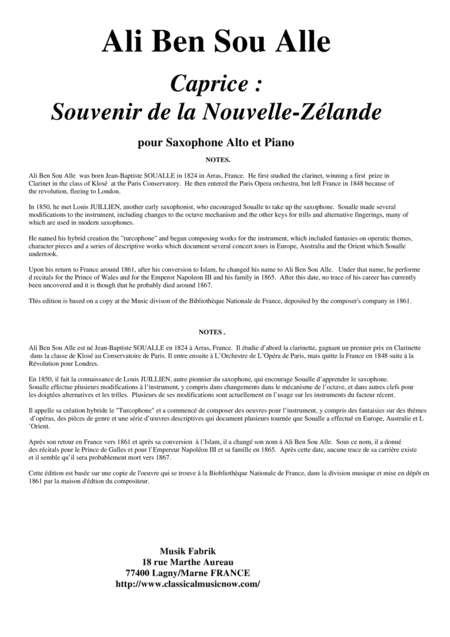
Ali Ben Sou Alle: Caprice : Souvenir de la Nouvelle-Zélande for alto saxophone and piano
Saxophone Alto et Piano

$10.35 9.02 € Saxophone Alto et Piano PDF SheetMusicPlus


Partitions Gratuites
Acheter des Partitions Musicales
Acheter des Partitions Digitales à Imprimer
Acheter des Instruments de Musique

© 2000 - 2026

Accueil - Version intégrale





