EUROPE
5126 articles
USA
0 articles
DIGITAL
32649 articles (à imprimer)
Partitions Digitales
Partitions à imprimer
32649 partitions trouvées


Chamber Orchestra - Level 5 - Digital Download SKU: A0.1453498 Composed by Sy Brandon. 21st Century,Contest,Festival. 235 pages. Sy Brandon #1032727. Published by Sy Brandon (A0.1453498). Legacy is a three-movement composition for chamber orchestra that makes social commentary on the issue of global warming. It was commission in 2007 by the Washington Sinfonietta, Rufus Jones, conductor and rewritten for chamber orchestra in 2023. I. Conflicts - This movement begins with a cry from native cultures admonishing our neglect of the environment. The cry is interspersed with debate regarding the seriousness of global warming (woodwinds). The debate grows stronger as the cries grow weaker. The debate isquieted by a measure of repeated chords that could be the words, stop it! stop it now!” A weak cry in the English Horn brings the introduction to a close. An Allegro section follows with a rhythmic and primitive sounding section representing the underdeveloped nations that are destroying the rain forests for economic gain. This material evolves into a more harmonic and contrapuntal section representing industrialized nations reluctant to change, also for economic reasons. Things quiet down as the music takes the listener to another part of the globe, East Asia. Conflict is again present in this section. The music returns to a varied restatement of the industrialized nations music before traveling to India for a section influenced by Raga. This section builds in dissonance until we hear the repeated stop it now chords from the introduction. A brief reprise of the cries brings the movement to a close. II. Consequences - This movement evokes a somber mood that is reflective of living in a climate of extremes. The movement is in arch form as it begins and ends with open harmony reflective of barren lands that once were fertile. The middle section serves as a climax expressing the harshness of the climate. Colleen McCullough's book, A Creed for the Third Millennium was a source of inspiration for this movement. III. Sacrifice and Compromise - The movement begins with a strong section that suggests progress. It is followed by a quieter and intense section that alternates lyrical lines over a staccato ostinato creating a sense of urgency. The opening section returns and is followed by a development of the ostinato section. This section is symbolic of how ideas need to be adapted in order for progress to be made. The opening section returns once more before leading into the concluding section where there is coming together of the instruments on a long lyrical line representing more and more people working together for change. The movement ends with a sense of triumph over adversity. Score prints on legal size paper and parts on letter.
Legacy for Chamber Orchestra
Orchestre de chambre

$40.00 34.71 € Orchestre de chambre PDF SheetMusicPlus

Bass Clarinet,Instrumental Solo - Level 3 - Digital Download SKU: A0.1314265 Composed by Camille Saint-Saens. Arranged by James M. Guthrie. 19th Century,Chamber,Contest,Festival,Historic,Wedding. Individual part. 11 pages. Jmsgu3 #903006. Published by jmsgu3 (A0.1314265). Saint-Saëns: The Swan (Le Cygne) movement 13 from the Carnival of the Animals Suite. One of his most popular and widely recognized works, it is the only movement from the Carnival Suite that Saint-Saëns permitted to be performed publicly during his lifetime. This is an excellent recital encore to demonstrate melodic playing and strategic phrasing.The Carnival of the AnimalsThe Carnival of the Animals is an entertaining musical suite of fourteen movements by Camille Saint-Saëns. The work was composed for private performance by an ensemble of two pianos and solo instruments. The Swan (No. 13) is among the fourteen most famous movements. In its entirety, it lasts about 25 minutes.Saint-Saëns BackgroundCharles-Camille Saint-Saëns 1835 – 1921) was, by all means, in particular, a famous French composer, brilliant organist, and significant musical mastermind of the Romantic era. Indeed, his most famous compositions, in the long run, include his Piano Concerto No. 2 (1868), Cello Concerto No. 1 (1872), and the Danse macabre (1874). Notwithstanding, we must also add Violin Concerto No. 3 (1880), Symphony No. 3 (the Organ Symphony, 1886), and, it must be remembered, Carnival of the Animals (1886) to the list.ChildhoodIt is essential to realize that Saint-Saëns was undoubtedly, in fact, a child musical prodigy. Consequently, with this in mind, he made his concert debut, albeit at ten years old. Another critical point to remember is that he expressly studied at the Paris Conservatoire, then, despite reality, conversely followed a traditional career path as a church organist. Nevertheless, twenty years later, on the other hand, he left to become a successful freelance pianist and composer despite, as has been noted, his former employment situation. Furthermore, his performances were, after all, markedly in demand - not only in Europe but, above all, in the Americas all in all as well.YouthA point often overlooked is that in his youth, Saint-Saëns was undoubtedly excited about the modern music of the day. He was, in essence, fond of the music of his contemporaries, particularly Schumann, Liszt, and, for the most part, Wagner. In contrast, however, his compositions seemed, in fact, primarily confined within the conservative classical tradition. Be that as it may, he was, at the same time, nevertheless, a scholar of musical history.CriticismOn the whole, his conservatism, in fact, ultimately brought him into frequent conflict in his later years with composers of the impressionist and, in particular, the dodecaphonic schools of musical thought. A point often overlooked is that he included neoclassical elements in his music, contrary to some critics. Furthermore, in so doing, he provided the most compelling evidence that he predicted the techniques and works by Stravinsky and Les Six. To put it another way, given these points, he was regarded, perhaps for the most part unfairly, as a non-progressive reactionary henceforth around the time of his passing.LegacySaint-Saëns taught briefly in Paris, where his students included Gabriel Fauré. Maurice Ravel later studied with Fauré. In conclusion, both Ravel and Fauré were powerfully influenced by Saint-Saëns, whom they respected as a musical mastermind.
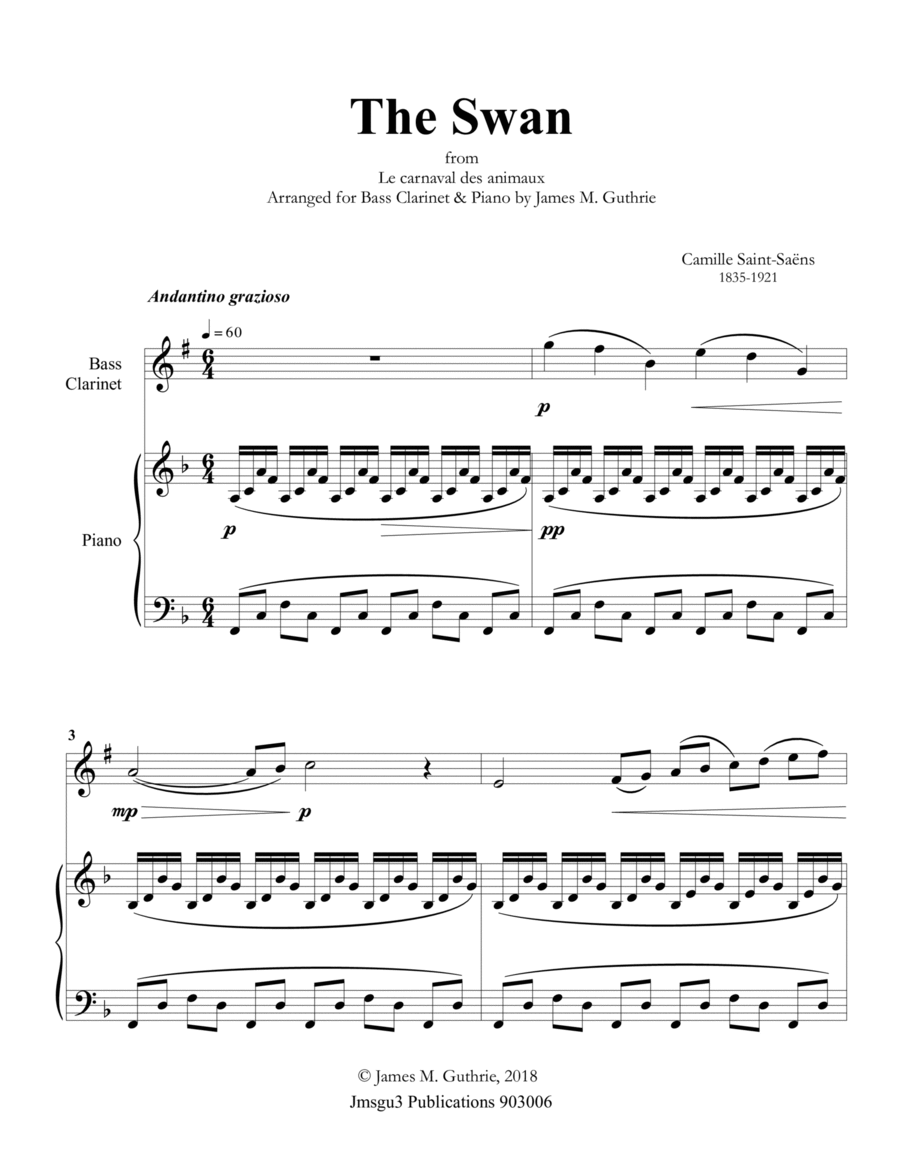
Saint-Saëns: The Swan for Bass Clarinet & Piano
Clarinette Basse

$32.95 28.59 € Clarinette Basse PDF SheetMusicPlus

Brass Ensemble - Level 4 - Digital Download SKU: A0.1123447 Composed by Nathan Grocholski. Classical,Contemporary. Score and parts. 65 pages. Nathan Grocholski #724258. Published by Nathan Grocholski (A0.1123447). The basis of this piece was centered around the complex emotions of cats in which we observe in our every day lives. With regards to this piece especially, there were three cats that I based this composition on, and their names are Storm, Zany and Tremor. Each miniature is a representation of a certain type of emotion that each of these cats is known for expressing. The first movement is for my favorite cat, Storm, and is titled, “Precious Storm.†Going back to my earliest memories of writing songs, I re-translated an old tune that I used to sing into a brass quintet miniature and dedicated to him, for he is the best cat. The second miniature is titled, “Mouse on a String,†and is supposed to portray the same energy that one would see from a cat in chase of a toy mouse being constantly propelled around the air from one end of a string, which is one of Storm’s favorite things to do. The third movement is called “Zany the Scaredy-Cat,†which is exactly the type of cat that Zany is. Always fearful and skittish, Zany sneaks around the house to avoid human contact at all costs. The fourth movement is titled “You Stuck, Zany?†This is named after a short video clip in which Zany finds herself stuck in the fireplace and struggling to get out. Once she frees herself, she runs away as fast as she can. The fifth movement is called “Passive-Aggressive Tremor†for the final cat, Tremor. Tremor likes to instigate conflicts with the other cats, but once the tension arises, he backs away, which can also be heard within the intense build ups and anti-climatic drops within the music as well. Finally, the sixth movement is called, “King Tremor,†in which is the boldest sounding of all the pieces, for when it does come to conflict, it is usually Tremor who comes out on top, outsmarting the other two cats.
The Duality of Cats
Ensemble de cuivres

$5.00 4.34 € Ensemble de cuivres PDF SheetMusicPlus

Choral Choir (SATB) - Level 4 - Digital Download SKU: A0.792022 Composed by Kevin G. Pace (ASCAP), Mark R. Fotheringham. Praise & Worship,Sacred,Spiritual. Octavo. 2 pages. Kevin G. Pace #399201. Published by Kevin G. Pace (A0.792022). A sacred hymn with music by Kevin G. Pace & text by Mark R. Fotheringham. Text: As a world in turmoil cries for peace, while it suffers the conflicts of men, There is calm and comfort to be found in Zion’s peaceful glen. The gospel is a cooling breeze in the heat of summer’s day, Encouraging each wayward soul to find a better way. When a soul in anger strikes a blow or in vengeance he sows vile discord, Know The Spirit cannot there abide; ‘tis grievous to The Lord. Forgiveness is the way of God, and His healing balm assures As you forgive each man his sins, The Lord will forgive yours. Looking unto Christ in ev’ry thought, looking to Him in word and in deed, We will find in Him a lasting peace to fill our deepest need. No man can be an enemy, and all war and conflict end When like The Christ we see each man, a brother and a friend.
A World in Turmoil, a sacred hymn
Chorale SATB

$1.99 1.73 € Chorale SATB PDF SheetMusicPlus

Piano,Soprano Saxophone - Level 2 - Digital Download SKU: A0.549121 Composed by Camille Saint-Saëns (1835 – 1921). Arranged by James M. Guthrie, ASCAP. Instructional,Romantic Period,Standards. Score and part. 9 pages. Jmsgu3 #3452273. Published by jmsgu3 (A0.549121). Saint-Saens: The Swan (Le Cygne) movement 13 from the Carnival of the Animals Suite. Duration: 2:50 Score: 5 pg, 28 ms. Solo part: 1 pg. Piano part: 3 pg. Performance: Level: Early intermediate and up. One of his most popular and widely recognized works, it is the only movement from the Carnival Suite that Saint-Saens permitted to be performed in public during his lifetime. This is an excellent recital encore choice to demonstrate melodic playing and strategic phrasing. The Carnival of the Animals The Carnival of the Animals is an entertaining musical suite of fourteen movements by Camille Saint-Saëns. The work was composed for private performance by an ensemble of two pianos and solo instruments. The Swan (No. 13) is one of the most popular of the fourteen movements. In its entirety, it lasts about 25 minutes. Saint-Saëns Background Charles-Camille Saint-Saëns (1835 – 1921) was, by all means, in particular, a famous French composer, brilliant organist, and significant musical mastermind of the Romantic era. Indeed, his most famous compositions, in the long run, including his Piano Concerto No. 2 (1868), Cello Concerto No. 1 (1872), and the Danse macabre (1874). Notwithstanding, we must also add Violin Concerto No. 3 (1880), Symphony No. 3 (the Organ Symphony, 1886), it must be remembered, Carnival of the Animals (1886) to the list. Childhood It is important to realize that Saint-Saëns was certainly, in fact, a child musical prodigy. Consequently, with this in mind, he made his concert debut albeit at ten years old. Another key point to remember is that he expressly studied at the Paris Conservatoire, then in spite of reality conversely followed a traditional career path as a church organist. Nevertheless, twenty years later, on the other hand, he left to become a successful freelance pianist and composer despite, as has been noted, his former employment situation. Furthermore, his performances were after all markedly in demand - not only in Europe but above all in the Americas all in all as well. Youth A point often overlooked is that in his youth, Saint-Saëns was certainly excited about the modern music of the day. He was in essence fond of the music of his contemporaries, in particular, Schumann, Liszt, and for the most part Wagner. In contrast, however, his own compositions seemed in fact largely confined within the conservative classical tradition. Be that as it may, he was at the same time nevertheless, in fact, a scholar of musical history. Criticism On the whole, his conservatism in fact ultimately brought him into frequent conflict in his later years with composers of the impressionist and in particular the dodecaphonic schools of musical thought.  A point often overlooked is that he included neoclassical elements in his music contrary to some critics. Furthermore, in so doing he provided the most compelling evidence that he predicted the techniques and works by Stravinsky and Les Six. To put it another way, given these points, he was regarded, perhaps for the most part unfairly so, as a non-progressive reactionary henceforth around the time of his passing. Legacy To sum up, Saint-Saëns taught for a short time in Paris, where his students included namely Gabriel Fauré. To clarify, Maurice Ravel later studied with Fauré. In conclusion, both Ravel and Fauré were powerfully influenced by Saint-Saëns, whom they respected as a musical mastermind.
Saint-Saens: The Swan for Soprano Sax & Piano
Saxophone Soprano et Piano

$32.95 28.59 € Saxophone Soprano et Piano PDF SheetMusicPlus

B-Flat Clarinet,Piano - Level 3 - Digital Download SKU: A0.1314273 Composed by Camille Saint-Saens. Arranged by James M. Guthrie. 19th Century,Chamber,Contest,Festival,Historic,Romantic Period. Score and part. 11 pages. Jmsgu3 #903015. Published by jmsgu3 (A0.1314273). Saint-Saëns: The Swan (Le Cygne) movement 13 from the Carnival of the Animals Suite. One of his most popular and widely recognized works, it is the only movement from the Carnival Suite that Saint-Saëns permitted to be performed publicly during his lifetime. This is an excellent recital encore to demonstrate melodic playing and strategic phrasing.The Carnival of the AnimalsThe Carnival of the Animals is an entertaining musical suite of fourteen movements by Camille Saint-Saëns. The work was composed for private performance by an ensemble of two pianos and solo instruments. The Swan (No. 13) is among the fourteen most famous movements. In its entirety, it lasts about 25 minutes.Saint-Saëns BackgroundCharles-Camille Saint-Saëns 1835 – 1921) was, by all means, in particular, a famous French composer, brilliant organist, and significant musical mastermind of the Romantic era. Indeed, his most famous compositions, in the long run, include his Piano Concerto No. 2 (1868), Cello Concerto No. 1 (1872), and the Danse macabre (1874). Notwithstanding, we must also add Violin Concerto No. 3 (1880), Symphony No. 3 (the Organ Symphony, 1886), and, it must be remembered, Carnival of the Animals (1886) to the list.ChildhoodIt is essential to realize that Saint-Saëns was undoubtedly, in fact, a child musical prodigy. Consequently, with this in mind, he made his concert debut, albeit at ten years old. Another critical point to remember is that he expressly studied at the Paris Conservatoire, then, despite reality, conversely followed a traditional career path as a church organist. Nevertheless, twenty years later, on the other hand, he left to become a successful freelance pianist and composer despite, as has been noted, his former employment situation. Furthermore, his performances were, after all, markedly in demand - not only in Europe but, above all, in the Americas all in all as well.YouthA point often overlooked is that in his youth, Saint-Saëns was undoubtedly excited about the modern music of the day. He was, in essence, fond of the music of his contemporaries, particularly Schumann, Liszt, and, for the most part, Wagner. In contrast, however, his compositions seemed, in fact, primarily confined within the conservative classical tradition. Be that as it may, he was, at the same time, nevertheless, a scholar of musical history.CriticismOn the whole, his conservatism, in fact, ultimately brought him into frequent conflict in his later years with composers of the impressionist and, in particular, the dodecaphonic schools of musical thought. A point often overlooked is that he included neoclassical elements in his music, contrary to some critics. Furthermore, in so doing, he provided the most compelling evidence that he predicted the techniques and works by Stravinsky and Les Six. To put it another way, given these points, he was regarded, perhaps for the most part unfairly, as a non-progressive reactionary henceforth around the time of his passing.LegacySaint-Saëns taught briefly in Paris, where his students included Gabriel Fauré. Maurice Ravel later studied with Fauré. In conclusion, both Ravel and Fauré were powerfully influenced by Saint-Saëns, whom they respected as a musical mastermind.

Saint-Saëns: The Swan for Clarinet & Piano
Clarinette et Piano

$32.95 28.59 € Clarinette et Piano PDF SheetMusicPlus

French Horn,Piano - Level 3 - Digital Download SKU: A0.1313124 Composed by Camille Saint-Saens. Arranged by James M. Guthrie. 19th Century,Chamber,Contest,Festival,Romantic Period,Wedding. Score and part. 9 pages. Jmsgu3 #901955. Published by jmsgu3 (A0.1313124). Saint-Saëns: The Swan (Le Cygne) movement 13 from the Carnival of the Animals Suite. One of his most popular and widely recognized works, it is the only movement from the Carnival Suite that Saint-Saëns permitted to be performed publicly during his lifetime. This is an excellent recital encore to demonstrate melodic playing and strategic phrasing.The Carnival of the AnimalsThe Carnival of the Animals is an entertaining musical suite of fourteen movements by Camille Saint-Saëns. The work was composed for private performance by an ensemble of two pianos and solo instruments. The Swan (No. 13) is among the fourteen most famous movements. In its entirety, it lasts about 25 minutes.Saint-Saëns BackgroundCharles-Camille Saint-Saëns 1835 – 1921) was, by all means, in particular, a famous French composer, brilliant organist, and significant musical mastermind of the Romantic era. Indeed, his most famous compositions, in the long run, include his Piano Concerto No. 2 (1868), Cello Concerto No. 1 (1872), and the Danse macabre (1874). Notwithstanding, we must also add Violin Concerto No. 3 (1880), Symphony No. 3 (the Organ Symphony, 1886), and, it must be remembered, Carnival of the Animals (1886) to the list.ChildhoodIt is essential to realize that Saint-Saëns was undoubtedly, in fact, a child musical prodigy. Consequently, with this in mind, he made his concert debut, albeit at ten years old. Another critical point to remember is that he expressly studied at the Paris Conservatoire, then, despite reality, conversely followed a traditional career path as a church organist. Nevertheless, twenty years later, on the other hand, he left to become a successful freelance pianist and composer despite, as has been noted, his former employment situation. Furthermore, his performances were, after all, markedly in demand - not only in Europe but, above all, in the Americas all in all as well.YouthA point often overlooked is that in his youth, Saint-Saëns was undoubtedly excited about the modern music of the day. He was, in essence, fond of the music of his contemporaries, particularly Schumann, Liszt, and, for the most part, Wagner. In contrast, however, his compositions seemed, in fact, primarily confined within the conservative classical tradition. Be that as it may, he was, at the same time, nevertheless, a scholar of musical history.CriticismOn the whole, his conservatism, in fact, ultimately brought him into frequent conflict in his later years with composers of the impressionist and, in particular, the dodecaphonic schools of musical thought. A point often overlooked is that he included neoclassical elements in his music, contrary to some critics. Furthermore, in so doing, he provided the most compelling evidence that he predicted the techniques and works by Stravinsky and Les Six. To put it another way, given these points, he was regarded, perhaps for the most part unfairly, as a non-progressive reactionary henceforth around the time of his passing.LegacySaint-Saëns taught briefly in Paris, where his students included Gabriel Fauré. Maurice Ravel later studied with Fauré. In conclusion, both Ravel and Fauré were powerfully influenced by Saint-Saëns, whom they respected as a musical mastermind.

Saint-Saëns: The Swan for French Horn & Piano
Cor et Piano

$32.95 28.59 € Cor et Piano PDF SheetMusicPlus

Piano,Soprano Flute - Level 3 - Digital Download SKU: A0.1314255 Composed by Camille Saint-Saens. Arranged by James M. Guthrie. 19th Century,Chamber,Contest,Festival,Historic,Romantic Period. Score and part. 11 pages. Jmsgu3 #902996. Published by jmsgu3 (A0.1314255). Saint-Saëns: The Swan (Le Cygne) movement 13 from the Carnival of the Animals Suite. One of his most popular and widely recognized works, it is the only movement from the Carnival Suite that Saint-Saëns permitted to be performed publicly during his lifetime. This is an excellent recital encore to demonstrate melodic playing and strategic phrasing. The Carnival of the AnimalsThe Carnival of the Animals is an entertaining musical suite of fourteen movements by Camille Saint-Saëns. The work was composed for private performance by an ensemble of two pianos and solo instruments. The Swan (No. 13) is among the fourteen most famous movements. In its entirety, it lasts about 25 minutes. Saint-Saëns BackgroundCharles-Camille Saint-Saëns 1835 – 1921) was, by all means, in particular, a famous French composer, brilliant organist, and significant musical mastermind of the Romantic era. Indeed, his most famous compositions, in the long run, include his Piano Concerto No. 2 (1868), Cello Concerto No. 1 (1872), and the Danse macabre (1874). Notwithstanding, we must also add Violin Concerto No. 3 (1880), Symphony No. 3 (the Organ Symphony, 1886), and, it must be remembered, Carnival of the Animals (1886) to the list. Childhood It is essential to realize that Saint-Saëns was undoubtedly, in fact, a child musical prodigy. Consequently, with this in mind, he made his concert debut, albeit at ten years old. Another critical point to remember is that he expressly studied at the Paris Conservatoire, then, despite reality, conversely followed a traditional career path as a church organist. Nevertheless, twenty years later, on the other hand, he left to become a successful freelance pianist and composer despite, as has been noted, his former employment situation. Furthermore, his performances were, after all, markedly in demand - not only in Europe but, above all, in the Americas all in all as well. YouthA point often overlooked is that in his youth, Saint-Saëns was undoubtedly excited about the modern music of the day. He was, in essence, fond of the music of his contemporaries, particularly Schumann, Liszt, and, for the most part, Wagner. In contrast, however, his compositions seemed, in fact, primarily confined within the conservative classical tradition. Be that as it may, he was, at the same time, nevertheless, a scholar of musical history. Criticism On the whole, his conservatism, in fact, ultimately brought him into frequent conflict in his later years with composers of the impressionist and, in particular, the dodecaphonic schools of musical thought. A point often overlooked is that he included neoclassical elements in his music, contrary to some critics. Furthermore, in so doing, he provided the most compelling evidence that he predicted the techniques and works by Stravinsky and Les Six. To put it another way, given these points, he was regarded, perhaps for the most part unfairly, as a non-progressive reactionary henceforth around the time of his passing.LegacySaint-Saëns taught briefly in Paris, where his students included Gabriel Fauré. Maurice Ravel later studied with Fauré. In conclusion, both Ravel and Fauré were powerfully influenced by Saint-Saëns, whom they respected as a musical mastermind.

Saint-Saëns: The Swan for Flute & Piano
Flûte traversière et Piano

$32.95 28.59 € Flûte traversière et Piano PDF SheetMusicPlus

Small Ensemble Flute,Oboe,Piano - Level 5 - Digital Download SKU: A0.977041 Composed by Paul SanGregory. Contemporary. Score and parts. 50 pages. Distant Engraver Music #3544687. Published by Distant Engraver Music (A0.977041). (Score and parts for flute and oboe are contained in one PDF download.)    These are short inventive character pieces that, in some places, also have a more sincere emotional depth. Each one captures a mood, or the essence of a situation. Conflicting Interest is based on a situation in which one person’s attention is divided between two different interests. Musically, this conflict is created by having the flute and oboe play in what seems to be different tempos and meters. The second vignette, Drifting Away, was written for a promising former student who unexpectedly died during her first semester of graduate school. A series of pitches that leads to the note A at the end of this movement, which can be thought of as the goal of her final quiet journey. The title Breaking Free describes the feeling people get when they work through a problem or have a realization that seems to set them mentally or emotionally free. Certain rhythm and pitch structures control this movement until it finally breaks free with a moment of rhythmic chaos near the end. Because of the rhythmic/melodic interplay between parts, this piece requires intimate ensemble work.
Three Vignettes (for fl, cl, pf)
Flûte, Hautbois, Piano (trio)

$12.00 10.41 € Flûte, Hautbois, Piano (trio) PDF SheetMusicPlus

Piano,Vocal,Voice - Level 2 - Digital Download SKU: A0.818251 By Stephen R Dalrymple. By Stephen R Dalrymple (Dalrymple Designs). Arranged by Stephen R Dalrymple. Children,Instructional. Score. 13 pages. Stephen R Dalrymple #3560505. Published by Stephen R Dalrymple (A0.818251). You Can’t Get Even ♫ Original song by Stephen R Dalrymple ♫ (‘Songs That Teach’ collection) ♫ [teaches conflict resolution strategies] ♫ As a playground attendant in a K-8 school, there were hundreds of times when children approached me to report a problem with another child. I would always make the 2 children to speak to each other instead of tell me what happened. If I only listened to one or the other, I seldom heard the truth (or the whole truth.) Many of the arguments started, not on the playground, but 2 hours, or 2 days, or 2 weeks before the incident. It is never possible to actually get even, since none of us can gauge the physical or emotional pain the other person feels, plus conflicts seldom start and are immediately finished. Since I had almost every student in the school attend my general music classes, I wrote a song to address the problem. ♫ music © 2013 (copyright registered in 'Songs that Teach’ collection) ♫ recording ℗ 2021 Stephen R Dalrymple ♫ presentation © 2022 Stephen R Dalrymple ♫ sequenced by the composer ♫ This .pdf file includes 4 files: 1) Letter size lead sheet, 2) letter size piano score, 3) Small page lead sheet for performing from a 10 inch tablet, 4) Small page piano score for performing from a 10 inch tablet. Purchase price includes display, and performance for noncommercial activities in classroom(s) taught by one teacher. ♫ (Tell your computer which pages you want to print. There are programs online that will allow you to split pdf files so that you can choose the correct part of the pdf for your tablet.).
You Can't Get Even
Piano, Voix
Stephen R Dalrymple
$4.50 3.9 € Piano, Voix PDF SheetMusicPlus

Small Ensemble Cello,Clarinet,Piano,Violin - Level 4 - Digital Download SKU: A0.755023 Composed by Sy Brandon. 20th Century,Contemporary. Score and parts. 94 pages. Sy Brandon #3244205. Published by Sy Brandon (A0.755023). Legacy is a three movement composition that makes social commentary on the issue of global warming. It was commission and premiered by the Washington Sinfonietta, Rufus Jones, conductor, and later transcribed by the composer for quartet for the chamber music group, enhaké. I. Conflicts - This movement begins with a cry from native cultures admonishing our neglect of the environment. The cry is interspersed with debate regarding the seriousness of global warming. The debate grows stronger as the cries grow weaker. The debate is quieted by a measure of repeated chords that could be the words, stop it! stop it now!. A weak cry in the clarinet brings the introduction to a close. An Allegro section follows with a rhythmic and primitive sounding section representing the underdeveloped nations that are destroying the rain forests for economic gain. This material evolves into a more harmonic and contrapuntal section representing industrialized nations reluctant to change, also for economic reasons. Things quiet down as the music takes the listener to another part of the globe, East Asia. Conflict is again present in this section. The music returns to a varied restatement of the industrialized nations music before traveling to India for a section influenced by Raga. This section builds in dissonance until we hear the repeated stop it now chords from the introduction. A brief reprise of the cries bring the movement to a close. II. Consequences - This movement evokes a somber mood that is reflective of living in a climate of extremes. The movement is in arch form as it begins and ends with open harmony reflective of barren lands that once were fertile. The middle section serves as a climax expressive the harshness of the climate. Colleen McCollough’s book, A Creed for the Third Millennium was a source of inspiration for this movement. III. Sacrifice and Compromise - The movement begins with a strong section that suggests progress. It is followed by a quieter and intense section that alternates lyrical lines over a staccato ostinato that creates a sense of urgency. The opening section returns and is followed by a development of the ostinato section. This section is symbolic of how ideas need to be adapted in order for progress to be made. The opening section returns once more before leading into the concluding section where there is coming together of the instruments on a long lyrical line representing more and more people working together for change. The movement ends with a sense of triumph over adversity. Legacy has been recorded by enhaké on the Emeritus Recordings CD Legacy.
Legacy for Clarinet, Violin, Cello, and Piano

$14.99 13.01 € PDF SheetMusicPlus

Cello,Piano - Level 3 - Digital Download SKU: A0.1314243 Composed by Camille Saint-Saens. Arranged by James M. Guthrie. 19th Century,Contest,Festival,Historic,Romantic Period,Wedding. Score and part. 11 pages. Jmsgu3 #902984. Published by jmsgu3 (A0.1314243). Saint-Saëns: The Swan (Le Cygne) movement 13 from the Carnival of the Animals Suite. One of his most popular and widely recognized works, it is the only movement from the Carnival Suite that Saint-Saëns permitted to be performed publicly during his lifetime. This is an excellent recital encore to demonstrate melodic playing and strategic phrasing. The Carnival of the AnimalsThe Carnival of the Animals is an entertaining musical suite of fourteen movements by Camille Saint-Saëns. The work was composed for private performance by an ensemble of two pianos and solo instruments. The Swan (No. 13) is among the fourteen most famous movements. In its entirety, it lasts about 25 minutes. Saint-Saëns BackgroundCharles-Camille Saint-Saëns 1835 – 1921) was, by all means, in particular, a famous French composer, brilliant organist, and significant musical mastermind of the Romantic era. Indeed, his most famous compositions, in the long run, include his Piano Concerto No. 2 (1868), Cello Concerto No. 1 (1872), and the Danse macabre (1874). Notwithstanding, we must also add Violin Concerto No. 3 (1880), Symphony No. 3 (the Organ Symphony, 1886), and, it must be remembered, Carnival of the Animals (1886) to the list. ChildhoodIt is essential to realize that Saint-Saëns was undoubtedly, in fact, a child musical prodigy. Consequently, with this in mind, he made his concert debut, albeit at ten years old. Another critical point to remember is that he expressly studied at the Paris Conservatoire, then, despite reality, conversely followed a traditional career path as a church organist. Nevertheless, twenty years later, on the other hand, he left to become a successful freelance pianist and composer despite, as has been noted, his former employment situation. Furthermore, his performances were, after all, markedly in demand - not only in Europe but, above all, in the Americas all in all as well. YouthA point often overlooked is that in his youth, Saint-Saëns was undoubtedly excited about the modern music of the day. He was, in essence, fond of the music of his contemporaries, particularly Schumann, Liszt, and, for the most part, Wagner. In contrast, however, his compositions seemed, in fact, primarily confined within the conservative classical tradition. Be that as it may, he was, at the same time, nevertheless, a scholar of musical history.CriticismOn the whole, his conservatism, in fact, ultimately brought him into frequent conflict in his later years with composers of the impressionist and, in particular, the dodecaphonic schools of musical thought. A point often overlooked is that he included neoclassical elements in his music, contrary to some critics. Furthermore, in so doing, he provided the most compelling evidence that he predicted the techniques and works by Stravinsky and Les Six. To put it another way, given these points, he was regarded, perhaps for the most part unfairly, as a non-progressive reactionary henceforth around the time of his passing. LegacySaint-Saëns taught briefly in Paris, where his students included Gabriel Fauré. Maurice Ravel later studied with Fauré. In conclusion, both Ravel and Fauré were powerfully influenced by Saint-Saëns, whom they respected as a musical mastermind.

Saint-Saëns: The Swan for Cello & Piano
Violoncelle, Piano

$32.95 28.59 € Violoncelle, Piano PDF SheetMusicPlus

Oboe,Piano - Level 3 - Digital Download SKU: A0.1314269 Composed by Camille Saint-Saens. Arranged by James M. Guthrie. 19th Century,Chamber,Contest,Festival,Historic,Romantic Period. Score and part. 11 pages. Jmsgu3 #903011. Published by jmsgu3 (A0.1314269). Saint-Saëns: The Swan (Le Cygne) movement 13 from the Carnival of the Animals Suite. One of his most popular and widely recognized works, it is the only movement from the Carnival Suite that Saint-Saëns permitted to be performed publicly during his lifetime. This is an excellent recital encore to demonstrate melodic playing and strategic phrasing.The Carnival of the AnimalsThe Carnival of the Animals is an entertaining musical suite of fourteen movements by Camille Saint-Saëns. The work was composed for private performance by an ensemble of two pianos and solo instruments. The Swan (No. 13) is among the fourteen most famous movements. In its entirety, it lasts about 25 minutes.Saint-Saëns BackgroundCharles-Camille Saint-Saëns 1835 – 1921) was, by all means, in particular, a famous French composer, brilliant organist, and significant musical mastermind of the Romantic era. Indeed, his most famous compositions, in the long run, include his Piano Concerto No. 2 (1868), Cello Concerto No. 1 (1872), and the Danse macabre (1874). Notwithstanding, we must also add Violin Concerto No. 3 (1880), Symphony No. 3 (the Organ Symphony, 1886), and, it must be remembered, Carnival of the Animals (1886) to the list.ChildhoodIt is essential to realize that Saint-Saëns was undoubtedly, in fact, a child musical prodigy. Consequently, with this in mind, he made his concert debut, albeit at ten years old. Another critical point to remember is that he expressly studied at the Paris Conservatoire, then, despite reality, conversely followed a traditional career path as a church organist. Nevertheless, twenty years later, on the other hand, he left to become a successful freelance pianist and composer despite, as has been noted, his former employment situation. Furthermore, his performances were, after all, markedly in demand - not only in Europe but, above all, in the Americas all in all as well.YouthA point often overlooked is that in his youth, Saint-Saëns was undoubtedly excited about the modern music of the day. He was, in essence, fond of the music of his contemporaries, particularly Schumann, Liszt, and, for the most part, Wagner. In contrast, however, his compositions seemed, in fact, primarily confined within the conservative classical tradition. Be that as it may, he was, at the same time, nevertheless, a scholar of musical history.CriticismOn the whole, his conservatism, in fact, ultimately brought him into frequent conflict in his later years with composers of the impressionist and, in particular, the dodecaphonic schools of musical thought. A point often overlooked is that he included neoclassical elements in his music, contrary to some critics. Furthermore, in so doing, he provided the most compelling evidence that he predicted the techniques and works by Stravinsky and Les Six. To put it another way, given these points, he was regarded, perhaps for the most part unfairly, as a non-progressive reactionary henceforth around the time of his passing.LegacySaint-Saëns taught briefly in Paris, where his students included Gabriel Fauré. Maurice Ravel later studied with Fauré. In conclusion, both Ravel and Fauré were powerfully influenced by Saint-Saëns, whom they respected as a musical mastermind.

Saint-Saëns: The Swan for Oboe & Piano
Hautbois, Piano (duo)

$32.95 28.59 € Hautbois, Piano (duo) PDF SheetMusicPlus

Horn,Trombone,Trumpet - Level 5 - Digital Download SKU: A0.1158422 Composed by Dr. Daniel N. Thrower. 20th Century,Chamber,Classical. 20 pages. Https://gildedmusicpress.com/ #758708. Published by https://gildedmusicpress.com/ (A0.1158422). The introductory turbulent feel of the work intimately involves all three players. There is little respite for the nearly two and a half busy minutes of music. Much interplay rhythmically and motivically throughout presents an outward expression of an internal struggle. Within every person to ever live on this earth is a fight that stretches in many directions. Conflicts result from differences in opinion, stresses in relationships, societal demands vs. moral convictions, and even tastes in trivial matters. Internal struggles happen. They often push a person into a very bad day. Ultimately, the aural painting of this work intends to portray the victory of one’s decision to conquer the struggle, musically portraying my adopted mantra: It's OK to have a bad day; don't let it turn into a bad week!.
A Luta Interna--Internal Struggle (for Brass Trio)

$19.95 17.31 € PDF SheetMusicPlus

Descant recorder (flute/oboe/violin) and basso continuo - Digital Download SKU: S9.Q778820 Composed by Diogenio Bigaglia. Downloadable. Musikverlag Robert Lienau - Digital #Q778820. Published by Musikverlag Robert Lienau - Digital (S9.Q778820). Key: C major. German • English • French.Diogenio Bigaglia (approx. 1676-1745) does not only share similar biographical data with Vivaldi (who was two years his junior), but he also came from Venice and was a musician and member of the clergy. After joining the order of St. Benedict in 1694, Bigaglia spent his life in the monastery of S. Giorgio Maggiore and even became the monastery's prior in later years. The major part of his religious works has been lost; but we do know that their performance had not been restricted to Venice alone and there is reason to assume that his secular music met with the same widespread popularity. This new edition now presents yet another of Bigaglia's sonatas which has so far been neglected and is now available in print for the first time. The manuscript source is part of a volume which contains copies of further Soli, one of them being a violin sonata by Vivaldi which had been neglected for quite some time. Bigaglia's sonata is especially suited for soprano recorder but can also be performed by other instruments.
Sonata C major

$11.99 10.4 € PDF SheetMusicPlus


Partitions Gratuites
Acheter des Partitions Musicales
Acheter des Partitions Digitales à Imprimer
Acheter des Instruments de Musique

© 2000 - 2026

Accueil - Version intégrale
