EUROPE
5126 articles
USA
0 articles
DIGITAL
32647 articles ( imprimer)
Partitions Digitales
Partitions à imprimer
32647 partitions trouvées


Oboe Solo - Level 1 - Digital Download SKU: A0.1183101 By Dirk Quinn Band. By Charles Borrelli and Roger Courtland. Arranged by Marcony Carvalho. 20th Century,March,Traditional. Individual part. 1 pages. Zedas Couve #782821. Published by Zedas Couve (A0.1183101). The Eagles' Victory Song was the creation of Charles Borrelli and Richard Courtland Harrison, a Washington, D.C. music teacher and arranger for jazz guitarist Charlie Byrd. The song was mistakenly credited to R. Courtland by the Copyright office and in various editions of Eagles programs from the late 1950s through the 1960s.In 1963, Jerry Wolman purchased the Philadelphia Eagles. Wolman was a sports fan growing up and loved hearing the Washington Redskins' fight song Hail to the Redskins at games. Spawning from his admiration for the Redskins' song, Wolman searched for musicians to implement a team song for the Eagles, and founded The Philadelphia Eagles' Sound of Brass band in 1964. The group included 200 musicians and dancers, and was led by Arlen Saylor, who was appointed as the Eagles' entertainment director in 1966 and is credited with penning an arrangement of the fight song that the band played at home games during halftime in the 1960s. Wolman's push to popularize the fight song flew under the radar, however, and in 1969 the Sound of Brass band was discontinued.The song came back into light in 1997, when Bobby Mansure, founder of an unofficial Eagles pep band, asked team management to allow the band to play in the parking lot during home games. Management gave Mansure's pep band an audition, allowing them to play at two preseason games to gauge fan reaction. The song went over so well that Mansure and the band retained a permanent position as the official Philadelphia Eagles Pep Band.In 1998, following Mansure's reintroduction of the song, Eagles management attempted to rebuild its popularity among fans by changing some aspects of the song: they modified the key, changed the opening lyric from Fight, Eagles Fight to Fly, Eagles Fly, and re-marketed the song with that as the title. In addition, they appended the popular E-A-G-L-E-S chant—which had emerged in the 1980s—to the end of the song. While management planned to play the song throughout the 1998 season, the Eagles' poor performance that year caused them to hold off reintroducing the song until the following year. The Eagles fared better during their 1999 season, and subsequently, the fight song was played after every score.
Eagles' Victory Song
Hautbois (partie spare)
Dirk Quinn Band
$4.99 4.33 € Hautbois (partie spare) PDF SheetMusicPlus

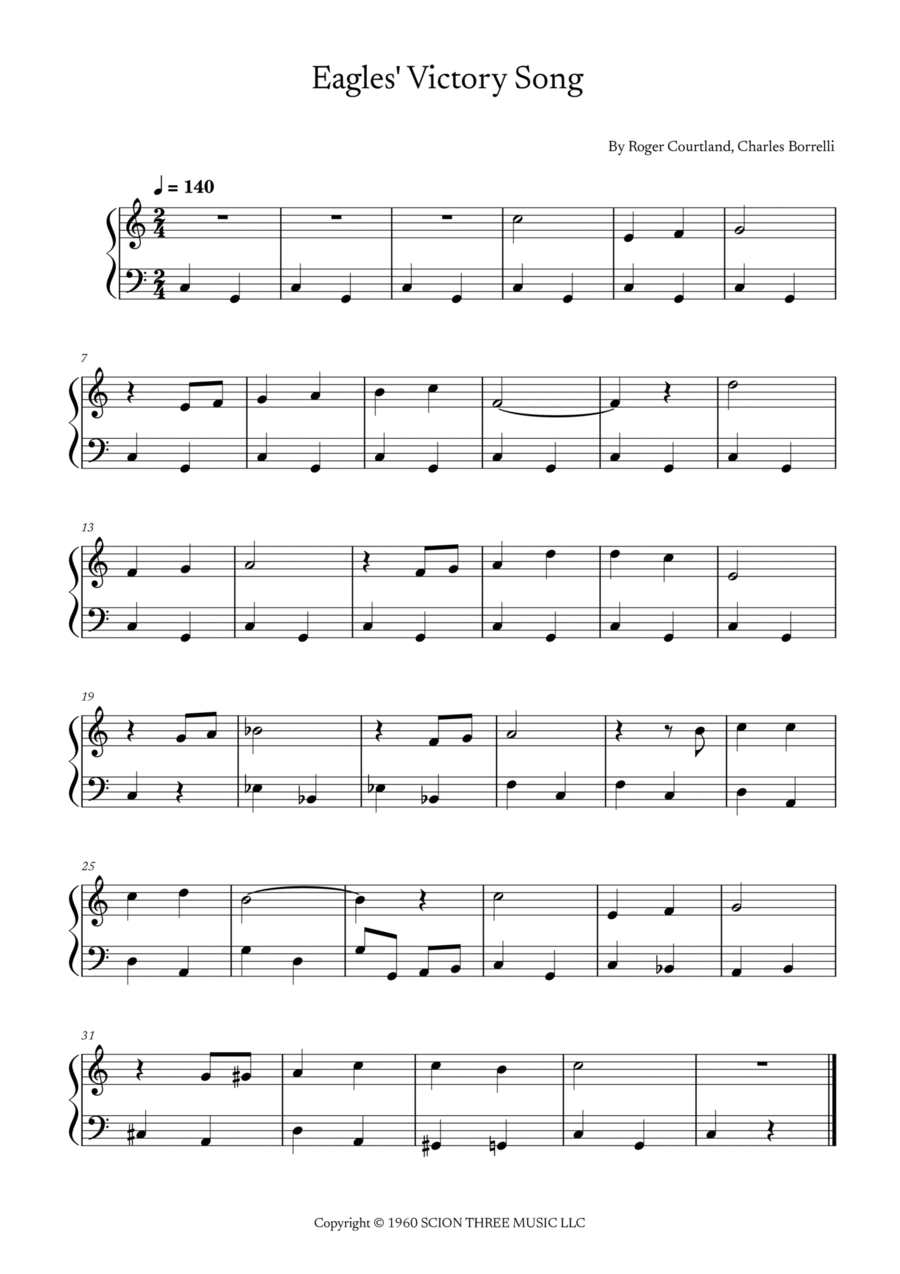
Easy Piano - Level 1 - Digital Download SKU: A0.1180746 By Dirk Quinn Band. By Charles Borrelli and Roger Courtland. Arranged by Marcony Carvalho. 20th Century,Classical,Historic,Patriotic,Pop. Score. 1 pages. Zedas Couve #780613. Published by Zedas Couve (A0.1180746). The Eagles' Victory Song was the creation of Charles Borrelli and Richard Courtland Harrison, a Washington, D.C. music teacher and arranger for jazz guitarist Charlie Byrd. The song was mistakenly credited to R. Courtland by the Copyright office and in various editions of Eagles programs from the late 1950s through the 1960s.In 1963, Jerry Wolman purchased the Philadelphia Eagles. Wolman was a sports fan growing up and loved hearing the Washington Redskins' fight song Hail to the Redskins at games. Spawning from his admiration for the Redskins' song, Wolman searched for musicians to implement a team song for the Eagles, and founded The Philadelphia Eagles' Sound of Brass band in 1964. The group included 200 musicians and dancers, and was led by Arlen Saylor, who was appointed as the Eagles' entertainment director in 1966 and is credited with penning an arrangement of the fight song that the band played at home games during halftime in the 1960s. Wolman's push to popularize the fight song flew under the radar, however, and in 1969 the Sound of Brass band was discontinued.The song came back into light in 1997, when Bobby Mansure, founder of an unofficial Eagles pep band, asked team management to allow the band to play in the parking lot during home games. Management gave Mansure's pep band an audition, allowing them to play at two preseason games to gauge fan reaction. The song went over so well that Mansure and the band retained a permanent position as the official Philadelphia Eagles Pep Band.In 1998, following Mansure's reintroduction of the song, Eagles management attempted to rebuild its popularity among fans by changing some aspects of the song: they modified the key, changed the opening lyric from Fight, Eagles Fight to Fly, Eagles Fly, and re-marketed the song with that as the title. In addition, they appended the popular E-A-G-L-E-S chant—which had emerged in the 1980s—to the end of the song. While management planned to play the song throughout the 1998 season, the Eagles' poor performance that year caused them to hold off reintroducing the song until the following year. The Eagles fared better during their 1999 season, and subsequently, the fight song was played after every score.
Eagles' Victory Song
Piano Facile
Dirk Quinn Band
$4.99 4.33 € Piano Facile PDF SheetMusicPlus

Piano; violin - Digital Download SKU: LV.14211 Composed by John Gildon. Campaigns & battles. Lester S. Levy Collection. 15 pages. Published by Johns Hopkins University Sheridan Libraries (LV.14211). The Victory of Salamanca for the Piano Forte, With an Accompaniment for the Violin ad lib. Composed by John Gildon. Published [n.d.] by G. Willig's Musical Magazine in Philadelphia. Composition of multimovement, sectional work, with descriptive headings (e.g., Groans of the Wounded & Bugle Call, and Park and Tower Guns, etc.); several marches and quick steps with piano; violin instrumentation. Subject headings for this piece include Campaigns & battles. About The Lester S. Levy CollectionThe Lester S. Levy Collection of Sheet Music consists of over 29,000 pieces of American popular music. Donated to Johns Hopkins University Sheridan Libraries, the collection's strength is its thorough documentation of nineteenth-century American through popular music. This sheet music has been provided by Project Gado, a San Francisco Bay Area startup whose mission is to digitize and share the world's visual history.WARNING: These titles are provided as historical documents. Language and concepts within reflect the opinions and values of the time and may be offensive to some.
The Victory of Salamanca
Violon

$5.99 5.2 € Violon PDF SheetMusicPlus

Piano,Trombone - Level 1 - Digital Download SKU: A0.1182600 By Dirk Quinn Band. By Charles Borrelli and Roger Courtland. Arranged by Marcony Carvalho. 20th Century,March,Patriotic,Traditional. Score and part. 2 pages. Zedas Couve #782346. Published by Zedas Couve (A0.1182600). The Eagles' Victory Song was the creation of Charles Borrelli and Richard Courtland Harrison, a Washington, D.C. music teacher and arranger for jazz guitarist Charlie Byrd. The song was mistakenly credited to R. Courtland by the Copyright office and in various editions of Eagles programs from the late 1950s through the 1960s.In 1963, Jerry Wolman purchased the Philadelphia Eagles. Wolman was a sports fan growing up and loved hearing the Washington Redskins' fight song Hail to the Redskins at games. Spawning from his admiration for the Redskins' song, Wolman searched for musicians to implement a team song for the Eagles, and founded The Philadelphia Eagles' Sound of Brass band in 1964. The group included 200 musicians and dancers, and was led by Arlen Saylor, who was appointed as the Eagles' entertainment director in 1966 and is credited with penning an arrangement of the fight song that the band played at home games during halftime in the 1960s. Wolman's push to popularize the fight song flew under the radar, however, and in 1969 the Sound of Brass band was discontinued.The song came back into light in 1997, when Bobby Mansure, founder of an unofficial Eagles pep band, asked team management to allow the band to play in the parking lot during home games. Management gave Mansure's pep band an audition, allowing them to play at two preseason games to gauge fan reaction. The song went over so well that Mansure and the band retained a permanent position as the official Philadelphia Eagles Pep Band.In 1998, following Mansure's reintroduction of the song, Eagles management attempted to rebuild its popularity among fans by changing some aspects of the song: they modified the key, changed the opening lyric from Fight, Eagles Fight to Fly, Eagles Fly, and re-marketed the song with that as the title. In addition, they appended the popular E-A-G-L-E-S chant—which had emerged in the 1980s—to the end of the song. While management planned to play the song throughout the 1998 season, the Eagles' poor performance that year caused them to hold off reintroducing the song until the following year. The Eagles fared better during their 1999 season, and subsequently, the fight song was played after every score.

Eagles' Victory Song
Trombone et Piano
Dirk Quinn Band
$4.99 4.33 € Trombone et Piano PDF SheetMusicPlus

Piano and voice - Digital Download SKU: LV.23027 Composed by Elizabeth A. Wilbur & Fay Foster. World War I, Soldiers, Flags, Patriotism, War allies. Lester S. Levy Collection. 6 pages. Published by Johns Hopkins University Sheridan Libraries (LV.23027). The Americans Come! An Episode in France in the Year 1918. A Victory Song. Elizabeth A. Wilbur. Fay Foster. Published 1918 by J. Fischer & Bro., Fourth Avenue and Eighth Street (Astor Place) in New York. Composition of through-composed with piano and voice instrumentation. Subject headings for this piece include World War I, Soldiers, Flags, Patriotism, War allies. First line reads What is the cheering, my little one? oh, that my blinded eyes could see!.. About The Lester S. Levy CollectionThe Lester S. Levy Collection of Sheet Music consists of over 29,000 pieces of American popular music. Donated to Johns Hopkins University Sheridan Libraries, the collection's strength is its thorough documentation of nineteenth-century American through popular music. This sheet music has been provided by Project Gado, a San Francisco Bay Area startup whose mission is to digitize and share the world's visual history.WARNING: These titles are provided as historical documents. Language and concepts within reflect the opinions and values of the time and may be offensive to some.
The Americans Come! An Episode in France in the Year 1918. A Victory Song
Piano, Voix

$5.99 5.2 € Piano, Voix PDF SheetMusicPlus

Piano Solo - Level 2 - Digital Download SKU: A0.951687 Composed by Rev. Michael J. Shea. Arranged by Travis Hayman. Contemporary. Score. 8 pages. Travis Hayman #6637929. Published by Travis Hayman (A0.951687). Victory March is the fight song for the University of Notre Dame. The Rev. Michael J. Shea, a 1905 Notre Dame graduate and organist at St. Patrick's Cathedral in New York, wrote the music, and his brother, John F. Shea, who earned degrees from Notre Dame in 1906 and 1908, wrote the original lyrics. At the behest of his former music teacher, Professor William C. Hammond of Mount Holyoke College, Rev. Shea would first perform the song publicly on the organ of the Second Congregational Church of Holyoke, Massachusetts, where Hammond was music director, soon after completing the composition with his brother in the winter of 1908. The song would first be performed on Notre Dame's campus on Easter Sunday, 1909, in the rotunda of the Golden Dome.
Notre Dame Victory March - Flute
Piano seul

$5.00 4.34 € Piano seul PDF SheetMusicPlus

Piano Quintet Cello,Piano,Viola,Violin - Level 5 - Digital Download SKU: A0.1399100 Composed by Modest Petrovich Mussorgsky. Arranged by James M. Guthrie. 19th Century,Chamber,Contest,Festival,Historic,Romantic Period. 235 pages. Jmsgu3 #982395. Published by jmsgu3 (A0.1399100). The Second edition features more textural variety and interplay between the strings and piano.Mussorgsky is known for his ability to evoke vivid pictures through his music. He creates soundscapes that transport listeners to other places and times. Using complex harmonies and shifting tonalities, Mussorgsky creates sonic paintings that are as diverse and varied as any works of art in a museum. He takes listeners on a journey through different landscapes and environments, ranging from pastoral settings to the underworld depths. In his famous suite, Pictures at an Exhibition, Mussorgsky gives each movement a title referencing a painting, sculpture, or architectural feature from an art museum. The suite is composed to capture the moods and emotions the artworks evoke. From the bright and energetic Promenade to the somber and mysterious Catacombs, Mussorgsky's Pictures at an Exhibition paints a vivid sonic landscape that brings the listener into the art museum.Contents: Promenade 1 Allegro giusto, nel modo russico; senza allegrezza, ma poco sostenuto 1. GNOMUS (The Gnome) Sempre vivo  Promenade 2 Moderato commodo assai e con delicatezza  2. IL VECCHIO CASTELLO (The Old Castle) Andante molto cantabile e con dolore  Promenade 3 Moderato non tanto, pesamente  3. TUILLERIES Dispute d'enfants après jeux (Children's Quarrel after Games)      Allegretto non troppo, capriccioso 4. BYDLO (Cattle) Sempre moderato pesante Promenade 4 Tranquillo 5. Ballet of the Unhatched Chicks Балет невылупившихся птенцов   Scherzino 6. Samuel Goldenberg und Schmuÿle  Еврей в меховой шапке. Cандомир Andante Promenade 5 Allegro giusto, nel modo russico, poco sostenuto 7. LIMOGES. LE MARCHÉ. (La grande nouvelle) The Market (The Great News)      Allegretto vivo, sempre scherzando 8. CATACOMBAE (Sepulchrum romanum) (Roman Tomb) Парижские катакомбы Largo       CON MORTUIS IN LINGUA MORTUA (With the Dead in a Dead Language)      Andante non troppo, con lamento 9. The Hut on Hen's Legs (Baba Yaga) Избушка Бабы-Яги на курьих ожках. Часы в русском стиле      Allegro con brio, feroce  10. The Bogatyr Gates (In the Capital in Kiev) Проект городских ворот в Киеве. Главный фасадThe Great Gates of Kiev Allegro alla breve Maestoso con grandezza.
Mussorgsky: Pictures at an Exhibition for Piano Quintet - 2nd Edition
Piano Quintette: piano, 2 violons, alto, violoncelle

$54.95 47.68 € Piano Quintette: piano, 2 violons, alto, violoncelle PDF SheetMusicPlus


Partitions Gratuites
Acheter des Partitions Musicales
Acheter des Partitions Digitales à Imprimer
Acheter des Instruments de Musique

© 2000 - 2026

Accueil - Version intégrale




