EUROPE
44498 articles
USA
0 articles
DIGITAL
19313 articles (à imprimer)
Partitions Digitales
Partitions à imprimer
19313 partitions trouvées


Saxophone Quintet,Woodwind Ensemble Alto Saxophone,Baritone Saxophone,Tenor Saxophone - Level 4 - Digital Download SKU: A0.813089 Composed by George Frideric Handel. Arranged by Regis Bookshar. Baroque,Christmas,Easter,Multicultural,Standards,World. 22 pages. Regis Bookshar #6103659. Published by Regis Bookshar (A0.813089). Saxophone Quintet - Advanced Intermediate - Digital Download. This selection, the world-famous Hallelujah Chorus from George Frideric Handel's great masterpiece, Messiah, has been arranged for a Saxophone Quintet, consisting of 2 Alto Saxophones, 2 Tenor Saxophones and 1 Baritione Saxophone, by Regis Bookshar. I'm certain that this exciting arrangement will entertain both performers and audiences alike for years to come. It is suitable for high school and college students and is perfect for Christmas concerts and church services, especially Easter, but could be performed for any festive occasion. Included are a score and a complete set of parts (22 pages). Handel's original composition is written in the key of Concert D but this version is written in Concert Bb, to make it a little easier for some younger performers. Other versions of this selection, in both the keys of Concert Bb and Concert D, are also available for a variety of instrumental ensembles. If you are planning to have an organist or other keyboard player play along with this selection, I would suggest that you purchase a version in Concert D. Please feel free to search for other arrangements in a variety of styles by Regis Bookshar. You may find something else which might interest you as well. I'm certain that students will enjoy playing this arrangement and audiences will love hearing it.
Hallelujah (from "Messiah") (Bb) (Saxophone Quintet - 2 Alto, 2 Tenor, 1 Bari)
Quintette de Saxophone: 5 saxophones

$25.00 21.68 € Quintette de Saxophone: 5 saxophones PDF SheetMusicPlus

Instrumental Duet Instrumental Duet,Multi-Percussion,Oboe - Level 5 - Digital Download SKU: A0.816703 Composed by Guy Bunce. Contemporary. Score and parts. 11 pages. Enigma Music #4984881. Published by Enigma Music (A0.816703). Entrainment (2009)Written for New Noise​Oboe & PercussionEntrainment is the process by which two oscillating systems, which have different periods when they function independently, assume the same period when interacting. The principle of entrainment is universal, appearing in chemistry, pharmacology, biology, medicine, psychology, sociology, astronomy, architecture to name but a few.This piece explores the entrainment of tempo with two initially diverse tempo structures synchronising after a period of four minutes. At the start of the score the oboe begins at 137 bpm and the percussionist at 63 bpm. Over the course of the four minutes the percussionist speeds up whilst the oboist slows down resulting in the tempi synchronising at four minutes. After four minutes the two instruments begin a discourse in unison (rhythmically, melodically, and dynamically): the musical equivalent of total synchronisation. In the final section of the piece the parts diverge with the percussionist slowing down and the oboe part maintaining its speed.As with many of my pieces, the starting point for Entrainment was an external source, in this case the song Time by Pink Floyd. The rhythmic lines throughout Entrainment are based on the rhythm to the bass line of the first part of Time. This can be clearly seen in the opening in which the oboe part employs this rhythm.Harmonically Entrainment consists of a series of key centres whose period is determined by points within the four minutes where either of the two independent parts briefly synchronise at the semiquaver level with the unit of a second. At each of these points (which become more frequent as the piece progresses), the harmonic centre changes. The harmonic centres relate directly to the chord structure of Pink Floyd's Time: at each point where either part synchronises with seconds the harmonic centre in both parts moves one chord through Time's chord sequence. At 2' 19'' the percussion and oboe part synchronise (albeit briefly) for the first time. This event was used to mark the start of more polytonal harmony as both instruments from this point forward begin their own cycles through the Time chords. Throughout the piece, points of synchronisation are highlighted musically.Performance mp3 recordings that contain a dual click track for the first four minutes of the piece can be obtained by contacting guybunce@hotmail.com. The click track is arranged so that the oboe click is on the left channel and the percussion click is on the right. An alternative click track (track 3) is also provided using a different sound (a beep). The performers should wear the headphone in one ear which corresponds to the track of their part. The dual click track can then be played on a single CD player (or mp3 player) with the output going to both sets of headphones using a headphone splitter or other device. Alternatively, files can be put on either two iPods or Mp3 players. The players will then have to synchronize the beginnings of each track.It is possible to play the piece without the use of the click track(s). If this is the case, performers should use the metronome markings and general layout of the score to aid performance. It is advisable that one player (possibly the oboist) sets the tempo and tempo changes, and the other player follows.It was not always possible to represent accurately the relationship between the two parts in the score. Arrows have been added on the score to show points of synchronisation where the score layout differs.
Entrainment (2009)

$7.99 6.93 € PDF SheetMusicPlus

Piano Solo - Level 3 - Digital Download SKU: A0.1110803 By The Beatles. By John Lennon and Paul McCartney. Arranged by Frank Pisani. 20th Century,Pop,Rock. Score. 4 pages. Frank Pisani #713101. Published by Frank Pisani (A0.1110803). Solo Piano arrangement for The Beatles’ song, And Your Bird Can Sing from the band's 1966 album Revolver. This arrangement is in the original key and is perfect for intermediate pianists - featuring a very accurate vocal line and the iconic guitar riff. This arrangement also features lyrics and chord symbols, making it easy to sing along and learn the chord progression. Finger number markings make it easier to know which fingers to use, and how to easily move around the keyboard. You may find it easier to learn how to play this song if you practice both hand separately first before trying to play them together. Arrangement Duration: 1:57 This arrangement is appropriate for schools and students.
And Your Bird Can Sing
Piano seul
The Beatles
$4.99 4.33 € Piano seul PDF SheetMusicPlus

Instrumental Duet Instrumental Duet,Organ,Soprano Saxophone - Level 5 - Digital Download SKU: A0.981222 Composed by Judith Cloud. Contemporary. Score and parts. 24 pages. Judith Cloud #6690537. Published by Judith Cloud (A0.981222). What Would Nina Simone Say? For Soprano Sax and Organ (9'50)Program NotesI became interested in Nina Simone in the spring of 2018. She was born Eunice Waymon in Tryon, North Carolina, my own hometown. I knew little about her while I was growing up. Later I heard she was an activist and the sentiment around town I observed was that there was far from a feeling of pride about who Nina Simone was. If that really was the case (and I have no proof of it) there was a dramatic change with the creation of The Nina Simone Project in 2006. I was still ignorant of this, having lived in Arizona for most of my adult life. But researching Simone led me to an immense feeling of pride for my hometown when I read about the support she had from the white community in the 1940’s. Without that encouragement and financial support, as well as artistic support from a local piano teacher, Muriel Mazzanovich, Mrs. Mazzy, as she was called and who Nina treasured and respected all of her life, Nina Simone would never have reached the world with her unique prodigious musical talent. She was a diva by all counts and her original compositions reflect a balance of words with music that is far superior to what her contemporaries were creating. A bronze sculpture of her by Zenos Frudakis now stands on Main Street in Tryon. How can you be an artist and not reflect the times? Simone asked in an interview. That to me is the definition of an artist. The feminist writer Germaine Greer declared Every generation has to discover Nina Simone. She is evidence that female genius is real. What would Nina Simone say today? I think she’d be mad as hell and screaming about revolution, probably still advocating for the use of violence. I’ve used some of Simone’s energetic and compelling motives in this composition. It is my own tribute to her genius and to how she gave to the world so much even though she was plagued with agonizing physical and mental ailments. That suffering seems to me an undercurrent in each video I have watched of her concerts. What I would give to have been in her presence for one of those concerts! She embodied music as an art form, revering her musical teachers, Bach, especially. That she never achieved her main goal of becoming the first female African-American classical pianist of world stature is perhaps not so sad when you think of how many more people she moved with her talent expressed in jazz and folk popular idioms. But she was prone to violence and many people, even those closest to her, were often fearful of her rage. She was misunderstood for so many years and it was only in the last two decades of her life that her moods were somewhat controlled through use of prescription drugs. The musical life that began for Eunice Waymon when she was seven years old playing the piano and organ for services at St. Luke’s C.M.E. Church (where her mother was the preacher) in Tryon, N.C. traversed many cities in many countries. She died at the age of 70 in 2003 in Carry-le-Rouet, France.
What Would Nina Simone Say? For Soprano Sax & Organ (9'50")
Saxophone et Orgue

$15.00 13.01 € Saxophone et Orgue PDF SheetMusicPlus

Piano Solo - Level 3 - Digital Download SKU: A0.920348 Composed by Samuel Ward. Arranged by Dan Karlsberg. Children,Contemporary,Folk,Patriotic. Score. 2 pages. Daniel H. Karlsberg #5985561. Published by Daniel H. Karlsberg (A0.920348). Here is a beautiful arrangement of America the Beautiful. It was arranged for the immediate level pianist in mind, but will be enjoyed by much more advanced students as well. It has a touch of jazz harmony, making it sound more modern then the most traditional of arrangements. Also, all fingerings are included to help out where needed. Check out the audio clip. Enjoy!If you are interested in seeing more of my arrangements, checkout my publisher page here:https://www.sheetmusicplus.com/publishers/natijazz-sheet-music/3017286
America the Beautiful
Piano seul

$2.99 2.59 € Piano seul PDF SheetMusicPlus

Concert Band - Level 3 - Digital Download SKU: A0.878301 Composed by Sean A. Brown. Contemporary. Score and parts. 45 pages. SeanBrownMusic #566777. Published by SeanBrownMusic (A0.878301). This was written in 2010 with the aim of being an advanced middle school band piece, but it also works well with a high school group or higher. It is not incredibly technically demanding, and with limited range, but musically fulfilling. The challenge mainly lies in precision of articulations and dotted-eighth-sixteenth rhythms, as well as with individual entrances. It works well as an opening to a concert or as a filler. Published by Sean A. Brown, SeanBrownMusic. Please visit SeanBrownMusic.Weebly.com for contact information if you have any questions or comments.
Evergreen Fanfare
Orchestre d'harmonie

$40.00 34.69 € Orchestre d'harmonie PDF SheetMusicPlus

Piano,Viola - Level 3 - Digital Download SKU: A0.549767 Composed by Peter Ilyich Tchaikovsky. Arranged by James M. Guthrie, ASCAP. Children,Christmas,Romantic Period,Standards. Score and part. 11 pages. Jmsgu3 #3534709. Published by jmsgu3 (A0.549767). Duration: ca 1:00 Score: 5 pages, Solo part: 2 pages, piano part: 3 pages. Short but fascinating Chinese Dance from the Nutcracker Suite. Program this for a recital encore or Christmas pageant. Pyotr Ilyich Tchaikovsky Tchaikovsky is probably the most popular of the great composers in America. His music certainly appeals to musicians. Likewise, it appeals even to folks who don’t normally listen to serious music. This is probably because of his most noteworthy melodies. Above all, he writes with great emotion. This certainly makes a most noteworthy if not an unforgettable impact. Education First of all, He attended classes at the Russian Musical Society. Even more, He also attended the St. Petersburg Conservatory. There he studied music theory with Nikolai Zaremba. He also consequently studied composition with Anton Rubenstein. It seems like Rubenstein came under criticism from a group of Russian composers known as the Five. The Five The Five certainly rejected Western musical influences. They rather sought to use elements from Russian music. They furthermore wanted to use more exotic musical materials. Western Techniques More than other Russian composers, Tchaikovsky studied modern Western music. He certainly develops his music like the European masters. So, rather than repeating a motive, he moves to a new key. He then introduces a different theme in the new key. Hence, he maintained his independence from the Five. Even more, he became the first Russian composer of international stature. Influences Tchaikovsky was probably influenced in his ballet scoring by Léo Delibes. Richard Wagner influenced his symphonic writing. Tchaikovsky’s most famous works include the 1812 Overture, The Nutcracker Suite, and Swan Lake. Also famous are the Violin Concerto in D and the six symphonies. The greatest of the six symphonies may be No. 6, the Pathétique. Nutcracker Suite, Op. 71a The Nutcracker Suite is a ballet that was performed for the first time in December 1892 in St. Petersburg. To begin with, the original ballet failed to attract a positive reception. However, the ballet suite became probably one of the most popular of all of Tchaikovsky’s works. The ballet suite became even more famous in the 1960s. It is now performed all over the world, particularly during the Christmas season.
Tchaikovsky: Chinese Dance from Nutcracker Suite for Viola & Piano
Alto, Piano

$32.95 28.58 € Alto, Piano PDF SheetMusicPlus

Choral Choir (SSAA) - Digital Download SKU: A0.1007507 Composed by R. LaBanca. Contemporary. Octavo. 7 pages. R. LaBanca #3416041. Published by R. LaBanca (A0.1007507). This piece is based on text that I wrote several years ago. As a lover of the horror genre I have always had a fascination with the romantic creature known in modern culture as the vampire. I imagined in my mind the interaction between a mortal and an immortal creature. How would the mortal describe a romantic encounter with this creature that exists in the shadows, untouched by time? I used descriptive text to communicate the visceral details of this experience and make the listener create in their mind how the experience would have felt if they had experienced it. The encounter is intense, and painful but once it ends the narrator feels empty and only has a mysterious melody to keep as a memory. I set the text for treble voices because I felt that the close harmonies I could accomplish with voices in the same register would lend itself well to the imagery. The piece is lush and smooth when the text demands it and sharp and angular when the text calls for that sound. Once the interaction is over, the voices break off into an aleatoric section in which each voice sings the phrase Songs only bones can hear fading away into nothingness just as the text suggests the vampire moves into the velvet void.
Vampire
Chorale SSAA

$3.99 3.46 € Chorale SSAA PDF SheetMusicPlus

Mixed Percussion B-Flat Tuba,B-Flat trombone,Baritone Horn TC/Euphonium,Bass Trombone,E-Flat Cornet,E-Flat Tenor Horn,E-Flat Tuba TC,Flugelhorn,Percussion 1,Percussion 2,Tenor Trombone - Level 2 - Digital Download SKU: A0.759821 Composed by Giulio Caccini. Arranged by Raymond Fenech. Baroque,Praise & Worship,Sacred,Spiritual,Wedding. Brass Band. 39 pages. Raymond Fenech #3241545. Published by Raymond Fenech (A0.759821). This is a beautiful aria by a wonderful Baroque composer Giulio Caccini (1551 - 1618). It is arranged for Brass Band and Soprano voice, and it could also be sung with a choir. An extra part have been written (sop Manc. Solo Cornet) so that it could also be played without the voice.  If you are looking for something special listen to this arrangement. The level of this piece is Early Intermediate and the duration is just over 6 minutes.
Ave Maria (Giulio Caccini) - Soprano and Brass Band

$30.00 26.02 € PDF SheetMusicPlus

Instrumental Duet Bassoon,Instrumental Duet - Level 3 - Digital Download SKU: A0.549828 Composed by Peter Ilyich Tchaikovsky. Arranged by James M. Guthrie, ASCAP. Children,Christmas,Romantic Period,Standards. Score and parts. 48 pages. Jmsgu3 #3549777. Published by jmsgu3 (A0.549828). Duration: 6:12, Score: 29 pages, Solo part: 6 pages, Piano part: 12 pages. This is the grand finale of the Nutcracker Suite. Pyotr Ilyich Tchaikovsky Tchaikovsky is probably the most popular of the great composers in America. His music certainly appeals to musicians. Likewise, it appeals even to folks who don’t normally listen to serious music. This is probably because of his most noteworthy melodies. Above all, he writes with great emotion. This certainly makes a most noteworthy if not an unforgettable impact. Education First of all, He attended classes at the Russian Musical Society. Even more, He also attended the St. Petersburg Conservatory. There he studied music theory with Nikolai Zaremba. He also consequently studied composition with Anton Rubenstein. It seems like Rubenstein came under criticism from a group of Russian composers known as the Five. The Five The Five certainly rejected Western musical influences. They rather sought to use elements from Russian music. They furthermore wanted to use more exotic musical materials. Western Techniques More than other Russian composers, Tchaikovsky studied modern Western music. He certainly develops his music like the European masters. So, rather than repeating a motive, he moves to a new key. He then introduces a different theme in the new key. Hence, he maintained his independence from the Five. Even more, he became the first Russian composer of international stature. Influences Tchaikovsky was probably influenced in his ballet scoring by Léo Delibes. Richard Wagner influenced his symphonic writing. Tchaikovsky’s most famous works include the 1812 Overture, The Nutcracker Suite, and Swan Lake. Also famous are the Violin Concerto in D and the six symphonies. The greatest of the six symphonies may be No. 6, the Pathétique. Nutcracker Suite, Op. 71a The Nutcracker Suite is a ballet that was performed for the first time in December 1892 in St. Petersburg. To begin with, the original ballet failed to attract a positive reception. However, the ballet suite became probably one of the most popular of all of Tchaikovsky’s works. The ballet suite became even more famous in the 1960s. It is now performed all over the world, particularly during the Christmas season.  
Tchaikovsky: Waltz of the Flowers from Nutcracker Suite for Bassoon & Piano
2 Bassons (duo)

$32.95 28.58 € 2 Bassons (duo) PDF SheetMusicPlus

Choral Choir (SA) - Level 1 - Digital Download SKU: A0.1079571 By Bruno Mars. By Andrew Wyatt, Ari Levine, Bruno Mars, and Philip Lawrence. Arranged by Matt Arnett. Pop. Octavo. 7 pages. Matt Arnett Music #683749. Published by Matt Arnett Music (A0.1079571). Another solid title from Bruno Mars, Middle School students love this piece! If you've worked with them, you know that they love heartache and broken relationships, so this song definitely delivers. I kept this one very simple and it was just fun. Students really like and find accessible the easy alto harmonies throughout. There's definitely more of an opportunity to learn about dynamics and have a powerful moment in this piece than in most pop music, but make sure you have a big drop before the third verse - students love the feeling it gives them. The piece is also notated in cut time with swung eighths, so there are opportunities to teach some more complicated metric principles as well, though you can also easily ignore those details and keep it simple for a young group. The piano part is kept very simple throughout.
When I Was Your Man
Chorale 2 parties
Bruno Mars
$1.99 1.73 € Chorale 2 parties PDF SheetMusicPlus

Soprano voice,Vocal Solo - Level 1 - Digital Download SKU: A0.1476574 Composed by James Lord Pierpont. Arranged by Jps Arrangements. Christmas,Holiday,Traditional. 2 pages. Jps Arrangements #1054085. Published by Jps Arrangements (A0.1476574). Jingle Bells for Choir in C major is a classic Christmas song that brings joy and festive spirit. Here are some reasons why you should consider purchase of choral sheet music:Christmas Tradition: Jingle Bells is one of the best known and sung songs during Christmas. It evokes memories of celebrations, snow and gifts.Versatility: The score has been adapted for soprano. Universal Appeal: Music transcends cultures and languages. It is known throughout the world, which makes Jingle Bells an excellent choice for choirs looking to connect with diverse audiences.Performance opportunity: With sheet music in hand, your choir can perform Jingle Bells at concerts, community events, schools and churches. It's a way to spread Christmas joy.If you're looking for an affordable and exciting sheet music for your choir, Jingle Bells is an excellent option. Download the sheet music in PDF and get started rehearsing with enthusiasm.The arrangement is in C major and has the numbers.
Jingle Bells for Choir in C major
Voix Soprano, Piano

$1.99 1.73 € Voix Soprano, Piano PDF SheetMusicPlus

Euphonium - Level 4 - Digital Download SKU: A0.1111650 Composed by Wolfgang Amadeus Mozart. Arranged by Regis Bookshar. Chamber,Christian,Classical,Instructional,Religious. 41 pages. Regis Bookshar #713945. Published by Regis Bookshar (A0.1111650). Recordare (from Requiem (K. 626) - Wolfgang Amadeus Mozart/Franz Xaver Sussmayr - Euphonium Septet - Advanced/Intermediate - Digital Download. Hauntingly beautiful is how the Recordare from Mozart's Requiem is often described. Originally written for an orchestra and four vocal soloists, it has now been transcribed by Regis Bookshar for a Euphonium Septet, and would be a wonderful addition to any music library. This arrangement will provide students with the opportunity to practice breath control because of its long, sustained phrases, and also to give them the chance to play this beautiful composition, something which they may not have had the opportunity to do, otherwise. This selection could be performed for concerts, recitals and church services and is suitable for high school and college students but professional musicians would also enjoy playing this arrangement. Included are a score and a complete set of parts (41 pages) written in Bass Clef. There is also a version written in Treble Clef if you prefer. The Regis Bookshar Trumpet Ensemble has performed the Trumpet Quintet version of the Recordare for funerals, providing beautiful, introspective music for the occasion. There is some controversy surrounding the circumstances of the Requiem's composition because Mozart died before he could complete it. Count Franz von Walsegg had commissioned a Requiem Mass but Mozart had received only half of the payment in advance. So, upon his death on December 5th, 1791, his widow, Constanze, wished to have the work completed secretly by someone else and submit it to the count as having been completed by Mozart to collect the final payment. Joseph von Eybler was one of the first composers to be asked to complete the score and had worked on a number of movements but felt unable to complete the remainder and gave the manuscript back to Constanze Mozart. The task was then given to another composer, Franz Xaver Sussmayr. Sussmayr borrowed some of Eybler's work in making his completion, added his own orchestration to other movements and added several new movements which a Requiem Mass would normally comprise. He then added a final section by adapting the opening two movements which Mozart had written to the different words which finish the Requiem Mass, which according to both Sussmayr and Mozart's wife, was done according to Mozart's directions. The completed score, initially by Mozart but largely finished by Sussmayr, was then dispatched to Count Walsegg complete with a counterfeited signature of Mozart dated 1792. Despite the controversy over how much of the music is actually Mozart's, the commonly performed Sussmayr version has become widely accepted by the public, and is considered one of Mozart's finest compositions. The Recordare is considered by many people to be one of the most beautiful compositions in Mozart's entire catalogue. Regis Bookshar, a trumpet player, has performed the Requiem in concert with a full orchestra, soloists and a chorus and felt that other musicians should have the opportunity to play the hauntingly beautiful Recordare as well. So, in addition to this arrangement for a Euphonium Septet, he has made quite a few other arrangements of this beautiful composition. There are Quintets, Sextets, Septets and Octets readily available for a wide variety of instrumental ensembles. Please take the time to look for other versions of this composition. You may fine something else which may also suit your needs. I would also encourage you to search for other arrangements by Regis Bookshar as well, as there are numerous arrangements in a variety of styles, also available for purchase. You may find something else which might interest you. Please continue to check periodically because new arrangements are being added as often as possible. I'm certain that this beautiful arrangement of Mozart's Recordare, will continue to entertain both performers and audiences alike for years to come.
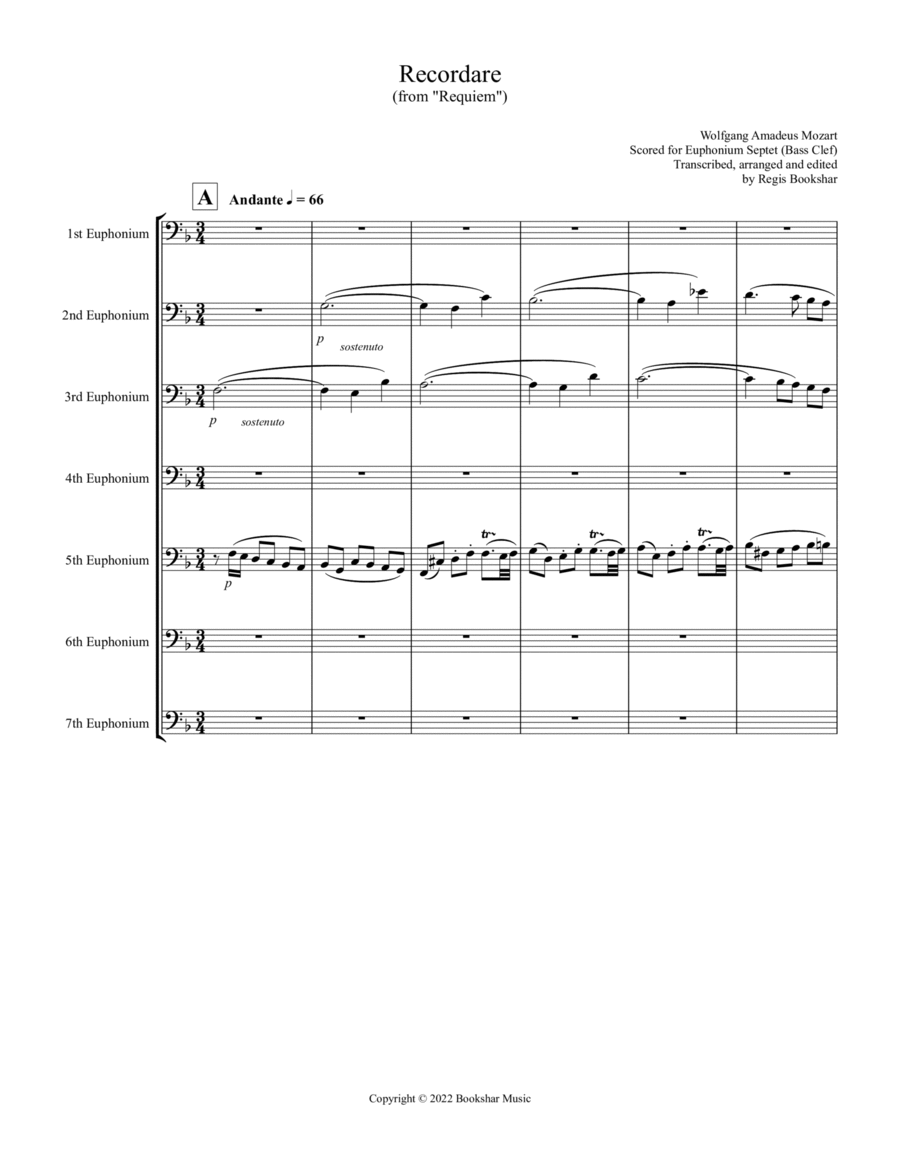
Recordare (from "Requiem") (F) (Euphonium Septet - Bass Clef)

$36.00 31.22 € PDF SheetMusicPlus

B-Flat Trumpet,Piano - Level 3 - Digital Download SKU: A0.549786 Composed by Peter Ilyich Tchaikovsky. Arranged by James M. Guthrie, ASCAP. Children,Christmas,Romantic Period,Standards. Score and part. 11 pages. Jmsgu3 #3536971. Published by jmsgu3 (A0.549786). Duration: ca 1:00 Score: 5 pages, Solo part: 2 pages, piano part: 3 pages. Short but fascinating Chinese Dance from the Nutcracker Suite. Program this for a recital encore or Christmas pageant. Pyotr Ilyich Tchaikovsky Tchaikovsky is probably the most popular of the great composers in America. His music certainly appeals to musicians. Likewise, it appeals even to folks who don’t normally listen to serious music. This is probably because of his most noteworthy melodies. Above all, he writes with great emotion. This certainly makes a most noteworthy if not an unforgettable impact. Education First of all, He attended classes at the Russian Musical Society. Even more, He also attended the St. Petersburg Conservatory. There he studied music theory with Nikolai Zaremba. He also consequently studied composition with Anton Rubenstein. It seems like Rubenstein came under criticism from a group of Russian composers known as the Five. The Five The Five certainly rejected Western musical influences. They rather sought to use elements from Russian music. They furthermore wanted to use more exotic musical materials. Western Techniques More than other Russian composers, Tchaikovsky studied modern Western music. He certainly develops his music like the European masters. So, rather than repeating a motive, he moves to a new key. He then introduces a different theme in the new key. Hence, he maintained his independence from the Five. Even more, he became the first Russian composer of international stature. Influences Tchaikovsky was probably influenced in his ballet scoring by Léo Delibes. Richard Wagner influenced his symphonic writing. Tchaikovsky’s most famous works include the 1812 Overture, The Nutcracker Suite, and Swan Lake. Also famous are the Violin Concerto in D and the six symphonies. The greatest of the six symphonies may be No. 6, the Pathétique. Nutcracker Suite, Op. 71a The Nutcracker Suite is a ballet that was performed for the first time in December 1892 in St. Petersburg. To begin with, the original ballet failed to attract a positive reception. However, the ballet suite became probably one of the most popular of all of Tchaikovsky’s works. The ballet suite became even more famous in the 1960s. It is now performed all over the world, particularly during the Christmas season.
Tchaikovsky: Chinese Dance from Nutcracker Suite for Trumpet & Piano
Trompette

$32.95 28.58 € Trompette PDF SheetMusicPlus


Partitions Gratuites
Acheter des Partitions Musicales
Acheter des Partitions Digitales à Imprimer
Acheter des Instruments de Musique

© 2000 - 2026

Accueil - Version intégrale





