EUROPE
44498 articles
USA
0 articles
DIGITAL
19320 articles (à imprimer)
Partitions Digitales
Partitions à imprimer
19320 partitions trouvées


Harp - Level 1 - Digital Download SKU: A0.896743 By James Ingram. By Al Hoffman, Jerry Livingston, and Mack David. Arranged by Janice Eckworth. Contemporary,Soul. Score. 5 pages. Janice Eckworth (aka Sanisi) #6589575. Published by Janice Eckworth (aka Sanisi) (A0.896743). This is a lovely Disney melody. I hope I have done it justice and you enjoy playing it!  Arranged for lever harp; one measure has lever changes. (If you would like to play this song without changes levers, the note with the accidental can be omitted.)One version with brackets and finger numbers. One version without.Key: F major (needs Bâ™­ )Lowest Note: Bass CHighest Note: F above treble CDifficulty: Late beginner (SMP doesn't have this option, so to make it extra clear: You will need to be confident reading the full music staff, a variety of hand placings, rolled chords, and lever changes.).
So This Is Love
Harpe
James Ingram
$5.50 4.79 € Harpe PDF SheetMusicPlus

French Horn,Piano - Level 4 - Digital Download SKU: A0.1416182 Composed by Franz Schumbert. Arranged by Layne Anspach. Classical. Score and part. 14 pages. Songburd Music #997866. Published by Songburd Music (A0.1416182). FRANZ SCHUBERT was an Austrian composer native to the cosmopolitan city of Vienna, colorfully called the “City of Music†as so many other non-native musicians composed or performed there, while others such as Mozart and Beethoven called it home.  While only 20 years of age in the year of 1814 Schubert composed a remarkable number of lieder (songs), drawing upon the works of many different poets of the period, which eventually connected him with the poems of Johann Goethe.  This lead Schubert in the year of 1815 to compose the well-known Erlkönig, op. 1 D. 328, based upon Goethe’s poem Der Erlköning, which was taken and revised from a widely told Scandinavian folk tale about a sinister daughter of a forest-dwelling Elf King. Johann Wolfgang von Goethe was a poet, playwright and novelist who is thought to have been influenced by the Sturm und Drang literary movement, becoming perhaps one of the greatest authors in the German language whose works have had a lasting impression on Western literature to this day.  Notably, it ought to be mentioned that many of his poems were set to music by the likes of Mozart, Liszt, Wagner, Mahler, Berlioz, Beethoven and of course Schubert, who used Goethe’s poem, Der Erlkönig, to produce one of his more fanciful art songs that depicts the death of a child who is attacked by the “king of the elves,†a mystical being who lingers in the woods only to stalk little children and kill them with a touch of his hand. The story of the Erlkönig is considered by some to have come from the Danish folk ballad Elveskud, and that Goethe’s variant was inspired by a work written by the philosopher, Johann Gottfried von Herder.  It tells the story of a boy who is being carried home by his father during the night, and the child hears noises and seems to see things in the woods, while the father attempts to comfort the son by explaining away the things that scare him, all the while riding ever faster on horseback, only in the end to discover that his son has died. (The Erlkönig translates literally from the German as “Alder King†rather than the commonly used “Elf King.â€)For this arrangement, German lyrics are included to assist the performer in connecting the music to the thoughts, feelings, and specific moments expressed in the words that might otherwise be lost if not aligned with the music.  Noting that changes in mood or tone of the music are better understood when aligned with the words, and by including the lyrics, the performer can phrase a passage while having a guide to see the end of the musical line. Romantic lieder allows for rubato in performance, as playing the piece exactly as written on the page will result in a less inspiring rendition.  To match the horn’s register with the vocal line, the piano part required alterations by moving some notation higher in the register.
Erlkönig
Cor et Piano

$14.99 13.06 € Cor et Piano PDF SheetMusicPlus

Instrumental Duet,Piano B-Flat Trumpet,Horn,Instrumental Duet,Piano - Level 1 - Digital Download SKU: A0.1231042 Composed by John Newton. Arranged by Benzaiten Editions. Christian,Early Music,Praise & Worship,Religious,Sacred. 4 pages. Benzaiten Editions #826723. Published by Benzaiten Editions (A0.1231042). The Benzaiten Editions Arrangement If you're looking for an easy trumpet (Bb) and horn (F) music sheet with intermediate piano accompaniment of the classic hymn Amazing Grace, look no further! I have created a simple yet beautiful version of this beloved song that is perfect for beginner trumpet and horn players or those who are just starting to learn how to play. With this arrangement of Amazing Grace, you'll be able to play this timeless melody with ease and grace. The simplified chords and melody make it easy to learn, while still retaining the emotional depth and spiritual resonance of the original hymn. So whether you're looking to add a new piece to your repertoire or share the gift of music with others, our easy/beginner trumpet and horn music sheet of Amazing Grace is sure to inspire and uplift. About the song Amazing Grace is a beloved hymn written by English poet and clergyman John Newton in the late 18th century. It reflects on his personal journey from a life of sin to one of faith and redemption. The melody's origin is unclear, but it's believed to have originated from an old Scottish folk tune. The hymn has been recorded and performed by countless musicians and artists over the years and has become a source of comfort and hope for people around the world in times of struggle and hardship.
Amazing Grace • super easy trumpet and french horn sheet music with intermediate piano accompaniment
Accompagnement Piano

$2.99 2.6 € Accompagnement Piano PDF SheetMusicPlus

Piano Solo - Level 4 - Digital Download SKU: A0.1000329 Composed by Johann Sebastian Bach, Paul Eber, and Steve Boudreau. Arranged by Steve Boudreau. 20th Century,Jazz,Sacred. Score. 2 pages. Steve Boudreau #6681051. Published by Steve Boudreau (A0.1000329). The Bach Chorales are ultimate examples of melodies creating harmonies, the parts coming together to form a whole. They are also great examples of a musician taking a melody and making a new arrangement of it, like jazz musicians do today. This piece is a combination of two chorale melodies that Bach arranged, originally based on hymns by 16th-century composer Paul Eber. For context, Bach set the melody around 200 years after it was written, and I re-worked the melodies with my own harmonies nearly 300 years after that.The first job I had when I moved back to Ottawa from Boston was as a church pianist. At one point there was a two-month stretch where I was in charge of programming the instrumental music we played, and I challenged myself to come up with new arrangements every week- the way Bach would have in his time, just on a much smaller scale. This was a terrific creative outpouring of music for me, and it renewed my enormous respect for the church music community and the work involved.For this piece I took two seemingly unrelated chorales (they are actually from the same Cantata, BWV 127) and attached them, using their distant keys of A Major and F Major to set up an interesting modulation halfway through. I had to actively try out some more modern harmonic progressions to take the overall sound of the piece further away from Bach's version. One of my favourite moments is when you finish the C major resolution and then repeat back into F# Minor at the top for improvising. In the solo piano version this surprising cut doesn't occur unless you take a second pass through the piece, so I encourage you to try repeating the piece even if you don't feel comfortable embellishing or changing anything the second time around.
Chorale
Piano seul

$1.99 1.73 € Piano seul PDF SheetMusicPlus

Chamber Orchestra - Level 3 - Digital Download SKU: A0.750316 Composed by Eddie Lewis. Folk. Score and parts. 19 pages. Tiger Music #4785795. Published by Tiger Music (A0.750316). Hopewell Farmscapes Third Movement from Hopewell Suite for Trumpet Ensemble by Eddie Lewis Hopewell Suite is a trumpet ensemble composition for four trumpets and two flugelhorns. It was composed in 2016 using inspirations Eddie Lewis collected while he was in South Africa for the jazz festival in Grahamstown, in the Eastern Cape. Hopewell is the name of the farm where Eddie and his wife stayed most of the time while they were in South Africa. The farm is owned by their brother-in-law. While Hopewell Farm was not the first farm Eddie ever visited, it is more common for him to see the farms from outside the fences. As a guest at Hopewell, Eddie had many opportunities to explore the land, accompanying his brother-in-law as he took care of the cattle. Some of this was on foot and sometimes they drove (off road) across the property in a bakkie. The scenes, the smells, the sounds, all of it calls out gladly to welcome you. If you are interested in purchasing the full suite with all seven movements, you can do so at: Sheet Music Plus: https://goo.gl/ry175L (affiliate link)
Hopewell Farmscapes from Hopewell Suite for Trumpet Sextet
Orchestre de chambre

$17.79 15.5 € Orchestre de chambre PDF SheetMusicPlus

Instrumental Duet Guitar,Instrumental Duet,Oboe - Level 3 - Digital Download SKU: A0.577533 Composed by Anon. Arranged by David Warin Solomons. Classical,Renaissance,World. Score and parts. 6 pages. David Warin Solomons #1985951. Published by David Warin Solomons (A0.577533). Instrumental duo based on an anonymous 15th century macaronic song about a girl who was made pregnant, and then abandoned, by a cleric. The melody is taken by the guitar in with variations in the middle, while the melody instrument has a countermelody, and then, in the final section, the melody instruments provides a few divisions. The sound sample is an electronic preview For interest here are the words of the original song with my translation of the Latin bits: Up I arose in verno tempore [in springtime] and found a maiden sub quadam arbore [under some tree] that did complain in suo pectore [in her bosom] saying I feel puerum movere [the little boy moving] Adieu pleasures antiquo tempore, [in times gone by] full oft with you solebam ludere. [I used to play] but for my sins mihi deridere [they hold me in derision] with right good cause incipio flere [I start to weep] Now what shall I say meis parentibus, [to my parents] because I lay with quidam clericus [some man of the cloth] They will beat me cum virgis et fustibus [with sticks and clubs] and me sore chaste coram omnibus [in front of everybody] With the said child quid faciam [what shall I do] shall I it keep vel interficiam [or kill it] If I slay it quo loco fugiam [where shall I flee to] I shall lose God et vitam eternam [and eternal life].
Up I arose in verno tempore for oboe and guitar
Hautbois, Guitare (duo)

$7.00 6.1 € Hautbois, Guitare (duo) PDF SheetMusicPlus

Instrumental Duet,Keyboard - Digital Download SKU: A0.1497852 Composed by Jenni Roditi. 21st Century,Classical,Contemporary. 17 pages. Jenni Roditi #1074264. Published by Jenni Roditi (A0.1497852). Piano Duo 2 pianos/4 hands. Curve, Between the Octaves points to a fugal past, where lines enter and build in stately flow. It invites lines to intermingle, without assuming they will all arrive somewhere, or at the same time. A certain intensity builds, then scales, both up and down, free themselves from the discussion of the interleaving lines. The chromaticism suggests curving between harmonies, and is nearly always ambivalent. An assertive chordal climax intervenes to shake off the tensions, yet this peels away into further curvatures that twist and twirl, until a final resting point agrees to present itself.  Names of all the movements in the suite Between the Octaves in the right order are Initiate, Surrender, Thread, Curve, Encircle, Ritualise, Ignite. The whole suite follows a long line from movement 1 to movement 7. However, individual pieces are well suited to be played alone too. Piano Duo is ideally two Steinway grands, otherwise, whatever is available. An enjoyment of the tensions and relationships generated between the two instruments: grand-upright, upright-electronic keyboard is to be explored as a positive. Each piece creates its own world in the suite and can be part of smaller subgroups taken from the suite, in any combination, but the order of the pieces needs to be maintained if more than one is played. Here is a taste of the background to the musical world of this 53 minute compositional suite. During a reflective time I read the following: The whole philosophy of dharma art (Buddhist art) is that you don't try to be artistic, but you just approach objects as they are, and the message comes through automatically. (Chogyam Trungpa Rinpoche, from 'True Perception The Path of Dharma Art.' Shambhala 2008, p.133.) The 'objects as they are' became the 'octaves as they are'. As the pieces were composed the octaves had a centring and clarifying role that allowed other material to circulate around or play against them. They acted as pivots, repetitions, drones, ostinati, pointillist nodes, pedals, melodic features, struts, harmonic turnpikes, breathing spaces, bass lines: musical imperatives. The octaves called the musical shots most of the time. When the music pulled a semitone up or down and away from the octaves (as it did quite often) it was especially telling in the context of the ringing spaces the octaves were creating. I became interested in the subtle dislocation that two pianos could provide. By dislocation I mean a degree of tension between the natural acoustics of the two instruments in the room and the players idiosyncrasies as musicians.  The whole point of this work was to examine the nature of my syntax, grammar, and compositional thinking. The title demanded one thing above all: what notes am I going to use between these octaves?? My choice of notes was derived in most instances from the tempo, pitch, and rhythm of the initial octaves at the beginning of each piece alongside the individual word titles that I set out to explore as musical images. The audio was developed from Sibelius software, via MIDI to Logic samples of a Steinway grand piano.
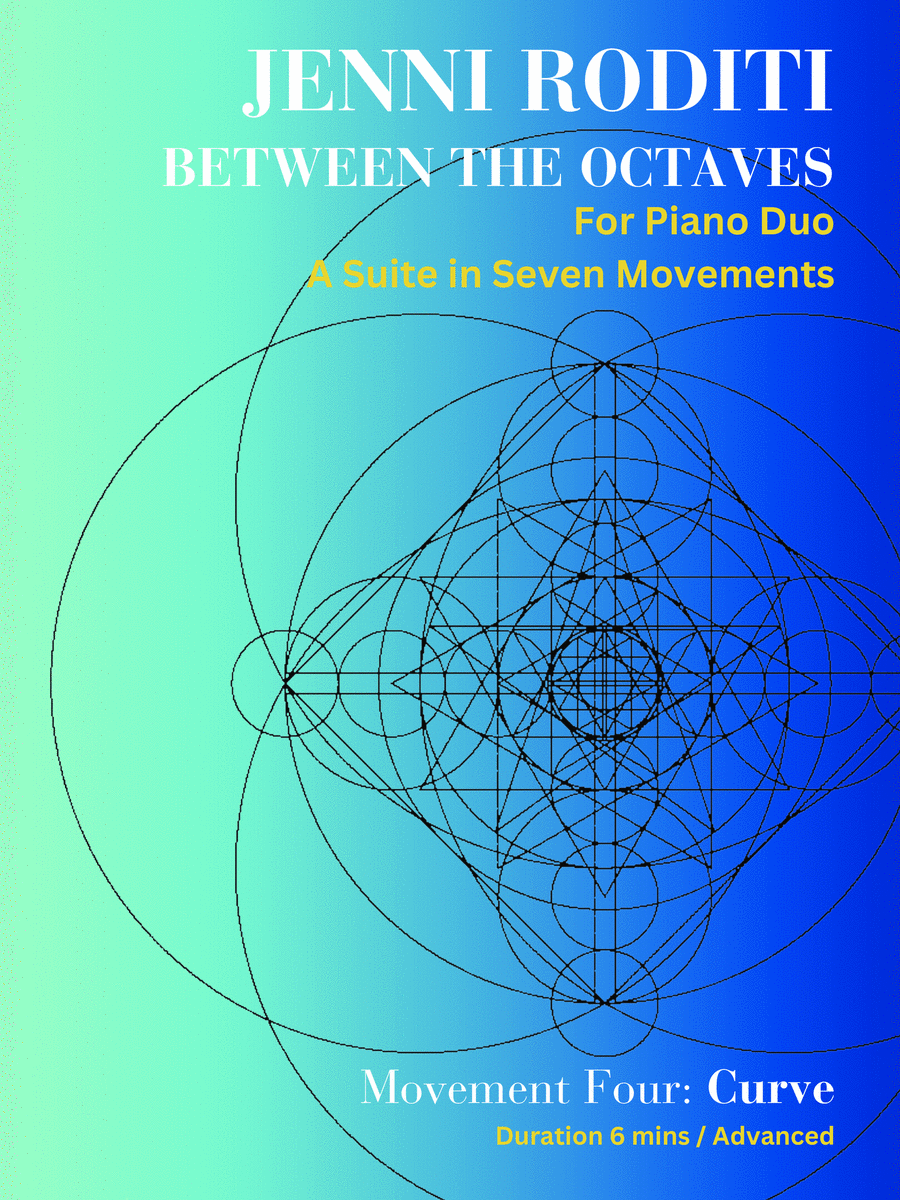
CURVE, Between the Octaves - A Piano Duo Suite (Movement 4 of 7)
2 Pianos, 4 mains
dislocation I mean a degree of tension between the natural acoustics of the two instruments in the room and the players idiosyncrasies as musicians  The whole point of this work was to examine the nature of my syntax, grammar, and compositional thinking
$20.00 17.42 € 2 Pianos, 4 mains PDF SheetMusicPlus

Piano Solo - Level 2 - Digital Download SKU: A0.719791 Composed by George Elvey / Dutch Traditional. Arranged by Curtis Hanson. Christian,Holiday,Sacred. Score. 5 pages. Curtis Hanson #6605333. Published by Curtis Hanson (A0.719791). Harvest Home is a setting of two well-known and beloved Thanksgiving hymns, Come, Ye Thankful People, Come and We Gather Together. The melodies are introduced in traditional hymn style and then expand somewhat in succeeding verses, but in general stay true to the familiar tune. This setting is for solo piano, but it is also available for SAB choir, SATB choir, and solo voice. It is not difficult and should be accessible for any pianist of modest ability, especially those serviceable church musicians who may be technically challenged. If you are looking for something for Thanksgiving that is widely known and cherished, this may be it.
Harvest Home (piano solo)
Piano seul

$4.99 4.35 € Piano seul PDF SheetMusicPlus

Choral Choir (SSA) - Level 2 - Digital Download SKU: A0.891202 Composed by Laurie Betts Hughes. Contemporary. Octavo. 11 pages. Dandelion Music Press #3104027. Published by Dandelion Music Press (A0.891202). If you are looking to highlight your women's group and feature soloists from within the ensemble, this women's-choir-friendly piece is a harmonically interesting and pianistically supported way to explore those textures.The composer writes: I often find it difficult to find music for grown women: much treble repertoire is written for children's ranges and feature children's themes, and the remainder seems to be about romantic relationships.  When searching for a text that speaks to the nature of a woman, I found Emily Dickinson's little-known For largest Woman's Heart I knew.  It seemed to pair naturally with Heart! We will forget him! and provide context rooted in personal strength.While Dickinson was a prolific private poet, fewer than a dozen of her nearly 1,800 poems were published during her lifetime, usually altered significantly to fit the conventional poetic rules of the time.  A complete, and mostly unaltered, scholarly collection of her poetry first became available five full years after Aaron Copland's musical settings of her poetry.  Laurie Betts Hughes explores what Copland never had the chance to: Emily Dickinson's poem as the poet had conceived it, unedited, and with the punctuation she intended.2017 Choral Contest EntryLaurie Betts Hughes, ASCAP | www.LaurieBettsHughes.com
Heart [SSA]
Chorale 3 parties

$2.10 1.83 € Chorale 3 parties PDF SheetMusicPlus

Brass Ensemble Euphonium - Level 3 - Digital Download SKU: A0.813539 Composed by Shaker Song (attr. Elder Joseph Brackett, Jr.). Arranged by Regis Bookshar. Folk,Sacred,Standards,Wedding. Score and parts. 13 pages. Regis Bookshar #6352513. Published by Regis Bookshar (A0.813539). Euphonium Octet - Intermediate - Digital Download. Simple Gifts ('Tis the Gift to Be Simple), an American Shaker Song, written in 1848 and attributed to Elder Joseph Brackett, Jr. of Alfred, Maine, would be a great addition to any music library. The song was largely unknown outside Shaker communities until Aaron Copland used its melody for the score of Martha Graham's ballet, Appalachian Spring, first performed in 1944. Simple Gifts has now been arranged for a Euphonium Octet by Regis Bookshar. It is suitable for high school and college students, and, depending upon their ability, even elementary school students. Professional musicians would also enjoy playing this selection. It could be performed for concerts and church services. The Regis Bookshar Trumpet Ensemble has often performed it for Weddings. Included are a score and a complete set of parts (13 pages) written in Treble Clef. Also available, if you would prefer, is a version written in Bass Clef. In addition to this arrangement of Simple Gifts for a Euphonium Octet, other arrangements of this tune are also available. There are Quintets and Octets readily available for a wide variety of instrumental ensembles. Please feel free to search for other arrangements by Regis Bookshar as well, as there are numerous arrangements in a variety of styles, also available for purchase. You may find something else which might also interest you. Please continue to check periodically because I continue to add new arrangements as often as I can. I'm certain that this arrangement of Simple Gifts will continue to entertain both performers and audiences alike for years to come.
Simple Gifts ('Tis the Gift to Be Simple) (F) (Euphonium Octet - Treble Clef)

$18.00 15.68 € PDF SheetMusicPlus

Instrumental Duet,Viola,Violin - Level 1 - Digital Download SKU: A0.1233179 Composed by John Newton. Arranged by Benzaiten Editions. Christian,Early Music,Praise & Worship,Religious,Sacred. 4 pages. Benzaiten Editions #828795. Published by Benzaiten Editions (A0.1233179). The Benzaiten Editions Arrangement If you're looking for an easy violin and viola music sheet of the classic hymn Amazing Grace, look no further! I have created a simple yet beautiful version of this beloved song that is perfect for beginner violin and violoncello players or those who are just starting to learn how to play. With this arrangement of Amazing Grace, you'll be able to play this timeless melody with ease and grace. The simplified chords and melody make it easy to learn, while still retaining the emotional depth and spiritual resonance of the original hymn. So whether you're looking to add a new piece to your repertoire or share the gift of music with others, our easy/beginner violin and viola duet music sheet of Amazing Grace is sure to inspire and uplift. About the song Amazing Grace is a beloved hymn written by English poet and clergyman John Newton in the late 18th century. It reflects on his personal journey from a life of sin to one of faith and redemption. The melody's origin is unclear, but it's believed to have originated from an old Scottish folk tune. The hymn has been recorded and performed by countless musicians and artists over the years and has become a source of comfort and hope for people around the world in times of struggle and hardship.
Amazing Grace • super easy violin and viola sheet music
Violon, Alto (duo)

$1.99 1.73 € Violon, Alto (duo) PDF SheetMusicPlus


Partitions Gratuites
Acheter des Partitions Musicales
Acheter des Partitions Digitales à Imprimer
Acheter des Instruments de Musique

© 2000 - 2026

Accueil - Version intégrale





