EUROPE
69 articles
USA
233 articles
DIGITAL
444 articles (à imprimer)
Partitions Digitales
Partitions à imprimer
444 partitions trouvées

1 16 31 46 61 ....436

Flute Solo - Level 5 - Digital Download SKU: A0.1018922 Composed by Benjamin Harry Sajo. 20th Century,Contemporary. Individual part. 4 pages. Benjamin Sajo #6072947. Published by Benjamin Sajo (A0.1018922). Fugue: Wear Pearls and Smile is, on the outset, a fast, rambunctious adventure for many voices playing at the same time. It was conceived as a pairing for the equally vivacious second symphony of Ludwig van Beethoven–his 250th birthday is this year–but can stand on its own as one of my hardest, most challenging works to cook up.This piece is dedicated to those forced to appear positive when internally they’re falling apart. The title is inspired by a quote that’s been with me for a while, Why is it that men can be bastards and women must wear pearls and smile? by Lynn Hecht Schafren, the celebrated American jurist famous for campaigning for gender equity in courts. I’m taking the quote out of its initial context, but the power of that quote, for me, exemplifies how hard it is to maintain a sense of emotional decorum and dignity when you’re authentically a hot mess. And what’s more of a musical hot mess than a fugue?There are two realities to this piece. I’ll quote Dmitri Shostakovich, from his autobiography: The rejoicing is forced, created under threat, [
] It’s as if someone were beating you with a stick and saying, ‘Your business is rejoicing, your business is rejoicing,’ and you rise, shaky, and go marching off, muttering ‘Our business is rejoicing, our business is rejoicing.’ On the one hand, it is insincere happiness, cloying perhaps. But the other truth, I’ll quote Oscar Hammerstein II, from The King and I: While shivering in my shoes / I strike a careless pose / And whistle a happy tune / And no one ever knows, / I'm afraid. I forced myself, against all impulses of my current being, to forge happiness. This piece, with its origin being a mental puzzle (fugues are puzzles), it became a construct where I could lift myself up and regain a sense of purpose. Therefore, it is invented–out of a literal need to survive–pure, genuine happiness.Future Performances: If you are interested in performing this work, please e-mail me.ABOUT THE COMPOSER: Benjamin Sajo (b. 1988) is a Canadian composer of contemporary classical music, as well as an educator. Since developing a fiercely independent creative voice upon the completion of his studies at Western (2010) and McGill Universities (2013), he continues to find inspiration from the intersection of mythology, art, and nature upon the contemporary human experience. In 2019, he released his premiere album of original music, The Great War Sextet: Canadian War Poetry with Trombone & Strings , with support from the Ontario Arts Council. He is a member of SOCAN and the League of Canadian Composers.
Fugue: "Wear Pearls and Smile" (A Pairing with Beethoven's Symphony #2) - Flute 1
Flute (partie séparée)

$3.50 3.03 € Flute (partie séparée) PDF SheetMusicPlus

Bassoon Solo - Level 5 - Digital Download SKU: A0.1018928 Composed by Benjamin Harry Sajo. 20th Century,Contemporary. Individual part. 5 pages. Benjamin Sajo #6072961. Published by Benjamin Sajo (A0.1018928). Fugue: Wear Pearls and Smile is, on the outset, a fast, rambunctious adventure for many voices playing at the same time. It was conceived as a pairing for the equally vivacious second symphony of Ludwig van Beethoven–his 250th birthday is this year–but can stand on its own as one of my hardest, most challenging works to cook up.This piece is dedicated to those forced to appear positive when internally they’re falling apart. The title is inspired by a quote that’s been with me for a while, Why is it that men can be bastards and women must wear pearls and smile? by Lynn Hecht Schafren, the celebrated American jurist famous for campaigning for gender equity in courts. I’m taking the quote out of its initial context, but the power of that quote, for me, exemplifies how hard it is to maintain a sense of emotional decorum and dignity when you’re authentically a hot mess. And what’s more of a musical hot mess than a fugue?There are two realities to this piece. I’ll quote Dmitri Shostakovich, from his autobiography: The rejoicing is forced, created under threat, [
] It’s as if someone were beating you with a stick and saying, ‘Your business is rejoicing, your business is rejoicing,’ and you rise, shaky, and go marching off, muttering ‘Our business is rejoicing, our business is rejoicing.’ On the one hand, it is insincere happiness, cloying perhaps. But the other truth, I’ll quote Oscar Hammerstein II, from The King and I: While shivering in my shoes / I strike a careless pose / And whistle a happy tune / And no one ever knows, / I'm afraid. I forced myself, against all impulses of my current being, to forge happiness. This piece, with its origin being a mental puzzle (fugues are puzzles), it became a construct where I could lift myself up and regain a sense of purpose. Therefore, it is invented–out of a literal need to survive–pure, genuine happiness.Future Performances: If you are interested in performing this work, please e-mail me.ABOUT THE COMPOSER: Benjamin Sajo (b. 1988) is a Canadian composer of contemporary classical music, as well as an educator. Since developing a fiercely independent creative voice upon the completion of his studies at Western (2010) and McGill Universities (2013), he continues to find inspiration from the intersection of mythology, art, and nature upon the contemporary human experience. In 2019, he released his premiere album of original music, The Great War Sextet: Canadian War Poetry with Trombone & Strings , with support from the Ontario Arts Council. He is a member of SOCAN and the League of Canadian Composers.
Fugue: "Wear Pearls and Smile" (A Pairing with Beethoven's Symphony #2) - Bassoon 1
Basson

$3.50 3.03 € Basson PDF SheetMusicPlus

Small Ensemble Baritone Saxophone,Bass Saxophone,Piano - Level 5 - Digital Download SKU: A0.533585 Composed by Carson Cooman. Concert,Contemporary,Standards. Score and parts. 15 pages. Musik Fabrik Music Publishing #3029121. Published by Musik Fabrik Music Publishing (A0.533585). Polpis Dreaming (2002) for contrabass saxophone and piano was commissioned for and isdedicated to Jay C. Easton. The work was inspired by Easton's championing of the more unusual members of the saxophone family, particularly the contrabass with its incredibly powerful and deep sound.  This work is recorded on Easton's SoLow CD.The title refers to Polpis, a region of Nantucket Island, Massachusetts that borders Nantucket Harbor with a variety of smaller inlets. This work is one of a variety of pieces connected to the landscape of Nantucket. In the case of this piece, the extra-musical image was one of the incredible depth of the ocean (perhaps parallel to the depth of the contrabass saxophone's sound) slowly being explored/achieved through the means of inlets.The work's basic material comes from the saxophone's opening gesture, which moves upwardfrom the bottom of the instrument. The pitch material and interval content that are transformed throughout the work are presented in that motion.The first section of the work is declamatory, with lyric impulses. The material of the work is unfolded as the sounds of the piano's resonance, combined with the tone of the contrabass saxophone are explored. A faster middle section occurs next in which the harmonic gestures and transformations are always moving towards greater consonance. After the middle section, there is a return to the mood of the opening, although the material of the middle section also appears in transformation.
Carso Cooman: Polpis Dreaming (2002) for Eb contrabass saxophone and piano

$11.95 10.34 € PDF SheetMusicPlus

Trumpet Solo - Level 5 - Digital Download SKU: A0.1018933 Composed by Benjamin Harry Sajo. 20th Century,Contemporary. Individual part. 3 pages. Benjamin Sajo #6072969. Published by Benjamin Sajo (A0.1018933). Fugue: Wear Pearls and Smile is, on the outset, a fast, rambunctious adventure for many voices playing at the same time. It was conceived as a pairing for the equally vivacious second symphony of Ludwig van Beethoven–his 250th birthday is this year–but can stand on its own as one of my hardest, most challenging works to cook up.This piece is dedicated to those forced to appear positive when internally they’re falling apart. The title is inspired by a quote that’s been with me for a while, Why is it that men can be bastards and women must wear pearls and smile? by Lynn Hecht Schafren, the celebrated American jurist famous for campaigning for gender equity in courts. I’m taking the quote out of its initial context, but the power of that quote, for me, exemplifies how hard it is to maintain a sense of emotional decorum and dignity when you’re authentically a hot mess. And what’s more of a musical hot mess than a fugue?There are two realities to this piece. I’ll quote Dmitri Shostakovich, from his autobiography: The rejoicing is forced, created under threat, [
] It’s as if someone were beating you with a stick and saying, ‘Your business is rejoicing, your business is rejoicing,’ and you rise, shaky, and go marching off, muttering ‘Our business is rejoicing, our business is rejoicing.’ On the one hand, it is insincere happiness, cloying perhaps. But the other truth, I’ll quote Oscar Hammerstein II, from The King and I: While shivering in my shoes / I strike a careless pose / And whistle a happy tune / And no one ever knows, / I'm afraid. I forced myself, against all impulses of my current being, to forge happiness. This piece, with its origin being a mental puzzle (fugues are puzzles), it became a construct where I could lift myself up and regain a sense of purpose. Therefore, it is invented–out of a literal need to survive–pure, genuine happiness.Future Performances: If you are interested in performing this work, please e-mail me.ABOUT THE COMPOSER: Benjamin Sajo (b. 1988) is a Canadian composer of contemporary classical music, as well as an educator. Since developing a fiercely independent creative voice upon the completion of his studies at Western (2010) and McGill Universities (2013), he continues to find inspiration from the intersection of mythology, art, and nature upon the contemporary human experience. In 2019, he released his premiere album of original music, The Great War Sextet: Canadian War Poetry with Trombone & Strings , with support from the Ontario Arts Council. He is a member of SOCAN and the League of Canadian Composers.

Fugue: "Wear Pearls and Smile" (A Pairing with Beethoven's Symphony #2) - Trumpet in C 1
Trompette

$3.50 3.03 € Trompette PDF SheetMusicPlus

High Voice,Vocal Solo - Digital Download SKU: A0.784831 Composed by McCorkle, Dennis F. Broadway,Christian,Jewish,Musical/Show,Rock. 25 pages. DF McCorkle Music and eBook Publications #11753. Published by DF McCorkle Music and eBook Publications (A0.784831). ACT TWO: Song 5. The King, by Dennis McCorkle, is a contemporary pop-rock musical of the first two kings of Israel, Saul ben Kish and David ben Jesse and explores the contrasting lives and outcome of each man’s choices in life. [2 Samuel 11:2-4
 - And it came to pass at eventide, that David arose from off his bed, and walked upon the roof of the king's house; and from the roof he saw a woman bathing; and the woman was very beautiful to look upon. 3 And David sent and inquired after the woman. And one said: ‘Is not this Bath-sheba, the daughter of Eliam, the wife of Uriah the Hittite?’ 4 And David sent messengers, and took her; and she came in unto him, and he lay with her;
] Once settled into Jerusalem and after a tiff with MICHAL, DAVID looks around his magnificent palace and as he walks on his balcony, he sees a lovely young woman bathing herself in the moonlight. Giving in to his impulses, orders his men to have her brought to the palace on the pretense of speaking to her about her husband, URIAH who is in the field with the troops. DAVID, seeing her beauty and rationalizing his own importance, proceeds to seduce her and lies with her [Come Lie with Me – David and Bathsheba]. BATHSHEBA, also lonely is seduced by his presence and gives in to his wishes. Leaving before daylight to escape notice, DAVID goes about business as usual, trying to forget what has happened. A few weeks later, a messenger arrives with a note from BATHSHEBA, DAVID, I'm pregnant! Also included with your order is our new 20 page catalog of over 150 titles at no additional charge.
Come Lie with Me (King David and Bathsheba) from "The Kings" - ACT 2:Song 5
Voix haute

$2.99 2.59 € Voix haute PDF SheetMusicPlus

Full Orchestra - Digital Download SKU: A0.746748 Composed by Keith Terrett. Contemporary,World. 33 pages. Keith Terrett #3129265. Published by Keith Terrett (A0.746748). ere at last is my ’’Elegy sentimentale’’ for orchestra, and my first original composition (opus 1), for full symphony orchestra.I hope it makes an excellent piece for amateur and professional orchestras alike; with some challenging and interesting string, woodwind and brass writing for all.I envisage the ’’Elegy’’ eventually making a good piece of film music, and in consequence any directors or producers looking for a movie theme; please feel free to contact me!Elegy Sentimenatle is a mournful & melancholic work, suited for performances on the concert platform.A Supreme Work of Art!The Elegy Sentimentale opens impressively. Keith Terrett plants a C deep in virgin soil; orchestrated brilliantly for bassoon, harp and delineated by pizzicato double basses this bass line is a tree of a forest; and we are at once held by the strength of the roots. The tonality is immediately clear, and there is a grand feeling of space and power in the wide layout of the score. A lone solo clarinet high in the tessitura accompanied by a solo cello with a counter subject state the opening eight bar theme which embodies the seeds of two ideas, which supplies the generating force for the slightly agitated Piu Mosso which follows. The counter subject given by the solo cello at the beginning is now reiterated by the plaintive voice of a solo oboe and a third motif makes an appearance in the solo clarinet; oboe and clarinet duet beautifully over arpeggiated rhythmic impulses in the harp. A new subject of an accompanying nature, derived from all the material thus far presented now comes off at a tangent on the strings cascading downwards and accompanying woodwind who, play the chief melodic subject while horns cry in anguish. This first section is then repeated; I found the whole experience spiritual, detached and wondering, intensified by the breath-taking stillness. Mr Terrett in the middle section that follows now uses his full orchestral forces; after a key change the emotional charge that follows is cataclysmic in its cry of anguish; the main theme is stated in a full dress orchestral tutti, which is then repeated. The music ebbs and flows with slight variations in the woodwind recalling the main ideas; at the very end high strings bring consolation and finally peace. Keith Terrett shows an admirable command of orchestration and melodic construction and combines these qualities with rare imagination and insight.Gerald Manning
Elegy Sentimentale for Orchestra
Orchestre

$30.00 25.95 € Orchestre PDF SheetMusicPlus

Bassoon,Piano - Level 5 - Digital Download SKU: A0.533586 Composed by Carson Cooman. Concert,Contemporary,Standards. Score and part. 15 pages. Musik Fabrik Music Publishing #3029125. Published by Musik Fabrik Music Publishing (A0.533586). Polpis Dreaming (2005) for contrabassoon and piano is dedicated to Henry Skolnick.The title refers to Polpis, a region of Nantucket Island, Massachusetts that borders Nantucket Harbor with a variety of smaller inlets. This work is one of a variety of pieces connected to the landscape of Nantucket. In the case of this piece, the extra-musical image was one of the incredible depth of the ocean (perhaps parallel to the depth of the contrabassoon's sound) slowly being explored/achieved through the means of inlets.The work's basic material comes from the contrabassoon's opening gesture, which moves upward from the bottom of the instrument. The pitch material and interval content that are transformed throughout the work are presented in that motion.The first section of the work is declamatory, with lyric impulses. The material of the work is unfolded as the sounds of the piano's resonance, combined with the tone of the contrabassoon are explored. A faster middle section occurs next in which the harmonic gestures and transformations are always moving towards greater consonance. After the middle section, thereis a return to the mood of the opening, although the material of the middle section also appears in transformation.
Carson Cooman: Polpis Dreaming (2005) for contrabassoon and piano
Basson, Piano (duo)

$11.95 10.34 € Basson, Piano (duo) PDF SheetMusicPlus

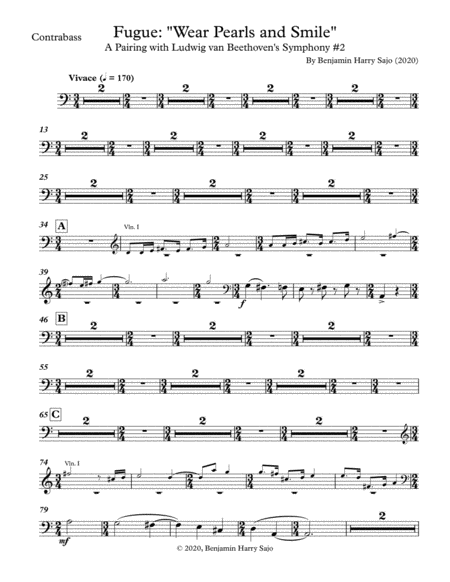
Double Bass,String Bass Solo - Level 5 - Digital Download SKU: A0.1018941 Composed by Benjamin Harry Sajo. 20th Century,Contemporary. Individual part. 4 pages. Benjamin Sajo #6072983. Published by Benjamin Sajo (A0.1018941). Fugue: Wear Pearls and Smile is, on the outset, a fast, rambunctious adventure for many voices playing at the same time. It was conceived as a pairing for the equally vivacious second symphony of Ludwig van Beethoven–his 250th birthday is this year–but can stand on its own as one of my hardest, most challenging works to cook up.This piece is dedicated to those forced to appear positive when internally they’re falling apart. The title is inspired by a quote that’s been with me for a while, Why is it that men can be bastards and women must wear pearls and smile? by Lynn Hecht Schafren, the celebrated American jurist famous for campaigning for gender equity in courts. I’m taking the quote out of its initial context, but the power of that quote, for me, exemplifies how hard it is to maintain a sense of emotional decorum and dignity when you’re authentically a hot mess. And what’s more of a musical hot mess than a fugue?There are two realities to this piece. I’ll quote Dmitri Shostakovich, from his autobiography: The rejoicing is forced, created under threat, [
] It’s as if someone were beating you with a stick and saying, ‘Your business is rejoicing, your business is rejoicing,’ and you rise, shaky, and go marching off, muttering ‘Our business is rejoicing, our business is rejoicing.’ On the one hand, it is insincere happiness, cloying perhaps. But the other truth, I’ll quote Oscar Hammerstein II, from The King and I: While shivering in my shoes / I strike a careless pose / And whistle a happy tune / And no one ever knows, / I'm afraid. I forced myself, against all impulses of my current being, to forge happiness. This piece, with its origin being a mental puzzle (fugues are puzzles), it became a construct where I could lift myself up and regain a sense of purpose. Therefore, it is invented–out of a literal need to survive–pure, genuine happiness.Future Performances: If you are interested in performing this work, please e-mail me.ABOUT THE COMPOSER: Benjamin Sajo (b. 1988) is a Canadian composer of contemporary classical music, as well as an educator. Since developing a fiercely independent creative voice upon the completion of his studies at Western (2010) and McGill Universities (2013), he continues to find inspiration from the intersection of mythology, art, and nature upon the contemporary human experience. In 2019, he released his premiere album of original music, The Great War Sextet: Canadian War Poetry with Trombone & Strings , with support from the Ontario Arts Council. He is a member of SOCAN and the League of Canadian Composers.

Fugue: "Wear Pearls and Smile" (A Pairing with Beethoven's Symphony #2) - Contrabass
Contre Basse

$3.50 3.03 € Contre Basse PDF SheetMusicPlus

Flute/bassflute (or clarinet), oboe and bassoon - difficult - Digital Download SKU: S9.Q6999 Composed by Benjamin Schweitzer. This edition: performance score. Downloadable, performance score. Duration 10 minutes. Schott Music - Digital #Q6999. Published by Schott Music - Digital (S9.Q6999). The image of a landscape in April, freed from winter's hold, with its mixture of barrenness and still dull colours, characterises the basic tone of this piece. Melodic elements and fast virtuoso figurations cannot be found, instead the piece is dominated by subtle nuances of just a few sounds and textures. The harmony is based almost entirely on a single chord type. Occasionally, short chains of repetitions and oscillating impulses emerge from this string of sounds. Ambitious performers can use this demanding and varied piece to try out modern playing techniques.
dull roots & spring rain
Hautbois, Basson (duo)

$27.99 24.21 € Hautbois, Basson (duo) PDF SheetMusicPlus

Violin Solo - Level 5 - Digital Download SKU: A0.1018937 Composed by Benjamin Harry Sajo. 20th Century,Contemporary. 5 pages. Benjamin Sajo #6072975. Published by Benjamin Sajo (A0.1018937). Fugue: Wear Pearls and Smile is, on the outset, a fast, rambunctious adventure for many voices playing at the same time. It was conceived as a pairing for the equally vivacious second symphony of Ludwig van Beethoven–his 250th birthday is this year–but can stand on its own as one of my hardest, most challenging works to cook up.This piece is dedicated to those forced to appear positive when internally they’re falling apart. The title is inspired by a quote that’s been with me for a while, Why is it that men can be bastards and women must wear pearls and smile? by Lynn Hecht Schafren, the celebrated American jurist famous for campaigning for gender equity in courts. I’m taking the quote out of its initial context, but the power of that quote, for me, exemplifies how hard it is to maintain a sense of emotional decorum and dignity when you’re authentically a hot mess. And what’s more of a musical hot mess than a fugue?There are two realities to this piece. I’ll quote Dmitri Shostakovich, from his autobiography: The rejoicing is forced, created under threat, [
] It’s as if someone were beating you with a stick and saying, ‘Your business is rejoicing, your business is rejoicing,’ and you rise, shaky, and go marching off, muttering ‘Our business is rejoicing, our business is rejoicing.’ On the one hand, it is insincere happiness, cloying perhaps. But the other truth, I’ll quote Oscar Hammerstein II, from The King and I: While shivering in my shoes / I strike a careless pose / And whistle a happy tune / And no one ever knows, / I'm afraid. I forced myself, against all impulses of my current being, to forge happiness. This piece, with its origin being a mental puzzle (fugues are puzzles), it became a construct where I could lift myself up and regain a sense of purpose. Therefore, it is invented–out of a literal need to survive–pure, genuine happiness.Future Performances: If you are interested in performing this work, please e-mail me.ABOUT THE COMPOSER: Benjamin Sajo (b. 1988) is a Canadian composer of contemporary classical music, as well as an educator. Since developing a fiercely independent creative voice upon the completion of his studies at Western (2010) and McGill Universities (2013), he continues to find inspiration from the intersection of mythology, art, and nature upon the contemporary human experience. In 2019, he released his premiere album of original music, The Great War Sextet: Canadian War Poetry with Trombone & Strings , with support from the Ontario Arts Council. He is a member of SOCAN and the League of Canadian Composers.

Fugue: "Wear Pearls and Smile" (A Pairing with Beethoven's Symphony #2) - Violin I
Violon

$3.50 3.03 € Violon PDF SheetMusicPlus

Full Orchestra - Digital Download SKU: A0.1008374 Composed by Claude Debussy. Arranged by Arkady Leytush. 20th Century. Score and parts. 24 pages. Arkady Leytush #4849775. Published by Arkady Leytush (A0.1008374). Estampes (Engravings) is the title of the triptych of three pieces which Debussy put together in 1903. The first complete performance was given on 9 January 1904 in the Salle Erard, Paris, by the young Spanish pianist Ricardo Viñes, who was already emerging as the prime interpreter of the new French music of Debussy and Ravel. The first two pieces were completed in 1903, but the third derives from an earlier group of pieces from 1894, collectively titled Images, which remained unpublished until 60 years after Debussy’s death, when they were printed as Images (oubliĂ©es). Estampes marks an expansion of Debussy’s keyboard style: he was apparently spurred to fuse neo-Lisztian technique with a sensitive, impressionistic pictorial impulse under the impact of discovering Ravel’s Jeux d’eau, published in 1902. The opening movement, ‘Pagodes’, is Debussy’s first pianistic evocation of the Orient and is essentially a fixed contemplation of its object, as in a Chinese print. This static impression is partly caused by Debussy’s use of long pedal-points, partly by his almost constant preoccupation with pentatonic melodies which subvert the sense of harmonic movement. He uses such pentatonic fragments in many different ways: in delicate arabesques, in two-part counterpoint, in canon, harmonized in fourths and fifths and as an underpinning for pattering, gamelan-like ostinato writing. Altogether the piece reflects the decisive impression made on him by hearing Javanese and Cambodian musicians at the 1889 Paris Exposition, which he had striven for years to incorporate effectively in music. In its final bars the music begins to dissolve into elaborate filigree.Just as ‘Pagodes’ was his first Oriental piece, so ‘La soirĂ©e dans Grenade’ was the first of Debussy’s evocations of Spain-that preternatural embodiment of an ‘imaginary Andalusia’ which would inspire Manuel de Falla, the native Spaniard, to go back to his country and create a true modern Spanish music based on Debussyan principles. Debussy’s personal acquaintance with Spain was virtually non-existent (he had spent a day just over the border at San Sebastian) and it is possible that one model for the piece was Ravel’s Habanera. Yet he wrote of this piece (to his friend Pierre LouĂżs, to whom it was dedicated), ‘if this isn’t the music they play in Granada, so much the worse for Granada!’-and there is no debate about the absolute authenticity of Debussy’s use of Spanish idioms here. Falla himself pronounced it ‘characteristically Spanish in every detail’. ‘La soirĂ©e dans Grenade’ is founded on an ostinato that echoes the rhythm of the habanera and is present almost throughout. Beginning and ending in almost complete silence, this dark nocturne of warm summer nights builds powerfully to its climaxes. The melodic material ranges from a doleful Moorish chant with a distinctly oriental character to a stamping, vivacious dance-measure, taking in brief suggestions of guitar strumming and perfumed Impressionist haze. There is even a hint of castanets near the end. The piece fades out in a coda that seems to distil all the melancholy of the Moorish theme and a last few distant chords of the guitar. â€˜Jardins sous la pluie’ is based on the children’s song ‘Nous n’rons plus au bois’ (We shan’t go to the woods): its original 1894 form was in fact entitled Quelques aspects de ‘Nous n’rons plus au bois’. The two versions are really two distinct treatments of the same set of ideas, but in ‘Jardins sous la pluie’ Estampes the earlier piece has been entirely rethought. The whole conception is more impressionistic, and subtilized. The teeming semiquaver motion is more all-pervasive, the tunes (for Debussy has added a second children’s song for treatment, ‘Do, do, l’enfant do’) more elusive and tinged sometimes with melancholy or nostalgia. The ending of the piece is entirely new. What it loses, perha.
Claude Debussy ‒ Estampes, Orchestra Suite, Orchestrated by Arkady Leytush, No. 2 La soirée dans
Orchestre

$25.00 21.62 € Orchestre PDF SheetMusicPlus

String Quartet Cello,String Quartet,Viola,Violin - Level 3 - Digital Download SKU: A0.1468405 By The Beatles. By John Lennon and Paul McCartney. Arranged by Sarah Cellobat Chaffee. Pop,Rock,Wedding. 17 pages. Sarah Cellobat Chaffee #1046719. Published by Sarah Cellobat Chaffee (A0.1468405). Everyone loves the Beatles - and since we all get Beatles requests so often, the more in your repertoire the better! This arrangement of Can't Buy Me Love for string quartet is great for concerts, weddings, receptions, cocktail parties, solo & ensemble contests, and any other event that needs some vintage rock & roll. Intermediate-level arrangement with a few syncopated rhythms; this will be learnable for students and easily sightreadable for professionals.Sarah “Cellobat” Chaffee is an in-demand acoustic & electric cellist and string arranger. You may have seen her onstage with legendary rock band Aerosmith as the cellist for their “Deuces Are Wild” residency, playing more than 50 sold-out shows with the Bad Boys from Boston; she is also the principal cellist for the Raiders House Band, playing for a crowd of 60,000 at all of the team's home games. She also plays and tours with many other world-renowned groups including the Femmes of Rock, Premiere Wedding Music, Bella Electric Strings, and David Perrico’s Pop Strings Orchestra. Sarah has made a number of TV appearances including the Billboard Music Awards, the Latin Grammy Awards, the iHeartRadio Music Festival, and the CBS reality show “Love Island”; she also played with Michael Bublé for his sold-out Resorts World residency and appeared with him on the Kelly Clarkson Show. Sarah has performed and recorded with a number of other artists including Disturbed, Mötley Crüe, Celine Dion, Halsey, Dionne Warwick, Sarah Brightman, and Sammy Hagar.Sarah is also an acclaimed string arranger with hundreds of arrangements published on Sheet Music Plus under her own label, Cellobat Charts. She is the exclusive arranger for several award-winning wedding and event companies across the United States, including Premiere Wedding Music, Las Vegas Music Oasis, and Impulse Strings, and she has created custom arrangements for many other ensembles worldwide. You can find her at:http://www.cellobat.comhttp://www.instagram.com/cellobathttps://www.youtube.com/@Cellobathttp://www.facebook.com/SarahCellobatChaffee
Can't Buy Me Love
Quatuor à cordes: 2 violons, alto, violoncelle
The Beatles
$16.99 14.7 € Quatuor à cordes: 2 violons, alto, violoncelle PDF SheetMusicPlus

String Quartet Cello,String Quartet,Viola,Violin - Level 3 - Digital Download SKU: A0.1036099 By One Direction. By Carl Falk, Rami Yacoub, and Savan Kotecha. Arranged by Sarah Cellobat Chaffee. Contemporary,Pop,Wedding. 18 pages. Sarah Cellobat Chaffee #641200. Published by Sarah Cellobat Chaffee (A0.1036099). What Makes You Beautiful was the debut single by famed boy band One Direction in 2011, and it was the song that catapulted the band to stardom. Reaching number one on the charts in several countries and hitting quadruple platinum in sales, the catchy song was praised for its hard-hitting guitar-based pop riffs and its appeal to the teenage crowd. Over a decade later, the song is still beloved by millions and has become a popular request for weddings and receptions -- so you can't go wrong having this one in your gig books! This Cellobat arrangement for string quartet maintains the catchy melodies, layered harmonies, and fun pop beat of the original for a chart that will be just as much fun to play as it is to listen to! Perfect for weddings, receptions, proposals, cocktail hour, solo & ensemble contest, or any occasion you need to put your audience in a good mood. Rated intermediate; this will be playable for students and sightreadable for professionals. Sarah “Cellobat” Chaffee is an in-demand acoustic & electric cellist and string arranger. Currently, she performs with legendary rock band Aerosmith in their “Deuces Are Wild” residency show, and she is the principal cellist for the Raiders House Band, playing for a crowd of 60,000 at all of the team's home games. She also plays with many other groups including Premiere Wedding Music, Bella Electric Strings, the Femmes Of Rock, and David Perrico’s Pop Strings Orchestra. Sarah has performed and recorded with numerous other artists including Disturbed, Mötley CrĂŒe, Celine Dion, Halsey, Michael BublĂ©, Sarah Brightman, and Lady A. She is the exclusive arranger for a number of award-winning wedding and event companies all across the United States, including Premiere Wedding Music, Las Vegas Music Oasis, and Impulse Strings, and she has created custom arrangements for many other ensembles all over the world. You can find her at:http://www.cellobat.comhttp://www.instagram.com/cellobathttps://www.youtube.com/@Cellobat.
What Makes You Beautiful
Quatuor à cordes: 2 violons, alto, violoncelle
One Direction
$16.99 14.7 € Quatuor à cordes: 2 violons, alto, violoncelle PDF SheetMusicPlus


1 16 31 46 61 ....436


Partitions Gratuites
Acheter des Partitions Musicales
Acheter des Partitions Digitales à Imprimer
Acheter des Instruments de Musique

© 2000 - 2026

Accueil - Version intégrale


