EUROPE
305932 articles
USA
595356 articles
DIGITAL
570296 articles (à imprimer)
Partitions Digitales
Partitions à imprimer
570296 partitions trouvées


Clarinet Quintet,Woodwind Ensemble Clarinet - Level 4 - Digital Download SKU: A0.1250018 Composed by Johann Sebastian Bach. Arranged by Regis Bookshar. Baroque,Chamber,Christian,Easter,Historic. 28 pages. Regis Bookshar #844432. Published by Regis Bookshar (A0.1250018). Three selections based on Christ lag in Todesbanden (Christ lay in death's bonds) (from Cantata No.   4, BMV   4) - Johann Sebastian Bach - Clarinet Quintet - Advanced/Intermediate - Digital Download.Cantata No.   4, BMV   4, Christ lag in Todesbanden (also spelled Todes Banden) (Christ lay in death's bonds) is a cantata for Easter written by Johann Sebastian Bach and is his earliest surviving Church Cantata. It was probably written in 1707 when he was 22 years old. It is a Chorale Cantata, a style in which both the text and music are based on a hymn. In this instance, the source was Martin Luther's hymn of the same name which became a main Easter hymn in German Lutheranism.Regis Bookshar has transcribed and arranged three selections based on this hymn tune, two from Bach's Cantata No.   4, BMV   4, and also his Chorale Prelude, BMV 625. They may be played individually or as a trilogy and each movement is more complex that the previous one. The first selection in this trilogy is the Chorale, Christ lag in Todesbanden, the final chorus from his Cantata No.   4, a straightforward four-part chorale setting of the hymn (Regis has also added a fifth part). This is followed by Bach's Chorale Prelude, BMV 625, a piece from his Orgelbuchlein (Little Organ Book), a collection of 46 Preludes for organ, written almost exclusively during the 1708-1717 period, while Bach was court organist at Weimar. For the final selection, Regis has placed the polyphonic and imitative chorus, Es war ein wunderlicher Krieg, da Tod und Leben rungen (It was a strange battle, that death and life waged), which Bach had placed in the middle of his Cantata No.   4.This arrangement is for a Clarinet Quintet, consisting of 5 Bb Clarinets. Included are a score and a complete set of parts (28 pages).I hope will you enjoy playing these selections and please search for other arrangements by Regis Bookshar. There are numerous selections in a variety of styles, also available for purchase. I think you will be pleased with what you may find.
Three selections based on "Christ lag in Todesbanden" (Clarinet Quintet)
Quintette de Clarinettes: 5 clarinettes

$30.00 25.38 € Quintette de Clarinettes: 5 clarinettes PDF SheetMusicPlus

Chamber Orchestra - Level 5 - Digital Download SKU: A0.723064 Composed by Joel Jacklich (ASCAP). Arranged by Joel Jacklich (ASCAP). Contemporary. Score and parts. 157 pages. Joel Jacklich #2075225. Published by Joel Jacklich (A0.723064). His is an arrangement by the composer of his Rondo in A minor (originally written for Guitar and Orchestra) for Cello and Orchestra. There is also a version arranged for Viola and Orchestra. In October, 2014, after my most recent commission, the creative juices were still flowing, and I felt the urge to write a work for guitar and orchestra (which I had always wanted to do, partly inspired by the memories Pepe Romero's performances with my orchestra forty years earlier). Amazingly, within two days I had, except for a few minor corrections, a completed work. The result was the Rondo in A minor for Guitar and Orchestra, which I dedicated to my friend, Sir Pepe Romero, with the greatest respect and admiration. In December of 2014, I realized the work was easily accessible for either viola or cello and created versions of the piece for solo cello and orchestra, and also a version for solo viola and orchestra. The work is rondo-like in form, but does not strictly follow all the rules. The form of the work is a kind of a musical palindrome: A B A C A D A C A B A (including a cadenza in the final rondo statement). The presence of castanets gives the work a bit of a Spanish flair. The piece is scored for pairs of flutes, oboes, clarinets in A, bassoons, horns, and trumpets in C; with timpani, castanets, and strings (8,8,5,5,3). Parts for clarinets and trumpets in B-flat are included in the set for those orchestras lacking clarinets in A or trumpets in C.
Rondo in A minor for Cello and Orchestra
Orchestre de chambre

$65.00 54.99 € Orchestre de chambre PDF SheetMusicPlus

Saxophone Quintet,Woodwind Ensemble Alto Saxophone,Baritone Saxophone,Tenor Saxophone - Level 4 - Digital Download SKU: A0.1254358 Composed by Johann Sebastian Bach. Arranged by Regis Bookshar. Baroque,Chamber,Christian,Easter,Historic. 29 pages. Regis Bookshar #847925. Published by Regis Bookshar (A0.1254358). Three selections based on Christ lag in Todesbanden (Christ lay in death's bonds) (from Cantata No.   4, BMV   4) - Johann Sebastian Bach - Saxophone Quintet (2 Altos, 2 Tenors, 1 Bari) - Adsvanced/Intermediate - Digital Download.Cantata No.   4, BMV   4, Christ lag in Todesbanden (also spelled Todes Banden) (Christ lay in death's bonds) is a cantata for Easter written by Johann Sebastian Bach and is his earliest surviving Church Cantata. It was probably written in 1707 when he was 22 years old. It is a Chorale Cantata, a style in which both the text and music are based on a hymn. In this instance, the source was Martin Luther's hymn of the same name which became a main Easter hymn in German Lutheranism.Regis Bookshar has transcribed and arranged three selections based on this hymn, two from Bach's Cantata No.   4, BMV   4, and also his Chorale Prelude, BMV 6215. They may be played individually or as a trilogy and each movement gets more complex than the previous one. The first selection in this trilogy is the Chorale, Christ lag in Todesbanden, the final chorus from his Cantata No.   4, a straightforward four-part chorale setting of the hymn (Regis has also added a fifth part). This is followed by Bach's Chorale Prelude, BMV 625, a piece from his Orgelbuchlein (Little Organ Book), a collection of 46 Preludes for organ, written almost exclusively during the 1708-1717 period, while Bach was court organist at Weimar. For the final selection, Regis has placed the polyphonic and imitative chorus, Es war ein wunderlicher Krieg, da Tod und Leben rungen (It was a strange battle, that death and life waged), which Bach had placed in the middle of his Cantata No.   4.This arrangement is for a Saxophone Quintet, consisting of 2 Alto Saxophones, 2 Tenor Saxophone and 1 Baritone Saxophone. Included are a score and a complete set of parts (29 pages).I hope you will enjoy playing these selections and please search for other arrangements by Regis Bookshar. There are numerous selections in a variety of styles, also available for purchase. I think you will be pleased with what you may find.
Three selections based on "Christ lag in Todesbanden" (Saxophone Quintet - 2 Alto, 2 Tenor, 1 Bari)
Quintette de Saxophone: 5 saxophones

$30.00 25.38 € Quintette de Saxophone: 5 saxophones PDF SheetMusicPlus

Brass Quintet Trombone,Trumpet,Tuba - Level 4 - Digital Download SKU: A0.1249436 Composed by Johann Sebastian Bach. Arranged by Regis Bookshar. Baroque,Chamber,Christian,Easter,Historic. 31 pages. Regis Bookshar #841720. Published by Regis Bookshar (A0.1249436). Three selections based on Christ lag in Todesbanden (Christ lay in death's bonds) (from Cantata No.   4, BMV   4) - Johann Sebastian Bach - Brass Quintet (2 Trps, 2 Trbs, 1 Tuba) - Advanced/Intermediate - Digital Download.Cantata No.   4, BMV   4, Christ lag in Todesbanden (also spelled Todes Banden) (Christ lay in death's bonds) is a cantata for Easter written by Johann Sebastian Bach and is his earliest surviving Church Cantata. It was probably written in 1707 when he was 22 years old. It is a Chorale Cantata, a style in which both the text and music are based on a hymn. In this instance, the source was Martin Luther's hymn of the same name which became a main Easter hymn in German Lutheranism.Regis Bookshar has transcribed and arranged three selections based on this hymn tune, two from Bach's Cantata No.   4, BMV   4, and also his Chorale Prelude, BMV 625. They may be played individually or as a trilogy and each movement is more complex than the previous one. The first selection in this trilogy is the Chorale, Christ lag in Todesbanden, the final chorus from his Cantata No.   4, a straightforward four-part chorale setting of the hymn (Regis has also added a fifth part). This is followed by Bach's Chorale Prelude, BMV 625, a piece from his Orgelbuchlein (Little Organ Book), a collection of 46 Preludes for organ, written almost exclusively during the 1708-1717 period, while Bach was court organist at Weimar. For the final selection, Regis has placed the polyphonic and imitative chorus, Es war ein wunderlicher Krieg, da Tod und Leben rungen (It was a strange battle, that death and life waged), which Bach had placed in th middle of his Cantata No.   4.This arrangement is for a Brass Quintet, consisting of 2 Bb Trumpets, 2 Trombones and 1 Tuba. Included are a score and a complete set of parts (31 pages).I hope you will enjoy playing these selections and please search for other arrangements by Regis Bookshar. There are numerous selections in a variety of styles, also available for purchase. I think you will be pleased with what you may find.
Three selections based on "Christ lag in Todesbanden" (Brass Quintet - 2 Trp, 2 Trb, 1 Tuba)
Quintette de Cuivres: 2 trompettes, Cor, trombone, tuba

$30.00 25.38 € Quintette de Cuivres: 2 trompettes, Cor, trombone, tuba PDF SheetMusicPlus

Piano Solo - Level 3 - Digital Download SKU: A0.1407993 By Johan Pachelbel. By Johan Pachelbel. Arranged by Jhonatan Lucio Viana. Classical,Early Music,Historic,Romantic Period,Traditional. Score. 5 pages. JLVPartitura #990559. Published by JLVPartitura (A0.1407993). Acquire now the CANON IN D a Traditional Song for Piano Intermediate.- Intermediate or Easy Intermediate level- D major- Canon in d, Canon in d piano, Canon in d easy intermediate, Canon in d easy intermediate piano, Canon in d piano sheet, Canon in d sheets, Canon in d pachelbel, Canon in d pachebel, romantic piano, canon in d intermediate.Purchase the sheet music today and immerse yourself in the beauty of this composition!I invite you to explore my extensive music collection. Enter Jhonatan Lucio Viana in the search field and discover my variety of arrangements tailored for various instruments, voices, and musical ensembles.
Canon in D
Piano seul
Johan Pachelbel
$2.99 2.53 € Piano seul PDF SheetMusicPlus

Piano Solo - Level 1 - Digital Download SKU: A0.962013 Composed by Terri H. DeLuca. Arranged by Claire Cavoto. Instructional. Score. 15 pages. Terri H. DeLuca #2009697. Published by Terri H. DeLuca (A0.962013). Minuet in C is one song in a series of Pattern Based Piano© titles written by Terri H. DeLuca for her own piano students to help them build and develop their reading and playing skills. These pieces focus on patterns and shapes that appear over and over. Level One is the easiest at the elementary level and Level Five is the final composition at a late elementary to early intermediate level. Each level has the same skeletal structure with varying modifications to help the student build their skills in reading and playing. As the levels get increasingly difficult, the challenge decreases. Ms. DeLuca found her students taking a new level every one to two weeks and these were beginning level readers! Each level includes a workbook sheet that focuses on the patterns and intervals introduced in each song, so the student can concentrate on specific skills prior to learning the entire piece. Minuet in C is a five-level song that takes the student to a very advanced piece of music in a very short period of time. It amazingly moves from dotted half notes in both hands in Level One to eighth note runs in both hands simultaneously in Level Five. You will be astounded at your students rapid progress in Ms. DeLuca's Minuet in C.
Minuet in C 1,2,3,4,5
Piano seul

$5.99 5.07 € Piano seul PDF SheetMusicPlus

Instrumental Duet - Level 5 - Digital Download SKU: A0.1475965 Composed by Johann Sebastian Bach. Arranged by Kamada, Mikio. Baroque. 23 pages. ACORDO Sheet Music #1053543. Published by ACORDO Sheet Music (A0.1475965). Toccata, Adagio and Fugue in C, BWV 564 is one of Johann Sebastian Bach's most famous organ works.Toccata: This part starts with an introduction that sounds like improvisation. It has fast, single-note passages like a concerto's cadenza. At measure 32, it changes to a bright, full sound like an orchestra.Adagio: This part is slow and very beautiful, with a sad feeling in a minor key.Fugue: In 6/8 time, this part is lively and bright, like a dance such as a Gigue or Passepied, even though it is not labeled as a dance.In my previous publication, Toccata & Fugue, BWV 565 for Violin and Viola, I showcased the unique beauty of string instruments. Similarly, in this piece, the beautiful melody of the Adagio fits perfectly with the Violin and Viola, as if it were originally composed for them. The dance-like energy of the Fugue is also easier to express with string instruments.When two people perform this piece, it creates an interesting dialogue, almost like a conversation. The introduction of the Toccata reflects this, inspired by my students who would chat enthusiastically before starting their practice. Their conversation in the music lasts for 31 measures without any chords together. The short unison phrase in measure 13 symbolizes their agreement to start playing together. After that, their conversation continues, with triplets and important motifs of this movement appearing, increasing the expectation for the ensemble to begin. From measure 32, the real ensemble playing begins. Although we don't know what Bach imagined when he wrote this introduction, I now hear it as a conversation, even when listening to the original organ version.In the Adagio viola part, the continuo notes are marked in black, and the notes that create harmony are marked in blue. Players who can control the volume balance of double stops should balance it so that the continuo flows naturally. Players who are not skilled in playing double stops, it might be better to omit the blue notes in difficult sections. If omitted, the section might feel empty, but with careful playing before and after, it could still sound natural.
Toccata, Adagio and Fugue in C, BWV 564 for Violin & Viola

$14.20 12.01 € PDF SheetMusicPlus

Saxophone Quintet,Woodwind Ensemble Alto Saxophone,Baritone Saxophone,Soprano Saxophone,Tenor Saxophone - Level 4 - Digital Download SKU: A0.1254343 Composed by Johann Sebastian Bach. Arranged by Regis Bookshar. Baroque,Chamber,Christian,Easter,Historic. 29 pages. Regis Bookshar #847423. Published by Regis Bookshar (A0.1254343). Three selections based on Christ lag in Todesbanden (Christ lay in death's bonds) (from Cantata No.   4, BMV   4) - Johann Sebastian Bach - Saxophone Quintet (1 Sop, 1 Alto, 2 Tenors, 1 Bari) - Adavanced/Intermediate - Digital Download.Cantata No.   4, BMV   4, Christ lag in Todesbanden (also spelled Todes Banden) (Christ lay in death's bonds) is a cantata for Easter written by Johann Sebastian Bach and is his earliest surviving Church Cantata. It was probably written in 1707 when he was 22 years old. It is a Chorale Cantata, a style in which both the text and music are based on a hymn. In this instance, the source was Martin Luther's hymn of the same name which became a main Easter hymn in German Lutheranism.Regis Bookshar has transcribed and arranged three selections based on this hymn tune, two from Bach's Cantata No.   4, BMV   4, and also his Chorale Prelude, BMV 625. They may be played individually or as a trilogy and each movement gets more complex that the previous one. The first selection in this trilogy is the Chorale, Christ lag in Todesbanden, the final chorus from his Cantata No.   4, a straightforward four-part chorale setting of the hymn (Regis has also added a fifth part). This is followed by Bach's Chorale Prelude, BMV 625, a piece from his Orgelbuchlein (Little Organ Book), a collection of 46 Preludes for organ, written almost exclusively during the 1708-1717 period, while Bach was court organist at Weimar. For the final selection, Regis has placed the polyphonic and imitative chorus, Es war ein wunderlicher Krieg, da Tod und Leben rungen (It was a strange battle, that death and life waged), which Bach had placed in the middle of his Cantata No.   4.This arrangement is for a Saxophone Quintet, consisting of 1 Soprano Saxophone, 1 Alto Saxophone, 2 Tenor Saxophones and 1 Baritone Saxophone. Included are a score and a complete set of parts (29 pages).I hope you will enjoy playing these selections and please search for other arrangements by Regis Bookshar. There are numerous selections in a variety of styles, also available for purchase. I think you will be pleased with what you may find.
Three selections based on "Christ lag in Todesbanden" (Saxophone Quintet - 1 Sop, 1 Alto, ...)
Quintette de Saxophone: 5 saxophones

$30.00 25.38 € Quintette de Saxophone: 5 saxophones PDF SheetMusicPlus

Brass Quintet Trombone,Trumpet,Tuba - Level 4 - Digital Download SKU: A0.1249439 Composed by Johann Sebastian Bach. Arranged by Regis Bookshar. Baroque,Chamber,Christian,Easter,Historic. 29 pages. Regis Bookshar #842456. Published by Regis Bookshar (A0.1249439). Three selections based on Christ lag in Todesbanden (Christ lay in death's bonds) (from Cantata No.   4, BMV   4) - Johann Sebastian Bach - Brass Quintet (3 Trps, 1 Trb, 1 Tuba) - Advanced /Intermediate - Digital Download.Cantata No.   4, BMV   4, Christ lag in Todesbanden (also spelled Todes Banden) (Christ lay in death's bonds) is a cantata for Easter written by Johann Sebastian Bach and is his earliest surviving Church Cantata. It was probably written in 1707 when he was 22 years old. It is a Chorale Cantata, a style in which both the text and music are based on a hymn. In this instance, the source was Martin Luther's hymn of the same name which became a main Easter hymn in German Lutheranism.Regis Bookshar has transcribed and arranged three selections based on this hymn tune, two from Bach's Cantata No.   4, BMV   4, and also his Chorale Prelude, BMV 625. They may be played individually or as a trilogy and each movement is more complex than the previous one. The first selection in this trilogy is the Chorale, Christ lag in Todesbanden, the final chorus from his Cantata No.   4, a straightforward four-part chorale setting of the hymn (Regis has also added a fifth part).  This is followed by Bach's Chorale Prelude, BMV 625, a piece from his Orgelbuchlein (Little Organ Book), a collection of 46 Preludes for organ, written almost exclusively during the 1708-1717 period, while Bach was court organist at Weimar. For the final selection, Regis has placed the polyphonic and imitative chorus, Es war ein wunderlicher Krieg, da Tod und Leben rungen (It was a strange battle, that death and life waged), which Bach had placed in the middle of his Cantata No.   4.This arrangement is for a Brass Quintet, consisting of 3 Bb Trumpets, 1 Trombone and 1 Tuba. Included are a score and a complete set of parts (29 pages).I hope you will enjoy playing these selections and please search for other arrangements by Regis Bookshar. There are numerous selections in a variety of styles, also available for purchase. I think you will be pleased with what you may find.
Three selections based on "Christ lag in Todesbanden" (Brass Quintet - 3 Trp, 1 Trb, 1 Tuba)
Quintette de Cuivres: 2 trompettes, Cor, trombone, tuba

$30.00 25.38 € Quintette de Cuivres: 2 trompettes, Cor, trombone, tuba PDF SheetMusicPlus

Brass Quintet Horn,Trombone,Trumpet - Level 4 - Digital Download SKU: A0.1249434 Composed by Johann Sebastian Bach. Arranged by Regis Bookshar. Baroque,Chamber,Christian,Easter,Historic. 29 pages. Regis Bookshar #840551. Published by Regis Bookshar (A0.1249434). Three selections based on Christ lag in Todesbanden (Christ lay in death's bonds) (from Cantata No.   4, BMV   4) - Johann Sebastian Bach - Brass Quintet (2 Trps, 1 Hrn, 2 Trbs) - Advanced/Intermediate - Digital Download.Cantata No.   4, BMV   4, Christ lag in Todesbanden (also spelled Todes Banden) (Christ lay in death's bonds) is a cantata for Easter written by Johann Sebastian Bach and is his earliest surviving Church Cantata. It was probably written in 1707 when he was 22 years old. It is a Chorale Cantata, a style in which both the text and music are based on a hymn. In this instance, the source was Martin Luther's hymn of the same name which became a main Easter hymn in German Lutheranism.Regis Bookshar has transcribed and arranged three selections based on this hymn tune, two from Bach's Cantata No.   4, BMV   4, and also his Chorale Prelude, BMV 625. They may be played individually or as a trilogy and each movement is more complex than the prevous one. The first selection in this trilogy is the Chorale, Christ lag in Todesbanden, the final chorus from his Cantata No.   4, a straightforward four-part chorale setting of the hymn (Regis has also added a fifth part). This is followed by Bach's Chorale Prelude, BMV 625, a piece from his Orgelbuchlein (Little Organ Book), a collection of 46 Preludes for organ, written almost exclusively during the 1708-1717 period, while Bach was court organist a Weimar. For the final selection, Regis has placed the polyphonic and imitative chorus, Es war ein wunderlicher Krieg, da Tod und Leben rungen (It was a strange battle, that death and life waged), which Bach had placed in the middle of his Cantata No.   4.This arrangement is for a Brass Quintet, consisting of 2 Bb Trumpets, 1 French Horn and 2 Trombones. Included are a score and a complete set of parts (29 pages).I hope you will enjoy playing these selections and please search for other arrangements by Regis Bookshar. There are numerous selections in a variety of styles, also available for purchase. I think you will be pleased with what you may find.
Three selections based on "Christ lag in Todesbanden" (Brass Quintet - 2 Trp, 1 Hrn, 2 Trb)
Quintette de Cuivres: 2 trompettes, Cor, 2 trombones

$30.00 25.38 € Quintette de Cuivres: 2 trompettes, Cor, 2 trombones PDF SheetMusicPlus

Horn,Keyboard Accompaniment,Trombone,Trumpet - Level 4 - Digital Download SKU: A0.1297419 Composed by Johann Pachelbel. Arranged by Regis Bookshar. Baroque,Chamber,Historic,Instructional,Wedding. 22 pages. Regis Bookshar #887496. Published by Regis Bookshar (A0.1297419). Canon in D - Johann Pachelbel - Brass Trio (1 Trumpet, 1 French Horn, 1 Trombone), Keyboard - Advanced/Intermediate - Digital Download.Johann Pachelbel's celebrated Canon in D is perhaps the most famous canon ever written. A canon is a polyphonic device in which several voices play the same music, entering in sequence. Pachelbel's Canon in D was originally scored for three violins arranged in canon, accompanied by a basso continuo playing an ostinato pattern, repeating the same harmonic preogression throughout the entire composition.Regis Bookshar has now arranged this composition for a Brass Trio, consisting of 1 Trumpet in Bb, 1 French Horn and 1 Trombone, which play the melody in canon and a Keyboard instrument, either a Piano ot Organ, which plays the ostinato pattern. This arrangement is suitable for high school and college students and is perfect for concerts, recitals and church services, especially for weddings, but could be performed for any occasion,. Included are a score and a complete set of parts (22 pages).This version is written in the key of D Major, as was the original version. However, another version, transposed to the key of Bb Major, to make it a little easier for some younger performers, is also available, if you would prefer. Also available are other versions of this well-known Canon in D for a wide variety of instrumental ensembles. Please take the time to compare the different versions to find the version (or versions) which best suits your needs. Also, please feel free to search for other arrangements by Regis Bookshar as there are numerous selections in a variety of styles, also available for purchase. You may find something else which might interest you. Please continue to check back periodically because new arrangements are being added as often as possible. I'm certain that this wonderful arrangement of Johann Pachelbel's delightful Canon in D will continue to entertain both performers and audiences alike for years to come.
Canon in D (Pachelbel) (D) (Brass Trio - 1 Trp, 1 Hrn, 1 Trb), Keyboard)

$18.00 15.23 € PDF SheetMusicPlus

Chamber Orchestra - Level 3 - Digital Download SKU: A0.1027281 Composed by Australian neo-classical composer, Mr. Phillip Anthony Russo, and born 19/03/1965. Classical,Contemporary,Instructional,Standards,World. Score and parts. 56 pages. Mr. Phillip Anthony Russo #2029033. Published by Mr. Phillip Anthony Russo (A0.1027281). Divertimento in F major for Piano and Harp, Opus 1. Copyright, 2005, 2010, 2014, by Phillip Russo, born 19/03/1965. All Rights Reserved. This beautiful, melodious and fun piece, which plays for 12 minutes and 17 seconds on the CD, is scored in a bright F major key, has two sections in C major, and employs 43 orchestral instruments, played by 40 musicians. Two percussionists play five instruments. The pianist directs and conducts the work from the piano, or a conductor may be employed instead. I chose a concert grand piano, or a baby grand piano, and a concert harp as the two leading, but not solo, orchestral instruments which are used to showcase the piece. I have included a .mp3 audio clip of this piece to illustrate the neo-classical melodies in it. Divertimenti, were first written by Franz Joseph Haydn, Michael Haydn and Wolfgang Amadeus Mozart during the Classical period, between 1750 and 1809. A divertimento is a short, entertaining, chamber ensemble or orchestral work, usually in the form of an orchestral suite, written in several sections and/or movements. It can have as few as three, or many more instruments! A divertimento does not have a strict format, but a liberal one, within acceptable limits or conventions, and only small chamber ensembles were employed to perform divertimenti in Haydn's and Mozart's day in the eighteenth century. Both a divertimento and a cassation may contain a leading or obbligato instrument(s), or can even be integrated with vocal or choral music. However, divertimenti and cassations never have solo instruments, as in a concerto. An Opus number 1, means that this is the first written work of a composer; opus 2 means the second work, and so forth. 'Opus' means a work, or composition. I sub-titled the piece: Luna Park rides, Milson's Point, N.S.W., 2061, Australia, and circus sideshows. I chose this sub-title because the work reminds me of my childhood days, of the rides at Luna Park, Sydney, such as the Merry-go-Round, the Ferris Wheel, the Cha-Cha, the Dodgem cars, the Rotor, the Mirror Maze, the slippery dips in Coney Island, the River Caves, the Ghost Train - burnt down presumably due to an electrical fault, in December, 1974, killing 7 people, the Giant Pendulum ride, the Giant Spider ride, the Big Dipper, later renamed the Wild Cat and later the Wild Mouse, which is actually a Roller-coaster ride. Some of the Harp part sounds like the movement of the Roller-coaster! Also, the work reminisces on my experience of the Sole Brothers' Circus sideshows, in 1977, such as the targeting games and prizes, and clowns sideshows, which my dad took me to see when I was about 12 years old.
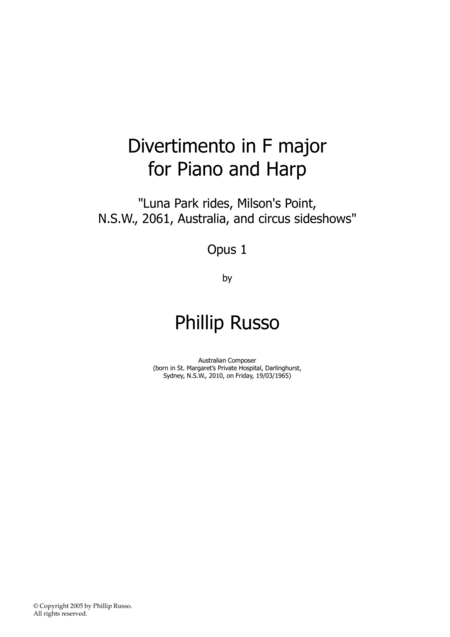
Divertimento in F major for Piano and Harp, Opus 1: "Luna Park rides, Milson's Point, N.S.W., 2061,
Harpe et Piano

$40.00 33.84 € Harpe et Piano PDF SheetMusicPlus

Piano Solo - Level 5 - Digital Download SKU: A0.1225761 By The Platters. By Jerome Kern and Otto Harbach. Arranged by Timothy Stapay. Broadway,Film/TV,Jazz,Musical/Show,Singer/Songwriter,Standards. Score. 8 pages. Timothy Stapay #821814. Published by Timothy Stapay (A0.1225761). Smoke Gets In Your Eyes is arranged as played by piano artist, Liberace.This version is from the rare early album Liberace At Home.  Smoke Gets in Your Eyes is a show tune written by American composer Jerome Kern and lyricist Otto Harbach for the 1933 musical Roberta. The song was sung in the Broadway show by Tamara Drasin. Its first recorded performance was by Gertrude Niesen, who recorded the song with orchestral direction from Ray Sinatra, Frank Sinatra's second cousin,[1] on October 13, 1933. On October 30, 1946, Nat King Cole recorded the song in his trio with Oscar Moore on guitar and Johnny Miller on double bass, during a live broadcast from New York City.[10] Cole performed it on television in 1957 for The Nat King Cole Show.  Władziu Valentino Liberace (May 16, 1919 – February 4, 1987) was an American pianist, singer, and actor.  A child prodigy born in Wisconsin to parents of Italian and Polish origin, he enjoyed a career spanning four decades of concerts, recordings, television, motion pictures, and endorsements. At the height of his fame from the 1950s to 1970s, he was the highest-paid entertainer in the world!Lyrics below:They asked me how I knewMy true love was trueI of course repliedSomething here inside cannot be deniedThey said someday you'll find all who love are blindWhen your heart's on fire,You must realize, smoke gets in your eyesSo I chaffed them and I gaily laughedTo think they could doubt my loveYet today my love has flown away,I am without my love (without my love)Now laughing friends derideTears I cannot hideSo I smile and sayWhen a lovely flame dies, smoke gets in your eyes(Smoke gets in your eyes, smoke gets in your eyes)Smoke gets in your eyes
Smoke Gets In Your Eyes
Piano seul
The Platters
$8.99 7.61 € Piano seul PDF SheetMusicPlus

Saxophone Quintet,Woodwind Ensemble Alto Saxophone,Tenor Saxophone - Level 4 - Digital Download SKU: A0.1254362 Composed by Johann Sebastian Bach. Arranged by Regis Bookshar. Baroque,Chamber,Christian,Easter,Historic. 29 pages. Regis Bookshar #847934. Published by Regis Bookshar (A0.1254362). Three selections based on Christ lag in Todesbanden (Christ lay in death's bonds) (from Cantata No.   4, BMV   4) - Johann Sebastian Bach - Saxophone Quintet (2 Altos, 3 Tenors) - Digital Download.Cantata No.   4, BMV   4, Christ lag in Todesbanden (also spelled Todes Banden) (Christ lay in death's bonds) is a cantata for Easter written by Johann Sebastian Bach and is his earliest surviving Church Cantata. It was probably written in 1707 when he was 22 years old. It is a Chorale Cantata, a style in which both the text and the music are based on a hymn. In this instance, the source was Martin Luther's hymn of the same name which became a main Easter hymn in German Lutheranism.Regis Bookshar has transcribed and arranged three selections based on this hymn tune, two from Bach's Cantata No.   4, BMV   4, and also his Chorale Prelude, BMV 625. They may be played individually or as a trilogy and each movement gets more complex than the previous one. The first selection in this trilogy is the Chorale, Christ lag in Todesbanden, the final chorus from his Cantata No.   4, a straighforward four-part chorale setting of the hymn (Regis has also added a fifth part). This is followed by Bach's Chorale Prelude, BMV 625, a piece from his Orgelbuchlein (Little Organ Book), a collection of 46 Preludes for organ, written almost exclusively during the 1708-1717 period, while Bach was court organist at Weimar. For the final selection, Regis has placed the polyphonic and imitative chorus, Es war ein wunderlicher Krieg, da Tod und Leben rungen) (It was a strange battle, that death and life waged), which Bach had placed in the middle of his Cantata No.   4.This arrangement is for a Saxophone Quintet, consisting of 2 Alto Saxophones and 3 Tenor Saxophones. Included are a score and a complete set of parts (29 pages).I hope you will enjoy playing these selections and please search for other arrangements by Regis Bookshar. There are numerous selections in a variety of styles, also available for purchase. I think you will be pleased with what you may find.
Three selections based on "Christ lag in Todesbanden" (Saxophone Quintet - 2 Alto, 3 Tenor)
Quintette de Saxophone: 5 saxophones

$30.00 25.38 € Quintette de Saxophone: 5 saxophones PDF SheetMusicPlus


Partitions Gratuites
Acheter des Partitions Musicales
Acheter des Partitions Digitales à Imprimer
Acheter des Instruments de Musique

© 2000 - 2026

Accueil - Version intégrale





