EUROPE
7756 articles
USA
0 articles
DIGITAL
13971 articles (à imprimer)
Partitions Digitales
Partitions à imprimer
13971 partitions trouvées


Small Ensemble Bassoon,Cello - Level 4 - Digital Download SKU: A0.796251 By Daniel Kelley. By Various. Arranged by Daniel Kelley. Baroque,Classical,Instructional,Romantic Period,Traditional. Score and parts. 43 pages. Last Resort Music Publishing #403432. Published by Last Resort Music Publishing (A0.796251). Part 4 Cello or Bassoon - Featuring ingenious and very accessible arrangements of works by Schubert, Sibelius, Mozart, and more! Arrangements for String Quartet or 3 Violins & Cello Wind Quartet, Sax Quartet and...the possibilities are endless! Ideal for String Quartet or Wind Quartet or Piano Quartet or 4 Clarinets 4 Saxophones & more! The keyboard/guitar part encompasses parts 2, 3 and 4. Therefore, the arrangements could be played as a piano quartet, or an entire quartet could play with a pianist - as long as Part 1 is being played. Table of Contents Turkish March from The Ruins of Athens (Beethoven) Hungarian March from Damnation of Faust (Berlioz) St. Anthony Chorale from Variations on a Theme of Haydn (Brahms) Scarf Dance from the ballet Callirhoe, Op. 37 (Chaminade) Mazurka from Op. 67 #3 (Chopin) Trumpet Voluntary in D Major (Clarke) La Marseillaise French National Anthem (De Lisle) Largo from Symphony #9, Op. 92 From the New World (Dvorak) Dixie (Emmett) I'm Called Little Buttercup from H. M. S. Pinafore (Gilbert & Sullivan) Elfin Dance from Lyric Pieces, Op. 12 #4 (Grieg) Bourree from Sonata in G for Flute, Op. 1 #5 (Handel) Sarabande from Suite #4 in D minor for piano, 2nd set (Handel) See the Conquering Hero Comes from Judas Maccabaeus (Handel) Farewell Symphony from Symphony #45, fifth movement (Haydn) Minuet from Symphony #95 in C minor (Haydn) Santa Lucia (Italian Traditional) 'Tis the Last Rose of Summer Irish Air (Moore) Allegro & Presto Symphony #1 in Eb Major, K. 16 (Mozart) The Great Gate of Kiev & Promenade from Pictures at an Exhibition (Mussorgsky) Ave Maria from Thirty Pieces for Young People, Op. 107 #24 (Reinecke) Three O'Clock in the Morning (Robledo) Over the Waves from Sobre Las Olas Waltzes (Rosas) Dark Eyes (Russian Folk Melody) March Militaire from Three Military Marches, Op. 51 #1 (Schubert) Norse Song from Album for the Young, Op. 68 #41 (Schumann) Chanson Sans Paroles from Pensees Lyriques, Opus 40, #2 (Sibelius) Valse Triste from Kuolema, Op. 44 #1 (Sibelius) Morning Prayer from Album for the Young, Op. 39 (Tschaikovsky) Espana Waltz #1 & # 2 from the Espana Waltzes, Op. 263 (Waldteufel) www.lastresortmusic.com.
Intermediate Music for Four, Volume 2, Part 4 - Cello or Bassoon 72241
Daniel Kelley
$20.00 17.31 € PDF SheetMusicPlus

Woodwind Ensemble,Woodwind Quartet - Level 3 - Digital Download SKU: A0.529976 Composed by Various. Arranged by Daniel Kelley. Baroque,Classical,Folk,Romantic Period,Standards. 42 pages. Last Resort Music Publishing #28467. Published by Last Resort Music Publishing (A0.529976). This is the second part in the Intermediate Music for Four, Volume 1 Series. Fantastic arrangements for quartet with flexible instrumentation. Each volume is arranged in progressive order of difficulty. This series is designed to progress to the level of the Music for Four series. Each part is sold separately. Perfect for String Quartet, Wind Quartet, Piano Quartet, Clarinet Quartet, & More! The keyboard/guitar part encompasses parts 2, 3 and 4. Therefore, the arrangements could be played as a piano quartet, or an entire quartet could play with a pianist - as long as Part 1 is being played. Other parts available: Part 1 Flute or Oboe or Violin Part 1 Clarinet or Soprano Sax in Bb Part 1 Alto Sax in Eb Part 2 Flute or Oboe or Violin Part 2 Clarinet or Trumpet in Bb Part 2 Alto Sax in Eb Part 3 Violin in C Part 3 Viola Part 3 Clarinet or Trumpet in Bb Part 3 Tenor Sax in Bb Part 3 French Horn in F Part 4 Cello or Bassoon Part 4 Bass Clarinet in Bb Part 4 Baritone Sax in Eb Keyboard or Guitar Score (Parts 1-4 in C) Table of Contents Turkish March from The Ruins of Athens (Beethoven) Hungarian March from Damnation of Faust (Berlioz) St. Anthony Chorale from Variations on a Theme of Haydn (Brahms) Scarf Dance from the ballet Callirhoe, Op. 37 (Chaminade) Mazurka from Op. 67 #3 (Chopin) Trumpet Voluntary in D Major (Clarke) La Marseillaise French National Anthem (De Lisle) Largo from Symphony #9, Op. 92 From the New World (Dvorak) Dixie (Emmett) I'm Called Little Buttercup from H. M. S. Pinafore (Gilbert & Sullivan) Elfin Dance from Lyric Pieces, Op. 12 #4 (Grieg) Bourree from Sonata in G for Flute, Op. 1 #5 (Handel) Sarabande from Suite #4 in D minor for piano, 2nd set (Handel) See the Conquering Hero Comes from Judas Maccabaeus (Handel) Farewell Symphony from Symphony #45, fifth movement (Haydn) Minuet from Symphony #95 in C minor (Haydn) Santa Lucia (Italian Traditional) 'Tis the Last Rose of Summer Irish Air (Moore) Allegro & Presto Symphony #1 in Eb Major, K. 16 (Mozart) The Great Gate of Kiev & Promenade from Pictures at an Exhibition (Mussorgsky) Ave Maria from Thirty Pieces for Young People, Op. 107 #24 (Reinecke) Three O'Clock in the Morning (Robledo) Over the Waves from Sobre Las Olas Waltzes (Rosas) Dark Eyes (Russian Folk Melody) March Militaire from Three Military Marches, Op. 51 #1 (Schubert) Nore Song from Album for the Young, Op. 68 #41 (Schumann) Chanson Sans Paroles from Pensees Lyriques, Opus 40, #2 (Sibelius) Valse Triste from Kuolema, Op. 44 #1 (Sibelius) Morning Prayer from Album for the Young, Op. 39 (Tschaikovsky) Espana Waltz #1 & # 2 from the Espana Waltzes, Op. 263 (Waldteufel).
Intermediate Music for Four, Volume 1 Part 2 Clarinet or Trumpet in Bb 72123DD
Flûte, Hautbois, Clarinette, Basson

$18.50 16.01 € Flûte, Hautbois, Clarinette, Basson PDF SheetMusicPlus

B-Flat Clarinet,Baritone Saxophone,Cello,Flute,Oboe/English Horn,Piano,Soprano Saxophone,Tenor Saxophone,Viola,Violin - Level 3 - Digital Download SKU: A0.1255173 Composed by Various. Arranged by Daniel Kelley. 19th Century,Baroque,Classical,Instructional,Standards. 43 pages. Last Resort Music Publishing #848738. Published by Last Resort Music Publishing (A0.1255173). Intermediate Music for Four, Volume 1 Part 3 for French Horn or English Horn - #72134Fantastic arrangements for quartet with flexible instrumentation. Each volume is arranged in progressive order of difficulty. This series is designed to progress to the level of the Music for Four series. Each part is sold separately.Perfect for String Quartet, Wind Quartet, Piano Quartet, Clarinet Quartet, & More! The keyboard/guitar part encompasses parts 2, 3 and 4. Therefore, the arrangements could be played as a piano quartet, or an entire quartet could play with a pianist - as long as Part 1 is being played. Table of ContentsTurkish March from The Ruins of Athens (Beethoven) Hungarian March from Damnation of Faust (Berlioz) St. Anthony Chorale from Variations on a Theme of Haydn (Brahms) Scarf Dance from the ballet Callirhoe, Op. 37 (Chaminade) Mazurka from Op. 67 #3 (Chopin) Trumpet Voluntary in D Major (Clarke) La Marseillaise French National Anthem (De Lisle) Largo from Symphony #9, Op. 92 From the New World (Dvorak) Dixie (Emmett) I'm Called Little Buttercup from H. M. S. Pinafore (Gilbert & Sullivan) Elfin Dance from Lyric Pieces, Op. 12 #4 (Grieg) Bourree from Sonata in G for Flute, Op. 1 #5 (Handel) Sarabande from Suite #4 in D minor for piano, 2nd set (Handel) See the Conquering Hero Comes from Judas Maccabaeus (Handel) Farewell Symphony from Symphony #45, fifth movement (Haydn) Minuet from Symphony #95 in C minor (Haydn) Santa Lucia (Italian Traditional) 'Tis the Last Rose of Summer  Irish Air (Moore) Allegro & Presto Symphony #1 in Eb Major, K. 16 (Mozart) The Great Gate of Kiev & Promenade from Pictures at an Exhibition (Mussorgsky) Ave Maria from Thirty Pieces for Young People, Op. 107 #24 (Reinecke) Three O'Clock in the Morning (Robledo) Over the Waves from Sobre Las Olas Waltzes (Rosas) Dark Eyes (Russian Folk Melody) March Militaire from Three Military Marches, Op. 51 #1 (Schubert) Norse Song from Album for the Young, Op. 68 #41 (Schumann) Chanson Sans Paroles from Pensees Lyriques, Opus 40, #2 (Sibelius) Valse Triste from Kuolema, Op. 44 #1 (Sibelius) Morning Prayer from Album for the Young, Op. 39 (Tschaikovsky) Espana Waltz #1 & # 2 from the Espana Waltzes, Op. 263 (Waldteufel)  All available on SheetMusicPlus and www.lastresortmusic.com Published by Last Resort Music Publishing 
Intermediate Music for Four, Volume 1 Part 3 for French Horn or English Horn - #72134

$20.00 17.31 € PDF SheetMusicPlus

Woodwind Ensemble,Woodwind Quartet - Level 3 - Digital Download SKU: A0.529972 Composed by Various. Arranged by Daniel Kelley. 20th Century,Classical,Instructional,Romantic Period,Standards. 45 pages. Last Resort Music Publishing #1915519. Published by Last Resort Music Publishing (A0.529972). Part 2 Eb Alto Saxophone - Featuring ingenious and very accessible arrangements of works by Schubert, Sibelius, Mozart, and more! Arrangements for String Quartet or 3 Violins & Cello Wind Quartet, Sax Quartet and...the possibilities are endless! Ideal for String Quartet or Wind Quartet or Piano Quartet or 4 Clarinets 4 Saxophones & more! The keyboard/guitar part encompasses parts 2, 3 and 4. Therefore, the arrangements could be played as a piano quartet, or an entire quartet could play with a pianist - as long as Part 1 is being played.Table of ContentsTurkish March from The Ruins of Athens (Beethoven) Hungarian March from Damnation of Faust (Berlioz) St. Anthony Chorale from Variations on a Theme of Haydn (Brahms) Scarf Dance from the ballet Callirhoe, Op. 37 (Chaminade) Mazurka from Op. 67 #3 (Chopin) Trumpet Voluntary in D Major (Clarke) La Marseillaise French National Anthem (De Lisle) Largo from Symphony #9, Op. 92 From the New World (Dvorak) Dixie (Emmett) I'm Called Little Buttercup from H. M. S. Pinafore (Gilbert & Sullivan) Elfin Dance from Lyric Pieces, Op. 12 #4 (Grieg) Bourree from Sonata in G for Flute, Op. 1 #5 (Handel) Sarabande from Suite #4 in D minor for piano, 2nd set (Handel) See the Conquering Hero Comes from Judas Maccabaeus (Handel) Farewell Symphony from Symphony #45, fifth movement (Haydn) Minuet from Symphony #95 in C minor (Haydn) Santa Lucia (Italian Traditional) 'Tis the Last Rose of Summer  Irish Air (Moore) Allegro & Presto Symphony #1 in Eb Major, K. 16 (Mozart) The Great Gate of Kiev & Promenade from Pictures at an Exhibition (Mussorgsky) Ave Maria from Thirty Pieces for Young People, Op. 107 #24 (Reinecke) Three O'Clock in the Morning (Robledo) Over the Waves from Sobre Las Olas Waltzes (Rosas) Dark Eyes (Russian Folk Melody) March Militaire from Three Military Marches, Op. 51 #1 (Schubert) Norse Song from Album for the Young, Op. 68 #41 (Schumann) Chanson Sans Paroles from Pensees Lyriques, Opus 40, #2 (Sibelius) Valse Triste from Kuolema, Op. 44 #1 (Sibelius) Morning Prayer from Album for the Young, Op. 39 (Tschaikovsky) Espana Waltz #1 & # 2 from the Espana Waltzes, Op. 263 (Waldteufel)www.lastresortmusic.com.
Intermediate Music for Four, Volume 2, Part 2 - Alto Saxophone in Eb 72125DD
Flûte, Hautbois, Clarinette, Basson

$20.00 17.31 € Flûte, Hautbois, Clarinette, Basson PDF SheetMusicPlus

Woodwind Ensemble,Woodwind Quartet - Level 3 - Digital Download SKU: A0.530438 Composed by Various. Arranged by Daniel Kelley. Baroque,Classical,Romantic Period,Standards. 45 pages. Last Resort Music Publishing #3602199. Published by Last Resort Music Publishing (A0.530438). Intermediate Music for Four, Volume 1 Part 3 for Clarinet or Trumpet in Bb - #72133Fantastic arrangements for quartet with flexible instrumentation. Each volume is arranged in progressive order of difficulty. This series is designed to progress to the level of the Music for Four series. Each part is sold separately.Perfect for String Quartet, Wind Quartet, Piano Quartet, Clarinet Quartet, & More! The keyboard/guitar part encompasses parts 2, 3 and 4. Therefore, the arrangements could be played as a piano quartet, or an entire quartet could play with a pianist - as long as Part 1 is being played. Table of ContentsTurkish March from The Ruins of Athens (Beethoven) Hungarian March from Damnation of Faust (Berlioz) St. Anthony Chorale from Variations on a Theme of Haydn (Brahms) Scarf Dance from the ballet Callirhoe, Op. 37 (Chaminade) Mazurka from Op. 67 #3 (Chopin) Trumpet Voluntary in D Major (Clarke) La Marseillaise French National Anthem (De Lisle) Largo from Symphony #9, Op. 92 From the New World (Dvorak) Dixie (Emmett) I'm Called Little Buttercup from H. M. S. Pinafore (Gilbert & Sullivan) Elfin Dance from Lyric Pieces, Op. 12 #4 (Grieg) Bourree from Sonata in G for Flute, Op. 1 #5 (Handel) Sarabande from Suite #4 in D minor for piano, 2nd set (Handel) See the Conquering Hero Comes from Judas Maccabaeus (Handel) Farewell Symphony from Symphony #45, fifth movement (Haydn) Minuet from Symphony #95 in C minor (Haydn) Santa Lucia (Italian Traditional) 'Tis the Last Rose of Summer  Irish Air (Moore) Allegro & Presto Symphony #1 in Eb Major, K. 16 (Mozart) The Great Gate of Kiev & Promenade from Pictures at an Exhibition (Mussorgsky) Ave Maria from Thirty Pieces for Young People, Op. 107 #24 (Reinecke) Three O'Clock in the Morning (Robledo) Over the Waves from Sobre Las Olas Waltzes (Rosas) Dark Eyes (Russian Folk Melody) March Militaire from Three Military Marches, Op. 51 #1 (Schubert) Norse Song from Album for the Young, Op. 68 #41 (Schumann) Chanson Sans Paroles from Pensees Lyriques, Opus 40, #2 (Sibelius) Valse Triste from Kuolema, Op. 44 #1 (Sibelius) Morning Prayer from Album for the Young, Op. 39 (Tschaikovsky) Espana Waltz #1 & # 2 from the Espana Waltzes, Op. 263 (Waldteufel)
Intermediate Music for Four, Volume 1 Part 3 for Clarinet or Trumpet in Bb - #72133
Flûte, Hautbois, Clarinette, Basson

$18.50 16.01 € Flûte, Hautbois, Clarinette, Basson PDF SheetMusicPlus

Alto Saxophone,Piano - Level 2 - Digital Download SKU: A0.548976 Composed by Johann Sebastian Bach. Arranged by James M. Guthrie, ASCAP. Baroque,Holiday,Standards,Wedding. Score and part. 11 pages. Jmsgu3 #3444569. Published by jmsgu3 (A0.548976). Was mir behagt, ist nur die muntre Jagd (The lively hunt is all my heart's desire), BWV 208 is the earliest secular cantata by Bach composed in 1713 for the birthday of the Duke of Weissenfels. It is also called the Hunting Cantata, and/or the Birthday Cantata. The most famous piece from this collection is the soprano aria Sheep may safely graze. Duration: 5:50, Score - 6 pg. Solo part - 2 pg. Piano part - 3 pg. 41 ms. Melodic range: M10 Sheep May Safely Graze Sheep may safely graze (Schafe können sicher weiden) is an aria from the Cantata BWV 208. The title of the Cantata, Was mir behagt, ist nur die muntre Jagd (nicknamed the Hunting Cantata) translates as The lively hunt is all my heart's desire. Programming Similar to Bach’s Jesu, Joy of Man's Desiring, or I Stand at the Threshold, it is an all-time favorite and frequently requested at weddings. Originally, Bach composed this aria for a royal birthday celebration, that of the Duke of Saxe-Weissenfels. Lyrics Sheep may safely graze and pasture In a watchful Shepherd’s sight. Those who rule with wisdom guiding Bring to hearts a peace abiding Bless a land with joy made bright.   Bach Overview First of all, Johann Sebastian Bach is maybe the greatest composer in music history. Indeed, he was prolific. As a result, everyone has heard of his works. Furthermore, these works number well over a thousand. People are probably most familiar with instrumental works such as the Brandenburg Concertos, and the Goldberg Variations. But, similarly famous are such noteworthy works as the Well-Tempered Clavier, the Musical Offering, and the Art of Fugue. Seems like his most famous vocal works include the most noteworthy Mass in B Minor. Also, most noteworthy, though, are the St. John Passion, and certainly the Christmas Oratorio.  History Bach came from a long line of musicians and above all, composers. Consequently, he, first of all, pursued a career as a church organist. So as a result, he gained employment in various Protestant churches in Germany. For a while, he worked as a court musician in Weimar and Köthen. Here he probably developed his organ style and likewise his chamber music style. Eventually, he, therefore, gained an appointment as Cantor of St. Thomas in Leipzig. Here he worked until difficulties with his employer ultimately drove him away. The King of Poland finally appointed him as court composer.  Style It seems like Bach created a fascinating new international style. He synthesized elements of the most noteworthy European music ideas into his new style. Even more, this new style was probably his synthesis of European musical rhythm and form. Furthermore, he demonstrated a complete mastery of counterpoint and motivic development. His sense of harmonic organization probably propelled him to the top. Revival               Mendelssohn conducted a Bach revival in the nineteenth century. His effort probably helped to re-familiarize the public with the magnitude of Bach’s works. During this period, scholars published many noteworthy Bach biographies. Moreover, Wolfgang Schmieder published the BWV (Bach Werke Verzeichnis). As a result, this is now the official catalog of his entire artistic output. The BWV number allows us to locate a work in the catalog. Sometimes scholars will simply use an S (Schmieder) as an abbreviation for BWV.
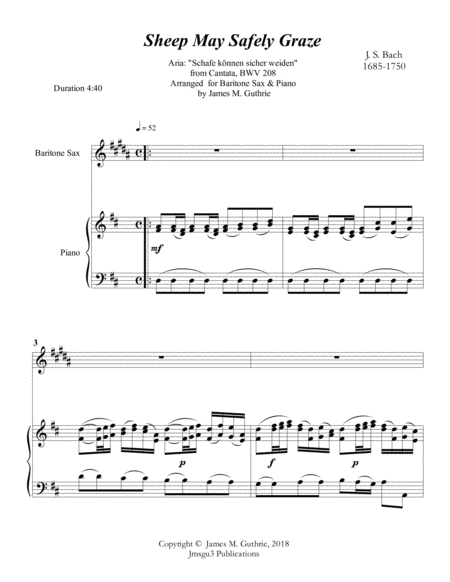
Bach: Sheep May Safely Graze for Alto Sax & Piano
Saxophone Alto et Piano

$32.95 28.52 € Saxophone Alto et Piano PDF SheetMusicPlus

Piano,Tenor Saxophone - Level 2 - Digital Download SKU: A0.550935 Composed by J. S. Bach - Gounod. Arranged by James M. Guthrie, ASCAP. Christmas,Concert,Contemporary,Easter,Wedding. Score and part. 12 pages. Jmsgu3 #4888767. Published by jmsgu3 (A0.550935). This arrangement features the controversial Schwencke measure (ms. 27) that was originally introduced in 1783 by Christian Friedrich Gottlieb Schwencke. The convenient 1st & 2nd endings provide an option for extended performance. Duration with repeat - 4:50. Score: 7 pages. Solo part: 1 page, piano part: 4 pages. Based on Prelude #1 in C Major from the Well-Tempered Clavier, Book 1. Well suited for church meditations or school programs or recital encores. Register for free lifetime updates and revisions at www.jamesguthrie.comAve MariaAve Maria is a Catholic prayer that consequently asks for the mother of Jesus (Mary) to intercede. Charles Gounod composed a famous version of the Ave Maria. He was a French Romantic composer who overlaid a new melody on an existing Bach chord progression. The progression is from Bach’s Prelude No. 1 from Well-Tempered Clavier I. This version, as well as Schubert’s version, have become essential items at weddings, masses, and funerals.Bach OverviewFirst of all, Johann Sebastian Bach is maybe the greatest composer in music history. Certainly, he was prolific. As a result, everyone has heard of his works. Furthermore, these works number well over a thousand. It seems like people are probably most familiar with the instrumental works such as the Brandenburg Concertos, and the Goldberg Variations. But, similarly famous are such noteworthy works as the Well-Tempered Clavier, the Musical Offering, and certainly the Art of Fugue. Seems like his most famous vocal works include the most noteworthy Mass in B Minor. Also, most noteworthy, though, are the St. John Passion, and certainly the Christmas Oratorio. HistoryBach came from a long line of musicians and above all, composers. Consequently, he, first of all, pursued a career as a church organist. So as a result, he gained employment in various Protestant churches in Germany. For a while, he worked as a court musician in Weimar and Köthen. Here he probably developed his organ style and likewise his chamber music style. Eventually, he, therefore, gained an appointment as Cantor of St. Thomas in Leipzig. Here he worked until difficulties with his employer ultimately drove him away. The King of Poland finally appointed him as a court composer. StyleIt seems like Bach created a fascinating new international style. He synthesized elements of the most noteworthy European music ideas into his new style. Even more, this new style was probably his synthesis of European musical rhythm and form. Furthermore, he demonstrated a complete mastery of counterpoint and motivic development. His sense of harmonic organization probably propelled him to the top.Revival              Mendelssohn conducted a Bach revival in the nineteenth century. His effort probably helped to re-familiarize the public with the magnitude of Bach’s works. During this period, scholars published many noteworthy Bach biographies. Moreover, Wolfgang Schmieder published the BWV (Bach Werke Verzeichnis). As a result, this is now the official catalog of his entire artistic output. The BWV number allows us to locate a work in the catalog. Sometimes scholars will simply use an S (Schmieder) as an abbreviation for BWV. VoyagerNASA launched two Voyager spacecraft in 1977. Onboard are phonograph records with sounds, music, and images of life on Earth. The purpose of the launch was to inform intelligent extraterrestrial life forms about conditions on Earth. The music on the disc is varied. There is Bach, Mozart, Beethoven and Stravinsky among others. However, because Bach is so important in our music history, it contains three times more Bach that all the others combined.
Bach-Gounod: Ave Maria, Schwencke version for Tenor Sax & Piano
Saxophone Tenor et Piano

$27.95 24.19 € Saxophone Tenor et Piano PDF SheetMusicPlus

Euphonium,Piano - Level 2 - Digital Download SKU: A0.550923 Composed by J. S. Bach - Gounod. Arranged by James M. Guthrie, ASCAP. Christmas,Easter,Standards. Score and part. 12 pages. Jmsgu3 #4888311. Published by jmsgu3 (A0.550923). This arrangement features the controversial Schwencke measure (ms. 27) that was originally introduced in 1783 by Christian Friedrich Gottlieb Schwencke. The convenient 1st & 2nd endings provide an option for extended performance. Duration with repeat - 4:50. Score: 7 pages. Solo part: 1 page, piano part: 4 pages. Based on Prelude #1 in C Major from the Well-Tempered Clavier, Book 1. Well suited for church meditations or school programs or recital encores. Ave Maria Ave Maria is a Catholic prayer that consequently asks for the mother of Jesus (Mary) to intercede. Charles Gounod composed a famous version of the Ave Maria. He was a French Romantic composer who overlaid a new melody on an existing Bach chord progression. The progression is from Bach’s Prelude No. 1 from Well-Tempered Clavier I. This version, as well as Schubert’s version, have become essential items at weddings, masses, and funerals. Bach Overview First of all, Johann Sebastian Bach is maybe the greatest composer in music history. Certainly, he was prolific. As a result, everyone has heard of his works. Furthermore, these works number well over a thousand. It seems like people are probably most familiar with instrumental works such as the Brandenburg Concertos, and the Goldberg Variations. But, similarly famous are such noteworthy works as the Well-Tempered Clavier, the Musical Offering, and the Art of Fugue. Seems like his most famous vocal works include the most noteworthy Mass in B Minor. Also, most noteworthy, though, are the St. John Passion, and certainly the Christmas Oratorio.  History Bach came from a long line of musicians and above all, composers. Consequently, he, first of all, pursued a career as a church organist. So as a result, he gained employment in various Protestant churches in Germany. For a while, he worked as a court musician in Weimar and Köthen. Here he probably developed his organ style and likewise his chamber music style. Eventually, he, therefore, gained an appointment as Cantor of St. Thomas in Leipzig. Here he worked until difficulties with his employer ultimately drove him away. The King of Poland finally appointed him as a court composer.  Style It seems like Bach created a fascinating new international style. He synthesized elements of the most noteworthy European music ideas into his new style. Even more, this new style was probably his synthesis of European musical rhythm and form. Furthermore, he demonstrated a complete mastery of counterpoint and motivic development. His sense of harmonic organization probably propelled him to the top. Revival               Mendelssohn conducted a Bach revival in the nineteenth century. His effort probably helped to re-familiarize the public with the magnitude of Bach’s works. During this period, scholars published many noteworthy Bach biographies. Moreover, Wolfgang Schmieder published the BWV (Bach Werke Verzeichnis). As a result, this is now the official catalog of his entire artistic output. The BWV number allows us to locate a work in the catalog. Sometimes scholars will simply use an S (Schmieder) as an abbreviation for BWV.  Voyager NASA launched two Voyager spacecraft in 1977. Onboard are phonograph records with sounds, music, and images of life on Earth. The purpose of the launch was to inform intelligent extraterrestrial life forms about conditions on Earth. The music on the disc is varied. There is Bach, Mozart, Beethoven, and Stravinsky among others. However, because Bach is so important in our music history, it contains three times more Bach than all the others combined.

Bach-Gounod: Ave Maria, Schwencke version for Baritone Horn & Piano
Euphonium, Piano (duo)

$32.95 28.52 € Euphonium, Piano (duo) PDF SheetMusicPlus

Oboe,Piano - Level 2 - Digital Download SKU: A0.550929 Composed by J. S. Bach - Gounod. Arranged by James M. Guthrie, ASCAP. Christmas,Easter,Standards. Score and part. 12 pages. Jmsgu3 #4888381. Published by jmsgu3 (A0.550929). This arrangement features the controversial Schwencke measure (ms. 27) that was originally introduced in 1783 by Christian Friedrich Gottlieb Schwencke. The convenient 1st & 2nd endings provide an option for extended performance. Duration with repeat - 4:50. Score: 7 pages. Solo part: 1 page, piano part: 4 pages. Based on Prelude #1 in C Major from the Well-Tempered Clavier, Book 1. Well suited for church meditations, school programs or recital encores.  Ave Maria Ave Maria is a Catholic prayer that consequently asks for the mother of Jesus (Mary) to intercede. Charles Gounod composed a famous version of the Ave Maria. He was a French Romantic composer who overlaid a new melody on an existing Bach chord progression. The progression is from Bach’s Prelude No. 1 from Well-Tempered Clavier I. This version, as well as Schubert’s version, have become essential items at weddings, masses, and funerals. Bach Overview First of all, Johann Sebastian Bach is maybe the greatest composer in music history. Certainly, he was prolific. As a result, everyone has heard of his works. Furthermore, these works number well over a thousand. It seems like people are probably most familiar with the instrumental works such as the Brandenburg Concertos, and the Goldberg Variations. But, similarly famous are such noteworthy works as the Well-Tempered Clavier, the Musical Offering, and certainly the Art of Fugue. Seems like his most famous vocal works include the most noteworthy Mass in B Minor. Also, most noteworthy, though, are the St. John Passion, and certainly the Christmas Oratorio.  History Bach came from a long line of musicians and above all, composers. Consequently, he, first of all, pursued a career as a church organist. So as a result, he gained employment in various Protestant churches in Germany. For a while, he worked as a court musician in Weimar and Köthen. Here he probably developed his organ style and likewise his chamber music style. Eventually, he, therefore, gained an appointment as Cantor of St. Thomas in Leipzig. Here he worked until difficulties with his employer ultimately drove him away. The King of Poland finally appointed him as a court composer.  Style It seems like Bach created a fascinating new international style. He synthesized elements of the most noteworthy European music ideas into his new style. Even more, this new style was probably his synthesis of European musical rhythm and form. Furthermore, he demonstrated a complete mastery of counterpoint and motivic development. His sense of harmonic organization probably propelled him to the top. Revival               Mendelssohn conducted a Bach revival in the nineteenth century. His effort probably helped to re-familiarize the public with the magnitude of Bach’s works. During this period, scholars published many noteworthy Bach biographies. Moreover, Wolfgang Schmieder published the BWV (Bach Werke Verzeichnis). As a result, this is now the official catalog of his entire artistic output. The BWV number allows us to locate a work in the catalog. Sometimes scholars will simply use an S (Schmieder) as an abbreviation for BWV.  Voyager NASA launched two Voyager spacecraft in 1977. Onboard are phonograph records with sounds, music, and images of life on Earth. The purpose of the launch was to inform intelligent extraterrestrial life forms about conditions on Earth. The music on the disc is varied. There is Bach, Mozart, Beethoven, and Stravinsky among others. However, because Bach is so important in our music history, it contains three times more Bach than all the others combined.

Bach-Gounod: Ave Maria, Schwencke version for Oboe & Piano
Hautbois, Piano (duo)

$32.95 28.52 € Hautbois, Piano (duo) PDF SheetMusicPlus

Bass Flute,Instrumental Solo,Piano - Level 2 - Digital Download SKU: A0.550921 Composed by J. S. Bach - Gounod. Arranged by James M. Guthrie, ASCAP. Christian,Christmas,Concert,Easter,Standards. Score and individual part. 12 pages. Jmsgu3 #4888307. Published by jmsgu3 (A0.550921). This arrangement features the controversial Schwencke measure (ms. 27) that was originally introduced in 1783 by Christian Friedrich Gottlieb Schwencke. The convenient 1st & 2nd endings provide an option for extended performance. Duration with repeat - 4:50. Score: 7 pages. Solo part: 1 page, piano part: 4 pages. Based on Prelude #1 in C Major from the Well-Tempered Clavier, Book 1. Well suited for church meditations or school programs or recital encores. Register for free lifetime updates and revisions at www.jamesguthrie.comAve MariaAve Maria is a Catholic prayer that consequently asks for the mother of Jesus (Mary) to intercede. Charles Gounod composed a famous version of the Ave Maria. He was a French Romantic composer who overlaid a new melody on an existing Bach chord progression. The progression is from Bach’s Prelude No. 1 from Well-Tempered Clavier I. This version, as well as Schubert’s version, have become essential items at weddings, masses, and funerals.Bach OverviewFirst of all, Johann Sebastian Bach is maybe the greatest composer in music history. Certainly, he was prolific. As a result, everyone has heard of his works. Furthermore, these works number well over a thousand. It seems like people are probably most familiar with the instrumental works such as the Brandenburg Concertos, and the Goldberg Variations. But, similarly famous are such noteworthy works as the Well-Tempered Clavier, the Musical Offering, and certainly the Art of Fugue. Seems like his most famous vocal works include the most noteworthy Mass in B Minor. Also, most noteworthy, though, are the St. John Passion, and certainly the Christmas Oratorio. HistoryBach came from a long line of musicians and above all, composers. Consequently, he, first of all, pursued a career as a church organist. So as a result, he gained employment in various Protestant churches in Germany. For a while, he worked as a court musician in Weimar and Köthen. Here he probably developed his organ style and likewise his chamber music style. Eventually, he, therefore, gained an appointment as Cantor of St. Thomas in Leipzig. Here he worked until difficulties with his employer ultimately drove him away. The King of Poland finally appointed him as a court composer. StyleIt seems like Bach created a fascinating new international style. He synthesized elements of the most noteworthy European music ideas into his new style. Even more, this new style was probably his synthesis of European musical rhythm and form. Furthermore, he demonstrated a complete mastery of counterpoint and motivic development. His sense of harmonic organization probably propelled him to the top.Revival              Mendelssohn conducted a Bach revival in the nineteenth century. His effort probably helped to re-familiarize the public with the magnitude of Bach’s works. During this period, scholars published many noteworthy Bach biographies. Moreover, Wolfgang Schmieder published the BWV (Bach Werke Verzeichnis). As a result, this is now the official catalog of his entire artistic output. The BWV number allows us to locate a work in the catalog. Sometimes scholars will simply use an S (Schmieder) as an abbreviation for BWV. VoyagerNASA launched two Voyager spacecraft in 1977. Onboard are phonograph records with sounds, music, and images of life on Earth. The purpose of the launch was to inform intelligent extraterrestrial life forms about conditions on Earth. The music on the disc is varied. There is Bach, Mozart, Beethoven and Stravinsky among others. However, because Bach is so important in our music history, it contains three times more Bach that all the others combined.

Bach-Gonoud: Ave Maria, Schwencke version for Bass Flute & Piano

$27.95 24.19 € PDF SheetMusicPlus

Baritone Saxophone,Piano - Level 2 - Digital Download SKU: A0.548979 Composed by Johann Sebastian Bach. Arranged by James M. Guthrie, ASCAP. Baroque,Holiday,Standards,Wedding. Score and part. 11 pages. Jmsgu3 #3444583. Published by jmsgu3 (A0.548979). Was mir behagt, ist nur die muntre Jagd (The lively hunt is all my heart's desire), BWV 208 is the earliest secular cantata by Bach composed in 1713 for the birthday of the Duke of Weissenfels. It is also called the Hunting Cantata, and/or the Birthday Cantata. The most famous piece from this collection is the soprano aria Sheep may safely graze. Duration: 5:50, Score - 6 pg. Solo part - 2 pg. Piano part - 3 pg. 41 ms. Melodic range: M10 Level: Early intermediate and up. A popular choice for weddings, Christmas, Easter, birthdays, and recitals. Sheep May Safely Graze Sheep may safely graze (Schafe können sicher weiden) is an aria from the Cantata BWV 208. The title of the Cantata, Was mir behagt, ist nur die muntre Jagd (nicknamed the Hunting Cantata) translates as The lively hunt is all my heart's desire. Programming Similar to Bach’s Jesu, Joy of Man's Desiring, or I Stand at the Threshold, it is an all-time favorite and frequently requested at weddings. Originally, Bach composed this aria for a royal birthday celebration, that of the Duke of Saxe-Weissenfels. Lyrics Sheep may safely graze and pasture In a watchful Shepherd’s sight. Those who rule with wisdom guiding Bring to hearts a peace abiding Bless a land with joy made bright.   Bach Overview First of all, Johann Sebastian Bach is maybe the greatest composer in music history. Indeed, he was prolific. As a result, everyone has heard of his works. Furthermore, these works number well over a thousand. People are probably most familiar with instrumental works such as the Brandenburg Concertos, and the Goldberg Variations. But, similarly famous are such noteworthy works as the Well-Tempered Clavier, the Musical Offering, and the Art of Fugue. Seems like his most famous vocal works include the most noteworthy Mass in B Minor. Also, most noteworthy, though, are the St. John Passion, and certainly the Christmas Oratorio.  History Bach came from a long line of musicians and above all, composers. Consequently, he, first of all, pursued a career as a church organist. So as a result, he gained employment in various Protestant churches in Germany. For a while, he worked as a court musician in Weimar and Köthen. Here he probably developed his organ style and likewise his chamber music style. Eventually, he, therefore, gained an appointment as Cantor of St. Thomas in Leipzig. Here he worked until difficulties with his employer ultimately drove him away. The King of Poland finally appointed him as court composer.  Style It seems like Bach created a fascinating new international style. He synthesized elements of the most noteworthy European music ideas into his new style. Even more, this new style was probably his synthesis of European musical rhythm and form. Furthermore, he demonstrated a complete mastery of counterpoint and motivic development. His sense of harmonic organization probably propelled him to the top. Revival               Mendelssohn conducted a Bach revival in the nineteenth century. His effort probably helped to re-familiarize the public with the magnitude of Bach’s works. During this period, scholars published many noteworthy Bach biographies. Moreover, Wolfgang Schmieder published the BWV (Bach Werke Verzeichnis). As a result, this is now the official catalog of his entire artistic output. The BWV number allows us to locate a work in the catalog. Sometimes scholars will simply use an S (Schmieder) as an abbreviation for BWV.

Bach: Sheep May Safely Graze for Baritone Sax & Piano
Saxophone Baryton, Piano

$32.95 28.52 € Saxophone Baryton, Piano PDF SheetMusicPlus

Piano,Vocal,Voice - Level 3 - Digital Download SKU: A0.958769 Composed by Felipe Pinglo Alva. Arranged by Juan Carlos Cortés A. 20th Century,Concert,Holiday,Love,Standards,World. Score. 3 pages. Juan Carlos Cortés Aguirre #6593915. Published by Juan Carlos Cortés Aguirre (A0.958769). Transcripción para Piano Solo por:JUAN CARLOS CORTÉS A.Basado en la versión fonográfica vocalizada por Rafael Miguel Sciorra, conocido artistíscamente como Juan Carlos Miranda nacido en Chivilcoy, provincia de Buenos Aires, Argentina, el 23 de julio de 1917 y fallecido el 8 de julio de 1999. Acompañado por la orquesta del maestro peruano Jorge Huirse Reyes, nacido en Puno, el 30 de agosto de 1920 y fallecido en Lima, el 11 de diciembre de 1992.Felipe Pinglo Alva es conocido como el Maestro de los Autores y Compositores del Perú. Nació en 1899 y fallece en 1936 a los 35 años. A él le pertenecen la letra y música de los valses peruanos El Plebeyo y El espejo de mi Vida de gran difusión en la Argentina, él no llego a conocer en vida la trascendencia de sus temas.Texto:PASION Y ODIO(Vals peruano) Por: Felipe Pinglo AlvaINTRODUCCIÓN:Ayer la amaba yo, hoy mi pasión es cruel,germinó en mí el deseo, de amar sin querer.En mi memoria están, promesa de infame mujer,que el tiempo ya borró, al lapidar un falso amor.Esos labios que plenos, de pasión he besado,Que llevan el estigma, de un recuerdo angustiado.Las mejillas que un día mis labios colorearon,el polvo del olvido, las ha envuelto en el fango...¡Hoy odio a la mujer, que antes idolatré!¡Hoy odio a la mujer, que antes idolatré!INTERLUDIO:¡Hoy odio a la mujer, que antes idolatré!¡Hoy odio a la mujer…que antes idolatré!Enlaces: Videos en You Tube por Juan Carlos Cortés A.http://www.youtube.com/channel/UCW5way12kaK8-vcW0ww-jRwSoundcloud (Nube de sonido):https://soundcloud.com/juan-carlos-cortes-aguirreURL HISPASONIC + MÚSICA NAVEGANTE:http://www.hispasonic.com/usuarios/navegante/musicaTwitter: https://twitter.com/navegantemusicohttp://www.matrimonio.com.co/musica-matrimonio/conjunto-navegante--e109925Página de Editor Musical en Sheet Music Plus:https://www.sheetmusicplus.com/publishers/publicado-por-juan-carlos-corts-a-sheet-music/3011587?ac=1.
Pasión y Odio. Vals Peruano por: Felipe Pinglo Alva
Piano, Voix

$7.99 6.91 € Piano, Voix PDF SheetMusicPlus

Woodwind Ensemble,Woodwind Quartet - Level 2 - Digital Download SKU: A0.1257713 Composed by Guillaume de Machaut, 1300-1377. Arranged by James M. Guthrie, ASCAP. Chamber,Contest,Early Music,Festival,Historic,Medieval. 38 pages. Jmsgu3 #850942. Published by jmsgu3 (A0.1257713). Guillaume de Machaut composed the Messe de Nostre Dame, also known as the Mass of Our Lady, in the early 1360s. He composed the mass for the Cathedral at Reims, where he served as a canon, and a permanent clergy member. According to a rubric found at the Cathedral, it would have likely been performed for the Saturday Lady Mass. Some scholars hypothesize that Machaut did not actually come to work for the Reims Cathedral until the end of the 1350s, composing the mass as an act of devotion and dedication marking his arrival in the precinct.Guillaume de Machaut's Messe de Nostre Dame is significant in the history of music for several reasons: It is the first complete setting of the Ordinary of the mass by a single composer that has survived. It is a unified mass, meaning that the composer selected relevant chants for each section as the borrowed tenor.   It was composed for four voices, which was unusual at the time. The texts of both Gloria and Credo are quite lengthy, and therefore Machaut set these movements in a style reminiscent of the earlier discant style, having short phrases, similar rhythmic motion in all parts, and a low ratio of notes per syllable of text, both ending with long, rhapsodic sections for the final word, Amen. Machaut's Messe de Nostre Dame is a landmark in musical history, but it is far from being avant-garde merely for the sake of uniqueness. It is considered to be a culmination of the musical style of the Ars Nova period, which was characterized by complex polyphonic textures and rhythmic innovations. The mass is also significant because it was composed during a time of great political and social upheaval in Europe, and it reflects the changing attitudes towards religion and music during this period.Overall, Machaut's Messe de Nostre Dame is a significant work that represents a culmination of the musical style of the Ars Nova period and reflects the changing attitudes towards religion and music during the 14th century.T.
Machaut: La Messe de Nostre Dame for Saxophone Quartet - Score Only
Quatuor de Saxophones: 4 saxophones

$49.95 43.23 € Quatuor de Saxophones: 4 saxophones PDF SheetMusicPlus

Guitar - Level 3 - Digital Download SKU: A0.1381415 Composed by Ernesto Leucona. Arranged by Edina Balczo. Classical,Latin,Multicultural,Standards,Traditional,World. Guitar Tab. 6 pages. Edina Balczo #966126. Published by Edina Balczo (A0.1381415). Malagueña is a song by Cuban composer Ernesto Lecuona. It was originally the sixth movement of Lecuona's Suite Andalucía (1933), to which he added lyrics in Spanish. The song has since become a popular, jazz, marching band, and drum and bugle corps standard and has been provided with lyrics in several languages. In general terms, malagueñas are flamenco dance styles from Málaga, in the southeast of Spain. This is an arrangement for the guitar.
Malaguena
Guitare notes et tablatures

$7.99 6.91 € Guitare notes et tablatures PDF SheetMusicPlus


Partitions Gratuites
Acheter des Partitions Musicales
Acheter des Partitions Digitales à Imprimer
Acheter des Instruments de Musique

© 2000 - 2026

Accueil - Version intégrale

