EUROPE
7756 articles
USA
0 articles
DIGITAL
13971 articles (à imprimer)
Partitions Digitales
Partitions à imprimer
13971 partitions trouvées


Piano Solo - Level 2 - Digital Download SKU: A0.1292733 By Various. By Wolfgang Amadeus Mozart. Arranged by Piano. Children,Classical,Instructional,Wedding. Score. 1 pages. Sérgio Matias da Cunha #883296. Published by Sérgio Matias da Cunha (A0.1292733). Partitura clara, objetiva, concisa e acessível apresentando marcações de cifra, dedilhado, sinais de repetição e figuras rítmicas maiores que a semicolcheia, distribuindo toda a música em uma única página, oferecendo as devidas informações, cuidadosamente diagramada e organizada para melhor visualização, entendimento e execução. Encontre mais partituras como essa, colando o nome do arranjador (Sérgio Matias da Cunha) na barra de pesquisa. ATENÇÃO: Compre os quatro volumes do “Curso de Teclado Primeiros Toques†no site https://www.sheetmusicplus.com/ colando o código na barra de pesquisa. Volume1 (A0.1314018) Volume2 (A0.1314021) Volume3 (A0.1314023) Volume4 (A0.1314028).
Uma Bela Canção - W. A. Mozart
Piano seul
Various
$2.99 2.59 € Piano seul PDF SheetMusicPlus

Piano Solo - Level 2 - Digital Download SKU: A0.1292716 By Various. By Georg Bohm. Arranged by Piano. Baroque,Children,Christmas,Instructional,Wedding. Score. 1 pages. Sérgio Matias da Cunha #883278. Published by Sérgio Matias da Cunha (A0.1292716). Partitura clara, objetiva e concisa apresentando marcações de cifra, dedilhado, sinais de repetição e figuras rítmicas maiores que a semicolcheia, distribuindo toda a música em uma única página, oferecendo as devidas informações, cuidadosamente diagramada e organizada para melhor visualização, entendimento e execução. Encontre mais partituras como essa, colando o nome do arranjador (Sérgio Matias da Cunha) na barra de pesquisa. ATENÇÃO: Compre os quatro volumes do “Curso de Teclado Primeiros Toques†no site https://www.sheetmusicplus.com/ colando o código na barra de pesquisa. Volume1 (A0.1314018) Volume2 (A0.1314021) Volume3 (A0.1314023) Volume4 (A0.1314028).
Menuet fait par Mons, Böhm in G major
Piano seul
Various
$2.99 2.59 € Piano seul PDF SheetMusicPlus

C Instrument - Level 2 - Digital Download SKU: A0.1292726 By Andy Williams. By Antonio Carlos Jobim and Gene Lees. Arranged by Piano. 20th Century,Jazz,Latin. Lead Sheet / Fake Book. 1 pages. Sérgio Matias da Cunha #883289. Published by Sérgio Matias da Cunha (A0.1292726). Partitura clara, objetiva e concisa, apresentando marcações de cifra, quiálteras, figuras rítmicas maiores que a semicolcheia, notas sincopadas, tríades, tétrades, notas de tensão, sinais de repetição e linha de oitava, distribuindo toda a música em uma única página, oferecendo as devidas informações para uma livre interpretação através da exposição deste fio melódico, cuidadosamente diagramado e organizado para melhor visualização, entendimento e execução. Encontre mais partituras como essa, colando o nome do arranjador (Sérgio Matias da Cunha) na barra de pesquisa. ATENÇÃO: Compre os quatro volumes do “Curso de Teclado Primeiros Toques†no site https://www.sheetmusicplus.com/ colando o código na barra de pesquisa. Volume1 (A0.1314018) Volume2 (A0.1314021) Volume3 (A0.1314023) Volume4 (A0.1314028).
Quiet Nights Of Quiet Stars (corcovado)
Instruments en Do
Andy Williams
$3.99 3.45 € Instruments en Do PDF SheetMusicPlus

Piano Solo - Level 2 - Digital Download SKU: A0.1292718 By Various. By Wolfgang Amadeus Mozart. Arranged by Piano. Classical,Instructional. Score. 1 pages. Sérgio Matias da Cunha #883281. Published by Sérgio Matias da Cunha (A0.1292718). Partitura clara, objetiva e concisa apresentando marcações de cifra, dedilhado, sinais de repetição e células rítmicas envolvendo quartos de tempo, distribuindo toda a música em uma única página, cuidadosamente diagramada e organizada para melhor visualização, entendimento e execução. Encontre mais partituras como essa, colando o nome do arranjador (Sérgio Matias da Cunha) na barra de pesquisa. ATENÇÃO: Compre os quatro volumes do “Curso de Teclado Primeiros Toques†no site https://www.sheetmusicplus.com/ colando o código na barra de pesquisa. Volume1 (A0.1314018) Volume2 (A0.1314021) Volume3 (A0.1314023) Volume4 (A0.1314028).
Minuet from Don Giovanni, K. 527
Piano seul
Various
$2.99 2.59 € Piano seul PDF SheetMusicPlus

Piano Solo - Level 1 - Digital Download SKU: A0.1292707 By Various. By George Frideric Handel. Arranged by Piano. Baroque,Children,Instructional,Wedding. Score. 1 pages. Sérgio Matias da Cunha #883270. Published by Sérgio Matias da Cunha (A0.1292707). Partitura clara, objetiva, concisa e acessível apresentando marcações de cifra, dedilhado, sinais de repetição, dinâmica, figuras rítmicas maiores que a semicolcheia, distribuindo toda a música em uma única página, oferecendo as devidas informações, cuidadosamente diagramada e organizada para melhor visualização, entendimento e execução. Encontre mais partituras como essa, colando o nome do arranjador (Sérgio Matias da Cunha) na barra de pesquisa. ATENÇÃO: Compre os quatro volumes do “Curso de Teclado Primeiros Toques†no site https://www.sheetmusicplus.com/ colando o código na barra de pesquisa. Volume1 (A0.1314018) Volume2 (A0.1314021) Volume3 (A0.1314023) Volume4 (A0.1314028).
Gavotte in G Major, HWV 491
Piano seul
Various
$2.99 2.59 € Piano seul PDF SheetMusicPlus

C Instrument - Level 3 - Digital Download SKU: A0.1292792 By John & Yoko Ono W/harlem Comm. By John Lennon and Yoko Ono. Arranged by Sérgio Matias da Cunha. 20th Century,Christian,Christmas,Pop,Religious. Lead Sheet / Fake Book. 1 pages. Sérgio Matias da Cunha #883358. Published by Sérgio Matias da Cunha (A0.1292792). Arranjo objetivo e conciso apresentando marcações de cifra, linhas de oitava e compasso composto, oferecendo as devidas informações para uma livre interpretação através da exposição deste fio melódico, cuidadosamente diagramado e organizado. Presença de sinais de repetição contribui para a praticidade e a concisão deste arranjo, distribuindo toda a música em uma página. Encontre mais partituras como essa, colando o nome do arranjador (Sérgio Matias da Cunha) na barra de pesquisa. ATENÇÃO: Compre os quatro volumes do “Curso de Teclado Primeiros Toques†no site https://www.sheetmusicplus.com/ colando o código na barra de pesquisa. Volume1 (A0.1314018) Volume2 (A0.1314021) Volume3 (A0.1314023) Volume4 (A0.1314028).
Happy Xmas (war Is Over)
Instruments en Do
John & Yoko Ono W/harlem Comm
$6.99 6.05 € Instruments en Do PDF SheetMusicPlus

String Quartet Cello,String Quartet,Viola,Violin - Level 3 - Digital Download SKU: A0.1080351 By Chanel. By Arjen Thonen, Bere Fortes, Keith Ernesto Harris, Leroy Sanchez, and Maggie Szabo. Arranged by Luis Turina and Nonamé Música. Contest,Festival,Latin,Multicultural,Pop,World. Score and parts. 16 pages. Nonamé Música #684577. Published by Nonamé Música (A0.1080351). (English below) Tercer puesto en Eurovisión 2022, esta canción de dos acordes y medio fue la más bailada del Festival. Chanel fue la gran diva ese año y aquí se le rinde un pequeño homenaje para cuarteto de cuerdas. Ojo a ese ponticello de la viola para imitar el autotune, el cello en su papel y el tema muy repartido a lo largo de toda la partitura. Todas las partituras de Nonamé están perparadas para evitar los pasos de página si se imprimen con las portadas correctamente. Third place in Eurovision 2022, this song with two and a half chords was the most danced at the Festival. Chanel was the great diva that year and here a small tribute is paid to her for string quartet. Watch out for that ponticello of the viola to imitate the autotune, the cello in its role and the theme widely distributed throughout the entire score. All Nonamé arrangements are prepared to avoid page turns if they are printed with the covers correctly.
Slomo
Quatuor à cordes: 2 violons, alto, violoncelle
Chanel
$19.99 17.3 € Quatuor à cordes: 2 violons, alto, violoncelle PDF SheetMusicPlus

Piano Solo - Level 3 - Digital Download SKU: A0.1269412 By Wolfgang Amadeus Mozart. By Wolfgang Amadeus Mozart. Arranged by Sérgio Matias da Cunha. Christian,Classical,Praise & Worship,Religious,Sacred. Score. 2 pages. Sérgio Matias da Cunha #861933. Published by Sérgio Matias da Cunha (A0.1269412). Arranjo claro e objetivo, buscando a maior fidelidade com a obra original através das notas mais marcantes e características desta maravilhosa obra musical, buscando o melhor resultado com simplicidade e harmonia. Elaborado para uma interpretação expressiva e de efeito respeitando os aspectos melódico-harmônicos, combinados com um acompanhamento marcado pela precisão e continuidade através de arpejos que evoluem por semicolcheias sobre as notas dos acordes em compasso binário composto, contribuindo para uma atmosfera reflexiva e religiosa desta arrebatadora melodia. Ornamentos, linhas de oitava e sinais de expressão, também contribuem para uma boa interpretação. Encontre mais partituras como essa, colando o nome do arranjador (Sérgio Matias da Cunha) na barra de pesquisa. ATENÇÃO: Compre os quatro volumes do “Curso de Teclado Primeiros Toques†no site https://www.sheetmusicplus.com/ colando o código na barra de pesquisa. Volume1 (A0.1314018) Volume2 (A0.1314021) Volume3 (A0.1314023) Volume4 (A0.1314028).
Laudate Dominum - Solemn Vespers for a Confessor - K. 339
Piano seul
Wolfgang Amadeus Mozart
$4.99 4.32 € Piano seul PDF SheetMusicPlus

E-Flat Clarinet,Piano - Level 2 - Digital Download SKU: A0.549357 Composed by Bach-Gounod. Arranged by James M. Guthrie, ASCAP. Christmas,Contemporary,Easter,Wedding. Score and part. 11 pages. Jmsgu3 #3490029. Published by jmsgu3 (A0.549357). This arrangement follows the original Bach prelude and so excludes the extra measure that Schwencke introduced in 1783. If you prefer the extra measure, please see Bach-Gounod: Ave Maria, Schwencke version for Alto Clarinet & Piano, S0.661759. The convenient 1st & 2nd endings provide an option for extended performance with minimal page turns for the accompanist. The duration with repeat is about 4:50. Score: 6 pages. Solo part: 1 page, piano part: 4 pages. Based on Prelude #1 in C Major from the Well-Tempered Clavier, Book 1. Well suited for church meditations or school programs or recital encores. Ave Maria Ave Maria is a Catholic prayer that consequently asks for the mother of Jesus (Mary) to intercede. Charles Gounod composed a famous version of the Ave Maria. He was a French Romantic composer who overlaid a new melody on an existing Bach chord progression. The progression is from Bach’s Prelude No. 1 from Well-Tempered Clavier I. This version, as well as Schubert’s version, have become essential items at weddings, masses, and funerals. Bach Overview First of all, Johann Sebastian Bach is maybe the greatest composer in music history. Certainly, he was prolific. As a result, everyone has heard of his works. Furthermore, these works number well over a thousand. It seems like people are probably most familiar with instrumental works such as the Brandenburg Concertos, and the Goldberg Variations. But, similarly famous are such noteworthy works as the Well-Tempered Clavier, the Musical Offering, and the Art of Fugue. Seems like his most famous vocal works include the most noteworthy Mass in B Minor. Also, most noteworthy, though, are the St. John Passion, and certainly the Christmas Oratorio.  History Bach came from a long line of musicians and above all, composers. Consequently, he, first of all, pursued a career as a church organist. So as a result, he gained employment in various Protestant churches in Germany. For a while, he worked as a court musician in Weimar and Köthen. Here he probably developed his organ style and likewise his chamber music style. Eventually, he gained an appointment as Cantor of St. Thomas in Leipzig. Here he worked until difficulties with his employer ultimately drove him away. The King of Poland finally appointed him as court composer.  Style It seems like Bach created a fascinating new international style. He synthesized elements of the most noteworthy European music ideas into his new style. Even more, this new style was probably his synthesis of European musical rhythm and form. Furthermore, he demonstrated a complete mastery of counterpoint and motivic development. His sense of harmonic organization probably propelled him to the top. Revival               Mendelssohn conducted a Bach revival in the nineteenth century. His effort probably helped to re-familiarize the public with the magnitude of Bach’s works. During this period, scholars published many noteworthy Bach biographies. Moreover, Wolfgang Schmieder published the BWV (Bach Werke Verzeichnis). As a result, this is now the official catalog of his entire artistic output. The BWV number allows us to locate a work in the catalog. Sometimes scholars will simply use an S (Schmieder) as an abbreviation for BWV.  
Bach-Gounod: Ave Maria for Alto Clarinet & Piano
Clarinette

$32.95 28.52 € Clarinette PDF SheetMusicPlus

Jazz Combo - Level 3 - Digital Download SKU: A0.1257807 By Brindis and Breeze. By Cazz Brindis and Garrett Breeze. Arranged by Garrett Breeze. Contemporary,Hip-Hop,Pop,R & B,Rock,Singer/Songwriter. 36 pages. Lagom Music #851041. Published by Lagom Music (A0.1257807). **This product is the instrumental score and parts only.**Celebrating determination, grit, and courage, this original show choir song by Cazz Brindis and Garrett Breeze features a blend of hip-hop and rock elements.  Available in SATB, SAB, and SSA it is suitable for performance with piano only, full show band, or accompaniment tracks.  *Instrumental accompaniment and tracks sold separately*LYRICS: Something has been lurking in the corners of my mind, Circling in my blood like vultures in the sky. There's no turning back, time to raise the flag, I'm sending out a signal for my sisters, my brothers... Hear the battle cry echoing inside To remind us we are the ones, we are the warriors! In the final fight, when it's do or die Remember we are the ones, we are the ones who Hear the song, the call of a warrior! Waves are getting stronger, now they throw us overboard, Fire raining down til it burns the ocean floor. Grab your sword and shield. Let your arrows fly! We'll rage against the darkness for our mothers, our fathers, our futures, our warriors!
Call of a Warrior (Orchestration)
Jazz combo
Brindis and Breeze
$150.00 129.81 € Jazz combo PDF SheetMusicPlus

Concert Band - Level 3 - Digital Download SKU: A0.933695 Composed by Frederick M. Lehman. Arranged by Leandro Bizama. Christian,Christmas,Easter,Jewish,Sacred. Score and parts. 44 pages. Leandro Bizama Music #2907105. Published by Leandro Bizama Music (A0.933695). The Love of God, for Concert Band, Grade Level 2.5, dur. 4 mins.The lyrical nature of the tune combined with the powerful poem about God's love make this one of the greatest hymns ever. This arrangement maintains the power of the tune and represents the beauty of the poetry musically. Each verse has its own special setting corresponding to the words of the hymn. Starting in a mysterious, martial and subdued style, The Love of God develops into a strong but respectful to the hymn type of finale, complete with musical representations of the waves of the sea. It is accessible to High School groups but also appropriate for Community or College ensembles. Because of its history (see below) it can appeal to a wide range of faiths and inspire unity and peace. Audiences and performers alike are sure to find it inspiring and uplifting.---A little about the history of the hymn:Could we with ink the ocean fill, and were the skies of parchment made;Were every stalk on earth a quill, and every man a scribe by trade;To write the love of God above would drain the ocean dry;Nor could the scroll contain the whole, though stretched from sky to sky.These timeless words inspired Lehman to write The Love of God after they were found edged on the wall of an asylum patient's room. They are an adaptation and translation of a poem originally written in Aramaic by the Jewish Rabbi of Worms, Germany around the year 1050. This poem in turn is similar to a passage in the Qur'an. What an incredible journey for these great words: an ancient poem that has its roots in the Qur'an, later adapted by a Rabbi, written on the wall of an insane asylum by a patient, and finally taken up by a Christian to be the basis of a beautiful song. Surely God's love and music are the only two things powerful enough in our World to bring unity and respect in the face of pride and violence.For more about the arranger, visitwww.leandrobizama.comSources:http://www.hymnary.org/text/the_love_of_god_is_greater_farhttp://library.timelesstruths.org/music/The_Love_of_God/http://www.tanbible.com/tol_sng/sng_theloveofgod.htm 
The Love of God
Orchestre d'harmonie

$30.00 25.96 € Orchestre d'harmonie PDF SheetMusicPlus

Flute and orchestra - intermediate - Digital Download SKU: S9.Q49450 Composed by Wolfgang Amadeus Mozart. Arranged by Wolfgang Birtel. This edition: piano reduction with solo part. Flute - Orchestra - teaching repertoire - Wolfgang Amadeus Mozart. Schott Student Edition - Repertoire. Dieser hübsche Einzelsatz wird hier in einer sorgfältig edierten Neuausgabe, mit einer Kadenz des Herausgebers, vorgelegt – ein serenadenhafter Satz, der dem Solisten alle Möglichkeiten für kantables Spiel bietet. Downloadable, Piano reduction with solo part. Duration 5 minutes. Schott Music - Digital #Q49450. Published by Schott Music - Digital (S9.Q49450). Key: C major. German • English • French.Even though Wolfgang Amadeus Mozart (1756-1791), admittedly, was no fan of the flute, he wrote unforgettable music for this instrument 'that I can't stand': two concertos, a double concerto with harp, the original version of the Wind Concertante and the four flute quartets. Commissioned by the Dutch physician and amateur musician Ferdinand Dejean, Mozart wrote his two solo concertos in 1777/78 during a stay in Mannheim. As the middle movement of the Concerto in G major KV 313 supposedly was too difficult for the client – with regard to the playing technique and/or music – the composer wrote an alternative version, 'Andante' KV 315 (285e). This nice individual movement is now presented in a carefully edited new edition, with a cadenza of the editor – a serenade-like setting that offers the soloist many possibilities for cantabile playing. About Schott Student EditionThe Schott Student Edition gathers instrumental works for music lessons providing a unique and varied repertoire resource including standard teaching works, lesser known pieces which are perfectly suited to lessons as well as to student concerts and competitions.The repertoire is divided into levels 1-5, from very easy to difficult, and includes works from the Renaissance up to modern performance pieces. Each title is graded, from very easy works for beginners up to demanding pieces for more advanced students who are preparing for further study or examinations.Every work in the series has been carefully selected and edited by experienced music teachers. The editions also contain a wealth of information on the pieces as well as useful advice on studying, rehearsing and interpreting the works. The first titles to be published in the Schott Student Edition series contain works for violin, violoncello, flute, clarinet and recorder. Further editions are in preparation.
Andante
Flûte traversière et Piano

$9.99 8.65 € Flûte traversière et Piano PDF SheetMusicPlus

Oboe,Piano - Level 3 - Digital Download SKU: A0.549470 Composed by Alexander Scriabin. Arranged by James M. Guthrie, ASCAP. Concert,Instructional,Romantic Period,Sacred,Standards. Score and part. 12 pages. Jmsgu3 #3499773. Published by jmsgu3 (A0.549470). Score: 8 pages, solo part: 2 pages, piano part: 2 pages. Duration: 3:10. An introspective and meditative work with a lot of dynamic and phrasing nuance. Works well for church meditations or recital encores. Background Op.11/2 Alto Clarinet version. First of all, Scriabin composed mostly for the solo piano and also the orchestra. This is probably because he was a gifted pianist and therefore certainly appreciated the piano. Scriabin grew up in the late Romantic period, consequently, he was fond of the great piano masters of the time. As a result, he wrote his first noteworthy compositions in the manner of Chopin and Liszt. Forms Likewise, Scriabin used many of the same forms as Chopin. These certainly include the étude, prelude, nocturne, and even the mazurka. In contrast, as he developed his own sense of style his music became more and more unusual. So, the last five of his Piano Sonatas do not have a key signature and therefore lean towards atonality. Philosophy Scriabin also developed a keen interest in philosophy and likewise poetry. He was above all particularly fascinated by Nietzsche, Delville, and Blavatsky. Consequently, he finally established his own ideas about metaphysics and certainly mysticism. Scriabin consequently advanced theories about the relationship between color and musical keys. Synesthesia He also may have experienced a condition called synesthesia where he could probably sense a response created from a different stimulus. Therefore, it was almost as if he could see music and hear colors. Scriabin, therefore, arranged the colors in a circle similar to the circle-of-fifths and assigned each key area a color. Finally, he assigned the key of C to the color red, while the key of G was orange. Similarly, he assigned D to yellow, A to green, and so forth. Strangely, he did not differentiate between major and minor key colors.  Multimedia Hence, his ability to translate colors into music certainly gave Scriabin a most noteworthy interest in creating multimedia events. Furthermore, He designed his biggest work, the Mysterium, to last an entire week. Even more, Scriabin made plans not only for music, but also colored lights, incense, and dancing. He designed the performance to occur in the foothills of the Himalaya mountains. The Mysterium was never performed, and only sketches of the work remain. Modern Performances In modern times, we often experience performances of Scriabin’s most famous completed works accompanied by colored laser lights and incense. These are the Poem of Ecstasy (completed in 1908) and the Poem of Fire (completed in 1910). The lighting effects for these early performances were accomplished by the clavier à lumiéres. It was a keyboard instrument that projected colored light onto a screen.
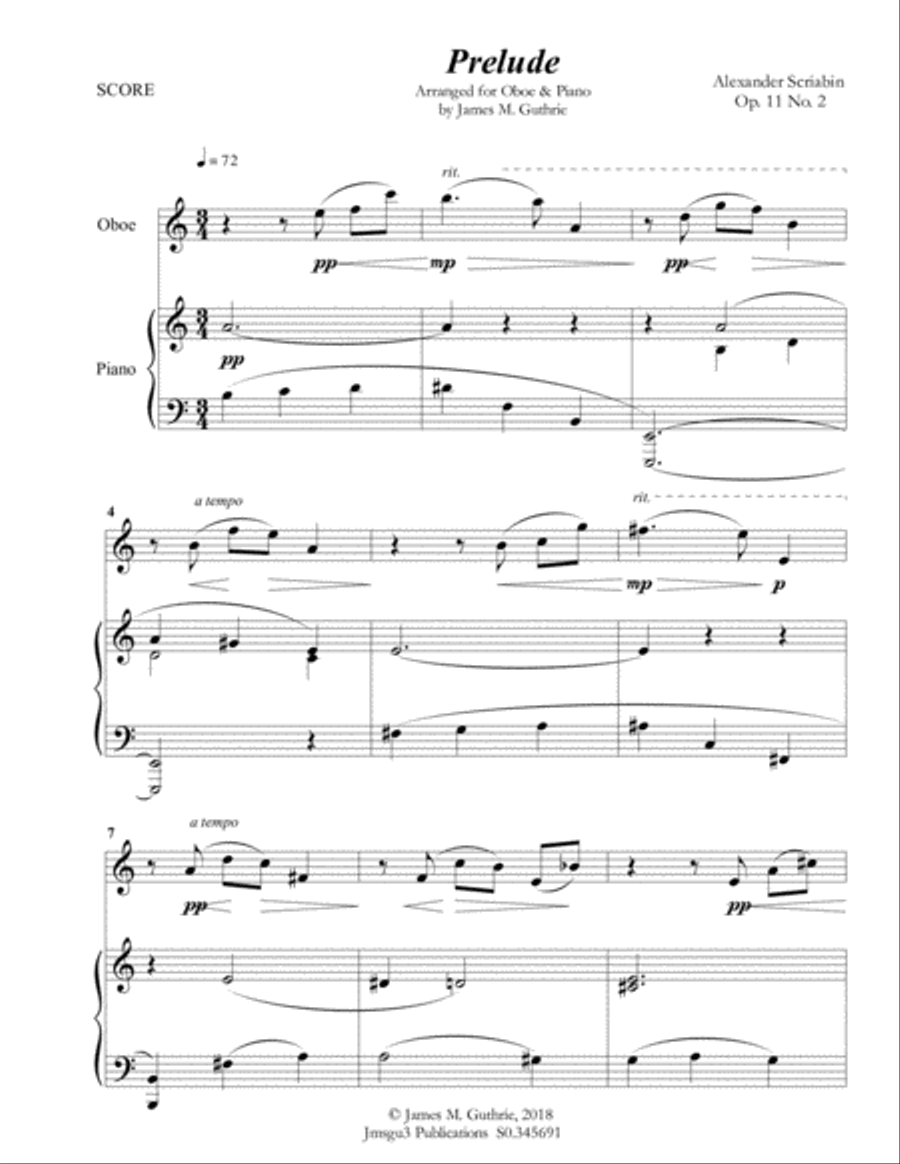
Scriabin: Prelude Op. 11 No. 2 for Oboe & Piano
Hautbois, Piano (duo)

$19.95 17.27 € Hautbois, Piano (duo) PDF SheetMusicPlus

Euphonium,Piano - Level 3 - Digital Download SKU: A0.549480 Composed by Alexander Scriabin. Arranged by James M. Guthrie, ASCAP. Concert,Instructional,Romantic Period,Sacred,Standards. Score and part. 12 pages. Jmsgu3 #3500061. Published by jmsgu3 (A0.549480). Alexander Scriabin Op. 11 No. 2. Score: 8 pages, solo part: 2 pages, piano part: 2 pages. Duration: 3:10. An introspective and meditative work with a lot of dynamic and phrasing nuance. Works well for church meditations or recital encores. Background Op.11/2 Alto Clarinet version. First of all, Scriabin composed mostly for the solo piano and also the orchestra. This is probably because he was a gifted pianist and therefore certainly appreciated the piano. Scriabin grew up in the late Romantic period, consequently, he was fond of the great piano masters of the time. As a result, he wrote his first noteworthy compositions in the manner of Chopin and Liszt. Forms Likewise, Scriabin used many of the same forms as Chopin. These certainly include the étude, prelude, nocturne, and even the mazurka. In contrast, as he developed his own sense of style his music became more and more unusual. So, the last five of his Piano Sonatas do not have a key signature and therefore lean towards atonality. Philosophy Scriabin also developed a keen interest in philosophy and likewise poetry. He was above all particularly fascinated by Nietzsche, Delville, and Blavatsky. Consequently, he finally established his own ideas about metaphysics and certainly mysticism. Scriabin consequently advanced theories about the relationship between color and musical keys. Synesthesia He also may have experienced a condition called synesthesia where he could probably sense a response created from a different stimulus. Therefore, it was almost as if he could see music and hear colors. Scriabin, therefore, arranged the colors in a circle similar to the circle-of-fifths and assigned each key area a color. Finally, he assigned the key of C to the color red, while the key of G was orange. Similarly, he assigned D to yellow, A to green, and so forth. Strangely, he did not differentiate between major and minor key colors.  Multimedia Hence, his ability to translate colors into music certainly gave Scriabin a most noteworthy interest in creating multimedia events. Furthermore, He designed his biggest work, the Mysterium, to last an entire week. Even more, Scriabin made plans not only for music, but also colored lights, incense, and dancing. He designed the performance to occur in the foothills of the Himalaya mountains. The Mysterium was never performed, and only sketches of the work remain. Modern Performances In modern times, we often experience performances of Scriabin’s most famous completed works accompanied by colored laser lights and incense. These are the Poem of Ecstasy (completed in 1908) and the Poem of Fire (completed in 1910). The lighting effects for these early performances were accomplished by the clavier à lumiéres. It was a keyboard instrument that projected colored light onto a screen.
Scriabin: Prelude Op. 11 No. 2 for Euphonium & Piano
Euphonium, Piano (duo)

$19.95 17.27 € Euphonium, Piano (duo) PDF SheetMusicPlus

English Horn,Piano - Level 3 - Digital Download SKU: A0.549472 Composed by Alexander Scriabin. Arranged by James M. Guthrie, ASCAP. Concert,Instructional,Romantic Period,Sacred,Standards. Score and part. 12 pages. Jmsgu3 #3499777. Published by jmsgu3 (A0.549472). Alexander Scriabin Op. 11 No. 2. Score: 8 pages, solo part: 2 pages, piano part: 2 pages. Duration: 3:10. An introspective and meditative work with a lot of dynamic and phrasing nuance. Works well for church meditations or recital encores. Background Op.11/2 Alto Clarinet version. First of all, Scriabin composed mostly for the solo piano and also the orchestra. This is probably because he was a gifted pianist and therefore certainly appreciated the piano. Scriabin grew up in the late Romantic period, consequently, he was fond of the great piano masters of the time. As a result, he wrote his first noteworthy compositions in the manner of Chopin and Liszt. Forms Likewise, Scriabin used many of the same forms as Chopin. These certainly include the étude, prelude, nocturne, and even the mazurka. In contrast, as he developed his own sense of style his music became more and more unusual. So, the last five of his Piano Sonatas do not have a key signature and therefore lean towards atonality. Philosophy Scriabin also developed a keen interest in philosophy and likewise poetry. He was above all particularly fascinated by Nietzsche, Delville, and Blavatsky. Consequently, he finally established his own ideas about metaphysics and certainly mysticism. Scriabin consequently advanced theories about the relationship between color and musical keys. Synesthesia He also may have experienced a condition called synesthesia where he could probably sense a response created from a different stimulus. Therefore, it was almost as if he could see music and hear colors. Scriabin, therefore, arranged the colors in a circle similar to the circle-of-fifths and assigned each key area a color. Finally, he assigned the key of C to the color red, while the key of G was orange. Similarly, he assigned D to yellow, A to green, and so forth. Strangely, he did not differentiate between major and minor key colors.  Multimedia Hence, his ability to translate colors into music certainly gave Scriabin a most noteworthy interest in creating multimedia events. Furthermore, He designed his biggest work, the Mysterium, to last an entire week. Even more, Scriabin made plans not only for music, but also colored lights, incense, and dancing. He designed the performance to occur in the foothills of the Himalaya mountains. The Mysterium was never performed, and only sketches of the work remain. Modern Performances In modern times, we often experience performances of Scriabin’s most famous completed works accompanied by colored laser lights and incense. These are the Poem of Ecstasy (completed in 1908) and the Poem of Fire (completed in 1910). The lighting effects for these early performances were accomplished by the clavier à lumiéres. It was a keyboard instrument that projected colored light onto a screen.

Scriabin: Prelude Op. 11 No. 2 for English Horn & Piano
Cor anglais, Piano

$19.95 17.27 € Cor anglais, Piano PDF SheetMusicPlus


Partitions Gratuites
Acheter des Partitions Musicales
Acheter des Partitions Digitales à Imprimer
Acheter des Instruments de Musique

© 2000 - 2026

Accueil - Version intégrale




