EUROPE
7756 articles
USA
0 articles
DIGITAL
13974 articles (à imprimer)
Partitions Digitales
Partitions à imprimer
13974 partitions trouvées


Flute Duet Flute - Level 1 - Digital Download SKU: A0.1186146 Composed by Christopher Smith, John Newton, and Traditional. Arranged by Josiel Oliveira. Christian,Praise & Worship,Religious,Spiritual. Score. 3 pages. M das Melodias #785801. Published by M das Melodias (A0.1186146). Amazing Grace é uma música cristã que se tornou um hino popular em todo o mundo, e é frequentemente tocada em funerais, serviços religiosos e eventos solenes. A música foi escrita pelo poeta e clérigo anglicano John Newton no século XVIII, originalmente como um hino para o serviço dominical da Igreja da Inglaterra.Sheet Music for Flute Duet.A letra da música fala sobre a graça redentora de Deus e a salvação que Ele oferece a todos, independentemente de suas falhas e pecados. A letra também reflete a própria história de vida de Newton, que anteriormente era um comerciante de escravos, mas depois se converteu ao cristianismo e se tornou um defensor da abolição da escravidão.A melodia da música é baseada em uma antiga melodia escocesa, e é simples e comovente, permitindo que as letras se destaquem. A música é geralmente cantada em um ritmo lento e emocional, com arranjos instrumentais minimalistas que destacam ainda mais a beleza das letras.Amazing Grace é considerada uma das músicas mais conhecidas e amadas da tradição cristã, e já foi gravada por inúmeros artistas em todo o mundo, em uma variedade de estilos musicais diferentes. A música também é um exemplo do poder da música em conectar as pessoas, independentemente de sua fé ou crenças, e em oferecer conforto e esperança em tempos difíceis.
Amazing Grace
2 Flûtes traversières (duo)

$4.99 4.34 € 2 Flûtes traversières (duo) PDF SheetMusicPlus

Violin Duet Violin - Level 1 - Digital Download SKU: A0.1186173 Composed by Christopher Smith, John Newton, and Traditional. Arranged by Josiel Oliveira. Christian,Praise & Worship,Religious,Spiritual. 3 pages. M das Melodias #785828. Published by M das Melodias (A0.1186173). Sheet Music for Violin Duet.Amazing Grace é uma música cristã que se tornou um hino popular em todo o mundo, e é frequentemente tocada em funerais, serviços religiosos e eventos solenes. A música foi escrita pelo poeta e clérigo anglicano John Newton no século XVIII, originalmente como um hino para o serviço dominical da Igreja da Inglaterra.A letra da música fala sobre a graça redentora de Deus e a salvação que Ele oferece a todos, independentemente de suas falhas e pecados. A letra também reflete a própria história de vida de Newton, que anteriormente era um comerciante de escravos, mas depois se converteu ao cristianismo e se tornou um defensor da abolição da escravidão.A melodia da música é baseada em uma antiga melodia escocesa, e é simples e comovente, permitindo que as letras se destaquem. A música é geralmente cantada em um ritmo lento e emocional, com arranjos instrumentais minimalistas que destacam ainda mais a beleza das letras.Amazing Grace é considerada uma das músicas mais conhecidas e amadas da tradição cristã, e já foi gravada por inúmeros artistas em todo o mundo, em uma variedade de estilos musicais diferentes. A música também é um exemplo do poder da música em conectar as pessoas, independentemente de sua fé ou crenças, e em oferecer conforto e esperança em tempos difíceis.
Amazing Grace
2 Violons (duo)

$4.99 4.34 € 2 Violons (duo) PDF SheetMusicPlus

Trombone Solo - Level 1 - Digital Download SKU: A0.1186159 Composed by Christopher Smith, John Newton, and Traditional. Arranged by Josiel Oliveira. Christian,Praise & Worship,Religious,Spiritual. Individual part. 1 pages. M das Melodias #785814. Published by M das Melodias (A0.1186159). Amazing Grace é uma música cristã que se tornou um hino popular em todo o mundo, e é frequentemente tocada em funerais, serviços religiosos e eventos solenes. A música foi escrita pelo poeta e clérigo anglicano John Newton no século XVIII, originalmente como um hino para o serviço dominical da Igreja da Inglaterra.Sheet Music for Trombone.A letra da música fala sobre a graça redentora de Deus e a salvação que Ele oferece a todos, independentemente de suas falhas e pecados. A letra também reflete a própria história de vida de Newton, que anteriormente era um comerciante de escravos, mas depois se converteu ao cristianismo e se tornou um defensor da abolição da escravidão.A melodia da música é baseada em uma antiga melodia escocesa, e é simples e comovente, permitindo que as letras se destaquem. A música é geralmente cantada em um ritmo lento e emocional, com arranjos instrumentais minimalistas que destacam ainda mais a beleza das letras.Amazing Grace é considerada uma das músicas mais conhecidas e amadas da tradição cristã, e já foi gravada por inúmeros artistas em todo o mundo, em uma variedade de estilos musicais diferentes. A música também é um exemplo do poder da música em conectar as pessoas, independentemente de sua fé ou crenças, e em oferecer conforto e esperança em tempos difíceis.
Amazing Grace
Trombone

$4.99 4.34 € Trombone PDF SheetMusicPlus

B-Flat Clarinet Solo - Level 1 - Digital Download SKU: A0.1186145 Composed by Christopher Smith, John Newton, and Traditional. Arranged by Josiel Oliveira. Christian,Praise & Worship,Religious,Spiritual. Individual part. 1 pages. M das Melodias #785800. Published by M das Melodias (A0.1186145). Amazing Grace é uma música cristã que se tornou um hino popular em todo o mundo, e é frequentemente tocada em funerais, serviços religiosos e eventos solenes. A música foi escrita pelo poeta e clérigo anglicano John Newton no século XVIII, originalmente como um hino para o serviço dominical da Igreja da Inglaterra.Sheet Music for Clarinet in Bb.A letra da música fala sobre a graça redentora de Deus e a salvação que Ele oferece a todos, independentemente de suas falhas e pecados. A letra também reflete a própria história de vida de Newton, que anteriormente era um comerciante de escravos, mas depois se converteu ao cristianismo e se tornou um defensor da abolição da escravidão.A melodia da música é baseada em uma antiga melodia escocesa, e é simples e comovente, permitindo que as letras se destaquem. A música é geralmente cantada em um ritmo lento e emocional, com arranjos instrumentais minimalistas que destacam ainda mais a beleza das letras.Amazing Grace é considerada uma das músicas mais conhecidas e amadas da tradição cristã, e já foi gravada por inúmeros artistas em todo o mundo, em uma variedade de estilos musicais diferentes. A música também é um exemplo do poder da música em conectar as pessoas, independentemente de sua fé ou crenças, e em oferecer conforto e esperança em tempos difíceis.
Amazing Grace
Clarinette

$4.99 4.34 € Clarinette PDF SheetMusicPlus

Cello Solo - Level 1 - Digital Download SKU: A0.1186137 Composed by Christopher Smith, John Newton, and Traditional. Arranged by Josiel Oliveira. Christian,Praise & Worship,Religious,Spiritual. Individual part. 1 pages. M das Melodias #785794. Published by M das Melodias (A0.1186137). Amazing Grace é uma música cristã que se tornou um hino popular em todo o mundo, e é frequentemente tocada em funerais, serviços religiosos e eventos solenes. A música foi escrita pelo poeta e clérigo anglicano John Newton no século XVIII, originalmente como um hino para o serviço dominical da Igreja da Inglaterra.Sheet Music for Cello.A letra da música fala sobre a graça redentora de Deus e a salvação que Ele oferece a todos, independentemente de suas falhas e pecados. A letra também reflete a própria história de vida de Newton, que anteriormente era um comerciante de escravos, mas depois se converteu ao cristianismo e se tornou um defensor da abolição da escravidão.A melodia da música é baseada em uma antiga melodia escocesa, e é simples e comovente, permitindo que as letras se destaquem. A música é geralmente cantada em um ritmo lento e emocional, com arranjos instrumentais minimalistas que destacam ainda mais a beleza das letras.Amazing Grace é considerada uma das músicas mais conhecidas e amadas da tradição cristã, e já foi gravada por inúmeros artistas em todo o mundo, em uma variedade de estilos musicais diferentes. A música também é um exemplo do poder da música em conectar as pessoas, independentemente de sua fé ou crenças, e em oferecer conforto e esperança em tempos difíceis.
Amazing Grace
Violoncelle

$4.99 4.34 € Violoncelle PDF SheetMusicPlus

Flute Solo - Level 1 - Digital Download SKU: A0.1186148 Composed by Christopher Smith, John Newton, and Traditional. Arranged by Josiel Oliveira. Christian,Praise & Worship,Religious,Spiritual. Individual part. 1 pages. M das Melodias #785803. Published by M das Melodias (A0.1186148). Amazing Grace é uma música cristã que se tornou um hino popular em todo o mundo, e é frequentemente tocada em funerais, serviços religiosos e eventos solenes. A música foi escrita pelo poeta e clérigo anglicano John Newton no século XVIII, originalmente como um hino para o serviço dominical da Igreja da Inglaterra.Sheet Music for Flute.A letra da música fala sobre a graça redentora de Deus e a salvação que Ele oferece a todos, independentemente de suas falhas e pecados. A letra também reflete a própria história de vida de Newton, que anteriormente era um comerciante de escravos, mas depois se converteu ao cristianismo e se tornou um defensor da abolição da escravidão.A melodia da música é baseada em uma antiga melodia escocesa, e é simples e comovente, permitindo que as letras se destaquem. A música é geralmente cantada em um ritmo lento e emocional, com arranjos instrumentais minimalistas que destacam ainda mais a beleza das letras.Amazing Grace é considerada uma das músicas mais conhecidas e amadas da tradição cristã, e já foi gravada por inúmeros artistas em todo o mundo, em uma variedade de estilos musicais diferentes. A música também é um exemplo do poder da música em conectar as pessoas, independentemente de sua fé ou crenças, e em oferecer conforto e esperança em tempos difíceis.
Amazing Grace
Flûte traversière

$4.99 4.34 € Flûte traversière PDF SheetMusicPlus

Piano Solo - Level 2 - Digital Download SKU: A0.775887 By Ed Sheeran. By Ed Sheeran, Johnny McDaid, Kandi Burruss, Kevin Briggs, Steve Mac, and Tameka Cottle. Arranged by Bernardo Pereira. Hip-Hop,Latin,Multicultural,Pop,R & B,Wedding,World. Score. 5 pages. Bernardo Pereira #383409. Published by Bernardo Pereira (A0.775887). This arrangement of Shape Of You features the main intro with the main rhythmic pattern in both hands (bars 1-4). Later, the left hand keep the rhythmic pattern while the right hand plays the main melody (bar 5 - 68). The chord progression of C♯m–F♯m–A–B is present in the whole song, except for the bridge session. After the chorus, the same structure from the first verse returns on the first ending and go back to second verse on page 2. In the bridge (bars 45-48), a pedal point on the left hand follows the new melody in the right hand. Afterwards, the main chord progression (C♯m–F♯m–A–B) reappears with arpeggios in the first and third beat (bars 49-53). In the final section, the chorus reappears and later the bridge material dialogues with the last fragment of the chorus (bars 54-69). Fingering suggestions and chord symbols are available throughout the arrangement.
Shape Of You
Piano seul
Ed Sheeran
$4.99 4.34 € Piano seul PDF SheetMusicPlus

Piano Solo - Level 1 - Digital Download SKU: A0.860225 By Ed Sheeran. By Ed Sheeran, Johnny McDaid, Kandi Burruss, Kevin Briggs, Steve Mac, and Tameka Cottle. Arranged by Bernardo Pereira. Hip-Hop,Latin,Multicultural,Pop,R & B,Wedding,World. Score. 5 pages. Bernardo Pereira #466718. Published by Bernardo Pereira (A0.860225). This arrangement of Shape Of You is a clean sheet music without chords symbols and fingerings. It features the main intro with the main rhythmic pattern in both hands (bars 1-4). Later, the left hand keep the rhythmic pattern while the right hand plays the main melody (bar 5 - 68). The chord progression of C♯m–F♯m–A–B is present in the whole song, except for the bridge session. After the chorus, the same structure from the first verse returns on the first ending and go back to second verse on page 2. In the bridge (bars 45-48), a pedal point on the left hand follows the new melody in the right hand. Afterwards, the main chord progression (C♯m–F♯m–A–B) reappears with arpeggios in the first and third beat (bars 49-53). In the final section, the chorus reappears and later the bridge material dialogues with the last fragment of the chorus (bars 54-69).
Shape Of You
Piano seul
Ed Sheeran
$4.99 4.34 € Piano seul PDF SheetMusicPlus

Piano,Violin - Level 1 - Digital Download SKU: A0.1367818 By Olivia Rodrigo. By Olivia Rodrigo. Arranged by Josiel Oliveira. Multicultural,Pop,Romantic Period,Singer/Songwriter,World. 7 pages. M das Melodias #952194. Published by M das Melodias (A0.1367818). Sheet music for violin ans piano.A música Happier é a segunda faixa do álbum de estreia de Olivia Rodrigo, Sour. Foi lançada em 21 de maio de 2021 como o segundo single do álbum.A música é uma balada pop sobre a dor de ver o ex-namorado com outra pessoa. A narradora da música está lutando para aceitar que seu ex está feliz com outra pessoa, mesmo que ela ainda o ame.A música começa com a narradora vendo seu ex e sua nova namorada juntos. Ela se sente traída e magoada, e começa a questionar se ele realmente a amou.No refrão, a narradora canta sobre como ela não consegue acreditar que seu ex está feliz com outra pessoa. Ela se pergunta se ele realmente esqueceu dela, e se ela foi apenas uma fase em sua vida.No segundo verso, a narradora relembra os momentos felizes que ela passou com seu ex. Ela se sente triste por saber que eles nunca mais serão os mesmos.No refrão, a narradora canta novamente sobre como ela não consegue acreditar que seu ex está feliz com outra pessoa. Ela se pergunta se ela nunca será capaz de superar ele.A música termina com a narradora aceitando que seu ex está feliz com outra pessoa. Ela ainda o ama, mas sabe que precisa seguir em frente.Happier é uma música poderosa e comovente que fala sobre uma experiência universal. A música é uma ótima representação do processo de superação de um término de relacionamento.A música foi um sucesso comercial, alcançando o número 1 na Billboard Hot 100 dos Estados Unidos. Também foi um sucesso de crítica, sendo elogiada pela sua letra honesta e pela performance vocal de Olivia Rodrigo.
Happier
Violon et Piano
Olivia Rodrigo
$4.99 4.34 € Violon et Piano PDF SheetMusicPlus

Strings - Level 3 - Digital Download SKU: A0.549209 Composed by Gabrieli. Arranged by James M. Guthrie, ASCAP. Renaissance,Standards. 58 pages. Jmsgu3 #3462323. Published by jmsgu3 (A0.549209). Instrumentation: Two string quartets arranged antiphonally. Full Score: 28 pgs. Study Score: 14 pgs. Instrumental parts: 2 pg. ea. Duration: ca. 3:00. Innovations First of all, Gabrieli preferred sacred vocal and certainly instrumental music. Hence, he concentrated on music that consequently took advantage of resonance and likewise reverberation for maximum effect. Seems like Gabrieli may have invented dynamics – or was rather the first to indicate them such as in his Sonata Pian’ e Forte. Consequently, he was also a pioneer in spatial techniques. He therefore developed and used very specific notation to indicate instrumentation. Gabrieli experimented with assembling massive instrumental forces into isolated groups separated by space. In this way, he consequently contributed heavily to the Baroque Concertato style. Polychoral Works Gabrieli probably used the layout of the San Marco church for his experiments. This is because he worked there as a musician and composer. Furthermore, the church had two choir lofts facing each other. He certainly used these to create striking spatial effects between instrumental forces. Certainly, many of his works are composed such that a choir or instrumental group could first be heard on one side, then consequently followed by a response from the group on the other side. Sometimes there was probably a third group positioned near the main altar as well. Spatial Music Above all, Gabrieli studied carefully detailed groups of instruments and singers. Furthermore, it seems like he created precise directions for instrumentation in rather more than two groups. The instruments, because they could be appropriately situated, could consequently be heard with perfect clearness at distant locations. As a result, arrangements which seem bizarre on paper, can in contrast sound perfectly in-balance. First Works Finally, Gabrieli published his first motets along with his uncle Andrea's compositions in Concerti (1587). These compositions furthermore indicate considerable usage of dialogue and echo effects. Consequently, here we see low and high choirs with the variance between their ranges indicated by instrumental accompaniment. Seems like Gabrieli’s later motets Sacrae Symphoniae (1597) move away from close antiphony. In contrast, he moves towards not simply echoing the material, but developing it by sequential choral entrances. Even more, he takes this procedure to the extreme in the Motet Omnes Gentes. Unlike earlier works, here the instruments are certainly an essential part of the presentation. Also, only parts marked: Capella are supposed to be sung. Homophony Hence, after 1605, Gabrieli moves to a much more homophonic style. He writes sections purely for instruments – which calls Sinfonia – and smaller sections for vocal soloists, accompanied by a basso continuo.  www.jamesguthrie.com.
Gabrieli: Canzon Septimi Toni Ch 172 for Double String Quartet

$47.95 41.74 € PDF SheetMusicPlus

Brass Ensemble Bass Trombone,Cornet,Horn - Level 3 - Digital Download SKU: A0.1227832 Composed by Giovanni Gabrieli. Arranged by James M. Guthrie, ASCAP. Chamber,Contest,Early Music,Festival,Historic,Renaissance. 72 pages. Jmsgu3 #823794. Published by jmsgu3 (A0.1227832). Minimum instrumentation: 4 Cornets in Bb, 4 Horns in F, 2 Tenor Trombones, and 2 Bass Trombones.InnovationsGabrieli preferred sacred vocal and, indeed, instrumental music. Hence, he concentrated on music that consequently took advantage of resonance and reverberation for maximum effect. Gabrieli may have invented dynamics – or was the first to indicate them, such as in his Sonata Pian' e Forte. Consequently, he was also a pioneer in spatial techniques. He, therefore, developed and used particular notation to indicate instrumentation. Gabrieli experimented with assembling massive instrumental forces into isolated groups separated by space. In this way, he consequently contributed heavily to the Baroque Concertato style.Polychoral WorksGabrieli probably used the layout of the San Marco church for his experiments. This is because he worked there as a musician and composer. Furthermore, the church had two choir lofts facing each other. He indeed used these to create striking spatial effects between instrumental forces. Indeed, many of his works are composed such that a choir or instrumental group could first be heard on one side, followed by a group response. Sometimes, there was probably a third group near the main altar.Spatial MusicAbove all, Gabrieli studied carefully detailed groups of instruments and singers. Furthermore, it seems like he created precise directions for instrumentation rather than two groups. Because they could be appropriately situated, the instruments could consequently be heard with perfect clearness at distant locations. As a result, arrangements that seem bizarre on paper can, in contrast, sound perfectly in balance.First WorksFinally, Gabrieli published his first motets and his uncle Andrea's compositions in Concerti (1587). Furthermore, these compositions indicate considerable usage of dialogue and echo effects. Consequently, here we see low and high choirs with the variance between their ranges characterized by instrumental accompaniment. Gabrieli's later motets Sacrae Symphoniae (1597) seem to move away from close antiphony. In contrast, he moves towards not simply echoing the material but developing it through sequential choral entrances. Even more, he takes this procedure to the extreme in the Motet Omnes Gentes. Unlike earlier works, here, the instruments are an essential part of the presentation—also, only parts marked Capella are supposed to be sung.HomophonyHence, after 1605, Gabrieli moves to a much more homophonic style. He writes sections purely for instruments – called Sinfonia – and smaller sections for vocal soloists, accompanied by a basso continuo. Above all, Gabrieli studied carefully detailed groups of instruments and singers. Furthermore, it seems like he created precise directions for instrumentation rather than two groups. Because they could be appropriately situated, the instruments could consequently be heard with perfect clearness at distant locations. As a result, arrangements that seem bizarre on paper can, in contrast, sound perfectly in balance.
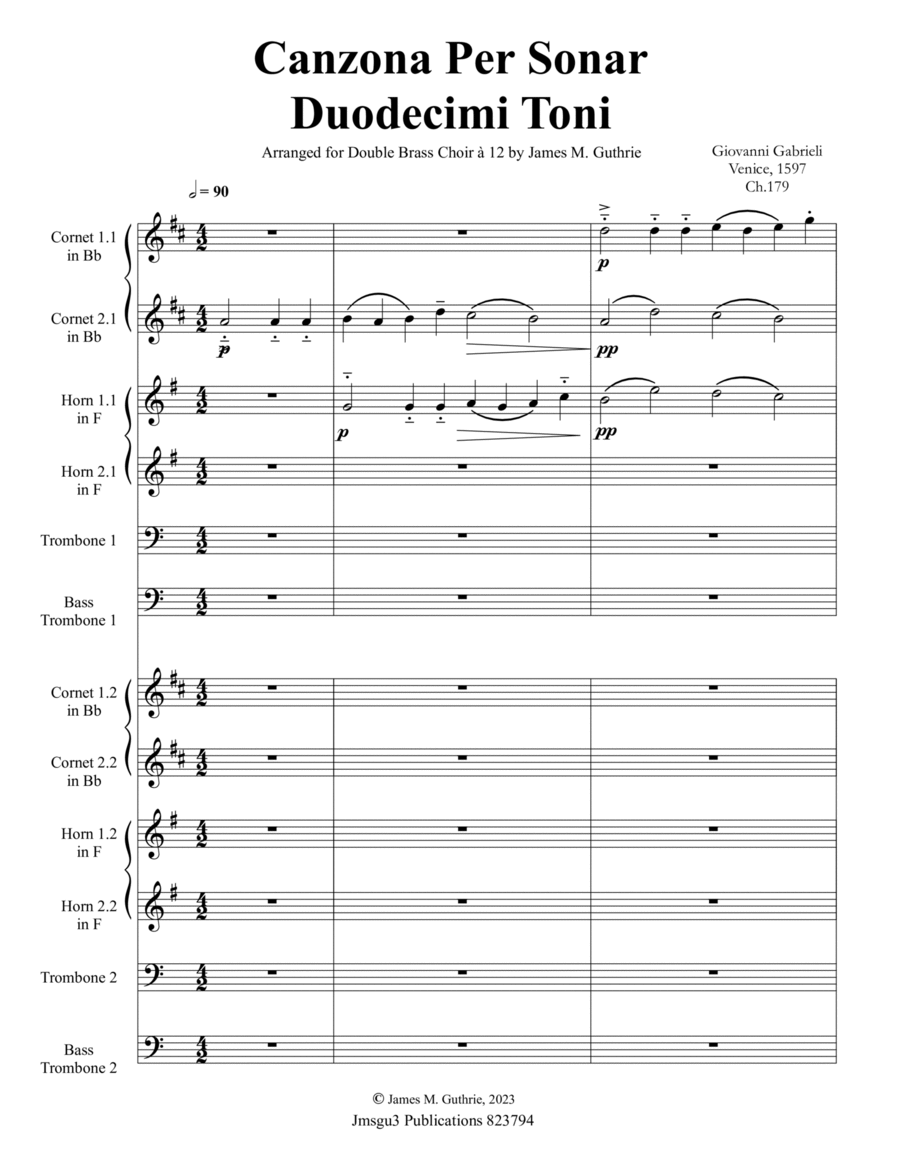
Gabrieli: Canzon per Sonar Ch. 179 for Double Brass Choir à 12

$47.95 41.74 € PDF SheetMusicPlus

Brass Ensemble Cornet,Horn,Trombone - Level 3 - Digital Download SKU: A0.1227819 Composed by Giovanni Gabrieli. Arranged by James M. Guthrie. Chamber,Contest,Early Music,Festival,Renaissance,Traditional. Score and Parts. 44 pages. Jmsgu3 #823781. Published by jmsgu3 (A0.1227819). Minimum instrumentation: 4 cornets in Bb, 4 French Horms in F, 2 Trombones. See also arrangement à 12 which includes 2 Bass Trombones.InnovationsGabrieli preferred sacred vocal and certainly instrumental music. Hence, he concentrated on music that consequently took advantage of resonance and likewise reverberation for maximum effect. Seems like Gabrieli may have invented dynamics – or was rather the first to indicate them such as in his Sonata Pian’ e Forte. Consequently, he was also a pioneer in spatial techniques. He therefore developed and used very specific notation to indicate instrumentation. Gabrieli experimented with assembling massive instrumental forces into isolated groups separated by space. In this way, he consequently contributed heavily to the Baroque Concertato style.Polychoral WorksGabrieli probably used the layout of the San Marco church for his experiments. This is because he worked there as a musician and composer. Furthermore, the church had two choir lofts facing each other. He certainly used these to create striking spatial effects between instrumental forces. Certainly, many of his works are composed such that a choir or instrumental group could first be heard on one side, then consequently followed by a response from the group on the other side. Sometimes there was probably a third group positioned near the main altar as well.Spatial MusicAbove all, Gabrieli studied carefully detailed groups of instruments and singers. Furthermore, it seems like he created precise directions for instrumentation rather than two groups. The instruments, because they could be appropriately situated, could consequently be heard with perfect clearness at distant locations. As a result, arrangements that seem bizarre on paper, can in contrast sound perfectly in balance.First WorksFinally, Gabrieli published his first motets along with his uncle Andrea's compositions in Concerti (1587). These compositions furthermore indicate considerable usage of dialogue and echo effects. Consequently, here we see low and high choirs with the variance between their ranges indicated by instrumental accompaniment. Seems like Gabrieli’s later motets Sacrae Symphoniae (1597) move away from close antiphony. In contrast, he moves towards not simply echoing the material but developing it through sequential choral entrances. Even more, he takes this procedure to the extreme in the Motet Omnes Gentes. Unlike earlier works, here the instruments are certainly an essential part of the presentation. Also, only parts marked: Capella are supposed to be sung.HomophonyHence, after 1605, Gabrieli moves to a much more homophonic style. He writes sections purely for instruments – which calls Sinfonia – and smaller sections for vocal soloists, accompanied by a basso continuo.
Gabrieli: Canzon per Sonar Ch 179 for Double Brass Choir à 10

$47.95 41.74 € PDF SheetMusicPlus

Woodwind Ensemble Flute - Level 3 - Digital Download SKU: A0.549210 Composed by Gabrieli. Arranged by James M. Guthrie, ASCAP. Renaissance,Standards. 59 pages. Jmsgu3 #3464701. Published by jmsgu3 (A0.549210). A musical monument: the first composition to employ dynamics. Instrumentation: 1 piccolo, 5 concert flutes, 1 alto flute, 1 bass flute 1 cello. Arranged in two antiphonal choirs. Full Score: 27 pg. 81 ms 4/2, Study Score: 14 pg., Instrumental parts: 2 pg. Duration: 3:45 at half-note = 86. Innovations First of all, Gabrieli preferred sacred vocal and certainly instrumental music. Hence, he concentrated on music that consequently took advantage of resonance and likewise reverberation for maximum effect. Seems like Gabrieli may have invented dynamics – or was rather the first to indicate them such as in his Sonata Pian’ e Forte. Consequently, he was also a pioneer in spatial techniques. He therefore developed and used very specific notation to indicate instrumentation. Gabrieli experimented with assembling massive instrumental forces into isolated groups separated by space. In this way, he consequently contributed heavily to the Baroque Concertato style. Polychoral Works Gabrieli probably used the layout of the San Marco church for his experiments. This is because he worked there as a musician and composer. Furthermore, the church had two choir lofts facing each other. He certainly used these to create striking spatial effects between instrumental forces. Certainly, many of his works are composed such that a choir or instrumental group could first be heard on one side, then consequently followed by a response from the group on the other side. Sometimes there was probably a third group positioned near the main altar as well. Spatial Music Above all, Gabrieli studied carefully detailed groups of instruments and singers. Furthermore, it seems like he created precise directions for instrumentation in rather than two groups. The instruments, because they could be appropriately situated, could consequently be heard with perfect clearness at distant locations. As a result, arrangements that seem bizarre on paper, can in contrast sound perfectly in balance. First Works Finally, Gabrieli published his first motets along with his uncle Andrea's compositions in Concerti (1587). These compositions furthermore indicate considerable usage of dialogue and echo effects. Consequently, here we see low and high choirs with the variance between their ranges indicated by instrumental accompaniment. Seems like Gabrieli’s later motets Sacrae Symphoniae (1597) move away from close antiphony. In contrast, he moves towards not simply echoing the material, but developing it through sequential choral entrances. Even more, he takes this procedure to the extreme in the Motet Omnes Gentes. Unlike earlier works, here the instruments are certainly an essential part of the presentation. Also, only parts marked: Capella are supposed to be sung. Homophony Hence, after 1605, Gabrieli moves to a much more homophonic style. He writes sections purely for instruments – which calls Sinfonia – and smaller sections for vocal soloists, accompanied by a basso continuo.
Gabrieli: Sonata Pian e Forte Ch. 175 for Flute Choir
Ensemble de Flûtes

$47.95 41.74 € Ensemble de Flûtes PDF SheetMusicPlus


Partitions Gratuites
Acheter des Partitions Musicales
Acheter des Partitions Digitales à Imprimer
Acheter des Instruments de Musique

© 2000 - 2026

Accueil - Version intégrale





