EUROPE
7756 articles
USA
0 articles
DIGITAL
13975 articles (à imprimer)
Partitions Digitales
Partitions à imprimer
13975 partitions trouvées


Chorus - Digital Download SKU: AX.00-PO-0003191 O Hear the Joyful Singing - TBB, a cappella. Composed by Giovanni Giacomo Gastoldi. Arranged by Patrick M. Liebergen. Secular Choral. 7 pages. Alfred Music - Digital Sheet Music #00-PO-0003191. Published by Alfred Music - Digital Sheet Music (AX.00-PO-0003191). UPC: 038081487335.Perform this buoyant Italian madrigal a cappella or accompanied by the optional piano, hand drum, and finger cymbals. The Baroque harmonies are easy to read and tune, and the 3-part mixed/SAB voicing includes several alternate notes to accommodate the vocal ranges of young men. May be sung in English, Italian, or a combination of both.A cappella; Inst. Parts Available (choral).
O Hear the Joyful Singing
Chorale 3 parties

$1.90 1.65 € Chorale 3 parties PDF SheetMusicPlus

Piano Quintet,String Ensemble Piano - Level 3 - Digital Download SKU: A0.552018 Composed by George Friderick Handel (1685-1756). Arranged by James M. Guthrie. Baroque,Instructional,Standards,Wedding. Score and parts. 43 pages. Jmsgu3 #6053173. Published by jmsgu3 (A0.552018). Seven popular pieces from Handel's Water Music - most often requested for weddings. Score: 16 pages, Duration 12:15. Players may read from the score, or from the included instrumental parts.Contents: 1. Air2. Minuet3. Bourrée4. Hornpipe5. Rigaudon6. Minuet7. AndanteHandel's Water Music is one of his most famous compositions. It was written for King George I's pleasure barge trip along the River Thames in 1717. The Water Music is divided into three suites, each containing a variety of movements. The music features a mix of dance rhythms such as minuets, bourrees, and hornpipes, along with lively fanfares and slower, more stately airs. Its combination of light and playful music with grandeur and pomp has made it one of the most beloved pieces of classical music. Water Music has been performed by many orchestras and is a popular choice for special occasions, such as coronations and weddings. Its enduring popularity has helped to make it one of Handel's most famous and beloved compositions.Weddings during the time of Handel were usually quite extravagant affairs. The ceremony was typically held in a church and was accompanied by a full orchestra. Handel's own compositions were frequently used to provide the music for the ceremony. This was especially true in London, where Handel was based and where his music was extremely popular. Handel wrote a number of pieces specifically for use at weddings, including the popular Wedding Anthem and the Wedding Anthem in D Major. Handel's music provided a sense of grandeur and elegance to the proceedings and was often used to give the wedding an extra special touch.The festivities following the ceremony were also often quite lavish, with a large feast and plenty of dancing. Handel's music was often used to provide the background music for the dancing, and he wrote many dance suites that were specifically designed for this purpose. The bride and groom would often have a special dance to the music of Handel's Water Music, a particularly popular piece for the occasion. Guests at the wedding would be treated to a variety of Handel's works, ranging from his operas to his oratorios, which often had a spiritual or religious theme. Handel's music provided a sense of joy and celebration to the wedding and helped make it an occasion to remember.
Handel: Seven Pieces from Water Music for Piano Quintet

$38.95 33.87 € PDF SheetMusicPlus

Clarinet Duet Clarinet - Level 3 - Digital Download SKU: A0.552347 Composed by Georg Philipp Telemann 1681-1767. Arranged by James M. Guthrie. Baroque,Instructional,Standards,Wedding. 2 scores. 21 pages. Jmsgu3 #6329817. Published by jmsgu3 (A0.552347). I. Dolce II. Allegro III. Largo IV. VivaceGeorg Philipp Telemann's Sonatas Op. 2, also known as the Six Sonatas for two flutes (or violins), are significant for several reasons. First, they are dedicated to two young music lovers, explicitly appealing to a circle of pupils and music enthusiasts. The pieces foster the ability of musical expression and are characterized by a combination of expansive baroque thematic material and charming galant features in the slow and fast movements, respectively. Telemann was considered one of the leading German composers of his time, and his works, including the Sonatas Op. 2, reflect his significant contribution to the Baroque music era. The Methodical nature of these sonatas, as described when they were published in 1732, is also noteworthy, as they included a second, ornamented version of the simple melodies, showcasing Telemann's innovative approach to composition.  Furthermore, Telemann's music, which incorporates French, Italian, and German national styles, remained highly regarded by colleagues and critics alike during his lifetime and the latter half of the 18th century. Numerous theorists and prominent composers cited his works as models, and he influenced pupils of J.S. Bach in Leipzig, such as Wilhelm Friedemann Bach. Therefore, Telemann's Sonatas Op. 2 contributed to the expansion of domestic music-making and influenced other composers and musicians of his time and beyond.
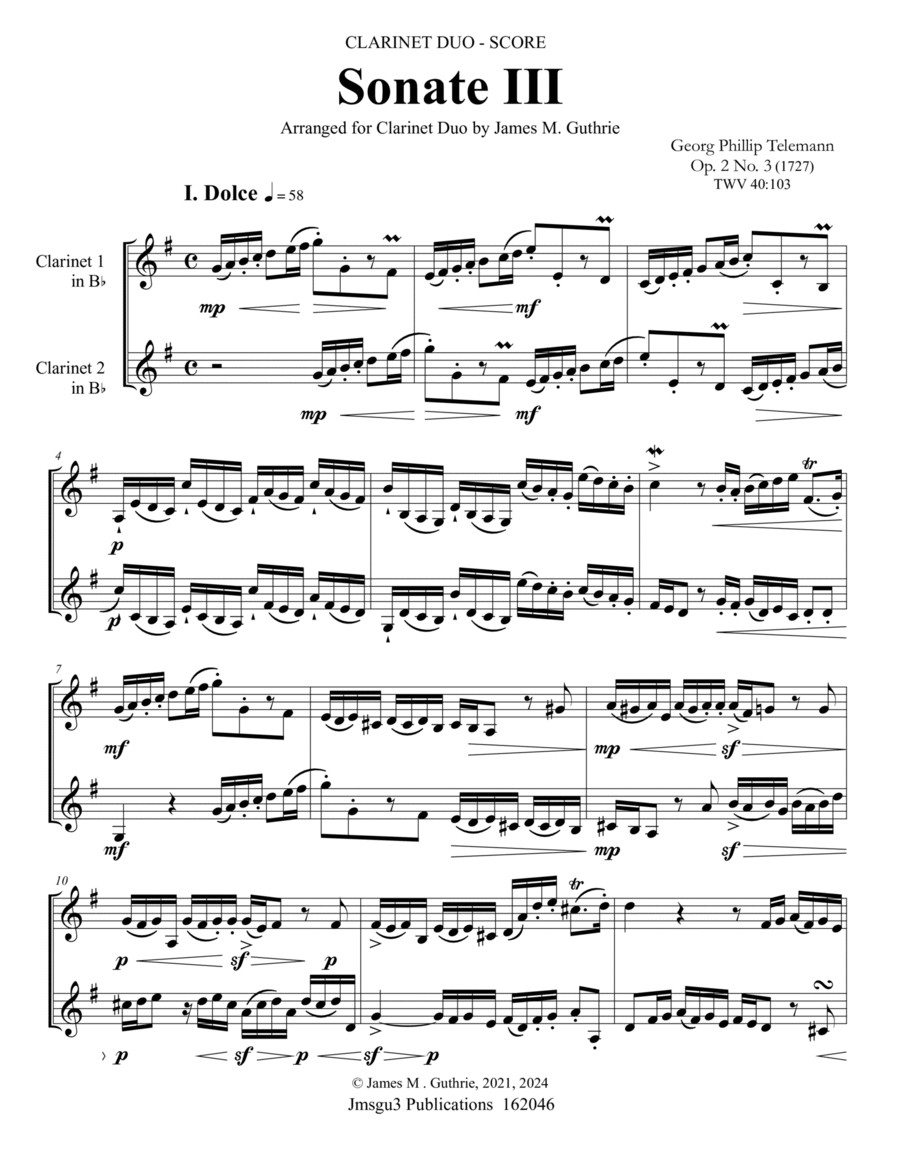
Telemann: Sonata Op. 2 No. 3 for Clarinet Duo
2 Clarinettes (duo)

$32.95 28.65 € 2 Clarinettes (duo) PDF SheetMusicPlus

Cello,Flute,Instrumental Duet - Level 2 - Digital Download SKU: A0.1281496 Composed by Wolfgang Amadeus Mozart. Arranged by Eric Lamb and Martin Rummel. Classical. 23 pages. Paladino Editions #872832. Published by Paladino Editions (A0.1281496). This edition is a welcome addition to the small repertoire for flute and violoncello duo combination. Combining famous tunes from Mozart’s Magic Flute with some of his earlier keyboard pieces, this is perfect repertoire to entertain concert audiences and friends in your living room alike. All works of this edition can be heard on a recording of Eric Lamb and Martin Rummel (paladino music pmr 0050).Content: From Die Zauberflöte, K 620: “Der Vogelfänger bin ich jaâ€, Das klinget so herrlich, Ein Mädchen oder Weibchen, Wie stark ist nicht dein Zauberton Allegro, K 1b K 15a (from “London Sketchbookâ€, K 109b) Menuet, K 1 (1e) Menuet, K 2 Allegro, K 3 Andante, K 616 Menuet (from violin sonata No. 2, K 7) Rondo, K 15hh (No. 33 from “London Sketchbookâ€, K 109b) Klavierstück, K 33b
Mozart (re)inventions - Arrangements for Flute and Violoncello
Flûte, Violoncelle

$19.95 17.35 € Flûte, Violoncelle PDF SheetMusicPlus

A Clarinet Solo,B-Flat Clarinet Solo - Digital Download SKU: A0.1309185 Composed by Jason Alder. 20th Century,21st Century,Instructional. Individual part. 18 pages. AMA Editions #898359. Published by AMA Editions (A0.1309185). This is the newly updated 3rd Edition of the most comprehensive fingering chart for clarinet. The 2nd Edition became widely popular and used by clarinetists around the world, and this new 3rd Edition adds 127 fingerings for a total offering of over 300 fingerings through four and a half octaves in quarter-tones for clarinet, from written E3 to A7.Author's Notes:Ten years have passed since releasing the 2nd Edition of my Bass Clarinet Quarter-Tone Fingering Charts, which coincided with the first release of a chart for soprano clarinet. I’m now already on the 3rd Edition of both the clarinet and bass clarinet charts, which are being released simultaneously, following the recent release of a compilation of three separate charts for Leblanc, Selmer, and Eppelsheim contrabass clarinets.The first obvious change in the 3rd Edition is to the title. I have added Altissimo to better reflect that these charts are not only useful for their quarter-tones, but also for their stratospheric range. The charts have also had a formatting revision and are now being published through AMA Editions, available in print as well as digital forms.The next big change is the addition of 127 quarter-tone and altissimo fingerings, and some corrections and revisions to the existing ones. With these revisions come some new notations of the diagrams. One of these is the use of grey-colored keys, first used in the contrabass clarinet charts, to indicate keys which may be added to help tuning, response, and/or resonance. Rather than creating a new diagram for every possible combination, I thought it would be more effective to show the fundamental fingering in black, with the grey keys as possible additions dependent on what works best for a player and their instrument.
Clarinet Quarter-Tone & Altissimo Fingering Chart
Clarinette

$9.00 7.83 € Clarinette PDF SheetMusicPlus


Partitions Gratuites
Acheter des Partitions Musicales
Acheter des Partitions Digitales à Imprimer
Acheter des Instruments de Musique

© 2000 - 2026

Accueil - Version intégrale





