EUROPE
7756 articles
USA
0 articles
DIGITAL
13974 articles (à imprimer)
Partitions Digitales
Partitions à imprimer
13974 partitions trouvées


Woodwind Ensemble,Woodwind Quartet Alto Saxophone,Baritone Saxophone,Soprano Saxophone,Tenor Saxophone - Level 5 - Digital Download SKU: A0.891915 Composed by Johann Sebastian Bach. Arranged by Stephen Davies. Baroque. 49 pages. Stephen Davies #3480611. Published by Stephen Davies (A0.891915). The final composition of J.S.Bach is surprisingly triumphant, despite his demise just after bar 239. It's also a matter of scholarly conjecture that Bach wrote 'The Art of Fugue' for the keyboard, as some will argue that certain Contrapunctii (?!) are almost impossible to play, bearing in mind that the sustain pedal had yet to be invented. And thus, the most credible path would be that Bach wrote them as A) Academic exercises for study or B) To be played by a suitable ensemble. I'm going with the latter obviously! I include Donald Tovey's conclusion to the work, its brilliance is noted the world over, but surely not what Bach intended, but damn close! This Saxophone version is particularly LOUD!!, so, go make some noise!!
'Contrapunctus 19' By J.S.Bach BWV 1080 from 'The Art of the Fugue' for Saxophone Quartet.
Quatuor de Saxophones: 4 saxophones

$14.99 13.03 € Quatuor de Saxophones: 4 saxophones PDF SheetMusicPlus

Full Orchestra - Level 3 - Digital Download SKU: A0.1335304 Composed by Robin M. Butler. 20th Century,Classical,Film/TV,Romantic Period,Traditional. 22 pages. Robin Butler #921134. Published by Robin Butler (A0.1335304). Adagio A Silent Tear is a somber piece I wrote to capture the emotions and struggle felt through the loss of those closest to us. The use of sentimental melodies accompanied with emerging harmonies was inspired by music of the early 20th century, with orchestration inspired by a variety of composers from Tchaikovsky to Samuel Barber. I wrote the piece in ternary form to tell a sort of story, one of tears, struggle, and sorrow. However, at the end, struggle falls away as hope breaks through, imagined in the piece through the final climax.It was premired by the UMSL Symphony Orchestra in the fall of 2018.
Adagio "A Silent Tear" for Intermediate Orchestra
Orchestre

$29.99 26.08 € Orchestre PDF SheetMusicPlus

Clarinet Quartet,Woodwind Ensemble Bass Clarinet,E-Flat Clarinet - Level 4 - Digital Download SKU: A0.1435859 Composed by Johann Sebastian Bach. Arranged by James M. Guthrie. Baroque,Chamber,Contest,Festival,Historic,Standards. 75 pages. Jmsgu3 #1015958. Published by jmsgu3 (A0.1435859). BACH: Partita No. 2 BWV 826 Contents: Sinfonia, Allemande, Courante, Sarabande, Rondeau, Capriccio. Bach's Partita No. 2 in C minor, BWV 826, is an essential work for several reasons: Significance in Bach's Oeuvre It is part of Bach's monumental collection of six partitas (suites) for the keyboard, considered among music history's most famous and challenging suites. The partitas were published as Bach's Opus 1 in 1731, showcasing the diversity of forms and ingenious counterpoint in his keyboard writing. Partita No. 2 was one of the earliest partitas to be published individually in 1727, highlighting its significance. Musical Characteristics It opens with a grand Sinfonia movement akin to a French overture, followed by an expressive Andante aria-like movement. The fugue movement has an intense subject spanning a minor 9th interval. It includes a double (ornamented variation) of the traditional Sarabande dance movement. The final Capriccio movement is a virtuosic and contrapuntal concerto-like piece testing the performer's technical prowess. Overall, the partita exhibits a weighty, substantial, and momentous character compared to the first. Influence and Legacy It expanded keyboard suites' technical and musical boundaries and other partitas. Due to its artistic merit and challenges, it has remained a pinnacle of the keyboard repertoire, studied and performed by generations of musicians. In summary, Bach's Partita No. 2 is a significant work that exemplifies the composer's mastery of counterpoint, variation forms, and virtuosic keyboard writing, solidifying the partitas' enduring importance in the canon of Western classical music.
Bach: Partita No. 2 BWV 826 for Clarinet Quartet
Quatuor de Clarinettes: 4 clarinettes

$42.95 37.35 € Quatuor de Clarinettes: 4 clarinettes PDF SheetMusicPlus

Choral Choir (SATB) - Level 3 - Digital Download SKU: A0.864441 Composed by Mark D. Templeton. 20th Century,Contemporary. Octavo. 12 pages. Mark Templeton Choral Music #2343381. Published by Mark Templeton Choral Music (A0.864441). Lesbia mi dicit semper male, commonly known as Catullus 92, consists of two elegiac couplets written by Gaius Valerius Catullus (84-54 B.C.E) for his lover, Lesbia. Lesbia was the name believed to have been given by Catullus to his mistress. Her real name was Clodia, the sexually promiscuous wife of proconsul Quintus Caecilius Metellus Celer, known as Metellus. Catullus’ earlier poem, 83, brings some context to 92. In the first part of 83, Catullus says: Lesbia keeps insulting me in front of her husband:this fills the fatuous idiot with delight. Mule, do you perceive nothing? If she shut up and ignored me that’d show healthy indifference;… In 92, Catullus expounds on the idea of why Clodia insults him in front of Metellus. Catullus reckons that he is always cursing her, and he loves her. She always curses him, so she must love him as well. In his desperation, Catullus uses his wit and humor to reason that his obsessive love for Coldia is reciprocated. This setting of 92 uses incessant driving rhythms in the women’s voices to paint the words, Lesbia mi dicit semper male nec tacet umquam de me (Lesbia always speaks ill of me, never shuts up about me). The repeating rhythms return in the men’s voices when Catullus says he does the same, quia sunt totidem mea: deprecor illam assidue (…it’s the same with me: I’m continually complaining.) The piece comes to a final rest after Catullus realizes the he will always be cursed to love her.
Lesbia mi dicit semper male
Chorale SATB

$2.00 1.74 € Chorale SATB PDF SheetMusicPlus

Tenor voice solo, SATB choir unaccompanied - Moderately Difficult - Digital Download SKU: MQ.8322-E Composed by David Conte. Advanced/Collegiate. Secular, 21st Century, Americana, Children, Creation/Nature, Hope/Assurance. Instrument part. 15 pages. Duration 5 minutes, 42 seconds. E. C. Schirmer Music Company - Digital #8322-E. Published by E. C. Schirmer Music Company - Digital (MQ.8322-E). UPC: 600313483226. English. The three a cappella choral pieces that comprise “A Whitman Triptych†were composed between 2012 and 2014. O Setting Sun was commissioned by the Madison Chamber Choir, Madison, Wisconsin, Anthony Cao, conductor, and was premiered on April 20th, 2012. “What is the Grass†was composed for Cappella SF, Ragnar Bohlin, conductor, and is being premiered on tonight’s concert. Facing West was commissioned in celebration of the 75th anniversary of the Golden Gate Bridge by the International Orange Chorale, Zane Fiala, conductor, and was premiered on May 27th, 2012. I first set Whitman to music in 1986,when I adapted part of “When Lilacs Last in the Dooryard Bloomed†as the basis for my composition “Invocation and Dance.†I went on to set “Good-Bye, My Fancy†for Male Chorus and Soprano Saxophone in 1992, and “Song of the Open Road†for Mixed Chorus and Piano in 2004. Like so many composers, I have found the visionary quality of Whitman’s verse inspiring; the vigor and intensity of the poetry seem naturally to draw out music. “What is the Grass?†is also an adaptation of a much longer poem, one of Whitman’s deepest, and most mysterious. The poem begins as a child-like meditation on grass; as hope, as an embodiment of new life and new growth in the plant world. Then suddenly there is a somber turn with the line “And now it seems to me the beautiful uncut hair of graves.†Here Whitman enters an extended mediation on how grass connects life and death, informed by his experiences in the Civil War. Hope returns with the line: “They are alive and well somewhere,†leading to the mysterious final line: “And to die is different from what anyone supposed, and luckier…†Here Whitman affirms that death can be an initiation into a broader participation of existence. In the words of poet Ivan M. Granger, Whitman offers a “Zen-like riddle that doesn’t offer an answer so much as a pathway of questioning.†My musical setting follows Whitman’s exploration, first taking a child’s point of view, expressed with lilting melodies set in a lively compound meter. The entry of the tenor soloist indicates a change of mood to the serious. The first mood returns, leading to a climax on the words “And led forward life…â€, set in 9-part harmony. The mood turns reverent, as the tenor soloist intones: “All goes onward and outward; nothing collapses.†The piece ends with a tone of gentle, slightly ironic questioning. -David ConteDuration: 5:42
A Whitman Triptych: II. What Is the Grass? (Downloadable)

$2.85 2.48 € PDF SheetMusicPlus

Instrumental Solo,Viola - Level 1 - Interactive Download SKU: A0.1403991 By Traditional. Arranged by Emma Dansak. This edition: Interactive Download. Folk. Individual part. 1 pages. Duration 48. Mockingbird Violin #45BaXgUHOnDG9eB8Bk11ay. Published by Mockingbird Violin (A0.1403991). Key: G major.Simple viola transcription with generous fingering. A few notes. First, this version is in A minor. I chose this key because it sits well on the viola. But this tune is traditionally in E minor - so this version won't work if you bring it to the local Irish session. Secondly, I made the decision not to include first and second endings, where the only change is the length of the final note because the beginning of the A section has a pickup. I'm only 62% sure of this... but, I mean, it's pretty much implied, isn't it? It looks so fussy and confusing if you don't read music regularly, and this version is not geared at strong readers. The purpose of this edition is more to support by-ear learners anyway.
Swallowtail Jig
Alto seul
Traditional Arranged by Emma Dansak
$2.99 2.6 € Alto seul PDF SheetMusicPlus

Brass Ensemble Horn,Trombone,Trumpet,Tuba - Level 5 - Digital Download SKU: A0.828055 Composed by Georges Bizet. Arranged by John van Gulik. Opera. Score and parts. 63 pages. John van Gulik #6366281. Published by John van Gulik (A0.828055). This brass quintet arrangement of music from the opera Carmen by Georges Bizet is organized in 3 sections. The first section is the March of the Torreadors. Following this is the beautiful solo for trombone of the Flower Song (La fleur que tu m’avais jetée). The final section concludes with the classic tune always associated with Carmen, Habanera, a real workout for the tuba player. For additional parts and other arrangements, contact me at vangulik.john@gmail.com or visit my website at https://jvgmusiconline.com Included parts Part I - Trumpet in Bb Part I - Trumpet in C Part II - Trumpet in Bb Part II - Trumpet in C Part III - Horn in F Part III - Tenor Horn in Eb Part IV - Trombone Part IV - Trombone (TC) Part V - Tuba Part V - Bass in Bb Part V - Bass in Eb
Excerpts from Carmen - for Brass Quintet
Quatuor de Cuivres : 2 trompettes, trombone, tuba

$10.00 8.7 € Quatuor de Cuivres : 2 trompettes, trombone, tuba PDF SheetMusicPlus

French Horn,Piano - Level 3 - Digital Download SKU: A0.548657 Composed by James Pierpont. Arranged by James M. Guthrie, ASCAP. Christmas. Score and part. 8 pages. Jmsgu3 #3408217. Published by jmsgu3 (A0.548657). Jingle Bells arranged for French Horn& Piano featuring a surprise final verse harmonization. Jingle Bells is perhaps the most famous songs in American music history. James L. Pierpont published the song as One Horse Open Sleigh in the late 1850’s. Since its introduction, people began to insist that Pierpont wrote it for a Sunday school choir. However, it seems unlikely that such a secular song would be considered appropriate during that historical period for Sunday school.Christmas Repertoire Pierpont wrote the song for the Thanksgiving holidays, but over time people began to think of it more as a Christmas song. Some choirs adopted it as part of their Christmas repertoire in the 1860s and 1870s. Jingle Bells was first recorded in 1889 on a wax cylinder. Origins No one knows where Pierpont composed the song. One theory suggests he wrote it in Medford Massachusetts in 1850. Sleigh races were certainly popular in 19th Century Massachusetts. To this day, a commemorative placard appears in Medford square claiming that it is the birthplace of Jingle Bells. Others suggest that he wrote it in Savannah, Georgia where he was an organist and music director at the Unitarian Church. This theory gains support from the copyright date of 1857. We know he was living in Savannah by then. Traffic Signals Horse-drawn sleighs are relatively quiet in the snow. Consequently, horses were usually equipped with bell-laden straps so as to avoid accidents at blind intersections. Sleigh drivers in 19th Century New England were constantly vigilant, listening for the sounds of approaching horse-drawn sleighs. The tune imitates the rhythm that the trotting horse bells produce. Social Context Jingle Bells was sung as a drinking song at local revelries: during the song folks would rhythmically jangle the ice in their glasses. A sleigh ride gave couples an opportunity to be alone together. The term Jingle bells is a poetic descriptive adjective referring specifically to the more accurate term sleigh bells. In many arrangements, sleigh bells are used to accentuate the rhythm during the song chorus. Register for free lifetime updates and revisions at www.jamesguthrie.com
Jingle Bells for French Horn & Piano
Cor et Piano

$24.95 21.7 € Cor et Piano PDF SheetMusicPlus

Piano Quartet - Level 1 - Digital Download SKU: A0.548636 Composed by Mueller. Arranged by James M. Guthrie, ASCAP. Christmas. 7 pages. Jmsgu3 #3405937. Published by jmsgu3 (A0.548636). Arranged with a re-harmonized final verse. Away in a Manger is a popular Christmas song published in the late 19th century and performed worldwide. In England, it is considered one of the two most popular carols of all time; a 1996 poll ranked it as a tie for second place. To begin with, many thought Martin Luther wrote it, but now the song is considered to be American. The most common musical arrangements are by William Kirkpatrick (1895) and James R. Murray (1887). The melody was first published as Luther's Cradle Hymn by James R. Murray. Then came a confusing series of explanations about how Martin Luther wrote the song. Murray even went so far as to suggest that Luther wrote it for his children. As a result, the song has become known as “Mueller.†Nobody knows who this “Mueller†is, but the name stuck. PopularityBy the 1880’s the cradle song was being performed in church. By the 1990’s the song was becoming the most popular Christmas song ever. Nearly everyone sang it in school, in church, and at home.Other musical settingsThe first musical setting published with the lyrics appeared in the Little Children's Book for Schools and Families (1885). The title was Away in a Manger. This edition is the first one not attributing the song to Martin Luther. Charles H. Gabriel was the first arranger to present the third verse. He also composed and published many different arrangements of the song. In one of his settings, he supplies a chorus for each verse with asleep sung in canon. Another prevalent preparation uses the lyrics to the melody Flow Gently, Sweet Afton. Yet another arrangement dating uses the lyrics to an old Normandy Carol.
Away In A Manger for Piano Quartet
Piano Quatuor: piano, violon, alto, violoncelle
the 1880’s the cradle song was being performed in church
$24.95 21.7 € Piano Quatuor: piano, violon, alto, violoncelle PDF SheetMusicPlus

Choral Choir (SATB) - Level 4 - Digital Download SKU: A0.1271766 Composed by Rudesindo Soutelo. Arranged by Choir & Piano. 20th Century,A Cappella,Classical,Contemporary. Octavo. 30 pages. Publisher by Rudesindo Soutelo #864117. Published by Publisher by Rudesindo Soutelo (A0.1271766). À memoria da actriz Cruz ComesanhaLábios de sabor a mar (Derradeira epístola) / Sea flavour lips (Last epistle) for Choir and Piano [ca. 7' 34]Première: 27-V-2023. Igreja de Santo António, Lisboa. Int.: Coro da Academia Nacional Superior de Orquestra (ANSO). Dir: Rafael Araújo.The origin of this work is the emotional emptiness I felt when I received the news of the death of a close friend in an unfortunate accident at home. The text was constructed with ideas and phrases taken from the poetic correspondence we had exchanged in the previous months. A few years later, I plucked up the courage to write the music, firstly for Choir a Cappella, followed by a version for Brass Quintet and another for Voice and Piano. This new edition for Choir has been revised in its entirety and includes, as an option, the Piano.The English translation of the text at the end of the score is not intended to be sung. It is only inserted to help singers who do not understand Portuguese to comprehend the message.The complexes that organise the harmonic and melodic structure are [6, 2, 5, 1, 3], [10, 9, 2, 8] and [4, 8, 9, 7].--oOo--A origem desta obra está no vazio emocional que me produziu a notícia da morte de uma íntima amiga, num infortunado acidente caseiro. O texto foi construido com ideias e frases retiradas da correspondência poética que trocáramos nos meses anteriores. Alguns anos depois, ganhei coragem para escrever a música, primeiramente para Coro a Cappella, seguindo-se uma versão para Quinteto de Metais e outra para Voz e Piano. Esta nova edição para Coro foi revista na sua totalidade e inclui, como opção, o Piano.A tradução inglesa do texto, no final da partitura, não é para ser cantada. Só se insere para ajudar na compreensão da mensagem, aos cantores que não percebam português. Os complexos que organizam a estrutura harmónica e melódica são [6, 2, 5, 1, 3], [10, 9, 2, 8] e [4, 8, 9, 7].ISWC: T-041.574.843-4ISMN: 979-0-707704-16-5.
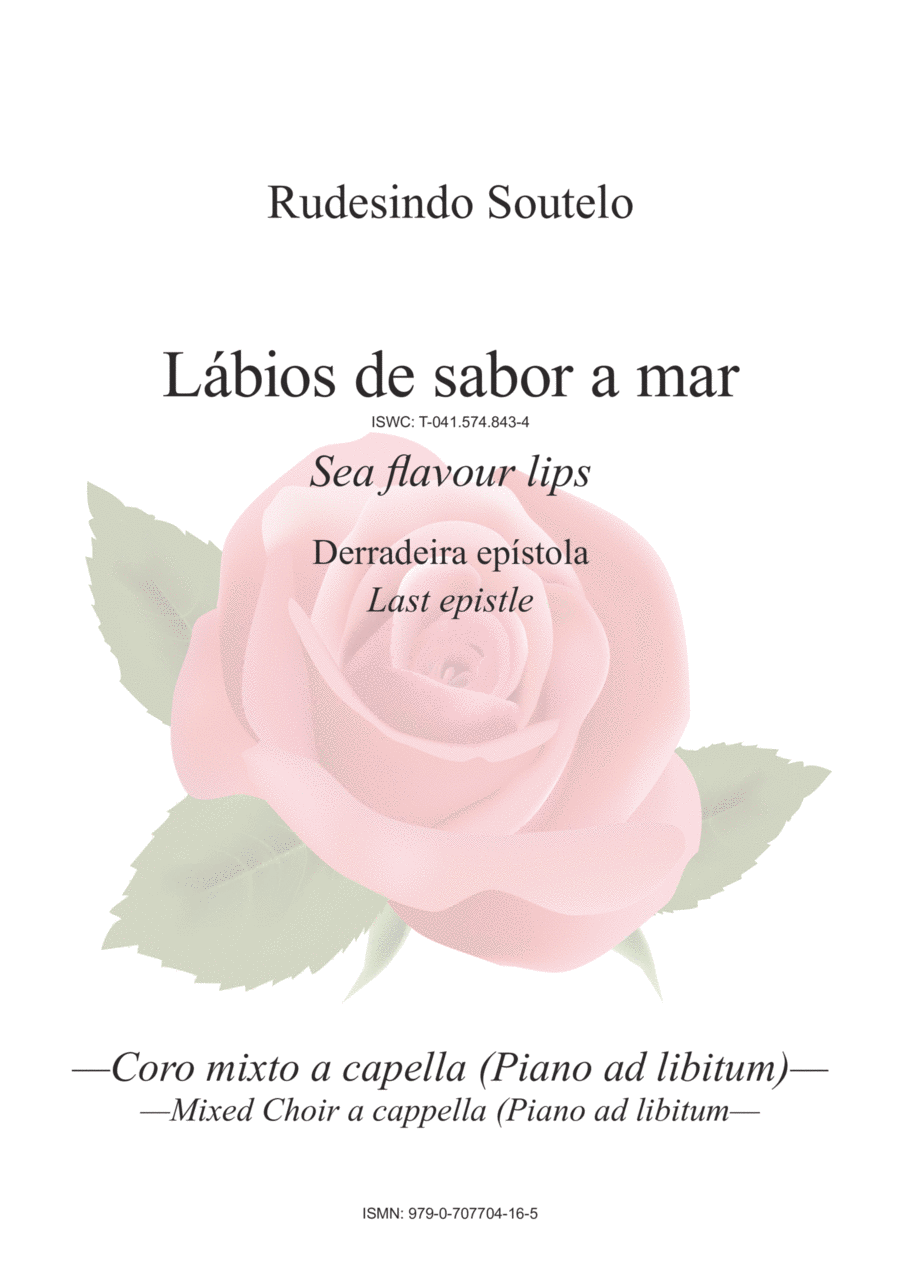
Lábios de sabor a mar / Sea flavour lips (Choir+Piano)
Chorale SATB

$3.00 2.61 € Chorale SATB PDF SheetMusicPlus

Piano - Digital Download SKU: A0.1068480 Composed by 1776, 1830, Music – Thomas Hastingsm, and Words – Augustus M. Toplady. Arranged by Pat Holmberg. Christian,Contemporary,Gospel. Full Performance. Duration 122. Patricia Tanttila Holmberg #1966901. Published by Patricia Tanttila Holmberg (A0.1068480). This is an old well-known Christian hymn played on the piano. It has an updated rhythmic feel to give it a bit of life. Here are the lyrics, if you want to sing along with it: Rock of Ages cleft for me; Let me hide myself in Thee. Let the water and the blood from thy wounded side which flowed, Be of sin the double cure; Save from wrath and make me pure. Could my tears forever flow, Could my zeal no respite know, This for sin could not atone – Thou must save, and Thou along; In my hand no price I bring, Simply to Thy cross I cling. When I draw my final breath, When my eyes shall close in death. When I rise to worlds unknown And be hold Thee on Thy throne, Rock of Ages, cleft for me, Let me hide myself in Thee. BMI www.patholmberg.com.
Rock of Ages
Piano seul

$1.99 1.73 € Piano seul PDF SheetMusicPlus

Baritone Horn TC,Instrumental Solo,Piano - Level 3 - Digital Download SKU: A0.552873 Composed by Frederic Chopin. Arranged by James M. Guthrie. Holiday,Romantic Period,Standards,Wedding. Score and individual part. 6 pages. Jmsgu3 #6050955. Published by jmsgu3 (A0.552873). Score: 5 pages. Duration 3:40This is the third movement of the Sonata in G Minor for Piano & Cello, Op. 65.Chopin performed this sonata on his final recital in 1848. Frédéric Chopin is considered one of the greatest composers of the Romantic era. He is best known for his solo piano works, which revolutionized the way the instrument was played and heard. Chopin's works are widely regarded as some of the most beautiful, lyrical, and technically demanding pieces ever written for the instrument.One of Chopin's most famous works is his Largo from Op. 65. Written in 1845, this piece is a beautiful example of Chopin's mastery of the piano. It is a slow, meditative piece, with its dreamy atmosphere, gentle chords, and haunting melodies. The piece builds to a dramatic climax, before fading away to a tranquil ending. It is one of the most beloved pieces in all of classical music, and is a testament to Chopin's genius.
Chopin: Largo from Op. 65 for Baritone Horn & Piano

$32.95 28.65 € PDF SheetMusicPlus


Partitions Gratuites
Acheter des Partitions Musicales
Acheter des Partitions Digitales à Imprimer
Acheter des Instruments de Musique

© 2000 - 2026

Accueil - Version intégrale





