EUROPE
5341 articles
USA
0 articles
DIGITAL
11808 articles (à imprimer)
Partitions Digitales
Partitions à imprimer
11808 partitions trouvées


Brass Ensemble Horn,Trombone,Trumpet,Tuba - Level 3 - Digital Download SKU: A0.813823 Composed by Antonin Dvorak. Arranged by Regis Bookshar. Contemporary,Folk,Romantic Period,Standards. Score and parts. 18 pages. Regis Bookshar #6533895. Published by Regis Bookshar (A0.813823). Largo (from Symphony No. 9 in E minor) (From the New World) (Db) (Brass Quintet) - Intermediate - Digital Download. This marvelous arrangement of the Largo, based on the second movement of Antonin Dvorak's Symphony No. 9 in E minor, would be a fabulous addition to any music library and could be performed for concerts, recitals and church services, especially Funerals, but would be appropriate any time during the church year. This arrangement is suitable for high school and college students but professional musicians would also enjoy playing this selection. Included are a score and a complete set of parts (18 pages). This selection is one of the many arrangements from the The Regis Bookshar Trumpet Ensemble's extensive music library which are being made available for the first time.Symphony No. 9 in E minor, Op. 95 (subtitled From the New World and popularly know as the New World Symphony), was composed by Antonin Dvorak in 1893 while he was the director of the National Conservatory of Music of America from 1892 to 1895. It premiered at Carnegie Hall in New York City on December 16, 1893 and has been described as one of the most popular of all symphonies. The second movement of the symphony, upon which this arrangement is based, is marked Largo, and begins with a harmonic progression of chords which is then followed by a solo instrument playing the famous main theme.Dvorak was interested in Native American music and the African-American spirituals he heard in North America. While director of the National Conservatory he encountered an African-American student, Harry T. Burleigh, who sang traditional spirituals to him. Burleigh, later a composer himself, said that Dvorak had absorbed their spirit before writing his own melodies. Dvorak stated:    I am convinced that the future music of this country must be founded on what are called Negro melodies. These can be the foundation of a serious and original school of composition to be developed in the United States. These beautiful and varied themes are the product of the soil. They are folk songs of America and your composers must turn to them.He further explained how Native American music influenced his symphony:  I have not actually used any of these (Native American) melodies. I have simply written original themes embodying the peculiarities of the Indian music, and, using these themes as subjects, have developed them with all the resources of modern rhythms, counterpoint, and orchestral colour.In 1893, a newspaper interview quoted Dvorak as saying, I found that the music of the negroes and of the Indians was practically identical, and that the music of the two races bore a remarkable similarity to the music of Scotland. Most historians agree that Dvorak is referring to the pentatonic scale, which is typical of each of these musical traditions.Dvorak was influenced not only by music he heard, but also by what he had seen, in America. He wrote that he would not have composed his American pieces as he had if he had not seen America. It has been said that Dvorak was inspired by the wide open spaces of America, such as the prairies he may have seen on his trip to Iowa in the summer of 1893. Notices about several performances of the symphony include the phrase wide open spaces about what inspired the symphony and/or about the feelings it conveys to listeners.The theme from the Largo was adapted into the spiritual Goin' Home (often mistakenly considered a folk song or traditional spiritual) by Dvorak's pupil, William Arms Fisher, who wrote the lyrics in 1922. Regis Bookshar thought it would be wonderful if other instrumentalists could have the opportunity to play this beautiful melody, so, in addition to this version for a Brass Quintet, consisting of 2 Trumpets, 1 French Horn, 1 Trombone and 1 Tuba, he has made quite a few other arrangements of this selectio.
Largo (from "Symphony No. 9") ("From the New World") (Db) (Brass Quintet - 2 Trp, 1 Hrn, 1 Trb, 1 Tu
Quatuor de Cuivres : 2 trompettes, trombone, tuba

$15.00 13.06 € Quatuor de Cuivres : 2 trompettes, trombone, tuba PDF SheetMusicPlus

String Ensemble,String Quintet - Level 3 - Digital Download SKU: A0.813834 Composed by Antonin Dvorak. Arranged by Regis Bookshar. Concert,Contemporary,Folk,Romantic Period,Standards. Score and parts. 18 pages. Regis Bookshar #6533937. Published by Regis Bookshar (A0.813834). Largo (from Symphony No. 9 in E minor) (From the New World) (Db) (String Quintet) - Intermediate - Digital Download. This marvelous arrangement of the Largo, based on the second movement of Antonin Dvorak's Symphony No. 9 in E minor, would be a fabulous addition to any music library and could be performed for concerts, recitals and church services, especially Funerals, but would be appropriate any time during the church year. This arrangement is suitable for high school and college students but professional musicians would also enjoy playing this selection. Included are a score and a complete set of parts (18 pages). This selection is one of the many arrangements from the The Regis Bookshar Trumpet Ensemble's extensive music library which are being made available for the first time.Symphony No. 9 in E minor, Op. 95 (subtitled From the New World and popularly know as the New World Symphony), was composed by Antonin Dvorak in 1893 while he was the director of the National Conservatory of Music of America from 1892 to 1895. It premiered at Carnegie Hall in New York City on December 16, 1893 and has been described as one of the most popular of all symphonies. The second movement of the symphony, upon which this arrangement is based, is marked Largo, and begins with a harmonic progression of chords which is then followed by a solo instrument playing the famous main theme.Dvorak was interested in Native American music and the African-American spirituals he heard in North America. While director of the National Conservatory he encountered an African-American student, Harry T. Burleigh, who sang traditional spirituals to him. Burleigh, later a composer himself, said that Dvorak had absorbed their spirit before writing his own melodies. Dvorak stated:    I am convinced that the future music of this country must be founded on what are called Negro melodies. These can be the foundation of a serious and original school of composition to be developed in the United States. These beautiful and varied themes are the product of the soil. They are folk songs of America and your composers must turn to them.He further explained how Native American music influenced his symphony:  I have not actually used any of these (Native American) melodies. I have simply written original themes embodying the peculiarities of the Indian music, and, using these themes as subjects, have developed them with all the resources of modern rhythms, counterpoint, and orchestral colour.In 1893, a newspaper interview quoted Dvorak as saying, I found that the music of the negroes and of the Indians was practically identical, and that the music of the two races bore a remarkable similarity to the music of Scotland. Most historians agree that Dvorak is referring to the pentatonic scale, which is typical of each of these musical traditions.Dvorak was influenced not only by music he heard, but also by what he had seen, in America. He wrote that he would not have composed his American pieces as he had if he had not seen America. It has been said that Dvorak was inspired by the wide open spaces of America, such as the prairies he may have seen on his trip to Iowa in the summer of 1893. Notices about several performances of the symphony include the phrase wide open spaces about what inspired the symphony and/or about the feelings it conveys to listeners.The theme from the Largo was adapted into the spiritual Goin' Home (often mistakenly considered a folk song or traditional spiritual) by Dvorak's pupil, William Arms Fisher, who wrote the lyrics in 1922. Regis Bookshar thought it would be wonderful if other instrumentalists could have the opportunity to play this beautiful melody, so, in addition to this version for a String Quintet, consisting of 3 Violins, 1 Violoncello and 1 Double Bass, he has made quite a few other arrangements of this selection which a.
Largo (from "Symphony No. 9") ("From the New World") (Db) (String Quintet - 3 Violins, 1 Cello, 1 Ba

$15.00 13.06 € PDF SheetMusicPlus

Trombone Solo - Level 3 - Digital Download SKU: A0.811087 Composed by Tom Ervin. Arranged by Marco Bordogni. Classical,Instructional,Opera,Romantic Period. Individual part. 26 pages. Gordon Cherry #5009439. Published by Gordon Cherry (A0.811087). The Rochut editions of Bordogni’s vocalises have become the most widly used etudes in American trombone pedigogy. They are prized for their lyric beauty, and also for their development of endurance, upper range, legato technique, styling and more. Other bass clef instrumentalists use Rochut. These Twenty Counterparts may be practiced and played as etudes alone. They are similar in style to the Bordogni; some are harder and some are easier than the Bordogni originals. But the primary intent was for recreational duet playing and for the trombone studio. Duets are fun and more, contributing to sightreading, intonation, ensemble, style-matching, confidence, independence, etc. As with the piano accompaniments, the duet parts also enhance the original melodies. Read what these famous trombonists have to say about this new contribution to the trombone literature …indisputably one of the most invaluable additions to appear in a very long time. Understanding lyricism is much easier when hearing this second voice. Joseph Alessi, Principal Trombone, New York Philharmonic …fantastic and beautiful. What a great idea! They will give the student a wonderful sense of music-making. Henry Charles Smith, Arizona State University …absolutely ingenious….they capture the essential character of each piece and cleverly expand and enhance the original material. Can be ‘stand alone’ material in its own right. I have already used them successfully on trombone, euphonium, and tuba. Loren Marsteller, Los Angeles An enjoyable new way to play the old favorites. Perform them with friends; record one part and play the other; play them alone…a great idea. Ralph Sauer, Principal Trombone Los Angeles Philharmonic A great book and a great idea! Really valuable; I am using it in my teaching. Jay Friedman, Principal Trombone, Chicago Symphony Orchestra Excellent studies, challenging in all registers, rewarding to play. Ned Meredith, formerly San Francisco Symphony Orchestra A very insightful and fresh approach to the trombone’s most important collection of etudes…destined to become a standard in the trombone literature. An absolute must! Michael Davis, jazz recording artist, New York City The unexpected harmonic progressions are a delight. They work great for euphoniums and for trombone and tuba R. Winston Morris, Tennessee Technological University …similar to the Rochut yet contains challenging rhythmic independence and contrast, increasing the value of ensemble experience. As an aid to duet performance, the measure, staff and page format is arranged the same as Rochut’s Fischer edition. Glenn P. Smith, Professor Emeritus University of Michigan A fine addition to the lyrical literature Charles Vernon, Bass Trombone Chicago Symphony Orchestra They’re not only enjoyable to play, but add some ‘zip’, harmonically, melodically, and rhythmically, to the original melodies. Buddy Baker University of Northern Colorado Compositionally, very interesting, not just a duet in thirds…stylistically appropriate…a great way to begin a lesson. Vern Kagarice, University of North Texas An outstanding idea, very valuable Keith Brown, Indiana University I enjoy the book with my students and then also change parts Carsten Svanberg, Danish National Symphony Orchestra Bravo! They serve a great purpose, very musical and playable. Will become a part of the standard trombone repertoire in a very short time…already part of mine. Jiggs Whigham, Professor of Trombone and Jazz, Cologne Germany
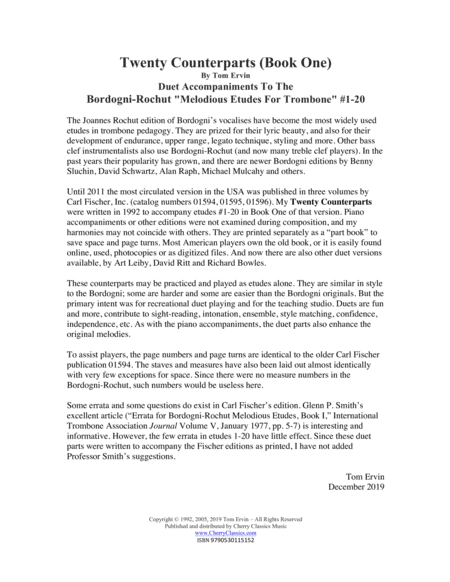
20 Counterparts from Book 1 Rochut Bordogni Duet Accompaniments for Trombones 1-20
Trombone

$25.00 21.77 € Trombone PDF SheetMusicPlus

Brass Quintet Horn,Trombone,Trumpet,Tuba - Level 2 - Digital Download SKU: A0.1395988 By Celine Dion & Peabo Bryson. By Alan Menken and Howard Ashman. Arranged by Glauco Fernandes. Broadway,Chamber,Film/TV,Musical/Show,Wedding. 15 pages. Glauco Fernandes #979364. Published by Glauco Fernandes (A0.1395988). Discover the magic of music with our special arrangement of the classic The Beauty and the Beast for ensemble! This arrangement, at an intermediate easy level, is perfect for musicians of all levels, from students seeking challenging repertoire to teachers looking for engaging materials for their classes. The score has been carefully crafted, with clear and practical notation, making it easy for all instrumentalists to perform.Ideal for a variety of occasions, from recital performances to special events such as weddings, receptions, and parties, this arrangement will enchant your audience with its beauty and sophistication. Whether you're a professional musician, a dedicated student, or an enthusiastic teacher, this arrangement offers a unique opportunity to explore the charms of classical music in an accessible and engaging way.With its versatility, this arrangement is also an excellent choice for musicians looking to expand their repertoire for performances in diverse settings such as hotels, restaurants, and corporate events. The exceptional quality of the score ensures a memorable musical experience, capable of captivating and moving any audience.Don't miss the chance to add this charming arrangement to your repertoire and elevate your performances to a new level of excellence. Get your copy now and turn your next performance into a truly magical experience!Tags: Beauty and the Beast arrangement, ensemble music, intermediate level, piano sheet music, piano, music education, wedding music, recital piece, classical music, engaging teaching material, versatile repertoire, memorable performance.
Beauty And The Beast
Quintette de Cuivres: 2 trompettes, Cor, trombone, tuba
Celine Dion & Peabo Bryson
$19.99 17.41 € Quintette de Cuivres: 2 trompettes, Cor, trombone, tuba PDF SheetMusicPlus

Brass Ensemble Trombone,Trumpet,Tuba - Level 3 - Digital Download SKU: A0.813824 Composed by Antonin Dvorak. Arranged by Regis Bookshar. Concert,Contemporary,Folk,Romantic Period,Standards. Score and parts. 18 pages. Regis Bookshar #6533897. Published by Regis Bookshar (A0.813824). Largo (from Symphony No. 9 in E minor) (From the New World) (Db) (Brass Quintet) - Intermediate - Digital Download. This marvelous arrangement of the Largo, based on the second movement of Antonin Dvorak's Symphony No. 9 in E minor, would be a fabulous addition to any music library and could be performed for concerts, recitals and church services, especially Funerals, but would be appropriate any time during the church year. This arrangement is suitable for high school and college students but professional musicians would also enjoy playing this selection. Included are a score and a complete set of parts (18 pages). This selection is one of the many arrangements from the The Regis Bookshar Trumpet Ensemble's extensive music library which are being made available for the first time.Symphony No. 9 in E minor, Op. 95 (subtitled From the New World and popularly know as the New World Symphony), was composed by Antonin Dvorak in 1893 while he was the director of the National Conservatory of Music of America from 1892 to 1895. It premiered at Carnegie Hall in New York City on December 16, 1893 and has been described as one of the most popular of all symphonies. The second movement of the symphony, upon which this arrangement is based, is marked Largo, and begins with a harmonic progression of chords which is then followed by a solo instrument playing the famous main theme.Dvorak was interested in Native American music and the African-American spirituals he heard in North America. While director of the National Conservatory he encountered an African-American student, Harry T. Burleigh, who sang traditional spirituals to him. Burleigh, later a composer himself, said that Dvorak had absorbed their spirit before writing his own melodies. Dvorak stated:    I am convinced that the future music of this country must be founded on what are called Negro melodies. These can be the foundation of a serious and original school of composition to be developed in the United States. These beautiful and varied themes are the product of the soil. They are folk songs of America and your composers must turn to them.He further explained how Native American music influenced his symphony:  I have not actually used any of these (Native American) melodies. I have simply written original themes embodying the peculiarities of the Indian music, and, using these themes as subjects, have developed them with all the resources of modern rhythms, counterpoint, and orchestral colour.In 1893, a newspaper interview quoted Dvorak as saying, I found that the music of the negroes and of the Indians was practically identical, and that the music of the two races bore a remarkable similarity to the music of Scotland. Most historians agree that Dvorak is referring to the pentatonic scale, which is typical of each of these musical traditions.Dvorak was influenced not only by music he heard, but also by what he had seen, in America. He wrote that he would not have composed his American pieces as he had if he had not seen America. It has been said that Dvorak was inspired by the wide open spaces of America, such as the prairies he may have seen on his trip to Iowa in the summer of 1893. Notices about several performances of the symphony include the phrase wide open spaces about what inspired the symphony and/or about the feelings it conveys to listeners.The theme from the Largo was adapted into the spiritual Goin' Home (often mistakenly considered a folk song or traditional spiritual) by Dvorak's pupil, William Arms Fisher, who wrote the lyrics in 1922. Regis Bookshar thought it would be wonderful if other instrumentalists could have the opportunity to play this beautiful melody, so, in addition to this version for a Brass Quintet, but in this case, consisting of 3 Trumpets, 1 Trombone and 1 Tuba, he has made quite a few other arrangements of this selection.
Largo (from "Symphony No. 9") ("From the New World") (Db) (Brass Quintet - 3 Trp, 1 Trb, 1 Tuba)
Quatuor de Cuivres : 2 trompettes, trombone, tuba

$15.00 13.06 € Quatuor de Cuivres : 2 trompettes, trombone, tuba PDF SheetMusicPlus

Brass Ensemble Horn,Trombone,Trumpet,Tuba - Level 3 - Digital Download SKU: A0.1038764 Composed by Edward Elgar. Arranged by James Symington. 20th Century,Classical,Film/TV,Patriotic,Romantic Period. Score and parts. 9 pages. James Edward Ernest Symington #643742. Published by James Edward Ernest Symington (A0.1038764). The name of the variation refers to Augustus J. Jaeger, who was employed as music editor by the London publisher Novello & Co. He was a close friend of Elgar's, giving him useful advice but also severe criticism, something Elgar greatly appreciated. Elgar later related how Jaeger had encouraged him as an artist and had stimulated him to continue composing despite setbacks. Nimrod is described in the Old Testament as a mighty hunter before the Lord, Jäger being German for hunter. In 1904 Elgar told Dora Penny (Dorabella) that this variation is not really a portrait, but the story of something that happened. Once, when Elgar had been very depressed and was about to give it all up and write no more music, Jaeger had visited him and encouraged him to continue composing. He referred to Ludwig van Beethoven, who had a lot of worries, but wrote more and more beautiful music. And that is what you must do, Jaeger said, and he sang the theme of the second movement of Beethoven's Piano Sonata No. 8 Pathétique. Elgar disclosed to Dora that the opening bars of Nimrod were made to suggest that theme. Can't you hear it at the beginning? Only a hint, not a quotation. This variation has become popular in its own right and is sometimes used at British funerals, memorial services, and other solemn occasions. It is always played at the Cenotaph, Whitehall in London at the National Service of Remembrance. A version was also played during the Hong Kong handover ceremony in 1997 and at the opening ceremony of the London 2012 Olympic Games. The “Nimrod†variation was the final orchestral composition (before the national anthem) played by the Greek National Orchestra in a televised June 2013 concert, before the 75-year-old Athenian ensemble was dissolved in the wake of severe government cutbacks. An adaptation of the piece appears at the ending of the 2017 film Dunkirk in the score by Hans Zimmer. This arrangement for Brass Quintet has been adapted to suit the instrumentalists. The key has changed and this makes it much more playable and more secure.
Nimrod for Brass Quintet
Quatuor de Cuivres : 2 trompettes, trombone, tuba

$12.99 11.31 € Quatuor de Cuivres : 2 trompettes, trombone, tuba PDF SheetMusicPlus

Large Ensemble - Level 1 - Digital Download SKU: A0.842412 By ABBA. By Benny Andersson and Bjorn Ulvaeus. Arranged by Tony Tournoff. Contemporary. Score and parts. 37 pages. Fairways Music #3561213. Published by Fairways Music (A0.842412). This arrangement is for the Inspired Instrumentalists of Worthing. A U3A group which was formed in 2015 with 6 members with a view to making music it now has 36 members and has a waiting list (this is due to the fact that there is no room in hall for more people). The ensemble is a mixed group with instruments ranging from a Bowed Psaltery to Guitars and Ukuleles; a full set of Brass; Alto & Tenor Saxophones; Flute and Recorders. As the group has grown it wants to perform various pieces of music which are not of the usual repertoire. To date the audiences  have been Wowed with the sound produced by the group and have enjoyed all the concerts they have done helping to raise many thousands of pounds for charitable events. All the parts can be played by similar instruments of the same pitch. Enjoy!
Chiquitita
ABBA
$25.00 21.77 € PDF SheetMusicPlus

Brass Ensemble Horn - Level 3 - Digital Download SKU: A0.813830 Composed by Antonin Dvorak. Arranged by Regis Bookshar. Contemporary,Romantic Period,Standards. Score and parts. 18 pages. Regis Bookshar #6533921. Published by Regis Bookshar (A0.813830). Largo (from Symphony No. 9 in E minor) (From the New World) (Db) (French Horn Quintet) - Intermediate - Digital Download. This marvelous arrangement of the Largo, based on the second movement of Antonin Dvorak's Symphony No. 9 in E minor, would be a fabulous addition to any music library and could be performed for concerts, recitals and church services, especially Funerals, but would be appropriate any time during the church year. This arrangement is suitable for high school and college students but professional musicians would also enjoy playing this selection. Included are a score and a complete set of parts (18 pages). This selection is one of the many arrangements from the The Regis Bookshar Trumpet Ensemble's extensive music library which are being made available for the first time.Symphony No. 9 in E minor, Op. 95 (subtitled From the New World and popularly know as the New World Symphony), was composed by Antonin Dvorak in 1893 while he was the director of the National Conservatory of Music of America from 1892 to 1895. It premiered at Carnegie Hall in New York City on December 16, 1893 and has been described as one of the most popular of all symphonies. The second movement of the symphony, upon which this arrangement is based, is marked Largo, and begins with a harmonic progression of chords which is then followed by a solo instrument playing the famous main theme.Dvorak was interested in Native American music and the African-American spirituals he heard in North America. While director of the National Conservatory he encountered an African-American student, Harry T. Burleigh, who sang traditional spirituals to him. Burleigh, later a composer himself, said that Dvorak had absorbed their spirit before writing his own melodies. Dvorak stated:    I am convinced that the future music of this country must be founded on what are called Negro melodies. These can be the foundation of a serious and original school of composition to be developed in the United States. These beautiful and varied themes are the product of the soil. They are folk songs of America and your composers must turn to them.He further explained how Native American music influenced his symphony:  I have not actually used any of these (Native American) melodies. I have simply written original themes embodying the peculiarities of the Indian music, and, using these themes as subjects, have developed them with all the resources of modern rhythms, counterpoint, and orchestral colour.In 1893, a newspaper interview quoted Dvorak as saying, I found that the music of the negroes and of the Indians was practically identical, and that the music of the two races bore a remarkable similarity to the music of Scotland. Most historians agree that Dvorak is referring to the pentatonic scale, which is typical of each of these musical traditions.Dvorak was influenced not only by music he heard, but also by what he had seen, in America. He wrote that he would not have composed his American pieces as he had if he had not seen America. It has been said that Dvorak was inspired by the wide open spaces of America, such as the prairies he may have seen on his trip to Iowa in the summer of 1893. Notices about several performances of the symphony include the phrase wide open spaces about what inspired the symphony and/or about the feelings it conveys to listeners.The theme from the Largo was adapted into the spiritual Goin' Home (often mistakenly considered a folk song or traditional spiritual) by Dvorak's pupil, William Arms Fisher, who wrote the lyrics in 1922. Regis Bookshar thought it would be wonderful if other instrumentalists could have the opportunity to play this beautiful melody, so, in addition to this version for a French Horn Quintet, he has made quite a few other arrangements of this selection which are readily available for a wide variety of instr.
Largo (from "Symphony No. 9") ("From the New World") (Db) (French Horn Quintet)

$15.00 13.06 € PDF SheetMusicPlus

Saxophone Quintet,Woodwind Ensemble Alto Saxophone - Level 3 - Digital Download SKU: A0.813820 Composed by Antonin Dvorak. Arranged by Regis Bookshar. Contemporary,Folk,Romantic Period,Standards. 18 pages. Regis Bookshar #6533331. Published by Regis Bookshar (A0.813820). Largo (from Symphony No. 9 in E minor) (From the New World) (Alto Saxophone Quintet) - Intermediate - Digital Download. This marvelous arrangement of the Largo, based on the second movement of Antonin Dvorak's Symphony No. 9 in E minor, would be a fabulous addition to any music library and could be performed for concerts, recitals and church services, especially Funerals, but would be appropriate any time during the church year. This arrangement is suitable for high school and college students but professional musicians would also enjoy playing this selection. Included are a score and a complete set of parts (18 pages). This selection is one of the many arrangements from the The Regis Bookshar Trumpet Ensemble's extensive music library which are being made available for the first time.Symphony No. 9 in E minor, Op. 95 (subtitled From the New World and popularly know as the New World Symphony), was composed by Antonin Dvorak in 1893 while he was the director of the National Conservatory of Music of America from 1892 to 1895. It premiered at Carnegie Hall in New York City on December 16, 1893 and has been described as one of the most popular of all symphonies. The second movement of the symphony, upon which this arrangement is based, is marked Largo, and begins with a harmonic progression of chords which is then followed by a solo instrument playing the famous main theme.Dvorak was interested in Native American music and the African-American spirituals he heard in North America. While director of the National Conservatory he encountered an African-American student, Harry T. Burleigh, who sang traditional spirituals to him. Burleigh, later a composer himself, said that Dvorak had absorbed their spirit before writing his own melodies. Dvorak stated:    I am convinced that the future music of this country must be founded on what are called Negro melodies. These can be the foundation of a serious and original school of composition to be developed in the United States. These beautiful and varied themes are the product of the soil. They are folk songs of America and your composers must turn to them.He further explained how Native American music influenced his symphony:  I have not actually used any of these (Native American) melodies. I have simply written original themes embodying the peculiarities of the Indian music, and, using these themes as subjects, have developed them with all the resources of modern rhythms, counterpoint, and orchestral colour.In 1893, a newspaper interview quoted Dvorak as saying, I found that the music of the negroes and of the Indians was practically identical, and that the music of the two races bore a remarkable similarity to the music of Scotland. Most historians agree that Dvorak is referring to the pentatonic scale, which is typical of each of these musical traditions.Dvorak was influenced not only by music he heard, but also by what he had seen, in America. He wrote that he would not have composed his American pieces as he had if he had not seen America. It has been said that Dvorak was inspired by the wide open spaces of America, such as the prairies he may have seen on his trip to Iowa in the summer of 1893. Notices about several performances of the symphony include the phrase wide open spaces about what inspired the symphony and/or about the feelings it conveys to listeners.The theme from the Largo was adapted into the spiritual Goin' Home (often mistakenly considered a folk song or traditional spiritual) by Dvorak's pupil, William Arms Fisher, who wrote the lyrics in 1922. Regis Bookshar thought it would be wonderful if other instrumentalists could have the opportunity to play this beautiful melody, so, in addition to this version for an Alto Saxophone Quintet, he has made quite a few other arrangements of this selection which are readily available for a wide variety o.
Largo (from "Symphony No. 9") ("From the New World") (Db) (Alto Saxophone Quintet)
Quintette de Saxophone: 5 saxophones

$15.00 13.06 € Quintette de Saxophone: 5 saxophones PDF SheetMusicPlus

Saxophone Quintet,Woodwind Ensemble Tenor Saxophone - Level 3 - Digital Download SKU: A0.813836 Composed by Antonin Dvorak. Arranged by Regis Bookshar. Contemporary,Folk,Romantic Period,Standards. 19 pages. Regis Bookshar #6533941. Published by Regis Bookshar (A0.813836). Largo (from Symphony No. 9 in E minor) (From the New World) (Db) (Tenor Saxophone Quintet) - Intermediate - Digital Download. This marvelous arrangement of the Largo, based on the second movement of Antonin Dvorak's Symphony No. 9 in E minor, would be a fabulous addition to any music library and could be performed for concerts, recitals and church services, especially Funerals, but would be appropriate any time during the church year. This arrangement is suitable for high school and college students but professional musicians would also enjoy playing this selection. Included are a score and a complete set of parts (19 pages). This selection is one of the many arrangements from the The Regis Bookshar Trumpet Ensemble's extensive music library which are being made available for the first time.Symphony No. 9 in E minor, Op. 95 (subtitled From the New World and popularly know as the New World Symphony), was composed by Antonin Dvorak in 1893 while he was the director of the National Conservatory of Music of America from 1892 to 1895. It premiered at Carnegie Hall in New York City on December 16, 1893 and has been described as one of the most popular of all symphonies. The second movement of the symphony, upon which this arrangement is based, is marked Largo, and begins with a harmonic progression of chords which is then followed by a solo instrument playing the famous main theme.Dvorak was interested in Native American music and the African-American spirituals he heard in North America. While director of the National Conservatory he encountered an African-American student, Harry T. Burleigh, who sang traditional spirituals to him. Burleigh, later a composer himself, said that Dvorak had absorbed their spirit before writing his own melodies. Dvorak stated:    I am convinced that the future music of this country must be founded on what are called Negro melodies. These can be the foundation of a serious and original school of composition to be developed in the United States. These beautiful and varied themes are the product of the soil. They are folk songs of America and your composers must turn to them.He further explained how Native American music influenced his symphony:  I have not actually used any of these (Native American) melodies. I have simply written original themes embodying the peculiarities of the Indian music, and, using these themes as subjects, have developed them with all the resources of modern rhythms, counterpoint, and orchestral colour.In 1893, a newspaper interview quoted Dvorak as saying, I found that the music of the negroes and of the Indians was practically identical, and that the music of the two races bore a remarkable similarity to the music of Scotland. Most historians agree that Dvorak is referring to the pentatonic scale, which is typical of each of these musical traditions.Dvorak was influenced not only by music he heard, but also by what he had seen, in America. He wrote that he would not have composed his American pieces as he had if he had not seen America. It has been said that Dvorak was inspired by the wide open spaces of America, such as the prairies he may have seen on his trip to Iowa in the summer of 1893. Notices about several performances of the symphony include the phrase wide open spaces about what inspired the symphony and/or about the feelings it conveys to listeners.The theme from the Largo was adapted into the spiritual Goin' Home (often mistakenly considered a folk song or traditional spiritual) by Dvorak's pupil, William Arms Fisher, who wrote the lyrics in 1922. Regis Bookshar thought it would be wonderful if other instrumentalists could have the opportunity to play this beautiful melody, so, in addition to this version for a Tenor Saxophone Quintet, he has made quite a few other arrangements of this selection which are readily available for a wide variety.
Largo (from "Symphony No. 9") ("From the New World") (Db) (Tenor Saxophone Quintet)
Quintette de Saxophone: 5 saxophones

$15.00 13.06 € Quintette de Saxophone: 5 saxophones PDF SheetMusicPlus

Brass Ensemble Euphonium - Level 3 - Digital Download SKU: A0.813828 Composed by Antonin Dvorak. Arranged by Regis Bookshar. Contemporary,Folk,Romantic Period,Standards. Score and parts. 18 pages. Regis Bookshar #6533917. Published by Regis Bookshar (A0.813828). Largo (from Symphony No. 9 in E minor) (From the New World) (Db) (Euphonium Quintet) - Intermediate - Digital Download. This marvelous arrangement of the Largo, based on the second movement of Antonin Dvorak's Symphony No. 9 in E minor, would be a fabulous addition to any music library and could be performed for concerts, recitals and church services, especially Funerals, but would be appropriate any time during the church year. This arrangement is suitable for high school and college students but professional musicians would also enjoy playing this selection. Included are a score and a complete set of parts (18 pages). This selection is one of the many arrangements from the The Regis Bookshar Trumpet Ensemble's extensive music library which are being made available for the first time.Symphony No. 9 in E minor, Op. 95 (subtitled From the New World and popularly know as the New World Symphony), was composed by Antonin Dvorak in 1893 while he was the director of the National Conservatory of Music of America from 1892 to 1895. It premiered at Carnegie Hall in New York City on December 16, 1893 and has been described as one of the most popular of all symphonies. The second movement of the symphony, upon which this arrangement is based, is marked Largo, and begins with a harmonic progression of chords which is then followed by a solo instrument playing the famous main theme.Dvorak was interested in Native American music and the African-American spirituals he heard in North America. While director of the National Conservatory he encountered an African-American student, Harry T. Burleigh, who sang traditional spirituals to him. Burleigh, later a composer himself, said that Dvorak had absorbed their spirit before writing his own melodies. Dvorak stated:    I am convinced that the future music of this country must be founded on what are called Negro melodies. These can be the foundation of a serious and original school of composition to be developed in the United States. These beautiful and varied themes are the product of the soil. They are folk songs of America and your composers must turn to them.He further explained how Native American music influenced his symphony:  I have not actually used any of these (Native American) melodies. I have simply written original themes embodying the peculiarities of the Indian music, and, using these themes as subjects, have developed them with all the resources of modern rhythms, counterpoint, and orchestral colour.In 1893, a newspaper interview quoted Dvorak as saying, I found that the music of the negroes and of the Indians was practically identical, and that the music of the two races bore a remarkable similarity to the music of Scotland. Most historians agree that Dvorak is referring to the pentatonic scale, which is typical of each of these musical traditions.Dvorak was influenced not only by music he heard, but also by what he had seen, in America. He wrote that he would not have composed his American pieces as he had if he had not seen America. It has been said that Dvorak was inspired by the wide open spaces of America, such as the prairies he may have seen on his trip to Iowa in the summer of 1893. Notices about several performances of the symphony include the phrase wide open spaces about what inspired the symphony and/or about the feelings it conveys to listeners.The theme from the Largo was adapted into the spiritual Goin' Home (often mistakenly considered a folk song or traditional spiritual) by Dvorak's pupil, William Arms Fisher, who wrote the lyrics in 1922. Regis Bookshar thought it would be wonderful if other instrumentalists could have the opportunity to play this beautiful melody, so, in addition to this version for a Euphonium Quintet written in Treble Clef, he has made quite a few other arrangements of this selection which are readily available for a wi.
Largo (from "Symphony No. 9") ("From the New World") (Db) (Euphonium Quintet - Treble Clef)

$15.00 13.06 € PDF SheetMusicPlus

String Ensemble,String Quintet Cello - Level 3 - Digital Download SKU: A0.813841 Composed by Antonin Dvorak. Arranged by Regis Bookshar. Contemporary,Folk,Romantic Period,Standards. Score and parts. 18 pages. Regis Bookshar #6533955. Published by Regis Bookshar (A0.813841). Largo (from Symphony No. 9 in E minor) (From the New World) (Db) (Violoncello Quintet) - Intermediate - Digital Download. This marvelous arrangement of the Largo, based on the second movement of Antonin Dvorak's Symphony No. 9 in E minor, would be a fabulous addition to any music library and could be performed for concerts, recitals and church services, especially Funerals, but would be appropriate any time during the church year. This arrangement is suitable for high school and college students but professional musicians would also enjoy playing this selection. Included are a score and a complete set of parts (18 pages). This selection is one of the many arrangements from the The Regis Bookshar Trumpet Ensemble's extensive music library which are being made available for the first time.Symphony No. 9 in E minor, Op. 95 (subtitled From the New World and popularly know as the New World Symphony), was composed by Antonin Dvorak in 1893 while he was the director of the National Conservatory of Music of America from 1892 to 1895. It premiered at Carnegie Hall in New York City on December 16, 1893 and has been described as one of the most popular of all symphonies. The second movement of the symphony, upon which this arrangement is based, is marked Largo, and begins with a harmonic progression of chords which is then followed by a solo instrument playing the famous main theme.Dvorak was interested in Native American music and the African-American spirituals he heard in North America. While director of the National Conservatory he encountered an African-American student, Harry T. Burleigh, who sang traditional spirituals to him. Burleigh, later a composer himself, said that Dvorak had absorbed their spirit before writing his own melodies. Dvorak stated:    I am convinced that the future music of this country must be founded on what are called Negro melodies. These can be the foundation of a serious and original school of composition to be developed in the United States. These beautiful and varied themes are the product of the soil. They are folk songs of America and your composers must turn to them.He further explained how Native American music influenced his symphony:  I have not actually used any of these (Native American) melodies. I have simply written original themes embodying the peculiarities of the Indian music, and, using these themes as subjects, have developed them with all the resources of modern rhythms, counterpoint, and orchestral colour.In 1893, a newspaper interview quoted Dvorak as saying, I found that the music of the negroes and of the Indians was practically identical, and that the music of the two races bore a remarkable similarity to the music of Scotland. Most historians agree that Dvorak is referring to the pentatonic scale, which is typical of each of these musical traditions.Dvorak was influenced not only by music he heard, but also by what he had seen, in America. He wrote that he would not have composed his American pieces as he had if he had not seen America. It has been said that Dvorak was inspired by the wide open spaces of America, such as the prairies he may have seen on his trip to Iowa in the summer of 1893. Notices about several performances of the symphony include the phrase wide open spaces about what inspired the symphony and/or about the feelings it conveys to listeners.The theme from the Largo was adapted into the spiritual Goin' Home (often mistakenly considered a folk song or traditional spiritual) by Dvorak's pupil, William Arms Fisher, who wrote the lyrics in 1922. Regis Bookshar thought it would be wonderful if other instrumentalists could have the opportunity to play this beautiful melody, so, in addition to this version for a Violoncello Quintet, he has made quite a few other arrangements of this selection which are readily available for a wide variety of.
Largo (from "Symphony No. 9") ("From the New World") (Db) (Violoncello Quintet)

$15.00 13.06 € PDF SheetMusicPlus

Large Ensemble Bass Guitar,Drums,Glockenspiel,Orff Instrument,Percussion,Piano,Recorder,Xylophone - Level 1 - Digital Download SKU: A0.1002941 By Eddy Grant. By Eddy Grant. Arranged by Andrew Will. Contemporary. Score and parts. 26 pages. Willscore Publishing #6696349. Published by Willscore Publishing (A0.1002941). Written and arranged for an Orff Ensemble but with the inclusion of all classroom instruments available. I have used this piece with upper primary and junior secondary students (ages 10-14 years) in the classroom setting. You can rote teach the complete piece in a 2 lesson time frame. You may wish to teach the piece using formal notation so I have extracted all required parts for every possible combination of classroom instrumentation. Also catering for beginner to advanced instrumentalists with scope for improvisation using the aeolian mode for all tuned instruments. Parts are also available for all types of tuned percussion, keyboard, recorder, guitar etc. A great classroom music resource. Enjoy!
Electric Avenue
Eddy Grant
$24.99 21.76 € PDF SheetMusicPlus


Partitions Gratuites
Acheter des Partitions Musicales
Acheter des Partitions Digitales à Imprimer
Acheter des Instruments de Musique

© 2000 - 2026

Accueil - Version intégrale





