EUROPE
31596 articles
USA
27081 articles
DIGITAL
20014 articles (à imprimer)
Partitions Digitales
Partitions à imprimer
20014 partitions trouvées


String Ensemble Cello,Violin - Level 4 - Digital Download SKU: A0.1111381 Composed by Wolfgang Amadeus Mozart. Arranged by Regis Bookshar. Chamber,Christian,Classical,Instructional,Religious. 28 pages. Regis Bookshar #713668. Published by Regis Bookshar (A0.1111381). Recordare (from Requiem (K. 626) - Wolfgang Amadeus Mozart/Franz Xaver Sussmayr - String Sextet - Advanced/Intermediate - Digital Download. Hauntingly beautiful is how the Recordare from Mozart's Requiem is often described. Originally written for an orchestra and four vocal soloists, it has now been transcribed by Regis Bookshar for a String Sextet, consisting of 3 Violins and 3 Violoncellos, and would be a wonderful addition to any music library. This arrangement will provide students with the opportunity to play this beautiful composition, something which they may not have had the opportunity to do, otherwise. This selection could be performed for concerts, recitals and church services and is suitable for high school and college students but professional musicians would also enjoy playing this arrangement. Included are a score and a complete set of parts (28 pages). The Regis Bookshar Trumpet Ensemble has performed the Trumpet Quintet version of the Recordare for funerals, providing beautiful, introspective music for the occasion. There is some controversy surrounding the circumstances of the Requiem's composition because Mozart died before he could complete it. Count Franz von Walsegg had commissioned a Requiem Mass but Mozart had received only half of the payment in advance. So, upon his death on December 5th, 1791, his widow, Constanze, wished to have the work completed secretly by someone else and submit it to the count as having been completed by Mozart to collect the final payment. Joseph von Eybler was one of the first composers to be asked to complete the score and had worked on a number of movements but felt unable to complete the remainder and gave the manuscript back to Constanze Mozart. The task was then given to another composer, Franz Xaver Sussmayr. Sussmayr borrowed some of Eybler's work in making his completion, added his own orchestration to other movements and added several new movements which a Requiem Mass would normally comprise. He then added a final section by adapting the opening two movements which Mozart had written to the different words which finish the Requiem Mass, which according to both Sussmayr and Mozart's wife, was done according to Mozart's directions. The completed score, initially by Mozart but largely finished by Sussmayr, was then dispatched to Count Walsegg complete with a counterfeited signature of Mozart dated 1792. Despite the controversy over how much of the music is actually Mozart's, the commonly performed Sussmayr version has become widely accepted by the public, and is considered one of Mozart's finest compositions. The Recordare is considered by many people to be one of the most beautiful compositions in Mozart's entire catalogue. Regis Bookshar, a trumpet player, has performed the Requiem in concert with a full orchestra, soloists and a chorus and felt that other musicians should have the opportunity to play the hauntingly beautiful Recordare as well. So, in addition to this arrangement for a String Sextet, he has made quite a few other arrangements of this beautiful composition. There are Quintets, Sextets, Septets and Octets readily available for a wide variety of instrumental ensembles. Please take the time to look for other versions of this composition. You may fine something else which may also suit your needs. I would also encourage you to search for other arrangements by Regis Bookshar as well, as there are numerous arrangements in a variety of styles, also available for purchase. You may find something else which might interest you. Please continue to check periodically because new arrangements are being added as often as possible. I'm certain that this beautiful arrangement of Mozart's Recordare, will continue to entertain both performers and audiences alike for years to come.
Recordare (from "Requiem") (F) (String Sextet - 3 Violins, 3 Cellos)

$32.00 26.98 € PDF SheetMusicPlus

Euphonium - Level 4 - Digital Download SKU: A0.1110890 Composed by Wolfgang Amadeus Mozart. Arranged by Regis Bookshar. Chamber,Christian,Classical,Instructional,Religious. 28 pages. Regis Bookshar #713185. Published by Regis Bookshar (A0.1110890). Recordare (from Requiem (K. 626) - Wolfgang Amadeus Mozart/Franz Xaver Sussmayr - Euphonium Sextet - Advanced/Intermediate - Digital Download. Hauntingly beautiful is how the Recordare from Mozart's Requiem is often described. Originally written for an orchestra and four vocal soloists, it has now been transcribed by Regis Bookshar for a Euphonium Sextet, and would be a wonderful addition to any music library. This arrangement will provide students with the opportunity to practice breath control because of its long, sustained phrases, and also to give them the chance to play this beautiful composition, something which they may not have had the opportunity to do, otherwise. This selection could be performed for concerts, recitals and church services and is suitable for high school and college students but professional musicians would also enjoy playing this arrangement. Included are a score and a complete set of parts (28 pages) written in Treble Clef. There is also a version written in Bass Clef, if you prefer. The Regis Bookshar Trumpet Ensemble has performed the Trumpet Quintet version of the Recordare for funerals, providing beautiful, introspective music for the occasion. There is some controversy surrounding the circumstances of the Requiem's composition because Mozart died before he could complete it. Count Franz von Walsegg had commissioned a Requiem Mass but Mozart had received only half of the payment in advance. So, upon his death on December 5th, 1791, his widow, Constanze, wished to have the work completed secretly by someone else and submit it to the count as having been completed by Mozart to collect the final payment. Joseph von Eybler was one of the first composers to be asked to complete the score and had worked on a number of movements but felt unable to complete the remainder and gave the manuscript back to Constanze Mozart. The task was then given to another composer, Franz Xaver Sussmayr. Sussmayr borrowed some of Eybler's work in making his completion, added his own orchestration to other movements and added several new movements which a Requiem Mass would normally comprise. He then added a final section by adapting the opening two movements which Mozart had written to the different words which finish the Requiem Mass, which according to both Sussmayr and Mozart's wife, was done according to Mozart's directions. The completed score, initially by Mozart but largely finished by Sussmayr, was then dispatched to Count Walsegg complete with a counterfeited signature of Mozart dated 1792. Despite the controversy over how much of the music is actually Mozart's, the commonly performed Sussmayr version has become widely accepted by the public, and is considered one of Mozart's finest compositions. The Recordare is considered by many people to be one of the most beautiful compositions in Mozart's entire catalogue. Regis Bookshar, a trumpet player, has performed the Requiem in concert with a full orchestra, soloists and a chorus and felt that other musicians should have the opportunity to play the hauntingly beautiful Recordare as well. So, in addition to this arrangement for a Euphonium Sextet, he has made quite a few other arrangements of this beautiful composition. There are Quintets, Sextets, Septets and Octets readily available for a wide variety of instrumental ensembles. Please take the time to look for other versions of this composition. You may fine something else which may also suit your needs. I would also encourage you to search for other arrangements by Regis Bookshar as well, as there are numerous arrangements in a variety of styles, also available for purchase. You may find something else which might interest you. Please continue to check periodically because new arrangements are being added as often as possible. I'm certain that this beautiful arrangement of Mozart's Recordare, will continue to entertain both performers and audiences alike for years to come.
Recordare (from "Requiem") (F) (Euphonium Sextet - Treble Clef)

$32.00 26.98 € PDF SheetMusicPlus

String Ensemble Double Bass,Violin - Level 4 - Digital Download SKU: A0.1111387 Composed by Wolfgang Amadeus Mozart. Arranged by Regis Bookshar. Chamber,Christian,Classical,Instructional,Religious. 28 pages. Regis Bookshar #713674. Published by Regis Bookshar (A0.1111387). Recordare (from Requiem (K. 626) - Wolfgang Amadeus Mozart/Franz Xaver Sussmayr - String Sextet - Advanced/Intermediate - Digital Download. Hauntingly beautiful is how the Recordare from Mozart's Requiem is often described. Originally written for an orchestra and four vocal soloists, it has now been transcribed by Regis Bookshar for a String Sextet, consisting of 5 Violins and 1 Double Bass, and would be a wonderful addition to any music library. This arrangement will provide students with the opportunity to play this beautiful composition, something which they may not have had the opportunity to do, otherwise. This selection could be performed for concerts, recitals and church services and is suitable for high school and college students but professional musicians would also enjoy playing this arrangement. Included are a score and a complete set of parts (28 pages). The Regis Bookshar Trumpet Ensemble has performed the Trumpet Quintet version of the Recordare for funerals, providing beautiful, introspective music for the occasion. There is some controversy surrounding the circumstances of the Requiem's composition because Mozart died before he could complete it. Count Franz von Walsegg had commissioned a Requiem Mass but Mozart had received only half of the payment in advance. So, upon his death on December 5th, 1791, his widow, Constanze, wished to have the work completed secretly by someone else and submit it to the count as having been completed by Mozart to collect the final payment. Joseph von Eybler was one of the first composers to be asked to complete the score and had worked on a number of movements but felt unable to complete the remainder and gave the manuscript back to Constanze Mozart. The task was then given to another composer, Franz Xaver Sussmayr. Sussmayr borrowed some of Eybler's work in making his completion, added his own orchestration to other movements and added several new movements which a Requiem Mass would normally comprise. He then added a final section by adapting the opening two movements which Mozart had written to the different words which finish the Requiem Mass, which according to both Sussmayr and Mozart's wife, was done according to Mozart's directions. The completed score, initially by Mozart but largely finished by Sussmayr, was then dispatched to Count Walsegg complete with a counterfeited signature of Mozart dated 1792. Despite the controversy over how much of the music is actually Mozart's, the commonly performed Sussmayr version has become widely accepted by the public, and is considered one of Mozart's finest compositions. The Recordare is considered by many people to be one of the most beautiful compositions in Mozart's entire catalogue. Regis Bookshar, a trumpet player, has performed the Requiem in concert with a full orchestra, soloists and a chorus and felt that other musicians should have the opportunity to play the hauntingly beautiful Recordare as well. So, in addition to this arrangement for a String Sextet, he has made quite a few other arrangements of this beautiful composition. There are Quintets, Sextets, Septets and Octets readily available for a wide variety of instrumental ensembles. Please take the time to look for other versions of this composition. You may fine something else which may also suit your needs. I would also encourage you to search for other arrangements by Regis Bookshar as well, as there are numerous arrangements in a variety of styles, also available for purchase. You may find something else which might interest you. Please continue to check periodically because new arrangements are being added as often as possible. I'm certain that this beautiful arrangement of Mozart's Recordare, will continue to entertain both performers and audiences alike for years to come.
Recordare (from "Requiem") (F) (String Sextet - 5 Violins, 1 Bass)

$32.00 26.98 € PDF SheetMusicPlus

Guitar Ensemble Guitar - Level 2 - Digital Download SKU: A0.797763 Composed by Eddie Newton and Jill Gallina. Arranged by Derek Hasted. Contemporary,Film/TV. Score and parts. 14 pages. Derek Hasted #5206431. Published by Derek Hasted (A0.797763). CASEY JONES - 6 GUITARS or LARGE ENSEMBLEThe Ballad of Casey Jones - most famously used as the Theme Music to the TV series Casey Jones.Derek Hasted writes This is a great piece for six or more guitars, especially for those with limited experience of playing in ensemble.Schoolteachers - this is ideal for a school ensemble of mixed ability players, as there are parts from 'very much a novice' up to intermediate (which the teacher can help support).My arrangement sets out to make classical guitars sound like a steam locomotive - I hope you find that it works better than you imagined!The slow introduction and the gathering speed doesn’t require a collective accelerando, it’s all done in the writing - the metronome mark stays the same.Be sure to accent the beats where shown, and keep that pulsing accent rippling through the entire piece.Guitar 6 requires the bottom string tuned down to D - as this is the line suited to those with the least experience, you might want to mark up the fret numbers for the bass notes below the open A - they are all two frets higher than they normally are.This piece has featured in concerts played by The Hampshire Guitar Orchestra, and it’s always gone down well.I hope you enjoy playing this piece!
Ballad Of Casey Jones

$4.99 4.21 € PDF SheetMusicPlus

Small Ensemble Bassoon,Piano,Voice - Level 2 - Digital Download SKU: A0.843233 Composed by Johann Sebastian Bach. Arranged by Cássio Silva Chaves. Baroque,Gospel,Instructional,Standards. Score and parts. 10 pages. Cassio Silva #6346785. Published by Cassio Silva (A0.843233). Jesu, Joy of Man's Desiring is a popular piece of choral music. It was composed by Johann Sebastian Bach. It is the 10th movement of the cantata Herz und Mund und Tat und Leben. It was written during Bach's first year in Leipzig, Germany. Bach did not compose the melody. That was written by Johann Schop. Bach only harmonized and orchestrated Schop's melody. A transcription of Jesu was done by English pianist Myra Hess (1890-1965), and was published in 1926 for solo piano.In 1934, Hess' version was adapted for piano duet. British organist Peter Hurford made a transcription of Jesu for organ. Today, Bach's piece is often performed at weddings and funerals. Bach wrote the piece for voices with trumpet, oboes, strings and continuo. Jesu, Joy of Man's Desiring is one of Bach's most enduring pieces of music.This song has an Intermediate Level of difficulties and can serve as a new step forward in the training of a musician.
Jesu, joy of man's Desiring fo Bassoon and Piano (With Chords) - Score and Parts
Basson, Piano (duo)

$4.99 4.21 € Basson, Piano (duo) PDF SheetMusicPlus

Brass Ensemble Horn - Level 3 - Digital Download SKU: A0.750824 Composed by Rev. Clement Cotterill Scholefield (1839–1904). Arranged by Brendan Elliget MAGA 537. Christian,Contemporary,Sacred. Score and parts. 31 pages. BJE Music #3630321. Published by BJE Music (A0.750824). This piece of music is dedicated to the memory of Vic Sykes (1929-2018) - who was Principal Horn player for my local orchestra - The Frankston Symphony Orchestra - for over 50 years!It is an arrangement of the hymn tune St. Clement - The Day Thou Gavest Lord Is Ended - or Evening Hymn. It features, of course, the French Horn -a Horn Quartet in fact with orchestral accompaniment.St Clement, in 98. 98. meter is a popular British tune to John Ellerton's hymn The Day Thou Gavest, Lord, is Ended. The tune is generally credited to the Rev. Clement Cotterill Scholefield (1839–1904). It first appeared in Sir Arthur Sullivan's Church Hymns with Tunes (1874). Scholefield was born at Edgbaston, Birmingham, and was the youngest son of William Scholefield, MP for Birmingham. [Wikipedia]Grade = 3.5  Duration = 3:05 mins.The MP3 recording was done with NotePerformer 3.
The Day Thou Gavest Lord Is Ended (St. Clement) - For 4 Horns and Orchestra Score and Parts PDF
Orchestre

$30.00 25.29 € Orchestre PDF SheetMusicPlus

Small Ensemble Flute,Piano,Voice - Level 2 - Digital Download SKU: A0.843204 Composed by Johann Sebastian Bach. Arranged by Cássio Silva Chaves. Baroque,Gospel,Instructional,Standards. Score and parts. 10 pages. Cassio Silva #6345629. Published by Cassio Silva (A0.843204). Jesu, Joy of Man's Desiring is a popular piece of choral music. It was composed by Johann Sebastian Bach. It is the 10th movement of the cantata Herz und Mund und Tat und Leben. It was written during Bach's first year in Leipzig, Germany. Bach did not compose the melody. That was written by Johann Schop. Bach only harmonized and orchestrated Schop's melody. A transcription of Jesu was done by English pianist Myra Hess (1890-1965), and was published in 1926 for solo piano.In 1934, Hess' version was adapted for piano duet. British organist Peter Hurford made a transcription of Jesu for organ. Today, Bach's piece is often performed at weddings and funerals. Bach wrote the piece for voices with trumpet, oboes, strings and continuo. Jesu, Joy of Man's Desiring is one of Bach's most enduring pieces of music.This song has an Intermediate Level of difficulties and can serve as a new step forward in the training of a musician.
Jesu, Joy of Man's Desiring for Piccolo and Piano (Arpeggios With Chords) - Score and Parts

$4.99 4.21 € PDF SheetMusicPlus

Saxophone Ensemble,Woodwind Ensemble Alto Saxophone,Baritone Saxophone,Soprano Saxophone,Tenor Saxophone - Level 4 - Digital Download SKU: A0.1110899 Composed by Wolfgang Amadeus Mozart. Arranged by Regis Bookshar. Chamber,Christian,Classical,Instructional,Religious. 28 pages. Regis Bookshar #713194. Published by Regis Bookshar (A0.1110899). Recordare (from Requiem (K. 626) - Wolfgang Amadeus Mozart/Franz Xaver Sussmayr - Saxophone Sextet - Advanced/Intermediate - Digital Download. Hauntingly beautiful is how the Recordare from Mozart's Requiem is often described. Originally written for an orchestra and four vocal soloists, it has now been transcribed by Regis Bookshar for a Saxophone Sextet, consisting of 1 Soprano Saxophone, 2 Alto Saxophones, 2 Tenor Saxophones and 1 Baritone Saxophone, and would be a wonderful addition to any music library. This arrangement will provide students with the opportunity to practice breath control because of its long, sustained phrases, This selection could be performed for concerts, recitals and church services and is suitable for high school and college students but professional musicians would also enjoy playing this arrangement. Included are a score and a complete set of parts (28 pages). The Regis Bookshar Trumpet Ensemble has performed the Trumpet Quintet version of the Recordare for funerals, providing beautiful, introspective music for the occasion. There is some controversy surrounding the circumstances of the Requiem's composition because Mozart died before he could complete it. Count Franz von Walsegg had commissioned a Requiem Mass but Mozart had received only half of the payment in advance. So, upon his death on December 5th, 1791, his widow, Constanze, wished to have the work completed secretly by someone else and submit it to the count as having been completed by Mozart to collect the final payment. Joseph von Eybler was one of the first composers to be asked to complete the score and had worked on a number of movements but felt unable to complete the remainder and gave the manuscript back to Constanze Mozart. The task was then given to another composer, Franz Xaver Sussmayr. Sussmayr borrowed some of Eybler's work in making his completion, added his own orchestration to other movements and added several new movements which a Requiem Mass would normally comprise. He then added a final section by adapting the opening two movements which Mozart had written to the different words which finish the Requiem Mass, which according to both Sussmayr and Mozart's wife, was done according to Mozart's directions. The completed score, initially by Mozart but largely finished by Sussmayr, was then dispatched to Count Walsegg complete with a counterfeited signature of Mozart dated 1792. Despite the controversy over how much of the music is actually Mozart's, the commonly performed Sussmayr version has become widely accepted by the public, and is considered one of Mozart's finest compositions. The Recordare is considered by many people to be one of the most beautiful compositions in Mozart's entire catalogue. Regis Bookshar, a trumpet player, has performed the Requiem in concert with a full orchestra, soloists and a chorus and felt that other musicians should have the opportunity to play the hauntingly beautiful Recordare as well. So, in addition to this arrangement for a Saxophone Sextet, he has made quite a few other arrangements of this beautiful composition. There are Quintets, Sextets, Septets and Octets readily available for a wide variety of instrumental ensembles. Please take the time to look for other versions of this composition. You may fine something else which may also suit your needs. I would also encourage you to search for other arrangements by Regis Bookshar as well, as there are numerous arrangements in a variety of styles, also available for purchase. You may find something else which might interest you. Please continue to check periodically because new arrangements are being added as often as possible. I'm certain that this beautiful arrangement of Mozart's Recordare, will continue to entertain both performers and audiences alike for years to come.
Recordare (from "Requiem") (F) (Saxophone Sextet - 1 Sop, 2 Alto, 2 Ten, 1 Bari)
Ensemble de saxophones

$32.00 26.98 € Ensemble de saxophones PDF SheetMusicPlus

Piano,Violin - Level 3 - Digital Download SKU: A0.587600 Composed by Jeremiah Clarke. Arranged by David McKeown. Baroque,Concert,Instructional,Standards,Wedding. 7 pages. David McKeown #4367470. Published by David McKeown (A0.587600). The Prince of Denmark’s March is better known nowadays as the Trumpet Voluntary and is often used in wedding ceremonies. It was in fact written for organ, with the melody played on thetrumpet stop.  Written around 1700, for many years this piece was mistakenly attributed to Henry Purcell. Only recently has it been established that the composer was Jeremiah Clarke, organist at St Paul’s Cathedral. It is somewhat ironic that this composer of a wedding mainstay was himself a victim of unrequited love. He consequently shot himself in the cathedral graveyard. This full version is arranged as a Solo for Violin and Piano; the performance time is around two and a half minutes. Of course, performers, especially at weddings, may wish to abridge and shorten the arrangement. This is easily done as the different sections are self-contained and the repeat may be ignored. The single pdf file contains both the score and the solo instrumental part. Musicians at an intermediate level and above will find this ideal for formal and informal performances, with both the solo and accompaniment enjoying melodic interest. Teachers will enjoy using this arrangement as a fun way to help with strict time, full tone and dynamics.The short sample here and the full length version on the youtube link are from the Clarinet version of this arrangement.There are many more top quality arrangements and compositions by David McKeown for you to browse at http://www.sheetmusicplus.com/publishers/david-mckeown/6203  
Trumpet Voluntary, (Prince of Denmark's March), for Solo Violin and Piano
Violon et Piano

$4.60 3.88 € Violon et Piano PDF SheetMusicPlus

String Ensemble Cello,Double Bass,Viola,Violin - Level 4 - Digital Download SKU: A0.1112892 Composed by Wolfgang Amadeus Mozart. Arranged by Regis Bookshar. Chamber,Christian,Classical,Instructional,Religious. 44 pages. Regis Bookshar #714845. Published by Regis Bookshar (A0.1112892). Recordare (from Requiem (K. 626) - Wolfgang Amadeus Mozart/Franz Xaver Sussmayr - String Octet - Advanced/Intermediate - Digital Download. Hauntingly beautiful is how the Recordare from Mozart's Requiem is often described. Originally written for an orchestra and four vocal soloists, it has now been transcribed by Regis Bookshar for a String Octet, consisting of 2 Violins, 2 Violas, 3 Violoncellos and 1 Double Bass, and would be a wonderful addition to any music library. This arrangement will provide students with the opportunity to play this beautiful composition, something which they may not have had the opportunity to do, otherwise. This selection could be performed for concerts, recitals and church services and is suitable for high school and college students but professional musicians would also enjoy playing this arrangement. Included are a score and a complete set of parts (44 pages). The Regis Bookshar Trumpet Ensemble has performed the Trumpet Quintet version of the Recordare for funerals, providing beautiful, introspective music for the occasion. There is some controversy surrounding the circumstances of the Requiem's composition because Mozart died before he could complete it. Count Franz von Walsegg had commissioned a Requiem Mass but Mozart had received only half of the payment in advance. So, upon his death on December 5th, 1791, his widow, Constanze, wished to have the work completed secretly by someone else and submit it to the count as having been completed by Mozart to collect the final payment. Joseph von Eybler was one of the first composers to be asked to complete the score and had worked on a number of movements but felt unable to complete the remainder and gave the manuscript back to Constanze Mozart. The task was then given to another composer, Franz Xaver Sussmayr. Sussmayr borrowed some of Eybler's work in making his completion, added his own orchestration to other movements and added several new movements which a Requiem Mass would normally comprise. He then added a final section by adapting the opening two movements which Mozart had written to the different words which finish the Requiem Mass, which according to both Sussmayr and Mozart's wife, was done according to Mozart's directions. The completed score, initially by Mozart but largely finished by Sussmayr, was then dispatched to Count Walsegg complete with a counterfeited signature of Mozart dated 1792. Despite the controversy over how much of the music is actually Mozart's, the commonly performed Sussmayr version has become widely accepted by the public, and is considered one of Mozart's finest compositions. The Recordare is considered by many people to be one of the most beautiful compositions in Mozart's entire catalogue. Regis Bookshar, a trumpet player, has performed the Requiem in concert with a full orchestra, soloists and a chorus and felt that other musicians should have the opportunity to play the hauntingly beautiful Recordare as well. So, in addition to this arrangement for a String Octet, he has made quite a few other arrangements of this beautiful composition. There are Quintets, Sextets, Septets and Octets readily available for a wide variety of instrumental ensembles. Please take the time to look for other versions of this composition. You may fine something else which may also suit your needs. I would also encourage you to search for other arrangements by Regis Bookshar as well, as there are numerous arrangements in a variety of styles, also available for purchase. You may find something else which might interest you. Please continue to check periodically because new arrangements are being added as often as possible. I'm certain that this beautiful arrangement of Mozart's Recordare, will continue to entertain both performers and audiences alike for years to come.
Recordare (from "Requiem") (F) (String Octet - 2 Violins, 2 Violas, 3 Cellos, 1 Bass)

$40.00 33.72 € PDF SheetMusicPlus

Choral Choir (TTBB) - Level 4 - Digital Download SKU: A0.563722 By Madness. By Michael Barson. Arranged by Austin Ralphson. Pop. Octavo. 18 pages. Austin Ralphson #4783565. Published by Austin Ralphson (A0.563722). Ska/pop band Madness released this song in the 1980s along with a whacky video! This arrangement is not difficult to put together and has interesting parts for all singers; it adds many additional vocal parts to the original and also includes optional car-related percussion rhythms as well! I've done optional parts for the sax solo parts in the middle; these are provided in C, B flat and E flat to cater for almost any solo wind/brass instrument you have available to play it (possibly a choir member?). The piece still works perfectly well without, however. It is great to perform and to listen to for the audience. Enjoy!
Driving In My Car
Chorale TTBB
Madness
$2.49 2.1 € Chorale TTBB PDF SheetMusicPlus

Voice, recorder and percussion - Digital Download SKU: S9.Q53825 Major: Dominant and Subdominant Triads. Arranged by Margaret Murray. This edition: score for voice and/or instruments. Orchestration - Orff Schulwerk - keys. Orff-Schulwerk. Downloadable, Vocal and performing score. Op. 3. Schott Music - Digital #Q53825. Published by Schott Music - Digital (S9.Q53825). English.Carl Orff devoted much of his life to the development of a philosophy of Music for Children, based on his belief that music is the natural outcome of speech, rhythm and movement. His ideas and pioneering work have had a major influence on music and dance education throughout the world and today that work continues under the guidance of leading teachers and educators in many countries. The five basic German volumes of Music for Children by Carl Orff and Gunild Keetman were published between 1950 and 1954. Editions have since been published in Bolivia, Brazil, Canada, Czechoslovakia, Denmark, Estonia, France, Ghana, Great Britain (including a special Welsh edition), Greece, Italy, Japan, Korea, Latin-America, the Netherlands, Portugal, Spain, Sweden, Taiwan and the USA. In 1952 the first edition in translation appeared an English language adaptation by Doreen Hall and Arnold Walter for their Canadian and American students. A few years later, Margaret Murray independently developed a version (1957-1966), essentially to fulfil the needs of United Kingdom teachers. Inevitably the considerable growth of Orff-Schulwerk in the United States led to the publication of the American Edition (1977) to satisfy the requirements of a different educational system and national heritage. Orff-Schulwerk: Music for Children has proved itself to be a stimulating source of material for music teaching. Carl Orff's fundamental educational ideas have revitalized music education in nursery schools, at all levels of primary and secondary education and in special music schools, based on the concepts that: - music, dance and language are inter-related and animated through rhythm. - when children discover, invent, improvise and compose, their experience of music is intensified. These creative activities are complementary to those of interpreting and listening to music. - all who take part are encouraged to contribute, not only vocally but also instrumentally. - the Orff approach to music education is many sided; it is concerned with practical music-making, it provides fundamental experiences and it lays the foundation for a comprehensive musical training. - movement games and activities for body awareness in space, time and flow, lead to movement improvisation and dance forms. - music and dance have been notated in many different ways in history. Various ways of writing down sounds and music, as well as playing from and interpreting different kinds of sources are being explored. Today, countless teachers and institutions are using these ideas. More and more teachers look for ways of involving their students in active music making. In particular, they seek to challenge their pupils' creativity by the use of music, dance and speech - as media of human expression - as a foundation of all education. A prerequisite for work in Orff-Schulwerk is the artistic and pedagogical training of teachers. The Orff Institute was founded in 1961 as a Department of the 'Mozarteum', in Salzburg, Austria. Training offered includes a four-year diploma course, a two-year post-graduate course, and a one-year-course in English. At the opening of the Orff Institute in Salzburg in 1963, Carl Orff ended his speech with a quotation from Schiller: 'I have done my part, now do yours.' That challenge has been taken up by teachers worldwide. Murray Edition English adaption, with additional material, by Margaret Murray. Besed on, and containing all the rhythmic and instrumental material from the main five volumes of the original German edition. Contents of this third volume: The instrumentation and range of keys are inceased. The settings include the chords on the fourth and fifth notes of the major scale.
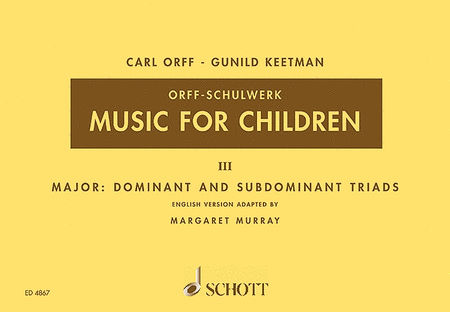
Music for Children

$21.99 18.54 € PDF SheetMusicPlus

Horn,Trombone,Trumpet,Tuba - Level 4 - Digital Download SKU: A0.1111643 Composed by Wolfgang Amadeus Mozart. Arranged by Regis Bookshar. Chamber,Christian,Classical,Instructional,Religious. 37 pages. Regis Bookshar #713937. Published by Regis Bookshar (A0.1111643). Recordare (from Requiem (K. 626) - Wolfgang Amadeus Mozart/Franz Xaver Sussmayr - Brass Septet - Advanced/Intermediate - Digital Download. Hauntingly beautiful is how the Recordare from Mozart's Requiem is often described. Originally written for an orchestra and four vocal soloists, it has now been transcribed by Regis Bookshar for a Brass Septet, consisting of 3 Bb Trumpets, 2 French Horns, 1 Trombones and 1 Tuba, and would be a wonderful addition to any music library. This arrangement will provide students with the opportunity to practice breath control because of its long, sustained phrases, and also to give them the chance to play this beautiful composition, something which they may not have had the opportunity to do, otherwise. This selection could be performed for concerts, recitals and church services and is suitable for high school and college students but professional musicians would also enjoy playing this arrangement. Included are a score and a complete set of parts (37 pages). The Regis Bookshar Trumpet Ensemble has performed the Trumpet Quintet version of the Recordare for funerals, providing beautiful, introspective music for the occasion. There is some controversy surrounding the circumstances of the Requiem's composition because Mozart died before he could complete it. Count Franz von Walsegg had commissioned a Requiem Mass but Mozart had received only half of the payment in advance. So, upon his death on December 5th, 1791, his widow, Constanze, wished to have the work completed secretly by someone else and submit it to the count as having been completed by Mozart to collect the final payment. Joseph von Eybler was one of the first composers to be asked to complete the score and had worked on a number of movements but felt unable to complete the remainder and gave the manuscript back to Constanze Mozart. The task was then given to another composer, Franz Xaver Sussmayr. Sussmayr borrowed some of Eybler's work in making his completion, added his own orchestration to other movements and added several new movements which a Requiem Mass would normally comprise. He then added a final section by adapting the opening two movements which Mozart had written to the different words which finish the Requiem Mass, which according to both Sussmayr and Mozart's wife, was done according to Mozart's directions. The completed score, initially by Mozart but largely finished by Sussmayr, was then dispatched to Count Walsegg complete with a counterfeited signature of Mozart dated 1792. Despite the controversy over how much of the music is actually Mozart's, the commonly performed Sussmayr version has become widely accepted by the public, and is considered one of Mozart's finest compositions. The Recordare is considered by many people to be one of the most beautiful compositions in Mozart's entire catalogue. Regis Bookshar, a trumpet player, has performed the Requiem in concert with a full orchestra, soloists and a chorus and felt that other musicians should have the opportunity to play the hauntingly beautiful Recordare as well. So, in addition to this arrangement for a Brass Septet, he has made quite a few other arrangements of this beautiful composition. There are Quintets, Sextets, Septets and Octets readily available for a wide variety of instrumental ensembles. Please take the time to look for other versions of this composition. You may fine something else which may also suit your needs. I would also encourage you to search for other arrangements by Regis Bookshar as well, as there are numerous arrangements in a variety of styles, also available for purchase. You may find something else which might interest you. Please continue to check periodically because new arrangements are being added as often as possible. I'm certain that this beautiful arrangement of Mozart's Recordare, will continue to entertain both performers and audiences alike for years to come.
Recordare (from "Requiem") (F) (Brass Septet - 3 Trp, 2 Hrn, 1 Trb, 1 Tuba)
Quatuor de Cuivres

$36.00 30.35 € Quatuor de Cuivres PDF SheetMusicPlus


Partitions Gratuites
Acheter des Partitions Musicales
Acheter des Partitions Digitales à Imprimer
Acheter des Instruments de Musique

© 2000 - 2026

Accueil - Version intégrale





