EUROPE
7917 articles
USA
0 articles
DIGITAL
16419 articles (à imprimer)
Partitions Digitales
Partitions à imprimer
16419 partitions trouvées


Large Ensemble Bass Voice,Cello,Flute,Piccolo,Viola,Violin - Digital Download SKU: A0.830756 Composed by Louis Moreau Gottschalk. Arranged by Richard Byrnes. Contemporary. Score and parts. 59 pages. Richard Byrnes #4983481. Published by Richard Byrnes (A0.830756). Now Orleans’s born Louis Moreau Gottschalk was an acclaimed 19th century pianist and composer. A pasquinade is a satire or lampoon. It was composed in Rio de Janeiro in 1869 and published in 1870.The arrangement is for (Picc,Fl,3Vn,2Va,3Vc,Cb).This piece would create a delightful addition to an ensemble concert, especially as a flute and piccolo feature.In addition to the Pasquinade by Gottschalk, we offer works by J.S. Bach, Debussy, Fauré, Glinka, Granados, Lotti, Mozart, Ravel, Richard Strauss, and Turina.
Pasquinade (String Nonet + Flute & Piccolo)

$39.99 34.77 € PDF SheetMusicPlus

Flute Solo - Digital Download SKU: A0.494114 Composed by Antonio Carlos Jobim and Newton Mendonça. Arranged by Leo Silva. Jazz. Individual part. 3 pages. Published by MP Sheet Music (A0.494114). Desafinado is a Bossa Nova song written by Antônio Carlos Jobim and Newton Mendonça recorded on November 10, 1958, at Estúdios Odeon, in Rio de Janeiro. It is considered one of the songs that best defines the genre. The song is a response to criticism at the time, which considered bossa nova as music for out-of-tune singers. It was later recorded by several artists, including Herb Alpert, Nara Leão, Ella Fitzgerald and Stan Getz who, in 1963, won the Grammy for Best Jazz Performance by a Soloist or Small Group for the song. Two English language adaptations of the song were made: Slightly Out of Tune by Jon Hendricks and Off Key by Gene Lees. The song appears on the Showtime series Dexter in its 8th season.
Desafinado
Flûte traversière

$5.10 4.43 € Flûte traversière PDF SheetMusicPlus

Instrumental Duet Alto Saxophone,Clarinet,Instrumental Duet - Level 3 - Digital Download SKU: A0.588526 Composed by David McKeown. Jazz,Latin,World. Score and parts. 5 pages. David McKeown #5770151. Published by David McKeown (A0.588526). Bossa de Bastião is an exciting original composition by David McKeown, arranged as a duet for one Clarinet and one Alto Saxophone.This duet is based on the Brazilian style of Bossa Nova which evolved in Rio de Janeiro during the late 1950s. Bossa in its purest form is lyrical song accompanied by nylon-stringed guitar. The rhythm derives from Samba but is played at around half tempo. The harmony is often complex and influenced by jazz; indeed it was the collaboration between guitarist João Gilberto and American Saxophonist Stan Getz that led to the huge international popularity of Bossa Nova in the 1960s and beyond.If you play to an intermediate standard and upwards, then you and your audience will enjoy this piece. Rhythms should be lightly articulated, the melody should always flow, and following the articulation in the score will help convey the style. Bossa de Bastião has a performance time of around two and a half minutes. You can listen to a full performance the Clarinet version of this duet by following the YouTube link above.There are many more top quality arrangements and compositions by David McKeown for you to browse at http://www.sheetmusicplus.com/publishers/david-mckeown/6203
Bossa de Bastião, for Clarinet and Alto Saxophone Duet
Saxophone, Clarinette (duo)

$3.99 3.47 € Saxophone, Clarinette (duo) PDF SheetMusicPlus

Trombone,Trumpet,Tuba - Level 4 - Digital Download SKU: A0.1139612 Composed by Szymon Wysocki. Arranged by John Fries. 20th Century,Jazz,Latin,Standards. 9 pages. John Fries #739886. Published by John Fries (A0.1139612). Please contact me by email at jfries@ptd.net to make a special request or to find out all that I have to offer and to express your comments or concerns.  You can also type John Fries in the searchbar to see all I have to offer.  Blue Bossa is an instrumental jazz composition by Kenny Dorham. This arrangement is for 2 trumpets, trombone and tuba. All parts are score are included. It was introduced on Joe Henderson's 1963 album Page One. A blend of hard bop and bossa nova, the tune was possibly influenced by Dorham's visit to the Rio de Janeiro Jazz Festival in 1961. The tune has since been recorded numerous times by different artists, making it a jazz standard.
Blue Bossa
Trio de Cuivres

$12.99 11.3 € Trio de Cuivres PDF SheetMusicPlus

Instrumental Duet,Piano Flute,Instrumental Duet,Piano,Violin - Level 3 - Digital Download SKU: A0.985912 Composed by Roger Davidson. Jazz,Latin. Score and parts. 2 pages. Musica Universalis Publishing #3012283. Published by Musica Universalis Publishing (A0.985912). From the CD Journey To Rio by Roger Davidson (Soundbrush Records)Like many Americans, Roger Davidson discovered the bossa nova through the recordings of Stan Getz, and since then, the sounds of Brazil have been especially close to his heart. In four previous CDs – Brazilian Love Song, Bom Dia, Rodgers in Rio, and Bingo – he brought his unique spin to the music of a country that, remarkably, he had never visited. In October 2011, that changed.Accompanied by his producer, the Argentine bassist and bandleader Pablo Aslan, Roger took his first trip to Brazil. Most of his eight days there, which he spent in Rio de Janeiro, were occupied by six recording sessions. Roger arrived with a hundred of his Brazilian compositions to choose from; the songs he recorded – in addition to several new ones he composed in Rio – comprise these two CDs.Journey to Rio features deeply emotional Brazilian love songs alongside Davidson’s French inspired compositions. These compositions enforce a sense of rooted emotion that melds Davidson’s vast life experiences of international culture with the modern expressions of Brazilian jazz. Latin Jazz Cornerhttp://soundbrush.com/album/journey-to-rio/
O Jogo (Maxixe) by Roger Davidson
Flûte, Violon, Piano

$1.99 1.73 € Flûte, Violon, Piano PDF SheetMusicPlus

Trombone Solo - Digital Download SKU: A0.495362 By Stan Getz & Astrud Gilberto. By Antonio Carlos Jobim, Norman Gimbel, and Vinicius De Moraes. Arranged by Leo Silva. Jazz,Latin. Individual part. 2 pages. Published by MP Sheet Music (A0.495362). The Girl From Ipanema (Girl from Ipanema) is a Brazilian song from Bossa Nova. It was composed by Antônio Carlos Jobim and written by Vinicius de Moraes in 1962. A 1964 version, recorded by Astrud Gilberto and Stan Getz in the United States, became an international success. This is present on the Getz/Gilberto album, which also included songs by João Gilberto. In the United States, the single reached number five on the Billboard Hot 100, remaining for two weeks, and in the United Kingdom it reached number 29. Ipanema is a beachfront neighborhood located in the southern region of the city of Rio de Janeiro/Brazil. The song was inspired by Heloísa Eneida Menezes Paes Pinto (now known as Helo Pinheiro), a seventeen-year-old girl who lived on Montenegro Street in Ipanema. Every day, she passed the bar-café Veloso on her way to the beach.
The Girl From Ipanema (garôta De Ipanema)
Trombone
Stan Getz & Astrud Gilberto
$5.42 4.71 € Trombone PDF SheetMusicPlus

Trombone Duet Trombone - Level 3 - Digital Download SKU: A0.589039 Composed by David McKeown. Jazz,Latin,World. Score. 5 pages. David McKeown #5770193. Published by David McKeown (A0.589039). Bossa de Bastião is an exciting original composition by David McKeown, arranged as a duet for two Trombones.This duet is based on the Brazilian style of Bossa Nova which evolved in Rio de Janeiro during the late 1950s. Bossa in its purest form is lyrical song accompanied by nylon-stringed guitar. The rhythm derives from Samba but is played at around half tempo. The harmony is often complex and influenced by jazz; indeed it was the collaboration between guitarist João Gilberto and American Saxophonist Stan Getz that led to the huge international popularity of Bossa Nova in the 1960s and beyond.If you play to an intermediate standard and upwards, then you and your audience will enjoy this piece. Rhythms should be lightly articulated, the melody should always flow, and following the articulation in the score will help convey the style. Bossa de Bastião has a performance time of around two and a half minutes. You can listen to a full performance the Clarinet version of this duet by following the YouTube link above.There are many more top quality arrangements and compositions by David McKeown for you to browse at http://www.sheetmusicplus.com/publishers/david-mckeown/6203
Bossa de Bastião, for Trombone Duet
2 Trombones (duo)

$3.99 3.47 € 2 Trombones (duo) PDF SheetMusicPlus

Instrumental Duet,Piano Flute,Instrumental Duet,Piano,Violin - Level 3 - Digital Download SKU: A0.985905 Composed by Roger Davidson. Jazz,Latin. Score and parts. 3 pages. Musica Universalis Publishing #3012265. Published by Musica Universalis Publishing (A0.985905). From the CD Journey To Rio by Roger Davidson (Soundbrush Records)Like many Americans, Roger Davidson discovered the bossa nova through the recordings of Stan Getz, and since then, the sounds of Brazil have been especially close to his heart. In four previous CDs – Brazilian Love Song, Bom Dia, Rodgers in Rio, and Bingo – he brought his unique spin to the music of a country that, remarkably, he had never visited. In October 2011, that changed.Accompanied by his producer, the Argentine bassist and bandleader Pablo Aslan, Roger took his first trip to Brazil. Most of his eight days there, which he spent in Rio de Janeiro, were occupied by six recording sessions. Roger arrived with a hundred of his Brazilian compositions to choose from; the songs he recorded – in addition to several new ones he composed in Rio – comprise these two CDs.Journey to Rio features deeply emotional Brazilian love songs alongside Davidson’s French inspired compositions. These compositions enforce a sense of rooted emotion that melds Davidson’s vast life experiences of international culture with the modern expressions of Brazilian jazz. Latin Jazz Cornerhttp://soundbrush.com/album/journey-to-rio/
Journey To Rio (Samba) by Roger Davidson
Flûte, Violon, Piano

$1.99 1.73 € Flûte, Violon, Piano PDF SheetMusicPlus

Woodwind Ensemble,Woodwind Quartet - Level 4 - Digital Download SKU: A0.747011 By The Andrews Sisters. By Aloysio Oliveira, Ervin Drake, and Zequinha Abreu. Arranged by Keith Terrett. Classical,Latin,Multicultural,World. 14 pages. Keith Terrett #5869499. Published by Keith Terrett (A0.747011). Arranged for Recorder Quartet  Tico-Tico no fubá (sparrow in the cornmeal, or, literally, rufous-collared sparrow in the cornmeal) is a Brazilian choro song written by Zequinha de Abreu in 1917. A great arrangement for your next performance, sure to be a big hit with your audience!Its original title was Tico-Tico no farelo (sparrow in the bran), but since Brazilian guitarist Américo Jacomino Canhoto (1889–1928) had a work with the same title, Abreu's work was given its present name in 1931, and sometime afterward Aloysio de Oliveira wrote the original Portuguese lyrics.Eros Volusia and her dancers dance to Tico-Tico in 1942 Rio Rita. Ethel Smith performed Tico-Tico onscreen in Bathing Beauty (1944). Carmen Miranda performed Tico-Tico onscreen in Copacabana (1947); It was also featured in the Aquarela do Brasil segment of the Walt Disney film Saludos Amigos (1942) and in Woody Allen's Radio Days (1987).In Quebec the song has been used for several decades in commercials for Sico paint.In season three of Mama's Family episode An Ill Wind, an intoxicated Iola briefly sings the song's chorus before passing out onto a bed.This song can be heard on various episodes of the Belgian Kabouter Wesley cartoon.In season one of Narcos: Mexico, episode 3 (El Padrino), the orchestral version of the song is played by a band during a reception. A biographical movie about Zequinha de Abreu with the same title, Tico-Tico no Fubá was produced in 1952 by the Brazilian film studio Companhia Cinematográfica Vera Cruz, starring Anselmo Duarte as Abreu.The title phrase also features in the lyrics to the song O Pato made famous by João Gilberto.Choro (Portuguese pronunciation: [ˈʃoɾu], cry or lament), also popularly called chorinho (little cry or little lament), is an instrumental Brazilian popular music genre which originated in 19th century Rio de Janeiro. Despite its name, the music often has a fast and happy rhythm. It is characterized by virtuosity, improvisation and subtle modulations, and is full of syncopation and counterpoint. Choro is considered the first characteristically Brazilian genre of urban popular music. The serenaders who play choros are known as chorões.
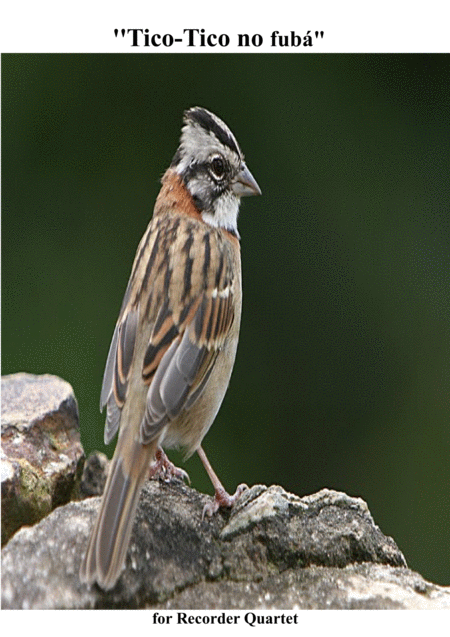
Tico Tico (tico Tico No Fuba)
Flûte, Hautbois, Clarinette, Basson
The Andrews Sisters
$12.99 11.3 € Flûte, Hautbois, Clarinette, Basson PDF SheetMusicPlus


Partitions Gratuites
Acheter des Partitions Musicales
Acheter des Partitions Digitales à Imprimer
Acheter des Instruments de Musique

© 2000 - 2026

Accueil - Version intégrale





