EUROPE
17275 articles
USA
0 articles
DIGITAL
11895 articles (à imprimer)
Partitions Digitales
Partitions à imprimer
11895 partitions trouvées


Woodwind Ensemble,Woodwind Quintet Bassoon,Clarinet,Flute,Horn,Oboe - Level 4 - Digital Download SKU: A0.764746 Composed by St. Jean De Brébeuf (1593-1649). Arranged by James Pybus. Christmas,Classical,Spiritual,Standards. 25 pages. James Pybus #6672567. Published by James Pybus (A0.764746). The Huron Carol (or ‘Twas in the Moon of Wintertime) is a Canadian Christmas hymn (Canada's oldest Christmas song), written probably in 1643 by Jean de Brébeuf, a Jesuit missionary at Sainte-Marie among the Hurons in Canada. Brébeuf wrote the lyrics in the native language of the Huron/Wendat people; the song's original Huron title is Jesous Ahatonhia (Jesus, he is born). The song's melody is based on a traditional French folk song, Une Jeune Pucelle (A Young Maid). The well-known English lyrics were written in1926 by Jesse Edgar Middleton. This arrangement is for Woodwind Quintet. Duration is 4:08. Contact me at james.pybus56@gmail.com.
Huron Carol ('Twas in the Moon of Wintertime) (woodwind quintet arrangement)
Quintette à Vent: flûte, Hautbois, basson, clarinette, Cor

$19.99 17.34 € Quintette à Vent: flûte, Hautbois, basson, clarinette, Cor PDF SheetMusicPlus

Voice and piano (2 songs with violoncello; 1 vocal duet) - Medium - Digital Download SKU: MQ.8491-39E Composed by MeeAe Cecilia Nam and Theodore Gouvy. 3 pages. E. C. Schirmer Music Company - Digital #8491-39E. Published by E. C. Schirmer Music Company - Digital (MQ.8491-39E). French.A French composer, Théodore Gouvy (1819-1898) was one of the most significant composers of 19th Century in Europe. The movement of rediscovering his instrumental music has been increasingly successful in Europe since the 1990s, especially following the birth of L’Institut Gouvy in France. However, his solo vocal music has been waiting to be unveiled to the public. Volume One includes 52 songs of Gouvy.Gouvy traveled widely throughout Europe. He was also a lover of nature. Generally, he spent his winters in Leipzig, but in the summertime, he always returned to Hombourg-Haut, France, to stroll through the woods, to hunt, and to relax. Gouvy was fluent in several languages and had a great appreciation of the Renaissance French Poetry of Pierre de Ronsard whose poetry he had set to music. The fifty-two songs in this volume are largely by Ronsard and other Renaissance poets of La Pléiade.Although Ronsard is approximately 300 years older than Gouvy, they both seem to have the same interest in classical literature, though, admittedly, for different reasons. Celebrated by the French and English courts, Ronsard (1525-1585) was the leader of La Pléiade: a group of seven poets (Joachim Du Bellay (1522-1560), Rémy Belleau (1528-1577), Étienne Jodelle (1532-1573), Pontus de Tyard (1521-1603), Jean–Antoine Baïf (1532-1589), and Jean Daurat (1508-1588), who dedicated their efforts to writing poetry in French rather than in Latin (or Greek) as most of the Romantic poets did. They wished to enrich the French language, and establish a new literature which would be the equal of the other literature of their period, and the equal to poets of the past. French Romantic poetry featured the closeness of the poet to nature, and his ability to communicate with nature by personifying (anthropomorphizing) all of nature’s elements: flowers, the planets, the moon, the breeze, and even the sand upon the shore. As a significant melodist, Gouvy’s treatment of the vocal solo line and his treatment and development of the piano accompaniment places him in the upper echelons as a composer of songs. His diverse cultural life led a rich and significant musical life, interacting with his contemporaries who admired his work, and whom Gouvy knew well, such as Liszt, Brahms, Schumann, Mendelssohn, Berlioz and Gounod. Contents:Six Odes de Ronsard pour ténor et piano, Op. 37 (No. 3 et No. 5 avec violoncelle) Neuf Poésies de Ronsard pour soprano ou ténor et piano, Op. 41 Six Poésies de Ronsard pour soprano ou ténor et piano, Op. 42 Quatre Odes de Ronsard pour baryton et piano, Op. 43 Huit Poésies de Ronsard pour ténor ou soprano et piano, Op. 44 Sept Poésies de Ronsard pour ténor ou soprano et piano, Op. 47.
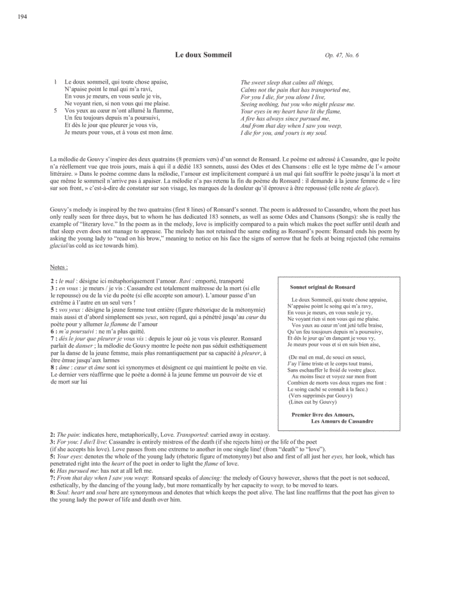
Op. 47, No. 6: Le doux Sommeil from Songs of Gouvy, V1 (Downloadable)
Piano, Voix

$3.00 2.6 € Piano, Voix PDF SheetMusicPlus

Voice and piano (2 songs with violoncello; 1 vocal duet) - Medium - Digital Download SKU: MQ.8491-21E Composed by MeeAe Cecilia Nam and Theodore Gouvy. 7 pages. E. C. Schirmer Music Company - Digital #8491-21E. Published by E. C. Schirmer Music Company - Digital (MQ.8491-21E). French.A French composer, Théodore Gouvy (1819-1898) was one of the most significant composers of 19th Century in Europe. The movement of rediscovering his instrumental music has been increasingly successful in Europe since the 1990s, especially following the birth of L’Institut Gouvy in France. However, his solo vocal music has been waiting to be unveiled to the public. Volume One includes 52 songs of Gouvy.Gouvy traveled widely throughout Europe. He was also a lover of nature. Generally, he spent his winters in Leipzig, but in the summertime, he always returned to Hombourg-Haut, France, to stroll through the woods, to hunt, and to relax. Gouvy was fluent in several languages and had a great appreciation of the Renaissance French Poetry of Pierre de Ronsard whose poetry he had set to music. The fifty-two songs in this volume are largely by Ronsard and other Renaissance poets of La Pléiade.Although Ronsard is approximately 300 years older than Gouvy, they both seem to have the same interest in classical literature, though, admittedly, for different reasons. Celebrated by the French and English courts, Ronsard (1525-1585) was the leader of La Pléiade: a group of seven poets (Joachim Du Bellay (1522-1560), Rémy Belleau (1528-1577), Étienne Jodelle (1532-1573), Pontus de Tyard (1521-1603), Jean–Antoine Baïf (1532-1589), and Jean Daurat (1508-1588), who dedicated their efforts to writing poetry in French rather than in Latin (or Greek) as most of the Romantic poets did. They wished to enrich the French language, and establish a new literature which would be the equal of the other literature of their period, and the equal to poets of the past. French Romantic poetry featured the closeness of the poet to nature, and his ability to communicate with nature by personifying (anthropomorphizing) all of nature’s elements: flowers, the planets, the moon, the breeze, and even the sand upon the shore. As a significant melodist, Gouvy’s treatment of the vocal solo line and his treatment and development of the piano accompaniment places him in the upper echelons as a composer of songs. His diverse cultural life led a rich and significant musical life, interacting with his contemporaries who admired his work, and whom Gouvy knew well, such as Liszt, Brahms, Schumann, Mendelssohn, Berlioz and Gounod. Contents:Six Odes de Ronsard pour ténor et piano, Op. 37 (No. 3 et No. 5 avec violoncelle) Neuf Poésies de Ronsard pour soprano ou ténor et piano, Op. 41 Six Poésies de Ronsard pour soprano ou ténor et piano, Op. 42 Quatre Odes de Ronsard pour baryton et piano, Op. 43 Huit Poésies de Ronsard pour ténor ou soprano et piano, Op. 44 Sept Poésies de Ronsard pour ténor ou soprano et piano, Op. 47.
Op. 42, No. 6: Chanson from Songs of Gouvy, V1 (Downloadable)
Piano, Voix

$3.00 2.6 € Piano, Voix PDF SheetMusicPlus

Voice and piano (2 songs with violoncello; 1 vocal duet) - Medium - Digital Download SKU: MQ.8491-28E Composed by MeeAe Cecilia Nam and Theodore Gouvy. 5 pages. E. C. Schirmer Music Company - Digital #8491-28E. Published by E. C. Schirmer Music Company - Digital (MQ.8491-28E). French.A French composer, Théodore Gouvy (1819-1898) was one of the most significant composers of 19th Century in Europe. The movement of rediscovering his instrumental music has been increasingly successful in Europe since the 1990s, especially following the birth of L’Institut Gouvy in France. However, his solo vocal music has been waiting to be unveiled to the public. Volume One includes 52 songs of Gouvy.Gouvy traveled widely throughout Europe. He was also a lover of nature. Generally, he spent his winters in Leipzig, but in the summertime, he always returned to Hombourg-Haut, France, to stroll through the woods, to hunt, and to relax. Gouvy was fluent in several languages and had a great appreciation of the Renaissance French Poetry of Pierre de Ronsard whose poetry he had set to music. The fifty-two songs in this volume are largely by Ronsard and other Renaissance poets of La Pléiade.Although Ronsard is approximately 300 years older than Gouvy, they both seem to have the same interest in classical literature, though, admittedly, for different reasons. Celebrated by the French and English courts, Ronsard (1525-1585) was the leader of La Pléiade: a group of seven poets (Joachim Du Bellay (1522-1560), Rémy Belleau (1528-1577), Étienne Jodelle (1532-1573), Pontus de Tyard (1521-1603), Jean–Antoine Baïf (1532-1589), and Jean Daurat (1508-1588), who dedicated their efforts to writing poetry in French rather than in Latin (or Greek) as most of the Romantic poets did. They wished to enrich the French language, and establish a new literature which would be the equal of the other literature of their period, and the equal to poets of the past. French Romantic poetry featured the closeness of the poet to nature, and his ability to communicate with nature by personifying (anthropomorphizing) all of nature’s elements: flowers, the planets, the moon, the breeze, and even the sand upon the shore. As a significant melodist, Gouvy’s treatment of the vocal solo line and his treatment and development of the piano accompaniment places him in the upper echelons as a composer of songs. His diverse cultural life led a rich and significant musical life, interacting with his contemporaries who admired his work, and whom Gouvy knew well, such as Liszt, Brahms, Schumann, Mendelssohn, Berlioz and Gounod. Contents:Six Odes de Ronsard pour ténor et piano, Op. 37 (No. 3 et No. 5 avec violoncelle) Neuf Poésies de Ronsard pour soprano ou ténor et piano, Op. 41 Six Poésies de Ronsard pour soprano ou ténor et piano, Op. 42 Quatre Odes de Ronsard pour baryton et piano, Op. 43 Huit Poésies de Ronsard pour ténor ou soprano et piano, Op. 44 Sept Poésies de Ronsard pour ténor ou soprano et piano, Op. 47.

Op. 44, No. 3: À Marie from Songs of Gouvy, V1 (Downloadable)
Piano, Voix

$3.00 2.6 € Piano, Voix PDF SheetMusicPlus

Brass Ensemble Horn,Trombone,Trumpet,Tuba - Level 4 - Digital Download SKU: A0.764745 Composed by St. Jean De Brébeuf (1593-1649). Arranged by James Pybus. Christmas,Classical,Spiritual,Standards. Score and parts. 25 pages. James Pybus #6671015. Published by James Pybus (A0.764745). The Huron Carol (or ‘Twas in the Moon of Wintertime) is a Canadian Christmas hymn (Canada's oldest Christmas song), written probably in 1643 by Jean de Brébeuf, a Jesuit missionary at Sainte-Marie among the Hurons in Canada. Brébeuf wrote the lyrics in the native language of the Huron/Wendatpeople; the song's original Huron title is Jesous Ahatonhia (Jesus, he is born). The song's melody is based on a traditional French folk song, Une Jeune Pucelle (A Young Maid). The well-known English lyrics were written in1926 by Jesse Edgar Middleton. This arrangement is for Brass Quintet. Duration is 4:08. Contact me at james.pybus56@gmail.com.
Huron Carol ('Twas in the Moon of Wintertime) (brass quintet arrangement)
Quatuor de Cuivres : 2 trompettes, trombone, tuba

$19.99 17.34 € Quatuor de Cuivres : 2 trompettes, trombone, tuba PDF SheetMusicPlus

Cello,Instrumental Duet,Violin - Level 4 - Digital Download SKU: A0.1454090 Composed by Jean-Joseph Mouret. Arranged by Dina H. L. Slechta. Baroque,Chamber,Classical,Wedding. 8 pages. Dina H. L. Slechta #1033264. Published by Dina H. L. Slechta (A0.1454090). Standard prelude repertoire in the Wedding Music Series, Rondeau from Première Suite, by Jean-Joseph Mouret, is arranged here by ArrangeMe.com arranger, Dina H. L. Slechta, for Violin and Cello Duet.  The approximate playing time for Rondeau is two and a half minutes for the entire piece.  Rehearsal letters are provided at the beginnings of phrases to allow some possibilities for starting and stopping places within the arrangement for different times needed in weddings.Cover, Score, Violin and Cello Parts - altogether 8 pages.Recommended for late intermediate musicians.
Rondeau (From Première Suite)
Violon, Violoncelle (duo)

$7.99 6.93 € Violon, Violoncelle (duo) PDF SheetMusicPlus


Partitions Gratuites
Acheter des Partitions Musicales
Acheter des Partitions Digitales à Imprimer
Acheter des Instruments de Musique

© 2000 - 2026

Accueil - Version intégrale




