EUROPE
17275 articles
USA
0 articles
DIGITAL
11893 articles (à imprimer)
Partitions Digitales
Partitions à imprimer
11893 partitions trouvées


Choral Choir,Choral (SATB divisi) - Level 3 - Digital Download SKU: A0.596678 By Michael Feinstein. By Paul Horner. Arranged by Réjean Marois. A Cappella,Contemporary,Pop. 7 pages. Marois Music Publications #4777839. Published by Marois Music Publications (A0.596678). For Alto solo and SSAATBB a cappella. A beautiful melody by Paul Horner with lovely, touching lyrics by Peggy Lee. Peggy actually made a professionally recorded demo of this song. Over the decades, she expressed a desire to release it, but it never happened. I have made this arrangement for a workshop and concert with Carol Welsman. This interpretation is from one of my vocal ensemble at Capilano University, North Vancouver, Canada. Complete live recording at :https://maroismusic.com/arrangements/
Angels On Your Pillow
Chorale SATB
Michael Feinstein
$3.99 3.46 € Chorale SATB PDF SheetMusicPlus

Choral Choir (SATB) - Level 4 - Digital Download SKU: A0.984035 Composed by Adam de la Halle. Arranged by Jean Beck, Jilly Cooke. Children,Classical,Musical/Show,Opera,World. Octavo. 108 pages. Jilly Paige Cooke #5797601. Published by Jilly Paige Cooke (A0.984035). This is the first COMPLETE digital piano-vocal score of Adam de la Halle's Le Jeu de Robin et Marion.Le Jeu de Robin et Marion is reputedly the earliest French secular play with music, written in around 1282 or 1283, and is the most famous work of Adam de la Halle. It was performed at the Angevin Court in Naples around this time. The story is a dramatization of a traditional genre of medieval French song, the pastourelle. This genre typically tells of an encounter between a knight and a shepherdess, frequently named Marion. Adam de la Halle's version of the story places a greater emphasis on the activities of Marion, her lover Robin and their friends after she resists the knight's advances.
Le Jeu de Robin et Marion
Chorale SATB

$27.99 24.29 € Chorale SATB PDF SheetMusicPlus

B-Flat Clarinet,Piano - Level 3 - Digital Download SKU: A0.549554 Composed by Edvard Grieg. Arranged by James M. Guthrie, ASCAP. Instructional,Multicultural,Romantic Period,Standards,World. Score and part. 15 pages. Jmsgu3 #3507527. Published by jmsgu3 (A0.549554). Edvard Grieg (1843 –1907) was a Norwegian composer as well as a concert pianist. Most music historians consider him one of the foremost Romantic era composers. Consequently, his music is part of the international standard classical repertoire. Grieg, moreover, used Norwegian folk music in his compositions.  Consequently, he ushered Norwegian music to transnational consciousness. Furthermore, he forged a national musical identity for Norway. It is essential to realize that he did this in a manner similar to Jean Sibelius in Finland and Bedřich Smetana in Bohemia. Grieg's Anitra's Dance is a significant movement from his Peer Gynt Suite. It depicts a seductive dance emphasizing the grace and beauty of Anitra, the daughter of a chieftain, who steals Peer Gynt's money after he attempts to seduce her. The movement acts as a fun and playful scherzo, with a waltz feel and pizzicato string sections creating a chaotic and fast-paced atmosphere, reflecting Anitra's seductiveness and Peer Gynt's infatuation with her. This piece is part of Grieg's incidental music to Henrik Ibsen's play Peer Gynt, and it is a notable example of Grieg's ability to musically capture the essence of the play's characters and scenes.
Grieg: Anitra's Dance from Peer Gynt Suite for Clarinet & Piano
Clarinette et Piano

$24.95 21.65 € Clarinette et Piano PDF SheetMusicPlus

Viola and piano - easy to intermediate - Digital Download SKU: S9.Q18642 Composed by Erik Satie. Arranged by Wolfgang Birtel. This edition: Sheet music. Edition Schott - Single Edition. Downloadable. Schott Music - Digital #Q18642. Published by Schott Music - Digital (S9.Q18642). The music scene took notice of Erik Satie (1866-1925) all of a sudden: The world premiere of his ballet 'Parade' on 18 May 1917 [siehe dt. Text!] caused quite a scandal. The production which involved Sergey Diaghilev with his 'Ballets Russes', Pablo Picasso (scenery and costumes), Jean Cocteau (story) as well as Léonide Massine (choreography) divided the music scene of Paris, yet made the composer widely known. Satie who hardly had had any solid musical training and lived in Paris for almost all his life developed a new musical style, in deliberate rejection of the 'Wagnérisme' of his time. Classical form models, new harmonies, stylistic ease, meditative and clownish elements amalgamated in an original way, the perfect example being his '3 Gymnopédies' of 1888 the first of which was here arranged for a solo instrument with piano accompaniment: Thus, it is now possible, even for non-pianists, to play this famous miniature by Satie. Thanks to its easy playability, it can also be used for educational purposes.
Gymnopédie No. 1
Alto, Piano

$4.99 4.33 € Alto, Piano PDF SheetMusicPlus

Concert Band - Digital Download SKU: AX.00-PC-0014584_WPBTC1 (wp) Baritone T.C.. Arranged by Vince Gassi. Instructional. World Part. 1 pages. Alfred Music - Digital Sheet Music #00-PC-0014584_wpBTC1. Published by Alfred Music - Digital Sheet Music (AX.00-PC-0014584_WPBTC1). UPC: 038081380674.The Huron Carol is Canada's oldest Christmas carol, written in 1643 by Jean de BrA(c)beuf, a Jesuit missionary. The melody is from a tradition French folk song, Une Jeune Pucelle (A Young Maid). Intended as a gift and teaching aid to the Huron people, BrA(c)beuf wrote the lyrics in their native language. The Moon of Winter is a powerful and moving adaptation of this carol for band that will enhance your next Christmas concert, adding a sense of reverence and honor. (2:57) This title is available in SmartMusic.
The Moon of Winter (The Huron Carol): (wp) Baritone T.C.
Orchestre d'harmonie

$3.00 2.6 € Orchestre d'harmonie PDF SheetMusicPlus

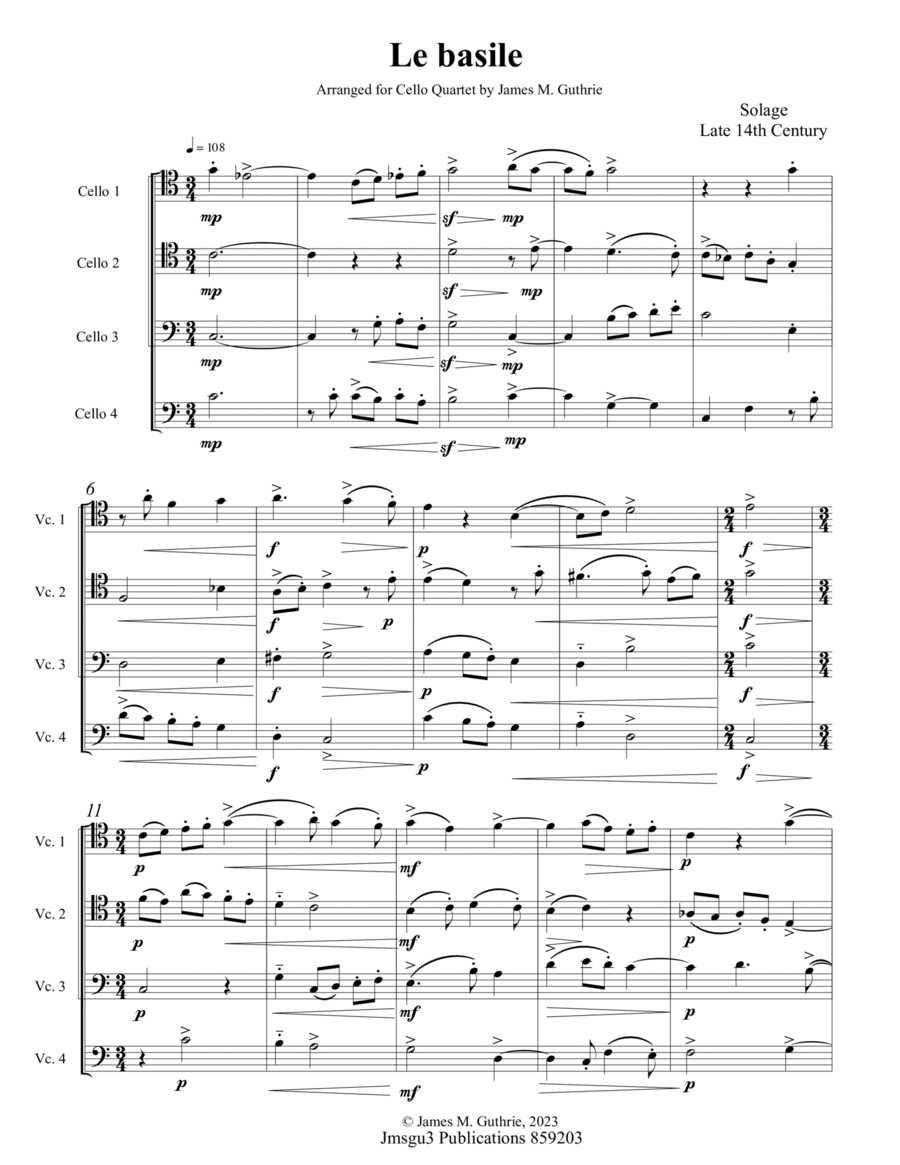
String Quartet Cello,String Quartet - Level 2 - Digital Download SKU: A0.1266472 Composed by Solage. Arranged by James M. Guthrie. Chamber,Contest,Early Music,Festival,Historic,Medieval. 8 pages. Jmsgu3 #859203. Published by jmsgu3 (A0.1266472). Solage's ballade Le basile de sa propre nature is a significant work in the history of medieval music. Here are some of its historical significances:1. It is one of the twelve surviving works attributed to Solage, a French composer who lived in the late 14th century. Solage's works are known for their complex rhythms, intricate harmonies, and expressive melodies.2. Le basile de sa propre nature is a four-voice ballade that features a text about the mythical creature known as the basilisk. The lyrics describe the basilisk as a monster that kills everything it sees with its deadly venom. The music is characterized by its intricate rhythms and harmonies, which reflect the text's vivid imagery.3. The ballade is preserved in the Chantilly Codex, a manuscript that contains a collection of French secular music from the late 14th century. The Chantilly Codex is one of the most important sources of medieval music, and it provides valuable insights into the musical practices of the time.4.Le basile de sa propre nature is an example of the Ars subtilior style, which was a highly experimental and complex musical style that emerged in the late 14th century. This style was characterized by its use of intricate rhythms, complex harmonies, and unusual notational practices. The Ars subtilior style was highly influential in the development of later musical styles, and it remains an important part of the medieval musical canon.Overall, Solage's ballade Le basile de sa propre nature is a significant work that reflects the complex and experimental musical practices of the late 14th century. Its vivid imagery, intricate rhythms, and complex harmonies make it a valuable contribution to the medieval musical canon.Lyrics:All those he sees he kills suddenly,For his venom is deadly.He is a basilisk by his own nature,And he has no other way of being. He is a monster of great power,And he is feared by all who know him.He is a creature of the earth,And he is a master of death. He is a basilisk by his own nature,And he has no other way of being.All those he sees he kills suddenly,For his venom is deadly. He is a creature of the night,And he is a master of the dark.He is a monster of great might,And he is feared by all who hear his name. He is a basilisk by his own nature,And he has no other way of being.All those he sees he kills suddenly,For his venom is deadly.Solage was a French composer and probably also a poet who lived in the late 14th century. He composed the most pieces in the Chantilly Codex, which is the principal source of music of the ars subtilior, a manneristic compositional school centered on Avignon at the end of the century. Solage is an obscure composer, and aside from what can be deduced from the pieces attributed to him in the Chantilly Codex, nothing else is known about him. There are several interpretations of his name, and it is not clear whether his first name was Jean or Charles. The ars subtilior was a manneristic compositional school centered on Avignon at the end of the 14th century. It was characterized by complex rhythms and pitch, and it was a transitional period between the late medieval and Renaissance periods. Solage was one of the composers who fit into this school, and he composed the most pieces in the Chantilly Codex, which is the principal source of music of the ars subtilior. Stylistically, Solage's works exhibit two distinctly different characters: a relatively simple one usually associated with his great predecessor and elder contemporary Guillaume de Machaut, and a more recherché one, complex in the areas of both pitch and rhythm, characteristic of the ars subtilior. 
Solage: Le basile for Cello Quartet
4 Violoncelles

$32.95 28.59 € 4 Violoncelles PDF SheetMusicPlus


Partitions Gratuites
Acheter des Partitions Musicales
Acheter des Partitions Digitales à Imprimer
Acheter des Instruments de Musique

© 2000 - 2026

Accueil - Version intégrale