EUROPE
17275 articles
USA
0 articles
DIGITAL
11896 articles (à imprimer)
Partitions Digitales
Partitions à imprimer
11896 partitions trouvées


Large Ensemble Alto Recorder,Alto Saxophone,Banjo,Bassoon,Clarinet,English Horn,Flute,Guitar,Harpsichord,Oboe,Organ,Piano,Soprano Recorder,Soprano Saxophone,Tenor Recorder,Tenor Saxophone,Trumpet,Ukulele,Viola,Violin,Voice - Digital Download SKU: A0.858930 Composed by Giovanni Battista Martini. Arranged by Stephen Bulat. Classical,Holiday,Love,Praise & Worship,Sacred,Wedding. Score and parts. 3 pages. Stephen Bulat Publishing #6244997. Published by Stephen Bulat Publishing (A0.858930). Plaisir d'amour (literally Pleasure of love) is a classical French love song written in 1784 by Jean-Paul-Égide Martini. It's melody was the basis for Elvis Presley's hit, Can't Help Falling In Love. It has been performed by many recording artists including Charlotte Church, Joan Baez, Marianne Faithful, Roger Whittaker, The King's Singers, Andrea Bocelli, Nana Mouskouri and Emmylou Harris. A classical songbook must-have, this arrangement has been gig-tested and has a very easy to follow roadmap, with all essential music notes, musical cues and rehearsal markings throughout. Layout is in a larger style font than lead sheets in a typical fakebook yet still condensed to fit on 2 pages. This format can be used for guitar sheet music, for piano sheet music, as instrumental sheet music, vocal sheet music or as accompaniment to a soloist (e.g. violin, flute)Please click on the publisher to view this song in other keys as well as to purchase it in the Classical Wedding Fake Book or the Classic Love Songs - A Valentine's Day Fake Book.Classical Wedding Fake Book (C Instruments): https://www.sheetmusicplus.com/title/21758919 - Item Number: S0.776313Classical Wedding Fake Book (Bb Instruments): https://www.sheetmusicplus.com/title/21758922- Item Number: S0.776329Classical Wedding Fake Book (Eb Instruments): https://www.sheetmusicplus.com/title/21758923- Item Number: S0.776333Classical Wedding Fake Book - Band Leader Gig Pack (C, Bb & Eb Instruments): https://www.sheetmusicplus.com/title/21758924 - Item Number: S0.776337Classic Love Songs - A Valentine's Day Fake Book (C Instruments): https://www.sheetmusicplus.com/title/21964690 - Item Number: S0.975249Classic Love Songs - A Valentine's Day Fake Book (Bb Instruments): https://www.sheetmusicplus.com/21964694 - Item Number: S0.975257Classic Love Songs - A Valentine's Day Fake Book (Eb Instruments): https://www.sheetmusicplus.com/title/21964697 - Item Number: S0.975263Classic Love Songs - A Valentine's Day Fake Book - Band Leader Gig Pack (C, Bb & Eb Instruments): https://www.sheetmusicplus.com/title/21964701 - Item Number: S0.975271SMPPress publisher page: https://www.sheetmusicplus.com/publishers/stephen-bulat-sheet-music/3007289 Stephen Bulat (H0.873589-SC000010569Online: http://stephenbulat.com
Plaisir d'amour (Pleasure of Love) - Lead sheet in original key of Eb

$2.99 2.59 € PDF SheetMusicPlus

Woodwind Ensemble,Woodwind Quintet Baritone Saxophone - Level 2 - Digital Download SKU: A0.1128144 Composed by Ludwig van Beethoven. Arranged by Ander. Classical,Folk,March,Opera,Romantic Period. 12 pages. Woods Only, Arrangements #728759. Published by Woods Only, Arrangements (A0.1128144). This arrangement adapted for baritone sax quintet was written keeping the characteristics of the original work, in order to be performed by young music students who want to enter the symphonic music. Besides, it can also be used by professional musicians for recitals, repertoire, academic presentations and didactic material. The transcription remains faithful to the structure, with only one change in tone, so that it is comfortable for all the instruments in the formation, as well as being used as an activity in ensemble practice among musicians of different traditions. Beethoven's Turkish March (Op. 113) is the 4th movement of the operatic work: The Ruins of Athens, a set of incidental pieces written in 1812 by Ludwig van Beethoven, where the melody was originally written in 1809 as Theme with Six Variations for Piano, Op. 76. The work was written to accompany the play of the same name by August von Kotzebue, for the dedication of a new theater in Pest. Perhaps the best known part of the composition is the Marcia alla turca, In Latin America, this movement became known in Jean-Jacques Perrey's version (who titled it The Elephant never Forgets) since it was used as the opening theme of the successful Mexican TV comedy El Chavo del Ocho. The opening and the turkish march are often performed separately, and the other pieces in this set are not often heard.
Turkish March by Beethoven for Baritone Sax Quintet
Quintette de Saxophone: 5 saxophones

$9.99 8.64 € Quintette de Saxophone: 5 saxophones PDF SheetMusicPlus

Chamber Orchestra - Level 4 - Digital Download SKU: A0.534136 Composed by Louis Adolphe Mayeur. Opera,Romantic Period,Standards. Score and parts. 49 pages. Musik Fabrik Music Publishing #3133403. Published by Musik Fabrik Music Publishing (A0.534136). Louis Adolphe Mayeur (1837 - 1894), was a Belgium clarinetist, saxophonist, composer and conductor who spent most of his musical career in France; Entering the French Military in 1855, he was a clarinetist in the Second Régiment of the Cuirassiers (Mounted Calvary) of the Garde Impériale. A student of Klosé at the Paris Conservatory, he received his First Prize in Clarinet in 1860. One of the inner circle of Adolphe Sax (along with fellow Belgiums Jules Demersseman and Jean-Baptiste Singelée, whose “Quartet for Saxophones“ was premièred with Mayeur playing and Demersseman conducting), Mayeur took up the saxophone and was quickly engaged as the saxophone soloist in the Opera House of Brussels, La Monnaie (the Mint). Sax commissioned a number of works from Mayeur for the saxophone, which were published by his company and used in his class at the Paris Conservatory.By 1871, Mayeur was also named Saxophone Solo with the Paris Opera, performing in opears and ballets by Halévy, Meyerbeer, Thomas, Saint-Saens, Massenet,   Délibes and Paladlihe. It would appear that sometime during this period, his relations with Sax became difficult, culminating in his publications of works by Buffet-Crampon, one of Sax’s rival companies and one of the main protagonists in the series of lawsuits which led to Sax’s bankrupcy. Mayeur’s own declining health lead to his death in 1894.The Grande Fantaisie de Concert sur Rigoletto dates from 1877. The contrasting sections use motifs from arias and duets from Verdi’s opera. Florid cadenzas seperate the various sections, but those passages should be played in the manner of “bel canto†ornamentation, always lyrical and songlike.  This is the score and solo part for the orchestral version. Versions are available from Musik Fabrik for piano for Symhony Orchestra (on rental : 2222/2000/Timp/hp/strings) and for Concert Band (for sale). The score plus solo part for each of the versions is available for sale, as well as the individual parts for the concert band version
Louis Mayeur: Grande Fantaisie de Concert sur Rigoletto (de Verdi) for alto saxophone and orchestra
Orchestre de chambre
1871, Mayeur was also named Saxophone Solo with the Paris Opera, performing in opears and ballets by Halévy, Meyerbeer, Thomas, Saint-Saens, Massenet,   Délibes and Paladlihe It would appear that sometime during this period, his relations with Sax became difficult, culminating in his publications of works by Buffet-Crampon, one of Sax’s rival companies and one of the main protagonists in the series of lawsuits which led to Sax’s bankrupcy
$25.95 22.45 € Orchestre de chambre PDF SheetMusicPlus

A Clarinet,Bassoon,Double Bass,Flute,Oboe/English Horn,Percussion,Timpani,Tuba - Level 4 - Digital Download SKU: A0.1300657 Composed by Erik Satie. Arranged by Ray Thompson. 20th Century,Chamber. 27 pages. RayThompsonMusic #890400. Published by RayThompsonMusic (A0.1300657). Arranged double wind quintet/bass and optional percussion.Background info:Parade is a ballet choreographed by Leonide Massine, with music by Erik Satie and a one-act scenario by Jean Cocteau. The ballet was composed in 1916–17 for Sergei Diaghilev's Ballets Russes. The ballet premiered on Friday, May 18, 1917, at the Théâtre du Châtelet in Paris, with costumes and sets designed by Pablo Picasso, choreography by Léonide Massine (who danced), and the orchestra conducted by Ernest Ansermet.The ballet was remarkable for several reasons. It was the first collaboration between Satie and Picasso, and also the first time either of them had worked on a ballet, thus making it the first time either collaborated with Diaghilev and the Ballets Russes.The plot of Parade incorporated and was inspired by popular entertainments of the period, such as Parisian music-halls and American silent-films.Much of the settings used in Parade's plot occurred outside of the formal Parisian theater, depicting the streets of Paris.The plot reproduces various elements of everyday life such as the music hall and fairground.Before Parade, the use of popular entertainment materials was considered unsuitable for the elite world of the ballet.The plot of Parade composed by Cocteau includes the failed attempt of a troupe of performers to attract audience members to view their show.Some of Picasso's Cubist costumes were in solid cardboard, allowing the dancers only a minimum of movement.The score contained several noise-making instruments (typewriter, foghorn, an assortment of bottles, pistol, and so on), which had been added by Cocteau (somewhat to the dismay of Satie).It is supposedthat such additions by Cocteau showed his eagerness to create a succès de scandale, comparable to that of Igor Stravinsky's Le Sacre du Printemps which had been premiered by the Ballets Russes some years before, and caused no less scandal.Although Parade was quite revolutionary, bringing common street entertainments to the elite, being scorned by audiences and being praised by critics,nonetheless many years later Stravinsky could still pride himself in never having been topped in the matter of succès de scandale.The ragtime contained in Parade would later be adapted for piano solo and attained considerable success as a separate piano piece.The finale is a rapid ragtime dance in which the whole cast [makes] a last desperate attempt to lure the audience in to see their showThe premiere of the ballet resulted in a number of scandals. One faction of the audience booed, hissed, and was very unruly, nearly causing a riot before they were drowned out by enthusiastic applause.Many of their objections were focused on Picasso's cubist design, which was met with cries of sale boche.Prestidigitateur chinois (Chinese Conjuror) is no 1 in the ballet, and includes some of the odd percussion : sirens in addition to normal orchestral perc.The piece can be performed without percussion....but the percussion gives it an extra something!!
Satie: Parade I. Prestidigitateur chinois - wind dectet/bass (with optional percussion)

$19.95 17.26 € PDF SheetMusicPlus

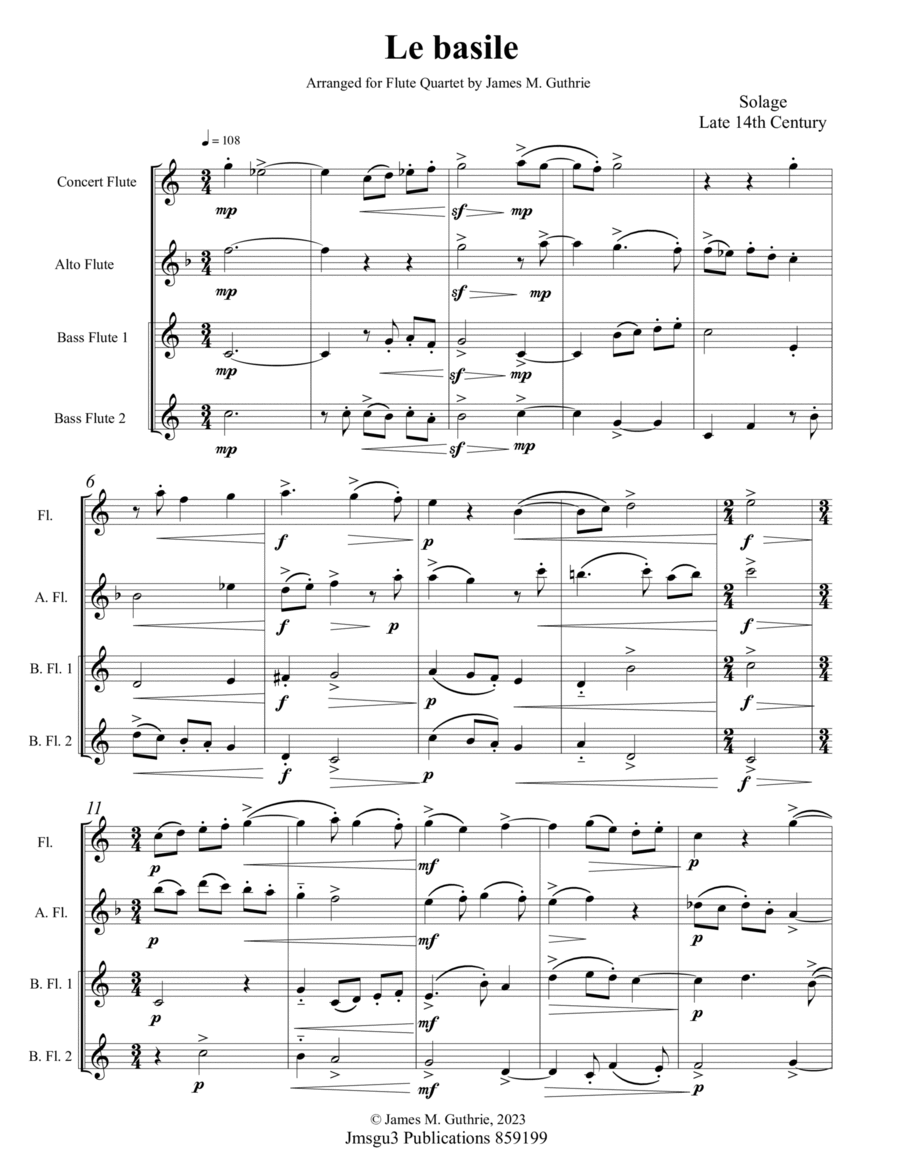
Flute Quartet,Woodwind Ensemble Alto Flute,Bass Flute - Level 2 - Digital Download SKU: A0.1266468 Composed by Solage. Arranged by James M. Guthrie. Chamber,Contest,Early Music,Festival,Historic,Medieval. 8 pages. Jmsgu3 #859199. Published by jmsgu3 (A0.1266468). Solage's ballade Le basile de sa propre nature is a significant work in the history of medieval music. Here are some of its historical significances:1. It is one of the twelve surviving works attributed to Solage, a French composer who lived in the late 14th century. Solage's works are known for their complex rhythms, intricate harmonies, and expressive melodies.2. Le basile de sa propre nature is a four-voice ballade that features a text about the mythical creature known as the basilisk. The lyrics describe the basilisk as a monster that kills everything it sees with its deadly venom. The music is characterized by its intricate rhythms and harmonies, which reflect the text's vivid imagery.3. The ballade is preserved in the Chantilly Codex, a manuscript that contains a collection of French secular music from the late 14th century. The Chantilly Codex is one of the most important sources of medieval music, and it provides valuable insights into the musical practices of the time.4. Le basile de sa propre nature is an example of the Ars subtilior style, which was a highly experimental and complex musical style that emerged in the late 14th century. This style was characterized by its use of intricate rhythms, complex harmonies, and unusual notational practices. The Ars subtilior style was highly influential in the development of later musical styles, and it remains an important part of the medieval musical canon.Overall, Solage's ballade Le basile de sa propre nature is a significant work that reflects the complex and experimental musical practices of the late 14th century. Its vivid imagery, intricate rhythms, and complex harmonies make it a valuable contribution to the medieval musical canon.Lyrics:All those he sees he kills suddenly,For his venom is deadly.He is a basilisk by his own nature,And he has no other way of being. He is a monster of great power,And he is feared by all who know him.He is a creature of the earth,And he is a master of death. He is a basilisk by his own nature,And he has no other way of being.All those he sees he kills suddenly,For his venom is deadly. He is a creature of the night,And he is a master of the dark.He is a monster of great might,And he is feared by all who hear his name. He is a basilisk by his own nature,And he has no other way of being.All those he sees he kills suddenly,For his venom is deadly.Solage was a French composer and probably also a poet who lived in the late 14th century. He composed the most pieces in the Chantilly Codex, which is the principal source of music of the ars subtilior, a manneristic compositional school centered on Avignon at the end of the century. Solage is an obscure composer, and aside from what can be deduced from the pieces attributed to him in the Chantilly Codex, nothing else is known about him. There are several interpretations of his name, and it is not clear whether his first name was Jean or Charles.  The ars subtilior was a manneristic compositional school centered on Avignon at the end of the 14th century. It was characterized by complex rhythms and pitch, and it was a transitional period between the late medieval and Renaissance periods. Solage was one of the composers who fit into this school, and he composed the most pieces in the Chantilly Codex, which is the principal source of music of the ars subtilior. Stylistically, Solage's works exhibit two distinctly different characters: a relatively simple one usually associated with his great predecessor and elder contemporary Guillaume de Machaut, and a more recherché one, complex in the areas of both pitch and rhythm, characteristic of the ars subtilior. 
Solage: Le basile for Flute Quartet
Quatuor de Flûtes : 4 flûtes

$32.95 28.51 € Quatuor de Flûtes : 4 flûtes PDF SheetMusicPlus


Partitions Gratuites
Acheter des Partitions Musicales
Acheter des Partitions Digitales à Imprimer
Acheter des Instruments de Musique

© 2000 - 2026

Accueil - Version intégrale