EUROPE
17275 articles
USA
0 articles
DIGITAL
11895 articles (à imprimer)
Partitions Digitales
Partitions à imprimer
11895 partitions trouvées


Woodwind Ensemble,Woodwind Quartet Bassoon,Clarinet,Flute,Oboe - Level 5 - Digital Download SKU: A0.722053 Composed by Jean-Joseph Mouret. Arranged by Anne L Christopherson GRSM ARCM. Concert,Contemporary,Film/TV,Wedding. 20 pages. Music-Scores.com #5730569. Published by Music-Scores.com (A0.722053). Rondeau, also known as the Fanfare from Masterpiece Theatre. It is the first movement of a Suite of Symphonies and was first performed in the Palace of Versailles for King Louis XV.For Flute, Oboe, 2 Clarinets, Bass Clarinet and Bassoon.Concert C major.Arranged by Anne L Christopherson GRSM ARCM at https://www.music-scores.com
Rondeau - Bridal Fanfare - Flute, Oboe, 2 Clarinets, Bass Clarinet and Bassoon
Flûte, Hautbois, Clarinette, Basson

$6.95 5.94 € Flûte, Hautbois, Clarinette, Basson PDF SheetMusicPlus

Clarinet quartet Clarinet - Level 3 - Digital Download SKU: A0.532820 Composed by Jules Demersseman. Arranged by Paul Wehage. Christian,Contemporary,Romantic Period,Sacred,Wedding. 24 pages. Musik Fabrik Music Publishing #38025. Published by Musik Fabrik Music Publishing (A0.532820). Jules Demersseman was born on January 9, 1833 in Hondschoote, a small town in the north of France now near the border of Belgium. He entered the Paris Conservatory in 1844 in the class of Jean-Louis Tulou and won a first prize in flute in 1845. Demersseman had a career as a pedogogue and soloist, often performing his own compositions. A close friend of Adolphe Sax, he wrote some of the first works ever written for the saxophone, as well as for the saxhorn and for Sax‘s valved trombone, most of which were published by Sax himself.. Demersseman died in Paris on December 1, 1866 at the age of 33. Two versions of this work were published by the Adolphe Sax puublishing company: a version for voice and organ and a version for voice with Alto Saxophone, Sax Valved Trombone and Bass Saxhorn, an interesting combination which is perhaps not as easy to find as it was in Sax's showroom, where the piece was likely performed to show the qualities of Sax's instruments. These versions are also published by Musik Fabrik in seperate editions. This current version was arranged using the first edition of the trio version as its source, and the saxophone and voice parts remain essentially as in the original, with some editorial dynamic changes. The version may be performed in three possible ways: either as a piece for Clarinet Quartet, as a work with Voice and Clarinet Trio, or as a work with Voice and clarinet quartet, with Clarinet 1 doubling the voice. A voical part (in C) is included with the set.
Jules Demersseman : Ave Maria for 3 Bb clarinets and bass clarinet (or medium voice, 2 Bb clarinets
Quatuor de Clarinettes: 4 clarinettes

$12.95 11.06 € Quatuor de Clarinettes: 4 clarinettes PDF SheetMusicPlus

Choral Choir (SAB) - Level 3 - Digital Download SKU: A0.1120365 By Philip Le Bas. By J-B Lully / G Bizet. Arranged by Philip Le Bas. Christmas,Praise & Worship,Religious,Sacred,Traditional. Octavo. 8 pages. Philip Le Bas #721616. Published by Philip Le Bas (A0.1120365). A new arrangement by Philip Le Bas of a thirteenth century French Christmas carol from Provence harmonized by Jean-Baptiste Lully (1632-87, attrib.) and, more famously, by Georges Bizet (1838-75, in his L'Arlesienne Suite of 1872.) In France the melody is still tightly associated with Christmas, and French audiences start singing their own Christmas words whenever they hear the melody (the arranger has heard it himself!) The English translation used here is adapted from a variety of sources. The three kings (or more precisely the magi from St Matthew's gospel) are seen marching towards Bethlehem with their fantastic golden wealth and grandeur. But why are they going to see a low-born baby and why do they worship this child who will die on a cross? The organ sets the scene from the beginning with its marching accompaniment, and the first verse is sung in unison by all three parts. The second begins with a canon, as used by Bizet, and then breaks into harmony. The first section of the third verse is much quieter and legato, sung by the sopranos and altos, using wonderful chromatic harmonies based on another section from Bizet's suite. The lyrics express wonder at the beautiful music heard from the camp of the kings. The second section, sung in differentiated unison then begins to wonder why the kings stoop so low to a baby in a manger. Finally the fourth verse, sung in full harmony, returns to the marching accompaniment and reiterates the amazement of meeting these kings with their mysterious mission. The carol is aimed at parish choirs with limited resources, but a good organist. The melody is well-known, much of it is in unison, and other sections are relatively easy to sing. Care should however should be taken to sing the dotted rhythms accurately - this is what gives the carol its marching character.
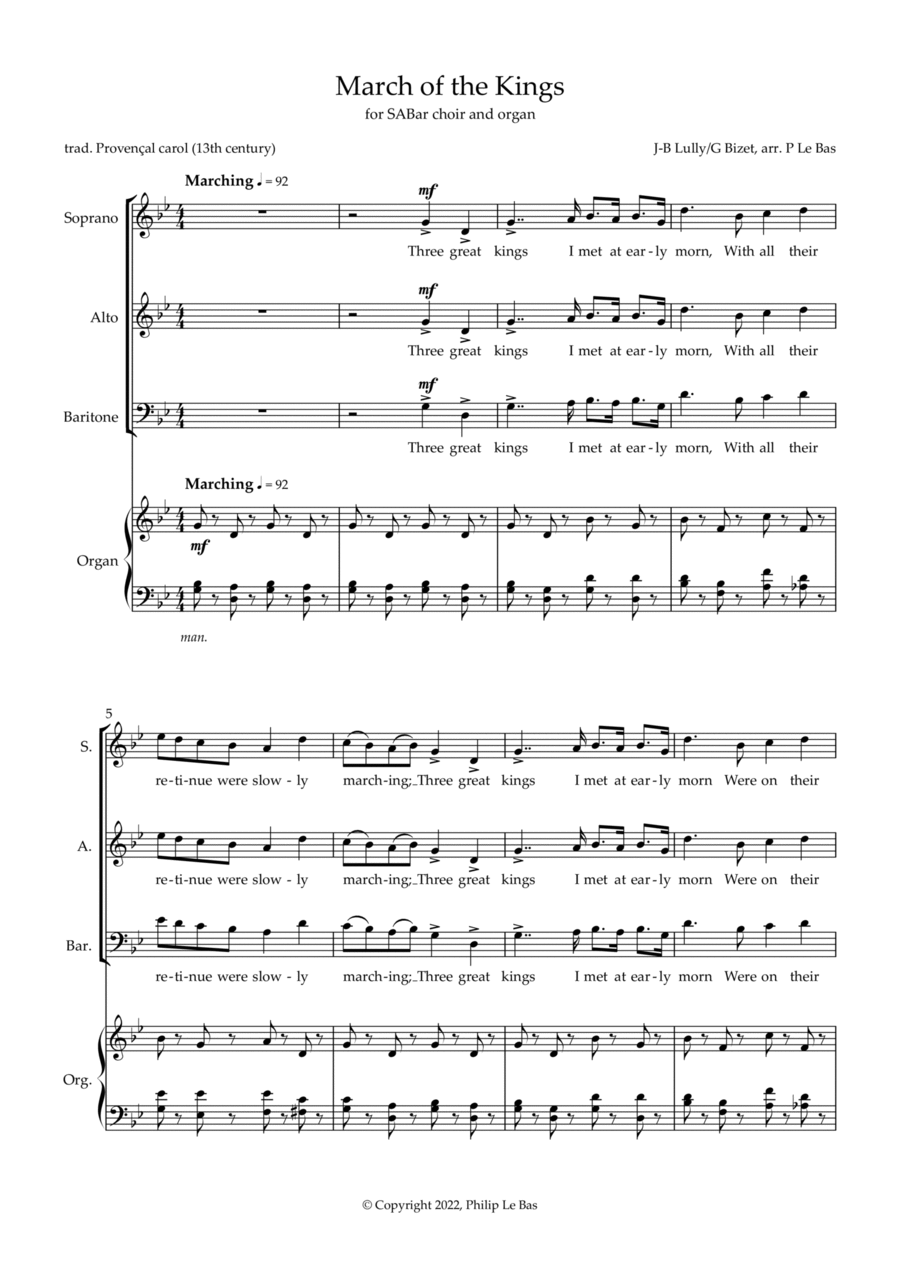
March of the Kings
Chorale 3 parties
Philip Le Bas
$1.99 1.7 € Chorale 3 parties PDF SheetMusicPlus


Partitions Gratuites
Acheter des Partitions Musicales
Acheter des Partitions Digitales à Imprimer
Acheter des Instruments de Musique

© 2000 - 2026

Accueil - Version intégrale





