EUROPE
3889 articles
USA
1087 articles
DIGITAL
1433 articles (à imprimer)
Partitions Digitales
Partitions à imprimer
1433 partitions trouvées


Instrumental Duet Harpsichord,Instrumental Duet,Piano - Level 3 - Digital Download SKU: A0.534710 Composed by Anne-Louise Brillon de Jouy. Classical,Concert,Folk,Holiday,Patriotic,Standards. Score and parts. 16 pages. Musik Fabrik Music Publishing #6359025. Published by Musik Fabrik Music Publishing (A0.534710). A NO. 7 IN B FLAT MAJOR I. Allegro II. Andante III. PrestoThe composer and harpsichordist Anne-Louise Brillon de Jouy was born in Paris in 1744, and died in 1824 in Villers-sur-Mer in Normandie. She married Jacques Brillon de Jouy 22 years her senior,and had two daughters, Cunégonde and Aldegonde, Anne-Louise Brillon de Jouy had a salon in Passy whose guests included the violinist Jean-Pierre Pagin and cellist and composer Luigi Boccherini. Benjamin Franklin was also a frequent vistor and Madame Brillon has an extensive correspondence with him, including the period after his stay in Paris during the American Revolution .Many of her compositions were purchased in 1957 by the American Philosophical Society of Philadelphia, in honor of this friendship.In 2021, French Pianist Nicolas Horvath recorded a landmark CD for Grand Piano (GP872-73) of Brillon’s keyboard noatas with extensive notes by Aliette de Laleu, Deborah Hayes and Nicolas Horvath and Christine de Pas The keyboard sonatas published here are intended to document this reocrding.The twelve numbered sonatas, marked “Troisième Recueil de Sonates pour le pianoforte ou clavecin avec accompagnement d’un viiolon ad libitumâ€, are in the hand of a copyist and are contained in a bound volume labeled as her Troisième Recueil (‘Third Collection’) and dedicated to Mesdemoiselles Brillon. Evidently the composer at some point chose these 12 sonatas to be copied as a sampling of her work for her two daughters. The manuscript is in the collection of the American Philosopical Society in Philadelphia.
Anne-Louise Brillon de Jouy: Sonata no. 7 in Bb Major for piano or harpsichord
Piano seul

$10.35 8.73 € Piano seul PDF SheetMusicPlus

Instrumental Duet Harpsichord,Instrumental Duet,Piano - Level 3 - Digital Download SKU: A0.534712 Composed by Anne-Louise Brillon de Jouy. Classical,Concert,Folk,Holiday,Patriotic,Standards. Score and parts. 12 pages. Musik Fabrik Music Publishing #6359053. Published by Musik Fabrik Music Publishing (A0.534712). SONATA NO. 9 IN F MINOR I. Andante amoroso II. Allegro assai The composer and harpsichordist Anne-Louise Brillon de Jouy was born in Paris in 1744, and died in 1824 in Villers-sur-Mer in Normandie. She married Jacques Brillon de Jouy 22 years her senior,and had two daughters, Cunégonde and Aldegonde, Anne-Louise Brillon de Jouy had a salon in Passy whose guests included the violinist Jean-Pierre Pagin and cellist and composer Luigi Boccherini. Benjamin Franklin was also a frequent vistor and Madame Brillon has an extensive correspondence with him, including the period after his stay in Paris during the American Revolution .Many of her compositions were purchased in 1957 by the American Philosophical Society of Philadelphia, in honor of this friendship.In 2021, French Pianist Nicolas Horvath recorded a landmark CD for Grand Piano (GP872-73) of Brillon’s keyboard noatas with extensive notes by Aliette de Laleu, Deborah Hayes and Nicolas Horvath and Christine de Pas The keyboard sonatas published here are intended to document this reocrding.The twelve numbered sonatas, marked “Troisième Recueil de Sonates pour le pianoforte ou clavecin avec accompagnement d’un viiolon ad libitumâ€, are in the hand of a copyist and are contained in a bound volume labeled as her Troisième Recueil (‘Third Collection’) and dedicated to Mesdemoiselles Brillon. Evidently the composer at some point chose these 12 sonatas to be copied as a sampling of her work for her two daughters. The manuscript is in the collection of the American Philosopical Society in Philadelphia.  
Anne-Louise Brillon de Jouy: Sonata no. 9 in f minor for piano or harpsichord
Piano seul

$9.10 7.67 € Piano seul PDF SheetMusicPlus

Instrumental Duet Harpsichord,Instrumental Duet,Piano - Level 3 - Digital Download SKU: A0.534703 Composed by Anne-Louise Brillon de Jouy. Classical,Concert,Standards. Score and parts. 17 pages. Musik Fabrik Music Publishing #6341543. Published by Musik Fabrik Music Publishing (A0.534703). The composer and harpsichordist Anne-Louise Brillon de Jouy was born in Paris in 1744, and died in 1824 in Villers-sur-Mer in Normandie. She married Jacques Brillon de Jouy 22 years her senior,and had two daughters, Cunégonde and Aldegonde, Anne-Louise Brillon de Jouy had a salon in Passy whose guests included the violinist Jean-Pierre Pagin and cellist and composer Luigi Boccherini. Benjamin Franklin was also a frequent vistor and Madame Brillon has an extensive correspondence with him, including the period after his stay in Paris during the American Revolution .Many of her compositions were purchased in 1957 by the American Philosophical Society of Philadelphia, in honor of this friendship.In 2021, French Pianist Nicolas Horvath recorded a landmark CD for Grand Piano (GP872-73) of Brillon’s keyboard noatas with extensive notes by Aliette de Laleu, Deborah Hayes and Nicolas Horvath and Christine de Pas The keyboard sonatas published here are intended to document this reocrding.The manuscript of the Sonata in A minor, Madame Brillon’s only solo keyboard work, s in her hand. Crossed-out measures and partially abbreviated notation indicate that t was for her own use in salon performances. This is probably an early work, given the classical haronic vocabulary and typical classical balance of the forms.   The second movement is more virtuosic, with an initial theme in four octaves, scales in doubled thirds and figures which are in alternate hands.
Anne-Louise Brillon de Jouy: Sonata in a minor for piano or harpsichord
Piano seul

$9.10 7.67 € Piano seul PDF SheetMusicPlus

Choral Choir (SATB) - Digital Download SKU: A0.828730 Composed by Giuseppe Dogliani. Arranged by Guido Menestrina. Romantic Period,Sacred. Octavo. 6 pages. Guido Menestrina #1986533. Published by Guido Menestrina (A0.828730). SATB + Piano solo Musica dal dramma (su libretto di Jean-Baptiste Lemoyne) Cristoforo Colombo, 1896. Qui di seguito info sul compositore. n. a Costigliole di Saluzzo (Cuneo-Italia) il 13 maggio 1849; prof. a Lanzo il 23 settemre 1870; m. a Torino il 22 ottobre 1934. Fu accolto da don Bosco nel suo Oratorio di Valdocco (Torino) nel 1864, a 14 anni di età, come allievo falegname. Egli però, già cantore del duomo di Saluzzo, aveva una spiccata inclinazione alla musica, e trovò in don Bosco chi lo comprese e l'assecondò. Sotto la guida del M. De Vecchi poté studiare musica strumentale, armonia e composizione. I suoi progressi furono così rapidi che, fattosi salesiano, divenne il più attivo collaboratore del M. Cagliero, e, allorché questi partì per l'Argentina a capo della prima spedizione di missionari salesiani (1875), a lui fu affidata la direzione della Schola cantorum,e nel 1889 anche della banda musicale dell'Oratorio. Maestro impareggiabile - come attesta un suo ex-allievo, don Alberto Caviglia - trasformò la scuola di canto col suo metodo d'insegnamento, sia nella preparazione della lettura, sia nell'educazione delle voci bianche e nell'addestramento delle masse corali, che giunsero fino a quattrocento voci. Con mezzi così poderosi il M. Dogliani ricondusse in chiesa la musica classica, e la Basilica di Maria Ausiliatrice fu rinomata per le grandiose esecuzioni inappuntabili degli spartiti di Rossini, Cherubini, Haydn, Gounod, Sgambati, Bossi, Tebaldini, Pagella, Perosi, Bottazzo, Ravanello, Mattioli, Donini, giungendo perfino a eseguire la Missa Papae Marcelli del Palestrina, senza accompagnamento (1876), e le classiche composizioni di Vittoria, Lolli, Gabrielli, Orlando di Lasso. La presenza della sua Schola cantorum e della sua banda strumentale fu spesso ambita e richiesta in altre città d'Italia in solenni circostanze, meritando elogi e premi, e perfino a Marsiglia per le feste centenarie di santa Giovanna d'Arco e l'inaugurazione della nuova cattedrale (1894). Il Cagliero - di cui ridusse a stile liturgico le più solenni composizioni - lo invitò in Argentina per portarvi la sua esperienza pratica d'insegnamento, che poi concretò nel celebre Metodo di canto corale, edito varie volte e su cui si formarono generazioni di Pueri cantores. Fu pure compositore di musica sacra e inni d'occasione di ottimo effetto: notevole l'antifona Corona aurea, composta per l'incoronazione dell'effige di Maria Ausiliatrice nel suo santuario (1903). Ma soprattutto egli - seguendo il metodo educativo di don Bosco - seppe fare della scuola di canto e di banda validi strumenti di formazione interiore, educando soprattutto con l'esempio di perfetto religioso, sicché i suoi allievi, per la sua abituale compostezza e inalterabile pazienza, lo tenevano in concetto di santo. Tra essi vi fu pure il celebre tenore Francesco Tamagno; altro suo discepolo affezionatissimo fu Federico Caudana, poi maestro di cappella a Cremona e buon compositore di musica. È da notare che il M. Dogliani, col suo insegnamento e col suo esempio, precorse di un trentennio la riforma della musica sacra fatta da san Pio X col Motu proprio del 1903. (da http://www.coadiutoresalesiano.net/ ) follow the score online on youtube: https://youtu.be/kAj11WStQqc.
Giuseppe Dogliani - Salve o Regina (1896)
Chorale SATB

$1.99 1.68 € Chorale SATB PDF SheetMusicPlus

Choral Choir (SATB) - Level 3 - Digital Download SKU: A0.535408 Composed by Jacques Dussouil. Christmas,Contemporary,Sacred. Octavo. 6 pages. Musik Fabrik Music Publishing #4285279. Published by Musik Fabrik Music Publishing (A0.535408). Jacques Dussouil was the Titular Organist of the Grand Orgue Boisseau of Notre-Dame de Royan from 1966 until his death in 2016. During his studies at the High School of Poitiers, he was also the student of pianist Hélène d’Ambelle who was herself a student of the great French Pianist Alfred Cortot. It was his work with Jean-Albert Villard, the organist of the Cliquot organ of the Cathedral of Poitiers which would determine his vocation as an organist. Jacques Dussouil continued his studies in Paris with Noëlie Pierront and especially with Edouard SouberbielleHis duties at the Royan Cathedral lead him to also become a choral director and composer, founding one of the best Cathedral Choirs in France which he directed for many years. This activity lead to the compostion of a large number of sacred works, including his Mass in D for two organs and Chorus.4. Pastoureaux et Pasturelles1. Pastoureaux et pastourelles, Arrivent très vitementEt volant à tire d’aile, Des anges chantent gaiement.Gloria in excelsis, In excelsis Deo!2. Quelle est dans cette nouvelle, Qui s’lève jusqu’aux cieux?Pastoureaux et pastourelles, Que faites-vous en ce lieux?Gloria in excelsis, In excelsis Deo!3. Je viens voir ce bel enfantQu’en dit couché sur la pailleNous voulons dès maintenant, Le voir avant qu’il s’en aille.Gloria in excelsis, In excelsis Deo!4. On dit que dans une étableDans Bethléem assoupi, Un petit enfant aimableEst né puis s’est endormi.Gloria in excelsis, In excelsis Deo!5. Le monde entier qui l’ignoreSaura demain pour toujours.Que le ciel entier l’adore, L’enfant Dieu source d’amour.Gloria in excelsis, In excelsis Deo!
Jacques Dussouil: "Pastouroux et Pastourelles" from Quatre Noëls for SATB mixed chorus
Chorale SATB

$1.99 1.68 € Chorale SATB PDF SheetMusicPlus

Guitar,Piano,Vocal,Voice - Level 4 - Digital Download SKU: A0.1201363 By Les Baxter. By Jack Lawrence, Marguerite Monnot, and Rene Gustave Rouzaud. Arranged by John Fries. 20th Century,Jazz,Pop,Standards. Score. 3 pages. John Fries #800018. Published by John Fries (A0.1201363). Please contact me by email at jfries@ptd.net to make a special request or to find out all that I have to offer and to express your comments or concerns.  You can also type John Fries in the searchbar to see all I have to offer. Thanks, John.  The Poor People of Paris is the English name of a popular song from France. The original French language song was La goualante du pauvre Jean (The Ballad of Poor John), with music by Marguerite Monnot and words by René Rouzaud. A recording of the tune by Les Baxter's orchestra (Capitol Records catalog number 3336, with the flip side Theme from 'Helen of Troy') was a number-one hit on the Billboard chart in the US in 1956: for four weeks on the Best Sellers in Stores chart, for six weeks on the Most Played by Jockeys and Hot 100 charts, and for three weeks on the Most Played on Jukeboxes chart.
The Poor People Of Paris
Piano, Voix et Guitare
Les Baxter
$4.99 4.21 € Piano, Voix et Guitare PDF SheetMusicPlus

Clarinet quartet Clarinet - Level 3 - Digital Download SKU: A0.532820 Composed by Jules Demersseman. Arranged by Paul Wehage. Christian,Contemporary,Romantic Period,Sacred,Wedding. 24 pages. Musik Fabrik Music Publishing #38025. Published by Musik Fabrik Music Publishing (A0.532820). Jules Demersseman was born on January 9, 1833 in Hondschoote, a small town in the north of France now near the border of Belgium. He entered the Paris Conservatory in 1844 in the class of Jean-Louis Tulou and won a first prize in flute in 1845. Demersseman had a career as a pedogogue and soloist, often performing his own compositions. A close friend of Adolphe Sax, he wrote some of the first works ever written for the saxophone, as well as for the saxhorn and for Sax‘s valved trombone, most of which were published by Sax himself.. Demersseman died in Paris on December 1, 1866 at the age of 33. Two versions of this work were published by the Adolphe Sax puublishing company: a version for voice and organ and a version for voice with Alto Saxophone, Sax Valved Trombone and Bass Saxhorn, an interesting combination which is perhaps not as easy to find as it was in Sax's showroom, where the piece was likely performed to show the qualities of Sax's instruments. These versions are also published by Musik Fabrik in seperate editions. This current version was arranged using the first edition of the trio version as its source, and the saxophone and voice parts remain essentially as in the original, with some editorial dynamic changes. The version may be performed in three possible ways: either as a piece for Clarinet Quartet, as a work with Voice and Clarinet Trio, or as a work with Voice and clarinet quartet, with Clarinet 1 doubling the voice. A voical part (in C) is included with the set.
Jules Demersseman : Ave Maria for 3 Bb clarinets and bass clarinet (or medium voice, 2 Bb clarinets
Quatuor de Clarinettes: 4 clarinettes

$12.95 10.92 € Quatuor de Clarinettes: 4 clarinettes PDF SheetMusicPlus

Concert Band - Level 4 - Digital Download SKU: A0.534137 Composed by Louis Adolphe Mayeur. Arranged by Paul Wehage. Opera,Romantic Period,Standards. Score and parts. 50 pages. Musik Fabrik Music Publishing #3133405. Published by Musik Fabrik Music Publishing (A0.534137). Louis Adolphe Mayeur (1837 - 1894), was a Belgium clarinetist, saxophonist, composer and conductor who spent most of his musical career in France; Entering the French Military in 1855, he was a clarinetist in the Second Régiment of the Cuirassiers (Mounted Calvary) of the Garde Impériale. A student of Klosé at the Paris Conservatory, he received his First Prize in Clarinet in 1860. One of the inner circle of Adolphe Sax (along with fellow Belgiums Jules Demersseman and Jean-Baptiste Singelée, whose “Quartet for Saxophones“ was premièred with Mayeur playing and Demersseman conducting), Mayeur took up the saxophone and was quickly engaged as the saxophone soloist in the Opera House of Brussels, La Monnaie (the Mint). Sax commissioned a number of works from Mayeur for the saxophone, which were published by his company and used in his class at the Paris Conservatory.By 1871, Mayeur was also named Saxophone Solo with the Paris Opera, performing in opears and ballets by Halévy, Meyerbeer, Thomas, Saint-Saens, Massenet,   Délibes and Paladlihe. It would appear that sometime during this period, his relations with Sax became difficult, culminating in his publications of works by Buffet-Crampon, one of Sax’s rival companies and one of the main protagonists in the series of lawsuits which led to Sax’s bankrupcy. Mayeur’s own declining health lead to his death in 1894.The Grande Fantaisie de Concert sur Rigoletto dates from 1877. The contrasting sections use motifs from arias and duets from Verdi’s opera. Florid cadenzas seperate the various sections, but those passages should be played in the manner of “bel canto†ornamentation, always lyrical and songlike.  This is the score and solo part only for the concert band version. Versions are available from Musik Fabrik for piano, for Symhony Orchestra (on rental : 2222/2000/Timp/hp/strings) and for Concert Band (for sale). The score plus solo part for each of the versions is available for sale, as well as the individual parts for the concert band version
Louis Mayeur: Grande Fantaisie de Concert sur Rigoletto (de Verdi) for alto saxophone and concert b
Orchestre d'harmonie
1871, Mayeur was also named Saxophone Solo with the Paris Opera, performing in opears and ballets by Halévy, Meyerbeer, Thomas, Saint-Saens, Massenet,   Délibes and Paladlihe It would appear that sometime during this period, his relations with Sax became difficult, culminating in his publications of works by Buffet-Crampon, one of Sax’s rival companies and one of the main protagonists in the series of lawsuits which led to Sax’s bankrupcy
$25.95 21.88 € Orchestre d'harmonie PDF SheetMusicPlus

Full Orchestra - Level 5 - Digital Download SKU: A0.534555 Composed by Thierry Pélicant. 20th Century,Contemporary,Standards. Score and parts. 46 pages. Musik Fabrik Music Publishing #4283543. Published by Musik Fabrik Music Publishing (A0.534555). In 2004, the Orchestre Philharmonique de l’Oise commissioned its musical director, t Thierry Pélicant, this concerto for the late Claude Caens, the principal contrabass of this orchestra. This great artist, who was friends with everyone in this ensemble, wanted everyone to have a part in the festivities, not only the strings, but also the winds, the horns, the trumpets and the percussion, and also that they all should be heard ! Thierry Pélicant wrote therefore a concerto which is at once very symphonic – and for this reason, it is strongly advised that the contrabass be amplified – but also a piece which would express the friendship between the orchestra and the soloist. This concerto strives to be both warm and lyrical : it is not a virtuoso showpiece, inspite of the real technical that it offers to the soloist and which he would do well to try to hid them from the audience. It is also not a battle between the orchestra and this gentle giant : they stroll together, sometimes joyously, sometimes with nostalgia and go through the strong storms which do not fail to present themselves, smiling together and finding them to be envigorating.The work is scored for (2(Pic)2(EH)22/2200/Timp/2perc/strings) and lasts aproximately 23 minutes. The orchestral parts are on rental from the pubilsher.  The full score is available for sale on this site.Thierry Pélicant was born in 1957 at Sainte-Adresse, France. After studying the organ and the horn, his meeting with Jean-Claude Hartemann, the Musical Director of the Opéra Comique in Paris lead him to decide to explore conducting. He was the student of Haremann for fifteen years. He is the Musical Director of the André Messager Orchestre and has also directed the Orchestre Philharmonique de l’Oise since 1980, one of the oldest French orchestras, since it was founded in 1750. A passionate ssupporter of French music, Pélicant reconstructed the Messe solennelle of L.V.A Boïeldieu and Te Deum of 1792 by Philidor and premièred and recorded the Suite Parnassienne, Massenet’s last work. At the same time, he has also served the music of our time in premièring or recording the works of Dazzi, Marchand, Braconnier, Bénard, Drouin, Preschez, etc. As a composer, musical grammar and stylistic debates only interest him from afar. As a true gourmet (since cooking is another of his passions), he strives to write the music that pleases him, that would be enjoyable to play and which would be enjoyable to hear, hopefully with real pleasure and in which he tries to express the emotions and the pleasant or surprising states of being which, to hime, these works are tied. Through this process, he has created concertos (for oboe, for bassoon, for organ, for contrabass), Escales & paysages, ma monumental literary concerto for narrator, piano and orchestra, written for his friend Dominique Preschez, Operas (Histoires comme ça, Ribouldingue, Élise et le fantôme) ; With the poet Luis Porquet, he wrote the song cycle Ombre légère (for soprano, harp and orchestre), Rhapsodie du Havre (for tenor and chamber orchestra, a commission from the Forum de Normandie to commemorate the 500 years of the founding of the city Le Havre), Et de toi, Bethleem, Christmas oratorio for baritone, chorus and orchestra and, finally, commissioned by the Orchestre de l’Oise in honor of the centennial of the First World War 14, fresque de la Grande Guerre, for the tenor Daniel Gàlvez-Vallejo, children’s chorus and orchestra. In the area of chamber music, he has written a sonata for horn and piano, for the Festival de Giverny, Borée (quintet for oboe and strings), Sextuor d’été, and Milonga (septet inspired by the World of Tango Music). Published in 2005, his novel Carnets de Walter Crane, explores the sufferings of a composer who has the obligation to write a string quartet ...
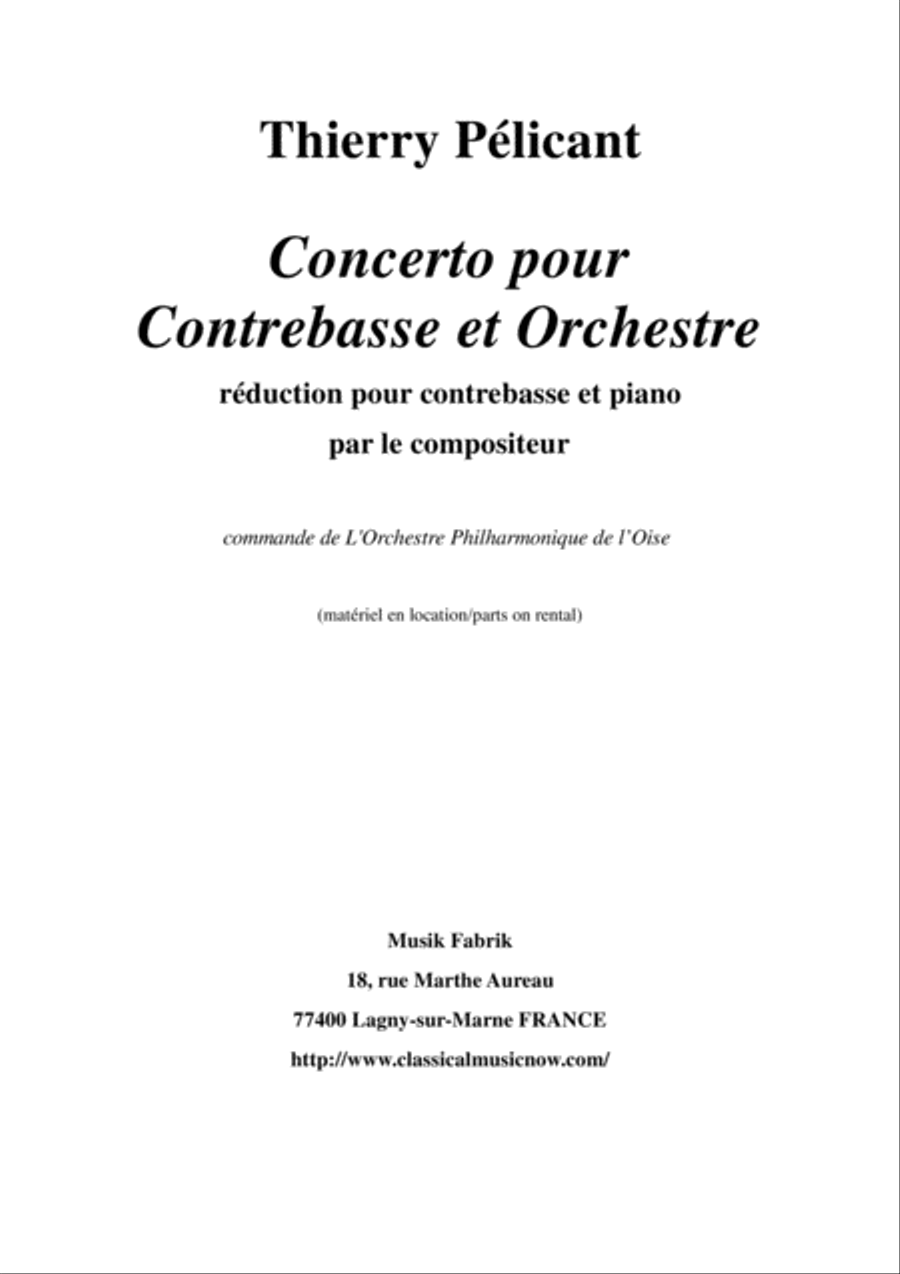
Thierry Pélicant: Concerto for contrabass and orchestra, piano reduction and solo part
Orchestre

$29.95 25.25 € Orchestre PDF SheetMusicPlus

Full Orchestra - Level 5 - Digital Download SKU: A0.534554 Composed by Thierry Pélicant. 20th Century,Contemporary,Standards. Score and parts. 136 pages. Musik Fabrik Music Publishing #4283537. Published by Musik Fabrik Music Publishing (A0.534554). In 2004, the Orchestre Philharmonique de l’Oise commissioned its musical director, t Thierry Pélicant, this concerto for the late Claude Caens, the principal contrabass of this orchestra. This great artist, who was friends with everyone in this ensemble, wanted everyone to have a part in the festivities, not only the strings, but also the winds, the horns, the trumpets and the percussion, and also that they all should be heard ! Thierry Pélicant wrote therefore a concerto which is at once very symphonic – and for this reason, it is strongly advised that the contrabass be amplified – but also a piece which would express the friendship between the orchestra and the soloist. This concerto strives to be both warm and lyrical : it is not a virtuoso showpiece, inspite of the real technical that it offers to the soloist and which he would do well to try to hid them from the audience. It is also not a battle between the orchestra and this gentle giant : they stroll together, sometimes joyously, sometimes with nostalgia and go through the strong storms which do not fail to present themselves, smiling together and finding them to be envigorating.The work is scored for (2(Pic)2(EH)22/2200/Timp/2perc/strings) and lasts aproximately 23 minutes. The orchestral parts are on rental from the pubilsher.  The piano reduction with the solo part is available for sale on this site.Thierry Pélicant was born in 1957 at Sainte-Adresse, France. After studying the organ and the horn, his meeting with Jean-Claude Hartemann, the Musical Director of the Opéra Comique in Paris lead him to decide to explore conducting. He was the student of Haremann for fifteen years. He is the Musical Director of the André Messager Orchestre and has also directed the Orchestre Philharmonique de l’Oise since 1980, one of the oldest French orchestras, since it was founded in 1750. A passionate ssupporter of French music, Pélicant reconstructed the Messe solennelle of L.V.A Boïeldieu and Te Deum of 1792 by Philidor and premièred and recorded the Suite Parnassienne, Massenet’s last work. At the same time, he has also served the music of our time in premièring or recording the works of Dazzi, Marchand, Braconnier, Bénard, Drouin, Preschez, etc. As a composer, musical grammar and stylistic debates only interest him from afar. As a true gourmet (since cooking is another of his passions), he strives to write the music that pleases him, that would be enjoyable to play and which would be enjoyable to hear, hopefully with real pleasure and in which he tries to express the emotions and the pleasant or surprising states of being which, to hime, these works are tied. Through this process, he has created concertos (for oboe, for bassoon, for organ, for contrabass), Escales & paysages, ma monumental literary concerto for narrator, piano and orchestra, written for his friend Dominique Preschez, Operas (Histoires comme ça, Ribouldingue, Élise et le fantôme) ; With the poet Luis Porquet, he wrote the song cycle Ombre légère (for soprano, harp and orchestre), Rhapsodie du Havre (for tenor and chamber orchestra, a commission from the Forum de Normandie to commemorate the 500 years of the founding of the city Le Havre), Et de toi, Bethleem, Christmas oratorio for baritone, chorus and orchestra and, finally, commissioned by the Orchestre de l’Oise in honor of the centennial of the First World War 14, fresque de la Grande Guerre, for the tenor Daniel Gàlvez-Vallejo, children’s chorus and orchestra. In the area of chamber music, he has written a sonata for horn and piano, for the Festival de Giverny, Borée (quintet for oboe and strings), Sextuor d’été, and Milonga (septet inspired by the World of Tango Music). Published in 2005, his novel Carnets de Walter Crane, explores the sufferings of a composer who has the obligation to write a string quartet ...
Thierry Pélicant: Concerto for contrabass and orchestra, score only
Orchestre

$38.95 32.84 € Orchestre PDF SheetMusicPlus

Full Orchestra - Level 5 - Digital Download SKU: A0.1292593 Composed by Ludovic Bource. Arranged by Kevin Riley. 21st Century,Film/TV. Score and Parts. 155 pages. Kevin Riley #883150. Published by Kevin Riley (A0.1292593). The Artist is a 2011 French[nb 1] comedy-drama film[nb 2] in the style of a black-and-white silent film or part-talkie. The film was written and directed by Michel Hazanavicius, produced by Thomas Langmann and stars Jean Dujardin and Bérénice Bejo. The story takes place in Hollywood, between 1927 and 1932, and focuses on the relationship between a rising young actress and an older silent film star as silent cinema falls out of fashion and is replaced by the talkies.The Artist received widespread critical acclaim and won many accolades. Dujardin won Best Actor at the 2011 Cannes Film Festival, where the film premiered. The film was nominated for six Golden Globes, the most of any 2011 film, and won three: Best Motion Picture – Musical or Comedy, Best Original Score, and Best Actor – Motion Picture Musical or Comedy for Dujardin. In January 2012, the film was nominated for twelve BAFTAs, the most of any film from 2011, and won seven, including Best Film, Best Director, Best Actor for Dujardin, and Best Original Screenplay for Hazanavicius.It was nominated for ten Academy Awards and won five,including Best Picture, Best Director for Hazanavicius, and Best Actor for Dujardin, making him the first French actor ever to win in this category. It was also the first French-produced film to win Best Picture, and the first mainly silent film to win since 1927's Wingswon at the 1st Academy Awards in 1929. It was also the first film presented in the 4:3 aspect ratio to win since 1953's From Here to Eternity. Additionally, it was the first black-and-white film to win since 1993's Schindler's List, though the latter contained limited colour sequences; it was the first 100% black-and-white film to win since 1960's The Apartment.In France it was nominated for ten César Awards, winning six, including Best Film, Best Director for Hazanavicius, and Best Actress for Bejo. The Artist has received more awards than any other French film.
The Artist Ouverture
Orchestre

$100.00 84.3 € Orchestre PDF SheetMusicPlus

Alto Saxophone,Piano - Level 4 - Digital Download SKU: A0.534438 Composed by Jules Demersseman. Arranged by Paul Wehage. Concert,Romantic Period,Standards. Score and part. 19 pages. Musik Fabrik Music Publishing #3493579. Published by Musik Fabrik Music Publishing (A0.534438). One of the first original compositions written for the saxophone, by one of Sax's closest associates. Jules Demersseman was born on January 9, 1833 in Hondschoote, a small town in the north of France now near the border of Belgium. He entered the Paris Conservatory in 1844 in the class of Jean-Louis Tulou and won a first prize in flute in 1845. Demersseman had a career as a pedogogue and soloist, often performing his own compositions. A close friend of Adolphe Sax, he wrote some of the first works ever written for the saxophone, as well as for the saxhorn and for Sax‘s valved trombone, most of which were published by Sax himself.. Demersseman died in Paris on December 1, 1866 at the age of 33. The work is in the form of a long lyrical episode punctuated with more florid passages which serve as counterpoint  to the main melody.. It is important to listen to vocal performances in this style, especially in performing the solo cadenzas, which (in spite of the notation) are not necessarily meant to be performed as virtuoso effects., but rather as a means of displaying expression and beautiful tone.
Jules Deersseman: Sérénade, Opus 33 for alto saxophone and piano
Saxophone Alto et Piano

$11.95 10.07 € Saxophone Alto et Piano PDF SheetMusicPlus

Choral Choir (SATB) - Level 3 - Digital Download SKU: A0.535405 Composed by Jacques Dussouil. Christmas,Sacred. Octavo. 6 pages. Musik Fabrik Music Publishing #4283611. Published by Musik Fabrik Music Publishing (A0.535405). Jacques Dussouil was the Titular Organist of the Grand Orgue Boisseau of Notre-Dame de Royan from 1966 until his death in 2016. During his studies at the High School of Poitiers, he was also the student of pianist Hélène d’Ambelle who was herself a student of the great French Pianist Alfred Cortot. It was his work with Jean-Albert Villard, the organist of the Cliquot organ of the Cathedral of Poitiers which would determine his vocation as an organist. Jacques Dussouil continued his studies in Paris with Noëlie Pierront and especially with Edouard SouberbielleHis duties at the Royan Cathedral lead him to also become a choral director and composer, founding one of the best Cathedral Choirs in France which he directed for many years. This activity lead to the compostion of a large number of sacred works, including his Mass in D for two organs and Chorus.1. La nuit s’étend sur la terre1. La nuit s’étend sur la terre, Il fait si-lence au dehorsAbandon-nous nos misères à qui bon souffrir encore?Toi qui pleures, et te lamentes, Prends espoir et te réveille.Ne res-te plus dans l’attente, viens voir l’en-fant qui sommeille.2. Oubliez peines et larmes, Et si vous souffrez encoreSoyez émus par les charmesDe cet enfant qui s’endortNoël enlève nos doutes,Joies passées, joies espérées,Létoile éclaire ma routeoù m’aide ce nouveau-né3. Oubliez ce qui nous blesseQue cesent nos trahisons!Que Noël soit jour de liesse,Qu’un enfant soit notre union.Que tous ceux qui se rassemblentVoyant nos cœurs rejouir.Nous aides à bâtir ensembleUn monde qui nous unit.
Jacques Dussouil: "La nuit s’étend sur la terre" from Quatre Noëls for SATB mixed chorus
Chorale SATB

$1.99 1.68 € Chorale SATB PDF SheetMusicPlus


Partitions Gratuites
Acheter des Partitions Musicales
Acheter des Partitions Digitales à Imprimer
Acheter des Instruments de Musique

© 2000 - 2026

Accueil - Version intégrale





