EUROPE
3889 articles
USA
1087 articles
DIGITAL
1434 articles (à imprimer)
Partitions Digitales
Partitions à imprimer
1434 partitions trouvées


Viola Solo - Level 3 - Digital Download SKU: A0.552083 Composed by Johann Pachelbel. Arranged by James M. Guthrie. Baroque,Instructional,Standards,Wedding. Individual part. 2 pages. Jmsgu3 #6116381. Published by jmsgu3 (A0.552083). The famous wedding classic arranged for Solo Viola.Duration: 2:12Score: 2 pages. The famous Pachelbel Canon arranged for Solo Viola. A great choice for weddings & receptions! Pachelbel's Canon Pachelbel's Canon is, in fact, the traditional title for a composition by the German composer Johann Pachelbel. Other names for the work include namely: Canon and Gigue for 3 violins and basso continuo, Canon and Gigue in D, and of course Canon in D. We do not know when or why in particular it was written. The oldest copy is surprisingly from the 19th century. It is important to realize that it was a common routine for organists to practice improvisation on the chord progression underlying the canon. Pachelbel originally scored the Canon notably for three violins and continuo. He also in fact paired the Canon with a gigue. The movements are homotonal, to clarify, both are in the key of D major. History In due time, Pachelbel's Canon went out of style and remained in virtual oblivion for centuries. The Jean-François Paillard chamber orchestra, however, recorded an arrangement of it in 1968. As a result, it gained approval. Many ensembles began likewise to record the piece in the 1970s and by the 1980s became ubiquitous as background music. From the 1970s to the early 2000s, pop songs correspondingly used elements of the piece. The chord progression, in particular, was used this way. Also, since the 1980s, it has been not only wildly popular for weddings, but also for funeral ceremonies in the USA and Europe. Pachelbel Background Johann Pachelbel (1653 –1706) was a German composer, as well as an organist. He was furthermore instrumental in bringing the south German organ school to its apex. He wrote a large body of music, both sacred and, equally important, secular. In particular, he uniquely helped develop the chorale prelude and fugue. For this, he has, in fact, earned a rightful place in the company of the most significant composers of the mid-Baroque period. Works Pachelbel's music was certainly popular. With this in mind, he also consequently had many pupils. His music expressly developed into a model for south German composers. Nowadays, Pachelbel is most famous, particularly for the Canon in D, as well as the F minor Chaconne, the Toccata in E minor, and of course the Hexachordum Apollinis, a set of variations for the keyboard. Influences Johann Jakob Froberger and Johann Caspar Kerll were south German composers who significantly influenced Pachelbel. Furthermore, he was especially influenced by Italians such as Frescobaldi and Poglietti. He frequently preferred an articulate, simple contrapuntal style that highlighted clarity. His music is markedly less extravagant and harmonically adventurous than that of Dieterich Buxtehude. However, as a point often overlooked, like Buxtehude, Pachelbel experimented with different instrumental combinations in his chamber music. Legacy All in all, Pachelbel was most famous as a composer for the keyboard. He composed over two hundred pieces specifically for the instrument. Pachelbel was also surprisingly a prolific composer of vocal music. All in all, about a hundred vocal works survive, including 40 or so large-scale works.
Pachelbel: Canon in D for Solo Viola
Alto (partie séparée)

$32.95 27.7 € Alto (partie séparée) PDF SheetMusicPlus

Clarinet,Flute,Oboe,Piano - Level 4 - Digital Download SKU: A0.857392 Composed by Johann Pachelbel. Arranged by Benson Kwan. Baroque,Concert,Contemporary,Standards,Wedding. 5 pages. Humilis #3864797. Published by humilis (A0.857392). Pachelbel's Canon, like his other works, although popular during his lifetime, soon went out of style, and remained in obscurity for centuries. A 1968 arrangement and recording of it by the Jean-François Paillard chamber orchestra gained popularity over the next decade. Since the 1980s, it has also been used frequently in weddings and funeral ceremonies in the Western world.  Instruments: Flute, Oboe, Clarinet in Bb, Piano.
"Canon in D" - arranged for Woodwind Trio (with Piano accompaniment)
Hautbois, Piano (duo)

$5.99 5.04 € Hautbois, Piano (duo) PDF SheetMusicPlus

Instrumental Duet Harp,Instrumental Duet,Oboe d'Amore - Level 2 - Digital Download SKU: A0.1098840 Composed by Johann Pachelbel. Arranged by James M. Guthrie. Baroque,Classical,Standards,Traditional,Wedding. Score and parts. 11 pages. Jmsgu3 #702688. Published by jmsgu3 (A0.1098840). Score: 6 pages. Duration: ca. 2:30 The famous Pachelbel Canon arranged for Oboe d'Amore & Harp. A great choice for weddings & receptions! Pachelbel's Canon Pachelbel's Canon is, in fact, the traditional title for a composition by the German composer Johann Pachelbel. Other names for the work include namely: Canon and Gigue for 3 violins and basso continuo, Canon and Gigue in D, and of course Canon in D. We do not know when or why in particular it was written. The oldest copy is surprisingly from the 19th century. It is important to realize that it was a common routine for organists to practice improvisation on the chord progression underlying the canon. Pachelbel originally scored the Canon notably for three violins and continuo. He also in fact paired the Canon with a gigue. The movements are homotonal, to clarify, both are in the key of D major. History In due time, Pachelbel's Canon went out of style and remained in virtual oblivion for centuries. The Jean-François Paillard chamber orchestra, however, recorded an arrangement of it in 1968. As a result, it gained approval. Many ensembles began likewise to record the piece in the 1970s and by the 1980s became ubiquitous as background music. From the 1970s to the early 2000s, pop songs correspondingly used elements of the piece. The chord progression, in particular, was used this way. Also, since the 1980s, it has been not only wildly popular for weddings, but also for funeral ceremonies in the USA and Europe. Pachelbel Background Johann Pachelbel (1653 –1706) was a German composer, as well as an organist. He was furthermore instrumental in bringing the south German organ school to its apex. He wrote a large body of music, both sacred and, equally important, secular. In particular, he uniquely helped develop the chorale prelude and fugue. For this, he has, in fact, earned a rightful place in the company of the most significant composers of the mid-Baroque period. Works Pachelbel's music was certainly popular. With this in mind, he also consequently had many pupils. His music expressly developed into a model for south German composers. Nowadays, Pachelbel is most famous, particularly for the Canon in D, as well as the F minor Chaconne, the Toccata in E minor, and of course the Hexachordum Apollinis, a set of variations for the keyboard. Influences Johann Jakob Froberger and Johann Caspar Kerll were south German composers who significantly influenced Pachelbel. Furthermore, he was especially influenced by Italians such as Frescobaldi and Poglietti. He frequently preferred an articulate, simple contrapuntal style that highlighted clarity. His music is markedly less extravagant and harmonically adventurous than that of Dieterich Buxtehude. However, as a point often overlooked, like Buxtehude, Pachelbel experimented with different instrumental combinations in his chamber music. Legacy All in all, Pachelbel was most famous as a composer for the keyboard. He composed over two hundred pieces specifically for the instrument. Pachelbel was also surprisingly a prolific composer of vocal music. All in all, about a hundred vocal works survive, including 40 or so large-scale works.
Pachelbel: Canon in D for Oboe d'Amore & Harp

$34.95 29.38 € PDF SheetMusicPlus

String Ensemble - Level 4 - Digital Download SKU: A0.1251101 Composed by Johann Pachelbel. Arranged by Johann Pachelbel. Baroque,Chamber,Holiday,Religious,Wedding. 23 pages. Arte Nova Music Lab #845383. Published by Arte Nova Music Lab (A0.1251101). Pachelbel's Canon (also known as the Canon in D, P 37) is an accompanied canon by the German Baroque composer Johann Pachelbel. The canon was originally scored for three violins and basso continuo and paired with a gigue, known as Canon and Gigue for 3 violins and basso continuo. Both movements are in the key of D major. Although a true canon at the unison in three parts, it also has elements of a chaconne. Neither the date nor the circumstances of its composition are known (suggested dates range from 1680 to 1706), and the oldest surviving manuscript copy of the piece dates from 1838 to 1842.Like his other works, Pachelbel's Canon went out of style, and remained in obscurity for centuries. A 1968 arrangement and recording of it by the Jean-François Paillard chamber orchestra gained popularity over the next decade, and in the 1970s the piece began to be recorded by many ensembles; by the early 1980s its presence as background music was deemed inescapable. From the 1970s onward, elements of the piece, especially its chord progression, were used in a variety of pop songs. Since the 1980s, it has also found increasingly common use in weddings and funeral ceremonies in the Western world.Taken from https://en.wikipedia.org/wiki/Pachelbel%27s_Canon.
Kanon and Guige

$20.00 16.82 € PDF SheetMusicPlus

Flute Duet Flute - Level 3 - Digital Download SKU: A0.1398817 By Cascia Talbert. By Johann Pachelbel. Arranged by Cascia Talbert. Classical. Score. 7 pages. Cascia Talbert #982092. Published by Cascia Talbert (A0.1398817). Pachelbel's Canon (also known as the Canon in D, P 37) is an accompanied canon by the German Baroque composer Johann Pachelbel. The canon was originally scored for three violins and basso continuo and paired with a gigue, known as Canon and Gigue for 3 violins and basso continuo. Both movements are in the key of D major. Although a true canon at the unison in three parts, it also has elements of a chaconne. Neither the date nor the circumstances of its composition are known (suggested dates range from 1680 to 1706), and the oldest surviving manuscript copy of the piece dates from 1838 to 1842.[1]Like his other works, Pachelbel's Canon went out of style, and remained in obscurity for centuries. A 1968 arrangement and recording of it by the Jean-François Paillard chamber orchestra gained popularity over the next decade, and in the 1970s the piece began to be recorded by many ensembles; by the early 1980s its presence as background music was deemed inescapable.[2] From the 1970s onward, elements of the piece, especially its chord progression, were used in a variety of pop songs. Since the 1980s, it has also found increasingly common use in weddings and funeral ceremonies in the Western world.This arrangement is for two flutes (duet).
Pachelbel Canon (Canon in D)
2 Flûtes traversières (duo)
Cascia Talbert
$3.99 3.35 € 2 Flûtes traversières (duo) PDF SheetMusicPlus

Piano Quartet,String Ensemble - Level 3 - Digital Download SKU: A0.552062 Composed by Johann Pachelbel. Arranged by James M. Guthrie. Baroque,Instructional,Standards,Wedding. Score and parts. 17 pages. Jmsgu3 #6104333. Published by jmsgu3 (A0.552062). Score: 9 pages.Duration: ca. 4:40. The famous Pachelbel Canon arranged for Piano Quartet. A great choice for weddings & receptions! Pachelbel's Canon Pachelbel's Canon is, in fact, the traditional title for a composition by the German composer Johann Pachelbel. Other names for the work include namely: Canon and Gigue for 3 violins and basso continuo, Canon and Gigue in D, and of course Canon in D. We do not know when or why in particular it was written. The oldest copy is surprisingly from the 19th century. It is important to realize that it was a common routine for organists to practice improvisation on the chord progression underlying the canon. Pachelbel originally scored the Canon notably for three violins and continuo. He also in fact paired the Canon with a gigue. The movements are homotonal, to clarify, both are in the key of D major. History In due time, Pachelbel's Canon went out of style and remained in virtual oblivion for centuries. The Jean-François Paillard chamber orchestra, however, recorded an arrangement of it in 1968. As a result, it gained approval. Many ensembles began likewise to record the piece in the 1970s and by the 1980s became ubiquitous as background music. From the 1970s to the early 2000s, pop songs correspondingly used elements of the piece. The chord progression, in particular, was used this way. Also, since the 1980s, it has been not only wildly popular for weddings, but also for funeral ceremonies in the USA and Europe. Pachelbel Background Johann Pachelbel (1653 –1706) was a German composer, as well as an organist. He was furthermore instrumental in bringing the south German organ school to its apex. He wrote a large body of music, both sacred and, equally important, secular. In particular, he uniquely helped develop the chorale prelude and fugue. For this, he has, in fact, earned a rightful place in the company of the most significant composers of the mid-Baroque period. Works Pachelbel's music was certainly popular. With this in mind, he also consequently had many pupils. His music expressly developed into a model for south German composers. Nowadays, Pachelbel is most famous, particularly for the Canon in D, as well as the F minor Chaconne, the Toccata in E minor, and of course the Hexachordum Apollinis, a set of variations for the keyboard. Influences Johann Jakob Froberger and Johann Caspar Kerll were south German composers who significantly influenced Pachelbel. Furthermore, he was especially influenced by Italians such as Frescobaldi and Poglietti. He frequently preferred an articulate, simple contrapuntal style that highlighted clarity. His music is markedly less extravagant and harmonically adventurous than that of Dieterich Buxtehude. However, as a point often overlooked, like Buxtehude, Pachelbel experimented with different instrumental combinations in his chamber music. Legacy All in all, Pachelbel was most famous as a composer for the keyboard. He composed over two hundred pieces specifically for the instrument. Pachelbel was also surprisingly a prolific composer of vocal music. All in all, about a hundred vocal works survive, including 40 or so large-scale works.
Pachelbel: Canon in D for Piano Quartet
Piano Quatuor: piano, violon, alto, violoncelle

$46.95 39.47 € Piano Quatuor: piano, violon, alto, violoncelle PDF SheetMusicPlus

Piano Solo - Level 3 - Digital Download SKU: A0.1096204 Composed by Johann Pachelbel. Arranged by James M. Guthrie. Baroque,Classical,Standards,Traditional,Wedding. Score. 4 pages. Jmsgu3 #700167. Published by jmsgu3 (A0.1096204). Score: 4 pages. Duration: 2:27. The famous Pachelbel Canon arranged for Solo Piano. A great choice for weddings & receptions! Pachelbel's Canon Pachelbel's Canon is, in fact, the traditional title for a composition by the German composer Johann Pachelbel. Other names for the work include namely: Canon and Gigue for 3 violins and basso continuo, Canon and Gigue in D, and of course Canon in D. We do not know when or why in particular it was written. The oldest copy is surprisingly from the 19th century. It is important to realize that it was a common routine for organists to practice improvisation on the chord progression underlying the canon. Pachelbel originally scored the Canon notably for three violins and continuo. He also in fact paired the Canon with a gigue. The movements are homotonal, to clarify, both are in the key of D major. History In due time, Pachelbel's Canon went out of style and remained in virtual oblivion for centuries. The Jean-François Paillard chamber orchestra, however, recorded an arrangement of it in 1968. As a result, it gained approval. Many ensembles began likewise to record the piece in the 1970s and by the 1980s became ubiquitous as background music. From the 1970s to the early 2000s, pop songs correspondingly used elements of the piece. The chord progression, in particular, was used this way. Also, since the 1980s, it has been not only wildly popular for weddings, but also for funeral ceremonies in the USA and Europe. Pachelbel Background Johann Pachelbel (1653 –1706) was a German composer, as well as an organist. He was furthermore instrumental in bringing the south German organ school to its apex. He wrote a large body of music, both sacred and, equally important, secular. In particular, he uniquely helped develop the chorale prelude and fugue. For this, he has, in fact, earned a rightful place in the company of the most significant composers of the mid-Baroque period. Works Pachelbel's music was certainly popular. With this in mind, he also consequently had many pupils. His music expressly developed into a model for south German composers. Nowadays, Pachelbel is most famous, particularly for the Canon in D, as well as the F minor Chaconne, the Toccata in E minor, and of course the Hexachordum Apollinis, a set of variations for the keyboard. Influences Johann Jakob Froberger and Johann Caspar Kerll were south German composers who significantly influenced Pachelbel. Furthermore, he was especially influenced by Italians such as Frescobaldi and Poglietti. He frequently preferred an articulate, simple contrapuntal style that highlighted clarity. His music is markedly less extravagant and harmonically adventurous than that of Dieterich Buxtehude. However, as a point often overlooked, like Buxtehude, Pachelbel experimented with different instrumental combinations in his chamber music. Legacy All in all, Pachelbel was most famous as a composer for the keyboard. He composed over two hundred pieces specifically for the instrument. Pachelbel was also surprisingly a prolific composer of vocal music. All in all, about a hundred vocal works survive, including 40 or so large-scale works.
Pachelbel: Canon in D for Solo Piano
Piano seul

$32.95 27.7 € Piano seul PDF SheetMusicPlus

Piano,Tenor Saxophone - Level 3 - Digital Download SKU: A0.548470 Composed by Johann Pachelbel. Arranged by James M. Guthrie, ASCAP. Baroque,Instructional,Standards,Wedding. Score and part. 8 pages. Jmsgu3 #3386301. Published by jmsgu3 (A0.548470). The famous Pachelbel Canon arranged for Tenor Sax & Piano. Great choice for weddings & receptions! Pachelbel's Canon Pachelbel's Canon is, in fact, the traditional title for a composition by the German composer Johann Pachelbel. Other names for the work include namely: Canon and Gigue for 3 violins and basso continuo, Canon and Gigue in D, and of course Canon in D. We do not know when or why in particular it was written. The oldest copy is surprisingly from the 19th century. It is important to realize that it was a common routine for organists to practice improvisation on the chord progression underlying the canon. Pachelbel originally scored the Canon notably for three violins and continuo. He also in fact paired the Canon with a gigue. The movements are homotonal, to clarify, both are in the key of D major. History In due time, Pachelbel's Canon went out of style and remained in virtual oblivion for centuries. The Jean-François Paillard chamber orchestra, however, recorded an arrangement of it in 1968. As a result, it gained approval.  Many ensembles began likewise to record the piece in the 1970s and by the 1980s became ubiquitous as background music. From the 1970s to the early 2000s, pop songs correspondingly used elements of the piece. The chord progression, in particular, was used this way. Also, since the 1980s, it has been not only wildly popular for weddings, but also for funeral ceremonies in the USA and Europe. Pachelbel Background Johann Pachelbel (1653 –1706) was a German composer, as well as an organist. He was furthermore instrumental in bringing the south German organ school to its apex. He wrote a large body of music, both sacred and, equally important, secular. In particular, he uniquely helped develop the chorale prelude and fugue. For this, he has, in fact, earned a rightful place in the company of the most significant composers of the mid-Baroque period. Works Pachelbel's music was certainly popular. With this in mind, he also consequently had many pupils. His music expressly developed into a model for the south German composers. Nowadays, Pachelbel is most famous particularly for the Canon in D, as well as the F minor Chaconne, the Toccata in E minor, and of course the Hexachordum Apollinis, a set of variations for the keyboard. Influences Johann Jakob Froberger and Johann Caspar Kerll were south German composers who significantly influenced Pachelbel. Furthermore, he was especially influenced by Italians such as Frescobaldi and Poglietti. He frequently preferred an articulate, simple contrapuntal style that highlighted clarity. His music is markedly less extravagant and harmonically adventurous than that of Dieterich Buxtehude. However, as a point often overlooked, like Buxtehude, Pachelbel experimented with different instrumental combinations in his chamber music. Legacy All in all, Pachelbel was most famous as a composer for the keyboard. He composed over two hundred pieces specifically for the instrument. Pachelbel was also surprisingly a prolific composer of vocal music. All in all, about a hundred vocal works survive, including 40 or so large-scale works. 
Pachelbel: Canon for Tenor Sax & Piano
Saxophone Tenor et Piano

$32.95 27.7 € Saxophone Tenor et Piano PDF SheetMusicPlus

B-Flat Clarinet,Piano - Level 3 - Digital Download SKU: A0.548466 Composed by Johann Pachelbel. Arranged by James M. Guthrie, ASCAP. Wedding. Score and part. 8 pages. Jmsgu3 #3386285. Published by jmsgu3 (A0.548466). The famous Pachelbel Canon arranged for clarinet in Bb and piano. Great choice for weddings & receptions! Pachelbel's Canon Pachelbel's Canon is, in fact, the traditional title for a composition by the German composer Johann Pachelbel. Other names for the work include namely: Canon and Gigue for 3 violins and basso continuo, Canon and Gigue in D, and of course Canon in D. We do not know when or why in particular it was written. The oldest copy is surprisingly from the 19th century. It is important to realize that it was a common routine for organists to practice improvisation on the chord progression underlying the canon. Pachelbel originally scored the Canon notably for three violins and continuo. He also in fact paired the Canon with a gigue. The movements are homotonal, to clarify, both are in the key of D major. History In due time, Pachelbel's Canon went out of style and remained in virtual oblivion for centuries. The Jean-François Paillard chamber orchestra, however, recorded an arrangement of it in 1968. As a result, it gained approval.  Many ensembles began likewise to record the piece in the 1970s and by the 1980s became ubiquitous as background music. From the 1970s to the early 2000s, pop songs correspondingly used elements of the piece. The chord progression, in particular, was used this way. Also, since the 1980s, it has been not only wildly popular for weddings, but also for funeral ceremonies in the USA and Europe. Pachelbel Background Johann Pachelbel (1653 –1706) was a German composer, as well as an organist. He was furthermore instrumental in bringing the south German organ school to its apex. He wrote a large body of music, both sacred and, equally important, secular. In particular, he uniquely helped develop the chorale prelude and fugue. For this, he has, in fact, earned a rightful place in the company of the most significant composers of the mid-Baroque period. Works Pachelbel's music was certainly popular. With this in mind, he also consequently had many pupils. His music expressly developed into a model for the south German composers. Nowadays, Pachelbel is most famous particularly for the Canon in D, as well as the F minor Chaconne, the Toccata in E minor, and of course the Hexachordum Apollinis, a set of variations for the keyboard. Influences Johann Jakob Froberger and Johann Caspar Kerll were south German composers who significantly influenced Pachelbel. Furthermore, he was especially influenced by Italians such as Frescobaldi and Poglietti. He frequently preferred an articulate, simple contrapuntal style that highlighted clarity. His music is markedly less extravagant and harmonically adventurous than that of Dieterich Buxtehude. However, as a point often overlooked, like Buxtehude, Pachelbel experimented with different instrumental combinations in his chamber music. Legacy All in all, Pachelbel was most famous as a composer for the keyboard. He composed over two hundred pieces specifically for the instrument. Pachelbel was also surprisingly a prolific composer of vocal music. All in all, about a hundred vocal works survive, including 40 or so large-scale works. .
Pachelbel: Canon for Clarinet & Piano
Clarinette et Piano

$32.95 27.7 € Clarinette et Piano PDF SheetMusicPlus

String Quartet String Quartet - Level 3 - Digital Download SKU: A0.552063 Composed by Johann Pachelbel. Arranged by James M. Guthrie. Baroque,Instructional,Standards,Wedding. Score and parts. 11 pages. Jmsgu3 #6105631. Published by jmsgu3 (A0.552063). Score: 6 pagesDuration: ca. 4:40. The famous Pachelbel Canon arranged for String Quartet A great choice for weddings & receptions! Pachelbel's Canon Pachelbel's Canon is, in fact, the traditional title for a composition by the German composer Johann Pachelbel. Other names for the work include namely: Canon and Gigue for 3 violins and basso continuo, Canon and Gigue in D, and of course Canon in D. We do not know when or why in particular it was written. The oldest copy is surprisingly from the 19th century. It is important to realize that it was a common routine for organists to practice improvisation on the chord progression underlying the canon. Pachelbel originally scored the Canon notably for three violins and continuo. He also in fact paired the Canon with a gigue. The movements are homotonal, to clarify, both are in the key of D major. History In due time, Pachelbel's Canon went out of style and remained in virtual oblivion for centuries. The Jean-François Paillard chamber orchestra, however, recorded an arrangement of it in 1968. As a result, it gained approval. Many ensembles began likewise to record the piece in the 1970s and by the 1980s became ubiquitous as background music. From the 1970s to the early 2000s, pop songs correspondingly used elements of the piece. The chord progression, in particular, was used this way. Also, since the 1980s, it has been not only wildly popular for weddings, but also for funeral ceremonies in the USA and Europe. Pachelbel Background Johann Pachelbel (1653 –1706) was a German composer, as well as an organist. He was furthermore instrumental in bringing the south German organ school to its apex. He wrote a large body of music, both sacred and, equally important, secular. In particular, he uniquely helped develop the chorale prelude and fugue. For this, he has, in fact, earned a rightful place in the company of the most significant composers of the mid-Baroque period. Works Pachelbel's music was certainly popular. With this in mind, he also consequently had many pupils. His music expressly developed into a model for south German composers. Nowadays, Pachelbel is most famous, particularly for the Canon in D, as well as the F minor Chaconne, the Toccata in E minor, and of course the Hexachordum Apollinis, a set of variations for the keyboard. Influences Johann Jakob Froberger and Johann Caspar Kerll were south German composers who significantly influenced Pachelbel. Furthermore, he was especially influenced by Italians such as Frescobaldi and Poglietti. He frequently preferred an articulate, simple contrapuntal style that highlighted clarity. His music is markedly less extravagant and harmonically adventurous than that of Dieterich Buxtehude. However, as a point often overlooked, like Buxtehude, Pachelbel experimented with different instrumental combinations in his chamber music. Legacy All in all, Pachelbel was most famous as a composer for the keyboard. He composed over two hundred pieces specifically for the instrument. Pachelbel was also surprisingly a prolific composer of vocal music. All in all, about a hundred vocal works survive, including 40 or so large-scale works.
Pachelbel: Canon in D for String Quartet
Quatuor à cordes: 2 violons, alto, violoncelle

$42.95 36.11 € Quatuor à cordes: 2 violons, alto, violoncelle PDF SheetMusicPlus

Piano/Vocal/Chords - Digital Download SKU: AX.00-PS-0015825 Composed by Jean-François Côté. Pop/Rock. 6 pages. Alfred Music - Digital Sheet Music #00-PS-0015825. Published by Alfred Music - Digital Sheet Music (AX.00-PS-0015825). ISBN 9781470617059. UPC: 038081486901.Cirque du Soleil, French for Circus of the Sun, is a unique entertainment venture that has been thrilling audiences since its inception by two street performers over 20 years ago. This amazing fusion of circus, acrobatics, and theater has also produced a breathtaking repertoire of original music ranging in style from classical Impressionism to modern pop and rock. Alfred Music now introduces the music to some of Cirque du Soleil's most popular songs, derived from a variety of show soundtracks. This updated volume includes selections from TOTEM, KOOZA, OVO, KAEUR, and O. Songs come complete with lyrics, melody line, and chord changes with professionally arranged piano accompaniment. Titles: AlegrAa (from AlegrAa) * All Come Together (from Amaluna) * Alone (from DELIRIUM) * Banquete (from OVO) * Blue Silk (from ZED) * Flying Scarlett (from IRIS - A Journey Through the World of Cinema) * Gamelan (from O) * If I Could Reach Your Heart (from KAEUR) * KumbalawA(c) (from Saltimbanco) * Kunya SobA(c) (from MystAre Live) * Let Me Fall (from Quidam) * Liama (from La Nouba) * Love Dance (from KAEUR) * Mio Bello Bello Amore (from Zumanity: Another Side of Cirque du Soleil) * Nostalgie (from O) * O (from O) * Ombra (from Dralion) * OmA(c) Yo KanoubA(c) (from TOTEM) * Pageant (from KAEUR) * Pearl (from KOOZA) * PokinoA- (from Saltimbanco) * QuA(c) ViyA(c)ra (from TOTEM) * Querer (from AlegrAa) * Quidam (from Quidam) * Solitude (from KOOZA) * Time Flies (from DELIRIUM) * Triangle Tango (from Corteo).
Solitude
Piano, Voix et Guitare

$3.99 3.35 € Piano, Voix et Guitare PDF SheetMusicPlus

Brass Quintet Horn,Trombone,Trumpet,Tuba - Level 4 - Digital Download SKU: A0.1446054 Composed by Christoph Willibald Gluck,. Arranged by Keith Terrett. Classical,Contest,Festival,Historic,Instructional,Opera. 16 pages. Keith Terrett #1025876. Published by Keith Terrett (A0.1446054). Orfeo ed Euridice is an opera composed by Christoph Willibald Gluck, based on the myth of Orpheus and set to a libretto by Ranieri de' Calzabigi. It belongs to the genre of the azione teatrale, meaning an opera on a mythological subject with choruses and dancing.The piece was first performed at the Burgtheater in Vienna on 5 October 1762, in the presence of Empress Maria Theresa. Orfeo ed Euridice is the first of Gluck's reform operas, in which he attempted to replace the abstruse plots and overly complex music of opera seria with a noble simplicity in both the music and the drama.The opera is the most popular of Gluck's works, and was one of the most influential on subsequent German operas. Variations on its plot—the underground rescue mission in which the hero must control, or conceal, his emotions—can be found in Mozart's The Magic Flute, Beethoven's Fidelio, and Wagner's Das Rheingold.Though originally set to an Italian libretto, Orfeo ed Euridice owes much to the genre of French opera, particularly in its use of accompanied recitative and a general absence of vocal virtuosity. Indeed, twelve years after the 1762 premiere, Gluck re-adapted the opera to suit the tastes of a Parisian audience at the Académie Royale de Musique with a libretto by Pierre-Louis Moline. This reworking was given the title Orphée et Eurydice, and several alterations were made in vocal casting and orchestration to suit French tastes.Ther picture is Count Francesco Algarotti, an Italian polymath, philosopher, poet, essayist, anglophile, art critic and art collector. He was a man of broad knowledge, an expert in Newtonianism, architecture and opera. He was a friend of Frederick the Great and leading authors of his times: Voltaire, Jean-Baptiste de Boyer, Marquis d'Argens, Pierre-Louis de Maupertuis and the atheist Julien Offray de La Mettrie. Lord Chesterfield, Thomas Gray, George Lyttelton, Thomas Hollis, Metastasio, Benedict XIV and Heinrich von Brühl were among his correspondents.''The Sicilienne and Rigaudon is one of the many pieces that violin virtuoso Fritz Kreisler composed in the style of other composers. When he first presented and published these pieces, he offered them as recently discovered works by those other composers, newly adapted and arranged by himself. In the case of Sicilienne and Rigaudon, it is eighteenth-century French violinist/composer François Francoeur whose name is on the title sheet, though the piece really has nothing to do with Francoeur's style.The piece is a simple and a charming one, however. The Sicilienne is a binary-form miniature that sweeps along on a characteristic dotted rhythm, with a rather melancholy melody. Think old French ballet. The constant 16th notes of the Rigaudon, give it a character quite unlike that of a traditional rigaudon-a cheerful Baroque dance movement in duple meter.
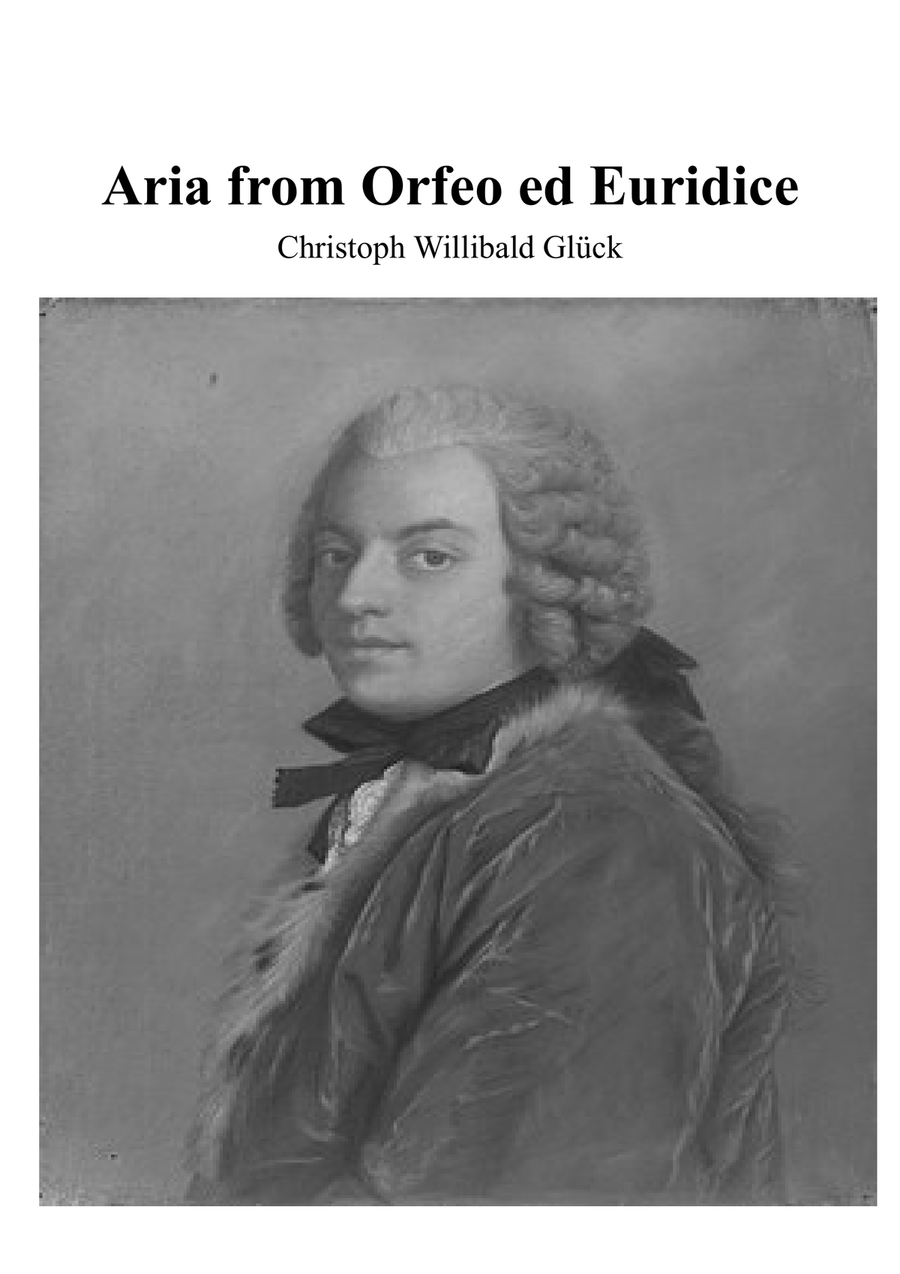
Aria from the Opera Orfeo ed Euridice for Brass Quintet (French Horn solo)
Quintette de Cuivres: 2 trompettes, Cor, trombone, tuba

$8.99 7.56 € Quintette de Cuivres: 2 trompettes, Cor, trombone, tuba PDF SheetMusicPlus

Choral Choir,Choral (SATB divisi) - Level 5 - Digital Download SKU: A0.900166 By Sarah Labrie, Conductor - Chamber Choral Conducting Workshop, Sarteano, Italy. By Mary Ellen Haupert. Easter,Sacred,Spiritual. 5 pages. Mary Ellen Haupert #3031789. Published by Mary Ellen Haupert (A0.900166). ILLUMINE LE TENEBRE (SSAATTBB) For Jean Saladino and the Viterbo University Concert Choir TRANSLATION of TEXT: Most High, glorious God, enlighten the darkness of my heart and give me true faith, certain hope and perfect charity, sense and knowledge, Lord, that I may carry out your holy and true command. Amen. - St. Francis of Assisi's Prayer before the Crucifix NOTES from the composer: One year ago, I had the privilege of participating in the Leadership Pilgrimage to Assisi and Rome (2011) sponsored by the Franciscan Sisters of Perpetual Adoration, Franciscan Healthcare, and Viterbo University.  I carried with me, not only the responsibility of bringing back a hint of Francis’ lived experience to my students, but the desire to compose something wholly Franciscan. The San Damiano Cross is one of the most distinctive Franciscan images we have on campus.  The gentle Jesus that hangs on this 12th-century icon will forever be linked to Francis’ dramatic step from citizen to sainthood-welcoming his earnest prayer to enlighten the darkness of his heart.  The Basilica of Santa Chiara in Assisi holds both the San Damiano Cross and the remains of his confidante, St. Clare.  It seemed a good place to start getting serious. Copying the prayer in at least six different languages, I tucked it away in my travel books, not digging it out again until the following summer (2012).  The opening phrases in the piece came easily enough (Altissimo, glorioso Dio), but I stumbled through a handful of ideas before coming up with the mantra (illumine le tenebre…).  It made sense that Francis would joyfully address God singing forte (Altissimo and Signore), while quietly chanting his humble prayers for faith, hope, charity, and knowledge. The friendship between Francis and Clare can’t be missed, not only in the intermingling of SATB voices, but in the setting of che faccia lo tuo santo e verace comadamento (that I may carry out your holy and true command).  The phrase is sung only once by the women before the final return of the illumine chant (which is repeated throughout by the men).  Maybe I chanced on weaving some of Clare’s courage with Francis’ persistence into Illumina le tenebre, all while trying to compose something wholly Franciscan?   ---Mary Ellen Haupert, October 2012.  
Illumine le tenebre
Chorale SATB
Sarah Labrie, Conductor - Chamber Choral Conducting Workshop, Sarteano, Italy
$3.99 3.35 € Chorale SATB PDF SheetMusicPlus


Partitions Gratuites
Acheter des Partitions Musicales
Acheter des Partitions Digitales à Imprimer
Acheter des Instruments de Musique

© 2000 - 2026

Accueil - Version intégrale





