EUROPE
3889 articles
USA
1087 articles
DIGITAL
1434 articles (à imprimer)
Partitions Digitales
Partitions à imprimer
1434 partitions trouvées


String Quartet String Quartet - Level 4 - Digital Download SKU: A0.742473 Composed by Jean Phillipe Rameau. Arranged by Arte Nova Music Lab. Baroque,Concert,Standards,World. Score and parts. 8 pages. Arte Nova Music Lab #4600763. Published by Arte Nova Music Lab (A0.742473). Les Indes galantes (French: The Amorous Indies) Opéra-ballet with a prologue and two entrées. Choreography: Louis Dupré. Music: Jean-Philippe Rameau. Libretto: Louis Fuzelier. Sets: Giovanni-Niccolò Servandoni. First performance: 23 August 1735, Théâtre de l'Académie de Musique, Paris. Principals: David Dumoulin, Louis Dupré, M. le Breton, M. Javellier, Marie Sallé. The premiere, including only the prologue and the first two of its four entrées (acts), was staged by the Académie Royale de Musique at itstheatre in the Palais-Royal in Paris on 23 August 1735, starring the leading singers of the Opéra, Marie Antier, Marie Pélissier, Mlle Errémans, Mlle Petitpas, Denis-François Tribou, Pierre Jélyotte, and Claude-Louis-Dominique Chassé de Chinais, and the dancers Marie Sallé and Louis Dupré. Michel Blondy provided the choreography. The ballet's Premier Menuet was used in the soundtrack of the 2006 film Marie Antoinette. Le Turc Generaux. Osman Pasha is in love with his slave, the young Émilie, but she rejects him, telling him she was about to be married when a group of brigands abducted her. Osman urges her to give up hope that her fiancé is still alive (Air: Il faut que l'amour s'evole) but Émilie refuses to believe this is true. The sky turns dark as a storm brews; Émilie sees the violent weather as an image of her despair (Air: Vaste empire des mers). A chorus of shipwrecked sailors is heard (Chorus: Ciel! de plus d'une mort). Émilie laments that they too will be taken captive. She recognises one of the sailors as her fiancé Valère. Their joy at their reunion is tempered by sadness at the thought they are both slaves now. Osman enters and is furious to see the couple embracing. However, unexpectedly, he announces he will free them. He too has recognised Valère, who was once his master but magnanimously freed him. Osman loads Valère's surviving ships with gifts and the couple praise his generosity. They call on the winds to blow them back to France (Duet and chorus: Volez, Zéphyrs). The act ends with celebratory dances as Valère and Émilie prepare to set sail.
Les Indes Galantes - Le Turc Generaux (Premiere Entree)
Quatuor à cordes: 2 violons, alto, violoncelle

$20.00 16.82 € Quatuor à cordes: 2 violons, alto, violoncelle PDF SheetMusicPlus

French Horn Duet Horn - Level 3 - Digital Download SKU: A0.1316234 Composed by Jean-Baptiste Loeillet. Arranged by James M. Guthrie. Chamber,Classical,Contest,Festival,Traditional,Wedding. Score. 8 pages. Jmsgu3 #904982. Published by jmsgu3 (A0.1316234). Sonata No. 1 for French Horn DuoJean Baptiste Loeillet was a Flemish baroque composer and performer on the recorder, flute, oboe, and harpsichord. He is known for his compositions, including the 12 Sonatas, Op. 5, which includes Sonata No. 6 for Flute Duo. The piece is important because it is a well-known and frequently performed work in the flute repertoire, showcasing Loeillet's skill as a composer and his contributions to baroque music. Loeillet spent most of his life in France serving the archbishop of Lyon, Paul-François de Neufville de Villeroy.
Loeillet: Sonata No. 1 for French Horn Duo
2 Cors (duo)

$24.95 20.98 € 2 Cors (duo) PDF SheetMusicPlus

Brass Quintet Horn,Trombone,Trumpet,Tuba - Level 3 - Digital Download SKU: A0.1444646 Composed by Franklin Stover. 20th Century,21st Century,Medieval. 54 pages. Edition Hohenstaufen #1024536. Published by Edition Hohenstaufen (A0.1444646). This partly derivative work was written in 2024 and centers around Fumeux Fume par fumée, a secular song praising smoking, is a product of the Ars Subtillior school in France, the so-called 'avant-garde' of the 14th century. The composers of this time and place using neume notation witnessed and survived the Black Plague. In Fumeux, Jean Solage (c.1350-c.1403) experimented with different combinations of hexachords approved by the Church since the days of Guido van Arezzo (11th century). Using Fumeux as the basis of my composition, my idea was to alternate the tune with a complimentary contrapuntal responsive of my own making.
Reverie on 'Fumeux Fume par fumée' after Solage
Quintette de Cuivres: 2 trompettes, Cor, trombone, tuba

$6.00 5.04 € Quintette de Cuivres: 2 trompettes, Cor, trombone, tuba PDF SheetMusicPlus

String Quartet Cello,String Quartet,Viola,Violin - Level 4 - Digital Download SKU: A0.936387 Composed by Antonin Dvorak, Bach/Gounod, C. Franck, CLARKE, Camille Saint-Saens, Edward Elgar, Felix Bartholdy Mendelssohn, Franz Liszt, Franz Schubert, Frederic Chopin, George Frideric Handel, Jean-Joseph Mouret, Johann Pachelbel, Johann Sebastian Bach, Joseph Joachim Raff, P. Tchaikovsky, R. Schumann, Richard Wagner, Vincenzo Bellini, and Zdenek Fibich. Arranged by Abolin. Baroque,Classical,Romantic Period,Sacred,Wedding. 195 pages. Abolin #6864027. Published by Abolin (A0.936387). Parts only (no score) A collection of 30 pieces for string quartet that are popular for weddings and other occasions.
The Wedding Essentials for String Quartet, Vol. 1 and 2 - Album of 30 pieces - Parts (no score)
Quatuor à cordes: 2 violons, alto, violoncelle

$44.99 37.83 € Quatuor à cordes: 2 violons, alto, violoncelle PDF SheetMusicPlus

String Orchestra - Level 4 - Digital Download SKU: A0.1183537 Composed by Joseph Bologne, Chevalier de St. Georges. Arranged by Robert Debbaut. Classical,Contest,Festival,Historic,Multicultural,World. 57 pages. ROBERT DEBBAUT #783210. Published by ROBERT DEBBAUT (A0.1183537). How is it that one can be born a slave in French colonial Guadeloupe and rise to be among Paris’ musical giants, to become a colonel in the French Army as well as the frequent dinner guest of princes and potentates? The story of Joseph Bologne, Chevalier de Saint-Georges, is surely an interesting one, even the stuff of which movies are made.Joseph Bologne’s father, Georges Bologne de Saint-Georges was a French planter. Saint-Georges was the name of his plantation. He impregnated Anne, the Senegalese slave of his wife, who bore him a son in 1745. Uncharacteristic of many of these sort of relationships he acknowledged the child was his and gave him his family name. When he was seven Bologne’s father took him to Paris for his education, enrolling him in a boarding school. Two years later he and the child’s mother returned to France and set up housekeeping as a family in Paris’ Saint-Germain-des-Prés district.At age thirteen Joseph’s father enrolled him in the Royal Technical Academy of Fencing and Swordsmanship. He quickly became the finest swordsman in the academy, perhaps in all of Paris. Upon graduation he was made an Officer of the King’s Bodyguard and a chevalier (an honorary knighthood). He went on to serve tours of duty in the French Army during the Seven Years War (1756-1763) and later after the French Revolution, where he was Colonel and commander of an all-Black regiment of the Revolutionary Army. All this in spite of the fact that French law forbade him, a man of African heritage, to become a citizen, to retain his father’s royal title of “Gentleman of the King’s Chamber,†or to marry outside his class.There is limited information about Bologne’s musical training, but he was obviously so well-skilled that Italian violinist-composer Antonio Lolli (1725-1802) wrote two violin concertos for him and French composer François-Joseph Gossec (1734-1829) dedicated his set of String Trios, Op. 9 to Bologne. Lolli may have worked with him on violin technique and Gossec composition, but this may be apocryphal. Bologne played in Gossec’s orchestra, and was later both leader and conductor of the group.As a composer Joseph Bologne was quite prolific, composing six operas, fourteen violin concertos, four symphonies concertantes, and numerous chamber works and songs. His Six String Quartets, Op. 1, Nos. 1-6 date from 1770-1771 and were published by the Paris publishing house of Jean-Georges Sieber (1738-1822) in 1773 (There are a total of 18 quartets: Six Quartets “au goût du jour†[up-to-date] from 1779 and the Opus 14 set of six which date from 1785). The Opus 1 quartets are dedicated to Anne Louis Alexandre de Montmorency (1724-1812), 7th Prince of Robeck (Robecq) and Grand Duke of Spain.The Opus 1 quartets all display a similarity to the Italian opera overtures from earlier in the Eighteenth Century (often called “sinfoniaâ€) in that they have an overall “A-B-A†form with the ‘A’ sections being robust allegros and all ‘B’ sections marked “rondo.†As such, in arranging them for string orchestra it seemed quite natural to rename them “overtures.†Certain liberties were taken by the arranger in order to maintain the integrity of the classic Rondo formula. All six have been arranged in this manner for string orchestra. They vary in length from twelve to almost twenty minutes. If you wish to obtain parts, write to debbaut@gmail.com and pay $42 via venmo or $40 via personal check and they will be sent to you in pdf format.
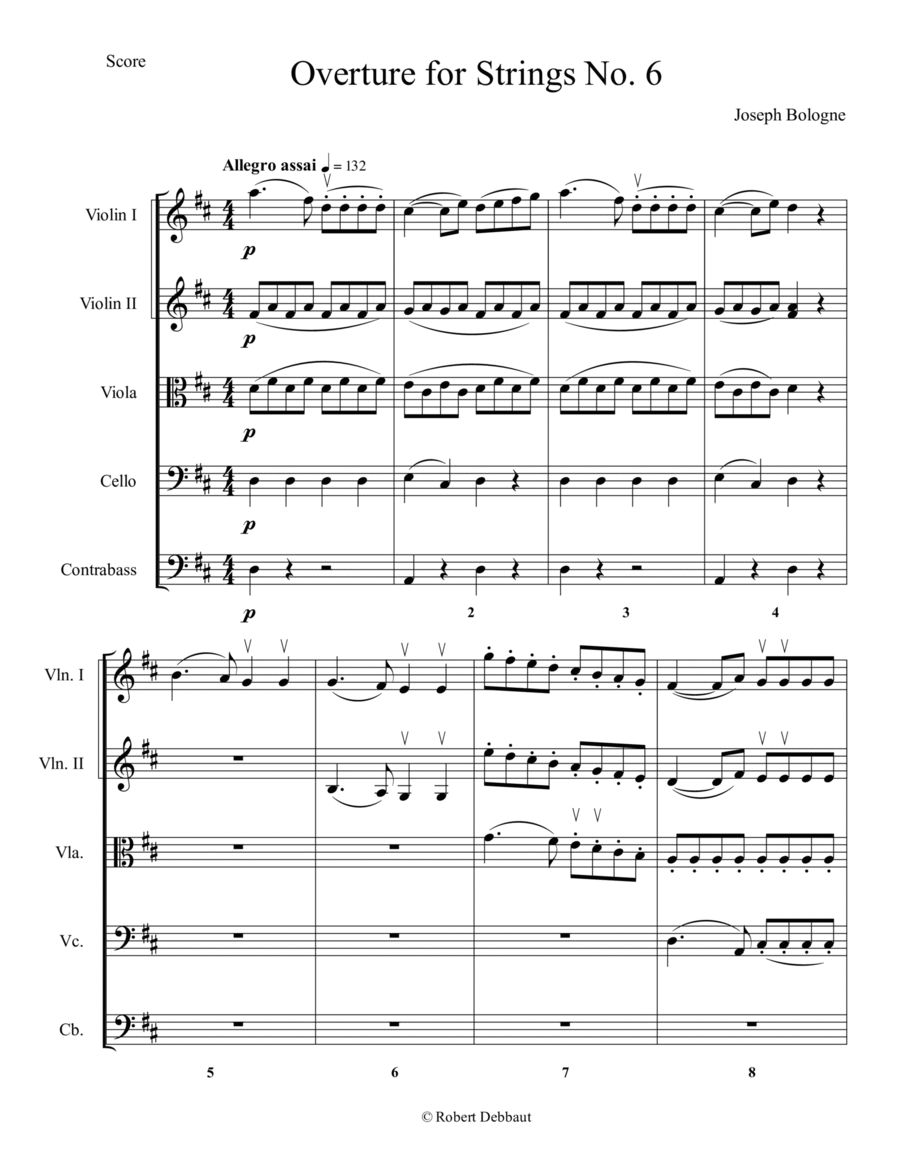
Overture for Strings No. 6 - Score Only
Orchestre à Cordes

$9.99 8.4 € Orchestre à Cordes PDF SheetMusicPlus

String Orchestra - Level 4 - Digital Download SKU: A0.1183533 Composed by Joseph Bologne, Chevalier de St. Georges. Arranged by Robert Debbaut. Classical,Contest,Festival,Historic,Multicultural,World. 43 pages. ROBERT DEBBAUT #783206. Published by ROBERT DEBBAUT (A0.1183533). How is it that one can be born a slave in French colonial Guadeloupe and rise to be among Paris’ musical giants, to become a colonel in the French Army as well as the frequent dinner guest of princes and potentates? The story of Joseph Bologne, Chevalier de Saint-Georges, is surely an interesting one, even the stuff of which movies are made.Joseph Bologne’s father, Georges Bologne de Saint-Georges was a French planter. Saint-Georges was the name of his plantation. He impregnated Anne, the Senegalese slave of his wife, who bore him a son in 1745. Uncharacteristic of many of these sort of relationships he acknowledged the child was his and gave him his family name. When he was seven Bologne’s father took him to Paris for his education, enrolling him in a boarding school. Two years later he and the child’s mother returned to France and set up housekeeping as a family in Paris’ Saint-Germain-des-Prés district.At age thirteen Joseph’s father enrolled him in the Royal Technical Academy of Fencing and Swordsmanship. He quickly became the finest swordsman in the academy, perhaps in all of Paris. Upon graduation he was made an Officer of the King’s Bodyguard and a chevalier (an honorary knighthood). He went on to serve tours of duty in the French Army during the Seven Years War (1756-1763) and later after the French Revolution, where he was Colonel and commander of an all-Black regiment of the Revolutionary Army. All this in spite of the fact that French law forbade him, a man of African heritage, to become a citizen, to retain his father’s royal title of “Gentleman of the King’s Chamber,†or to marry outside his class.There is limited information about Bologne’s musical training, but he was obviously so well-skilled that Italian violinist-composer Antonio Lolli (1725-1802) wrote two violin concertos for him and French composer François-Joseph Gossec (1734-1829) dedicated his set of String Trios, Op. 9 to Bologne. Lolli may have worked with him on violin technique and Gossec composition, but this may be apocryphal. Bologne played in Gossec’s orchestra, and was later both leader and conductor of the group.As a composer Joseph Bologne was quite prolific, composing six operas, fourteen violin concertos, four symphonies concertantes, and numerous chamber works and songs. His Six String Quartets, Op. 1, Nos. 1-6 date from 1770-1771 and were published by the Paris publishing house of Jean-Georges Sieber (1738-1822) in 1773 (There are a total of 18 quartets: Six Quartets “au goût du jour†[up-to-date] from 1779 and the Opus 14 set of six which date from 1785). The Opus 1 quartets are dedicated to Anne Louis Alexandre de Montmorency (1724-1812), 7th Prince of Robeck (Robecq) and Grand Duke of Spain.The Opus 1 quartets all display a similarity to the Italian opera overtures from earlier in the Eighteenth Century (often called “sinfoniaâ€) in that they have an overall “A-B-A†form with the ‘A’ sections being robust allegros and all ‘B’ sections marked “rondo.†As such, in arranging them for string orchestra it seemed quite natural to rename them “overtures.†Certain liberties were taken by the arranger in order to maintain the integrity of the classic Rondo formula. All six have been arranged in this manner for string orchestra. They vary in length from twelve to almost twenty minutes. If you wish to obtain parts, write to debbaut@gmail.com and pay $42 via venmo or $40 via personal check and they will be sent to you in pdf format.
Overture for Strings No. 2 - Score Only
Orchestre à Cordes

$9.99 8.4 € Orchestre à Cordes PDF SheetMusicPlus

String Orchestra - Level 4 - Digital Download SKU: A0.1183535 Composed by Joseph Bologne, Chevalier de St. Georges. Arranged by Robert Debbaut. Classical,Contest,Festival,Historic,Multicultural,World. 34 pages. ROBERT DEBBAUT #783208. Published by ROBERT DEBBAUT (A0.1183535). How is it that one can be born a slave in French colonial Guadeloupe and rise to be among Paris’ musical giants, to become a colonel in the French Army as well as the frequent dinner guest of princes and potentates? The story of Joseph Bologne, Chevalier de Saint-Georges, is surely an interesting one, even the stuff of which movies are made.Joseph Bologne’s father, Georges Bologne de Saint-Georges was a French planter. Saint-Georges was the name of his plantation. He impregnated Anne, the Senegalese slave of his wife, who bore him a son in 1745. Uncharacteristic of many of these sort of relationships he acknowledged the child was his and gave him his family name. When he was seven Bologne’s father took him to Paris for his education, enrolling him in a boarding school. Two years later he and the child’s mother returned to France and set up housekeeping as a family in Paris’ Saint-Germain-des-Prés district.At age thirteen Joseph’s father enrolled him in the Royal Technical Academy of Fencing and Swordsmanship. He quickly became the finest swordsman in the academy, perhaps in all of Paris. Upon graduation he was made an Officer of the King’s Bodyguard and a chevalier (an honorary knighthood). He went on to serve tours of duty in the French Army during the Seven Years War (1756-1763) and later after the French Revolution, where he was Colonel and commander of an all-Black regiment of the Revolutionary Army. All this in spite of the fact that French law forbade him, a man of African heritage, to become a citizen, to retain his father’s royal title of “Gentleman of the King’s Chamber,†or to marry outside his class.There is limited information about Bologne’s musical training, but he was obviously so well-skilled that Italian violinist-composer Antonio Lolli (1725-1802) wrote two violin concertos for him and French composer François-Joseph Gossec (1734-1829) dedicated his set of String Trios, Op. 9 to Bologne. Lolli may have worked with him on violin technique and Gossec composition, but this may be apocryphal. Bologne played in Gossec’s orchestra, and was later both leader and conductor of the group.As a composer Joseph Bologne was quite prolific, composing six operas, fourteen violin concertos, four symphonies concertantes, and numerous chamber works and songs. His Six String Quartets, Op. 1, Nos. 1-6 date from 1770-1771 and were published by the Paris publishing house of Jean-Georges Sieber (1738-1822) in 1773 (There are a total of 18 quartets: Six Quartets “au goût du jour†[up-to-date] from 1779 and the Opus 14 set of six which date from 1785). The Opus 1 quartets are dedicated to Anne Louis Alexandre de Montmorency (1724-1812), 7th Prince of Robeck (Robecq) and Grand Duke of Spain.The Opus 1 quartets all display a similarity to the Italian opera overtures from earlier in the Eighteenth Century (often called “sinfoniaâ€) in that they have an overall “A-B-A†form with the ‘A’ sections being robust allegros and all ‘B’ sections marked “rondo.†As such, in arranging them for string orchestra it seemed quite natural to rename them “overtures.†Certain liberties were taken by the arranger in order to maintain the integrity of the classic Rondo formula. All six have been arranged in this manner for string orchestra. They vary in length from twelve to almost twenty minutes. If you wish to obtain parts, write to debbaut@gmail.com and pay $42 via venmo or $40 via personal check and they will be sent to you in pdf format.

Overture for Strings No. 4 - Score Only
Orchestre à Cordes

$9.99 8.4 € Orchestre à Cordes PDF SheetMusicPlus

String Orchestra - Level 4 - Digital Download SKU: A0.1183534 Composed by Joseph Bologne, Chevalier de St. Georges. Arranged by Robert Debbaut. Classical,Contest,Festival,Historic,Multicultural,World. 28 pages. ROBERT DEBBAUT #783207. Published by ROBERT DEBBAUT (A0.1183534). How is it that one can be born a slave in French colonial Guadeloupe and rise to be among Paris’ musical giants, to become a colonel in the French Army as well as the frequent dinner guest of princes and potentates? The story of Joseph Bologne, Chevalier de Saint-Georges, is surely an interesting one, even the stuff of which movies are made.Joseph Bologne’s father, Georges Bologne de Saint-Georges was a French planter. Saint-Georges was the name of his plantation. He impregnated Anne, the Senegalese slave of his wife, who bore him a son in 1745. Uncharacteristic of many of these sort of relationships he acknowledged the child was his and gave him his family name. When he was seven Bologne’s father took him to Paris for his education, enrolling him in a boarding school. Two years later he and the child’s mother returned to France and set up housekeeping as a family in Paris’ Saint-Germain-des-Prés district.At age thirteen Joseph’s father enrolled him in the Royal Technical Academy of Fencing and Swordsmanship. He quickly became the finest swordsman in the academy, perhaps in all of Paris. Upon graduation he was made an Officer of the King’s Bodyguard and a chevalier (an honorary knighthood). He went on to serve tours of duty in the French Army during the Seven Years War (1756-1763) and later after the French Revolution, where he was Colonel and commander of an all-Black regiment of the Revolutionary Army. All this in spite of the fact that French law forbade him, a man of African heritage, to become a citizen, to retain his father’s royal title of “Gentleman of the King’s Chamber,†or to marry outside his class.There is limited information about Bologne’s musical training, but he was obviously so well-skilled that Italian violinist-composer Antonio Lolli (1725-1802) wrote two violin concertos for him and French composer François-Joseph Gossec (1734-1829) dedicated his set of String Trios, Op. 9 to Bologne. Lolli may have worked with him on violin technique and Gossec composition, but this may be apocryphal. Bologne played in Gossec’s orchestra, and was later both leader and conductor of the group.As a composer Joseph Bologne was quite prolific, composing six operas, fourteen violin concertos, four symphonies concertantes, and numerous chamber works and songs. His Six String Quartets, Op. 1, Nos. 1-6 date from 1770-1771 and were published by the Paris publishing house of Jean-Georges Sieber (1738-1822) in 1773 (There are a total of 18 quartets: Six Quartets “au goût du jour†[up-to-date] from 1779 and the Opus 14 set of six which date from 1785). The Opus 1 quartets are dedicated to Anne Louis Alexandre de Montmorency (1724-1812), 7th Prince of Robeck (Robecq) and Grand Duke of Spain.The Opus 1 quartets all display a similarity to the Italian opera overtures from earlier in the Eighteenth Century (often called “sinfoniaâ€) in that they have an overall “A-B-A†form with the ‘A’ sections being robust allegros and all ‘B’ sections marked “rondo.†As such, in arranging them for string orchestra it seemed quite natural to rename them “overtures.†Certain liberties were taken by the arranger in order to maintain the integrity of the classic Rondo formula. All six have been arranged in this manner for string orchestra. They vary in length from twelve to almost twenty minutes. If you wish to obtain parts, write to debbaut@gmail.com and pay $42 via venmo or $40 via personal check and they will be sent to you in pdf format.

Overture for Strings No. 3 - Score Only
Orchestre à Cordes

$9.99 8.4 € Orchestre à Cordes PDF SheetMusicPlus

String Orchestra - Level 4 - Digital Download SKU: A0.1183536 Composed by Joseph Bologne, Chevalier de St. Georges. Arranged by Robert Debbaut. Classical,Contest,Festival,Historic,Multicultural,World. 39 pages. ROBERT DEBBAUT #783209. Published by ROBERT DEBBAUT (A0.1183536). How is it that one can be born a slave in French colonial Guadeloupe and rise to be among Paris’ musical giants, to become a colonel in the French Army as well as the frequent dinner guest of princes and potentates? The story of Joseph Bologne, Chevalier de Saint-Georges, is surely an interesting one, even the stuff of which movies are made.Joseph Bologne’s father, Georges Bologne de Saint-Georges was a French planter. Saint-Georges was the name of his plantation. He impregnated Anne, the Senegalese slave of his wife, who bore him a son in 1745. Uncharacteristic of many of these sort of relationships he acknowledged the child was his and gave him his family name. When he was seven Bologne’s father took him to Paris for his education, enrolling him in a boarding school. Two years later he and the child’s mother returned to France and set up housekeeping as a family in Paris’ Saint-Germain-des-Prés district.At age thirteen Joseph’s father enrolled him in the Royal Technical Academy of Fencing and Swordsmanship. He quickly became the finest swordsman in the academy, perhaps in all of Paris. Upon graduation he was made an Officer of the King’s Bodyguard and a chevalier (an honorary knighthood). He went on to serve tours of duty in the French Army during the Seven Years War (1756-1763) and later after the French Revolution, where he was Colonel and commander of an all-Black regiment of the Revolutionary Army. All this in spite of the fact that French law forbade him, a man of African heritage, to become a citizen, to retain his father’s royal title of “Gentleman of the King’s Chamber,†or to marry outside his class.There is limited information about Bologne’s musical training, but he was obviously so well-skilled that Italian violinist-composer Antonio Lolli (1725-1802) wrote two violin concertos for him and French composer François-Joseph Gossec (1734-1829) dedicated his set of String Trios, Op. 9 to Bologne. Lolli may have worked with him on violin technique and Gossec composition, but this may be apocryphal. Bologne played in Gossec’s orchestra, and was later both leader and conductor of the group.As a composer Joseph Bologne was quite prolific, composing six operas, fourteen violin concertos, four symphonies concertantes, and numerous chamber works and songs. His Six String Quartets, Op. 1, Nos. 1-6 date from 1770-1771 and were published by the Paris publishing house of Jean-Georges Sieber (1738-1822) in 1773 (There are a total of 18 quartets: Six Quartets “au goût du jour†[up-to-date] from 1779 and the Opus 14 set of six which date from 1785). The Opus 1 quartets are dedicated to Anne Louis Alexandre de Montmorency (1724-1812), 7th Prince of Robeck (Robecq) and Grand Duke of Spain.The Opus 1 quartets all display a similarity to the Italian opera overtures from earlier in the Eighteenth Century (often called “sinfoniaâ€) in that they have an overall “A-B-A†form with the ‘A’ sections being robust allegros and all ‘B’ sections marked “rondo.†As such, in arranging them for string orchestra it seemed quite natural to rename them “overtures.†Certain liberties were taken by the arranger in order to maintain the integrity of the classic Rondo formula. All six have been arranged in this manner for string orchestra. They vary in length from twelve to almost twenty minutes. If you wish to obtain parts, write to debbaut@gmail.com and pay $42 via venmo or $40 via personal check and they will be sent to you in pdf format.

Overture for Strings No. 5 - Score Only
Orchestre à Cordes

$9.99 8.4 € Orchestre à Cordes PDF SheetMusicPlus


Partitions Gratuites
Acheter des Partitions Musicales
Acheter des Partitions Digitales à Imprimer
Acheter des Instruments de Musique

© 2000 - 2026

Accueil - Version intégrale


