EUROPE
12641 articles
USA
14487 articles
DIGITAL
26131 articles (à imprimer)
Partitions Digitales
Partitions à imprimer
26131 partitions trouvées


String Orchestra - Level 5 - Digital Download SKU: A0.1101540 By Johann Sebastian Bach. By Johann Sebastian Bach. Arranged by Johann Sebastian Bach. Baroque,Classical,Instructional,Multicultural,World. Score and parts. 63 pages. Gabriel Vinicius #704919. Published by Gabriel Vinicius (A0.1101540). Johann Sebastian Bach composed his Concerto Concerto for Two Violins, Strings, and Continuo in D minor, BWV 1043, at some point between 1717 and 1723, while he was the Kapellmeister at the court of Anhalt-Köthen, Germany. The work is commonly referred to as 'Bach's double violin Concerto'. An earlier version of the concerto (known as Sinfonia, BWV 1046a) which does not use the violin piccolo was used for the opening of cantata BWV 208. This version lacks the third movement entirely, and the Polacca from the final movement, leaving Menuet - Trio I - Menuet - Trio II - Menuet. The first movement can also be found as the sinfonia of the cantata Falsche Welt, dir trau ich nicht, BWV 52. The third movement was used as the opening chorus of cantata BWV 207.
Concerto for 2 Violins in D minor BWV 1043 complete score.
Orchestre à Cordes
Johann Sebastian Bach
$14.00 12.13 € Orchestre à Cordes PDF SheetMusicPlus

Bassoon,Flute,Oboe,Piano - Level 3 - Digital Download SKU: A0.1422054 Composed by Johann Sebastian Bach. Arranged by Kamada, Mikio. Baroque. 5 pages. ACORDO Sheet Music #1003395. Published by ACORDO Sheet Music (A0.1422054). Johann Sebastian Bach composed the cantata Ich hatte viel Bekümmernis BWV 21 during the Weimar period. Craig Smith of Emmanuel Music suggested that this work was not only written to accompany the readings for the third Sunday after Trinity, but also to bid farewell to the gravely ill Prince Johann Ernst of Sachsen-Weimar, one of Bach's talented students. However, at the time, Prince Johann was seriously ill and was on his way to Swabia for recovery.The first movement, Sinfonia, is a deeply sorrowful piece, characterized by a rich dialogue between the oboe and violin. Julian Mincham of The Cantatas of Johann Sebastian Bach described it is a continuous discourse between oboe and first violin, quite possibly suggestive of the dialogue structure (Christ and the Soul) to be found in later movements, however, it sounds like a dialogue between the Prince and Bach for me.The string ensemble part was transcribed for piano to make it easier to play. The solo parts are originally for oboe and violin, but in this arrangement, they are for oboe and flute.  The bassoon (or cello) part is the same as the piano's left hand and is optional.
" Sinfonia from Cantata "Ich hatte viel Bekummerniss", BWV 21 for Oboe, Flute and Piano "

$3.60 3.12 € PDF SheetMusicPlus

Level 3 - Digital Download SKU: A0.1426547 Composed by Johann Sebastian Bach. Arranged by Kamada, Mikio. Baroque. 5 pages. ACORDO Sheet Music #1007247. Published by ACORDO Sheet Music (A0.1426547). Johann Sebastian Bach composed the cantata Ich hatte viel Bekümmernis BWV 21 during the Weimar period. Craig Smith of Emmanuel Music suggested that this work was not only written to accompany the readings for the third Sunday after Trinity, but also to bid farewell to the gravely ill Prince Johann Ernst of Sachsen-Weimar, one of Bach's talented students. However, at the time, Prince Johann was seriously ill and was on his way to Swabia for recovery.The first movement, Sinfonia, is a deeply sorrowful piece, characterized by a rich dialogue between the oboe and violin. Julian Mincham of The Cantatas of Johann Sebastian Bach described it is a continuous discourse between oboe and first violin, quite possibly suggestive of the dialogue structure (Christ and the Soul) to be found in later movements, however, it sounds like a dialogue between the Prince and Bach for me.The string ensemble part was transcribed for piano to make it easier to play. The solo parts are originally for oboe and violin, but in this arrangement, they are for flute and clarinet.  The bassoon (or cello) part is the same as the piano's left hand and is optional.
Sinfonia from Cantata "Ich hatte viel Bekummerniss", BWV 21 for Flute, Clarinet and Piano

$3.60 3.12 € PDF SheetMusicPlus

Bassoon,Clarinet,Piano - Level 3 - Digital Download SKU: A0.1426548 Composed by Johann Sebastian Bach. Arranged by Kamada, Mikio. Baroque. 5 pages. ACORDO Sheet Music #1007248. Published by ACORDO Sheet Music (A0.1426548). Johann Sebastian Bach composed the cantata Ich hatte viel Bekümmernis BWV 21 during the Weimar period. Craig Smith of Emmanuel Music suggested that this work was not only written to accompany the readings for the third Sunday after Trinity, but also to bid farewell to the gravely ill Prince Johann Ernst of Sachsen-Weimar, one of Bach's talented students. However, at the time, Prince Johann was seriously ill and was on his way to Swabia for recovery.The first movement, Sinfonia, is a deeply sorrowful piece, characterized by a rich dialogue between the oboe and violin. Julian Mincham of The Cantatas of Johann Sebastian Bach described it is a continuous discourse between oboe and first violin, quite possibly suggestive of the dialogue structure (Christ and the Soul) to be found in later movements, however, it sounds like a dialogue between the Prince and Bach for me.The string ensemble part was transcribed for piano to make it easier to play. The solo parts are originally for oboe and violin, but in this arrangement, they are for Clarinets.  The bassoon (or cello) part is the same as the piano's left hand and is optional.
Sinfonia from Cantata "Ich hatte viel Bekummerniss", BWV 21 for two Clarinets and Piano

$3.60 3.12 € PDF SheetMusicPlus

English Horn,Oboe,Piano - Level 3 - Digital Download SKU: A0.1426549 Composed by Johann Sebastian Bach. Arranged by Kamada, Mikio. Baroque. 5 pages. ACORDO Sheet Music #1007249. Published by ACORDO Sheet Music (A0.1426549). Johann Sebastian Bach composed the cantata Ich hatte viel Bekümmernis BWV 21 during the Weimar period. Craig Smith of Emmanuel Music suggested that this work was not only written to accompany the readings for the third Sunday after Trinity, but also to bid farewell to the gravely ill Prince Johann Ernst of Sachsen-Weimar, one of Bach's talented students. However, at the time, Prince Johann was seriously ill and was on his way to Swabia for recovery.The first movement, Sinfonia, is a deeply sorrowful piece, characterized by a rich dialogue between the oboe and violin. Julian Mincham of The Cantatas of Johann Sebastian Bach described it is a continuous discourse between oboe and first violin, quite possibly suggestive of the dialogue structure (Christ and the Soul) to be found in later movements, however, it sounds like a dialogue between the Prince and Bach for me.The string ensemble part was transcribed for piano to make it easier to play. The solo parts are originally for oboe and violin, but in this arrangement, they are for Oboe and Cor Anglais.  The bassoon (or cello) part is the same as the piano's left hand and is optional.
Sinfonia from Cantata "Ich hatte viel Bekummerniss", BWV 21 for Oboe, Cor Anglais and Piano

$3.60 3.12 € PDF SheetMusicPlus

Bassoon,Clarinet,Oboe,Piano - Level 3 - Digital Download SKU: A0.1426546 Composed by Johann Sebastian Bach. Arranged by Kamada,Mikio. Baroque. 5 pages. ACORDO Sheet Music #1007246. Published by ACORDO Sheet Music (A0.1426546). Johann Sebastian Bach composed the cantata Ich hatte viel Bekümmernis BWV 21 during the Weimar period. Craig Smith of Emmanuel Music suggested that this work was not only written to accompany the readings for the third Sunday after Trinity, but also to bid farewell to the gravely ill Prince Johann Ernst of Sachsen-Weimar, one of Bach's talented students. However, at the time, Prince Johann was seriously ill and was on his way to Swabia for recovery.The first movement, Sinfonia, is a deeply sorrowful piece, characterized by a rich dialogue between the oboe and violin. Julian Mincham of The Cantatas of Johann Sebastian Bach described it is a continuous discourse between oboe and first violin, quite possibly suggestive of the dialogue structure (Christ and the Soul) to be found in later movements, however, it sounds like a dialogue between the Prince and Bach for me.The string ensemble part was transcribed for piano to make it easier to play. The solo parts are originally for oboe and violin, but in this arrangement, they are for oboe and clarinet.  The bassoon (or cello) part is the same as the piano's left hand and is optional.
Sinfonia from Cantata "Ich hatte viel Bekummerniss", BWV 21 for Oboe, Clarinet and Piano

$3.60 3.12 € PDF SheetMusicPlus

Cello,Oboe,Piano,Violin - Level 3 - Digital Download SKU: A0.1417698 Composed by Johann Sebastian Bach. Arranged by Kamada, Mikio. Baroque. 5 pages. ACORDO Sheet Music #999237. Published by ACORDO Sheet Music (A0.1417698). Johann Sebastian Bach composed the cantata Ich hatte viel Bekümmernis BWV 21 during the Weimar period. Craig Smith of Emmanuel Music suggested that this work was not only written to accompany the readings for the third Sunday after Trinity, but also to bid farewell to the gravely ill Prince Johann Ernst of Sachsen-Weimar, one of Bach's talented students. However, at the time, Prince Johann was seriously ill and was on his way to Swabia for recovery.The first movement, Sinfonia, is a deeply sorrowful piece, characterized by a rich dialogue between the oboe and violin. Julian Mincham of The Cantatas of Johann Sebastian Bach described it is a continuous discourse between oboe and first violin, quite possibly suggestive of the dialogue structure (Christ and the Soul) to be found in later movements, however, it sounds like a dialogue between the Prince and Bach for me.The string ensemble part was transcribed for piano to make it easier to play. The cello part is the same as the piano's left hand and is optional.
Sinfonia from Cantata "Ich hatte viel Bekummerniss", BWV 21 for Oboe, Violin and Piano

$3.60 3.12 € PDF SheetMusicPlus

Piano Solo - Level 3 - Digital Download SKU: A0.1452090 Composed by Christopher Benfield. 21st Century,Baroque,Classical,Contemporary,Jazz. Score. 2 pages. Christopher Benfield #1031364. Published by Christopher Benfield (A0.1452090). This is a negative harmony answer to the famous piece by Johanne Sebastian Bach, Prelude in C. Using the compositional device of negative harmony, harmonies are flipped along an axis to create new and interesting harmonic structures. This piece takes this concept one step further, finding the inverse for pitch direction, tempo, dynamics, key signature, and meter, as well. While interesting harmonically, the piece as a whole is rather simple and will work well for intermediate students looking for something to freshen up their repertoire selection.
Postlude in F Minor
Piano seul

$3.99 3.46 € Piano seul PDF SheetMusicPlus

Small Ensemble Chimes,Clarinet,Double Bass,Horn,Steel Pan - Level 4 - Digital Download SKU: A0.920015 Composed by Johann Sebastian Bach. Arranged by Shaula Kitan Walko. Baroque,Christmas,Holiday,Multicultural,Sacred,World. Score and parts. 15 pages. Shady Lady Music #6644311. Published by Shady Lady Music (A0.920015). Wachet Auf! (Sleepers, Awake) from Johann Sebastian Bach Cantata No. 140. Composed by Johann Sebastian Bach. Arranged by Shaula Kitan Walko.Arrangement for Bb Clarinet, Horn in F, Chimes, Double Seconds Steel Drums and String Bass Quintet. Key of E Major.Range of Double Seconds part is G#3 - G#5.This is an arrangement of Sleepers, Awake by Johann Sebastian Bach, written for Bb Clarinet, Horn in F, Chimes, Double Seconds Steel Drums and String Bass Quintet in the Key of E Major at an early advanced playing level. The use of steel drums and chimes reflects the hymn's message of joy, while the combination of the clarinet and horn highlight the comforting beauty of the hymn's music.This set contains a score and a set of individual parts.          
Sleepers, Awake

$12.99 11.25 € PDF SheetMusicPlus

Woodwind Ensemble Double Reed Quintet,Oboe - Level 4 - Digital Download SKU: A0.1253791 Composed by Johann Sebastian Bach. Arranged by Regis Bookshar. Baroque,Chamber,Christian,Easter,Historic. 29 pages. Regis Bookshar #847417. Published by Regis Bookshar (A0.1253791). Three selections based on Christ lag in Todesbanden (Christ lay in death's bonds) (from Cantata No.   4, BMV   4) - Johann Sebastian Bach - Oboe Quintet - Advanced/Intermediate - Digital Download.Cantata No.   4, BMV   4, Chris lag in Todesbanden (also spelled Todes Banden) (Christ lay in death's bonds) is a cantata for Easter written by Johann Sebastian Bach and is his earliest surviving Church Cantata. It was probably written in 1707 when he was 22 years old. It is a Chorale Cantata, a style in which both the text and music are based on a hymn. In this instance, the source was Martin Luther's hymn of the same name which became a main Easter hymn in German Lutheranism.Regis Bookshar has transcribed and arranged three selections based on this hymn, two from Bach's Cantata No.   4, BMV   4, and also his Chorale Prelude, BMV 625. They may be played individually or as a trilogy and each movement gets more complex than the previous one. The first selection in this trilogy is the Chorale, Christ lag in Todesbanden, the final chorus from his Cantata No.   4, a straightforward four-part chorale setting of the hymn (Regis has also added a fifth part). This is followed by Bach's Chorale Prelude, BMV 625, a piece from his Orgelbuchlein (Little Organ Book), a collection of 46 Preludes for organ, written almost exclusively during the 1708-1717 period, while Bach was court organist at Weimar. For the final selection, Regis has placed the polyphonic and imitative chorus, Es war ein wunderlicher Krieg, da Tod und Leben rungen') (It was a strange battle, that death and life waged), which Bach had placed in the middle of his Cantata No.   4.This arrangement is for an Oboe Quintet. Included are a score and a complete set of parts (29 pages).I hope you will enjoy playing these selections and please search for other arrangements by Regis Bookshar. There are numerous selections in a variety of styles, also available for purchase. I think you wil be pleased with what you may find.
Three selections based on "Christ lag in Todesbanden" (Oboe Quintet)

$30.00 25.99 € PDF SheetMusicPlus

Saxophone Quintet,Woodwind Ensemble Alto Saxophone,Baritone Saxophone,Tenor Saxophone - Level 4 - Digital Download SKU: A0.1255304 Composed by Johann Sebastian Bach. Arranged by Regis Bookshar. Baroque,Chamber,Christian,Easter,Historic. 29 pages. Regis Bookshar #848817. Published by Regis Bookshar (A0.1255304). Three selections based on Christ lag in Todsesbanden (Christ lay in death's bonds) (from Cantata No.   4, BMV   4) - Johann Sebastian Bach - Saxophone Quintet (3 Altos, 1 Tenor, 1 Baritone) - Advanced /Intermediate - Digital Download.Cantata No.   4, BMV   4, Christ lag in Todesbanden (also spelled Todes Banden) (Christ lay in death's bonds) is a cantata for Easter written by Johann Sebastian Bach and is his earliest surviving Church Cantata. It was probably written in 1707 when he was 22 years old. It is a Chorale Cantata, a style in which both the text and music are based on a hymn. In this instance, the source was Martin Luther's hymn of the same name which became a main Easter hymn in German Lutheranism.Regis Bookshar has transcribed and arranged three selections based on this hymn tune, two from Bach's Cantata No.   4, BMV   4, and also his Chorale Prelude, BMV 625. They may be played individually or as a trilogy and each movement gets more complex that the previous one. The first selection in this trology is the Chorale, Christ lag in Todesbanden, the final chorus from his Cantata No.   4, a straightforward four-part chorale setting of the hymn (Regis has also added a fifth part). This is followed by Bach's Chorale Prelude, BMV 625, a piece from his Orgelbuchlein (Little Organ Book), a collection of 46 Preludes for organ, written almost exclusively during the 1708-1717 period, while Bach was court organist at Weimar. For the final selection, Regis has placed the polyphonic and imitative chorus, Es war ein wunderlicher Krieg, da Tod und Leben rungen) (It was a strange battle, that death and life waged), which Bach had placed in the middle of his Cantata No.   4.This arrangement is for a Saxophone Quintet, consisting of 3 Alto Saxophones, 1 Tenor Saxophone and 1 Baritone Saxophone. Included are a score and a complete set of parts (29 Pages).I hope you will enjoy playing these selections and please search for other arrangements by Regis Bookshar. There are numerous selections in a variety of styles, also available for purchase. I think you will be pleased with what you may find.
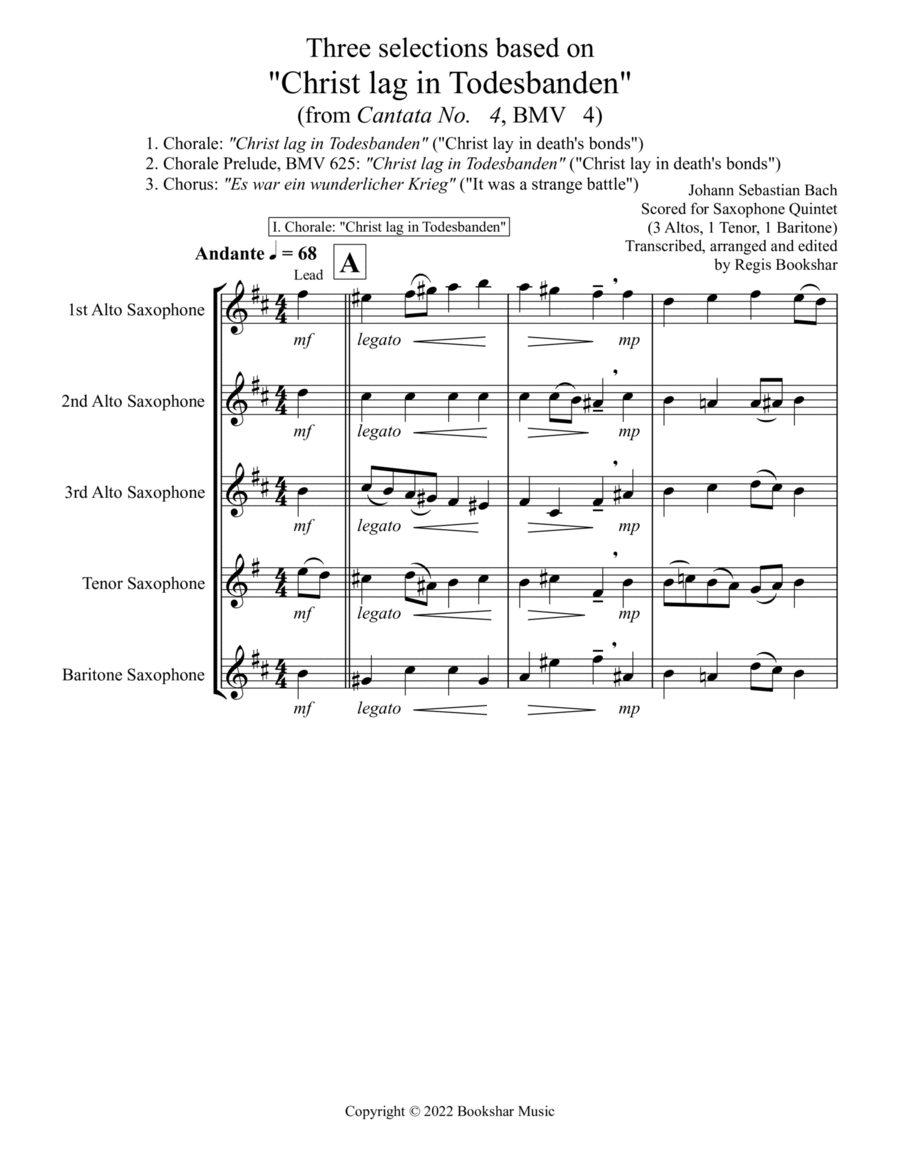
Three selections based on "Christ lag in Todesbanden" (Saxophone Quintet - 3 Alto, 1 Tenor, 1 Bari)
Quintette de Saxophone: 5 saxophones

$30.00 25.99 € Quintette de Saxophone: 5 saxophones PDF SheetMusicPlus


Partitions Gratuites
Acheter des Partitions Musicales
Acheter des Partitions Digitales à Imprimer
Acheter des Instruments de Musique

© 2000 - 2025

Accueil - Version intégrale





