EUROPE
2422 articles
USA
0 articles
DIGITAL
4101 articles (à imprimer)
Partitions Digitales
Partitions à imprimer
4101 partitions trouvées


Easy Piano - Level 1 - Digital Download SKU: A0.1389155 Composed by Ludwig van Beethoven. Arranged by SilverTonalities. Baroque,Classical,Instructional,Romantic Period. Score. 41 pages. SilverTonalities #972684. Published by SilverTonalities (A0.1389155). Moonlight Sonata and Friends Beginner Piano CollectionPopular Classics for Beginner Pianists by SilverTonalities!With Letter Names embedded in Noteheads to enable Beginner Pianists to read Music quickly and accurately!PREVIEW, pages 1-2ARIOSO BWV 156, is a Cantata written by the famous German Baroque Composer Johann Sebastian Bach in 1729. A Cantata is a Vocal composition with an Instrumental Accompaniment typically in several Movements and often including a Choir, pages 3-6HUNGARIAN DANCE NUMBER 6 by the German Romantic Composer, Johannes Brahms, originates from a set of 21 Pieces on a Hungarian Theme completed in 1879, pages 7-9REVERIE L68 is a delicate, gentle and “dreamy†Piano Solo Piece which was written in 1890 by the popular French Impressionistic/Romantic Era Composter, Claude Debussy, pages 10-12MARCH OF THE PRIESTS from the famous Austrian Composer Wolfgang Amadeus Mozart’s 2 Act Opera “The Magic Flute†K260 (Die Zauberflote), which premiered in 1791 and contains Masonic Ritual Elements as well as Fairy Tale themes, pages 13-15ROMEO AND JULIET is an Overture Fantasy by the Russian Romantic Era Composer, Peter Ilyich Tchaikovsky. Based on William Shakespeare’s famous Play “Romeo and Julietâ€, it premiered in Moscow in 1870, pages 16-19PAS DES FLEURS (Dance of the Flowers) is known as the “Grand Waltz†from the 1867 Ballet “Naila†by the French Romantic Composer, Leo Delibes, pages 20-23HORNPIPE from the famous German Baroque Composer, George Friedrich Handel’s, “Water Musicâ€, is from a collection of 3 Orchestral Suites which premiered in 1717, pages 24-26MOONLIGHT SONATA 1ST MOVEMENT Theme, from Ludwig van Beethoven’s Piano Sonata Number 14 In C Sharp Minor Opus 27, Number 2, which was written in 1801 and dedicated to his student, Countess Giulietta Guicciardi, pages 27-30PAVANE OF A SLEEPING BEAUTY (Pavane de le Belle au bois dormant) was written by the French 19th Century Composer, Maurice Ravel, and is the first Piece from his popular “Mother Goose Suiteâ€, pages 31-33THE GLADIATOR MARCH was written in 1886 by the American Composer John Philip Sousa while he was serving as the leader of the United States Marine Corps Band, pages 34-36WHERE THE LEMON TREES BLOOM (Wo die Zitronen Bluhen), Opus 364 written by the Austrian Composer Johann Strauss Junior in 1874, pages 37-39.
Moonlight Sonata and Friends Beginner Piano Collection
Piano Facile

$9.99 8.7 € Piano Facile PDF SheetMusicPlus

Double Bass,String Bass Solo - Level 1 - Digital Download SKU: A0.842805 Composed by Ludwig van Beethoven, Pièces faciles de Bach, Vivaldi ainsi que d'autres compositeurs, and Wolfgang Amadeus Mozart. Arranged by Javier Marcó. Baroque,Classical,Romantic Period,Standards. Individual part. 28 pages. Javier Marco #6358027. Published by Javier Marco (A0.842805). Cette collection présente une sélection d'oeuvres classiques appartenant aux compositeurs les plus renommés: Ludwig van Beethoven, George Frideric Handel, Wolfgang Amadeus Mozart, Antonio Lucio Vivaldi, Piotr Ilyich Tchaikovsky, Johann Strauss II, Johann Pachelbel, Giuseppe Verdi, Richard Wagner et Johannes Brahms.18 thèmes faciles et amusants à jouer comme solos, présentée dans une version simplifiée pour les débutants, qui peuvent être accompagnés de piano ou de guitare (chiffrage américain).Comprend:1812 Overture, Op. 49An der schönen blauen Donau, Op. 314Bourrée, BWV 996Dance of the Flowers, Op. 71aEine kleine Nachtmusik, K.525Für Elise, WoO 59GreensleevesGuten Abend, gut’ NachtI Dovregubbens hallJesus bleibet meine Freude, BWV 147Kanon in D-DurLa Donna è Mobilela Primavera, RV. 269Menuett, BWV Anh 114Ode an die Freude, Op. 125Pomp and Circumstance March Nº1, Op. 39Treulich geführtWater Music, HWV 349
La Contrebasse Classique
Contre Basse

$9.99 8.7 € Contre Basse PDF SheetMusicPlus

Bass Guitar - Level 1 - Digital Download SKU: A0.842808 Composed by Ludwig van Beethoven, Pièces faciles de Bach, Vivaldi ainsi que d'autres compositeurs, and Wolfgang Amadeus Mozart. Arranged by Javier Marcó. Baroque,Classical,Romantic Period,Standards. Score. 28 pages. Javier Marco #6358037. Published by Javier Marco (A0.842808). Cette collection présente une sélection d'oeuvres classiques appartenant aux compositeurs les plus renommés: Ludwig van Beethoven, George Frideric Handel, Wolfgang Amadeus Mozart, Antonio Lucio Vivaldi, Piotr Ilyich Tchaikovsky, Johann Strauss II, Johann Pachelbel, Giuseppe Verdi, Richard Wagner et Johannes Brahms.18 thèmes faciles et amusants à jouer comme solos, présentée dans une version simplifiée pour les débutants, qui peuvent être accompagnés de piano ou de guitare (chiffrage américain).Comprend:1812 Overture, Op. 49An der schönen blauen Donau, Op. 314Bourrée, BWV 996Dance of the Flowers, Op. 71aEine kleine Nachtmusik, K.525Für Elise, WoO 59GreensleevesGuten Abend, gut’ NachtI Dovregubbens hallJesus bleibet meine Freude, BWV 147Kanon in D-DurLa Donna è Mobilela Primavera, RV. 269Menuett, BWV Anh 114Ode an die Freude, Op. 125Pomp and Circumstance March Nº1, Op. 39Treulich geführtWater Music, HWV 349
La Guitare Basse Classique
Basse electrique

$9.99 8.7 € Basse electrique PDF SheetMusicPlus

Harmonica - Level 1 - Digital Download SKU: A0.842792 Composed by Ludwig van Beethoven, Mit Musik von Bach, Vivaldi und anderen Komponisten, and Wolfgang Amadeus Mozart. Arranged by Javier Marcó. Baroque,Classical,Romantic Period. Score. 20 pages. Javier Marco #6357179. Published by Javier Marco (A0.842792). Diese Sammlung bietet eine Auswahl an klassischen Stücken von den weltweit renommiertesten Komponisten: Ludwig van Beethoven, George Frideric Handel, Wolfgang Amadeus Mozart, Antonio Lucio Vivaldi, Piotr Ilyich Tchaikovsky, Johann Strauss II, Johann Pachelbel, Giuseppe Verdi, Richard Wagner und Johannes Brahms.10 leichte Themen zum Solos, die in einer vereinfachten Version für den Anfänger präsentiert werden, die von Klavier oder Gitarre begleitet werden können (Akkordsymbole).Enthält:1812 Overture, Op. 49An der schönen blauen Donau, Op. 314Eine kleine Nachtmusik, K.525Guten Abend, gut’ NachtKanon in D-DurLa Donna è Mobilela Primavera, RV. 269Ode an die Freude, Op. 125Treulich geführtWater Music, HWV 349
Klassische Mundharmonika
Harmonica

$9.99 8.7 € Harmonica PDF SheetMusicPlus

Viola Solo - Level 1 - Digital Download SKU: A0.842820 Composed by Ludwig van Beethoven, Pièces faciles de Bach, Vivaldi ainsi que d'autres compositeurs, and Wolfgang Amadeus Mozart. Arranged by Javier Marcó. Baroque,Classical,Romantic Period,Standards. Individual part. 28 pages. Javier Marco #6358067. Published by Javier Marco (A0.842820). Cette collection présente une sélection d'oeuvres classiques appartenant aux compositeurs les plus renommés: Ludwig van Beethoven, George Frideric Handel, Wolfgang Amadeus Mozart, Antonio Lucio Vivaldi, Piotr Ilyich Tchaikovsky, Johann Strauss II, Johann Pachelbel, Giuseppe Verdi, Richard Wagner et Johannes Brahms.18 thèmes faciles et amusants à jouer comme solos, présentée dans une version simplifiée pour les débutants, qui peuvent être accompagnés de piano ou de guitare (chiffrage américain).Comprend:1812 Overture, Op. 49An der schönen blauen Donau, Op. 314Bourrée, BWV 996Dance of the Flowers, Op. 71aEine kleine Nachtmusik, K.525Für Elise, WoO 59GreensleevesGuten Abend, gut’ NachtI Dovregubbens hallJesus bleibet meine Freude, BWV 147Kanon in D-DurLa Donna è Mobilela Primavera, RV. 269Menuett, BWV Anh 114Ode an die Freude, Op. 125Pomp and Circumstance March Nº1, Op. 39Treulich geführtWater Music, HWV 349
Le Violon alto Classique
Alto seul

$9.99 8.7 € Alto seul PDF SheetMusicPlus

Woodwind Ensemble,Woodwind Quartet Alto Saxophone,Baritone Saxophone,Soprano Saxophone,Tenor Saxophone - Level 1 - Digital Download SKU: A0.842817 Composed by Ludwig van Beethoven, Pièces faciles de Bach, Vivaldi ainsi que d'autres compositeurs, and Wolfgang Amadeus Mozart. Arranged by Javier Marcó. Baroque,Classical,Romantic Period,Standards. 28 pages. Javier Marco #6358063. Published by Javier Marco (A0.842817). Cette collection présente une sélection d'oeuvres classiques appartenant aux compositeurs les plus renommés: Ludwig van Beethoven, George Frideric Handel, Wolfgang Amadeus Mozart, Antonio Lucio Vivaldi, Piotr Ilyich Tchaikovsky, Johann Strauss II, Johann Pachelbel, Giuseppe Verdi, Richard Wagner et Johannes Brahms.18 thèmes faciles et amusants à jouer comme solos, présentée dans une version simplifiée pour les débutants, qui peuvent être accompagnés de piano ou de guitare (chiffrage américain).Comprend:1812 Overture, Op. 49An der schönen blauen Donau, Op. 314Bourrée, BWV 996Dance of the Flowers, Op. 71aEine kleine Nachtmusik, K.525Für Elise, WoO 59GreensleevesGuten Abend, gut’ NachtI Dovregubbens hallJesus bleibet meine Freude, BWV 147Kanon in D-DurLa Donna è Mobilela Primavera, RV. 269Menuett, BWV Anh 114Ode an die Freude, Op. 125Pomp and Circumstance March Nº1, Op. 39Treulich geführtWater Music, HWV 349
Le Saxophone Classique
Quatuor de Saxophones: 4 saxophones

$9.99 8.7 € Quatuor de Saxophones: 4 saxophones PDF SheetMusicPlus

Tuba Solo - Level 1 - Digital Download SKU: A0.842826 Composed by Ludwig van Beethoven, Pièces faciles de Bach, Vivaldi ainsi que d'autres compositeurs, and Wolfgang Amadeus Mozart. Arranged by Javier Marcó. Baroque,Classical,Romantic Period,Standards. Individual part. 28 pages. Javier Marco #6358083. Published by Javier Marco (A0.842826). Cette collection présente une sélection d'oeuvres classiques appartenant aux compositeurs les plus renommés: Ludwig van Beethoven, George Frideric Handel, Wolfgang Amadeus Mozart, Antonio Lucio Vivaldi, Piotr Ilyich Tchaikovsky, Johann Strauss II, Johann Pachelbel, Giuseppe Verdi, Richard Wagner et Johannes Brahms.18 thèmes faciles et amusants à jouer comme solos, présentée dans une version simplifiée pour les débutants, qui peuvent être accompagnés de piano ou de guitare (chiffrage américain).Comprend:1812 Overture, Op. 49An der schönen blauen Donau, Op. 314Bourrée, BWV 996Dance of the Flowers, Op. 71aEine kleine Nachtmusik, K.525Für Elise, WoO 59GreensleevesGuten Abend, gut’ NachtI Dovregubbens hallJesus bleibet meine Freude, BWV 147Kanon in D-DurLa Donna è Mobilela Primavera, RV. 269Menuett, BWV Anh 114Ode an die Freude, Op. 125Pomp and Circumstance March Nº1, Op. 39Treulich geführtWater Music, HWV 349
Le Tuba Classique
Tuba

$9.99 8.7 € Tuba PDF SheetMusicPlus

Flute Solo - Level 1 - Digital Download SKU: A0.842807 Composed by Ludwig van Beethoven, Pièces faciles de Bach, Vivaldi ainsi que d'autres compositeurs, and Wolfgang Amadeus Mozart. Arranged by Javier Marcó. Baroque,Classical,Romantic Period,Standards. Individual part. 28 pages. Javier Marco #6358033. Published by Javier Marco (A0.842807). Cette collection présente une sélection d'oeuvres classiques appartenant aux compositeurs les plus renommés: Ludwig van Beethoven, George Frideric Handel, Wolfgang Amadeus Mozart, Antonio Lucio Vivaldi, Piotr Ilyich Tchaikovsky, Johann Strauss II, Johann Pachelbel, Giuseppe Verdi, Richard Wagner et Johannes Brahms.18 thèmes faciles et amusants à jouer comme solos, présentée dans une version simplifiée pour les débutants, qui peuvent être accompagnés de piano ou de guitare (chiffrage américain).Comprend:1812 Overture, Op. 49An der schönen blauen Donau, Op. 314Bourrée, BWV 996Dance of the Flowers, Op. 71aEine kleine Nachtmusik, K.525Für Elise, WoO 59GreensleevesGuten Abend, gut’ NachtI Dovregubbens hallJesus bleibet meine Freude, BWV 147Kanon in D-DurLa Donna è Mobilela Primavera, RV. 269Menuett, BWV Anh 114Ode an die Freude, Op. 125Pomp and Circumstance March Nº1, Op. 39Treulich geführtWater Music, HWV 349
La Flûte Traversière Classique
Flûte traversière

$9.99 8.7 € Flûte traversière PDF SheetMusicPlus

Oboe,Piano - Level 3 - Digital Download SKU: A0.735981 Composed by Various. Arranged by Andrew Middleton. 20th Century,Romantic Period,World. Score and part. 62 pages. Andrew Middleton #5999473. Published by Andrew Middleton (A0.735981). A collection of 10 pieces of music for dance arranged for flute and piano accompaniment. The collection includes:Moritz Moszkowski – Bolero from Five Spanish DancesHenry Wood – Sailor’s Hornpipe from Fantasia on British Sea SongsJohann Strauss Jr. – One the Beautiful Blue DanubeFrederic Chopin – Mazurka in G MinorEdvard Grieg – Spring Dance Alexander Borodin – Polovtsian Dance No. 1Johannes Brahms – Hungarian Dance No. 5P.I. Tchaikovsky – Dance of the Sugar Plum Fairy from The NutcrackerCamillie Saint-Säens – Danse MacabreJacques Offenbach – Can-Can from Opheus in the UnderworldEach piece is also sold separately too!For more updates on new arrangements follow my Facebook page on https://www.facebook.com/a.middletonmusic/ Or subscribe to my Youtube page at https://www.youtube.com/channel/UCClIYqddA2wMpdaxSq3BKEw?view_as=subscriber
Dances for Oboe arranged for Oboe and Piano
Hautbois, Piano (duo)

$9.99 8.7 € Hautbois, Piano (duo) PDF SheetMusicPlus

Full Orchestra - Level 4 - Digital Download SKU: A0.1208496 Composed by Johann Strauss Sr. Arranged by Marek Czekala. 19th Century,Classical. Score and Parts. 83 pages. Marek Czekala #806610. Published by Marek Czekala (A0.1208496). Johann Strauss I (German: Johann Baptist Strauß, Johann Strauss (Vater); also Johann Baptist Strauss, Johann Strauss Sr., the Elder, the Father; 14 March 1804 – 25 September 1849) was an Austrian Romantic composer. He was famous for his waltzes, and he popularized them alongside Joseph Lanner, thereby setting the foundations for his sons to carry on his musical dynasty. He is best known for his composition of the Radetzky March (named after Joseph Radetzky von Radetz).In 1835 he composed one of his most beautiful waltzes – Elisabethen Walzer.Strauss died in Vienna on 25 September 1849 at the age of 45 from scarlet fever contracted from one of his illegitimate children. He was buried at the Döblinger cemetery beside his friend Joseph Lanner. In 1904, both of their remains were transferred to the graves of honour at the Zentralfriedhof. The former Döbling Cemetery is now a Strauss-Lanner Park. Hector Berlioz himself paid tribute to the 'Father of the Viennese Waltz' by commenting that Vienna without Strauss is like Austria without the Danube.
Elizabethen Walzer
Orchestre

$10.00 8.7 € Orchestre PDF SheetMusicPlus

String Orchestra - Level 4 - Digital Download SKU: A0.922634 Composed by Johann Strauss Jr. Arranged by Aaron Meier. Romantic Period,World. Score and parts. 1 pages. Aaron Meier #5792359. Published by Aaron Meier (A0.922634). Original by Johann Strauss II Reduction to String Orchestra by Aaron Meier Part: Violin I True to the original work by Strauss, this reduction for string orchestra features the ornaments and mystical writing that defines Strauss' polkas. There are optional percussion parts to be added at the discretion of the ensemble, however even without percussion the ensemble will sound full (the percussion acts as an ornament). Difficulty: Intermediate-advanced - advanced (best-suited for advanced student ensembles) --- Performance Notes: • Approximate length: 3:30 minutes • 1st Violins: In m. 1, trill a half step from a Dâ™­ to a Dâ™®  • 2nd Violins:  - At m. 42, divide players by 3, with 2 players playing line A and the remaining player playing line B  - At m. 72-75, emphasize the Eâ™­ in the div. • Snare Drum: The buzz roll needs to be quieter than how it is played in the midi recording (*see YouTube link ↓) History: The Olga-Polka itself owed its creation to a Russian royal wedding which took place in St. Petersburg on 28 August 1857. On that day, amid accompanying splendour, the music-loving Grand Duke Michail Nikolaievich (1832-1909), youngest brother of Tsar Alexander II, married Princess Caecilie of Baden (1839-91), daughter of Archduke Leopold of Baden. Johann Strauss, who at that time was giving a summer season of concerts in nearby Pavlovsk, used the opportunity occasioned by the event to enhance his already enviable popularity with the Russian royal family and composed the Caecilien-Polka in honour of the lovely young bride. Indeed, it is clear from a letter which Johann wrote in late July 1857 to Carl Haslinger, his publisher in Vienna, that the new polka had been prepared well in advance of the wedding (the fair copy of the full orchestral score made for the publisher's engraver is dated 9 August) and was enjoying success even before the royal couple's official engagement on 16August 1857. Sometime after performing the Caecilien-Polka in Pavlovsk, Johann despatched the work to the Austrian capital where his brother Josef conducted its Viennese première, together with that of Johann's waltz Telegraphische Depeschen (op. 195, Volume 28), at his own benefit concert in the Volksgartenon Sunday 18 October 1857. The Wiener Allgemeine Theaterzeitung (16.10.1857) remarked that both works have caused a sensation in St. Petersburg and are truly genial Viennese sounds full of verve and melody. Since tradition demanded that the German Princess Caecilie adopt a Russian name - Olga Feodorovna - before her marriage, so Johann's Caecilien-Polka also underwent a change of identity. On 8 December 1857 Carl Haslinger announced the publication of Strauss's Olga-Polka, on the title page of which is the inscription: Dedicated to her Imperial Highness Grand Duchess Olga, née Princess of Baden. It was under this title, too, that Johann himself first conducted the work in Vienna at a concert in the Volksgarten on 1 November 1857, shortly after his return from Russia. Reporting on this event, the Wiener Allgemeine Theaterzeitung (3.11.1857) observed: The 'Olga-Polka' is a most delightful, fragrant musical bouquet, full of fine, gracious rhythms. [excerpted from NAXOS Records] Kemp, Peter. Program Notes - About this Recording. NAXOS, 1993, www.naxos.com/mainsite/blurbs_reviews.asp?item_code=8.223232&catNum=223232&filetype=About%20.......... Accessed 5 June 2020. Resources: • Visit
Olga-Polka, Op. 196 (arr. for string orchestra): Violin I
Orchestre à Cordes

$3.99 3.47 € Orchestre à Cordes PDF SheetMusicPlus

String Orchestra - Level 4 - Digital Download SKU: A0.922637 Composed by Johann Strauss Jr. Arranged by Aaron Meier. Romantic Period,World. Score and parts. 1 pages. Aaron Meier #5792373. Published by Aaron Meier (A0.922637). Original by Johann Strauss II Reduction to String Orchestra by Aaron Meier Part: Cello True to the original work by Strauss, this reduction for string orchestra features the ornaments and mystical writing that defines Strauss' polkas. There are optional percussion parts to be added at the discretion of the ensemble, however even without percussion the ensemble will sound full (the percussion acts as an ornament). Difficulty: Intermediate-advanced - advanced (best-suited for advanced student ensembles) --- Performance Notes: • Approximate length: 3:30 minutes • 1st Violins: In m. 1, trill a half step from a Dâ™­ to a Dâ™®  • 2nd Violins:  - At m. 42, divide players by 3, with 2 players playing line A and the remaining player playing line B  - At m. 72-75, emphasize the Eâ™­ in the div. • Snare Drum: The buzz roll needs to be quieter than how it is played in the midi recording (*see YouTube link ↓) History: The Olga-Polka itself owed its creation to a Russian royal wedding which took place in St. Petersburg on 28 August 1857. On that day, amid accompanying splendour, the music-loving Grand Duke Michail Nikolaievich (1832-1909), youngest brother of Tsar Alexander II, married Princess Caecilie of Baden (1839-91), daughter of Archduke Leopold of Baden. Johann Strauss, who at that time was giving a summer season of concerts in nearby Pavlovsk, used the opportunity occasioned by the event to enhance his already enviable popularity with the Russian royal family and composed the Caecilien-Polka in honour of the lovely young bride. Indeed, it is clear from a letter which Johann wrote in late July 1857 to Carl Haslinger, his publisher in Vienna, that the new polka had been prepared well in advance of the wedding (the fair copy of the full orchestral score made for the publisher's engraver is dated 9 August) and was enjoying success even before the royal couple's official engagement on 16August 1857. Sometime after performing the Caecilien-Polka in Pavlovsk, Johann despatched the work to the Austrian capital where his brother Josef conducted its Viennese première, together with that of Johann's waltz Telegraphische Depeschen (op. 195, Volume 28), at his own benefit concert in the Volksgartenon Sunday 18 October 1857. The Wiener Allgemeine Theaterzeitung (16.10.1857) remarked that both works have caused a sensation in St. Petersburg and are truly genial Viennese sounds full of verve and melody. Since tradition demanded that the German Princess Caecilie adopt a Russian name - Olga Feodorovna - before her marriage, so Johann's Caecilien-Polka also underwent a change of identity. On 8 December 1857 Carl Haslinger announced the publication of Strauss's Olga-Polka, on the title page of which is the inscription: Dedicated to her Imperial Highness Grand Duchess Olga, née Princess of Baden. It was under this title, too, that Johann himself first conducted the work in Vienna at a concert in the Volksgarten on 1 November 1857, shortly after his return from Russia. Reporting on this event, the Wiener Allgemeine Theaterzeitung (3.11.1857) observed: The 'Olga-Polka' is a most delightful, fragrant musical bouquet, full of fine, gracious rhythms. [excerpted from NAXOS Records] Kemp, Peter. Program Notes - About this Recording. NAXOS, 1993, www.naxos.com/mainsite/blurbs_reviews.asp?item_code=8.223232&catNum=223232&filetype=About%20.......... Accessed 5 June 2020. Resources: • Visit
Olga-Polka, Op. 196 (arr. for string orchestra): Cello
Orchestre à Cordes

$3.99 3.47 € Orchestre à Cordes PDF SheetMusicPlus

Chamber Orchestra - Level 4 - Digital Download SKU: A0.922640 Composed by Johann Strauss Jr. Arranged by Aaron Meier. Romantic Period,World. Score and parts. 1 pages. Aaron Meier #5792381. Published by Aaron Meier (A0.922640). Original by Johann Strauss II Reduction to String Orchestra by Aaron Meier Part: *Optional Percussion (snare drum, triangle, cymbals) True to the original work by Strauss, this reduction for string orchestra features the ornaments and mystical writing that defines Strauss' polkas. There are optional percussion parts to be added at the discretion of the ensemble, however even without percussion the ensemble will sound full (the percussion acts as an ornament). Difficulty: Intermediate-advanced - advanced (best-suited for advanced student ensembles) --- Performance Notes: • Approximate length: 3:30 minutes • 1st Violins: In m. 1, trill a half step from a Dâ™­ to a Dâ™®  • 2nd Violins:  - At m. 42, divide players by 3, with 2 players playing line A and the remaining player playing line B  - At m. 72-75, emphasize the Eâ™­ in the div. • Snare Drum: The buzz roll needs to be quieter than how it is played in the midi recording (*see YouTube link ↓) History: The Olga-Polka itself owed its creation to a Russian royal wedding which took place in St. Petersburg on 28 August 1857. On that day, amid accompanying splendour, the music-loving Grand Duke Michail Nikolaievich (1832-1909), youngest brother of Tsar Alexander II, married Princess Caecilie of Baden (1839-91), daughter of Archduke Leopold of Baden. Johann Strauss, who at that time was giving a summer season of concerts in nearby Pavlovsk, used the opportunity occasioned by the event to enhance his already enviable popularity with the Russian royal family and composed the Caecilien-Polka in honour of the lovely young bride. Indeed, it is clear from a letter which Johann wrote in late July 1857 to Carl Haslinger, his publisher in Vienna, that the new polka had been prepared well in advance of the wedding (the fair copy of the full orchestral score made for the publisher's engraver is dated 9 August) and was enjoying success even before the royal couple's official engagement on 16August 1857. Sometime after performing the Caecilien-Polka in Pavlovsk, Johann despatched the work to the Austrian capital where his brother Josef conducted its Viennese première, together with that of Johann's waltz Telegraphische Depeschen (op. 195, Volume 28), at his own benefit concert in the Volksgartenon Sunday 18 October 1857. The Wiener Allgemeine Theaterzeitung (16.10.1857) remarked that both works have caused a sensation in St. Petersburg and are truly genial Viennese sounds full of verve and melody. Since tradition demanded that the German Princess Caecilie adopt a Russian name - Olga Feodorovna - before her marriage, so Johann's Caecilien-Polka also underwent a change of identity. On 8 December 1857 Carl Haslinger announced the publication of Strauss's Olga-Polka, on the title page of which is the inscription: Dedicated to her Imperial Highness Grand Duchess Olga, née Princess of Baden. It was under this title, too, that Johann himself first conducted the work in Vienna at a concert in the Volksgarten on 1 November 1857, shortly after his return from Russia. Reporting on this event, the Wiener Allgemeine Theaterzeitung (3.11.1857) observed: The 'Olga-Polka' is a most delightful, fragrant musical bouquet, full of fine, gracious rhythms. [excerpted from NAXOS Records] Kemp, Peter. Program Notes - About this Recording. NAXOS, 1993, www.naxos.com/mainsite/blurbs_reviews.asp?item_code=8.223232&catNum=223232&filetype=About%20.......... Accessed 5 June 2020.
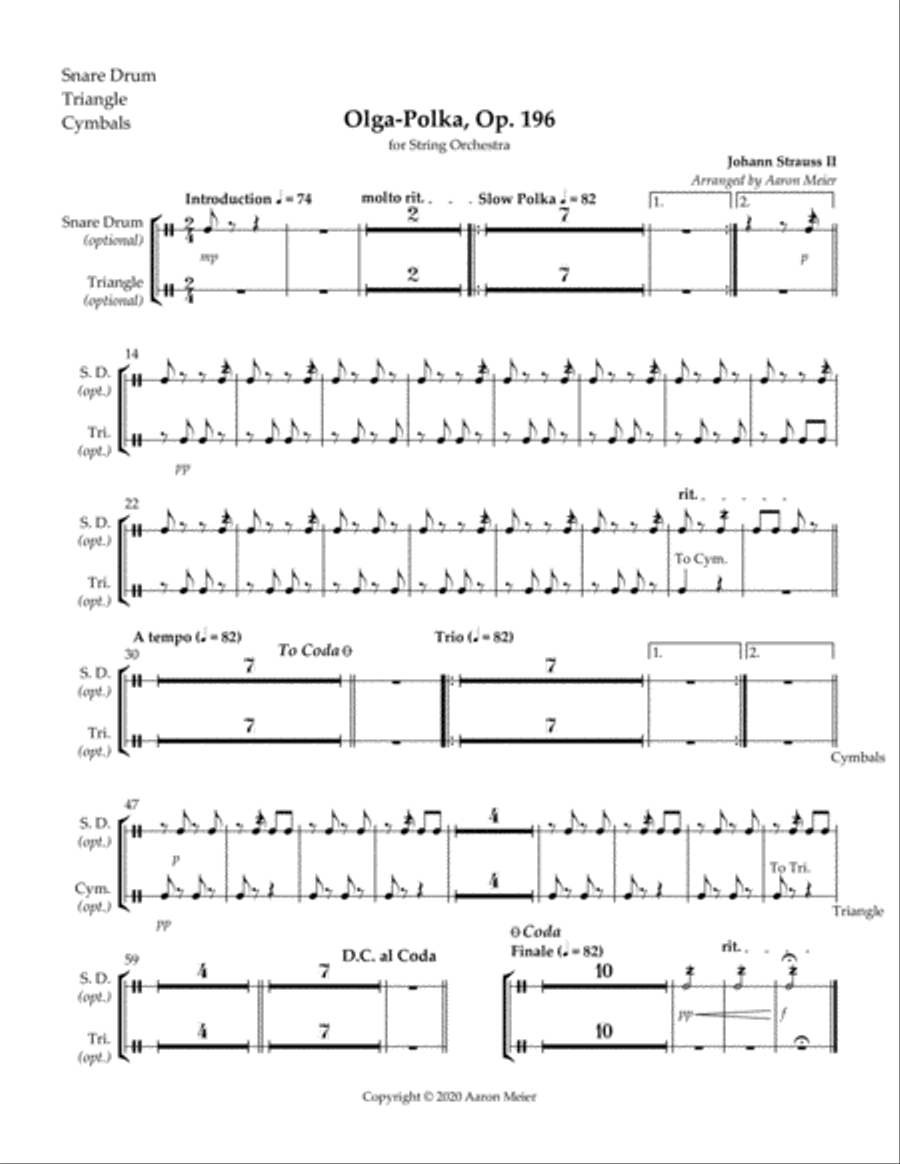
Olga-Polka, Op. 196 (arr. for string orchestra): Optional Percussion
Orchestre de chambre

$3.99 3.47 € Orchestre de chambre PDF SheetMusicPlus


Partitions Gratuites
Acheter des Partitions Musicales
Acheter des Partitions Digitales à Imprimer
Acheter des Instruments de Musique

© 2000 - 2026

Accueil - Version intégrale





