EUROPE
1151 articles
USA
496 articles
DIGITAL
1036 articles (ŕ imprimer)
Partitions Digitales
Partitions à imprimer
1036 partitions trouvées


Brass Ensemble Bass Trombone,Euphonium,Flugelhorn,Trumpet,Tuba - Level 3 - Digital Download SKU: A0.1411272 Composed by James P. Johnson. Arranged by Charles Decker. 20th Century,Broadway,Contest,Festival,Film/TV,Jazz,Musical/Show. 28 pages. Charles Decker Music Press #993606. Published by Charles Decker Music Press (A0.1411272). From the Music of Black Composers Series at Charles Decker Music Press is the The Charleston which debuted in James P. Johnson’s Broadway 1923 show “Runnin’ Wild” to become the wildly popular and unofficial anthem of the Roaring 20’s.  An important jazz pianist and composer, Johnson was a major influence on Count Basie, Duke Ellington, Art Tatum, Thelonious Monk, and Fats Waller.  Arranged for a ten-piece brass choir of three B-flat trumpets, two horns in F with a substitute flugelhorns parts, three trombones or euphoniums with substitute horn for trombone 1, euphonium and tuba, the arrangement uses the original 1923 piano edition and retains the style of the day. The recording is of the entire edition.“The Music of Black Composers Series is a welcome and timely addition to the brass repertoire. Interesting music, expertly arranged, fun to perform, and well received by audiences. Highly recommended!”   Wesley Nance, Rochester Philharmonic Orchestra, Eastman School of Music “I was so pleased to see the great works arranged for brass ensemble by Charles Decker Music Press especially the Music of Black Composers’ Series. It was especially rewarding to perform several of these with Summit Brass and with the students attending the Rafael Mendez Brass institute. Please keep these wonderful settings coming. You have provided the brass world with some real gems.”  Joseph Parisi, Director Summit Brass, FountainCity Brass Band, University of Missouri Kansas City Conservatory Wind EnsembleThe Interlochen Arts Academy and the University of Denver have purchased the Music of Black Composer Series with Charles Decker Music Press and the summer Rafael Mendez Brass Institute and Eastman School of Music uses the series arrangements in their chamber and brass ensembles music programs. See 50+ homogeneous brass editions for trumpet, horn and trombone ensembles and 75+ mixed brass ensemble publications with Charles Decker Music Press at Sheet Music Plus for inexperienced to advanced musicians with music ranging from the Renaissance to contemporary new works for trios, quartets, quintets, brass choir and brass band. Many of the mixed brass ensemble editions include alternate and substitute parts being alternate C trumpet parts for B-flat trumpet parts, flugelhorn/trumpet substitute for horn, horn substitute for trombone and treble clef euphonium substitute for trombone. To see our Music of Black Composers Series enter “Black Composers Series brass” in the search box at Charles Decker Music Press for 25 arrangements for mixed brass ensembles ranging from early jazz to symphonic works with composers Samuel Coleridge-Taylor, R. Nathaniel Dett, William Grant Still, Will Marion Cook, James Reese Europe, James Johnson and others.For more brass quintet editions by Charles Decker use these links to  Kendor Music  and  Cherry Classics Music for listings of my arrangements of music by J.S. Bach, H.L. Clarke, Debussy, Dukas, Elgar, Falla, Holst, Ives, Nestico, Rachmaninoff, Satie, and Tchaikovsky.
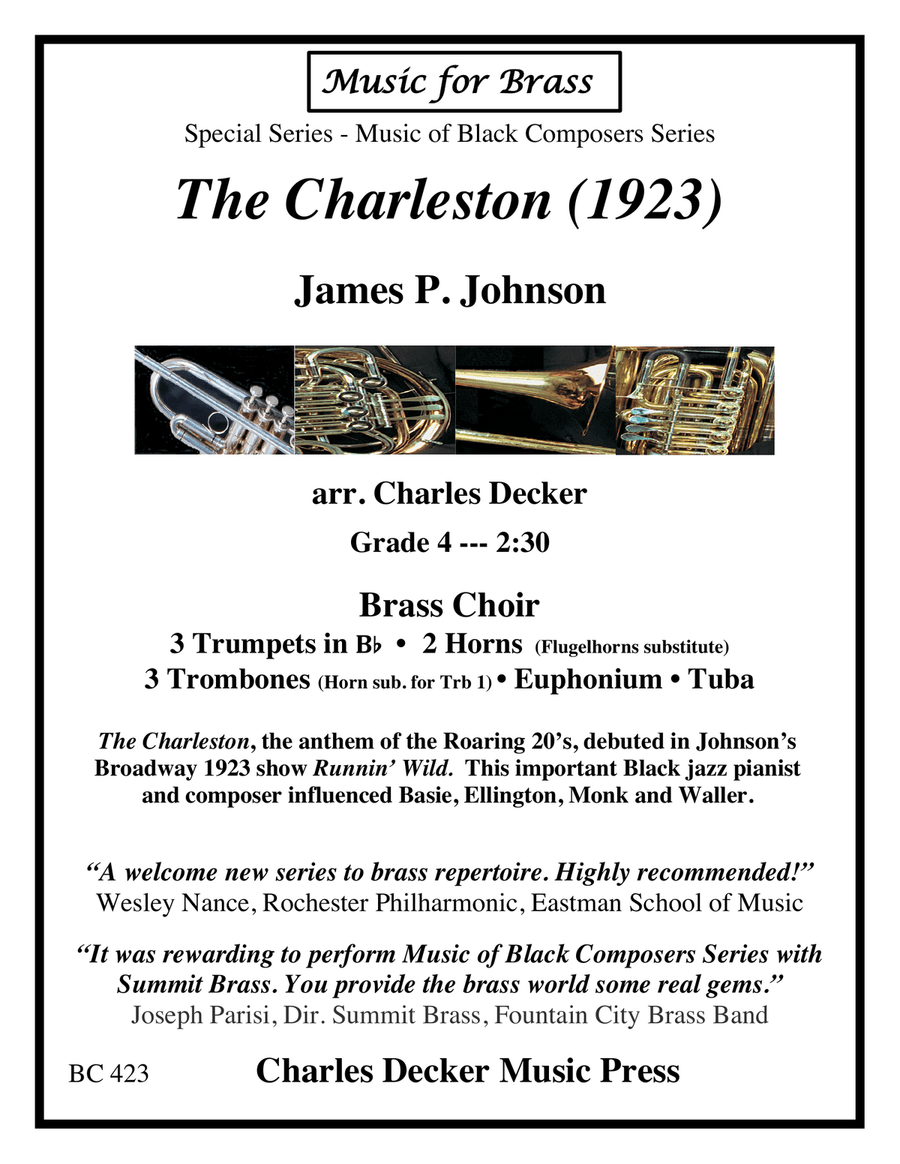
The Charleston (1923) for Brass Choir

$15.99 13.48 € PDF SheetMusicPlus

Euphonium,Piano - Level 5 - Digital Download SKU: A0.792530 Composed by Georges Bizet. Arranged by Ralph Sauer. 20th Century,Classical,Romantic Period. Score and part. 52 pages. Gordon Cherry #5008345. Published by Gordon Cherry (A0.792530). The Chants du Rhin (Songs of the Rhine), a cycle of six pieces, based on poems by Joseph MĂ©ry, were written in 1865, and Bizet performed two of them on 16 April 1866 at a soirĂ©e of the Beaujolais Philharmonic Society. The songs are grouped symmetrically around La bohĂ©mienne as the central piece, framed by two meditatively yearning pieces (in E and D flat major) and two vividly exuberant ones (similarly in E and D flat major), with L’aurore serving as an introduction. In this cycle Bizet takes up the theme of the gypsy girl which had already entered European music in the operas The Bohemian Girl by the Irish composer Michael William Balfe and Verdi’s Il trovatore, as well as in Franz Liszt’s Hungarian Rhapsodies for piano. Bizet will return to it one year later in La jolie fille de Perth and ten years later in Carmen. The fourth piece Les confidences shows similarities in tonality, structure and motifs to the middle part of the third movement of Chopin’s Sonata in B minor. This version includes parts in B-flat treble clef as well as bass clef.
Chants du Rhin for Euphonium and Piano
Euphonium, Piano (duo)

$22.50 18.97 € Euphonium, Piano (duo) PDF SheetMusicPlus

Piano Solo - Level 5 - Digital Download SKU: A0.1470662 Composed by Jean-Joseph Mouret. Arranged by Judith L. Maggs. Baroque,Classical,Early Music,Traditional,Wedding. Score. 5 pages. Maggs #1048314. Published by Maggs (A0.1470662). Mouret’s Rondeau, written in the 1600s, was brought used for several years as the theme music for PBS “Masterpiece Theatre.” It is an upbeat and inspiring tune that works well as a processional or recessional for any occasion. This arrangement for piano is in the key of Bb major, and is easily accessible for any advanced level pianist.Note: This arrangement is also available as part of my collection: “The Wedding Pianist,” which is available on this site. This collection contains 10 Processionals/Recessionals, as well as a bonus arrangement of the hymn “O Perfect Love.”(Note: I also have an intermediate level arrangement of the Rondeau, also published on this site.).
Rondeau
Piano seul

$2.99 2.52 € Piano seul PDF SheetMusicPlus

Brass Quintet Horn,Trombone,Trumpet,Tuba - Level 3 - Digital Download SKU: A0.1242857 Composed by Fred S. Stone. Arranged by Charles Decker. 19th Century,Jazz,March,Multicultural,Pop,World. 24 pages. Charles Decker Music Press #837904. Published by Charles Decker Music Press (A0.1242857). My Ragtime Baby was the 1898 mega hit featured in the Sousa Band European 1900 tour that introduced European audiences to American Ragtime. Fred Stone was a prominent African-American composer and conductor in the early Ragtime movement. The rag is arranged for two B-flat trumpets, horn in F, trombone and tuba. The recording is of the entire edition.“The Music of Black Composers Series is a welcome and timely addition to the brass repertoire. Interesting music, expertly arranged, fun to perform, and well received by audiences. These pieces are now permanently in my quintet book and I will be using them with my student groups as well. Highly recommended!”   Wesley Nance, Rochester Philharmonic Orchestra, Eastman School of Music “I was so pleased to see the great works arranged for brass ensemble by Charles Decker Music Press especially the Music of Black Composers’ Series. It was especially rewarding to perform several of these with Summit Brass and with the students attending the Rafael Mendez Brass institute. Please keep these wonderful settings coming. You have provided the brass world with some real gems.”  Joseph Parisi, Director Summit Brass, Fountain City Brass Band, University of Missouri Kansas City Conservatory Wind EnsembleThe Interlochen Arts Academy and the University of Denver have purchased the Music of Black Composer Series with Charles Decker Music Press and the summer Rafael Mendez Brass Institute and Eastman School of Music uses the series arrangements in their chamber and brass ensembles music programs. See 50+ homogeneous brass editions for trumpet, horn and trombone ensembles and 75+ mixed brass ensemble publications with Charles Decker Music Press at Sheet Music Plus for inexperienced to advanced musicians with music ranging from the Renaissance to contemporary new works for trios, quartets, quintets, brass choir and brass band. Many of the mixed brass ensemble editions include alternate and substitute parts being alternate C trumpet parts for B-flat trumpet parts, flugelhorn/trumpet substitute for horn, horn substitute for trombone and treble clef euphonium substitute for trombone. To see our Music of Black Composers Series enter “Black Composers Series” in the search box at Charles Decker Music Press for 25 arrangements for mixed brass ensembles ranging from early jazz to symphonic works with composers Samuel Coleridge-Taylor, R. Nathaniel Dett, William Grant Still, Will Marion Cook, James Reese Europe, James Johnson and others.For more brass quintet editions by Charles Decker use these links to Kendor Music  and Cherry Classics Music for listings of my arrangements of music by J.S. Bach, H.L. Clarke, Debussy, Dukas, Elgar, Falla, Holst, Ives, Nestico, Rachmaninoff, Satie, and Tchaikovsky.
My Ragtime Baby for Brass Quintet
Quintette de Cuivres: 2 trompettes, Cor, trombone, tuba

$12.99 10.95 € Quintette de Cuivres: 2 trompettes, Cor, trombone, tuba PDF SheetMusicPlus

Woodwind Ensemble,Woodwind Quartet Bass Clarinet,Bassoon,Flute,Oboe - Level 3 - Digital Download SKU: A0.1152087 Composed by Ludwig van Beethoven. Arranged by Joseph Judge. Chamber,Classical. 29 pages. School Ensemble Music #752300. Published by School Ensemble Music (A0.1152087). Sonatina, by L. Beethoven, 2:46, for woodwind quartet. Level 3. Flute, Oboe, Clarinet, Bassoon. As well as parts for Clarinet, Clarinet, Horn, Bass Clarinet. This recognizable song was arranged to be easy to play: range limited, rests provided, rehearsal marks designed for easy group cuing, and the workload shared (everyone gets to play the melody). Audio sample available at SchoolEnsemble.com.
Sonatina by Beethoven for Woodwind Quartet in Schools
Flűte, Hautbois, Clarinette, Basson

$8.99 7.58 € Flűte, Hautbois, Clarinette, Basson PDF SheetMusicPlus

String Orchestra - Level 5 - Digital Download SKU: A0.942953 Composed by Geoffrey Peterson. Contemporary. Score and parts. 43 pages. Geoffrey Peterson #4267231. Published by Geoffrey Peterson (A0.942953). Link to complete recording: https://soundcloud.com/geoffrey-peterson/sets/the-edmund-fitzgerald-concerto On November 9th, 1975, the S.S. Edmund Fitzgerald left port in Superior, Wisconsin. The 729-foot-long iron ore carrier, loaded with 26 thousand tons of taconite pellets for the auto industry, was bound for Detroit. Earlier that day, the weather service had issued a gale warning. This was not unusual, considering that gale storms are typical during November on Lake Superior. The Fitzgerald’s Captain, Ernest McSorley, and her 29-member crew headed northeast unaware of the maelstrom they would soon encounter. At around 2 a.m., Bernie Cooper, captain of the Arthur M. Andersen, another freighter which was following a few miles behind the Fitzgerald, radioed Captain McSorley to consult with him about the worsening storm. They had both decided to take a more northerly route along the Canadian shore, which they hoped would provide some shelter from the violent gale winds and waves. The Fitzgerald’s long-range radar stopped working the following day and was needed in order to avoid Six-Fathom Shoal, a shallow area of Lake Superior that could rupture the ship’s hull. McSorley soon radioed the Anderson to report that the Fitzgerald had sustained some topside damage...a fence rail down, two vents lost or damaged, and a starboard list. A list meant that the Fitzgerald was taking on too much water and was causing it to lean to one side. The short-range radar also stopped working, and the radio direction beacon from nearby Whitefish Point vanished. This would make it impossible for the Fitzgerald to reach the lee waters of Whitefish Bay and escape the 80 mph winds churning 20 to 30-foot waves. At 7:10 p.m. that night, First Mate Morgan Clark of the Andersen radioed the Fitzgerald to see how they were doing. Captain McSorley replied, We’re holding our own. This was the last contact anyone would have with the Fitzgerald. Shortly thereafter, the Edmund Fitzgerald disappeared from the Anderson’s radar screen. All 29 of her crew were lost on November 10th, 1975. The Edmund Fitzgerald chronicles the tragic final voyage of the well-known shipwreck in 4 movements; Embarkment, The Gales, Six-Fathom Shoal (We’re holding our own.) and Entombment-Dirge. The concerto makes use of several musical quotes. The first is Spanish Ladies, an English sea chantey, which appears in both the 1st and 3rd movements. The second is the funeral march theme from the 2nd movement of Beethoven’s 3rd Symphony which is heard in the 4th movement of the concerto. In addition, a chime is rung 29 times during the final bars of the concerto to memorialize the men who lost their lives. The Crew of the S.S. Edmund Fitzgerald: Michael E. Armagost, Frederick J. Beetcher, Thomas D. Bentsen, Edward F. Bindon, Thomas D. Borgeson, Oliver J. Champeau, Nolan S. Church, Ransom E. Cundy, Thomas E. Edwards, Russell G. Haskell, George J. Holl, Bruce L. Hudson, Allen G. Kalmon, Gordon F. MacLellan, Joseph W. Mazes, John H. McCarthy, Ernest M. McSorley, Eugene W. O'Brien, Karl A. Peckol, John J. Poviach, James A. Pratt, Robert C. Rafferty, Paul M. Riippa, John D. Simmons, William J. Spengler, Mark A. Thomas, Ralph G. Walton, David E. Weiss, Blaine H. Wilhelm.
The Edmund Fitzgerald - Concerto for Piano and Strings
Orchestre ŕ Cordes

$9.99 8.42 € Orchestre ŕ Cordes PDF SheetMusicPlus

Clarinet Quartet,Woodwind Ensemble Bass Clarinet - Level 2 - Digital Download SKU: A0.1422398 Composed by F-J. Gossec (1734-1829). Arranged by RUSSELL T. KING. Chamber,Classical,Contest,Festival. 9 pages. EMK Music #1003740. Published by EMK Music (A0.1422398). Performance time: 2.27 This piece is excellent for practising ensemble skills as well as for filling that small gap in your program with something light and entertaining. You can use as much rubato as you like.François-Joseph Gossec (1734 – 1829) was a French composer of operas, string quartets, symphonies, and choral works. His Gavotte, from his opera Rosine, ou L'épouse abandonnée (1786), remains familiar in popular culture because Carl Stalling and Charles M. Jones used arrangements of it in several Warner Brothers cartoons. Arguably the most notable of these is Porky Pig's dance to an uncredited version of Gossec's Gavotte in Jones’ Porky's Cafe (1942). (Wikipedia).
GAVOTTE – CLARINET QUARTET
Quatuor de Clarinettes: 4 clarinettes

$14.00 11.8 € Quatuor de Clarinettes: 4 clarinettes PDF SheetMusicPlus


Partitions Gratuites
Acheter des Partitions Musicales
Acheter des Partitions Digitales à Imprimer
Acheter des Instruments de Musique

© 2000 - 2026

Accueil - Version intégrale





