EUROPE
16190 articles
USA
51771 articles
DIGITAL
186137 articles (à imprimer)
Partitions Digitales
Partitions à imprimer
186137 partitions trouvées


Easy Piano - Level 1 - Digital Download SKU: A0.1460612 By David Archuleta. By John Lennon. Arranged by RIS. 20th Century,Contemporary,Folk,Pop,Singer/Songwriter. Score. 3 pages. RISsounds #1039513. Published by RISsounds (A0.1460612). ? Download the Lead Sheet Music for Imagine by John Lennon! ?We're excited to share the lead sheet music for Imagine by John Lennon with you. This sheet music is perfect for both beginners and more advanced players. The right hand is clearly written out on the staff, providing a clear guide for playing the melody, while the left hand is left open for improvisation, allowing you to add your own personal touch to this beautiful song.Why Use Our Lead Sheet Music? Beginner-Friendly: Clear notation for the right hand melody helps beginners follow along easily. Advanced Flexibility: The left hand is open for improvisation, giving advanced players the freedom to express their creativity. Comprehensive Learning: Combine the lead sheet with our piano tutorial to master Imagine step by step. Practice and Play: Ideal for practice sessions or live performances. ? Download Now and Start Playing! Don't forget to like, comment, and subscribe to our channel for more easy piano tutorials and sheet music. Let us know how you're enjoying playing Imagine and share your progress with us!#PianoSheetMusic #ImagineSheetMusic #JohnLennon #LearnPiano #EasyPiano #BeginnerPiano #AdvancedPiano #PianoPractice #MusicForBeginners #PianoImprovisation #PianoMelody #SheetMusicDownload #EasyPianoTutorials #PianoTutorial #PianoLessons #MusicSheet #PianoCover #PianoPerformance #PianoFun #PianoMusic #HowToPlayPiano #PianoTips #LearnPianoOnline #PianoLearning #SheetMusicForBeginners #PianoEducation #PianoPracticeMusic #PianoLeadSheet #PianoTutorialEasyBeginner #PianoTutorialEasySlowBeginner #PianoTutorialForBeginners.
Imagine
Piano Facile
David Archuleta
$4.99 4.19 € Piano Facile PDF SheetMusicPlus

Brass Ensemble - Level 3 - Digital Download SKU: A0.767270 Composed by Claudio Monteverdi. Arranged by Mike Lyons. Baroque,Renaissance. Score and parts. 13 pages. Lyons Music Services #3218673. Published by Lyons Music Services (A0.767270). As part of my continuing project to transcribe Monteverdi's madrigals onto winds, here is the 6th book. In this book we see a much greater development towards dramatic representation. In a way, this book is divisible into two Scenes with a number of single items in between. The vocal lines are all much more complex and we can also see the beginnings of monodic writing appear in the semi-recit sections of some of the songs. Also clearly developing are delineations of the voices into soloists and chorus. Several songs in this book are almost akin to arias, with clear soloistic writing for the higher voices (Cantus/Tenor). The first four songs form a kind of introductory scena, which Monteverdi calls Lamento d'Arianna. The first of these is Lasciatemi morire which translates as Let me die or, perhaps, Leave me to die. There is almost a conversation between two groups of voices, with the tenor leading one group and the Cantus leading the other. As with all things madrigalian, the lyrics are rife with double entendres. Monteverdi uses some very close dissonances to describe death and release.
Monteverdi - The Sixth Book of Madrigals - 01. Lasciatemi morire
Ensemble de cuivres

$5.99 5.03 € Ensemble de cuivres PDF SheetMusicPlus

Easy Guitar (with TAB) - Level 1 - Digital Download SKU: A0.1047465 By Dan Jones (www.danjonesguitarist.com). By Dan Jones. Blues,Folk,Rock. Tablature. 5 pages. DanJonesGuitarist #652027. Published by DanJonesGuitarist (A0.1047465). Three Pieces for Beginner Guitarists (Acoustic or Electric) by Dan Jones Presented in notes, TAB and easy chords (www.danjonesguitarist.com) As an active guitar teacher, I find that many beginner pupils want to learn either acoustic (steel string) guitar or electric guitar. I have also found a lack of quality resources in these styles which have musical interest, and which lay out some of the necessary technical and musical foundations for future learning. I composed these three little pieces for my own young students. They are played by those using their right-hand fingers, and a plectrum and I’ve found them to be very popular in both lessons and performance. The pieces can be learnt in any order (I have a slight preference for starting my pupils with D-Day Rock - the third in the collection). Below is an outline of the pedagogy behind them (1) Sore Finger Blues This is a simple twelve-bar blues which uses a combination of open strings and notes at the third and second frets. It can be played with a straight or swung rhythm. It is effective at a slow tempo for those needing time to place the fretting hand fingers. The main technical challenge is in bars 10 and 22 where the player moves the third finger between the G and A on string 1. Although this is traditionally an advanced technique, I’ve found my students find it comfortable, as long as the fingering outlined in the notes is followed. The chords are dominant (with major thirds). These clash against the minor pentatonic scale in a way which is typical of the style. The chords are quite simple for beginners. I have opted for a D5 power-chord in bars 9 & 21 which is easier than the usual D chord (which also works perfectly well). Plectrum players should be sure to anchor the plucking hand, either with the side of the hand resting on the bridge, or a finger against the scratch plate of the guitar. Fingerstyle players can anchor either with a finger touching the scratch plate of the guitar, or by resting the thumb on a bass string when the fingers are plucking, or vice versa. This is more typical of classical style. (2) Cross-String Traffic This piece was conceived as a fingerstyle piece, although it can be played using a plectrum. The challenge for plectrum players is to cross the strings smoothly. It is for this reason that the fretting hand is relatively simple so that learners can concentrate on the plucking hand. Players are also encouraged to press down the index finger on string 2 at the correct angle to allow the first string to resonate. Chords have once again been chosen to suit less-experienced fingers; therefore, I have opted for Dm6 instead of the more common Dm (a very tricky chord for beginners). Players should go for maximum resonance and notes played at fret 3 could be fretted with either fingers 3 or 4. (3) D-Day Rock This piece is made nearly entirely of open strings and third fret notes. Where there is string crossing, the music allows the player ‘thinking time’ to change accordingly. Teachers and learners can decide with which finger to press the third fret notes. The rhythmic complexities from bar 13 to the end pose no problems once players have the sound of the piece in their ear. Once again, chords have been selected for ease of playing. The Gm/D chord can be played with a 3-string barre (often quite easy for beginners where no fretted bass note is required) or using three separate fingers. The pedal D sounds effective musically. I have presented these pieces as ensemble works with large groups of beginners. Players and audiences alike have been very receptive! For a wealth of music for beginners, ensembles and advanced players, please visit www.danjonesguitarist.com. A YouTube link to a film of the pieces will be uploaded before the end of June 2022.
Three Pieces for Beginner Guitarists (Acoustic or Electric)
Guitare notes et tablatures
Dan Jones (www danjonesguitarist
$4.95 4.16 € Guitare notes et tablatures PDF SheetMusicPlus

Mezzo-Soprano Voice,Vocal Solo - Level 5 - Digital Download SKU: A0.1186002 Composed by Wolfgang Amadeus Mozart. Arranged by Nicole Elyse DiPaolo. Classical,Opera. 10 pages. Nicole Elyse DiPaolo #785660. Published by Nicole Elyse DiPaolo (A0.1186002). The first of its kind, this is a much more readable and sight-playable piano/vocal reduction of Ah, scostati!...Smanie implacabili,†Dorabella’s first aria from Mozart’s Così fan tutte (1790). The sextuplets in the right hand found in most standard reductions have been condensed into triplets with a grace note, emphasizing that the gestural shape is what needs to be heard rather than every individual note, and the result is a much clearer and less note-filled score for the audition pianist. Some large spans in the left hand have also been reduced out and redistributed for more ergonomic playing on long audition days. When a grace note has an accidental that is then repeated later in the gesture, I’ve rewritten that accidental on the full-size note containing it for ease of reading (so the cue-size accidental is not the only indication of said accidental in the measure, which would make it too easy to miss). The recitative “Ah, scostati!†is also included with slight alterations and courtesy accidentals in the melodic minor scales.As with any Accessible Accompaniments edition that’s not also an audition/solo cut, I suggest bringing two copies to each audition: one Accessible Accompaniment and one copy of a standard edition. Audition pianists who don’t know the aria will almost always choose the cleaner look of the Accessible Accompaniment, but those who know “Smanie†well might prefer to play from the edition they learned it from. This will provide singers and their audition pianists every chance of a successful collaboration.All Accessible Accompaniments, including this one, boast several unique features:1. No reduction ever requires stretches of over an octave, not including bass notes meant to be held or “fudged†with the pedal (though octaves may also contain chord tones within them). This reduces the amount of rearranging that smaller-handed pianists must already do. Obviously, further reworkings are to be expected and pianists should feel free to add to or modify what I’ve provided.2. I’ve included less essential, but potentially desirable additional voices/passages in cue-size noteheads so that pianists can easily see them, but know that they are not necessary in a “sink or swim†accompanying situation. Presenting less essential material in cue-size noteheads also reduces visual clutter on the page.3. In addition to the composer’s markings, when needed, I have included additional courtesy accidentals.4. All page turns have been carefully selected so as to result in the least possible disruption to the pianist when possible. 5. When known, I’ve noted alternate cuts that singers might like to take within certain arias.6. I’ve also replaced text “cresc.†and “dim.†markings with hairpins, which are easier to see in high-pressure sight-reading situations.About the Arranger:Praised as a sensitive pianist and outstanding accompanist who delivers powerful interpretations, Nicole Elyse DiPaolo enjoys a multifaceted career as a sought-after collaborative pianist, educational composer, arranger, coach, private teacher, and adjunct music professor. Currently based in the Cleveland area, Ms. DiPaolo has appeared as a concerto soloist with the Ambassador Chamber Players on multiple occasions and as a recitalist, collaborator, and presenter worldwide. Currently, Ms. DiPaolo is an online Adjunct Lecturer in Music at Indiana University; the Principal Theory Teacher at Liberty Park Music, an online-only video subscription-based music school; an invited blog contributor and guest instructor at Tonebase; and a sought-after online instructor of piano, music theory, and composition who includes partimento and historical improvisation in her curricula. For more information, please visit http://ndipaolo.musicaneo.com .
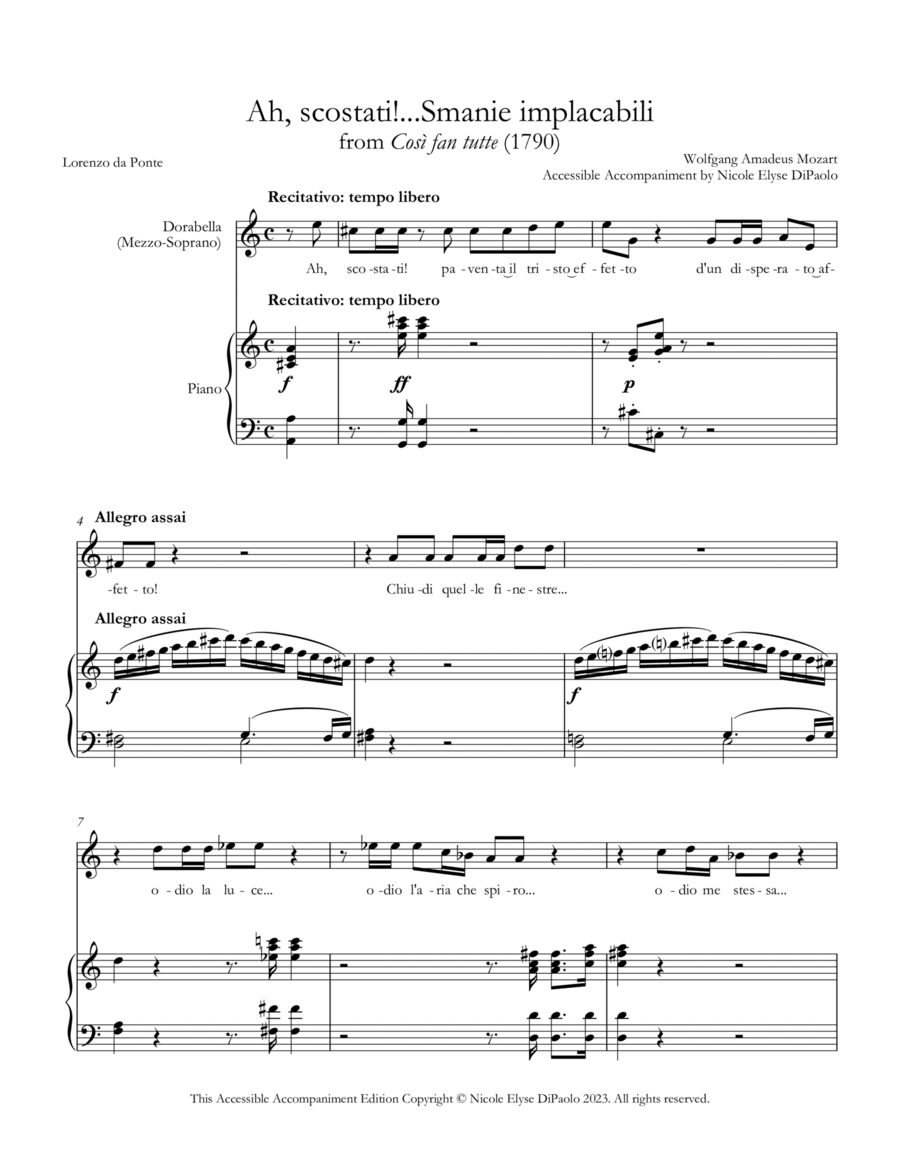
Ah, scostati!...Smanie implacabili (Dorabella) from Così fan tutte - Accessible Accompaniments Ed.

$8.95 7.52 € PDF SheetMusicPlus

C Instrument - Level 2 - Digital Download SKU: A0.1449410 By Leonard Cohen. By Leonard Cohen. Arranged by Barry McCormick. Film/TV,Pop,Singer/Songwriter. Lead Sheet / Fake Book. 4 pages. B. McCormick #1029183. Published by B. McCormick (A0.1449410). Discover the Beauty of “Hallelujah” with Our Lead Sheet Arrangement Immerse yourself in the soulful melody of Leonard Cohen’s “Hallelujah” with our versatile lead sheet arrangement. This product is designed to cater to musicians of varying skill levels, offering both a fingerpicking pattern and a strumming pattern that can be used interchangeably.“Hallelujah,” released in 1984, is one of Leonard Cohen’s most iconic songs. Its profound lyrics and haunting melody have made it a beloved piece across generations. Our arrangement captures the essence of this timeless song, providing a detailed guide to the melody, chords, and lyrics.Our arrangement is unique in its flexibility. The strumming pattern is simpler, making it suitable for beginners, while the fingerpicking pattern offers a more challenging option for those looking to advance their skills. The accompanying chord sheet includes the same picking and strumming patterns, formatted in a simpler way to cater to different music reading capabilities.The chord sheet also offers three alternative ways to play the F chord, accommodating musicians at different levels. With five different chords in this piece, it serves as an excellent tool for beginners to learn and practice, while the picking pattern adds an extra layer of challenge, making it a piece that bridges the higher end of beginner into a lower intermediate level.Small notehead notation is used in the lead sheet as each verse slightly differs. The lyrics for each verse will make it clear which of the notes should be sung/played.Given the repetitive nature of the song, you may choose to switch playing styles between strumming and picking to add variety, or shorten the arrangement by choosing a few verses rather than playing them all. Why Choose This Arrangement? Versatility: Our arrangement offers both a fingerpicking pattern and a strumming pattern, catering to different skill levels and learning preferences. Educational Value: With five different chords and various playing styles, this piece serves as an excellent tool for learning and practicing. Flexibility: The arrangement can be adapted to suit your performance needs, whether you want to switch playing styles or shorten the arrangement. Community Engagement: Share your performances on social media using our handle, @resourcesularrangements, and connect with our community of music enthusiasts. So why wait? Embark on your musical journey with our “Hallelujah” lead sheet arrangement. Remember, every note you play brings you one step closer to mastering the art of music.Note: Please ensure to tag @resourcesularrangements when sharing your performances on social media.
Hallelujah
Instruments en Do
Leonard Cohen
$3.99 3.35 € Instruments en Do PDF SheetMusicPlus

Cello,Oboe,Violin - Level 4 - Digital Download SKU: A0.1393758 Composed by Jean-Baptiste Loeillet. Arranged by Phil Beaman. Baroque,Instructional,Standards. 12 pages. Phil Beaman #977229. Published by Phil Beaman (A0.1393758). This Baroque piece was originally written by Jean Loeillet as part of a Harpsichord Suite.  It is written in the Italian Corant style in the characteristic Fast(Allegro) 3/4 with rapid running passages of eighth notes (quavers) which alternate scalar steps with large leaps.  Traditionally the piece would have been performed very cleanly, not legato.My arrangement takes the melody and passes it between the three instrument parts.  I wrote a highly ornamented continuo for each part when not playing melody.  In true Baroque style I have created a tight interplay between the parts.  Each part also has a rather wide range of about 2 octaves.  Although in a Minor Key, this piece is very bright and uplifting.  It is very accessible and thus a concert crowd pleaser.   Great for the student recitals too to learn and show mastery of Baroque techniques of clean ensemble playing and ornamentation.  Most of all, this piece is just Pure Fun!6 pages score, 2 pages @ partRanges -Violin - bottom space F# to high E above staffOboe - middle C to high A above staffCello - low C below staff to high E above staff.
Corant - trio- violin/oboe/cello

$7.99 6.71 € PDF SheetMusicPlus

Woodwind Ensemble,Woodwind Trio Bass Clarinet,Flute - Level 4 - Digital Download SKU: A0.1394226 Composed by Jean-Baptiste Loeillet. Arranged by Phil Beaman. Baroque,Instructional,Standards. 12 pages. Phil Beaman #977700. Published by Phil Beaman (A0.1394226). This Baroque piece was originally written by Jean Loeillet as part of a Harpsichord Suite.  It is written in the Italian Corant style in the characteristic Fast(Allegro) 3/4 with rapid running passages of eighth notes (quavers) which alternate scalar steps with large leaps.  Traditionally the piece would have been performed very cleanly, not legato.My arrangement takes the melody and passes it between the three instrument parts.  I wrote a highly ornamented continuo for each part when not playing melody.  In true Baroque style I have created a tight interplay between the parts.  Each part also has a rather wide range of about 2 octaves.  Although in a Minor Key, this piece is very bright and uplifting.  It is very accessible and thus a concert crowd pleaser.   Great for the student recitals too to learn and show mastery of Baroque techniques of clean ensemble playing and ornamentation.  Most of all, this piece is just Pure Fun!6 pages score, 2 pages @ partRanges -Flute -  second space A to high A above staffClarinet - second line G# to high D above staffBass Clarinet - low E below staff to high E above staff.
Corant - trio- flute/clarinet/bass clarinet

$7.99 6.71 € PDF SheetMusicPlus

Acoustic Guitar,Electric Bass Guitar,Xylophone - Level 5 - Digital Download SKU: A0.1394296 Composed by Jean-Baptiste Loeillet. Arranged by Phil Beaman. Baroque,Instructional,Standards. 12 pages. Phil Beaman #977773. Published by Phil Beaman (A0.1394296). This Baroque piece was originally written by Jean Loeillet as part of a Harpsichord Suite.  It is written in the Italian Corant style in the characteristic Fast(Allegro) 3/4 with rapid running passages of eighth notes (quavers) which alternate scalar steps with large leaps.  Traditionally the piece would have been performed very cleanly, not legato.My arrangement takes the melody and passes it between the three instrument parts.  I wrote a highly ornamented continuo for each part when not playing melody.  In true Baroque style I have created a tight interplay between the parts.  Each part also has a rather wide range of about 2 octaves.  Although in a Minor Key, this piece is very bright and uplifting.  It is very accessible and thus a concert crowd pleaser.   Great for the student recitals too to learn and show mastery of Baroque techniques of clean ensemble playing and ornamentation.  Most of all, this piece is just Pure Fun!  And who would expect a 17th century style piece on Xylophone, Acoustic Guitar, and Electric Bass Guitar!6 pages score, 2 pages @ partRanges -Xylophone -   bottom space F# to E above staffAcoustic Guitar - middle C to A above staffElecBass  Guitar - low B below staff to high E above staff.
Corant - trio- xylophone/acoustic guitar/electric bass guitar

$7.99 6.71 € PDF SheetMusicPlus

Bass Trombone,Clarinet,Flute - Level 4 - Digital Download SKU: A0.1394137 Composed by Jean-Baptiste Loeillet. Arranged by Phil Beaman. Baroque,Instructional,Standards. 12 pages. Phil Beaman #977597. Published by Phil Beaman (A0.1394137). This Baroque piece was originally written by Jean Loeillet as part of a Harpsichord Suite.  It is written in the Italian Corant style in the characteristic Fast(Allegro) 3/4 with rapid running passages of eighth notes (quavers) which alternate scalar steps with large leaps.  Traditionally the piece would have been performed very cleanly, not legato.My arrangement takes the melody and passes it between the three instrument parts.  I wrote a highly ornamented continuo for each part when not playing melody.  In true Baroque style I have created a tight interplay between the parts.  Each part also has a rather wide range of about 2 octaves.  Although in a Minor Key, this piece is very bright and uplifting.  It is very accessible and thus a concert crowd pleaser.   Great for the student recitals too to learn and show mastery of Baroque techniques of clean ensemble playing and ornamentation.  Most of all, this piece is just Pure Fun!6 pages score, 2 pages @ partRanges -Flute -  Ab to high F above staffClarinet - bottom space F# to high C above staffTrombone - low C below staff to high F above staff.
Corant - trio- flute/clarinet/trombone

$7.99 6.71 € PDF SheetMusicPlus

Bass Trombone,Clarinet,Violin - Level 4 - Digital Download SKU: A0.1394166 Composed by Jean-Baptiste Loeillet. Arranged by Phil Beaman. Baroque,Instructional,Standards. 12 pages. Phil Beaman #977651. Published by Phil Beaman (A0.1394166). This Baroque piece was originally written by Jean Loeillet as part of a Harpsichord Suite.  It is written in the Italian Corant style in the characteristic Fast(Allegro) 3/4 with rapid running passages of eighth notes (quavers) which alternate scalar steps with large leaps.  Traditionally the piece would have been performed very cleanly, not legato.My arrangement takes the melody and passes it between the three instrument parts.  I wrote a highly ornamented continuo for each part when not playing melody.  In true Baroque style I have created a tight interplay between the parts.  Each part also has a rather wide range of about 2 octaves.  Although in a Minor Key, this piece is very bright and uplifting.  It is very accessible and thus a concert crowd pleaser.   Great for the student recitals too to learn and show mastery of Baroque techniques of clean ensemble playing and ornamentation.  Most of all, this piece is just Pure Fun!6 pages score, 2 pages @ partRanges -Violin -  bottom space F# to high E above staffClarinet - bottom line E# to high B above staffTrombone - low C below staff to high E above staffrecording is of Violin/Trumpet/Trombone, clarinet would substitute for the trumpet part.
Corant - trio- violin/clarinet/trombone

$7.99 6.71 € PDF SheetMusicPlus

Cello,Clarinet,Flute - Digital Download SKU: A0.1393780 Composed by Jean-Baptiste Loeillet. Arranged by Phil Beaman. Baroque,Instructional,Standards. 12 pages. Phil Beaman #977252. Published by Phil Beaman (A0.1393780). This Baroque piece was originally written by Jean Loeillet as part of a Harpsichord Suite.  It is written in the Italian Corant style in the characteristic Fast(Allegro) 3/4 with rapid running passages of eighth notes (quavers) which alternate scalar steps with large leaps.  Traditionally the piece would have been performed very cleanly, not legato.My arrangement takes the melody and passes it between the three instrument parts.  I wrote a highly ornamented continuo for each part when not playing melody.  In true Baroque style I have created a tight interplay between the parts.  Each part also has a rather wide range of about 2 octaves.  Although in a Minor Key, this piece is very bright and uplifting.  It is very accessible and thus a concert crowd pleaser.   Great for the student recitals too to learn and show mastery of Baroque techniques of clean ensemble playing and ornamentation.  Most of all, this piece is just Pure Fun!6 pages score, 2 pages @ partRanges -Flute - second space Ab to high F above staffClarinet - bottom space F# to high C above staffCello - low C below staff to high E above staffrecording is of Flute-Oboe-Cello version, with Clarinet subbing for the Oboe part.
Corant - trio- flute/clarinet/cello

$7.99 6.71 € PDF SheetMusicPlus

Bass Trombone,Trumpet,Violin - Level 4 - Digital Download SKU: A0.1394185 Composed by Jean-Baptiste Loeillet. Arranged by Phil Beaman. Baroque,Instructional,Standards. 12 pages. Phil Beaman #977658. Published by Phil Beaman (A0.1394185). This Baroque piece was originally written by Jean Loeillet as part of a Harpsichord Suite.  It is written in the Italian Corant style in the characteristic Fast(Allegro) 3/4 with rapid running passages of eighth notes (quavers) which alternate scalar steps with large leaps.  Traditionally the piece would have been performed very cleanly, not legato.My arrangement takes the melody and passes it between the three instrument parts.  I wrote a highly ornamented continuo for each part when not playing melody.  In true Baroque style I have created a tight interplay between the parts.  Each part also has a rather wide range of about 2 octaves.  Although in a Minor Key, this piece is very bright and uplifting.  It is very accessible and thus a concert crowd pleaser.   Great for the student recitals too to learn and show mastery of Baroque techniques of clean ensemble playing and ornamentation.  Most of all, this piece is just Pure Fun!6 pages score, 2 pages @ partRanges -Violin -  bottom space F# to high E above staffTrumpet - bottom line E# to high B above staffTrombone - low C below staff to high E above staff.
Corant - trio- violin/trumpet/trombone

$7.99 6.71 € PDF SheetMusicPlus


Partitions Gratuites
Acheter des Partitions Musicales
Acheter des Partitions Digitales à Imprimer
Acheter des Instruments de Musique

© 2000 - 2026

Accueil - Version intégrale





