EUROPE
991 articles
USA
0 articles
DIGITAL
1360 articles (à imprimer)
Partitions Digitales
Partitions à imprimer
1360 partitions trouvées


Solo Guitar - Level 4 - Digital Download SKU: A0.914743 Composed by Eric J Roth. 20th Century,Contemporary. Individual part. 7 pages. Eric J Roth #5296287. Published by Eric J Roth (A0.914743). This Gigue is the finale of a four-movement sonata composed in 2018. Publication of the entire sonata is forthcoming. In the interim, I am offering three movements – the Passacaglia, Sarabande and Gigue – as single standalone works. I have performed them in my own concert programs both as part of the larger sonata and on their own. I believe that they work equally well both ways. The Gigue form is a lively dance in triple meter that stems from the Irish jig. It probably originated in England and Ireland in the 16th century. In the Baroque period and beyond, composers have often used gigues as the final movement of dance suites. The Gigue offered here is a galloping romp in 6/8 time with eighth notes running throughout most of the piece. It recalls similar gigues by the lutenist Sylvius Leopold Weiss (1687-1750) and the Tarantelle by Johann Kaspar Mertz (1806-1856). (The Tarantella is a similar lively dance form in triple time). Like the Passacaglia, the Gigue uses an E harmonic minor scale with an added (structural) B flat that helps to blur the sense of strict tonality. The second section includes hints of G and B tonal areas before returning to E minor to end the piece.
Gigue
Guitare

$2.99 2.59 € Guitare PDF SheetMusicPlus

Instrumental Solo,Piano,Recorder - Level 1 - Digital Download SKU: A0.1045596 Composed by Johann Sebastian Bach. Arranged by Ander. Baroque,Easter,Traditional,Wedding. Score and individual part. 4 pages. Woods Only, Arrangements #650175. Published by Woods Only, Arrangements (A0.1045596). This easy arrangement for recorder and piano was written to be uncomplicated to perform and understand the structure of the piece. It can be freely played by beginning students, because of the ease imposed on the piece; however, this does not prevent it from being played by professionals and music teachers. It is also ideal for academic recitals, student method and ceremonies that are arranged in the same way as the piece contains. The original piece is part of Johann Sebastian Bach's Suite No. 3 for orchestra, in D Major, BWV 1068, written for Prince Leopold of Anhalt. The so-called Air on the G String dates from one of these latter employments. In the service of the Prince of Cöthen, Bach composed not only the famous Brandenburg Concertos, but also several orchestral suites, from the third of which comes the Air on the G String. This curious title derives from a later arrangement of this piece for violin solo, in which the melody is played entirely on the lower, higher string of the instrument.
Air on the G String by Bach for Recorder and Piano

$1.99 1.72 € PDF SheetMusicPlus

Woodwind Ensemble,Woodwind Quintet Alto Saxophone,Baritone Saxophone,Soprano Saxophone,Tenor Saxophone - Level 1 - Digital Download SKU: A0.957297 Composed by Bach, Martin Luther. Arranged by Ander. Baroque,Easter,Renaissance,Sacred,Wedding. 51 pages. Woods Only, Arrangements #6748253. Published by Woods Only, Arrangements (A0.957297). This album contains 5 of Johann Sebastian Bach's most famous and versatile pieces for saxophone choir quintet, all very well suited for the beginners who want to get to know the baroque repertoire. They are also suitable for performances at events such as: weddings, Christian and church ceremonies, Easter, and academic recitals or concerts. They can be used in music institutions and by teachers as repertoire material and study methods, either for performance or instrumental technique. This collection includes a totally free bonus for you to enjoy: Martin Luther's A Mighty Fortress is Our God, a Renaissance sacred song for choir, which has been adapted for this set. You can also buy each one individually by checking right at the end of each description of each work.1: Air on the G String - The original piece is part of Johann Sebastian Bach's Suite No. 3 for orchestra, in D Major, BWV 1068, written for Prince Leopold of Anhalt. The so-called Air on the G String dates from one of these latter employments. In the service of the Prince of Cöthen, Bach composed not only the famous Brandenburg Concertos, but also several orchestral suites, from the third of which comes the Air on the G String. This curious title derives from a later arrangement of this piece for violin solo, in which the melody is played entirely on the lower, higher string of the instrument. ID: S0.11897852: Arioso - The Cantata 156 (BWV 156) was written for the third Sunday after Epiphany in 1729, and was first performed on January 23 of that year. The text is by Picander, one of Bach's favorite librettists. Of the four cantatas written by Bach for the feast, it was the last and only one scored for solo voice. This is a choral cantata, employing a choral melody in several movements. Cantata 156, in fact, employs two different choral melodies and texts in the second and sixth movements. A cantata is a sung symphony consisting of several parts, one of which is the Arioso, which is the initial instrumental part. ID: S0.11899873: Jesu, joy of man's desiring - This is one of Bach's most beautiful cantatas, made famous by the Jesus the Joy of Men chorus. It was originally composed for Advent 1716 in Weimar. Years later, already in Leipzig, Advent was tempus clausum, there was no music in the churches. Bach then reworked it for the Feast of Mary's Visitation. It is the final chorale of the cantata Herz und Mund und Tat und Leben. Although it is the 32nd cantata composed by Bach, of those that have survived, it was given BWV 147 in the complete catalog of his works. ID: S0.11900434: O Jesulein süss, o Jesulein mild - The Jesulein süß, the Jesulein mild is an original traditional German choral melody for voice and continuous bass arranged by Johann Sebastian Bach around 1735. With lyrics by Valentin Thilo, O Jesulein süss is a sacred melody adapted and catalogued as BWV 493. The first translation is by Dirk van Hogendorp, who made it more of a song for the time of suffering. ID: S0.11901835: Minuet in G major - This famous piece has traditionally been attributed to Johann Sebastian Bach, as it appears in the Notebook for Anna Magdalena , a notebook that Bach gave to his wife Anna Magdalena in 1725 and which was to be filled with the favorite selections of Bach family members. However, recent research has concluded that this minuet, sometimes referred to as BWV Anhang 114. was probably composed by Christian Petzold, a German composer and organist contemporary with Bach. ID: S0.1190379Bonuses: A Mighty Fortress is Our God, by Martin Luther - Ein feste Burg ist unser Gott is a hymn written by Martin Luther probably before 1529. The melody was also considered his work for a long time, but it was created at least with the collaboration of Johann Walter. The song is of great symbolic power for Protest.
5 Famous Songs by Bach for Saxophone Choir Quintet
Quintette de Saxophone: 5 saxophones

$39.99 34.6 € Quintette de Saxophone: 5 saxophones PDF SheetMusicPlus

Woodwind Ensemble,Woodwind Trio Clarinet,Flute,Oboe - Level 2 - Digital Download SKU: A0.1138509 Composed by Christian Petzold, Johann Sebastian Bach, and Martin Luther. Arranged by Ander. Baroque,Easter,Renaissance,Sacred,Wedding. 38 pages. Woods Only, Arrangements #738849. Published by Woods Only, Arrangements (A0.1138509). This album contains 5 of Johann Sebastian Bach's most famous and versatile pieces for woodwind trio, all very well suited for the beginners who want to get to know the baroque repertoire. They are also suitable for performances at events such as: weddings, Christian and church ceremonies, Easter, and academic recitals or concerts. They can be used in music institutions and by teachers as repertoire material and study methods, either for performance or instrumental technique. This collection includes a totally free bonus for you to enjoy: Martin Luther's A Mighty Fortress is Our God, a Renaissance sacred song for choir, which has been adapted for this set. 1: Air on the G String - The original piece is part of Johann Sebastian Bach's Suite No. 3 for orchestra, in D Major, BWV 1068, written for Prince Leopold of Anhalt. The so-called Air on the G String dates from one of these latter employments. In the service of the Prince of Cöthen, Bach composed not only the famous Brandenburg Concertos, but also several orchestral suites, from the third of which comes the Air on the G String. This curious title derives from a later arrangement of this piece for violin solo, in which the melody is played entirely on the lower, higher string of the instrument. 2: Arioso - The Cantata 156 (BWV 156) was written for the third Sunday after Epiphany in 1729, and was first performed on January 23 of that year. The text is by Picander, one of Bach's favorite librettists. Of the four cantatas written by Bach for the feast, it was the last and only one scored for solo voice. This is a choral cantata, employing a choral melody in several movements. Cantata 156, in fact, employs two different choral melodies and texts in the second and sixth movements. A cantata is a sung symphony consisting of several parts, one of which is the Arioso, which is the initial instrumental part. 3: Jesu, joy of man's desiring - This is one of Bach's most beautiful cantatas, made famous by the Jesus the Joy of Men chorus. It was originally composed for Advent 1716 in Weimar. Years later, already in Leipzig, Advent was tempus clausum, there was no music in the churches. Bach then reworked it for the Feast of Mary's Visitation. It is the final chorale of the cantata Herz und Mund und Tat und Leben. Although it is the 32nd cantata composed by Bach, of those that have survived, it was given BWV 147 in the complete catalog of his works. 4: O Jesulein süss, o Jesulein mild - The Jesulein süß, the Jesulein mild is an original traditional German choral melody for voice and continuous bass arranged by Johann Sebastian Bach around 1735. With lyrics by Valentin Thilo, O Jesulein süss is a sacred melody adapted and catalogued as BWV 493. The first translation is by Dirk van Hogendorp, who made it more of a song for the time of suffering. 5: Minuet in G major - This famous piece has traditionally been attributed to Johann Sebastian Bach, as it appears in the Notebook for Anna Magdalena , a notebook that Bach gave to his wife Anna Magdalena in 1725 and which was to be filled with the favorite selections of Bach family members. However, recent research has concluded that this minuet, sometimes referred to as BWV Anhang 114. was probably composed by Christian Petzold, a German composer and organist contemporary with Bach. Bonus: A Mighty Fortress is Our God, by Martin Luther - Ein feste Burg ist unser Gott is a hymn written by Martin Luther probably before 1529. The melody was also considered his work for a long time, but it was created at least with the collaboration of Johann Walter. The song is of great symbolic power for Protestantism, where it is also known as Deus noster refugium et virtus. Considered one of the most important hymns in the history of Christianity, it was considered by the Christian poet Johann Heirich Heine (1797-1856) to be the Marseillaise of the Reformation, in an allusion to the French national anthem.
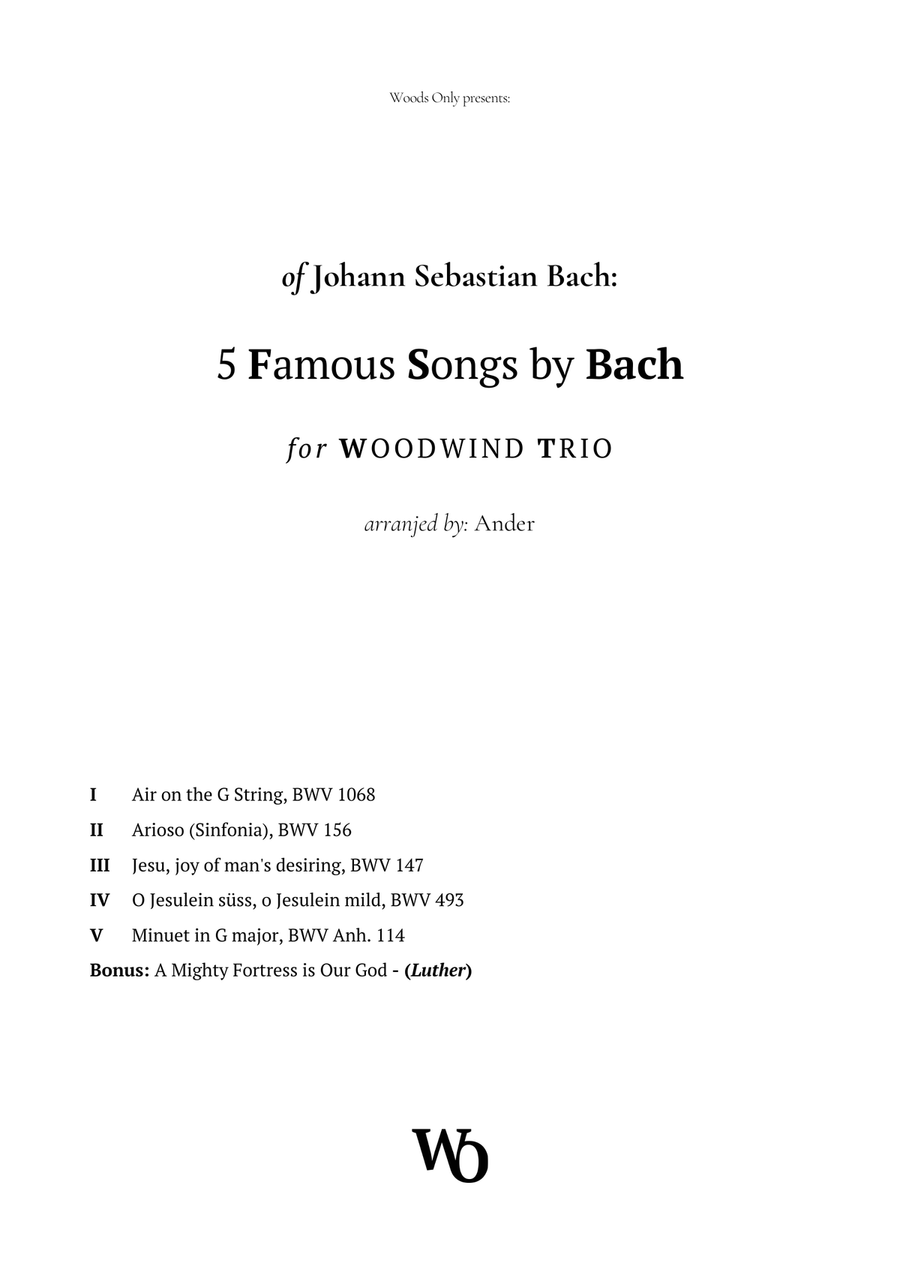
5 Famous Songs by Bach for Woodwind Trio
Flûte, Hautbois, Clarinette (trio)

$23.99 20.76 € Flûte, Hautbois, Clarinette (trio) PDF SheetMusicPlus


Partitions Gratuites
Acheter des Partitions Musicales
Acheter des Partitions Digitales à Imprimer
Acheter des Instruments de Musique

© 2000 - 2026

Accueil - Version intégrale





