EUROPE
8960 articles
USA
0 articles
DIGITAL
3078 articles (à imprimer)
Partitions Digitales
Partitions à imprimer
3078 partitions trouvées


Violin Solo - Level 5 - Digital Download SKU: A0.1018937 Composed by Benjamin Harry Sajo. 20th Century,Contemporary. 5 pages. Benjamin Sajo #6072975. Published by Benjamin Sajo (A0.1018937). Fugue: Wear Pearls and Smile is, on the outset, a fast, rambunctious adventure for many voices playing at the same time. It was conceived as a pairing for the equally vivacious second symphony of Ludwig van Beethoven–his 250th birthday is this year–but can stand on its own as one of my hardest, most challenging works to cook up.This piece is dedicated to those forced to appear positive when internally they’re falling apart. The title is inspired by a quote that’s been with me for a while, Why is it that men can be bastards and women must wear pearls and smile? by Lynn Hecht Schafren, the celebrated American jurist famous for campaigning for gender equity in courts. I’m taking the quote out of its initial context, but the power of that quote, for me, exemplifies how hard it is to maintain a sense of emotional decorum and dignity when you’re authentically a hot mess. And what’s more of a musical hot mess than a fugue?There are two realities to this piece. I’ll quote Dmitri Shostakovich, from his autobiography: The rejoicing is forced, created under threat, […] It’s as if someone were beating you with a stick and saying, ‘Your business is rejoicing, your business is rejoicing,’ and you rise, shaky, and go marching off, muttering ‘Our business is rejoicing, our business is rejoicing.’ On the one hand, it is insincere happiness, cloying perhaps. But the other truth, I’ll quote Oscar Hammerstein II, from The King and I: While shivering in my shoes / I strike a careless pose / And whistle a happy tune / And no one ever knows, / I'm afraid. I forced myself, against all impulses of my current being, to forge happiness. This piece, with its origin being a mental puzzle (fugues are puzzles), it became a construct where I could lift myself up and regain a sense of purpose. Therefore, it is invented–out of a literal need to survive–pure, genuine happiness.Future Performances: If you are interested in performing this work, please e-mail me.ABOUT THE COMPOSER: Benjamin Sajo (b. 1988) is a Canadian composer of contemporary classical music, as well as an educator. Since developing a fiercely independent creative voice upon the completion of his studies at Western (2010) and McGill Universities (2013), he continues to find inspiration from the intersection of mythology, art, and nature upon the contemporary human experience. In 2019, he released his premiere album of original music, The Great War Sextet: Canadian War Poetry with Trombone & Strings , with support from the Ontario Arts Council. He is a member of SOCAN and the League of Canadian Composers.
Fugue: "Wear Pearls and Smile" (A Pairing with Beethoven's Symphony #2) - Violin I
Violon

$3.50 3.05 € Violon PDF SheetMusicPlus

Bassoon Solo - Level 5 - Digital Download SKU: A0.1018928 Composed by Benjamin Harry Sajo. 20th Century,Contemporary. Individual part. 5 pages. Benjamin Sajo #6072961. Published by Benjamin Sajo (A0.1018928). Fugue: Wear Pearls and Smile is, on the outset, a fast, rambunctious adventure for many voices playing at the same time. It was conceived as a pairing for the equally vivacious second symphony of Ludwig van Beethoven–his 250th birthday is this year–but can stand on its own as one of my hardest, most challenging works to cook up.This piece is dedicated to those forced to appear positive when internally they’re falling apart. The title is inspired by a quote that’s been with me for a while, Why is it that men can be bastards and women must wear pearls and smile? by Lynn Hecht Schafren, the celebrated American jurist famous for campaigning for gender equity in courts. I’m taking the quote out of its initial context, but the power of that quote, for me, exemplifies how hard it is to maintain a sense of emotional decorum and dignity when you’re authentically a hot mess. And what’s more of a musical hot mess than a fugue?There are two realities to this piece. I’ll quote Dmitri Shostakovich, from his autobiography: The rejoicing is forced, created under threat, […] It’s as if someone were beating you with a stick and saying, ‘Your business is rejoicing, your business is rejoicing,’ and you rise, shaky, and go marching off, muttering ‘Our business is rejoicing, our business is rejoicing.’ On the one hand, it is insincere happiness, cloying perhaps. But the other truth, I’ll quote Oscar Hammerstein II, from The King and I: While shivering in my shoes / I strike a careless pose / And whistle a happy tune / And no one ever knows, / I'm afraid. I forced myself, against all impulses of my current being, to forge happiness. This piece, with its origin being a mental puzzle (fugues are puzzles), it became a construct where I could lift myself up and regain a sense of purpose. Therefore, it is invented–out of a literal need to survive–pure, genuine happiness.Future Performances: If you are interested in performing this work, please e-mail me.ABOUT THE COMPOSER: Benjamin Sajo (b. 1988) is a Canadian composer of contemporary classical music, as well as an educator. Since developing a fiercely independent creative voice upon the completion of his studies at Western (2010) and McGill Universities (2013), he continues to find inspiration from the intersection of mythology, art, and nature upon the contemporary human experience. In 2019, he released his premiere album of original music, The Great War Sextet: Canadian War Poetry with Trombone & Strings , with support from the Ontario Arts Council. He is a member of SOCAN and the League of Canadian Composers.
Fugue: "Wear Pearls and Smile" (A Pairing with Beethoven's Symphony #2) - Bassoon 1
Basson

$3.50 3.05 € Basson PDF SheetMusicPlus

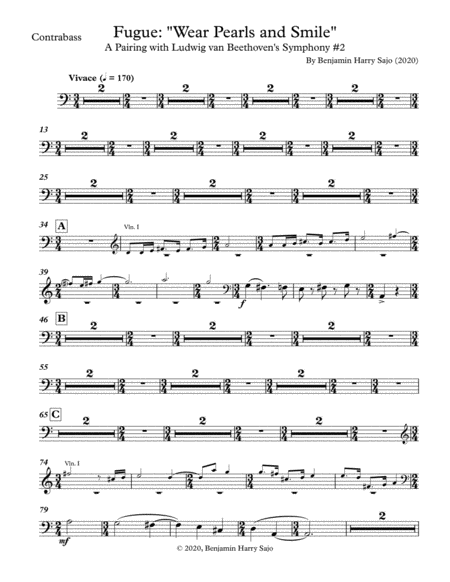
Double Bass,String Bass Solo - Level 5 - Digital Download SKU: A0.1018941 Composed by Benjamin Harry Sajo. 20th Century,Contemporary. Individual part. 4 pages. Benjamin Sajo #6072983. Published by Benjamin Sajo (A0.1018941). Fugue: Wear Pearls and Smile is, on the outset, a fast, rambunctious adventure for many voices playing at the same time. It was conceived as a pairing for the equally vivacious second symphony of Ludwig van Beethoven–his 250th birthday is this year–but can stand on its own as one of my hardest, most challenging works to cook up.This piece is dedicated to those forced to appear positive when internally they’re falling apart. The title is inspired by a quote that’s been with me for a while, Why is it that men can be bastards and women must wear pearls and smile? by Lynn Hecht Schafren, the celebrated American jurist famous for campaigning for gender equity in courts. I’m taking the quote out of its initial context, but the power of that quote, for me, exemplifies how hard it is to maintain a sense of emotional decorum and dignity when you’re authentically a hot mess. And what’s more of a musical hot mess than a fugue?There are two realities to this piece. I’ll quote Dmitri Shostakovich, from his autobiography: The rejoicing is forced, created under threat, […] It’s as if someone were beating you with a stick and saying, ‘Your business is rejoicing, your business is rejoicing,’ and you rise, shaky, and go marching off, muttering ‘Our business is rejoicing, our business is rejoicing.’ On the one hand, it is insincere happiness, cloying perhaps. But the other truth, I’ll quote Oscar Hammerstein II, from The King and I: While shivering in my shoes / I strike a careless pose / And whistle a happy tune / And no one ever knows, / I'm afraid. I forced myself, against all impulses of my current being, to forge happiness. This piece, with its origin being a mental puzzle (fugues are puzzles), it became a construct where I could lift myself up and regain a sense of purpose. Therefore, it is invented–out of a literal need to survive–pure, genuine happiness.Future Performances: If you are interested in performing this work, please e-mail me.ABOUT THE COMPOSER: Benjamin Sajo (b. 1988) is a Canadian composer of contemporary classical music, as well as an educator. Since developing a fiercely independent creative voice upon the completion of his studies at Western (2010) and McGill Universities (2013), he continues to find inspiration from the intersection of mythology, art, and nature upon the contemporary human experience. In 2019, he released his premiere album of original music, The Great War Sextet: Canadian War Poetry with Trombone & Strings , with support from the Ontario Arts Council. He is a member of SOCAN and the League of Canadian Composers.

Fugue: "Wear Pearls and Smile" (A Pairing with Beethoven's Symphony #2) - Contrabass
Contre Basse

$3.50 3.05 € Contre Basse PDF SheetMusicPlus

Flute Solo - Level 5 - Digital Download SKU: A0.1018922 Composed by Benjamin Harry Sajo. 20th Century,Contemporary. Individual part. 4 pages. Benjamin Sajo #6072947. Published by Benjamin Sajo (A0.1018922). Fugue: Wear Pearls and Smile is, on the outset, a fast, rambunctious adventure for many voices playing at the same time. It was conceived as a pairing for the equally vivacious second symphony of Ludwig van Beethoven–his 250th birthday is this year–but can stand on its own as one of my hardest, most challenging works to cook up.This piece is dedicated to those forced to appear positive when internally they’re falling apart. The title is inspired by a quote that’s been with me for a while, Why is it that men can be bastards and women must wear pearls and smile? by Lynn Hecht Schafren, the celebrated American jurist famous for campaigning for gender equity in courts. I’m taking the quote out of its initial context, but the power of that quote, for me, exemplifies how hard it is to maintain a sense of emotional decorum and dignity when you’re authentically a hot mess. And what’s more of a musical hot mess than a fugue?There are two realities to this piece. I’ll quote Dmitri Shostakovich, from his autobiography: The rejoicing is forced, created under threat, […] It’s as if someone were beating you with a stick and saying, ‘Your business is rejoicing, your business is rejoicing,’ and you rise, shaky, and go marching off, muttering ‘Our business is rejoicing, our business is rejoicing.’ On the one hand, it is insincere happiness, cloying perhaps. But the other truth, I’ll quote Oscar Hammerstein II, from The King and I: While shivering in my shoes / I strike a careless pose / And whistle a happy tune / And no one ever knows, / I'm afraid. I forced myself, against all impulses of my current being, to forge happiness. This piece, with its origin being a mental puzzle (fugues are puzzles), it became a construct where I could lift myself up and regain a sense of purpose. Therefore, it is invented–out of a literal need to survive–pure, genuine happiness.Future Performances: If you are interested in performing this work, please e-mail me.ABOUT THE COMPOSER: Benjamin Sajo (b. 1988) is a Canadian composer of contemporary classical music, as well as an educator. Since developing a fiercely independent creative voice upon the completion of his studies at Western (2010) and McGill Universities (2013), he continues to find inspiration from the intersection of mythology, art, and nature upon the contemporary human experience. In 2019, he released his premiere album of original music, The Great War Sextet: Canadian War Poetry with Trombone & Strings , with support from the Ontario Arts Council. He is a member of SOCAN and the League of Canadian Composers.

Fugue: "Wear Pearls and Smile" (A Pairing with Beethoven's Symphony #2) - Flute 1
Flute (partie séparée)

$3.50 3.05 € Flute (partie séparée) PDF SheetMusicPlus

Oboe Solo - Level 5 - Digital Download SKU: A0.1018926 Composed by Benjamin Harry Sajo. 20th Century,Contemporary. Individual part. 4 pages. Benjamin Sajo #6072953. Published by Benjamin Sajo (A0.1018926). Fugue: Wear Pearls and Smile is, on the outset, a fast, rambunctious adventure for many voices playing at the same time. It was conceived as a pairing for the equally vivacious second symphony of Ludwig van Beethoven–his 250th birthday is this year–but can stand on its own as one of my hardest, most challenging works to cook up.This piece is dedicated to those forced to appear positive when internally they’re falling apart. The title is inspired by a quote that’s been with me for a while, Why is it that men can be bastards and women must wear pearls and smile? by Lynn Hecht Schafren, the celebrated American jurist famous for campaigning for gender equity in courts. I’m taking the quote out of its initial context, but the power of that quote, for me, exemplifies how hard it is to maintain a sense of emotional decorum and dignity when you’re authentically a hot mess. And what’s more of a musical hot mess than a fugue?There are two realities to this piece. I’ll quote Dmitri Shostakovich, from his autobiography: The rejoicing is forced, created under threat, […] It’s as if someone were beating you with a stick and saying, ‘Your business is rejoicing, your business is rejoicing,’ and you rise, shaky, and go marching off, muttering ‘Our business is rejoicing, our business is rejoicing.’ On the one hand, it is insincere happiness, cloying perhaps. But the other truth, I’ll quote Oscar Hammerstein II, from The King and I: While shivering in my shoes / I strike a careless pose / And whistle a happy tune / And no one ever knows, / I'm afraid. I forced myself, against all impulses of my current being, to forge happiness. This piece, with its origin being a mental puzzle (fugues are puzzles), it became a construct where I could lift myself up and regain a sense of purpose. Therefore, it is invented–out of a literal need to survive–pure, genuine happiness.Future Performances: If you are interested in performing this work, please e-mail me.ABOUT THE COMPOSER: Benjamin Sajo (b. 1988) is a Canadian composer of contemporary classical music, as well as an educator. Since developing a fiercely independent creative voice upon the completion of his studies at Western (2010) and McGill Universities (2013), he continues to find inspiration from the intersection of mythology, art, and nature upon the contemporary human experience. In 2019, he released his premiere album of original music, The Great War Sextet: Canadian War Poetry with Trombone & Strings , with support from the Ontario Arts Council. He is a member of SOCAN and the League of Canadian Composers.

Fugue: "Wear Pearls and Smile" (A Pairing with Beethoven's Symphony #2) - Oboe 1
Hautbois (partie séparée)

$3.50 3.05 € Hautbois (partie séparée) PDF SheetMusicPlus

French Horn Solo - Level 5 - Digital Download SKU: A0.1018931 Composed by Benjamin Harry Sajo. 20th Century,Contemporary. Individual part. 4 pages. Benjamin Sajo #6072965. Published by Benjamin Sajo (A0.1018931). Fugue: Wear Pearls and Smile is, on the outset, a fast, rambunctious adventure for many voices playing at the same time. It was conceived as a pairing for the equally vivacious second symphony of Ludwig van Beethoven–his 250th birthday is this year–but can stand on its own as one of my hardest, most challenging works to cook up.This piece is dedicated to those forced to appear positive when internally they’re falling apart. The title is inspired by a quote that’s been with me for a while, Why is it that men can be bastards and women must wear pearls and smile? by Lynn Hecht Schafren, the celebrated American jurist famous for campaigning for gender equity in courts. I’m taking the quote out of its initial context, but the power of that quote, for me, exemplifies how hard it is to maintain a sense of emotional decorum and dignity when you’re authentically a hot mess. And what’s more of a musical hot mess than a fugue?There are two realities to this piece. I’ll quote Dmitri Shostakovich, from his autobiography: The rejoicing is forced, created under threat, […] It’s as if someone were beating you with a stick and saying, ‘Your business is rejoicing, your business is rejoicing,’ and you rise, shaky, and go marching off, muttering ‘Our business is rejoicing, our business is rejoicing.’ On the one hand, it is insincere happiness, cloying perhaps. But the other truth, I’ll quote Oscar Hammerstein II, from The King and I: While shivering in my shoes / I strike a careless pose / And whistle a happy tune / And no one ever knows, / I'm afraid. I forced myself, against all impulses of my current being, to forge happiness. This piece, with its origin being a mental puzzle (fugues are puzzles), it became a construct where I could lift myself up and regain a sense of purpose. Therefore, it is invented–out of a literal need to survive–pure, genuine happiness.Future Performances: If you are interested in performing this work, please e-mail me.ABOUT THE COMPOSER: Benjamin Sajo (b. 1988) is a Canadian composer of contemporary classical music, as well as an educator. Since developing a fiercely independent creative voice upon the completion of his studies at Western (2010) and McGill Universities (2013), he continues to find inspiration from the intersection of mythology, art, and nature upon the contemporary human experience. In 2019, he released his premiere album of original music, The Great War Sextet: Canadian War Poetry with Trombone & Strings , with support from the Ontario Arts Council. He is a member of SOCAN and the League of Canadian Composers.

Fugue: "Wear Pearls and Smile" (A Pairing with Beethoven's Symphony #2) - Horn in F 1
Cor

$3.50 3.05 € Cor PDF SheetMusicPlus

Clarinet Solo - Level 5 - Digital Download SKU: A0.1018927 Composed by Benjamin Harry Sajo. 20th Century,Contemporary. Individual part. 5 pages. Benjamin Sajo #6072957. Published by Benjamin Sajo (A0.1018927). Fugue: Wear Pearls and Smile is, on the outset, a fast, rambunctious adventure for many voices playing at the same time. It was conceived as a pairing for the equally vivacious second symphony of Ludwig van Beethoven–his 250th birthday is this year–but can stand on its own as one of my hardest, most challenging works to cook up.This piece is dedicated to those forced to appear positive when internally they’re falling apart. The title is inspired by a quote that’s been with me for a while, Why is it that men can be bastards and women must wear pearls and smile? by Lynn Hecht Schafren, the celebrated American jurist famous for campaigning for gender equity in courts. I’m taking the quote out of its initial context, but the power of that quote, for me, exemplifies how hard it is to maintain a sense of emotional decorum and dignity when you’re authentically a hot mess. And what’s more of a musical hot mess than a fugue?There are two realities to this piece. I’ll quote Dmitri Shostakovich, from his autobiography: The rejoicing is forced, created under threat, […] It’s as if someone were beating you with a stick and saying, ‘Your business is rejoicing, your business is rejoicing,’ and you rise, shaky, and go marching off, muttering ‘Our business is rejoicing, our business is rejoicing.’ On the one hand, it is insincere happiness, cloying perhaps. But the other truth, I’ll quote Oscar Hammerstein II, from The King and I: While shivering in my shoes / I strike a careless pose / And whistle a happy tune / And no one ever knows, / I'm afraid. I forced myself, against all impulses of my current being, to forge happiness. This piece, with its origin being a mental puzzle (fugues are puzzles), it became a construct where I could lift myself up and regain a sense of purpose. Therefore, it is invented–out of a literal need to survive–pure, genuine happiness.Future Performances: If you are interested in performing this work, please e-mail me.ABOUT THE COMPOSER: Benjamin Sajo (b. 1988) is a Canadian composer of contemporary classical music, as well as an educator. Since developing a fiercely independent creative voice upon the completion of his studies at Western (2010) and McGill Universities (2013), he continues to find inspiration from the intersection of mythology, art, and nature upon the contemporary human experience. In 2019, he released his premiere album of original music, The Great War Sextet: Canadian War Poetry with Trombone & Strings , with support from the Ontario Arts Council. He is a member of SOCAN and the League of Canadian Composers.

Fugue: "Wear Pearls and Smile" (A Pairing with Beethoven's Symphony #2) - Clarinet 1
Clarinette

$3.50 3.05 € Clarinette PDF SheetMusicPlus

Piano,Vocal,Voice - Level 4 - Digital Download SKU: A0.1470648 By Marcos Fernandez-Barrero. By Marcos Fernandez-Barrero. 21st Century,Chamber,Christian,Opera,Sacred. Score. 17 pages. Marcos Fernandez-Barrero #1048301. Published by Marcos Fernandez-Barrero (A0.1470648). Work commissioned for mezzo-soprano Sandra Ferrández and pianist Irene Alfageme to be premiered at the Teatro de la Zarzuela (Madrid) on 1st April 2024.The piece takes inspiration from the the XV Century Spanish poem by anonymous author 'Van Y Vienen', which gave the lyrics of the work. Although the poem was written in the Middle Ages, it resonates with a timeless universality, allowing for a deep connection with the contemporary audience. Its metaphor of the sea as a reflection of human emotions – that come and go like the waves of the sea – transcends eras, resonating with the instability and hope that characterize the human experience.By using it as lyrics for a sort of contemporary habanera, I saw the possibility of merging the nostalgia of the past with the artistic expression of the present, creating a bridge between different historical moments through music and poetry. ____________________________________________________________________Obra encargo para el estreno a cargo de la mezzosoprano Sandra Ferrández y la pianista Irene Alfageme en el Teatro de la Zarzuela (Madrid) el 1 de abril de 2024. La pieza se utiliza el poema anónimo del siglo XV 'Van y Vienen'. Aunque fue escrito en la Edad Media, resuena con una universalidad atemporal, permitiendo una profunda conexión en la era actual. Su metáfora del mar como reflejo de las emociones humanas – que van y vienen como las olas del mar – trasciende épocas, resonando con la inestabilidad y la esperanza que caracterizan la experiencia humana. Al utilizarlo como letra para una especie de habanera contemporánea, vi la posibilidad de fusionar la nostalgia del pasado con la expresión artística del presente, creando un puente entre diferentes momentos históricos a través de la música y la poesía.
Van y Vienen, for Mezzo-soprano and Piano
Piano, Voix
Marcos Fernandez-Barrero
$9.85 8.58 € Piano, Voix PDF SheetMusicPlus

Piano Solo - Level 4 - Digital Download SKU: A0.1030831 Composed by Michael C. Brown. 20th Century,Romantic Period. Score. 23 pages. Michael C. Brown #4051. Published by Michael C. Brown (A0.1030831). This piece celebrates the life and mourns the loss of my granddaughter, Paisley Gladys Hogan, who was but 2 months old when she was called to Heaven. These are the words I wrote just before her funeral.... I. The Presence - She was here. I held her the day she was born. I held her and watched her smile at me less than 24 hours before she departed. She only knew love. No one around her ever showed her anything else that humanity had to offer; like hatred, heartache, pain, control, or anger. II. The Shock - She feels a Hand beckon her to leave her mortal coil, and she enters into a world we cannot yet reach.. With no one home, her former body ceases to wake. The unimaginable has happened and we struggle to reverse it. Finally, it becomes clear that we cannot. She sees us cry and she wonders what is happening. Having never known sorrow, she only sees that love didn't cause this response. She wants to comfort us with the love she knows, but we do not yet sense it. III. The Questions - One word has confounded mankind from its creation; Why? We have never found an acceptable answer. We ask, Why did this happen? and What did I do? and What didn't we do right? and Why couldn't it have been me? among others. We only know that her absence has carved holes in our hearts shaped like her. She tries to tell us, You can still love me. I just cannot be seen by you now. It does not mean your love cannot make me happy. I still want it. I still feel it. Please feel my love for you. IV. Letting Go - The day comes to bid farewell to the vehicle by which she came to us. We struggle to cope that we will see her face no more except in pictures. Because of the brevity of her life, memories are few to relive, but to do so is to recall happiness. In sorrow, we return her to the earth. All that is left is to return to recall, to talk to her, to bring flowers and other gifts, and to await the day we follow her. V. Remembering - The days and years follow. Normalcy slowly sets back into our lives. The holes in our hearts will never fully heal. But the salve of her love and her memory help to soothe the ache. We still return to where we placed her mortal home, where we laugh and cry in tandem, where our hearts ache to fill the void left by her departure. It will never really get better, but it will become easier for her love to dull the sting of her absence. VI. The Reunion - One by one, we will feel the same Hand bid us to come. The same events will befall those left behind each time. One by one, she will greet us as we reunite with her. We marvel at how she has stayed with us as we stay to comfort those we had just bidden farewell. The rest cannot be imagined by we that remain..........
Paisley's Sonata
Piano seul

$4.99 4.35 € Piano seul PDF SheetMusicPlus

Brass Ensemble - Level 5 - Digital Download SKU: A0.792338 Composed by Wolking, Henryenry. 20th Century,Contemporary,Jazz,Ragtime. Score and parts. 56 pages. Gordon Cherry #4804655. Published by Gordon Cherry (A0.792338). As an adult I occasionally try to remember and or capture child-like experiences-maybe not so much the actual event, but the emotive atmosphere left from impressions long ago embedded in the psyche.Each movement of this work is based on spontaneous and uncalculated musical imagery of dreams and childhood reflections. I have deliberately avoided the professional composer’s bag of developmental tricks and worked for a more free flow of simple melodic ideas: they go wherever they want.Movement IInspired by the feelings I had growing up on Merritt Island Florida with my older sister Barbara. This music was a gift to her on the occasion of her 2004 marriage in Flemington New Jersey. It was originally scored for a brass quartet with which I performed. I have written three other brass quintets, and when I started thinking about this one (my fourth) this seemed like a logical choice for a first movement.Movement IIBased on a tune that came to me in a dream. It is dedicated to my wife Lois (we also married in 2004) and has a formal title of Wake Up To A Melody. I originally scored it for jazz band-more specifically for the excellent Salt Lake Alternative Jazz Orchestra, and it has recently been recorded by that group. I like the simplicity of this melody, and felt it would make a natural second movement for this brass quintet.Movement IIIThe third and most difficult movement is Tangoragrondo. It is literally a rondo with a turn-of-the century (19th-20th) ragtime melody/gallop occupying the A theme followed by a Tango (inspired by trips to Santiago Chile) for the B theme. The return to the rag (A theme) is then followed by a fantasy development (C area) with a return to to the rag (A theme) followed by a coda that recalls material from the first movement. The form is quite simple- ABACA-Coda.The material was originally developed as a movement for my double concerto Letting Midnight Out On Bail written for the Duehlmeier-Gritton piano duo and orchestra. It was recorded by the Warsaw Philharmonic and has been released on CD. A second version for two pianos has also been recorded and released by the Duehlmeier-Gritton piano duo. This orchestration for brass quintet will be the final resting place for this chaotic rondo.
A Child’s Garden of Jazz for Brass Quintet
Quintette de Cuivres: 2 trompettes, Cor, trombone, tuba

$27.50 23.95 € Quintette de Cuivres: 2 trompettes, Cor, trombone, tuba PDF SheetMusicPlus

Concert Band - Level 5 - Digital Download SKU: A0.1023994 Composed by Kyle Wernke. 20th Century,Contemporary. Score and parts. 425 pages. Kyle Wernke Publishing #2120113. Published by Kyle Wernke Publishing (A0.1023994). Formations, is a celebration of the cosmos; a celebration of the tiniest of particles to the largest galaxies and everything in between. Since I was a child I've looked up at the sky and seen a world full of wonder, beauty, and mystery. The same wonder that filled my heart when I was in elementary school still takes hold when I look up now, decades later. I chose the formation of things for a specific reason. When I was a kid I had a habit of asking my parents where everything came from. It wasn't enough that a star was there, I needed to know how it got there and if possible why it was there. As I grew up I developed an immense appetite for almost all things science and history and with that came some of the answers I needed. The reality of how these things came to be was so much more interesting and astounding than my imagination that all these years later I am still captivated by the idea of an exploding star or the Big Bang. So lets take a journey, you and I. First we'll see the death of an immense star and watch as its own gravity rips it apart and forms a black hole. We'll see it feed on matter and light around it until it too finally dies. Next we'll go back 13.7 billion years and watch as tiny particles dance in and out of existence in the endless nothingness that once was. We'll see one of these tiny bits expand in an instant and give rise to everything that ever has been or will be. Watch hydrogen form and gravity pull it into the first stars. Those stars will form galaxies and we'll see glimpses of the Universe as it exists now. Finally, we will travel to the end of time, a trillion years or more into the future. There we will witness the dissipation of the galaxies, the death of stars, and the final moments as even tiny electrons are pulled apart into the nothing from which we all came. Parts of this piece are violent, but we will see that at the end of time, the formation of nothing is just as beautiful as the formation of a star. Everything has its time and everything ends. Premiered by the Hartt Wind Ensemble - Glen Adsit, Conductor.
Formations for Wind Ensemble
Orchestre d'harmonie

$150.00 130.62 € Orchestre d'harmonie PDF SheetMusicPlus

Piano Solo - Level 3 - Digital Download SKU: A0.1192328 Composed by Kenny Ascher and Paul Williams. Arranged by Arranged by Elena Fortin. Children,Contemporary,Film/TV,Standards. Score. 5 pages. Elena Fortin #791761. Published by Elena Fortin (A0.1192328). The Rainbow Connection from The Muppet MovieIntermediate Piano Solo arrangement by Elena Fortin. Original words and music by Kenneth L. Ascher and Paul Williams.Most people hear the intro of this piece and immediately think of Kermit the Frog, strumming his banjo and singing this beautiful little melody. It is one of the very first sheets of music that I went out and purchased at our local music store. I was so excited to learn it! Fast forward many years later (ahem!) and I am so happy to see it entertaining a whole new generation of people. On YouTube, Kermit uploaded a special performance of it in April 2020!I performed it as a duet with a student at a recital and it was a big hit (we even came up with our own choreography to go along with the piece!) This melody is one of those timeless and iconic pieces that will forever live in my heart. I was excited to see that I would be able to share an arrangement I made!My version starts out in the key of A major and offers a simple, more pianistic left hand accompaniment. Smooth, flowing arpeggios accompany most of the piece. The first verse is left to be fairly simple and lets the melody shine. The second verse has more harmony in the right hand and some fills that build on the melody. The key change has more movement and signals the last verse done in a very full, orchestra-like sound. The finish brings us back to a more simple arrangement--back to it's humble beginnings!I hope I made Kermit proud!Please check out my other arrangements available on SheetMusicPlus and Sheet Music Direct.WIth love,Elena
The Rainbow Connection
Piano seul

$4.99 4.35 € Piano seul PDF SheetMusicPlus

B-Flat Clarinet,Piano - Level 4 - Digital Download SKU: A0.1271341 Composed by By Kara Williams. Chamber,Classical,Comedy,Contest,Festival. Score and part. 21 pages. Kara Williams #863736. Published by Kara Williams (A0.1271341). Suite in Sea is a fun and quirky work for solo clarinet and piano composed by Kara Williams. Each movement draws on inspiration from Kara’s own time at sea serving in the military imagined as a suite of four short programmatic movements. We follow a young sailor as they stagger around the deck in the rough weather, finally succumbing to the corkscrew motion of the ocean in ‘Sea Sick Shanty’; a moment of peace and beauty for the young sailor as the ship sails through an ‘Archipelago’ teaming with marine life; In ‘Brew Time March, the young sailor excitedly hears the bugle call to have a break from work (brew time), grab a coffee and sit on the bow to watch the waves… lost in thoughts, they unexpectedly hear the sound of work recommencing, and scurry back, making it just in the nick of time… waiting eagerly for next the next call for Brew Time! The preparation, spectacle, pride, and excitement of ‘Sailing into Harbour’ completes this suite, suitable for an intermediate to more advanced player looking for something entertaining and a little bit different! Range E1-G4. Total performance time, just over 10 minutes.To hear audio files of all four movements, please go to the composer's website karawilliamsmusic.com.
Suite in Sea for Clarinet and Piano
Clarinette et Piano
Kara Williams Chamber,Classical,Comedy,Contest,Festival
$20.00 17.42 € Clarinette et Piano PDF SheetMusicPlus

Violin and piano - intermediate to advanced - Digital Download SKU: S9.Q53344 Op. 62. Composed by Henri Ravina. Edited by Wolfgang Birtel. Arranged by E.W. Ritter. This edition: Sheet music. (c) 2020 Schott Music GmbH & Co. KG, Mainz. Classical. Downloadable. Op. 62. 12 pages. Schott Music - Digital #Q53344. Published by Schott Music - Digital (S9.Q53344). English • German.French pianist Jean-Henri Ravina was a child prodigy who came to public attention when he performed in a concert at the age of eight. The violinist Pierre Rode heard him and encouraged Ravina to go to Paris, where at the age of thirteen he became a student at the Conservatoire. After completing his own studies, Ravina was eventually to teach there, too; he gave up that position, however, to focus on his career as a virtuoso performer and composer. Concert tours to Russia and Spain secured the reputation of this pianist, who was awarded the Légion d’honneur in 1861. Ravina wrote almost exclusively for the piano: Études, Préludes, a piano concerto, a Rêverie for the left hand alone, compositions for piano duet – including transcriptions of all Beethoven’s Symphonies – and piano pieces for three and as many as six players. The stylistic influence of Rode and Chopin is evident here. Ravina’s Petit Boléro op. 62 reflects the nineteenth-century predilection for exoticism and for music from other cultures – in this case from neighbouring Spain. Ernst W. Ritter, who published numerous arrangements with Schott, also arranged this composition for violin and piano: it is a dashing, lively piece of music! Edition based on plate nos. 02372 (piano part) and 02371 (violin part), first published in 1887 as plate no. 24483.
Petit Boléro
Violon et Piano

$3.99 3.47 € Violon et Piano PDF SheetMusicPlus


Partitions Gratuites
Acheter des Partitions Musicales
Acheter des Partitions Digitales à Imprimer
Acheter des Instruments de Musique

© 2000 - 2026

Accueil - Version intégrale
