EUROPE
3915 articles
USA
7921 articles
DIGITAL
15248 articles (à imprimer)
Partitions Digitales
Partitions à imprimer
15248 partitions trouvées


C Instrument - Level 4 - Digital Download SKU: A0.1258035 By James Brown. By Clarence Gaskill, Leo Robin, and Russ Columbo. Arranged by John Fries. 20th Century,Pop,Standards. Lead Sheet / Fake Book. 1 pages. John Fries #851273. Published by John Fries (A0.1258035). Please contact me by email at jfries@ptd.net to make a special request or to find out all that I have to offer and to express your comments or concerns. Thanks, John.  Written in 1931, Leo Robin has related how publisher Con Conrad walked into his hotel room with Russ Columbo and asked him to write words within the hour for a tune he had.  Robin, who was on vacation, at first refused, but Conrad explained that he wanted Columbo to demonstrate it to Flo Ziegfeld who needed a song for Helen Morgan in one of his shows.  Robin then wrote the lyric, which he afterwards said he disliked, and the song was duly performed for Ziegfeld, but he did not accept it.  Russ Columbo, however, sang it on his radio show and recorded it on October 9, 1931, for Victor Records, and it was very popular in 1932.  Columbo also sang it in the 1933 short film That Goes Double.  In 1946, the song became a major hit for Billy Eckstine, Perry Como, and the Ink Spots.
Prisoner Of Love
Instruments en Do
James Brown
$3.99 3.43 € Instruments en Do PDF SheetMusicPlus

High voice and piano - Medium - Digital Download SKU: MQ.8318-4E Composed by Gwyneth W. Walker. Secular, 21st century. 9 pages. E. C. Schirmer Music Company - Digital #8318-4E. Published by E. C. Schirmer Music Company - Digital (MQ.8318-4E). The five letters which provide the lyrics for the songs (adapted by the composer) were selected for their range of topics and sentiments. Some portray the wildlife in the mountains (“Glacier Birds...â€). Others extol the beauty of the Sierra (“Mountain Glory,†“Yosemite Fallsâ€). One expresses the whimsical/temperamental personality of the author (“Ice!â€). And the final letter (“Sequoiaâ€) speaks reverently of the great trees, in a language both naturalistic and sacred. They are the “greatest light in the woods, the greatest light in the world.†The musical settings, especially in the piano accompaniment, are quite programmatic. Glacier birds scamper up and down the keyboard in tone clusters. “Icy†glissandi float off. The great trees take root in large, block chords, and waterfalls cascade down in scales.There is personality in the letters. The bond between John Muir and Mrs. Carr (whom he addresses formally) is one of great kinship- a blending of the souls, a “spiritual romance.†As he marvels at the beauty of the wilderness, he writes ardently, “I wish that you could see this...†When he learns that Mrs. Carr, a botanist (whose plants suffer from the frost), dislikes ice, he chides her, and creates a “mock argument†over the value of glacial ice.The songs begin with an ascent into the mountains. They close with the return to the coast, to the magnificent Sequoia trees, where John Muir camps for the night, in the company of a squirrel. Charmingly, he writes “therefore, my Carr, goodnight.â€.
Ice! from Songs from the High Sierra
Voix haute

$7.25 6.24 € Voix haute PDF SheetMusicPlus

String Trio Cello,Viola,Violin - Level 2 - Digital Download SKU: A0.1281002 Composed by Francesco Landini (1325-1397). Arranged by James M. Guthrie. Chamber,Contest,Early Music,Festival,Historic,Traditional. 13 pages. Jmsgu3 #872337. Published by jmsgu3 (A0.1281002). Si Dolce Non Sono (So sweet I am not ) is Landini's homage to French composer Philippe de Vitry, master of the sophisticated mathematical techniques of isorhythmic motet composition. It is one of his most famous works. It speaks of the sweet torment of loving someone who does not return that love.Landini was a leading composer of 14th-century Italy, famed during his lifetime for his musical memory, skill in improvisation, and virtuosity on the organetto, or portative organ, as well as for his compositions. Landini was blinded in childhood by smallpox. His blindness did not prevent him from becoming a highly skilled and renowned musician, composer, and instrument maker. His blindness may have contributed to his prodigious memory and great skill at improvisation. He was crowned with a laurel wreath as the winner of a poetical contest at Venice in 1364.  Landini's output, preserved in the Squarcialupi Codex, represents almost a quarter of all surviving 14th-century Italian music. He was by far the most famous composer in Italy and is considered one of the most revered composers of the second half of the 14th century.Landini's music is characterized by lyrical, songlike melodies that possess an easy-flowing grace and are charmingly harmonized. He was the foremost exponent of the Italian Trecento style, sometimes called the Italian ars nova. His output was almost exclusively secular, and he is known for his ballet and madrigals, which were popular forms of Italian secular songs. It is assumed that he wrote the texts for many of his works.Francesco Landini's music is characterized by its lyrical melodies, secular themes, and unique rhythms, which set him apart from his contemporaries and contributed to his enduring legacy as a composer.
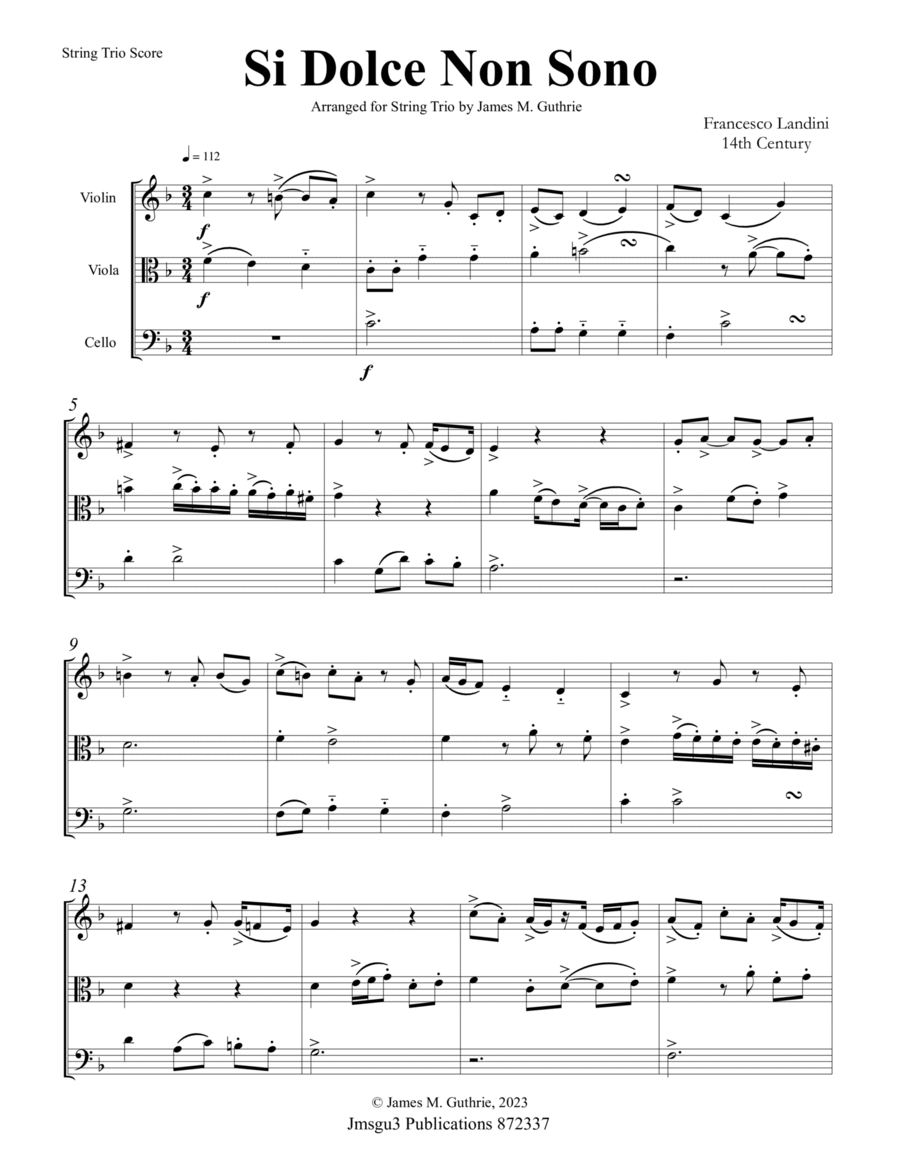
Landini: Si Dolce Non Sono for String Trio
Trio à Cordes: violon, alto, violoncelle

$24.95 21.46 € Trio à Cordes: violon, alto, violoncelle PDF SheetMusicPlus

String Quartet Cello,String Quartet,Viola,Violin - Level 4 - Digital Download SKU: A0.1086066 Composed by Chevalier de Saint-Georges. Arranged by Artaria Editions. Classical. Score and parts. 142 pages. Artaria Editions #690260. Published by Artaria Editions (A0.1086066). For string quartet Score and parts Artaria Editions AE431 Edited by Allan Badley 142 pages This is a scholarly edition of a public domain work. The string quartet holds pride of place in Bologne de Saint-Georges instrumental works, with three sets of six works each. With neat but surely unintentional symmetry these quartets include his first and last instrumental works, the Six quatuors à cordes, Op.1, and the Six Quatuors concertans, Op.15. The present quartets fall midway between these two publications. Composed in 1777 (according to Gabriel Banat, the best and most recent of Saint-Georges’ biographers) the Six Quartetto concertans were issued two years later in a breathtakingly inaccurate edition by Durieu in Paris. Given the unusually high number of errors and inconsistencies in Durieu’s edition it seems most unlikely that Saint-Georges was involved in its preparation. No other edition of the quartets is known although a second printing of the set using the same plates was made ca 1782. Quartet I in Bb major Quartet II in G minor Quartet III in C major Quartet IV in F major Quartet V in G major Quartet VI in Bb major.
Six Concertante Quartets (score and parts)
Quatuor à cordes: 2 violons, alto, violoncelle

$101.00 86.89 € Quatuor à cordes: 2 violons, alto, violoncelle PDF SheetMusicPlus

Chamber Orchestra - Level 3 - Digital Download SKU: A0.500957 By Marc-Antoine Charpentier. By Marc-Antoine Charpentier. Arranged by Flavio Regis Cunha. Baroque,Classical,Contest,Festival,Film/TV,Wedding. Score and parts. 32 pages. FRC Music #114031. Published by FRC Music (A0.500957). The “Te Deum†(H 146) is unquestionably the best known composition of Marc-Antoine Charpentier (1643–1704), especially since its “ Prélude en rondeau †was made the Eurovision signature tune. Although Charpentier set the “Te Deum†altogether four times, this is his only setting employing a “military bandâ€, i.e. trumpets and kettledrums. Charpentier considered the key D-major as bright and very warlike; indeed D-major was regarded as the key of glory in Baroque music. This brilliant and magnificent piece was frequently played at victory celebrations and other occasions of public jubilation during the 17th century. Even today it is still ideal for festive church services and concerts.
CHARPENTIER: PRELUDE (From 'Te Deum in D major', H. 146) for Chamber Orchestra
Orchestre de chambre
Marc-Antoine Charpentier
$12.99 11.18 € Orchestre de chambre PDF SheetMusicPlus

Woodwind Ensemble,Woodwind Quintet - Level 3 - Digital Download SKU: A0.553740 Composed by E Waldteufel. Arranged by Ray Thompson. 20th Century,Christmas,Holiday,Standards,Wedding. 53 pages. RayThompsonMusic #3677061. Published by RayThompsonMusic (A0.553740). Les Patineurs Valse or The Skaters' Waltz or Der Schlittschuhläufer-Walzer (German), Op. 183, is a waltz by Émile Waldteufel.It was composed in 1882, inspired by the Cercle des Patineurs or Rink of Skaters at the Bois de Boulogne in Paris. The introduction to the waltz can be likened to the poise of a skater, and the rapid runs invoke scenes of a wintry atmosphere.It is arranged here for symphonic winds.. the piccolo part is optional, but if used, adds to the brilliance of the piece.It has been performed many times by the orchestra of André Rieu.I have removed some of the repeats. It is a very long blow.2018 Holiday Contest Entry
Waldteufel: Les Patineurs (The Skaters' Waltz)(transposed into Bb) - symphonic wind
Quintette à Vent: flûte, Hautbois, basson, clarinette, Cor

$19.95 17.16 € Quintette à Vent: flûte, Hautbois, basson, clarinette, Cor PDF SheetMusicPlus

Instrumental Duet Cello,Instrumental Duet,Violin - Level 4 - Digital Download SKU: A0.889443 Composed by Luis Anjos Teixeira. Christmas,Concert,Contemporary,Standards. Score and parts. 44 pages. Luis Anjos Teixeira #4767545. Published by Luis Anjos Teixeira (A0.889443). The Celtiberian Suite for Violin and Cello has multiple dancelike movements. Some interpretation symbols where used in the score, they are mere personal suggestions for a performance. Most of the score is left to the interpretation of the artists involved, particularly the use of fingering.  The bowing is very often simply used as a reference to a musical legato. The staccato is meant to shorten the length of the notes to half of its duration and is often used to simplify the righting and the reading of the score. The piece is not very difficult but it demands endurance, focused concentration, listening very consciously each other and a very clean mind while keeping tempo and learning to differentiate the musical phrases. The high pitched notes of some passages on the cello can be transposed an octave lower. It can be performed slower or a little bit faster.  It is a very flexible piece that can be used in all kinds of events. The score was written on Finale. The sound file was produced with samplers from Garritan and conceived merely as an audio support for the presentation of this score. Thank you very much for taking your time to read this text and to listen to the file. I hope you have a lot of fun and enjoy the music. Sheers! Luis Anjos Teixeira Thanks to Claudia Eppelt for the all the Love and cover design. Special Thanks to Stray Dog Nina, Stray Queen Mimi, Carlinhos, Maria Pontinha, Maria Joaninha, Schwarzenegger, Maria Koboldinha.  For all Living beings on Earth, for all our Ancestors,  Thank You for all of You  For All Your Love and Compassion. Love Forever. Luis Anjos Teixeira
Celtiberian Suite For Violin And Cello
Violon, Violoncelle (duo)

$18.14 15.61 € Violon, Violoncelle (duo) PDF SheetMusicPlus

Full Orchestra - Level 3 - Digital Download SKU: A0.850629 By Donny Osmond. By Jerry Livingston and Paul Francis Webster. Arranged by Kevin Riley. 20th Century,Pop. Score and parts. 86 pages. Kevin Riley #457301. Published by Kevin Riley (A0.850629). The Twelfth of Never is a popular song written in 1956 and first recorded by Johnny Mathis the following year. The title is a popular expression, which is used as the date of a future occurrence that will never come to pass. In the case of the song, the 12th of Never is given as the date on which the singer will stop loving his beloved, thus indicating that he will always love her. Mathis initially disliked the song, which was released as the flip side to his number 1 hit single Chances Are. It was written by Jerry Livingston and Paul Francis Webster, the tune (except for the bridge) being adapted from The Riddle Song (also known as I Gave My Love a Cherry), an old English folk song. Mathis's original version reached number 9 on what is now called the Billboard Hot 100 in the USA in 1957. A version by Cliff Richard was released in 1964 and reached number 8 in the UK. Donny Osmond's version, produced by Mike Curb and Don Costa, was his second number 1 single in the UK, spending a single week at the top of the UK Singles Chart in March 1973. In the U.S. it peaked at number 8.
The Twelfth Of Never
Orchestre
Donny Osmond
$60.00 51.62 € Orchestre PDF SheetMusicPlus


Partitions Gratuites
Acheter des Partitions Musicales
Acheter des Partitions Digitales à Imprimer
Acheter des Instruments de Musique

© 2000 - 2026

Accueil - Version intégrale





