EUROPE
18434 articles
USA
0 articles
DIGITAL
34409 articles (à imprimer)
Partitions Digitales
Partitions à imprimer
34409 partitions trouvées


Piano,Soprano Saxophone - Level 1 - Digital Download SKU: A0.548675 Composed by Adam. Arranged by James M. Guthrie, ASCAP. Christian,Christmas. Score and part. 10 pages. Jmsgu3 #3410437. Published by jmsgu3 (A0.548675). Duration: 4:56. Score 5 pg. 44 ms. Solo part: 2 pg. Piano part: 3 pg.Cantique de Noël The French composer Adolphe Adam was already famous as a composer of many successful ballets and operas. Then, in the 1840’s he wrote his most famous work - O Holy Night. The original song title was Minuit Chretiens or Cantique de Noël.  Placide Cappeau provided the original song lyrics. The song was first performed in Roquemaure by the opera singer Emily Laurey at midnight mass in 1847. It became very popular among the French, much the way that Silent Night was famous elsewhere. In the 1850’s John S. Dwight, a Unitarian minister and music teacher translated the song into English.   Adolphe Adam In his younger years, Adam studied organ and composition at the Paris Conservatoire. He also played the timpani in the Conservatoire orchestra. Adam used his savings and borrowed money to open a new opera house - the fourth opera house in Paris in 1847. Unfortunately, the Revolution of 1848 forced him to close. He taught composition at the Paris Conservatoire from 1849 until his death in 1856. Placide Cappeau The poet Cappeau was an advocate of the French Enlightenment philosopher Voltaire.  Voltaire was renowned for criticizing the Catholic church, religious intolerance, and dogma in general. Consequently, Cappeau made the Redeemer figure in his song a kind of reformer of injustices, in particular, the problem of original sin. To begin with, people recognized Cappeau’s theology as eccentric, probably even doubtful. Theology In the earlier form of Minuit, the Christ figure descends to intervene with His Father’s plan to punish mankind.  Traditional doctrine pronounces that Christ came from love, not to intervene. This version also declares that Christ appeared to expunge the original sin of Adam. Cappeau removed this part from his poem years later, because he just didn’t believe it.  He preferred to portray Christ as the reformer of disparity and unfairness. Before long, the writer/politician Alphonse de Lamartine referred to the Minuit as the the Marseillaise of religion. Most French churchmen agreed with this idea but certainly did not consider it a tribute.  Register for free lifetime updates and revisions at www.jamesguthrie.com
O Holy Night for Soprano Sax & Piano
Saxophone Soprano et Piano

$24.95 21.59 € Saxophone Soprano et Piano PDF SheetMusicPlus

Mixed choir (SSATB) SKU: M2.MOS-62018 Lagrime da!! Amante al Sepolcro della!! Amata. Composed by Claudio Monteverdi. Möseler Verlag #MOS 62018. Published by Möseler Verlag (M2.MOS-62018). ISBN 9790203760238.La Sestina (Sestine), ist eine Gedichtform, die aus sechs Strophen zu je sechs Zeilen besteht und durch eine dreizeilige Coda beendet wird. Die Schlussworter der ersten Strophe (tomba, cielo, terra, seno, foco/pianto, Glauco) werden in den nachfolgenden Strophen in geanderter Reihenfolge als Schlussworter wiederholt; die Coda enthalt die Schlussworter, zwei pro Zeile, in ihrer ursprunglichen Reihenfolge. Anlass fur Gedicht und Vertonung war der Tod der erst 18-jahrigen und von Monteverdi sehr geschatzten Gesangsschulerin Caterina Martinelli, die als 13-jahrige zu ihm kam; er hatte ihr die Titelrolle seiner Oper Arianna zugedacht. Zwei Jahre spater vollendete Monteverdi die Trauermusik mit dem Titel Lagrime d'amante al sepolcro dell'amata (Tranen des Liebenden am Grab der Geliebten). - Der Trauernde bezeichnet sich als (Merresgott) Glaukos, der um seine (Nymphe) Corinna weint. Er schreit seinen Schmerz in die Welt hinaus, dass die Luft zittert, seine Tranen fliessen in Stromen. Er beschwort die Nymphen und Musen, die Winde und die Erde am Grab der Geliebten zu singen.
Sestina

$12.95 11.21 € PDF SheetMusicPlus

Mixed choir (SATB div./SAATBB) a cappella - advanced - Digital Download SKU: S9.Q19205 The Dove - Asleep. Composed by Pascal Martine. This edition: choral score. Schott Choral Music. Eine zart vertonte Liebesgeschichte. Durch zahlreiche Taktwechsel bekommt Asleep einen etwas undurchschaubaren Charakter. The Dove taucht ganz ein in die Zierlichkeit und Zärtlichkeit der Liebe und besticht durch subtile Harmoniewechsel. Downloadable, Choral score. Schott Music - Digital #Q19205. Published by Schott Music - Digital (S9.Q19205). English.Die Vertonungen der romantischen Liebesgedichte wirken sehr zart und einfühlsam. Durch zahlreiche Taktwechsel, die die größte Schwierigkeit von Asleep darstellen, bekommt das Stück einen etwas undurchschaubaren Charakter. The Dove taucht ganz ein in die Zierlichkeit und Zärtlichkeit der Liebe und besticht durch subtile Harmoniewechsel.
Two Poems of John Keats

$4.99 4.32 € PDF SheetMusicPlus

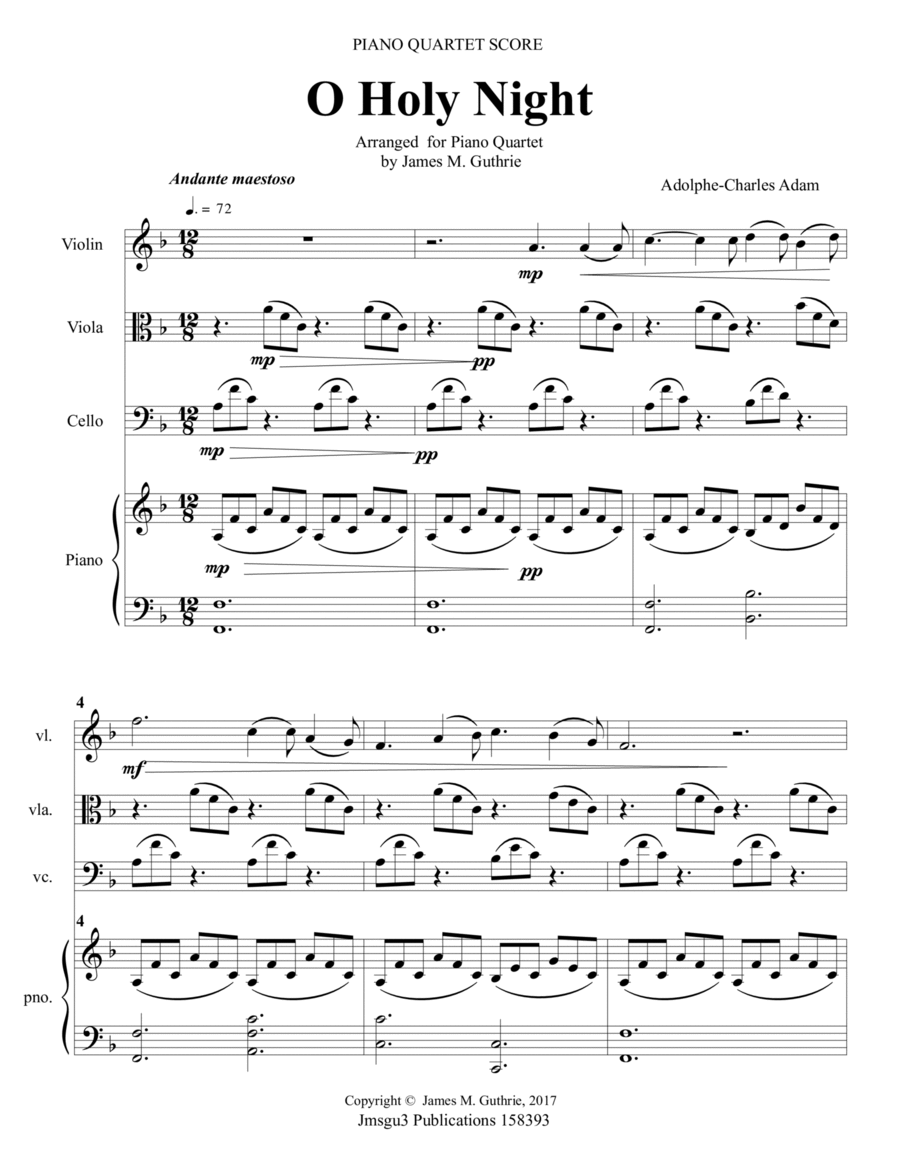
Cello,Piano,Viola,Violin - Level 2 - Digital Download SKU: A0.548706 Composed by Adam. Arranged by James M. Guthrie, ASCAP. Christmas,Standards. 18 pages. Jmsgu3 #3411563. Published by jmsgu3 (A0.548706). Cantique de Noël The French composer Adolphe Adam was already famous as a composer of many successful ballets and operas. Then, in the 1840s, he wrote his most famous work - O Holy Night. The original song title was Minuit Chretiens or Cantique de Noël.  Placide Cappeau provided the original song lyrics. The song was first performed in Roquemaure by the opera singer Emily Laurey at midnight mass in 1847. It became trendy among the French, much like Silent Night was famous elsewhere. In 1850, John S. Dwight, a Unitarian minister and music teacher, translated the song into English.   Adolphe Adam Adam studied organ and composition at the Paris Conservatoire in his younger years. He also played the timpani in the Conservatoire orchestra. Adam used his savings and borrowed money to open a new opera house - the fourth opera house in Paris in 1847. Unfortunately, the Revolution of 1848 forced him to close. He taught composition at the Paris Conservatoire from 1849 until he died in 1856. Placide Cappeau The poet Cappeau was an advocate of the French Enlightenment philosopher Voltaire. Voltaire was renowned for criticizing the Catholic church, religious intolerance, and dogma in general. Consequently, Cappeau made the Redeemer figure in his song a kind of reformer of injustices, particularly the problem of original sin. To begin with, people recognized Cappeau's theology as eccentric, probably even doubtful. Theology In the earlier form of Minuit, the Christ figure descends to intervene with His Father's plan to punish humanity. Traditional doctrine pronounces that Christ came from love, not to intervene. This version also declares that Christ appeared to delete the original sin of Adam. Cappeau removed this part from his poem years later because he didn't believe it. He preferred to portray Christ as the reformer of disparity and unfairness. Before long, the writer/politician Alphonse de Lamartine called the Minuit the Marseillaise of religion. Most French churchmen agreed with this idea but did not consider it a tribute.    
O Holy Night for Piano Quartet
Piano Quatuor: piano, violon, alto, violoncelle

$39.95 34.57 € Piano Quatuor: piano, violon, alto, violoncelle PDF SheetMusicPlus

Concert Band - Level 4 - Digital Download SKU: A0.1503656 Composed by Sean A. Ryan. 21st Century,Classical,Comedy,Contemporary,March. 71 pages. Sean A. Ryan #1079139. Published by Sean A. Ryan (A0.1503656). This piece tells the ficticious story of an inept, incompitant, yet quite pompous prefect conquistador and his poor attempt to colonize an indigenous village.  The natives keep out smarting him, and sabotaging his plans.  Things get so out of hand, that he can't even keep his own people in line.  This makes the Prefect irate and ill-tempered, more so to his own company, than to the natives!  What am I to tell the queen?!.  I can't have my name soiled like this!.  Upon hearing that the Prefect's superior officer, the Legate of Iberia, will be coming to check up on his progress, he comes up with a plan.  He'll make a deal with the natives to make it look like he's been kidnapped and murdered.  Dressed as conquistadors, the natives won't say a word and the Prefect's second in command will say that he's been killed.  To the Prefect's surprise, this actually worked and the Legate was fooled.  Upon the Legate returning back to Iberia, the now defunct Prefect conquistador has made arrangements with the natives in exchange for food and supplies to fool the Legate each time he visits.This rousing march is a great opener or closer for any concert.  Perfect for high school, college, or municiple/adult continuing level community band!  The music here perfectly encapsulates this swashbuckling, yet haphazardous story!
The Cantankerous Conquistador
Orchestre d'harmonie

$24.99 21.63 € Orchestre d'harmonie PDF SheetMusicPlus


Partitions Gratuites
Acheter des Partitions Musicales
Acheter des Partitions Digitales à Imprimer
Acheter des Instruments de Musique

© 2000 - 2026

Accueil - Version intégrale