EUROPE
18434 articles
USA
0 articles
DIGITAL
34403 articles (à imprimer)
Partitions Digitales
Partitions à imprimer
34403 partitions trouvées


Piano Solo - Level 5 - Digital Download SKU: A0.1231522 Composed by Franz Xaver Gruber. Arranged by Martin Neill. Blues,Christmas,Holiday,Jazz. Score. 4 pages. Martin Neill #827227. Published by Martin Neill (A0.1231522). The well known carol is there, but disguised by all the jazzy riffs and licks! An entertaining rectial piece for the advanced player.Martin Neill is a professional composer and arranger based in the UK. He has won many international composition competitions, and his music is published by Starshine, Chichester Music Press and others. His arrangements show great attention to detail, including phrasing, dynamics and fingering suggestions, which is why they are popular with tens of thousands of musicians around the globe.
Not So Silent Night
Piano seul

$5.99 5.19 € Piano seul PDF SheetMusicPlus

Woodwind Ensemble,Woodwind Quintet Soprano Saxophone - Level 1 - Digital Download SKU: A0.957293 Composed by Bach, Martin Luther. Arranged by Ander. Baroque,Easter,Renaissance,Sacred,Wedding. 51 pages. Woods Only, Arrangements #6748243. Published by Woods Only, Arrangements (A0.957293). This album contains 5 of Johann Sebastian Bach's most famous and versatile pieces for soprano sax quintet, all very well suited for the beginners who want to get to know the baroque repertoire. They are also suitable for performances at events such as: weddings, Christian and church ceremonies, Easter, and academic recitals or concerts. They can be used in music institutions and by teachers as repertoire material and study methods, either for performance or instrumental technique. This collection includes a totally free bonus for you to enjoy: Martin Luther's A Mighty Fortress is Our God, a Renaissance sacred song for choir, which has been adapted for this set. You can also buy each one individually by checking right at the end of each description of each work.1: Air on the G String - The original piece is part of Johann Sebastian Bach's Suite No. 3 for orchestra, in D Major, BWV 1068, written for Prince Leopold of Anhalt. The so-called Air on the G String dates from one of these latter employments. In the service of the Prince of Cöthen, Bach composed not only the famous Brandenburg Concertos, but also several orchestral suites, from the third of which comes the Air on the G String. This curious title derives from a later arrangement of this piece for violin solo, in which the melody is played entirely on the lower, higher string of the instrument. ID: S0.11897592: Arioso - The Cantata 156 (BWV 156) was written for the third Sunday after Epiphany in 1729, and was first performed on January 23 of that year. The text is by Picander, one of Bach's favorite librettists. Of the four cantatas written by Bach for the feast, it was the last and only one scored for solo voice. This is a choral cantata, employing a choral melody in several movements. Cantata 156, in fact, employs two different choral melodies and texts in the second and sixth movements. A cantata is a sung symphony consisting of several parts, one of which is the Arioso, which is the initial instrumental part. ID: S0.11899773: Jesu, joy of man's desiring - This is one of Bach's most beautiful cantatas, made famous by the Jesus the Joy of Men chorus. It was originally composed for Advent 1716 in Weimar. Years later, already in Leipzig, Advent was tempus clausum, there was no music in the churches. Bach then reworked it for the Feast of Mary's Visitation. It is the final chorale of the cantata Herz und Mund und Tat und Leben. Although it is the 32nd cantata composed by Bach, of those that have survived, it was given BWV 147 in the complete catalog of his works. ID: S0.11900274: O Jesulein süss, o Jesulein mild - The Jesulein süß, the Jesulein mild is an original traditional German choral melody for voice and continuous bass arranged by Johann Sebastian Bach around 1735. With lyrics by Valentin Thilo, O Jesulein süss is a sacred melody adapted and catalogued as BWV 493. The first translation is by Dirk van Hogendorp, who made it more of a song for the time of suffering. ID: S0.11901555: Minuet in G major - This famous piece has traditionally been attributed to Johann Sebastian Bach, as it appears in the Notebook for Anna Magdalena , a notebook that Bach gave to his wife Anna Magdalena in 1725 and which was to be filled with the favorite selections of Bach family members. However, recent research has concluded that this minuet, sometimes referred to as BWV Anhang 114. was probably composed by Christian Petzold, a German composer and organist contemporary with Bach. ID: S0.1190369Bonuses: A Mighty Fortress is Our God, by Martin Luther - Ein feste Burg ist unser Gott is a hymn written by Martin Luther probably before 1529. The melody was also considered his work for a long time, but it was created at least with the collaboration of Johann Walter. The song is of great symbolic power for Protestanti.
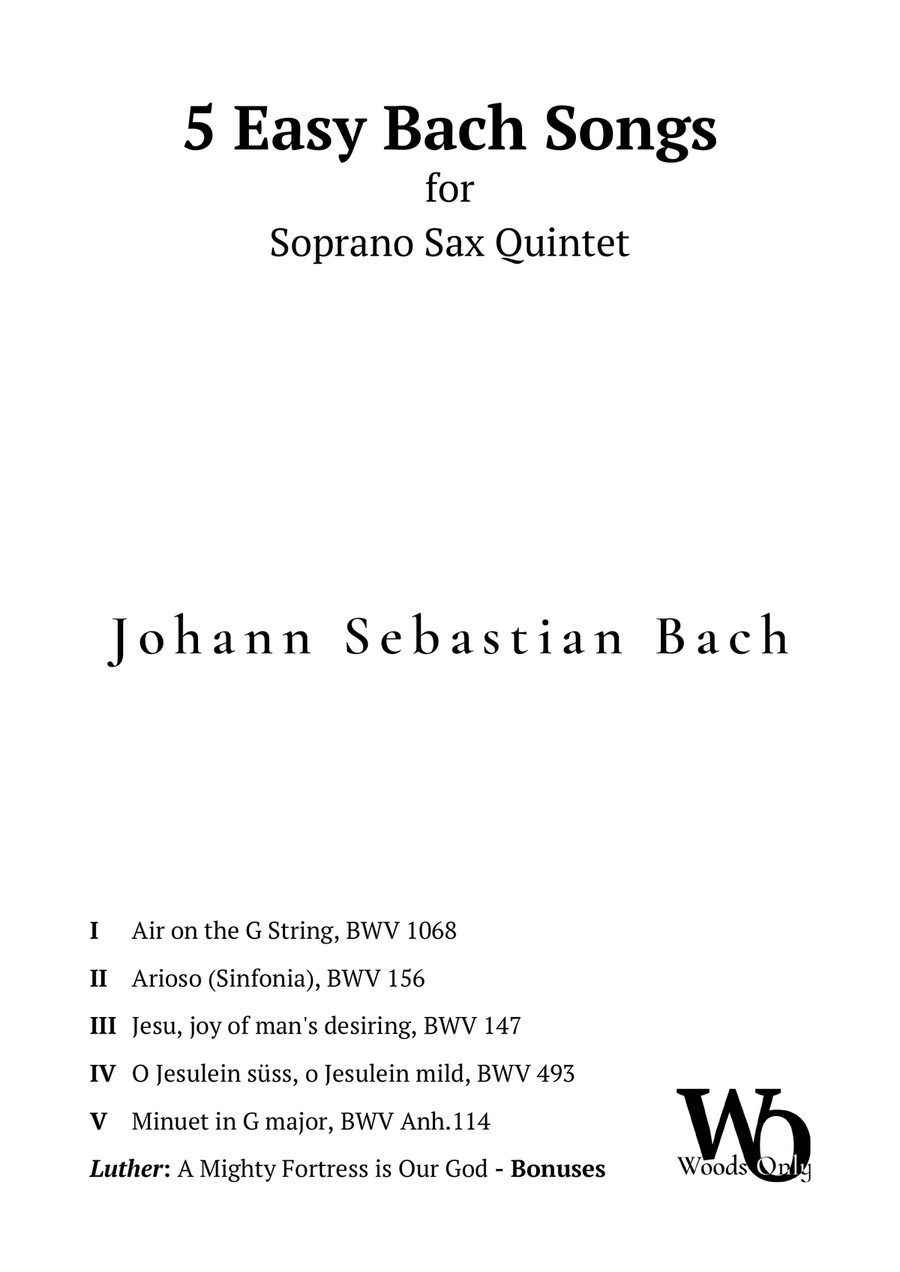
5 Famous Songs by Bach for Soprano Sax Quintet
Quintette de Saxophone: 5 saxophones

$39.99 34.68 € Quintette de Saxophone: 5 saxophones PDF SheetMusicPlus

Bass Flute,Instrumental Solo,Piano - Level 1 - Digital Download SKU: A0.548712 Composed by Martin Luther. Arranged by James M. Guthrie, ASCAP. Easter,Instructional,Standards. Score and individual part. 4 pages. Jmsgu3 #3411731. Published by jmsgu3 (A0.548712). Out of the Depths I Cry to You by Martin Luther arranged for bass flute & piano. The first verses feature modified counterpoint and harmony proceeding at quarter = 82. The final verse is reharmonized for maximum dramatic effect at a more contemplative tempo such as quarter = 64. Features the entire range of the instrument. Very powerful selection for Lent or Easter. Duration (3 verses) 3:05, 36 ms. Score: 3 pg. Solo part: 1 pg. The piano reads from the score. Out of the Depths Aus tiefer Not schrei ich zu dir (From deep affliction I cry out to you), is, of course, a hymn composed by Martin Luther. Moreover, Luther also wrote the lyrics, essentially a paraphrase of Psalm 130. First published in 1524, it is also one of eight songs in the original Lutheran hymnal. It appears likewise in many hymnals and in different translations. The lyrics furthermore stimulated compositions from the Renaissance to the contemporary. Consequently, composers such as Johann Sebastian Bach built an entire chorale cantata on it. Other composers similarly contributed pieces, such as Felix Mendelssohn and Max Reger. Luther Background Martin Luther, (1483 –1546) was a German professor of theology, composer, priest, and moreover, an influential character in the Protestant Reformation. Luther had a momentous impact on church and society due to his contributions to the musical arts. He wanted to disseminate the gospel among mankind and with this intention thought that the best way to do that was through music. Influence It is important to realize that other musicians, and their descendants, were encouraged by Luther’s songs and wrote their own hymns. Luther, to be sure, had a thorough musical education. For example, he knew secular and sacred songs from an early age. He, in particular, played the lute well and sang in the monastery when he was a monk. That is to say, music was an essential part of his life. He in fact first began writing songs in 1523, sometimes writing the melody as well as the lyrics. Luther was certainly able to evaluate the composers of his time. He thought especially highly of Josquin des and Ludwig Senfl. He was also acquainted, with this in mind, with other composers and their works. Legacy The Lutheran musical ethos soon covered all of Germany and later significantly fashioned Protestant musical culture. Heinrich Schütz and Johann Sebastian Bach are the most compelling evidence of this Protestant musical culture. Additionally, as a point often overlooked, the pedal organ, first refined in northern Germany, became universally prevalent. As a matter of fact, Dieterich Buxtehude established a regular evening organ concert series in Lübeck. Another key point is that this concert series, in turn, spread North German Musical ideas worldwide. Luther was especially convinced that music is a beautiful and exclusive offering of the divine.
Luther: Out of the Depths for Bass Flute & Piano

$24.95 21.64 € PDF SheetMusicPlus

Alto Saxophone,Piano - Level 1 - Digital Download SKU: A0.548709 Composed by Martin Luther. Arranged by James M. Guthrie. Easter,Instructional,Standards. Score and part. 4 pages. Jmsgu3 #3411721. Published by jmsgu3 (A0.548709). Out of the Depths I Cry to You by Martin Luther arranged for alto sax & piano. The first verses feature modified counterpoint and harmony proceeding at quarter = 82. The final verse is reharmonized for maximum dramatic effect at a more contemplative tempo such as quarter = 64. Features the entire range of the instrument. Very powerful selection for Lent or Easter. Duration (3 verses) 3:05, 36 ms. Score: 3 pg. Solo part: 1 pg. The piano reads from the score. Out of the Depths Aus tiefer Not schrei ich zu dir (From deep affliction I cry out to you), is, of course, a hymn composed by Martin Luther. Moreover, Luther also wrote the lyrics, essentially a paraphrase of Psalm 130. First published in 1524, it is also one of eight songs in the original Lutheran hymnal. It appears likewise in many hymnals and in different translations. The lyrics furthermore stimulated compositions from the Renaissance to the contemporary. Consequently, composers such as Johann Sebastian Bach built an entire chorale cantata on it. Other composers similarly contributed pieces, such as Felix Mendelssohn and Max Reger. Luther Background Martin Luther, (1483 –1546) was a German professor of theology, composer, priest, and moreover, an influential character in the Protestant Reformation. Luther had a momentous impact on church and society due to his contributions to the musical arts. He wanted to disseminate the gospel among mankind and with this intention thought that the best way to do that was through music. Influence It is important to realize that other musicians, and their descendants, were encouraged by Luther’s songs and wrote their own hymns. Luther, to be sure, had a thorough musical education. For example, he knew secular and sacred songs from an early age. He, in particular, played the lute well and sang in the monastery when he was a monk. That is to say, music was an essential part of his life. He in fact first began writing songs in 1523, sometimes writing the melody as well as the lyrics. Luther was certainly able to evaluate the composers of his time. He thought especially highly of Josquin des and Ludwig Senfl. He was also acquainted, with this in mind, with other composers and their works. Legacy The Lutheran musical ethos soon covered all of Germany and later significantly fashioned Protestant musical culture. Heinrich Schütz and Johann Sebastian Bach are the most compelling evidence of this Protestant musical culture. Additionally, as a point often overlooked, the pedal organ, first refined in northern Germany, became universally prevalent. As a matter of fact, Dieterich Buxtehude established a regular evening organ concert series in Lübeck. Another key point is that this concert series, in turn, spread North German Musical ideas worldwide. Luther was especially convinced that music is a beautiful and exclusive offering of the divine.
Luther: Out of the Depths for Alto Sax & Piano
Saxophone Alto et Piano

$24.95 21.64 € Saxophone Alto et Piano PDF SheetMusicPlus

Choral (2-Part choir) SKU: HL.8739053 Composed by J. Paul Williams and Joseph M. Martin. 2 part. Fred Bock Publications. Children, Elementary, Sacred. Octavo. 8 pages. Fred Bock Music Company #BG2366. Published by Fred Bock Music Company (HL.8739053). UPC: 073999390537. 6.8x10.5 inches. Martin/Williams.The musical “Heroes of the Faith” burst on the scene just last year – an exciting children's show by J. Paul Williams and Pamela Martin, including such musical luminaries as Lloyd Larson, Craig Curry, Cindy Berry, Mark Hayes and Joe Martin. The story leads the children through the museum of Biblical Heroes and discovers what they had that exists in each of us – the ability to serve God with the gifts we are given. The title song “Hero of the Faith” is presented here as a single, and is a wonderful anthem of joy and praise. Available: 2-Part.
Hero of the Faith

$1.60 1.39 € PDF SheetMusicPlus

String Quartet Cello,String Quartet,Viola,Violin - Level 4 - Digital Download SKU: A0.910169 Composed by Vasily Sapelnikov. Arranged by Monica Re Martin. Children,Holiday,Love,Romantic Period,Wedding. Score and parts. 12 pages. Monica Re Martin #6248741. Published by Monica Re Martin (A0.910169). Arranged for string quartet, Lily of the Valley is the first movement from Vasily Sapelnikov's Op. 8 for piano solo. It is a short and charming piece that lends itself well to string players! It will make a wonderful addition to your repertoire. If you like this, please check out my publisher page on Sheet Music Plus: https://www.sheetmusicplus.com/publishers/monica-re-martin-sheet-music/3013880?ac=1
Lily of the Valley, Op. 8 No. 1
Quatuor à cordes: 2 violons, alto, violoncelle

$1.99 1.73 € Quatuor à cordes: 2 violons, alto, violoncelle PDF SheetMusicPlus


Partitions Gratuites
Acheter des Partitions Musicales
Acheter des Partitions Digitales à Imprimer
Acheter des Instruments de Musique

© 2000 - 2026

Accueil - Version intégrale





