EUROPE
964 articles
USA
0 articles
DIGITAL
1555 articles (à imprimer)
Partitions Digitales
Partitions à imprimer
1555 partitions trouvées


Instrumental Duet Cello,Double Bass,Instrumental Duet - Level 1 - Digital Download SKU: A0.841356 Composed by Jean-Baptiste Breval. Arranged by Yuriy Leonovich, Michele Galvagno. Classical,Instructional,Standards. Score and parts. 106 pages. Artistic Score Engraving di Galvagno Michele #6029285. Published by Artistic Score Engraving di Galvagno Michele (A0.841356). Jean-Baptiste Sebastien Bréval (1753-1823) was a French cellist and composer, who is, perhaps, best known for his cello sonatas, namely the ones in C major (Op. 40, No. 1) and G major (Op. 12, No. 5). Bréval was one of the last students of the cellist and composer Martin Berteau (1691-1771), continuing his teacher’s tradition of composing sonatas for cello with bass accompaniment. With both composers, the bass part was to be played by a second cello, very likely by the cello teacher. Many cellists opt in to have Berteau’s unfigured bass part realised by a harpsichord. However, the two-cello layout was common in the late Classical Era, especially in method books, such as Bréval’s own Traité du violoncelle (where Bréval states that the bass and the cello are one and the same), as well as Romberg’s, Dotzauer’s, et al. Romberg and Dotzauer even composed sonatas for cello and basso (second cello) accompaniment as well, Op. 43 and Op. 103, respectively. Our current publication presents student cellists with a beautifully engraved edition of Bréval’s 6 Cello Sonatas, Op. 28 and Air de Malborough, Op. 13. Bréval composed the Sonatas in c1795, most likely in conjunction with Op. 40, since Op. 28, No. 1 picks up right where Op. 40, No. 6 leaves off. Whereas Op. 40 and Op. 28, Nos. 1-4 are in two fast movements, Op. 28, Nos. 5 and 6 include a slow middle movement, No. 6 even using the thumb. The autograph, which the editor used as the primary source, and the first edition both present each sonata on four pages in score form. Our volume includes a score and parts for each player. The cello part includes fingering and bowing suggestions by Yuriy Leonovich. Each sonata begins with an Allegro movement in sonata form. The finales vary from five-part rondos (Nos. 1, 3, 5), to sonata form (Nos. 2, 6), to theme and variations (No. 4). The slow movement of No. 5 is in simple binary form, and No. 6 is in simple ternary. The six keys Bréval used for Op. 28 are the same as the ones he used for Op. 40, only in a different order. Op. 40 uses the following order: C, F, G, B-flat, A, D. Op. 28 uses the following order: D, C, A, G, B-flat, F. The Op. 28 sonatas are primarily written in tenor clef, whereas Op. 40 is primarily written in bass clef. The playing range is identical for both sets, with the exception of the high B-flat in m. 46 in the slow movement of No. 6, and high B and C in m. 37 of the finale of No. 6. Bréval explores more advanced bow techniques as well.
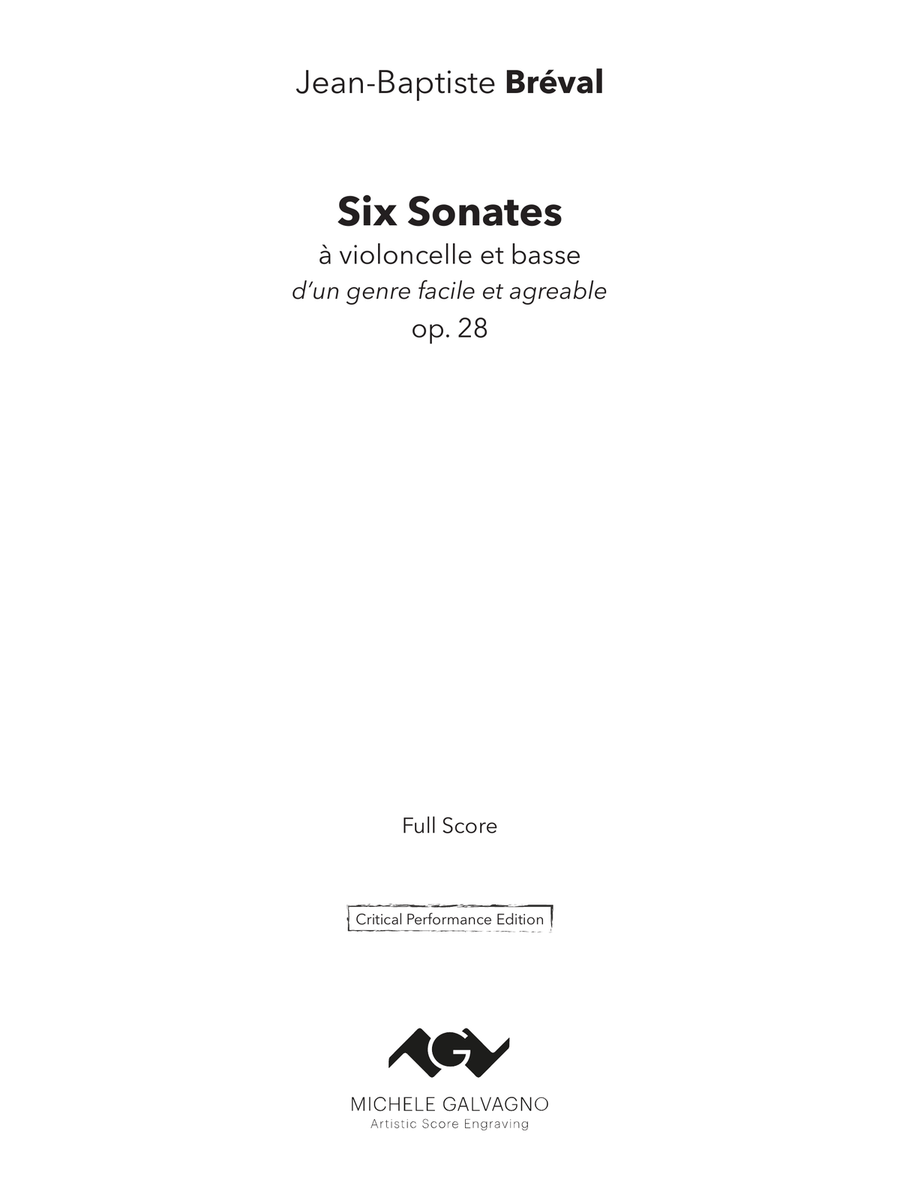
Six Sonates d'un genre facile et agréable à violoncello et basso, op. 28
Violoncelle, Contrebasse (duo)

$24.95 21.5 € Violoncelle, Contrebasse (duo) PDF SheetMusicPlus

Orff instruments Orff instruments - Level 3 - Digital Download SKU: A0.1423143 Composed by Rudesindo Soutelo. Arranged by Orff Instruments (Score + Parts). 21st Century,Children,Classical,Contemporary. 48 pages. Publisher by Rudesindo Soutelo #1004474. Published by Publisher by Rudesindo Soutelo (A0.1423143). Rudesindo SouteloFilhos da Revolução dos Cravos / Children of the Carnation Revolution (2024) for Orff Instruments [ca. 5' 21]Première: 24-IV-2024. Auditório Ramos Pereira, Vila Praia de Âncora (Portugal). Int.: Clube Instrumental da EBS do Vale do Âncora. Prof. Manuela Moura.  ISWC: T-324.609.051-3ISMN: 979-0-707704-20-2Info: https://soutelo.euSample pages / Páginas de amostra: https://www.researchgate.net/publication/379996834The songs of intervention that filled the revolutionary spirit are perceived by the generations born afterwards as grandfather’s little stories. The children of a revolution are always calm and carefree, but this complacent detachment contains within itself the germs of new tensions that could become the cause and beginning of a new revolution.The piece was composed for the Instrumental Club of the Vale do Âncora Primary and Secondary School to celebrate the 50th anniversary of the Carnation Revolution. There is a version for piano 4 hands. The generative complex that organises the whole work {6[2, 2, 2], 2, 9[3, 3, 3]} is taken from the number of letters in the words of the title.-oOo-Os cantos de intervenção que preencheram o espírito revolucionário são percebidos, pelas gerações que nasceram depois, como as historinhas do avô. Os filhos duma revolução são sempre calmos e despreocupados, mas essa acomodada distensão encerra em si mesma os germes de novas tensões que podem vir a ser a causa e o princípio duma nova revolução.A obra foi escrita para o Clube Instrumental da Escola Básica e Secundária do Vale do Âncora para assim celebrar o cinquenta aniversário da Revolução dos Cravos. Há uma versão para Piano a 4 mãos. O complexo geratriz que organiza toda a obra {6[2, 2, 2], 2, 9[3, 3, 3]} está tomado do número de letras que contêm as palavras do título.
Filhos da Revolução dos Cravos / Children of the Carnation Revolution (Orff Inst.)

$10.00 8.62 € PDF SheetMusicPlus

Brass Quintet Horn,Trombone,Trumpet,Tuba - Level 3 - Digital Download SKU: A0.1303802 Composed by F. Leslie Smith. 21st Century,Chamber,Children,Historic,Multicultural,World. 77 pages. Sweetwater Brass Press #893335. Published by Sweetwater Brass Press (A0.1303802).      A song learned in primary school years and years ago had words something along the lines of the following:          Oh!  I’m a young musician,          From distant lands I come.          Singing and playing,          Ever I’m straying.     Also known as “I Am a Fine Musician,†“I Am a Gay Musician†and perhaps other titles, that song is still around and has evolved into many different versions.  The original was probably a German folk song from the early 1800s.  As published in an 1889 collection of children’s songs, it bears the title, “Ich bin ein Musikant.â€Â  That translates as “I am a musician.â€Â  In the lyrics the musician claims to be “from Schwabenland†(Swabia) and to play geige (violin: “Dide schum schum schumâ€), flöte (flute: “Päde wäpp päpp päppâ€) and basse (bass: “Dide schum schum schump, päde wäpp päpp päpp).  Later versions list the instruments played by the musician as bassoon, bells, clarinet, drum, guitar, piano, piccolo, triangle, trombone, trumpet, tuba, tympani, viola and just about every instrument and noisemaker you can think of.      Anyway, that’s the tune on which “The Brass Player†was built.  But here, the musician is concerned only with brass.  Which brass?  Well, possibly trumpet.  Or maybe horn in F.  Or trombone.  Or tuba.  Or perhaps all four; certainly, all are featured in this piece.     “The Brass Player†comprises four sections.  The first is in the key of C major and is played at a moderate 2/4 tempo.  After a brief Trumpet/Tuba ostinato, Trombone introduces the main theme.  Other instruments join in and play around with a variation or two.      The second section is a sweet, nostalgic rendition in 4/4 carried mainly by Horn in F, with help from Trumpets and Trombone.      In section three, the mood changes radically.  Time signature goes to 3/4; tempo speeds up to vivace and the key changes to B Minor.  All five instruments participate, and some odd things take place rhythmically at I through K (measures 200 through 262), but Tuba seems to carry the melody most of the time.     Section four, in G Major, clips along at a fast 4/4 time.  It returns to the main theme and (as in “Ich bin ein Musikant†and its multitudinous derivations) presents in call-and-response form.  The first few measures are straight, but discord quickly creeps in.  The melody begins to include smears, flutter tonguing and off-beat rhythmic figures.  There is even a brief section in G Minor.  Gradually, order and theme are restored and the piece ends in a glorious, upbeat statement.     This piece, completed in 2023, consists of 398 measures, a little over nine minutes in length.  There are four changes of key and four changes of time signature.  Trumpet 1’s highest note is A above its staff; Trombone’s is F above the staff.  Trumpet 2 has a few G-below-its-staff notes.     The arranger, Les Smith, will be happy to provide substitute parts (for example, treble clef baritone for trombone) at no charge.  He would like to receive your suggestions, comments, corrections and criticisms.  Contact him at lessmith61@bellsouth.net.  For more arrangements by Les, enter Sweetwater Brass Press (without the quotation marks) in the Sheet Music Plus or Sheet Music Direct search box.
The Brass Player: Fantasy on Ich bin ein Musikant
Quintette de Cuivres: 2 trompettes, Cor, trombone, tuba

$6.99 6.02 € Quintette de Cuivres: 2 trompettes, Cor, trombone, tuba PDF SheetMusicPlus

Choral Choir (SATB) - Level 3 - Digital Download SKU: A0.835452 Composed by Stuart Brown. 20th Century,Contemporary,World. Octavo. 211 pages. Stuart Brown Music #5990681. Published by Stuart Brown Music (A0.835452). A fantastic offer price for the full score and all parts! ... Looking for something to add a sense of oriental exoticism to your amateur orchestral/choral concert? This may be what you're looking for! This charming little suite of six dances lasts about 15½ minutes. It consists of a Pavane, Bourée, Sarabande, Allemande, Basse Danse and Galliard, which vary widely in character. As a whole the suite provides some interesting challenges for both performers and listeners. Apart from conventional strings, flute and harp (which can be either pedal or lever) you will need:- One or maybe two Arabian ouds. The parts are playable also on a fretless acoustic guitar. (Needs to be fretless because of the quarter-tones in some of the Arabic modes used.)- A cimbalom (the part can be played on a piano also, with slight modification). You might get away with using a hammered dulcimer but you'd need to make a number of compromises.- A doumbek and a djembe. These beautiful drums are a must for Middle-Eastern or African music. They're fairly easy to find, though finding somebody who can play them properly may take a bit more doing!- Finger cymbals and a gong. These are regular western instruments.- A wind-chime. Anything that produces a nice shimmering spangle of sound will probably do!- A group of singers (SATB). Nothing particularly challenging but see below.The primary oud part, the strings and the singers need to have sufficiently good intonation to pitch quarter tones. These are the exception rather than the rule, but nevertheless play an important part in the character of the music. Apart from this, the music is relatively straightforward and probably playable by any reasonably competent amateur or high school orchestra.In the spring of 2020 I wrote a set of short music tracks for a charity of which I'm a trustee. In order to protect my intellectual property rights in the music, I decided to bring it together into an attractive if not intellectually challenging little suite, hence An Omani Dance Suite. Originally the dances were all in Arabic quarter-tone temperament, but obviously quarter-tones cannot be played easily (if at all) on the flute, harp and cimbalom. So I have made some adjustments but retained the Arabic temperament wherever reasonably possible. I had thought initially of using a santur instead of a cimbalom, but the santur lacks the range and the dynamic capability to be used with a string chamber orchestra. The cimbalom doesn't need to be a concert grand model; in fact it doesn't even need to have dampers.The Omani was something of an afterthought: a musician friend of mine had worked in Oman and commented on how authentically Omani the Basse Danse sounded. The period of composition coincided with a time when I was really missing friends in Vietnam and Romania, so somehow influences from those countries found their way into the music.I'm not bothering with performing rights for this - just go away and enjoy the music! ... but if it inspires you find out more about the charity work that inspires me, feel free to get in touch!https://www.facebook.com/stuartbrownmusic/
An Omani Dance Suite - COMPLETE BUNDLE (Score and all parts)
Chorale SATB

$30.00 25.85 € Chorale SATB PDF SheetMusicPlus

Easy Piano - Level 1 - Digital Download SKU: A0.1033516 Composed by Lynne Cox. Children,Contest,Festival,Instructional. Score. 4 pages. Lynne Coc Publications #638816. Published by Lynne Coc Publications (A0.1033516). Green, in Lynne Cox's new series, Box of Paints, is a secondary color that results from mixing the two primary colors, yellow and blue. Green symbolizes nature, the environment, harmony, and tranquility, as well as growth and renewal-as in the green growth of spring. It is considered restful-many doctors' and dentists' offices are painted this color to calm the patient! For these reasons, the tempo/mood indication is 'tranquilly'. Lyrics depict restful, tranquil scenes of nature and the flow of the music laid back. Rather a softly performed piece with nothing louder than mp. A sections utilize hands in middle C position with RH mindful of the F#. Divided melody here between hands. B section also displays divided melody but with an entirely different melody. Because of the 8va the piece covers 2 octaves. In m. 10 (likewise in m. 34) The right hand is set up for a 5-finger D position since melody reaches up to A easily by arranging a fingering change. Form: intro A B A coda Key of G major Time signature Intro begins with dotted-half notes alternating between hands on Gs covering 4 octaves, damper pedal held over all 4 measures here. Students asked if the Gs were because it is the first letter of green! Coda same as intro except for a ritardando at end. Touches: entire piece very legato requiring the fingers to produce this in A sections, not relying on damper pedal as the intro and coda do. As in all of solos in this series, Box of Paints, the piece is designed to be open-ended encouraging and inspiring the student to think of things they like in this color and compose their own lyrics, even composing their own music about their favorite color. Great recital and/or contest and/or festival lists. Lynne performs the vocals and piano on the following you tube link. Lynne also arranged this piece as an instrumental only with many additions such as instrumental voicing and different instruments entitled 'Green Instrumental', also on you tube. Link-- https://youtu.be/F1pnlo8y__A.
Green
Piano Facile

$3.40 2.93 € Piano Facile PDF SheetMusicPlus

Piano Solo - Level 3 - Digital Download SKU: A0.1247227 By New Christy Minstrels. By Richard M. Sherman and Robert B. Sherman. Arranged by Timothy Stapay. Broadway,Film/TV,Musical/Show,Pop,Singer/Songwriter,Standards. Score. 2 pages. Timothy Stapay #841772. Published by Timothy Stapay (A0.1247227). This is an arrangement of Chim Chim Cher-ee from the Walt Disney movie, Mary Poppins.Chim Chim Cher-ee is a song from Mary Poppins, the 1964 musical motion picture, and also is featured in the 2004 Mary Poppins musical.The song won the 1964 Academy Award for Best Original Song. In 2005, Julie Andrews included this song as part of Julie Andrews Selects Her Favorite Disney Songs.  The song was written by Robert B. Sherman & Richard M. Sherman (the Sherman Brothers) who also won an Oscar and a Grammy Award for Mary Poppins' song score.The song was inspired by one of the drawings of a chimney sweep created by Mary Poppins' screenwriter, Don DaGradi. When asked about the drawing by the Sherman Brothers, DaGradi explained the ancient British folklore attributed to sweeps and how shaking hands with one or touching their sleeve could bring a person good luck.  In their 1961 treatment, the Sherman Brothers had already amalgamated many of the P.L. Travers characters in the creation of Bert. His theme music became Chim Chim Cher-ee. Lyrics:Chim chimineyChim chimineyChim chim cher-eeA sweep is as luckyAs lucky can beChim chimineyChim chimineyChim chim cher-ooGood luck will rub off whenI shakes 'ands with youOr blow me a kissAnd that's lucky tooNow as the ladder of life'As been strungYou may think a sweep'sOn the bottommost rungThough I spends me timeIn the ashes and smokeIn this 'ole wide worldThere's no 'appier blokeChim chimineyChim chimineyChim chim cher-eeA sweep is as luckyAs lucky can beChim chimineyChim chimineyChim chim cher-ooGood luck will rub off whenI shakes 'ands with youChim chimineyChim chimineyChim chim cher-eeA sweep is as luckyAs lucky can beChim chimineyChim chimineyChim chim cher-ooGood luck will rub off whenI shakes 'ands with youI choose me bristles with prideYes, I doA broom for the shaftAnd a brush for the flumeUp where the smoke isAll billered and curled'Tween pavement and starsIs the chimney sweep worldWhen the's 'ardly no dayNor 'ardly no nightThere's things 'alf in shadowAnd 'alf way in lightOn the roof tops of LondonCoo, what a sightChim chimineyChim chimineyChim chim cher-eeWhen you're with a sweepYou're in glad companyNo where is thereA more 'appier crewThan them wot singsChim chim cher-eeChim cher-ooChim chim cher-eeChim chim cher-ee chim cher-oo.
Chim Chim Cher-ee
Piano seul
New Christy Minstrels
$4.99 4.3 € Piano seul PDF SheetMusicPlus

Choral Choir (4-Part) - Level 5 - Digital Download SKU: A0.535382 Composed by Carson Cooman. Contemporary,Sacred. Octavo. 187 pages. Musik Fabrik Music Publishing #3025403. Published by Musik Fabrik Music Publishing (A0.535382). The Revelations of Divine Love (Metaphors from Sea and Sky) (2009), an oratorio for soprano,baritone, chorus, and chamber orchestra (0000.1100.1perc.strings), was commissioned for and is dedicated to the choir ofRoyal Holloway, University of London and Rupert Gough, director of choral music.The texts of the work are adapted primarily from the writings of Julian of Norwich (c. 1342–1416).Julian is best-known for her Sixteen Revelations of Divine Love (c. 1393), believed to be the first Englishlanguagebook written by a woman. Considered one of the most significant English mystics of alltime, Julian lived a reclusive life as an anchoress at the Church of St. Julian in Norwich, England (hertrue name is unknown). Regarded even during her lifetime as a spiritual authority, her optimisticvisions have been very influential in the years that have followed.Texts are also drawn from three additional sources: an excerpt from the Book of Margery Kempe(translated by Christopher M. Brunelle), two poems by English poet Robert Herrick (1591–1674),and a poem by the American writer Elizabeth Kirschner (b. 1955).The primary concept underlying this oratorio is the presence of two distinct discourses. One is asequence taken from Julian’s religious visions. The other is a sonic geography of Nantucket Island(located 30 miles off the coast of Massachusetts in the United States). This interconnected conceptwas inspired by the writings of the great Scottish poet George Mackay Brown (1921–1996). Livinghis entire life on Scotland’s Orkney Islands, Mackay Brown consistently explored the transpositionof religious imagery and events to his native landscape. (For example, the poem Apple-Basket, Apple-Blossom takes the story and structure of the Stations of the Cross, and maps them onto imagery ofdistinctly Orcadian character.)The landscape of Nantucket Island has been the driving force behind a large number of mycompositions for many years. In this oratorio, Julian’s visions are transposed from Norwich andmapped onto the Nantucket landscape. Each movement of the work thus has two parallel purposes:a setting of the visionary words, and a portrayal of a specific place in Nantucket’s geography. Muchof the music was planned in the actual locations. Since the soloists and choir must, by necessity, singthe words, a great deal of the landscape is left to the orchestra. Thus, the orchestra’s role issubstantially greater than simply accompaniment.Because of these two discourses, the oratorio is not intended as comprehensive working out of allaspects of Julian’s visions, nor does it use her own structure and sequence. Rather, it takes herbeautiful words, and the fundamentals of her visions, and attempts to create a new narrative andspiritual experience from them.This is the full score.  The vocal score is available for sale.  The parts are available on rental from the publisher.
Carson Cooman: The Revelations of Divine Love (Metaphors from Sea and Sky) (2009) oratorio for sopra

$32.95 28.39 € PDF SheetMusicPlus

String Quartet String Quartet - Level 5 - Digital Download SKU: A0.550016 Composed by Felix Bartholdy Mendelssohn. Arranged by James M. Guthrie. Holiday,Multicultural,Romantic Period,Standards,World. 72 pages. Jmsgu3 #4574631. Published by jmsgu3 (A0.550016). The Hebrides Overture, also known as Fingal's Cave, is a concert overture composed by Felix Mendelssohn in 1830, revised in 1832, and published the following year as Mendelssohn's Op. 26. It is a standalone composition in a form familiar to the Romantic period and is not drawn from a stage work or opera. The overture consists of two primary themes, with the opening notes stating the theme Mendelssohn wrote while visiting Fingal's Cave and the second theme depicting movement at sea and rolling waves.Mendelssohn was inspired to compose this piece after visiting the Scottish island of Staffa and its famous Fingal’s Cave, which made a deep impression on him due to its echoing acoustics and the sound of waves crashing against rocks. The intense and rolling melodies within the music perfectly capture the sense of drama and awe of the Scottish landscape. The Hebrides Overture, also known as Fingal's Cave, has been used in popular culture in various ways. It has been performed by orchestras worldwide and has become part of the standard orchestral repertoire, retaining its position to the present day. The overture has also inspired literary works like Virginia Woolf's novel. Additionally, Mendelssohn's visit to the Hebrides and the composition of the overture have contributed to the popularity of Fingal's Cave as a tourist destination. Furthermore, the overture has been featured in recordings and concerts, contributing to its enduring presence in the musical landscape.
Mendelssohn: The Hebrides Overture for String Quartet
Quatuor à cordes: 2 violons, alto, violoncelle

$45.95 39.6 € Quatuor à cordes: 2 violons, alto, violoncelle PDF SheetMusicPlus

Choral Choir (Mixed) - Level 2 - Digital Download SKU: A0.1022856 Composed by M Calvert. Children,Instructional,Musical/Show. Octavo. 23 pages. Martin Calvert #3478431. Published by Martin Calvert (A0.1022856). Song for a children's group. A bright and pantomime-feel to the overall rhythm. This will be part of a suite of songs exploring feelings and positive messages.  Two relatively simple vocal parts in chant and echo with some harmony. Suitable for primary / elementary / middle schools as part of a production or one off. It helps children to understand perseverance and the ability to carry on through any troubles. #mental health support #socialmoraleducation Hyperlink to Sibelius score showing key changes. https://sibl.pub/HyMIIUFKM 
Take The Strain
Chorale SATB

$3.99 3.44 € Chorale SATB PDF SheetMusicPlus


Partitions Gratuites
Acheter des Partitions Musicales
Acheter des Partitions Digitales à Imprimer
Acheter des Instruments de Musique

© 2000 - 2026

Accueil - Version intégrale





