EUROPE
3427 articles
USA
15373 articles
DIGITAL
22479 articles (à imprimer)
Partitions Digitales
Partitions à imprimer
22479 partitions trouvées


French Horn,Piano - Level 3 - Digital Download SKU: A0.1313124 Composed by Camille Saint-Saens. Arranged by James M. Guthrie. 19th Century,Chamber,Contest,Festival,Romantic Period,Wedding. Score and part. 9 pages. Jmsgu3 #901955. Published by jmsgu3 (A0.1313124). Saint-Saëns: The Swan (Le Cygne) movement 13 from the Carnival of the Animals Suite. One of his most popular and widely recognized works, it is the only movement from the Carnival Suite that Saint-Saëns permitted to be performed publicly during his lifetime. This is an excellent recital encore to demonstrate melodic playing and strategic phrasing.The Carnival of the AnimalsThe Carnival of the Animals is an entertaining musical suite of fourteen movements by Camille Saint-Saëns. The work was composed for private performance by an ensemble of two pianos and solo instruments. The Swan (No. 13) is among the fourteen most famous movements. In its entirety, it lasts about 25 minutes.Saint-Saëns BackgroundCharles-Camille Saint-Saëns 1835 – 1921) was, by all means, in particular, a famous French composer, brilliant organist, and significant musical mastermind of the Romantic era. Indeed, his most famous compositions, in the long run, include his Piano Concerto No. 2 (1868), Cello Concerto No. 1 (1872), and the Danse macabre (1874). Notwithstanding, we must also add Violin Concerto No. 3 (1880), Symphony No. 3 (the Organ Symphony, 1886), and, it must be remembered, Carnival of the Animals (1886) to the list.ChildhoodIt is essential to realize that Saint-Saëns was undoubtedly, in fact, a child musical prodigy. Consequently, with this in mind, he made his concert debut, albeit at ten years old. Another critical point to remember is that he expressly studied at the Paris Conservatoire, then, despite reality, conversely followed a traditional career path as a church organist. Nevertheless, twenty years later, on the other hand, he left to become a successful freelance pianist and composer despite, as has been noted, his former employment situation. Furthermore, his performances were, after all, markedly in demand - not only in Europe but, above all, in the Americas all in all as well.YouthA point often overlooked is that in his youth, Saint-Saëns was undoubtedly excited about the modern music of the day. He was, in essence, fond of the music of his contemporaries, particularly Schumann, Liszt, and, for the most part, Wagner. In contrast, however, his compositions seemed, in fact, primarily confined within the conservative classical tradition. Be that as it may, he was, at the same time, nevertheless, a scholar of musical history.CriticismOn the whole, his conservatism, in fact, ultimately brought him into frequent conflict in his later years with composers of the impressionist and, in particular, the dodecaphonic schools of musical thought. A point often overlooked is that he included neoclassical elements in his music, contrary to some critics. Furthermore, in so doing, he provided the most compelling evidence that he predicted the techniques and works by Stravinsky and Les Six. To put it another way, given these points, he was regarded, perhaps for the most part unfairly, as a non-progressive reactionary henceforth around the time of his passing.LegacySaint-Saëns taught briefly in Paris, where his students included Gabriel Fauré. Maurice Ravel later studied with Fauré. In conclusion, both Ravel and Fauré were powerfully influenced by Saint-Saëns, whom they respected as a musical mastermind.
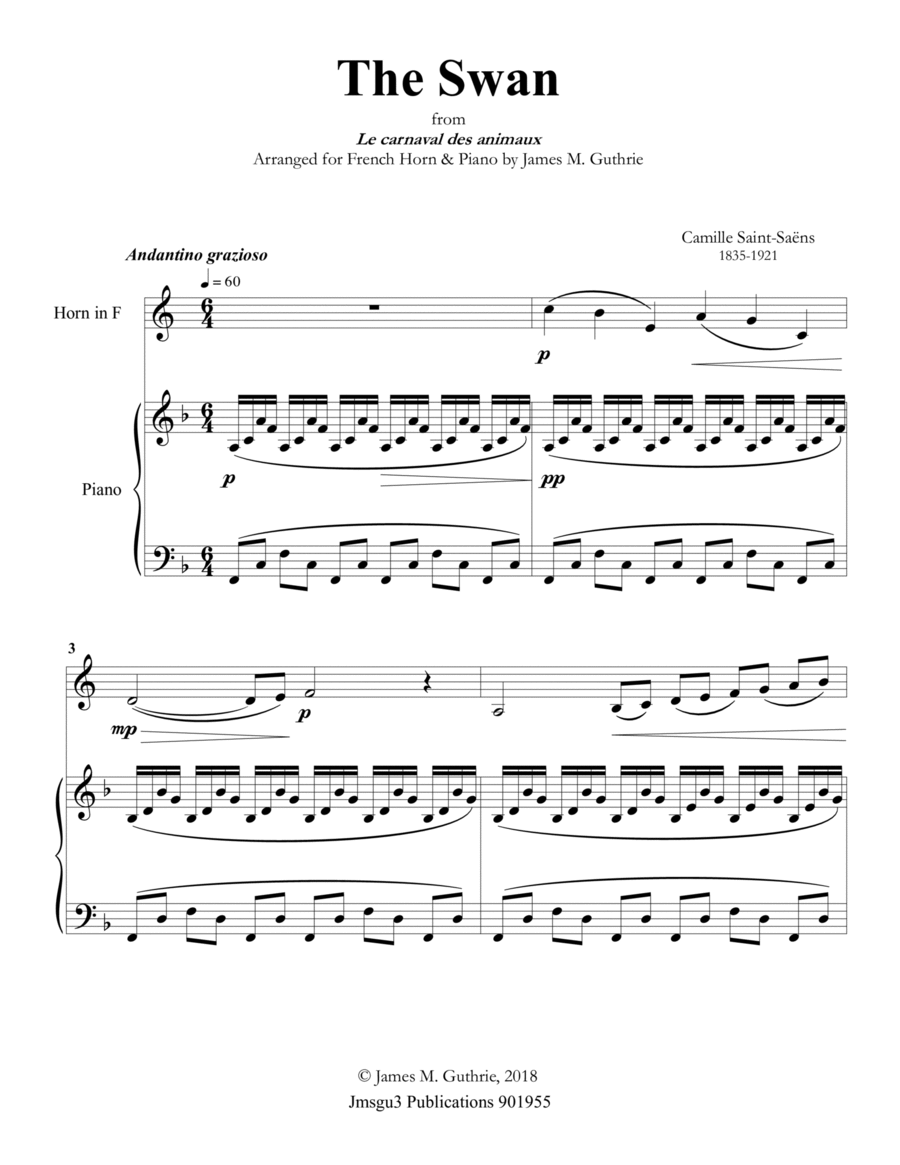
Saint-Saëns: The Swan for French Horn & Piano
Cor et Piano

$32.95 27.75 € Cor et Piano PDF SheetMusicPlus

Brass Ensemble Horn,Trombone,Trumpet - Level 4 - Digital Download SKU: A0.766981 Composed by Bob Delfausse. Concert,Jazz. Score and parts. 17 pages. Robert Delfausse #5322693. Published by Robert Delfausse (A0.766981). Bugs Bower composed several volumes of Bop Duets.  Like so many other jazz musicians, my roommate and I spent countless hours playing through the volume we had, him on tenor sax and me on trumpet.  Playing them is a masterclass in jazz phrasing, and studying them is a masterclass in the classic principles of counterpoint.  It's a little bit like a Bach fugue.  You start with a short catchy theme, and then let it go where it wants to go, but always building on that theme.  I allowed myself a third voice here, which allow a little more richness.  See also my Sundry Quartet, which adds a fourth instrument to the same basic music.  Level: advanced intermediate.  Duration: 3 minutes, 12 seconds.
Brass Trio, Homage to Bugs Bower
Quatuor de Cuivres: 2 trompettes, Cor, trombone

$10.00 8.42 € Quatuor de Cuivres: 2 trompettes, Cor, trombone PDF SheetMusicPlus

Strings Bass Voice,Bassoon,Bell (or Triangle),Celesta,Chimes,Clarinet,Digital Keyboard,Double Bass,Electric Bass Guitar,Electronic Keyboard,Flute,Glockenspiel,Harp,Horn,Marimba,Medium-High Voice,Oboe,Percussion,Piano and Keyboard,Piccolo,Pipe Organ,Sleigh Bells,Synthesizer,Trombone,Trumpet,Tuba,Vibraphone - Digital Download SKU: A0.1207456 Composed by Amphibia Cultural Legacy. Arranged by Amphibia Cultural Legacy. Children,Christmas,Hanukkah,Holiday,Traditional. 3 pages. Amphibia Cultural Legacy #805623. Published by Amphibia Cultural Legacy (A0.1207456). The beloved Christmas carol Here We Come A-Caroling was a significant upgrade with the DX version remastered by Amphibia Cultural Legacy. This new version of the classic song has been reimagined with additional instruments and a full orchestra, bringing new life to a cherished holiday tune. The DX version of Here We Come A-Caroling has been meticulously remastered to enhance the listening experience for kids and adults alike. The additional instruments add depth and complexity to the original melody, creating an immersive experience for listeners that will transport them straight into the heart of winter wonderland. Whether played at holiday parties or as background music while wrapping presents, this updated classic will become a new favorite for everyone who hears it.Fans of Little Fox - Kids Songs and Stories will especially appreciate this remix, which fits perfectly within their musical style.
Here We Come A-Caroling DX

$80.00 67.37 € PDF SheetMusicPlus

Cello,Piano - Level 3 - Digital Download SKU: A0.1314243 Composed by Camille Saint-Saens. Arranged by James M. Guthrie. 19th Century,Contest,Festival,Historic,Romantic Period,Wedding. Score and part. 11 pages. Jmsgu3 #902984. Published by jmsgu3 (A0.1314243). Saint-Saëns: The Swan (Le Cygne) movement 13 from the Carnival of the Animals Suite. One of his most popular and widely recognized works, it is the only movement from the Carnival Suite that Saint-Saëns permitted to be performed publicly during his lifetime. This is an excellent recital encore to demonstrate melodic playing and strategic phrasing. The Carnival of the AnimalsThe Carnival of the Animals is an entertaining musical suite of fourteen movements by Camille Saint-Saëns. The work was composed for private performance by an ensemble of two pianos and solo instruments. The Swan (No. 13) is among the fourteen most famous movements. In its entirety, it lasts about 25 minutes. Saint-Saëns BackgroundCharles-Camille Saint-Saëns 1835 – 1921) was, by all means, in particular, a famous French composer, brilliant organist, and significant musical mastermind of the Romantic era. Indeed, his most famous compositions, in the long run, include his Piano Concerto No. 2 (1868), Cello Concerto No. 1 (1872), and the Danse macabre (1874). Notwithstanding, we must also add Violin Concerto No. 3 (1880), Symphony No. 3 (the Organ Symphony, 1886), and, it must be remembered, Carnival of the Animals (1886) to the list. ChildhoodIt is essential to realize that Saint-Saëns was undoubtedly, in fact, a child musical prodigy. Consequently, with this in mind, he made his concert debut, albeit at ten years old. Another critical point to remember is that he expressly studied at the Paris Conservatoire, then, despite reality, conversely followed a traditional career path as a church organist. Nevertheless, twenty years later, on the other hand, he left to become a successful freelance pianist and composer despite, as has been noted, his former employment situation. Furthermore, his performances were, after all, markedly in demand - not only in Europe but, above all, in the Americas all in all as well. YouthA point often overlooked is that in his youth, Saint-Saëns was undoubtedly excited about the modern music of the day. He was, in essence, fond of the music of his contemporaries, particularly Schumann, Liszt, and, for the most part, Wagner. In contrast, however, his compositions seemed, in fact, primarily confined within the conservative classical tradition. Be that as it may, he was, at the same time, nevertheless, a scholar of musical history.CriticismOn the whole, his conservatism, in fact, ultimately brought him into frequent conflict in his later years with composers of the impressionist and, in particular, the dodecaphonic schools of musical thought. A point often overlooked is that he included neoclassical elements in his music, contrary to some critics. Furthermore, in so doing, he provided the most compelling evidence that he predicted the techniques and works by Stravinsky and Les Six. To put it another way, given these points, he was regarded, perhaps for the most part unfairly, as a non-progressive reactionary henceforth around the time of his passing. LegacySaint-Saëns taught briefly in Paris, where his students included Gabriel Fauré. Maurice Ravel later studied with Fauré. In conclusion, both Ravel and Fauré were powerfully influenced by Saint-Saëns, whom they respected as a musical mastermind.
Saint-Saëns: The Swan for Cello & Piano
Violoncelle, Piano

$32.95 27.75 € Violoncelle, Piano PDF SheetMusicPlus


Partitions Gratuites
Acheter des Partitions Musicales
Acheter des Partitions Digitales à Imprimer
Acheter des Instruments de Musique

© 2000 - 2026

Accueil - Version intégrale





