EUROPE
1009 articles
USA
0 articles
DIGITAL
1564 articles (à imprimer)
Partitions Digitales
Partitions à imprimer
1564 partitions trouvées


Piano,Violin - Level 3 - Digital Download SKU: A0.1249609 Composed by Maurice Ravel. Arranged by Rodrigo Faleiros. 20th Century,Chamber,Contest,Festival,Romantic Period,Wedding. 5 pages. Rodrigo Faleiros #843996. Published by Rodrigo Faleiros (A0.1249609). In this arrangement, the uplifting mood of the original composition is captured, as the solo violin takes center stage with a melody divided into two parts—radiant in a major key and infused with intriguing accidentals. The piano accompaniment (notated with chords) gracefully supports the violin, simplifying Ravel's beautiful dissonances. With accessible yet expressive qualities, this arrangement allows intermediate-level musicians to fully embrace the captivating melody, creating a harmonious musical experience that resonates with the original's timeless allure, showcasing the power of music to transcend skill levels and evoke profound emotions.
Bolero
Violon et Piano

$2.99 2.59 € Violon et Piano PDF SheetMusicPlus

Large Ensemble Alto Flute,Bass Clarinet,Bass Flute,Piccolo - Digital Download SKU: A0.830828 Composed by Juaquín Turina. Arranged by Richard Byrnes. 20th Century. Score and parts. 29 pages. Richard Byrnes #6645195. Published by Richard Byrnes (A0.830828). Juaquín Turina, a Spanish composer, was contemporary with the impressionistic movement. He became acquainted with Claude Debussy and Maurice Ravel, and his harmonic palette reflects that influence. Paseo notorno (Evening stroll) is a wonderful example of his music. This arrangement is scored for (2Picc,3Fl,2AFl,2BFl,2BCl,CbCl).Please peruse the pages and listen to the recording of the score that is offered to determine whether this arrangement can work for your ensemble.In addition to works by Turina, we offer works by J.S. Bach, Debussy, Fauré, Glinka, Gottschalk, Granados, Lotti, Mozart, Ravel, and Richard Strauss.
Paseo noturno (Flute Nonet + Bass Clarinet & Contrabass Clarinet)

$29.99 26.02 € PDF SheetMusicPlus

Piano,Soprano Saxophone - Level 2 - Digital Download SKU: A0.549121 Composed by Camille Saint-Saëns (1835 – 1921). Arranged by James M. Guthrie, ASCAP. Instructional,Romantic Period,Standards. Score and part. 9 pages. Jmsgu3 #3452273. Published by jmsgu3 (A0.549121). Saint-Saens: The Swan (Le Cygne) movement 13 from the Carnival of the Animals Suite. Duration: 2:50 Score: 5 pg, 28 ms. Solo part: 1 pg. Piano part: 3 pg. Performance: Level: Early intermediate and up. One of his most popular and widely recognized works, it is the only movement from the Carnival Suite that Saint-Saens permitted to be performed in public during his lifetime. This is an excellent recital encore choice to demonstrate melodic playing and strategic phrasing. The Carnival of the Animals The Carnival of the Animals is an entertaining musical suite of fourteen movements by Camille Saint-Saëns. The work was composed for private performance by an ensemble of two pianos and solo instruments. The Swan (No. 13) is one of the most popular of the fourteen movements. In its entirety, it lasts about 25 minutes. Saint-Saëns Background Charles-Camille Saint-Saëns (1835 – 1921) was, by all means, in particular, a famous French composer, brilliant organist, and significant musical mastermind of the Romantic era. Indeed, his most famous compositions, in the long run, including his Piano Concerto No. 2 (1868), Cello Concerto No. 1 (1872), and the Danse macabre (1874). Notwithstanding, we must also add Violin Concerto No. 3 (1880), Symphony No. 3 (the Organ Symphony, 1886), it must be remembered, Carnival of the Animals (1886) to the list. Childhood It is important to realize that Saint-Saëns was certainly, in fact, a child musical prodigy. Consequently, with this in mind, he made his concert debut albeit at ten years old. Another key point to remember is that he expressly studied at the Paris Conservatoire, then in spite of reality conversely followed a traditional career path as a church organist. Nevertheless, twenty years later, on the other hand, he left to become a successful freelance pianist and composer despite, as has been noted, his former employment situation. Furthermore, his performances were after all markedly in demand - not only in Europe but above all in the Americas all in all as well. Youth A point often overlooked is that in his youth, Saint-Saëns was certainly excited about the modern music of the day. He was in essence fond of the music of his contemporaries, in particular, Schumann, Liszt, and for the most part Wagner. In contrast, however, his own compositions seemed in fact largely confined within the conservative classical tradition. Be that as it may, he was at the same time nevertheless, in fact, a scholar of musical history. Criticism On the whole, his conservatism in fact ultimately brought him into frequent conflict in his later years with composers of the impressionist and in particular the dodecaphonic schools of musical thought.  A point often overlooked is that he included neoclassical elements in his music contrary to some critics. Furthermore, in so doing he provided the most compelling evidence that he predicted the techniques and works by Stravinsky and Les Six. To put it another way, given these points, he was regarded, perhaps for the most part unfairly so, as a non-progressive reactionary henceforth around the time of his passing. Legacy To sum up, Saint-Saëns taught for a short time in Paris, where his students included namely Gabriel Fauré. To clarify, Maurice Ravel later studied with Fauré. In conclusion, both Ravel and Fauré were powerfully influenced by Saint-Saëns, whom they respected as a musical mastermind.
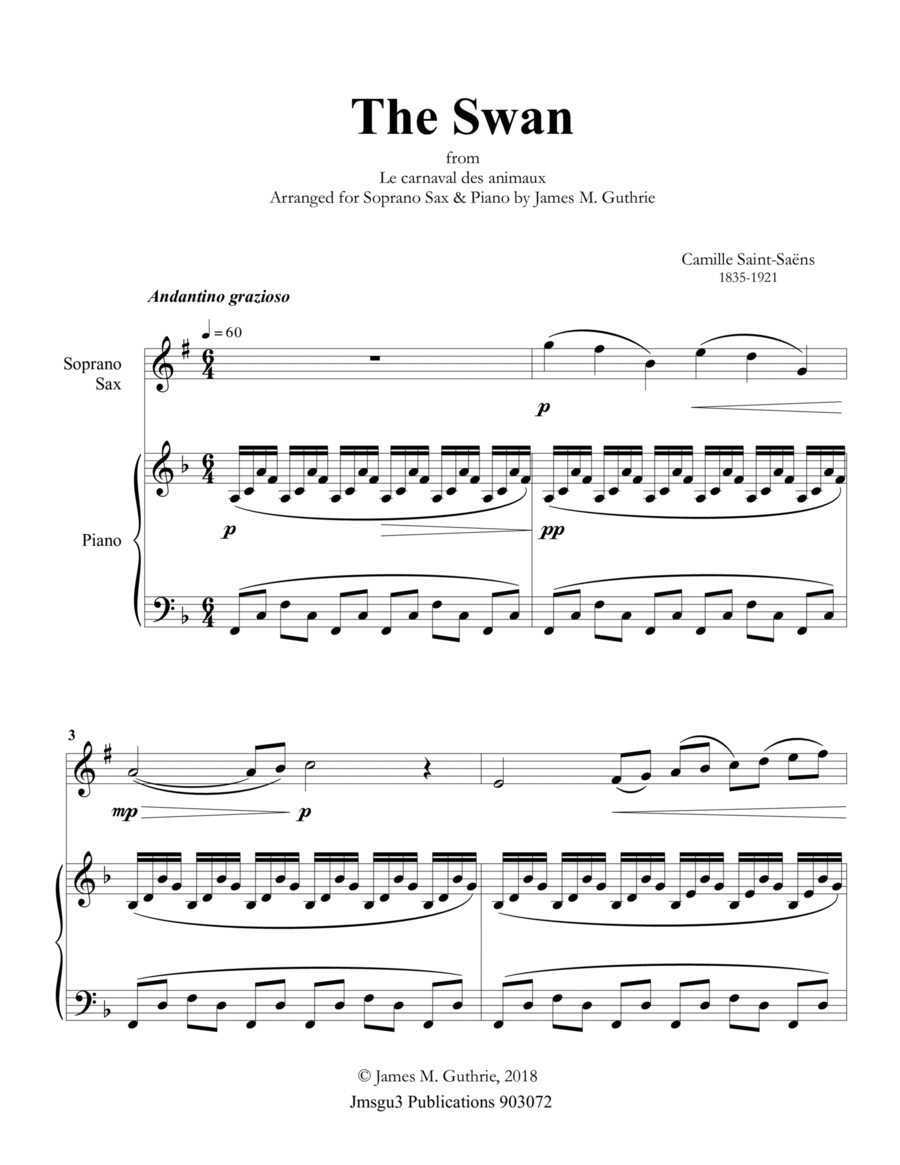
Saint-Saens: The Swan for Soprano Sax & Piano
Saxophone Soprano et Piano

$32.95 28.59 € Saxophone Soprano et Piano PDF SheetMusicPlus

Soprano voice,Vocal Solo - Level 5 - Digital Download SKU: A0.1185473 Composed by Maurice Ravel. Arranged by Nicole Elyse DiPaolo. Classical,Opera. 6 pages. Nicole Elyse DiPaolo #785149. Published by Nicole Elyse DiPaolo (A0.1185473). The first of its kind, this is a genuinely playable and slightly-to-moderately simplified piano/vocal reduction of Arrière! Je réchauffe les bons, the Fire Aria from Ravel's L'enfant et les sortilèges (1925)​. Sopranos who love this aria no longer need to fear bringing it in for auditions, last-minute performing engagements, or other situations in which the pianist may have to sight-read from the often chaotic vocal score, particularly if the murmuring section after the standard audition cut, which is very poorly rendered in the standard reduction, is also being included. Pianists may now enjoy playing this aria comfortably, without risking strain/injury or audition-room chaos.This Accessible Accompaniment is more generous than standard audition cuts, ending just before L'enfant re-enters with j'ai peur. It is 91 measures in total and ideal for recitals as well. All Accessible Accompaniments, including this one, boast several unique features:1. No reduction ever requires stretches of over an octave, not including bass notes meant to be held or “fudged†with the pedal (though octaves may also contain chord tones within them). This reduces the amount of rearranging that smaller-handed pianists must already do. Obviously, further reworkings are to be expected and pianists should feel free to add to or modify what I’ve provided.2. I’ve included less essential, but potentially desirable additional voices/passages in cue-size noteheads so that pianists can easily see them, but know that they are not necessary in a “sink or swim†accompanying situation. Presenting less essential material in cue-size noteheads also reduces visual clutter on the page. 3. In addition to the composer’s markings, when needed, I have included hints on particular notes to bring out when the singer is likely to need them as a pitch anchor or when it is not obvious which line should be brought out within the texture.4. All page turns have been carefully selected so as to result in the least possible disruption to the pianist when possible. 5. When known, I’ve noted alternate cuts that singers might like to take within certain arias. 6. In some cases I’ve modernized spelling conventions for easier readability (for example, by replacing “߆with “ss†in German arias) and occasionally I've enharmonically respelled brief passages for greater clarity. I’ve also replaced some text “cresc.†and “dim.†markings with hairpins, which are easier to see in high-pressure sight-reading situations.About the Arranger:Praised as a sensitive pianist and outstanding accompanist who delivers powerful interpretations, Nicole Elyse DiPaolo enjoys a multifaceted career as a sought-after collaborative pianist, educational composer, arranger, coach, private teacher, and adjunct music professor. Currently based in the Cleveland area, Ms. DiPaolo has appeared as a concerto soloist with the Ambassador Chamber Players on multiple occasions and as a recitalist, collaborator, and presenter worldwide. Currently, Ms. DiPaolo is an online Adjunct Lecturer in Music at Indiana University; the Principal Theory Teacher at Liberty Park Music, an online-only video subscription-based music school; an invited blog contributor and guest instructor at Tonebase; and a sought-after online instructor of piano, music theory, and composition who includes partimento and historical improvisation in her curricula. For more information, please visit http://ndipaolo.musicaneo.com .
Arrière! Je réchauffe les bons (Fire Aria) - L'enfant et les sortilèges - Accessible Accompaniments
Voix Soprano, Piano

$8.95 7.77 € Voix Soprano, Piano PDF SheetMusicPlus

Piano,Soprano Saxophone - Level 3 - Digital Download SKU: A0.1314331 Composed by Camille Saint-Saens. Arranged by James M. Guthrie. 19th Century,Chamber,Contest,Festival,Historic,Romantic Period. Score and part. 11 pages. Jmsgu3 #903074. Published by jmsgu3 (A0.1314331). Saint-Saëns: The Swan (Le Cygne) movement 13 from the Carnival of the Animals Suite. One of his most popular and widely recognized works, it is the only movement from the Carnival Suite that Saint-Saëns permitted to be performed publicly during his lifetime. This is an excellent recital encore to demonstrate melodic playing and strategic phrasing.The Carnival of the AnimalsThe Carnival of the Animals is an entertaining musical suite of fourteen movements by Camille Saint-Saëns. The work was composed for private performance by an ensemble of two pianos and solo instruments. The Swan (No. 13) is among the fourteen most famous movements. In its entirety, it lasts about 25 minutes.Saint-Saëns BackgroundCharles-Camille Saint-Saëns 1835 – 1921) was, by all means, in particular, a famous French composer, brilliant organist, and significant musical mastermind of the Romantic era. Indeed, his most famous compositions, in the long run, include his Piano Concerto No. 2 (1868), Cello Concerto No. 1 (1872), and the Danse macabre (1874). Notwithstanding, we must also add Violin Concerto No. 3 (1880), Symphony No. 3 (the Organ Symphony, 1886), and, it must be remembered, Carnival of the Animals (1886) to the list.ChildhoodIt is essential to realize that Saint-Saëns was undoubtedly, in fact, a child musical prodigy. Consequently, with this in mind, he made his concert debut, albeit at ten years old. Another critical point to remember is that he expressly studied at the Paris Conservatoire, then, despite reality, conversely followed a traditional career path as a church organist. Nevertheless, twenty years later, on the other hand, he left to become a successful freelance pianist and composer despite, as has been noted, his former employment situation. Furthermore, his performances were, after all, markedly in demand - not only in Europe but, above all, in the Americas all in all as well.YouthA point often overlooked is that in his youth, Saint-Saëns was undoubtedly excited about the modern music of the day. He was, in essence, fond of the music of his contemporaries, particularly Schumann, Liszt, and, for the most part, Wagner. In contrast, however, his compositions seemed, in fact, primarily confined within the conservative classical tradition. Be that as it may, he was, at the same time, nevertheless, a scholar of musical history.CriticismOn the whole, his conservatism, in fact, ultimately brought him into frequent conflict in his later years with composers of the impressionist and, in particular, the dodecaphonic schools of musical thought. A point often overlooked is that he included neoclassical elements in his music, contrary to some critics. Furthermore, in so doing, he provided the most compelling evidence that he predicted the techniques and works by Stravinsky and Les Six. To put it another way, given these points, he was regarded, perhaps for the most part unfairly, as a non-progressive reactionary henceforth around the time of his passing.LegacySaint-Saëns taught briefly in Paris, where his students included Gabriel Fauré. Maurice Ravel later studied with Fauré. In conclusion, both Ravel and Fauré were powerfully influenced by Saint-Saëns, whom they respected as a musical mastermind.
Saint-Saëns: The Swan for Soprano Sax & Piano
Saxophone Soprano et Piano

$32.95 28.59 € Saxophone Soprano et Piano PDF SheetMusicPlus

String Quartet String Quartet - Level 4 - Digital Download SKU: A0.923270 Composed by Modest Petrovich Mussorgsky. Arranged by Maurice Ravel, Belinda Niling Stohner. Romantic Period. Score and parts. 8 pages. Baby B Strings #6130667. Published by Baby B Strings (A0.923270). Based on Ravel's masterful orchestration of Mussorgsky's Pictures at an Exhibition, this arrangement brings out the various colors of a string quartet (2 violins, viola, and cello). Tuileries is the sixth movement from the suite. Score and parts - 8 pages. Advanced Intermediate to Advanced level. Arranged by Belinda Stohner. www.babybstrings.com
Tuileries from Pictures at an Exhibition - String Quartet
Quatuor à cordes: 2 violons, alto, violoncelle

$15.00 13.02 € Quatuor à cordes: 2 violons, alto, violoncelle PDF SheetMusicPlus

Full Orchestra - Level 3 - Digital Download SKU: A0.871413 Composed by M. Mussorgsky, M. Ravel. Arranged by Clara Obsidian, Decamonto. 20th Century,Concert,Patriotic,Romantic Period. Score and parts. 23 pages. Clara Obsidian #6328647. Published by Clara Obsidian (A0.871413).  Pictures at an Exhibition (A Remembrance of Viktor Hartmann, Tableaux d'une exposition) is a suite of ten pieces originally composed for piano by Modest Mussorgsky in 1874.Promenade With simple, strong rhythms in asymmetrical meter, Mussorgsky depicts himself roving through the exhibition, now leisurely, now briskly in order to come close to a picture that had attracted his attention, and at times sadly, thinking of his departed friend.This arrangement of Promenade is adapted from Maurice Ravel's 1922 version for full symphony orchestra. ------------------------------------------------------OrchestrationOrgan    Piano    Strings (Vln1 Vln2 Vla Vlc Db)Winds (2Bb Cls, 2Fls, 2Obs, 2Bsns, 4 Hns)Brass (2Bb  Tpts, Tbn 1, Tbn3, Tba)Glockenspiel---------------------------------------------
M. Mussorgsky: Pictures at the Exhibition "Promenade" For Orchestra
Orchestre

$24.00 20.82 € Orchestre PDF SheetMusicPlus

Woodwind Ensemble Alto Flute,Bass Clarinet,Bass Flute,Contra Alto Clarinet,Contrabassoon,Piccolo - Digital Download SKU: A0.830735 Composed by Juaquín Turina. Arranged by Richard Byrnes. 20th Century. 31 pages. Richard Byrnes #3538757. Published by Richard Byrnes (A0.830735). Juaquín Turina, a Spanish composer, was contemporary with the impressionistic movement. He became acquainted with Claude Debussy and Maurice Ravel, and his harmonic palette reflects that influence. Retrato means portrait. It is dedicated to Maria Martinez Sierra. Whether this movement offers a portrait of the lady is not established. Regardless, it is a delightful work. This arrangement is scored for (Picc,5Fl,AFl,2BFl,BCl,CalCl,Cbn). Please peruse the pages and listen to the recording of the score that is offered to determine whether this arrangement can work for your ensemble.In addition to works by Turina, we offer works by J.S. Bach, Debussy, Fauré, Glinka, Gottschalk, Granados, Lotti, Mozart, Ravel, and Richard  Strauss.
Retrato (Mvt. 1 from Álbum de viaje, Op.15) by Juaquín Turina (Flute Nonet + BCl,CalCl,Cbn.)

$29.99 26.02 € PDF SheetMusicPlus

Cello,Piano - Level 3 - Digital Download SKU: A0.1314243 Composed by Camille Saint-Saens. Arranged by James M. Guthrie. 19th Century,Contest,Festival,Historic,Romantic Period,Wedding. Score and part. 11 pages. Jmsgu3 #902984. Published by jmsgu3 (A0.1314243). Saint-Saëns: The Swan (Le Cygne) movement 13 from the Carnival of the Animals Suite. One of his most popular and widely recognized works, it is the only movement from the Carnival Suite that Saint-Saëns permitted to be performed publicly during his lifetime. This is an excellent recital encore to demonstrate melodic playing and strategic phrasing. The Carnival of the AnimalsThe Carnival of the Animals is an entertaining musical suite of fourteen movements by Camille Saint-Saëns. The work was composed for private performance by an ensemble of two pianos and solo instruments. The Swan (No. 13) is among the fourteen most famous movements. In its entirety, it lasts about 25 minutes. Saint-Saëns BackgroundCharles-Camille Saint-Saëns 1835 – 1921) was, by all means, in particular, a famous French composer, brilliant organist, and significant musical mastermind of the Romantic era. Indeed, his most famous compositions, in the long run, include his Piano Concerto No. 2 (1868), Cello Concerto No. 1 (1872), and the Danse macabre (1874). Notwithstanding, we must also add Violin Concerto No. 3 (1880), Symphony No. 3 (the Organ Symphony, 1886), and, it must be remembered, Carnival of the Animals (1886) to the list. ChildhoodIt is essential to realize that Saint-Saëns was undoubtedly, in fact, a child musical prodigy. Consequently, with this in mind, he made his concert debut, albeit at ten years old. Another critical point to remember is that he expressly studied at the Paris Conservatoire, then, despite reality, conversely followed a traditional career path as a church organist. Nevertheless, twenty years later, on the other hand, he left to become a successful freelance pianist and composer despite, as has been noted, his former employment situation. Furthermore, his performances were, after all, markedly in demand - not only in Europe but, above all, in the Americas all in all as well. YouthA point often overlooked is that in his youth, Saint-Saëns was undoubtedly excited about the modern music of the day. He was, in essence, fond of the music of his contemporaries, particularly Schumann, Liszt, and, for the most part, Wagner. In contrast, however, his compositions seemed, in fact, primarily confined within the conservative classical tradition. Be that as it may, he was, at the same time, nevertheless, a scholar of musical history.CriticismOn the whole, his conservatism, in fact, ultimately brought him into frequent conflict in his later years with composers of the impressionist and, in particular, the dodecaphonic schools of musical thought. A point often overlooked is that he included neoclassical elements in his music, contrary to some critics. Furthermore, in so doing, he provided the most compelling evidence that he predicted the techniques and works by Stravinsky and Les Six. To put it another way, given these points, he was regarded, perhaps for the most part unfairly, as a non-progressive reactionary henceforth around the time of his passing. LegacySaint-Saëns taught briefly in Paris, where his students included Gabriel Fauré. Maurice Ravel later studied with Fauré. In conclusion, both Ravel and Fauré were powerfully influenced by Saint-Saëns, whom they respected as a musical mastermind.

Saint-Saëns: The Swan for Cello & Piano
Violoncelle, Piano

$32.95 28.59 € Violoncelle, Piano PDF SheetMusicPlus


Partitions Gratuites
Acheter des Partitions Musicales
Acheter des Partitions Digitales à Imprimer
Acheter des Instruments de Musique

© 2000 - 2026

Accueil - Version intégrale




