EUROPE
4371 articles
USA
10242 articles
DIGITAL
11415 articles (à imprimer)
Partitions Digitales
Partitions à imprimer
11415 partitions trouvées


Flute,Piano - Level 2 - Digital Download SKU: A0.1158021 By Bella Poarch. By Alina Paulsen, Bella Poarch, Blvsh, Danny Maisonneuve, Denarie B Poarch, Elie Rizk, Geoffrey Hufford, Graydon Fritzsching, Joshua Linne, Miranda Glory, Natania Lalwani, Nikolay Mohr, Stefan Max, Stefan Max Kornwebel, and Stefan Maxim. Arranged by Samuel Sequeira. Pop,Singer/Songwriter. Score and part. 10 pages. Samuel Sequeira #758317. Published by Samuel Sequeira (A0.1158021). Dolls - Bella Poarchs - ScorePlay it at home, with friends, on class, for your teacher or student Play it on a public presentation. More arrangements on the link: Sam'S arrangementsFor Flute and Piano. Tonality: Em (original)Contact the Arranger:Youtube: @SamuelseqInstagram: @SamuelseqEmail: samyseq@gmail.com
Dolls
Flûte traversière et Piano
Bella Poarch
$4.99 4.19 € Flûte traversière et Piano PDF SheetMusicPlus

Jazz Ensemble Jazz Ensemble - Level 4 - Digital Download SKU: A0.1396334 Composed by Edward Kleban and Marvin Hamlisch. Arranged by Terry Vosbein. Broadway,Jazz,Musical/Show. 48 pages. Max Frank Music #979709. Published by Max Frank Music (A0.1396334). Experience â??What I Did For Loveâ? like never before with this new big band arrangement inspired by the legendary Stan Kenton. This slow ballad from the classic musical â??A Chorus Lineâ? takes on new life with the rich textures and dynamic energy of a full big band.The arrangement opens with a haunting piano introduction, setting the mood for a heartfelt performance. As the arrangement slowly builds, the alto saxophone takes center stage with a soulful improvised solo, adding a personal touch to the familiar melody. As it reaches its climax, the band explodes with big fat and loud chords that soar to new heights.With its blend of traditional big band elements and emotional harmonic content, this arrangement of â??What I Did For Loveâ? is sure to captivate audiences and leave a lasting impression. Donâ??t miss the opportunity to experience this timeless classic in a whole new way.Instrumentation: 5 saxes (AATTB), 5 trumpets, 4 trombones, tuba, piano, guitar, bass, drums.
What I Did For Love
Ensemble Jazz

$49.99 42.01 € Ensemble Jazz PDF SheetMusicPlus

Piano Quartet Cello,Piano,Viola,Violin - Level 4 - Digital Download SKU: A0.1404728 Composed by Terry Vosbein. 21st Century,Chamber,Classical. 57 pages. Max Frank Music #987795. Published by Max Frank Music (A0.1404728). “Parallel Tracks†was primarily inspired by a ten day train trip, from the heart of Virginia to the far west and back. It is not necessarily a narrative of that journey. Rather, it is a collage of sensations, taking in the sounds, smells, tastes, and feelings of the voyage. Much like the views through the train windows, the musical vistas of this work change rapidly. There are rolling fertile plains, deep river valleys, and jagged mountainous peaks. The train passes through some of the nations’s larg- est cities and some of its tiniest bergs, crosses some of the oldest and newest mountain ranges in the country. There are tunnels and trestles, forests, farms, and prairies. It is incredibly calm yet delightfully exciting.There is something elegant about spending an extended period crossing the country in an Amtrak roomette. On such trains as the Cardinal, the Empire Builder, the Coast Starlight, and the Califor- nia Zephyr, it feels as if one is stepping into the past. Nothing is rushed. Fine dining, spectacular views, riveting conversations with strangers. The grandeur of the mighty stations, such as Union Station in Chicago. And the humble beauty of the smaller stops like Staunton, Virginia, my starting and ending point.The perpetual motion of train travel is unique. The movement can feel smooth at times and bone rattling just a few minutes later. It can be a quiet purr or the sound of grating metal. And yet the gentle sway can envelop one like a blanket, enticing deep sleep throughout the night. Waking to pastries and coffee while rolling across the countryside is divine. And elegant.“Parallel Tracks†begins with a sound of forward motion put forth by the piano. Smooth and easy. Plucked strings ride on top of the steady piano pad as the chain of cars passes effortlessly through fields. As the cello presents the first theme, a more strident feeling is revealed and explored, driv- ing the engine toward its dramatic destinations. The first climax gives way to a playful scherzo-like section, the elegance of the journey on full display. The return of the first theme at a more majestic tempo announces that the voyage’s terminus is near.The parallel tracks on which a train glides are always a fixed distance and never cross. The parallel tracks of life are not so bound by mathematics. There is something more fluid when the tracks are allowed to cross. The string section and the piano each create their own track in this composition, frequently squaring off. At times it is if they are on the same train but sitting in opposite directions and on the opposite side of the car. There are moments that even sound as if they are proceeding at two different speeds. But their tracks are never too divergent, never really out of sync. And both arrive at the final stop together.
Parallel Tracks
Piano Quatuor: piano, violon, alto, violoncelle

$19.99 16.8 € Piano Quatuor: piano, violon, alto, violoncelle PDF SheetMusicPlus

String Quartet String Quartet - Level 1 - Digital Download SKU: A0.548729 Composed by Martin Luther. Arranged by James M. Guthrie, ASCAP. Easter,Instructional,Standards. Score and parts. 8 pages. Jmsgu3 #3412115. Published by jmsgu3 (A0.548729). Out of the Depths I Cry to You by Martin Luther. The first verses feature modified counterpoint and harmony proceeding at quarter = 82. The final verse is reharmonized for maximum dramatic effect at a more contemplative tempo such as quarter = 64. Very powerful selection for Lent or Easter. Duration (3 verses) 3:05, 36 ms. Score: 4 pg. parts: 1 pg. Bowings included. Out of the Depths Aus tiefer Not schrei ich zu dir (From deep affliction I cry out to you), is, of course, a hymn composed by Martin Luther. Moreover, Luther also wrote the lyrics which are essentially a paraphrase of Psalm 130. First published in 1524, it is also one of eight songs in the original Lutheran hymnal. It appears likewise in many hymnals and in different translations. The lyrics furthermore stimulated compositions from the Renaissance to the contemporary. Consequently, composers such as Johann Sebastian Bach built an entire chorale cantata on it. Other composers similarly contributed compositions, such as Felix Mendelssohn and Max Reger. Luther Background Martin Luther, (1483 –1546) was a German professor of theology, composer, priest, and moreover, an influential character in the Protestant Reformation. Luther had a momentous impact on church and society due to his contributions to the musical arts. He wanted to disseminate the gospel among mankind and with this intention thought that the best way to do that was through music. Influence It is important to realize that other musicians, and their descendants, were encouraged by Luther’s songs and wrote their own hymns. Luther, to be sure, had a thorough musical education. For example, he knew secular and sacred songs from an early age. He, in particular, played the lute well and sang in the monastery when he was a monk. That is to say, music was an essential part of his life. He in fact first began writing songs in 1523, sometimes writing the melody as well as the lyrics. Luther was certainly able to evaluate the composers of his time. He thought especially highly of Josquin des and Ludwig Senfl. He was also acquainted, with this in mind, with other composers and their works. Legacy The Lutheran musical ethos soon covered all of Germany and later significantly fashioned Protestant musical culture. Heinrich Schütz and Johann Sebastian Bach are the most compelling evidence of this Protestant musical culture. Additionally, as a point often overlooked, the pedal organ, first refined in northern Germany, became universally prevalent. As a matter of fact, Dieterich Buxtehude established a regular evening organ concert series in Lübeck. Another key point is that this concert series, in turn, spread North German Musical ideas worldwide. Luther was especially convinced that music is a beautiful and exclusive offering of the divine.
Luther: Out of the Depths for String Quartet
Quatuor à cordes: 2 violons, alto, violoncelle

$42.95 36.09 € Quatuor à cordes: 2 violons, alto, violoncelle PDF SheetMusicPlus

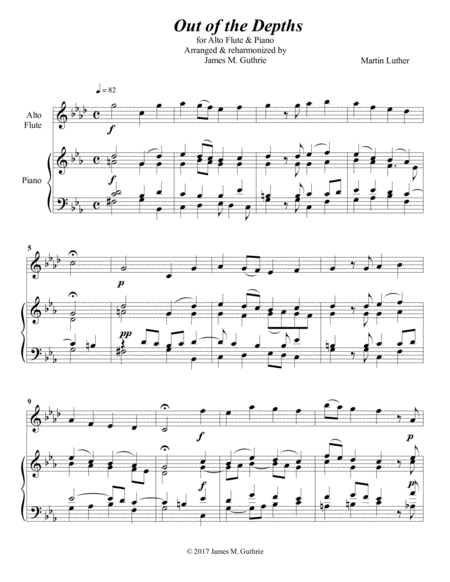
Flute,Piano - Level 1 - Digital Download SKU: A0.548707 Composed by Martin Luther. Arranged by James M. Guthrie, ASCAP. Easter,Instructional,Standards. Score and part. 4 pages. Jmsgu3 #3411715. Published by jmsgu3 (A0.548707). Out of the Depths I Cry to You by Martin Luther arranged for alto flute & piano. The first verses feature modified counterpoint and harmony proceeding at quarter = 82. The final verse is reharmonized for maximum dramatic effect at a more contemplative tempo such as quarter = 64. Very powerful selection for Lent or Easter. Duration (3 verses) 3:05, 36 ms.Score: 3 pg. Solo part: 1 pg. The piano reads from the score. Out of the Depths Aus tiefer Not schrei ich zu dir (From deep affliction I cry out to you), is, of course, a hymn composed by Martin Luther. Moreover, Luther also wrote the lyrics, essentially a paraphrase of Psalm 130. First published in 1524, it is also one of eight songs in the original Lutheran hymnal. It appears likewise in many hymnals and in different translations. The lyrics furthermore stimulated compositions from the Renaissance to the contemporary. Consequently, composers such as Johann Sebastian Bach built an entire chorale cantata on it. Other composers similarly contributed pieces, such as Felix Mendelssohn and Max Reger. Luther Background Martin Luther, (1483 –1546) was a German professor of theology, composer, priest, and moreover, an influential character in the Protestant Reformation. Luther had a momentous impact on church and society due to his contributions to the musical arts. He wanted to disseminate the gospel among mankind and with this intention thought that the best way to do that was through music. Influence It is important to realize that other musicians, and their descendants, were encouraged by Luther’s songs and wrote their own hymns. Luther, to be sure, had a thorough musical education. For example, he knew secular and sacred songs from an early age. He, in particular, played the lute well and sang in the monastery when he was a monk. That is to say, music was an essential part of his life. He in fact first began writing songs in 1523, sometimes writing the melody as well as the lyrics. Luther was certainly able to evaluate the composers of his time. He thought especially highly of Josquin des and Ludwig Senfl. He was also acquainted, with this in mind, with other composers and their works. Legacy The Lutheran musical ethos soon covered all of Germany and later significantly fashioned Protestant musical culture. Heinrich Schütz and Johann Sebastian Bach are the most compelling evidence of this Protestant musical culture. Additionally, as a point often overlooked, the pedal organ, first refined in northern Germany, became universally prevalent. As a matter of fact, Dieterich Buxtehude established a regular evening organ concert series in Lübeck. Another key point is that this concert series, in turn, spread North German Musical ideas worldwide. Luther was especially convinced that music is a beautiful and exclusive offering of the divine.
Luther: Out of the Depths for Alto Flute & Piano
Flûte traversière et Piano

$24.95 20.97 € Flûte traversière et Piano PDF SheetMusicPlus

Choral Choir,Choral,SATB Chorus divisi - Level 4 - Digital Download SKU: A0.1402916 By Jacob Collier. By Jacob Collier. Arranged by Kerry Marsh. 21st Century,A Cappella,Contemporary,Jazz,Pop. 13 pages. Kerry Marsh #986141. Published by Kerry Marsh (A0.1402916). Demo recording and a full suite of vocal part-learning tracks (All Tracks Pack) now available at KerryMarsh.com.Just in time for your advanced choir to learn for graduation ceremonies and year-end concerts!***Jacob Collier's glorious finale to his epic four-album Djesse collection is available for the first time for choirs everywhere to perform!This setting begins in four parts and builds over the course of six minutes to sixteen parts, carefully organized and laid out in open score (with rehearsal piano reduction), and with dynamic markings capturing the expression of the recorded performance on Djesse: Vol. 4 by The Aeolians from Oakwood University (conducted by Jason Max Ferdinand). The maximum is SSSSSAAAAATTTBBB, with the staves laid out as S1a/b, S2, S3a/b, A1a/b, A2a/b, A3, T1/2, T3/B1, B2/3. The use of a/b divisi is due to the fact that the those parts only go to divisi for a new chords at the end of the piece. There is also plenty of part-doubling throughout the arrangement, and this has been carefully considered to aid both balance and voice-leading, although the former is given priority. Collier pulls no punches emotionally or technically with this piece, which features Bass 3 singing C1 in a few places and Soprano 1 singing D6 in the final moments. Choirs without the lowest bass notes can safely omit them and sing the Bass 2 parts instead.
World O World
Chorale SATB
Jacob Collier
$1.99 1.67 € Chorale SATB PDF SheetMusicPlus

Contrabassoon,Instrumental Solo,Piano - Level 1 - Digital Download SKU: A0.548727 Composed by Martin Luther. Arranged by James M. Guthrie, ASCAP. Easter,Instructional,Standards. Score and individual part. 4 pages. Jmsgu3 #3411773. Published by jmsgu3 (A0.548727). Out of the Depths I Cry to You by Martin Luther. First verses feature modified counterpoint and harmony proceeding at quarter = 82. The final verse is reharmonized for maximum dramatic effect at a more contemplative tempo such as quarter = 64. Features the entire range of the instrument. Very powerful selection for Lent or Easter. Duration (3 verses) 3:05, 36 ms. Score: 3 pg. Solo part: 1 pg. Piano reads from the score. Out of the Depths Aus tiefer Not schrei ich zu dir (From deep affliction I cry out to you), is, of course, a hymn composed by Martin Luther. Moreover, Luther also wrote the lyrics which are essentially a paraphrase of Psalm 130. First published in 1524, it is also one of eight songs in the original Lutheran hymnal. It appears likewise in many hymnals and in different translations. The lyrics furthermore stimulated compositions from the Renaissance to contemporary. Consequently, composers such as Johann Sebastian Bach built an entire chorale cantata on it. Other composers similarly contributed compositions, such as Felix Mendelssohn and Max Reger. Luther Background Martin Luther, (1483 –1546) was a German professor of theology, composer, priest, and moreover, an influential character in the Protestant Reformation. Luther had a momentous impact on church and society due to his contributions to the musical arts. He wanted to disseminate the gospel among mankind and with this intention thought that the best way to do that was through music. Influence It is important to realize that other musicians, and their descendants, were encouraged by Luther’s songs and wrote their own hymns. Luther, to be sure, had a thorough musical education. For example, he knew secular and sacred songs from an early age. He, in particular, played the lute well and sang in the monastery when he was a monk. That is to say, music was an essential part of his life. He in fact first began writing songs in 1523, sometimes writing the melody as well as the lyrics. Luther was certainly able to evaluate the composers of his time. He thought especially highly of Josquin des and Ludwig Senfl. He was also acquainted, with this in mind, with other composers and their works. Legacy The Lutheran musical ethos soon covered all of Germany and later significantly fashioned Protestant musical culture. Heinrich Schütz and Johann Sebastian Bach are the most compelling evidence of this Protestant musical culture. Additionally, as a point often overlooked, the pedal organ, first refined in northern Germany, became universally prevalent. As a matter of fact, Dieterich Buxtehude established a regular evening organ concert series in Lübeck. Another key point is that this concert series, in turn, spread North German Musical ideas worldwide. Luther was especially convinced that music is a beautiful and exclusive offering of the divine.

Luther: Out of the Depths for Contrabassoon & Piano

$24.95 20.97 € PDF SheetMusicPlus

E-Flat Clarinet,Piano - Level 1 - Digital Download SKU: A0.548708 Composed by Martin Luther. Arranged by James M. Guthrie, ASCAP. Easter,Instructional,Standards. Score and part. 4 pages. Jmsgu3 #3411719. Published by jmsgu3 (A0.548708). Out of the Depths I Cry to You by Martin Luther arranged for alto clarinet & piano. The first verses feature modified counterpoint and harmony proceeding at quarter = 82. The final verse is reharmonized for maximum dramatic effect at a more contemplative tempo such as quarter = 64. Features the entire range of the instrument. Very powerful selection for Lent or Easter. Duration (3 verses) 3:05, 36 ms. Score: 3 pg. Solo part: 1 pg. The piano reads from the score. Out of the Depths Aus tiefer Not schrei ich zu dir (From deep affliction I cry out to you), is, of course, a hymn composed by Martin Luther. Moreover, Luther also wrote the lyrics, essentially a paraphrase of Psalm 130. First published in 1524, it is also one of eight songs in the original Lutheran hymnal. It appears likewise in many hymnals and in different translations. The lyrics furthermore stimulated compositions from the Renaissance to the contemporary. Consequently, composers such as Johann Sebastian Bach built an entire chorale cantata on it. Other composers similarly contributed pieces, such as Felix Mendelssohn and Max Reger. Luther Background Martin Luther, (1483 –1546) was a German professor of theology, composer, priest, and moreover, an influential character in the Protestant Reformation. Luther had a momentous impact on church and society due to his contributions to the musical arts. He wanted to disseminate the gospel among mankind and with this intention thought that the best way to do that was through music. Influence It is important to realize that other musicians, and their descendants, were encouraged by Luther’s songs and wrote their own hymns. Luther, to be sure, had a thorough musical education. For example, he knew secular and sacred songs from an early age. He, in particular, played the lute well and sang in the monastery when he was a monk. That is to say, music was an essential part of his life. He in fact first began writing songs in 1523, sometimes writing the melody as well as the lyrics. Luther was certainly able to evaluate the composers of his time. He thought especially highly of Josquin des and Ludwig Senfl. He was also acquainted, with this in mind, with other composers and their works. Legacy The Lutheran musical ethos soon covered all of Germany and later significantly fashioned Protestant musical culture. Heinrich Schütz and Johann Sebastian Bach are the most compelling evidence of this Protestant musical culture. Additionally, as a point often overlooked, the pedal organ, first refined in northern Germany, became universally prevalent. As a matter of fact, Dieterich Buxtehude established a regular evening organ concert series in Lübeck. Another key point is that this concert series, in turn, spread North German Musical ideas worldwide. Luther was especially convinced that music is a beautiful and exclusive offering of the divine.

Luther: Out of the Depths for Alto Clarinet & Piano
Clarinette

$24.95 20.97 € Clarinette PDF SheetMusicPlus


Partitions Gratuites
Acheter des Partitions Musicales
Acheter des Partitions Digitales à Imprimer
Acheter des Instruments de Musique

© 2000 - 2026

Accueil - Version intégrale



