EUROPE
362 articles
USA
0 articles
DIGITAL
1223 articles (à imprimer)
Partitions Digitales
Partitions à imprimer
1223 partitions trouvées


Instrumental Solo,Piano - Level 3 - Digital Download SKU: A0.1228118 Composed by Various and compiled by Michael Praetorius (1612). Arranged by Colin Kirkpatrick. Instructional,Renaissance. Score and individual part. 17 pages. Colin Kirkpatrick Publications #824216. Published by Colin Kirkpatrick Publications (A0.1228118). Dances from Terpsichore (Michael Praetorius)These are eleven of the most well-known dances of the Renaissance, selected from the famous collection entitled Terpsichore, pubished in 1612 by Michael Praetorius. They are sure to be a welcome addition to the recorder player's repertoire. The notes of the recorder part have been kept well within the intermediate range.By the time Michael Praetorius published his dance collection, he was one of the most famous musicians in Germany. The name is pronounced “terp-SI-cory†and rhymes with the word “hickoryâ€. The original publication consisted of 312 dances in four, five and six parts. Although the dances were probably conceived for string ensemble Praetorius was well aware that in practice, they would be played by any instruments that happened to be available.These arrangements for recorder (or recorders) and keyboard are based on the original 1612 publication. The music sounds more authentic using a harpsichord rather than a piano, or the harpsichord sound of a digital keyboard. The keyboard part may be interpreted quite freely with ornamentation added as appropriate. During the Renaissance, it was common practice to combine separate dances to create something of more substantial duration. A similar practice is used in these arrangements which are as follows: 1. Three Gavottes; 2. Two Ballets; 3. Two Bourées; 4. Two Courantes and 5. Two Voltas. The audio sample contains numbers 1, 2, 3 and 5.
Renaissance Dances for Recorder and Piano
Piano seul
the time Michael Praetorius published his dance collection, he was one of the most famous musicians in Germany The name is pronounced “terp-SI-cory†and rhymes with the word “hickoryâ€
$11.95 10.3 € Piano seul PDF SheetMusicPlus

Cello,Piano - Level 2 - Digital Download SKU: A0.1227711 Composed by Various and compiled by Michael Praetorius (1612). Arranged by Colin Kirkpatrick. Instructional,Renaissance. Score and part. 17 pages. Colin Kirkpatrick Publications #823673. Published by Colin Kirkpatrick Publications (A0.1227711). Dances from Terpsichore (Michael Praetorius)These are eleven of the most well-known dances of the Renaissance, selected from the famous collection entitled Terpsichore, pubished in 1612 by Michael Praetorius. They are sure to be a welcome addition to the elementary cellist’s repertoire. Some of them can be played in first position. The highest note is the “F†above the bass clef which occurs in only two of the pieces. By the time Michael Praetorius published his dance collection, he was one of the most famous musicians in Germany. The name is pronounced “terp-SI-cory†and rhymes with the word “hickoryâ€. The original publication consisted of 312 dances in four, five and six parts. Although the dances were probably conceived for string ensemble Praetorius was well aware that in practice, they would be played by any instruments that happened to be available. These arrangements for cello and keyboard are based on the original 1612 publication. The music sounds more authentic using a harpsichord rather than a piano, or the harpsichord sound of a digital keyboard. The keyboard part may be interpreted quite freely with ornamentation added as appropriate. During the Renaissance, it was common practice to combine separate dances to create something of more substantial duration. A similar practice is used in these arrangements which are as follows: 1. Three Gavottes; 2. Two Ballets; 3. Two Bourées; 4. Two Courantes and 5. Two Voltas. The audio sample contains numbers 1, 2, 3 and 5.
Renaissance Dances for Cello and Keyboard
Violoncelle, Piano
the time Michael Praetorius published his dance collection, he was one of the most famous musicians in Germany The name is pronounced “terp-SI-cory†and rhymes with the word “hickoryâ€
$11.95 10.3 € Violoncelle, Piano PDF SheetMusicPlus

Piano,Viola - Level 2 - Digital Download SKU: A0.1487758 Composed by Various. Arranged by Colin Kirkpatrick. Baroque,Renaissance. Score and part. 17 pages. Colin Kirkpatrick Publications #1064696. Published by Colin Kirkpatrick Publications (A0.1487758). These are eleven of the most well-known dances of the Renaissance set in five movements and selected from the famous collection entitled Terpsichore, published in 1612 by Michael Praetorius. They are sure to be a welcome addition to the elementary viola repertoire and the music is in the alto clef throughout. The highest note is the F above the alto staff and this appears in only one of the movements..By the time Michael Praetorius published his dance collection, he was one of the most famous musicians in Germany. The name is pronounced “terp-SI-cory” and rhymes with the word “hickory”. The original publication consisted of 312 dances in four, five and six parts. Although the dances were probably conceived for string ensemble, Praetorius was well aware that in practice they would be played by any instruments that happened to be available.These arrangements for viola (or violas) and keyboard are based on the original 1612 publication. The music sounds more authentic using a harpsichord rather than a piano, or the harpsichord sound of a digital keyboard. The keyboard part may be interpreted quite freely with ornamentation added as appropriate. During the Renaissance, it was common practice to combine separate dances to create something of more substantial duration. A similar practice is used in these arrangements which are as follows: 1. Three Gavottes; 2. Two Ballets; 3. Two Bourées; 4. Two Courantes and 5. Two Voltas.
Renaissance Hits for Viola and Keyboard from Terpsichore (Praetorius)
Alto, Piano
the time Michael Praetorius published his dance collection, he was one of the most famous musicians in Germany The name is pronounced “terp-SI-cory” and rhymes with the word “hickory”
$11.99 10.33 € Alto, Piano PDF SheetMusicPlus

Bassoon,Piano - Level 2 - Digital Download SKU: A0.1487747 Composed by Various. Arranged by Colin Kirkpatrick. Baroque,Renaissance. Score and part. 17 pages. Colin Kirkpatrick Publications #1064685. Published by Colin Kirkpatrick Publications (A0.1487747). These are eleven of the most well-known dances of the Renaissance set in five movements and selected from the famous collection entitled Terpsichore, published in 1612 by Michael Praetorius. They are sure to be a welcome addition to the elementary bassoon repertoire and make a pleasing performance item at a recital. The bassoon part is in the bass clef throughout and the highest note is usually the D above the bass staff. In a couple of pieces, the next note E is used.By the time Michael Praetorius published his dance collection, he was one of the most famous musicians in Germany. The name is pronounced “terp-SI-cory” and rhymes with the word “hickory”. The original publication consisted of 312 dances in four, five and six parts. Although the dances were probably conceived for string ensemble, Praetorius was well aware that in practice they would be played by any instruments that happened to be available.These arrangements for bassoon and keyboard are based on the original 1612 publication. The music sounds more authentic using a harpsichord rather than a piano, or the harpsichord sound of a digital keyboard. The keyboard part may be interpreted quite freely with ornamentation added as appropriate. During the Renaissance, it was common practice to combine separate dances to create something of more substantial duration. A similar practice is used in these arrangements which are as follows: 1. Three Gavottes; 2. Two Ballets; 3. Two Bourées; 4. Two Courantes and 5. Two Voltas.
Renaissance Hits for Bassoon and Keyboard from Terpsichore (Praetorius)
Basson, Piano (duo)
the time Michael Praetorius published his dance collection, he was one of the most famous musicians in Germany The name is pronounced “terp-SI-cory” and rhymes with the word “hickory”
$11.99 10.33 € Basson, Piano (duo) PDF SheetMusicPlus

Piano,Violin - Level 2 - Digital Download SKU: A0.1486413 Composed by Various. Arranged by Colin Kirkpatrick. Classical. 18 pages. Colin Kirkpatrick Publications #1063476. Published by Colin Kirkpatrick Publications (A0.1486413). These are eleven of the most well-known dances of the Renaissance set in five movements and selected from the famous collection entitled Terpsichore, published in 1612 by Michael Praetorius. They are sure to be a welcome addition to the elementary violin repertoire and most of them can be played in first position. By the time Michael Praetorius published his dance collection, he was one of the most famous musicians in Germany. The name is pronounced “terp-SI-cory” and rhymes with the word “hickory”. The original publication consisted of 312 dances in four, five and six parts. Although the dances were probably conceived for string ensemble, Praetorius was well aware that in practice they would be played by any instruments that happened to be available.These arrangements for violin and keyboard are based on the original 1612 publication. The music sounds more authentic using a harpsichord rather than a piano, or the harpsichord sound of a digital keyboard. The keyboard part may be interpreted quite freely with ornamentation added as appropriate. During the Renaissance, it was common practice to combine separate dances to create something of more substantial duration. A similar practice is used in these arrangements which are as follows: 1. Three Gavottes; 2. Two Ballets; 3. Two Bourées; 4. Two Courantes and 5. Two Voltas.
Renaissance Hits for Violin and Keyboard from Terpsichore (Praetorius)
Violon et Piano
the time Michael Praetorius published his dance collection, he was one of the most famous musicians in Germany The name is pronounced “terp-SI-cory” and rhymes with the word “hickory”
$9.99 8.61 € Violon et Piano PDF SheetMusicPlus

Oboe,Piano - Level 2 - Digital Download SKU: A0.1485586 Composed by Various. Arranged by Colin Kirkpatrick. Early Music,Renaissance. Score and part. 17 pages. Colin Kirkpatrick Publications #1062647. Published by Colin Kirkpatrick Publications (A0.1485586). These are eleven of the most well-known dances of the Renaissance, (in five movements) selected from the famous collection entitled Terpsichore, published in 1612 by Michael Praetorius. They are sure to be a welcome addition to the oboe player's repertoire. The notes of the oboe part have been kept well within the elementary range and the highest note is the B just above the treble staff.By the time Michael Praetorius published his dance collection, he was one of the most famous musicians in Germany. The name is pronounced terp-SI-cory and rhymes with the word “hickory”. The original publication consisted of 312 dances in four, five and six parts. Although the dances were probably conceived for string ensemble Praetorius was well aware that in practice, they would be played by any instruments that happened to be available.These arrangements for oboe and keyboard are based on the original 1612 publication. The music sounds more authentic using a harpsichord rather than a piano, or the harpsichord sound of a digital keyboard. The keyboard part may be interpreted quite freely with ornamentation added as appropriate. During the Renaissance, it was common practice to combine separate dances to create something of more substantial duration. A similar practice is used in these arrangements which are as follows: 1. Three Gavottes; 2. Two Ballets; 3. Two Bourées; 4. Two Courantes and 5. Two Voltas. These delightful dances are sure to add a sparkle to any oboe recital.
Renaissance Hits for Oboe and Keyboard from Terpsichore (Praetorius)
Hautbois, Piano (duo)
the time Michael Praetorius published his dance collection, he was one of the most famous musicians in Germany The name is pronounced terp-SI-cory and rhymes with the word “hickory”
$11.99 10.33 € Hautbois, Piano (duo) PDF SheetMusicPlus

Brass Ensemble - Level 3 - Digital Download SKU: A0.773479 By Anne-Marie. By Alphonso Henderson, Andreas Carlsson, Anne-Marie, Anne-Marie Nicholson, Benjamin Levin, Cornell Haynes, Ed Sheeran, Etterlene Jordan, George Clinton Jr., Julia Michaels, Kristian Lundin, Max Martin, Steve Mac, Tracy Marrow, William DeBarge, and etc. Arranged by Max Stannard. Contemporary. Score and parts. 47 pages. Max Stannard Music #3896851. Published by Max Stannard Music (A0.773479). 2002 is a song by English recording artist Anne-Marie. A Ballad about a childhood romance from the titular year, the song was not originally intended to be released as a single. After constant pestering from co-writer, Ed Sheeran, on instagram, Anne-Marie caved in and released the song in April 2018, where it peak in the UK charts at number 3, giving her a fourth top ten and highest charting song as the lead artist. It was also top ten in a further seven countries. This beautiful and lyric songs make a perfect solo for a Tenor Horn to show their delicate side. Duration: 3.15 www.maxstannardmusic.com @MStannardMusic.
2002
Ensemble de cuivres
Anne-Marie
$24.99 21.53 € Ensemble de cuivres PDF SheetMusicPlus

Guitar,Piano,Vocal,Voice - Level 2 - Digital Download SKU: A0.1268127 Composed by Randy Brooks. Arranged by Michael Thomas Coull. 20th Century,Christmas,Comedy,Country,Holiday. Score. 12 pages. MTC Publishing #860686. Published by MTC Publishing (A0.1268127). Grandma Got Run Over By A Reindeer - Arrangement for Voice, Piano and Guitar by Michael Thomas CoullGrandma Got Run Over By A Reindeer is a novelty holiday song.  Written by Randy Brooks, the song was originally performed by Elmo & Patsy, the husband-and-wife duo of Elmo Shropshire and Patsy Trigg in 1979. The lyrics tell the story of a grandmother celebrating at a Christmas Eve party with her family when, while drunk on eggnog and off her medication, she staggers out into a snowstorm despite everyone imploring her not to.  She is found the next day, trampled; Santa and his reindeer are determined to be the culprits when 'incriminating Claus marks' are found on Grandma's back.  Grandpa seems completely unfazed by his wife's demise and spends the holiday 'watching football, drinking beer and playing cards with cousin Mel', while the rest of the family mourns Grandma's death and wonders if the gifts they bought for her should be returned.  Christmas dinner otherwise goes on as normal, with a centrepiece of roast goose, figgy pudding for dessert, and 'blue and silver candles' to match Grandma’s hairpiece.  The upshot is a warning to the listeners that Santa is unfit to carry a driver's license!This arrangment of Grandma Got Run Over By A Reindeer is for solo voice, piano and guitar, but also contains harmonized sections (backing 'oohs', and the final few bars) that also enable this arrangment to be performed by an SSA choir - with the majority of it sung in unison.  However it is performed, it is a great choice for a fun, novelty song for Christmas.
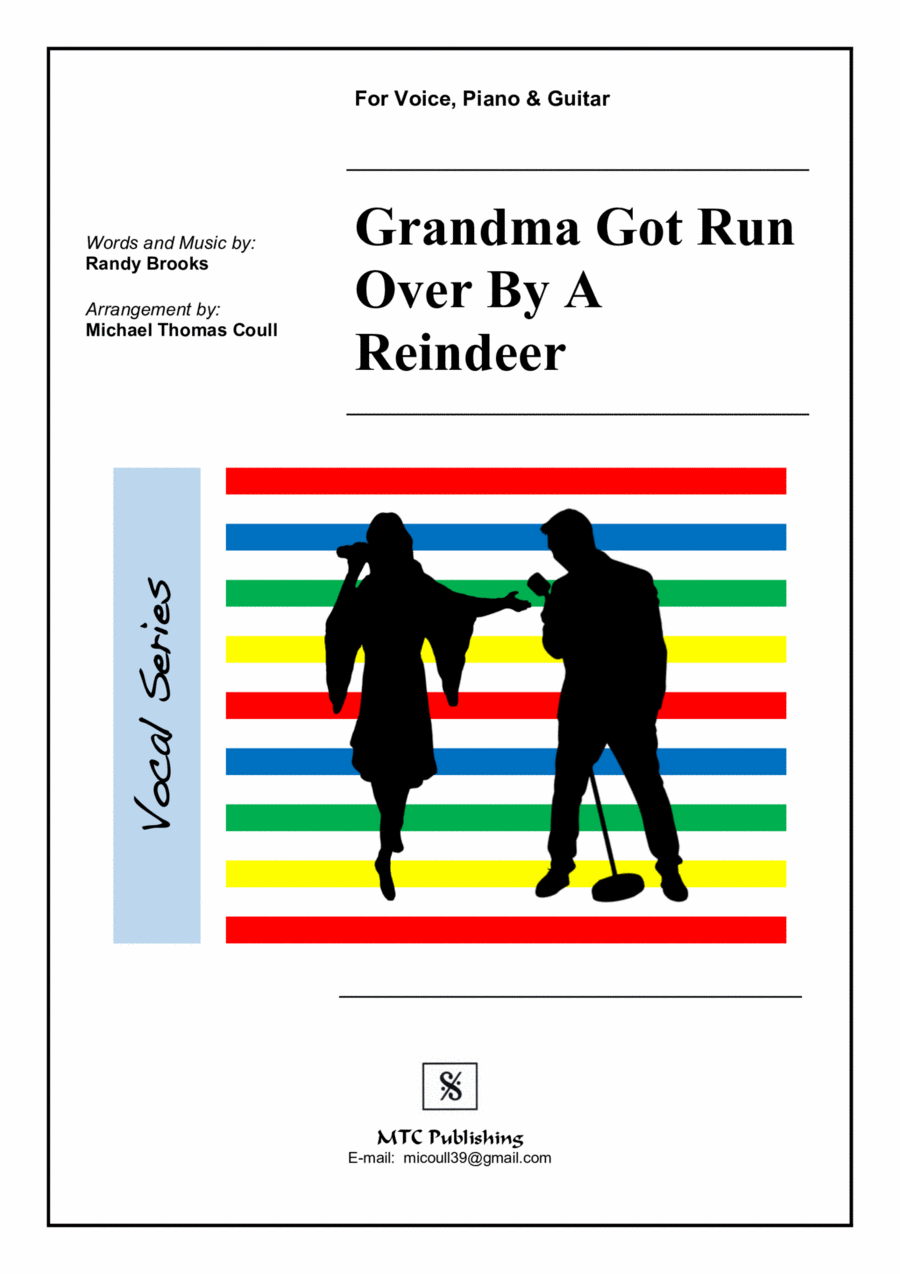
Grandma Got Run Over By A Reindeer
Piano, Voix et Guitare
A Reindeer - Arrangement for Voice, Piano and Guitar by Michael Thomas Coull

Grandma Got Run Over

$10.99 9.47 € Piano, Voix et Guitare PDF SheetMusicPlus


Partitions Gratuites
Acheter des Partitions Musicales
Acheter des Partitions Digitales à Imprimer
Acheter des Instruments de Musique

© 2000 - 2026

Accueil - Version intégrale





