EUROPE
124 articles
USA
275 articles
DIGITAL
106 articles (à imprimer)
Partitions Digitales
Partitions à imprimer
106 partitions trouvées

1 16 31 46 61 ....106

Small Ensemble Alto Saxophone,Bass Guitar,Drums,Piano,Tenor Saxophone,Trombone,Trumpet - Level 3 - Digital Download SKU: A0.734831 By Artie Shaw. By Hoagy Carmichael. Arranged by Joseph Hasper. Jazz. Score and parts. 27 pages. Joseph Hasper #3563009. Published by Joseph Hasper (A0.734831). The Hoagy Carmichael signature tune arranged for combo with four horns (trumpet, alto sax, tenor sax, trombone) and rhythm section (piano, bass, and drums). Key of Db. 80 measures. Includes a full score and complete set of parts.Stardust was composed in 1927 by Hoagy Carmichael with lyrics added in 1929 by Mitchell Parish. According to Carmichael, the inspiration for Stardust came to him while he was on the campus of his alma mater, Indiana University, in Bloomington, Indiana. He began whistling the tune, then rushed to the Book Nook, a popular student hangout, and started composing. He worked to refine the melody over the course of the next several months. There have been many interpretations of the standard over the decades, both as a jazz instrumental and as a popular song. Some artists who have recorded Stardust include Bing Crosby, Artie Shaw, Louis Armstrong, Art Tatum, Benny Goodman, Tommy Dorsey, Harry James, Django Reinhardt, The Glenn Miller Orchestra, Lester Young, Erroll Garner, Dizzy Gillespie, Clifford Brown, Dave Brubeck, John Coltrane, Wynton Marsalis, Frank Sinatra, Doris Day, Joni James, Nat King Cole, Mel Tormé, Connie Francis, Harry Connick Jr, Ella Fitzgerald, Barry Manilow, Pat Boone, Willie Nelson, George Benson, Al Hirt, and even Bob Dylan.
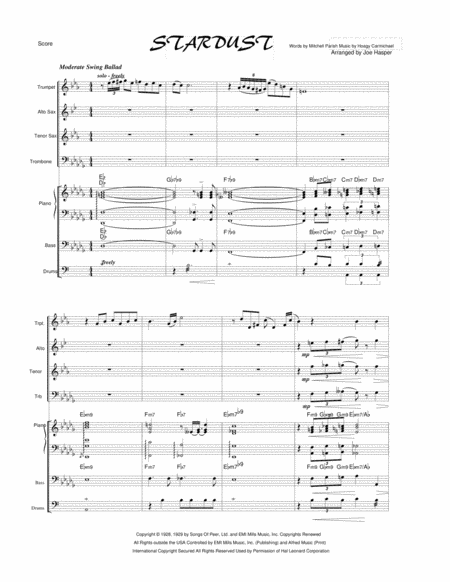
Stardust
Artie Shaw
$12.99 11.09 € PDF SheetMusicPlus

Large Ensemble Clarinet,Drum Set,Drums,Trombone,Trumpet,Tuba,Voice - Level 3 - Digital Download SKU: A0.734796 Composed by Traditional. Arranged by Joseph Hasper. Folk,Jazz,Traditional. Score and parts. 14 pages. Joseph Hasper #3213083. Published by Joseph Hasper (A0.734796). Traditional sailor's song arranged for German Band with two clarinets, trumpet, trombone, tuba, and optional drums. Includes a full score and all parts. Includes optional lyrics that let you sing a verse! Key of F. 81 measures, 20pages.Barnacle Bill the Sailor is an American drinking song adapted from Bollocky Bill the Sailor, a traditional folk song originally titled Abraham Brown. The first printed version of the song is in the public domain book Immortalia (1927). Later versions feature the eponymous Barnacle Bill, a fictional character loosely based on a 19th-century San Francisco sailor and Gold Rush miner named William Bernard. Versions are also known in England and Scotland from the early twentieth century.One version of Barnacle Bill refers to an exchange between Bill and a fair young maiden. Each verse opens with inquiries by the maiden, sung by women, or by men in falsetto, and continues with Bill's profane responses sung by men.Barnacle Bill the Sailor (Roud 4704) is an American drinking song adapted from Bollocky Bill the Sailor, a traditional folk song originally titled Abraham Brown.[1]There are several versions of the bawdy song in the Gordon Inferno Collection at the Library of Congress folklife archive. The first printed version of the song is in the public domain book Immortalia (1927). Later versions feature the eponymous Barnacle Bill, a fictional character loosely based on a 19th-century San Francisco sailor and Gold Rush miner named William Bernard.[2] Versions are also known in England and Scotland from the early twentieth century.The earliest known recording is an expurgated adaptation by Carson Robison and Frank Luther in 1928. This version was also recorded on May 21, 1930 by Bix Beiderbecke and Hoagy Carmichael with Carson Robison on vocals and released as a Victor 78, V-38139-A and 25371. In 1996 it was released on CD on the album Bix Beiderbecke 1927–1930.[3] According to Philip R. Evans, Bix Beiderbecke's biographer, in the second chorus of this recording, violinist Joe Venuti can be heard singing Barnacle Bill the Shit-head, either to express his attitude toward the record producer, or typical of his wacky sense of humor. Esten Spurrier, a friend of Beiderbecke's, is quoted by Evans as saying that Beiderbecke told him he could not believe the record would be pressed and had felt that it had been done just for laughs. Beiderbecke cut loose on the tune with what is believed to be one of his finest cornet solos. John Valby (aka Dr. Dirty) also recorded the song.The tune has inspired a Fleischer Studios Betty Boop cartoon and two films, as well as the name of a rock on Mars. Louis Jordan and the Tympany Five (then known as The Elks Rendezvous Band) recorded a clean version in 1938.[4] In the first Fleischer Popeye cartoon, Popeye the Sailor (1933), Barnacle Bill was used as the recurring theme for the Bluto character. A later Fleischer Popeye cartoon, Beware of Barnacle Bill (1935), is a mock operetta based around a toned-down version of the song.Example of lyrics[edit]One version of Barnacle Bill refers to an exchange between Bill and a fair young maiden. Each verse opens with inquiries by the maiden, sung by women, or by men in falsetto, and continues with Bill's profane responses sung by men.
Barnacle Bill the Sailor (for German Band)

$11.99 10.24 € PDF SheetMusicPlus


1 16 31 46 61 ....106


Partitions Gratuites
Acheter des Partitions Musicales
Acheter des Partitions Digitales à Imprimer
Acheter des Instruments de Musique

© 2000 - 2025

Accueil - Version intégrale





